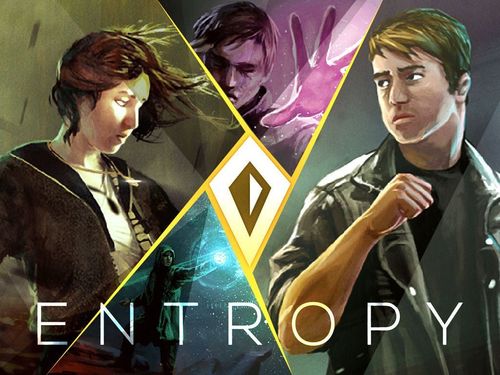
Entropy
Entropy Rulebook
Table of Contents
Table of Contents
Overview
Components
- Characters (5): Jessup, Kintriel, Cenec, Mary, Advaranau
- Nexus Board
- Reality Fragments (20)
- Wild Fragments (3)
- Vortex Fragment
- Actions (25)
- Unique Actions (5)
- Anchor
Gameplay Overview
Five parallel worlds have collided forming a Nexus where space-time has collapsed in on itself. You have been jettisoned from your world and into the Nexus. In order to return home, you must find the fragments of your reality and be the first to piece them back together.
Entropy is a game for 2- to 6-players and plays in 10 to 20 minutes.
Sequence of Play
Round Structure
A game is made up of several rounds with each round consisting of 4 turns. Each turn has 3 phases:
- Select: Each player secretly chooses an action.
- Reveal: All players simultaneously reveal their chosen action.
- Resolve: Actions are resolved in ascending order.
After 4 turns, a Fracture Event occurs and a new round begins (see "Fracture Event").
Winning The Game
The first player to reveal all 4 fragments of their reality is declared the winner.
Wild fragments also count towards completing your reality (see "Wild Fragments").
Game Set-up
Before setting up the game, remove the following cards based on the number of players in the game:
| Players | Wild Fragments | Actions |
|---|---|---|
| 2 | 2 wild fragments | Portal action |
| 3 | 1 wild fragment | (Keep all actions) |
| 4~6 | (Keep all fragments) | (Keep all actions) |
- Place the Nexus board in a central area, reachable by all players.
- Deal a character card at random, face-up, to each player. Remove the remaining characters and their reality fragments from the game (see "Fragments").
- Gather all fragments (reality, wild and Vortex). Shuffle the fragments and place them, face-down, on the Nexus board. This forms the Nexus deck.
- Draw the top fragment from the Nexus deck and then place it into the discard pile, face-up on the Nexus Board, as shown left.
- Place the Anchor near the Nexus board.
- Deal 1 fragment from the Nexus deck, face-down, to each player. The fragment is placed to the left of the character card.
- Give each player a set of action cards, ensuring the unique action corresponds to their character.
- Ensure all players reserve some space to place played action cards.
Gameplay
Fragments
A reality is broken into 4 fragments. Each fragment has a symbol that represents the reality to which it belongs. Dots underneath each symbol denote the order in which fragments can be placed to complete the panoramic scene.
Fragments of your reality may be placed in any order. Matching symbols indicate these reality fragments belong to the same character (e.g. Advaranau).
Drawing, Taking and Discarding Fragments
Some actions will have you draw, take or discard a fragment. Fragments can be in one of two states: shrouded (face-down) or revealed (face-up). As a general rule, the state of a fragment does not change when moving from one area to another.
Whenever fragments are drawn from the Nexus deck, taken from a player or taken from the discard, they do not change state. Fragments that are placed into the discard always become revealed, and fragments placed into the Nexus deck always become shrouded. Some actions can override this rule (see "Actions Explained").
Fragment Placement
Fragments taken from another player or drawn from the Nexus always enter your play area from the left. There is no limit to the number of fragments you can have in your play area. You can look at shrouded fragments in your play area at any time. Your play area expands as fragments are drawn or taken.
Revealing Fragments
When a fragment of your reality in your play area becomes revealed, or when it enters your play area revealed, immediately move it to the right side of your character. These fragments are considered locked. Once a fragment is locked it can no longer be taken or discarded.
Wild Fragments
Wild fragments do not belong to any particular reality and do not have any symbol. They may be used to complete any reality. They are never considered locked and may be taken or discarded at any time, regardless of their state.
Even though they are not considered locked, you should still place any revealed wild fragments to the right of your character, among your locked fragments.
Vortex Fragment
The Vortex fragment is shuffled into the Nexus deck along with wild and reality fragments. It has two effects on the game when revealed. The Vortex is an optional component unless playing with the Ronin Expansion.
Anytime the Vortex is revealed, all players must shroud a locked fragment of their reality if able. Your wild fragments cannot be taken or discarded so long as you possess the Vortex and it remains revealed.
First, it is the only card in the game that allows shrouding of locked fragments. Any fragment that becomes shrouded by the Vortex must be moved to the left of your character.
Second, it protects wild fragments from being taken or discarded.
Discard Pile
Should the discard run out of fragments at any time during the game, immediately reveal the top card from the Nexus deck and place it into the discard. Don't forget, this also applies during the Fracture Event.
The discard pile is open information. Players may look through it at any time.
Fracture Event
Every 4 turns, a Fracture Event occurs. The Nexus destabilises, resetting time and increasing the uncertainty of each reality's fate.
Collect all fragments from the Nexus board, including fragments in the discard, and shuffle them to form a new Nexus deck. Players that have clashed 3 or more times during the round (see "Temporal Clash") are involved in the Fracture Event. This is an opportunity for them to recover a single fragment of their reality before the Nexus resets.
Take the newly formed Nexus deck and deal 3 fragments face-up near the central area. All players involved in the Fracture Event take a single fragment of their reality, if able, and place it into their play area shrouded. Return any unclaimed fragments to the Nexus deck, shuffle the deck and place it back on the Nexus board.
Dealing fragments can be skipped if no players are involved in the Fracture Event. Fragments dealt during the Fracture Event are not considered to have been revealed. Any effects, such as the Vortex, are not carried out.
Following this, players return all their action cards to their hand and a new round begins.
Example: In a Fracture Event, 3 fragments are dealt from the Nexus deck and placed near the Nexus board. Cenec finds a fragment of his reality and takes it. Kintriel did not find a fragment of her reality so she does not take a fragment.
Actions
Actions represent the skills you have at your disposal to help piece fragments of your reality back together.
Each player has an identical set of action cards as well as a single unique action. At the start of a turn, you, along with all other players, select an action in secret. Once everyone is ready, simultaneously reveal the selected card.
Standard Actions
- Resourceful (1): Take all fragments of your reality from the discard. Fragments obtained this way become shrouded.
- Persuasive (1): Take the Anchor. For the duration of the round, whenever the Anchor is returned to the Nexus you may take it instead.
- Telekinesis (2): Discard a fragment from any player «or» take any revealed fragment from another player.
- Beacon (3): Reveal all fragments in your play area «or» another player of your choice must reveal a fragment of your reality if able.
- Eye of the Storm (4): Draw two fragments from the Nexus and discard one «or» take any fragment from the discard.
- Phase Shift (5): Take the Anchor from the Nexus or from another player.
- Portal (6): Swap a fragment in your play area with either the top fragment of the Nexus or any fragment in the discard.
- Anchor: When a temporal clash occurs, return the Anchor to the Nexus and resolve your action.
Initiatives
Each action has an initiative value on the bottom left corner. During the resolution phase, actions are resolved in ascending order.
Unique actions also have a reality symbol in the top right corner, indicating which character it belongs to.
Temporal Clash
A temporal clash occurs when 2 or more players reveal actions with the same initiative value during a turn. Their actions do not resolve unless they possess the Anchor. Players that have clashed 3 or more times during the round are involved in the Fracture Event (see "Fracture Event").
Resolution
To resolve an action, you must carry out the instructions exactly as stated. You may choose to not resolve the action; however, it is still considered to have been played.
Action Placement
Once an action has been played, place it in front of you, horizontally, with the initiative value clearly visible (to help other players identify which actions have already been played this round).
Clashed actions should be rotated 90 degrees in order to easily identify which actions have been involved in a temporal clash this round.
Anchor
The Anchor is the only way to protect yourself from a temporal clash.
Normally, players involved in a temporal clash do not get to resolve their actions. However, should you possess the Anchor you must immediately return it to the central area and resolve your action. Actions resolved in this way are not considered to have been involved in a temporal clash and are not rotated 90 degrees.
Actions Explained
- Beacon — When choosing to reveal all fragments in your play area, you must reveal every shrouded fragment. This includes fragments of your reality, fragments of other player's realities, the Vortex and wild fragments.
- Telekinesis — You may choose yourself when discarding a fragment. Revealed fragments taken from other players enter your play area locked if they are of your reality. Note that locked fragments cannot be effected by Telekinesis.
- Eye of the Storm — You cannot draw from the Nexus deck if only one fragment remains. You may still take any fragment from the discard.
- Phase Shift — You may play Phase Shift even when you already possess the Anchor. It will always resolve and you will always get the Anchor back.
- Portal — Fragments placed onto the Nexus deck become shrouded and fragments put in the discard are revealed. Fragments you remove from the Nexus deck or from the discard do not change state when they enter your play area.
Unique Actions
- Militant (1): For the duration of the round, draw a fragment from the Nexus whenever you clash.
- Resourceful (1): Take all fragments of your reality from the discard. Fragments obtained this way become shrouded.
- Deceptive (1): Choose an action you have played this round and resolve that action's effect.
- Adaptive (1): Search the Nexus for a fragment of your reality and place it on top.
- Persuasive (1): Take the Anchor. For the duration of the round, whenever the Anchor is returned to the Nexus you may take it instead.
Unique Actions Explained
- Militant — Militant must resolve before it takes effect.
- Resourceful — Only fragments of your reality can be taken when playing Resourceful. You cannot take wild fragments. All fragments taken must enter your play area shrouded.
- Deceptive — When playing Deceptive, you may select any action you have already played this round. This includes both resolved and clashed actions.
- Adaptive — When playing Adaptive, first search for a fragment of your reality and set it aside. Shuffle the Nexus deck, then place the fragment you've set aside on top of the deck.
- Persuasive — This action changes the default behaviour of the Anchor. For the remainder of the round, whenever the Anchor is used by anyone (including you) to avoid a temporal clash, instead of returning to the central area, it goes to you. This action must resolve before it comes into effect.
Extras
Ronin Expansion
The Ronin became stuck in the Nexus long before any of the other characters. His world was destroyed and he is desperate to piece together a reality, any reality, in order to leave the Nexus.
The Ronin has a more advanced play style, and can be included in games with 3 or more players. Unlike other characters, the Ronin has no reality of his own. When playing with the Ronin, make sure you include the Vortex fragment during set-up.
You must instead use a combination of wild fragments and the fragments of one other player's reality in order to win. Since you are of no particular reality, you cannot lock fragments, so using the Vortex to protect wild fragments is vital (see "Vortex Fragment"). You are immune to the shrouding effect of the Vortex fragment, but it still protects your wild fragments.
This also means that during a Fracture Event, rather than taking a fragment of a specific reality, you claim wild fragments instead. Similarly, Beacon helps you reveal wild fragments that other players possess.
Ronin Unique Actions
- Preemptive (1): Select an action from your hand. It resolves according to its initiative order.
- Disciplined (1): Search the Nexus for the Vortex and take it. You may reveal the Vortex.
Ronin Unique Actions Explained
- Preemptive — You only select an action once Preemptive has resolved. That action is played following the normal initiative order. E.g. Preemptive resolves and you select Eye of the Storm. It will not resolve until after Beacon and Telekinesis. It is possible for the selected action to cause a clash.
- Disciplined — The Nexus deck must be shuffled after searching for the Vortex. The Vortex enters your play area shrouded, but you may choose to reveal it.
Beyond the Game
The world of Entropy doesn't stop here. If you enjoy this game, we urge you to check out the game's official solo variant rules, the story of Entropy, the soundtrack and more.
Solo Variant
The world has ended and it is up to you alone to save the multiverse from destruction. This variant features a new way to play Entropy with multiple levels of difficulty and a scoring system.
Story
Learn about the characters featured in the game, discover the mysteries of the Nexus and meet the mysterious figure called the Ronin. Find out how the story ends by reading Entropy: Fractured Realities, a novella.
Original Soundtrack
The Entropy soundtrack features an official theme song and six tracks that represent each of the worlds in the game: Gemini, Terra, Chrysalis, Dumorya, The Garden and Ronin's World.