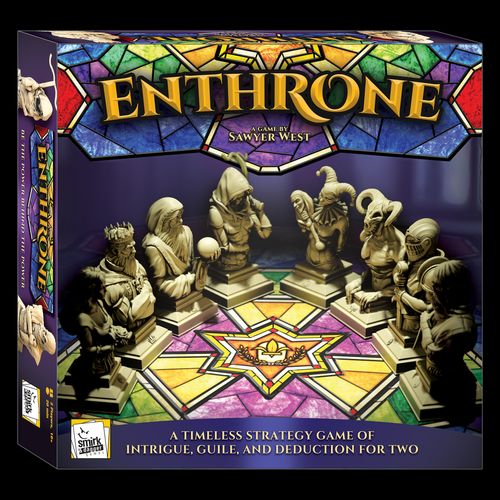
Enthrone
Enthrone Rulebook
Table of Contents
Table of Contents
Contents
- Main board (4 puzzle pieces)
- Action board
- 8 Identity cards
- 2 Reference cards
- 8 two-sided Action tiles: Knight, Demon, Archer, King, Jester, Priestess, Assassin, Wizard (tile back shows an arrow, for reference)
- 8 Pawns, with icons on their base matching one of the Action tiles: King, Archer, Wizard, Jester, Demon, Knight, Priestess, Assassin
First Player
The owner, or host, of the game will go first. If both have played before, choose the First Player at random. Hide the King tile (crown) in one of your closed fists. Have your opponent choose a fist. If they chose the hand with the King, they will be First Player. Otherwise, you are.
Starting with the First Player, players will take turns moving a single Pawn on the board, until a player meets one of the winning conditions.
Set Up
- Assemble the 4 puzzle pieces of the Main board and place it at the center of the table, positioned between both players. Then, place the Action board to one side of the Main board.
- Take the 8 Pawns and randomly place one onto each of the Lion spaces on the Main board.
- Shuffle the Action tiles, upside down, with the arrow on the back visible. Then, place one Action tile, face up, onto each of the hex spaces of the Action board, at random.
- Give 1 Reference card to each player.
- Shuffle the 8 Identity cards and randomly deal 3 cards face-down to each player. Without revealing them, set the 2 remaining cards aside face-down so that neither player knows what they are.
Identity Cards / Choosing your Pawn
Players examine their 3 Identity cards, keeping them secret from their opponent. Each player must choose 1 of their Identity cards to be their "Chosen Pawn" for the game.
You might choose a Pawn based on the current layout of the board, the order of the Action tokens or perhaps because of the Quarry targets listed at the card's bottom (see below) but there are absolutely no differences between the Pawns in how they play.
Equally important is the knowledge that the other two Pawns shown on your unchosen cards are NOT your opponent. Place these cards face-down under your Reference card. You may look at them at any time, but keep all three of your cards a secret from your opponent. Of course, your opponent has similar information of three cards - and two will remain unknown for the whole game.
From the moment the Pawns are placed and the Action tiles are revealed, the machinations begin and your choice of Pawn is already part of the strategy.
Your Reference card shows every Pawn and which 3 Quarry they want eliminated. Use it to gain insight into which Pawn may be your Opponent's.
Winning the Game
There are 4 WIN conditions. The game ends immediately - and you win if...
- You move your "Chosen Pawn" to the Regalia space at the center of the board.
- You can manage to capture your opponent's "Chosen Pawn."
- The 3 Quarry targets shown at the bottom of your "Chosen Pawn" card are captured - by ANY player.
- The 4th piece in a game is captured by your opponent but it did NOT result in them achieving any above WIN conditions. If a player doesn't win when capturing the 4th piece of the game, they lose.
Playing the Game
Moving Pawns
In ENTHRONE, there is no direct ownership of the Pawns. This means that either player can move any Pawn on the board by following the steps below.
- Take a Pawn's matching Action Tile from any of the top 5 hex spaces on the Action board and move it to the bottom space of Action board. Slide all in-between Action Tiles up one space to fill the gap. Note: Action tiles located in the bottom 3 spaces of the Action board are Locked and cannot be used.
- Take the matching Pawn on the Main board and move it to an adjacent unoccupied space. Note: A Pawn can also be moved into an occupied space, but only when performing a "Capture" (see below).
Notes on Movement
- After a Pawn has been moved out of its Lion space, no Pawn can be moved onto that space for the rest of the game. Capturing a Pawn on a Lion space is allowed however.
- The florettes on the Main board are NOT spaces that Pawns can occupy, but instead create adjacency between all connected spaces. A Pawn may pass through a florette into any adjoining space.
Claiming the Regalia
One of the ways to win the game is to move your Chosen Pawn onto the Regalia space at the center of the Main board. This can only be done under the following conditions:
- A player can only move their Chosen Pawn onto the Regalia space. They may not move any other Pawn onto the space. Their Pawn must be on one of the 6 spaces adjacent to the Regalia space.
- A player can ONLY move their Chosen Pawn onto the Regalia space by using the Pawn's matching Action Tile while it occupies one of the top 3 spaces on the Action board, marked with Laurels.
Capturing Pieces
Any Pawn on the board can capture any other Pawn adjacent to it, however:
- Capturing can only be accomplished by a Pawn whose Action tile occupies the top two hexes of the Action board. Note that the top 2 spaces of the Action board are marked with Capture icons (crossed swords). When an Action Tile occupies one of these top 2 spaces on the Action board, not only can it be used to move the matching Pawn, but that Pawn has the additional ability to enter an occupied space and capture the piece standing there. Only Pawns moved in this way are able to Capture a piece.
- As with normal movement rules, first take the Action Tile from one of the Capture hex spaces and move it to the bottom of the line, sliding all in-between tiles up to fill the gap.
- Then, move the matching Pawn to an adjacent space occupied by another Piece and remove that Pawn from the board. The captured Pawn is eliminated from the game and placed beside the Action board.
- If the captured Pawn is your opponent's Chosen Pawn, they must reveal their Identity card and the attacker wins the game.
- If the captured Pawn was the 3rd Quarry listed on the bottom of either player's chosen Identity card, that player must reveal their card and wins the game.
- If the captured Pawn was the 4th Pawn to be captured, the game is over. The player who captured the Pawn loses UNLESS the Capture achieved one of the win conditions.
- If the game has not ended, flip the Action Tile matching the captured Pawn to its opposite side, with the arrow pointing down. These flipped tiles are called Neutral Tiles.
Neutral Tiles can be selected on a player's turn and act as duplicates of whatever face-up Movement Tile is immediately beneath it. Later in the game, if multiple Neutral tiles stack, they ALL become duplicates of the next face-up Movement tile the arrows point to. This creates some interesting opportunities:
- A Neutral Tile in one of top 2 positions on the Action Board can perform a Capture as a duplicate of the Pawn its arrow points down to.
- A Neutral Tile in one of top 3 positions on the Action Board can move a Pawn into the Regalia space, as a duplicate of the Pawn its arrow points down to.
- A Neutral Tile, which is itself not in the lower three Locked positions, can be used to activate a Pawn that IS in a Locked position.
Play continues until one player is able to declare a Victory - or the 4th eliminated Pawn forces the game to end in a Loss.