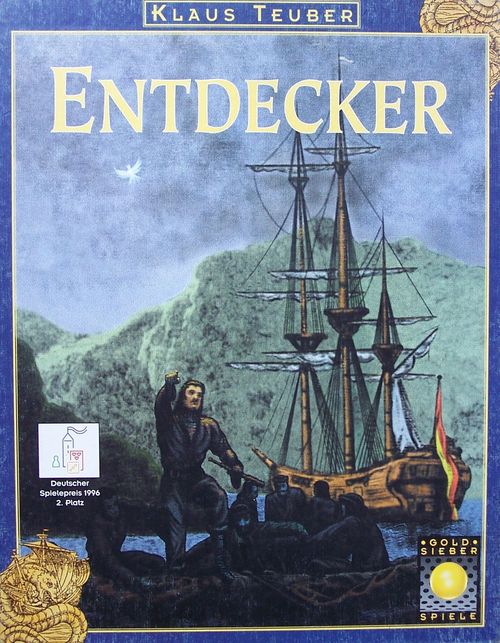
Entdecker (1996)
Entdecker Rulebook
Table of Contents
Table of Contents
Setup
Before the first game, punch out the various components. Set the spinning arrow on the income tracker. Sort the fill-in cards (the ones showing the Goldsieber balls and the numbers 1 to 6) out from the rest of the discovery cards. The fill-in cards are sorted by their number and placed beside the board, number-side down, in six piles. The remaining discovery cards are thoroughly shuffled and placed face down in five piles. The plant-discovery tokens are shuffled and placed face down in two piles. The event table is placed beside the game board. Each player receives all the pieces and the success marker of one color, a wealth tracker (the cardboard piece with the spiral of holes) and a wealth marker (the yellow peg). The wealth marker is placed in hole number 4 of the wealth tracker. The success marker is placed on the starting space of the success track around the board. The youngest player receives the income tracker and the ship; they go first.
Turn Overview
Each season unfolds the same way.
- Determine income. At the start of each season, the first player determines the income for all players for that season. Then each player in turn carries out phases 2 through 5 below, in order.
- Exploration. On your turn, place the ship on an already-discovered space of the board, or on a space around the board's edge, to try to discover new lands. The more you spend on exploration, the greater your chances of success.
- Construction. If you discover new land, you may build on it.
- Completing an island. If one or more islands have been completely discovered once a player finishes their turn, all players with units on that island receive victory points.
- Next player. The player then passes the ship clockwise to the next player.
The Turn in Detail
1. Determine Income
This phase happens exactly once per season, before the first player's turn.
The first player (the youngest player at the start of the game) spins the income arrow. Each player adds the number rolled to their wealth tracker, without being able to exceed twelve.
The remaining four phases are each played out fully by every player, starting with the first player.
2. Exploration
On your turn, you place the ship in the circle at the middle of an already-discovered space, or at the edge of the board. This circle must have at least one free white line connecting it to an undiscovered space.
On the very first turn, the ship may only be placed on a circle around the edge of the board.
Note: if a player begins their turn on a space containing another player's construction, this incurs an extra cost. The explorer must spend as much gold as the value of the opponent's construction — for example, if there is a fort, they must move their wealth marker back three holes.
Declaring the number of explorations
The player now declares how many discovery cards they will turn over during their turn. For each card declared, they move their wealth marker back one hole. They must declare at least one card, and are limited only by their wealth.
Drawing and placing discovery cards
i) The player draws a card from one of the five piles. If they draw a card with a question mark, then after the card is placed, the event is read from the event table and applied.
ii) They place the card on a free side of the space the ship currently occupies. All four sides of the new card must match their surroundings: water facing water, land facing land.
iii) If the card cannot be placed, it is removed from the game and returned to the box. Note: if it was an event card, the event is not applied. Option recommended by the translator: unplayable cards, if they are not event cards, are not discarded but instead go to the matching pile of fill-in cards.
iv) If the card fits, it must be placed. The player then moves the ship along the connecting line to the circle of the newly discovered space. If the player has several placement options, they choose whichever suits them best.
v) If the player declared more than one exploration, they may continue exploring to try to discover new spaces until their exploration credits run out. They are not obliged to; they may choose to stop. If they continue, they place the card on the board and move the ship onto the new card before drawing the next one.
vi) It can happen that a player plays fewer cards than they had planned, against their will. Indeed, if they move the ship onto a card that has no connecting lines leading to an undiscovered area, they have no choice but to stop.
vii) If, at the end of a player's turn, there is an empty space into which only one type of card can be played — that is, one whose all four sides touch a discovered area — then that space is filled with the matching card from the reserve. In some rare cases, a group of empty spaces may be entirely surrounded by land. This gap is filled using fill-in cards that show only land (the ones numbered 6 on the back).
3. Construction
If a player has moved the ship onto a card containing land, they may place a construction from their reserve. Their turn ends at that point, even if the player still had enough credit to turn over more cards.
The player places the construction on the land and moves their wealth marker back by the construction's cost: trading post = 1; fort = 3; colony = 6.
Only one construction may be placed on each card.
If two separate land segments appear on the same card, the player must choose which one to place their construction on.
A construction can only be removed once the island is complete (fully discovered), except for trading posts, which may be returned to your reserve at any time.
Note: if the last card a player draws is open sea, they cannot go back to build on a previously discovered space. They should have thought of that beforehand!
4. Completing an Island
If, at the end of a turn, an island is completely discovered, the island's greatest discoverer is determined. This is the player who owns the highest-value construction on the island. A colony outranks a fort, which in turn outranks a trading post. In case of a tie, the tied players are separated by whichever lower-ranking constructions they also own on that same island.
Examples:
A colony + a fort + two trading posts beats a colony + a fort + one trading post.
A single fort beats three trading posts (it is not the number of constructions that matters, but their quality).
If the tie persists, the tied players are joint discoverers of the island.
If there is at least one fort or colony on the island, then a new plant has been discovered on that island. The greatest discoverer (or the greatest discoverers, in case of a tie) takes a plant token from one of the piles and places it face up in front of them. If there are not enough tokens for all the tied players, none of them receives one.
An island's value is obtained by adding together the number of tiles that make up the island and the value of any plant discovered on the island. If more than one player drew a token, only the token with the highest value is kept.
The greatest discoverer receives the island's full value in victory points. Other players present on the island receive half the victory points of the player ranked just above them. That is, for example, if the winner receives twelve points, the second-place player receives six, the third three, and so on. Rounding is always in the player's favor (for example: 10, 5, 3, 2). All players who score points move their victory point marker around the board, and all constructions on the island are returned to their owners' respective reserves.
Note: in case of a tie between several players, the following players receive the share corresponding to their rank. For example, for an island worth 10 points:
Albert and Beatrice are tied for first, followed by Charles: Albert and Beatrice score 10; Charles scores 3 = (10:2):2.
Albert is first, Beatrice and Charles are tied for second, followed by Denise: Albert scores 10; Beatrice and Charles score 5 = 10:2; Denise scores 2 = ((10:2):2):2.
5. Next Player
Whoever just played passes the ship to the next player.
Once all players have had their turn and it is the first player's turn again, they carry out a new income roll (phase 1).
Option recommended by the translator: changing the first player. Whoever was just the first player skips their turn. The new first player — who was previously the second player — starts again at phase 1 by rolling income for the new season.
End of Game
The game ends when every space on the board has been discovered. If the last card played completes an island, that island is scored as usual.
Incomplete Board
In certain exceptional cases, the board may not be completely filled when the last discovery card is drawn. In that case, the game ends when the last card is placed. All incomplete islands are scored as if they had been fully discovered, without regard for any "logical" unit. These islands do not grant any plant-discovery token.
Grand Inventor
A bonus is awarded to the player who holds the most plant tokens in front of them. The bonus equals the number (not the total value) of plant-discovery tokens the player holds. This bonus is added to their victory points. If several players are tied for the most discovery tokens, each tied player scores the Grand Inventor bonus.
The player who has scored the most victory points is the winner.
Events
Storm: The player's turn ends immediately. The player may not place a construction or carry out further exploration.
Hostile natives (bow and arrows): If the player wants to build on this card, they must pay double the usual amount: 2 for a trading post, 6 for a fort. Building a colony is effectively impossible, since the player cannot have 12 wealth points available after moving.
Welcoming natives (flower crown): The player may draw a plant-discovery token from one of the piles and place it face up in front of them. Note: this token does not grant victory points immediately; it can, however, help a player become "Grand Inventor" at the end of the game.
Pirates (skull): the player loses half their money, rounded to their disadvantage. They must move their wealth marker back by that number of holes.
Ruins: the player who has just discovered historical ruins receives three victory points. They immediately advance their victory point marker three spaces.
Gold: the player finds three gold pieces. They advance their wealth marker three holes, without being able to exceed the maximum of twelve.
Variants
Personal Tiles
- At the start of the game, each player receives 4 tiles: one open-sea tile, one with three sea edges, and one of each type with two sea edges (2 sea sides opposite each other, 2 sea sides adjacent to each other).
- Instead of declaring how many cards they are going to use, players declare how much gold they are spending on exploration.
- Instead of drawing a card from one of the piles, a player may choose to play one of the tiles they were given at the start of the game. Placing a tile this way costs two gold. A player may use only one of their own tiles per turn, with no other limit besides their exploration spending for tiles drawn from the piles.
Changing the First Player
- At the start of the game, determine a first player. This player receives the income wheel.
- When their turn comes around again, instead of spinning the wheel again, the first player passes it to the next player on their left. That player becomes the new first player for the next turn — they spin the arrow, and so on. The former first player therefore skips their turn.