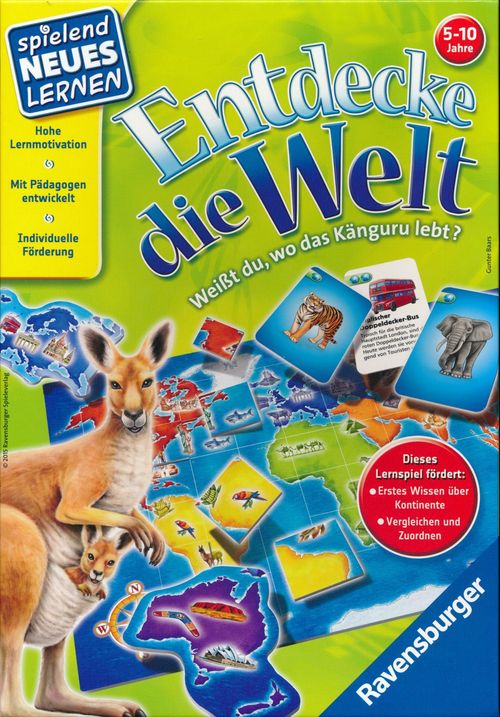
Entdecke die Welt
Entdecke die Welt Rulebook
Table of Contents
Table of Contents
Contents
- 1 die
- 30 cards
- 1 game board in four parts
- 42 placement tiles
- 6 continents
On the white sides of the cards, or on the last page of these instructions, each motif on the game board has a short piece of information.
Before the First Game
Take the game material out of the box. Carefully punch the placement tiles, the cards and the continents out of their punch sheets. Assemble the game board like a puzzle.
Note on the source: the box heading in the German original reads "5 Kontinente:" (5 continents), but the box lists six continents (North America, Asia, Europe, South America, Africa, Australia) and the component list gives 6 continents. The heading is transcribed as printed; the six listed continents are the ones meant.
Of course, the seven continents of our Earth also include Antarctica. In this first geography game, we concentrate on the other six continents.
Basic Game
Geography game for 2 to 4 children aged 5 and up.
Goal of the game: Find the motifs of the placement tiles on the game board and complete them. The player who completes the most motifs wins the most cards.
Setup
For the basic game you need the game board, the 42 placement tiles and the 30 cards. Set the continents and the die aside. Spread the placement tiles face down on the table and mix them. Then stack them next to the game board. Each player draws five placement tiles and lays them face up in front of themselves. The cards are laid out open along the edge of the game board, with the blue side face up.
Let's Go!
The youngest player begins. Play then continues clockwise. Place one of your five placement tiles on the matching spot of the game board. You are free to place it next to a placement tile already on the board or to lay your tile freely on the board, but look carefully to see whether you can place it next to a placement tile that is already lying there.
Does this complete one of the motifs? Super! You may take the card with this motif as your prize.
Remember to draw a placement tile from the stack at the end of your turn, so that you again have five placement tiles in front of you. Now the next player clockwise takes a turn.
End of the Game
When there are no more placement tiles in the stack, play continues without drawing. The game ends when all placement tiles have been distributed on the game board.
Now the cards you have won are counted. The player with the most cards wins the game.
Note: A player always receives a card when they complete the motif. It does not matter who laid the first part of the motif.
If you have difficulty counting, lay your cards side by side on the table. Who has the longest row?
Game Variant
Geography game for 2 to 4 children aged 6 and up.
Goal of the game: Complete the motifs on the world map and collect cards. If a motif on your own continent is completed, that card counts double.
Setup
The game is set up as in the basic game. In addition, each player may choose a continent and take it to themselves. You need the die.
Let's Go!
The youngest player begins. Play then continues clockwise. When it is your turn, you may roll the die and carry out the corresponding action:
- If the die shows a one, you place one of your own placement tiles on the matching spot of the game board, as in the basic game.
- If the die shows the thief, you steal a placement tile of any other player and place it on the game board.
If you can complete a motif by placing the placement tile, you receive the matching card. Lay it face up in front of you, with the blue side up. Is the completed motif even one of the three motifs on your continent? Then lay the card you have won with the white side up in front of you. This card counts double.
At the end of each turn, the player whose tile was placed on the game board draws a placement tile. Thus each player again has five tiles lying in front of them.
End of the Game
When there are no more placement tiles in the stack, play continues without drawing. As soon as one of the players has no placement tiles left in front of them, remove the die from the game.
Whoever is now on turn may place any placement tile from themselves or from one of the other players onto the game board. If a motif is completed, you receive the matching card.
The game ends when all placement tiles have been distributed on the game board.
Now the points of the cards you have won are counted.
The globes on the front and back of the cards help you count the points.
Example in the original: 1 + 2 + 1 + 1 = 5 points.
Expert Variant
Knowledge game for 2 to 4 children aged 7 and up.
The game is played as in the variant. It is important that here, too, the cards are laid out with the blue side up.
Once you have completed a motif, you can collect additional points through your knowledge. You now have the option of naming the completed motif. Use the white side of the card to check whether you named it correctly. If you are right, you may lay the card with the white side up in front of you. At the end, you receive two points for these cards. If you could not name the motif correctly, you lay the card with the blue side up in front of you. These cards are then worth one point each.
If you have completed one of the motifs of your own continent, you automatically receive two points and lay the card with the white side up in front of you. Naming the motif brings no additional points in this case.
Tip from the original: let the information about the motifs be read aloud to you right after you have won the cards.
Further Motifs on the Game Board
Short information on each motif on the game board is printed on the white sides of the cards, or on the last page of these instructions. Further motifs found on the game board:
- The cowboys of the USA: The herdsmen of the USA are also called cowboys. Through so-called Western films they became known worldwide.
- The scarlet macaw: Thanks to its particularly colourful plumage, the scarlet macaw is a very conspicuous parrot. With a size of up to 90 cm, it is one of the largest parrots in the world.
- The great white shark: The great white shark is the largest living predatory fish on Earth. Its habitat extends over all the world's oceans, and it prefers warm coastal waters.
- The chameleon: A chameleon's ability to change colour serves not only for camouflage, but above all for communication with other animals.
- The emperor penguin: Emperor penguins live around the coast of Antarctica. With a height of up to one metre, they are the largest penguin species.
- Sheep farming in New Zealand: Sheep farming has a very high standing in New Zealand. There are eight times as many sheep as inhabitants on the island.
- The polar bear: Polar bears live around the North Pole. It is so cold there that snow and ice cover the sea and land surface all year round.
- The oriental carpet: The distinguishing feature of an oriental carpet is its many different patterns. To this day, these are knotted by hand.
- The wolf: The wolf belongs to the dog family. It lives and hunts in a pack. Young animals are also raised together in the pack.
- The kangaroo: Kangaroos live exclusively in Australia, New Guinea and Tasmania. Some species can jump more than ten metres.
Our Earth is round. Showing countries and continents on one flat surface is not so easy. Our world map is meant to appeal to children and to give a first insight into geography. Many details have therefore been deliberately left out, in order to give children a clear orientation.
For the game principle it is important that the motifs lie on the intersections of the grid, which is why slight deviations from the original locations may occur.