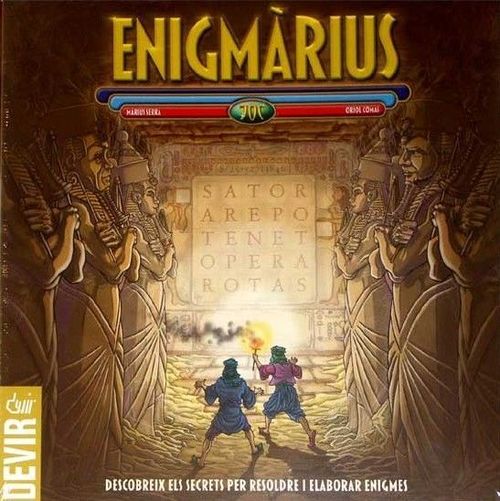
Enigmàrius
Enigmàrius Rulebook
Table of Contents
Table of Contents
Components
- 216 verbal challenge cards that let you win letters: vowels on one side and consonants on the other.
- 1 challenge die.
- 256 letters. *
- 20 boards with five words of five letters on one side and five words of six letters on the other side.
- 12 wildcards.
- 6 screens shaped like mastabas.
- 72 exclamation marks.
- Solucionarius (solution book).
- Rules.
* As in many word games, accents are not taken into account in Crucigramàrius. However, the words on the boards are accented. If a letter's tiles have run out, play can continue. If you need that particular letter to complete a board, you may borrow it from another word game, such as "Verbalia Juegos", or use coins, slips of paper or other objects to represent it.
You need a dictionary (paper or digital) and a timer. Many players will want paper and pencil to hand.
Setup
Shuffle the boards with the words and deal two to each player. Decide whether the game will be short or long. There are four possible modes. The longest mode is played to complete all five words on a board, on the side with six-letter words. The shortest mode is played to complete only three words on a board, on the side with five-letter words. (The printed rules describe only these two modes.)
For some challenges it is much better to control response time. Players may agree that one of them takes charge of the timer, once they have decided how long they have to solve each challenge. Agree on this at the start, because for some players one minute is too little and for others it is too much.
Each player chooses one of their two boards and discards the other. Each player also takes a screen, two wildcards and 12 exclamation marks. They hide everything behind the screen.
In the middle of the table, place the deck of verbal challenge cards, the letters spread face up, and the challenge die. Materials that are not used are returned to the box. Choose the first active player at random.
Turn Sequence
-
The active player asks for a Vowel or a Consonant.
-
The active player rolls the challenge die.
-
The active player draws any card from the deck, except the first card, and reads the challenge on the vowel (V) or consonant (C) side, according to what was asked for.
-
The active player issues the challenge shown on the die. If the result is "Choose a challenge", the active player picks whichever challenge they like.
-
All players, including the player who issued the challenge (except in the case of "Create a Crucigramàrius", see below), may respond to the challenge. To respond, they place an exclamation mark in the middle of the table. Five things can happen:
5A. Only one player (who is not the player who issued the challenge) accepts the challenge. They place an exclamation mark on the table and answer. If they are right, they take the letters corresponding to the solution of the challenge on the card and place them behind their screen. The active player keeps the exclamation marks that are in the middle of the table.
5B. Several players place an exclamation mark on the table, and none of them is the player who issued the challenge. This player asks whether anyone wants to raise the stakes. Each player may place at most two more exclamation marks. If at the end more than one player has placed the highest number of exclamation marks, those players write the answer on a piece of paper and show it at the same time. Those who are right keep the letters shown on the card. The player who issued the challenge keeps the exclamation marks in the middle of the table. If a player does not keep placing exclamation marks to match the other players' bids, they lose the ones they had placed.
5C. Several players place an exclamation mark on the table, and one of them is the player who issued the challenge. This player asks whether anyone wants to raise the stakes. Each player may place at most two more exclamation marks. If at the end more than one player has placed the highest number of exclamation marks, those players write the answer on a piece of paper and show it at the same time. Those who are right keep the letters shown on the card. If a player does not keep placing exclamation marks to match the other players' bids, they lose the ones they had placed. The exclamation marks stay in the middle of the table for the next turn.
Verbal Challenges
There are five different types of verbal challenge, all set out on the vowel (V) and consonant (C) sides of the cards. The die result "Choose a challenge" lets the active player pick any challenge they want.
Solve the Crucigramàrius
Read the statement aloud. Do not read out the letters it gives; this hint is only for your eyes.
Example. Íñigo has the lead and asks for a consonant. The challenge die shows "Solve the crucigramàrius". He draws a card and reads aloud the crucigramàrius on the consonant side: "Le ataques de maneras distintas (8 letras)", without giving the hint printed on the card. No player places an exclamation mark. Íñigo places one on the table and, thanks to the extra hint of the five consonants, works out the solution: DISPARES. He takes the consonants D, S, P, R, S and places them behind his screen, covering with them the letters he can on his board. He passes the turn to the player on his left. The exclamation mark stays on the table for the next turn.
Translator's note: the clue is a Spanish wordplay; the answer DISPARES means "dissimilar" or "unequal".
Find an Anagram
Read aloud the place name whose letters must be rearranged into an anagram. Caution: a correct anagram may not match the ones listed in the Solucionarius, because there are often many. In that case, check in the dictionary that the answer is a valid word. All words of the language are valid, including verb forms and inflections for number and gender. The players decide whether to accept dialect variants or Americanisms.
Example. Juan Carlos has the lead and asks for a vowel. The challenge die shows "Find an anagram". He draws a card and reads the place name on the vowel side, whose letters must form an anagram: "MENORCA". Only Pepa places an exclamation mark on the table and quickly says "COMERÁN". She wins the vowels O, A and E and places them behind her screen, covering with them the letters she can on her board. Juan Carlos keeps the exclamation mark.
Define the Hidden Word
Read the hidden word on the card and the three possible definitions.
Example. Juan Carlos has the lead and asks for a vowel. The challenge die shows "Define the hidden word". He draws a card and reads aloud the hidden word on the vowel side: "FLETÁN, A. Inflammation of the skin, B. Bony fish, C. Ship owner." Íñigo, Pepa and Carles place an exclamation mark on the table. Juan Carlos asks whether anyone wants to add more. No one else raises the stakes. Íñigo and Carles write A, and Pepa writes C. Since the solution is the second definition, nobody wins the letters E and A. Juan Carlos wins the three exclamation marks.
Say a Word
Read the condition the word must meet. All words of the language are valid, including verb forms and inflections for number and gender. The players decide whether to accept dialect variants or Americanisms. The words must meet the condition exactly. For example, if an adjective of 9 letters with an E is asked for, TEMERARIO is not a valid answer, because it has two E's, not one. Each player wins the vowels or consonants in the word they said. If, in a challenge to win Consonants, a player says a word with a K or a W, they may take any consonant.
Example. Íñigo has the lead and asks for a vowel. The challenge die shows "Say a word". He draws a card and reads aloud the challenge on the vowel side: "Seven-letter word without A or C". He himself, Juan Carlos, Pepa and Carles place an exclamation mark on the table. Íñigo then asks whether anyone is going to add more. He himself, Pepa and Carles place a second exclamation mark, and Juan Carlos does not (although he does not thereby avoid losing the first one he placed). Íñigo writes TARJETA, Pepa writes REPITEN and Carles writes LIBROS. Íñigo has written a word that does contain an A, and Carles has one of six letters, so neither wins any vowel. Pepa wins E, I, E (from REPITEN). The seven exclamation marks stay on the table for the next turn.
Translator's note: the example words are Spanish. "TARJETA" means card, "REPITEN" means they repeat, "LIBROS" means books.
Create a Crucigramàrius
You have been asked to exercise your imagination! You must create a crucigramàrius that hides the word shown on the card. To do this you must use three of the various clues associated with it. That is, your crucigramàrius definition must contain three of those words or expressions. When you have it ready, pose it aloud and also state the number of letters. Players who believe they know the answer may place an exclamation mark on the table. If nobody gets it right, you place an exclamation mark on the table yourself.
However, the other players may challenge your crucigramàrius on two grounds: a) because you did not use three complete clues, and b) because you did not keep agreement (concordance). If either of these is proven, you will not collect any exclamation marks, and those will be returned to the players who placed them. Challenges on grounds of agreement succeed when the gender, number or verb tense of the statement and the answer differ (singular for plural, infinitive for past). A challenge succeeds only if it is clear that an element is missing or that agreement fails. If doubt persists, the first player to say "tienes razón tú" ("you're right", in the familiar form) three times in a row wins.
Translator's note: "concordancia" is a grammatical term. The phrase "tienes razón tú" is a Spanish idiom used as a playful tie-break.
Players are advised to agree that they will act in good faith, especially regarding strictness when creating a crucigramàrius. In the first games it is wise to always pose them with the formula "It could be... or...".
Example. Íñigo has the lead and asks for a vowel. The challenge die shows "Create a crucigramàrius". He draws a card and, on the vowel side, sees that he must define a crucigramàrius based on the word BRAZOS (arms). The help clues are: "They are of the sea, tattooed of sailors, welcome with open ..., stand with ... crossed, strike of ... fallen, muscular, carry someone in ...". After much thought, Íñigo says: "They could be of the sea, muscular, or fallen through a strike, 6 letters." Nobody feels like placing exclamation marks, because they do not know the answer. Íñigo shrugs and places an exclamation mark on the table, where it accumulates for the next turn.
Translator's note: the clues are built on Spanish idioms about "arms" (brazos), such as brazos de mar (sea arms), brazos cruzados (arms crossed), brazos caídos (strike, literally "fallen arms") and llevar en brazos (carry in one's arms). The answer is BRAZOS, meaning arms.
End of the Game and Scoring
The game ends at the end of the turn in which a player declares that they have completed the corresponding words on their board (five in the long mode, three in the short mode). If they wish, they may use one or two wildcards to complete it. Then points are awarded:
- 5 points for the player (or players) who finish the board.
- 8 points for each completed word.
- 1 point for each letter of the words not completed.
- 1 point for each three loose letters outside the board.
- 1 point for each three exclamation marks.
- -5 points for having used one wildcard.
- -15 points for having used both wildcards.
The player with the most points wins. If there is a tie, the player who has completed more words on their board wins. If the tie persists, the player with more exclamation marks wins.
Solitaire Rules
Wildcards, exclamation marks and the screen are not used.
The player decides how much time they allow themselves to finish the board. They may solve all the challenges except "Create a Crucigramàrius". If that result comes up, roll the challenge die again. The player puts the cards containing the puzzles they did not solve in a separate pile from those they did solve.
At the end of the game, add 30 seconds for each unsolved challenge. In each new game, they try to beat their time record.