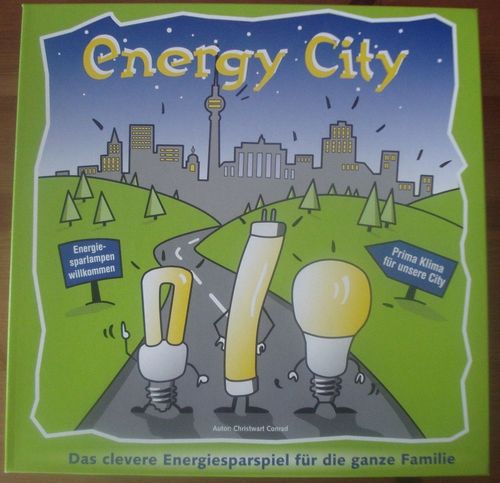
Energy City
Energy City Rulebook
Table of Contents
Table of Contents
Components
- Per player (max. 4 players): 2 playing pieces of the same colour
- 1 climate clock and 1 climate angel
- 20 octagonal company tiles. Red side: companies with conventional incandescent lamps. Green side: companies converted to energy-saving lamps
- 88 blue action cards (80 company cards and 8 climate clock cards)
- 22 green bonus cards
- 105 lobby chips, with values from 0 to 11 lobby points
- 30 incandescent lamp chips with values 10, 20 and 50
- 28 energy-saving lamp chips with values 1, 2, 5 and 10
- 6 green meadow tiles (the rules text calls them "Grüne Wiese" tiles; the component list calls them "Bunte-Wiese-Plättchen")
- 1 cloth bag
- 4 quick rules sheets
- Discard areas: Household Waste Landfill and Recycling Yard
Setup
- Lay out the game board. Attach the Recycling Yard and the Household Waste Landfill to each other and place them next to the board.
- Place the climate angel and the climate clock on their starting spaces of the climate scale. Set the climate clock according to the number of players.
- Distribute the company tiles with the red side up, placing them on any of the 30 spaces of the board. Place only one chip per space; 10 spaces remain empty.
- Distribute the lobby chips as follows:
- Place face up next to the board, as an exchange supply, three each of the 1s and 2s, and two each of the 3s and 4s.
- Place the chips with values 6 to 11 next to the power stations with the same values along the climate scale.
- Place one chip on each space with a company tile, at random and face down.
- Put the remaining chips into the bag.
- Place all incandescent lamp chips next to the board as a supply in the Household Waste Landfill.
- Place all energy-saving lamp chips next to the board as a supply in the Recycling Yard.
- Shuffle the action cards and deal 5 cards to each other player. Any climate clock cards dealt are returned to the deck and replaced with new cards.
- Prepare the action card draw pile.
- Shuffle the bonus cards and prepare them as a draw pile.
- Each player receives a quick rules sheet.
- Place the green meadow tiles next to the climate scale.
- Each player receives 2 playing pieces of the same colour: one lobby piece and one recycling piece. Then draw lots for the starting player.
- Beginning with the starting player, and then in turn order, each player places one of their two pieces on any space of the board. A piece may not be placed directly next to, or on a space with, another player's piece.
Overview of a Turn
A player carries out a complete turn (see steps 1 to 4). Then the next player clockwise takes a turn. This continues until the climate angel meets the climate clock, which ends the game:
- Waste creation (reveal the top action card)
- Move the lobby piece 1 to 3 spaces
- Player action (one of three options): recycle lamps, lobby work, or convert to energy-saving lamps
- Draw or exchange an action card
A Turn in Detail
1. Waste creation
The active player reveals the top card of the action card draw pile. This determines at random a company (a red octagonal tile) where incandescent lamps are used up. If the affected company has already been converted (green octagonal tile, later in the game), energy-saving lamps accumulate there instead.
Place as many lamp chips from the supply on the affected space as the action card states, either as incandescent lamps or as energy-saving lamps.
The action card then goes onto the discard pile, which is started at this point.
If the card drawn is a climate clock card, the climate angel moves 1 space in the direction of the climate clock, and the active player draws another action card.
2. Move the lobby piece
The active player moves their lobby piece 1 to 3 spaces, horizontally and vertically, but not diagonally. Within a single move, the starting space may not be entered again; spaces occupied by other pieces may be entered.
3. Choose an action (A, B or C)
The active player decides whether to collect and recycle lamps (A), to do lobby work at four companies (B), or to try to convert a power waster to energy-saving lamps (C).
A. Recycling
The player collects either all incandescent lamp chips or all energy-saving lamp chips from the space their piece stands on, and from the 4 spaces bordering it horizontally and vertically. The chips go into their respective supply (Household Waste Landfill or Recycling Yard) and can be reused.
For each recycled energy-saving lamp, or for every 10 incandescent lamps, the player moves their piece 1 space further along the recycling scale. Whoever moves past space 39 places a 10 (20) incandescent lamp chip under their piece and marks +40 (+80) with it.
Example: 4 recycled energy-saving lamps move the piece 4 spaces; 50 disposed-of incandescent lamps move it 5 spaces.
B. Lobby work
The active player draws 4 lobby chips from the bag and looks at them secretly. Then they place 1 chip face down on each of the 4 nearest red company tiles reachable from their piece by horizontal and vertical steps (combinations allowed). Where companies are at the same distance, the player may choose which company to use.
Whoever has done such "persuasion work" draws the top bonus card from the stack. They may play it immediately, or keep it and play any number of bonus cards in later turns. The timing for use is shown on the card. Each bonus card may be used only once; after use it is placed on its own discard stack.
At any time, each player may hold at most 3 bonus cards in hand. Whoever draws a 4th bonus card must immediately play one of them, or place it without effect on the discard pile.
Again: lobby work is only possible on spaces with red octagonal tiles. Lobby chips must never be placed face down on spaces of companies that have already been converted (green side).
C. Conversion
With an action card, the active player may convert a red power waster into a green power saver and collect lobby points for it. For this, the player must have played the card for the affected space, and must also be standing there with their piece. If that space is already converted (green octagonal tile) and face-up lobby chips are still lying there, the player may collect those chips.
The three cases below describe how conversion is resolved.
Case: Power Waster (red octagonal tile)
The active player turns over all lobby chips lying on the space and adds up their values. If this sum is at least as large as the lobby points required on the played action card, the player has convinced the company to convert.
The player collects as many lobby points as stated on the action card. Surplus chips remain on the space. If the exact point total cannot be formed from the chips lying face up, the player uses chips from the supply at the edge of the board as exchange chips (for example, exchanging a 3 for a 2 and a 1). The octagonal tile is then turned to its green side.
- If the player collected 7 or fewer lobby points, the climate angel moves 1 space toward the climate clock.
- If the player collected 8 or more lobby points, the climate angel moves 2 spaces toward the climate clock.
- If the climate angel lands on or passes over a power station space in this way, that power station becomes superfluous through power saving. It is covered with a green meadow tile. The player receives the adjacent lobby chip as a bonus.
If the sum of the face-up lobby chips is smaller than the lobby points required on the played action card, the player has a choice:
- Either they pay the difference from lobby points they have already won (exchanging chips where necessary). Then all lobby chips go into the bag, the climate angel advances accordingly, and the player possibly collects a bonus for a power station space.
- Or the player does not pay the difference, because they cannot or will not. Then the climate angel moves 1 space back (upward) and the climate clock moves 1 space forward (also upward). The face-up lobby chips are turned face down again.
Case: Power Saver (green octagonal tile)
The active player has played the action card for a space with a green octagonal tile (already converted), and face-up lobby chips are still lying there. The player collects all of those chips, regardless of the lobby points required on the played action card.
4. Draw or exchange an action card
At the end of their action, the active player draws an action card if they played one. Otherwise, they may place a card from their hand on the discard pile and draw a new card in its place.
If the card drawn shows a green company (already converted), the player may place it on the discard pile immediately and draw a new card in its place.
If the card drawn is a climate clock card, the climate clock moves 1 space toward the climate angel, and the player draws another card.
Game End
If the climate angel and the climate clock meet on one space, the game ends. The game also ends if all power stations have been replaced by green meadow tiles.
If one of these conditions occurs during a player's action, that player still completes their turn. They may still convert a power station located behind the climate angel, or play bonus cards, but may not use their turn to delay the game end any further.
Winner
Now each player adds up their lobby points and marks this value on the recycling scale with their lobby piece.
Of the player's two pieces now standing there, the one with the higher value is tipped over. The piece still standing marks the player's victory points.
Whoever is now furthest ahead has won. Only in a tie does the second (lying-down) piece decide.