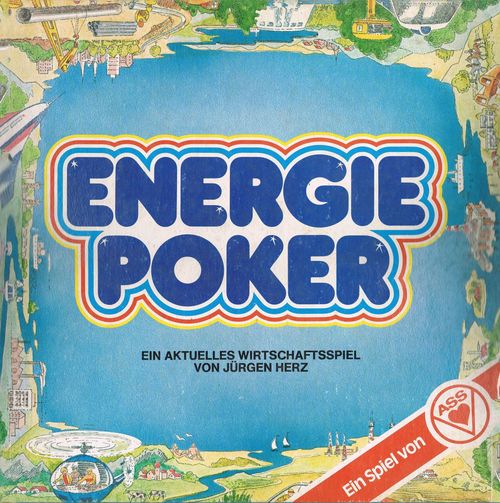
Energie Poker
Energie Poker Rulebook
Table of Contents
Table of Contents
Game Concept
Each player represents an industrialized nation and has to try to supply the energy requirements of his country from the energy on offer on the world market. The total number of units of energy required for a country in each round is shown on the edge of the board nearest that player. The game lasts from 1980 to 2025.
Should a player not plan his energy supply properly, or if there are any negative international or national events, supplies may be insufficient and the player will then have to switch to other types of energy - at higher prices.
The player who after 50 years (10 rounds) has best supplied his country with energy at the least cost wins the game.
The game is based on projections made of the energy demand and supply for the Federal Republic of Germany 1978 by Professor Bohn, Chair for Energy and Power Station Technology at the University of Essen.
Set Up
Each player is given a screen and Energy purchase cards in the following denominations: 4x1, 5x2, 3x3, 2x4, 2x5, 2 Energy Change cards, and 20 dollars (9x1, 2x3, 1x5). Note that the 2 player game is slightly different – see the end of the rules for details. Decide who the game leader will be using a random method of your choice. The game leader will change after each turn, passing to the player on the left of the current game leader at the end of each turn.
Shuffle the International and National Event cards and place them in face down piles.
Playing the Game
Each turn is comprised of the following:
The game leader places the metal rings on the Energy On Offer for the current year. This figure is shown on the World Energy Plan on the board. This is the amount of energy of each type offered for sale during the current year. It helps if you now place the appropriate coloured counters on the board for each energy type, ready for distribution to the players.
Each player secretly decides how much of each Energy he wants. (His total needs for each year are shown on the board., in the spaces around the edge). He places purchasing cards (Energy purchase cards) in his folder, totaling the number of energy units he must obtain this year (neither more nor less). These are placed in each of the sections of the folder. He may increase his chances of obtaining these (in case of shortage due rival bidders) by placing dollars in the appropriate slots. If he places $1, for example, this means he is willing to pay $1 for each unit of that Energy he gets. If a player wishes to purchase units of a particular type of Energy more than three above that which he obtained in the previous year, he must place in that section an Energy Change card. He must also pay $1 each extra for them because of this. This is not counted toward the extra payment. He may pay more than $1, of course, the excess being counted toward extra payment, so a bid for 5 units of energy when only was bought last turn, requires an Energy Change card and $1 to be placed with it. If additional money, say $2 more ($3 total) were also placed with the Energy purchase card and Energy Change card, this now counts as a bid of $2 for 5 units of energy, but will cost 5 x 3) = $15. After using an Energy Change card, it is removed from the game. The Energy purchase cards are retrieved after use, for use in future rounds.
Editor's note: the source text is garbled in two places in this paragraph, and is transcribed as printed. "when only was bought last turn" appears to be missing the number of units bought in the previous turn. "(5 x 3) = $15" appears to be missing an opening bracket, and the source's intended calculation is 5 units at $3 each.
Each player takes an international event card, unless they still have one from a previous round. Starting with the game leader each player must do one other following:
- Play an international event card for the current year – it will take effect if not overridden,
- Discard an international event card if for a previous year, or the current or a future year if they decide they do not want it. In this case the card has no effect.
- Keep a card for a future year, ready to play in that future year.
If a card was played (not discarded) then the effects should be read out. If another player plays a card then this will override any previous cards played for the current year, so only the last played card will take effect.
These cards alter the number of units of energy available. Some types of energy will increase, and some decrease, but overall the total amount of energy available will remain unchanged. However, there is an error in the maths on some cards, which can result in a type of energy having a negative availability. In this case reduce that energy type to zero and reduce the most plentiful energy type enough to keep the total energy availability unchanged.
The text on these cards is purely for flavour, only the year and the energy availability modifiers matter for game purposes.
The players reveal their purchasing plans. The available units (coloured discs) are distributed as follows:
Firstly to the player who has offered the highest premium per unit (cash bid), and then in descending order, with the players paying as appropriate. If equal then:
- The player who wants the most has priority. If equal then:
- The player who used most of this type of energy last turn. If equal then:
- The player who, at that moment, has the greatest deficit in discs for this year. If equal then:
- Divide the available energy evenly, with a dice roll to obtain an odd unit.
The units are distributed in the order on the screens: Oil, Natural Gas, Nuclear and then Renewable.
Any player who did not receive all units of energy bid for retains a deficit until stage 6. The units of energy are purchased from the bank for the prices bid per unit. For each unit purchased a coloured disc is taken from the supply set out for the year and is placed on a space in front of the player for the current year.
The bank then pays each player $1 for each disc he has received during this turn, at the same time collecting chips from the previous year, for resuse later.
Players with a deficit in Energy Units receive them from those unpurchased so far this year. Commencing with the player with the largest deficit, and then in reducing deficit order, the players choose which type of energy they will have (roll a die to break a tie). For each unit they take in this manner, they pay $3 to the Controller of that Energy or to the bank if there is no Controller. There is no need to use an Energy Change card in this phase. If you choose energy for which you are the controller, then no payment need be made.
The player with the most coloured discs of each Energy type becomes the Controller for that type of Energy during the next turn, and receives the Control Card. If there is a tie, the bank controls it.
On turns after the first turn the National Event the card drawn at the end of the previous turn is now dealt with if applicable (for some it clearly affects other stages of the turn). The previous card is then discarded and a new National Event card drawn ready for the following turn.
Editor's note: the sentence beginning "On turns after the first turn the National Event the card drawn..." is transcribed as printed; it appears to be missing a word (likely "the National Event card drawn at the end of the previous turn is now dealt with...").
Game End
The above sequence is carried out for each of the ten years, and the player with the most money at the end is the winner. If a player becomes bankrupt (ie. cannot pay for their fuel for the year), this signifies a collapse in the world economy and the game ends at the end of that turn, with the bank paying the bankrupt player's debts that turn. Players still total their money as normal to determine the winner.
2 Player Rules
Each player represents 2 countries, but uses only one bidding area for both, and can distribute his energy freely between the two countries. The Energy Change cards need to be played when the demand for a particular type of energy for both countries a player controls is more than 5 greater than the combined energy use the previous year. Each player gets $35 to start the game.