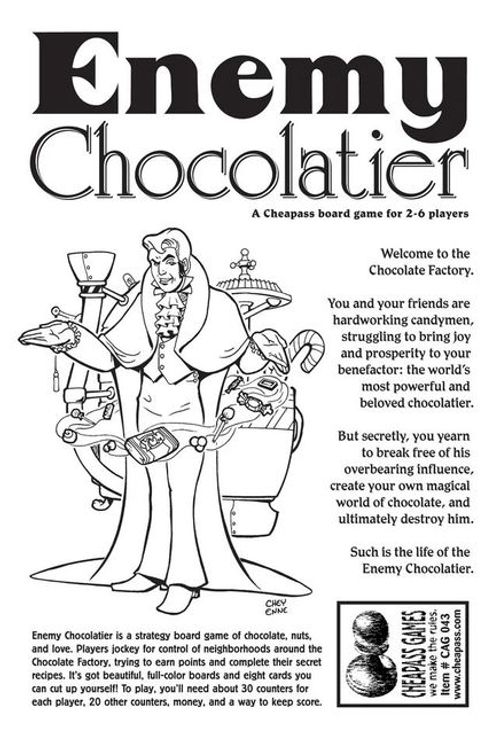
Enemy Chocolatier
Enemy Chocolatier Rulebook
Table of Contents
Table of Contents
What Comes With This Game
- Seven Board Segments
- Eight Recipe Cards (You'll need to cut these yourself. Look, you just saved a dollar!)
- This Rule Sheet
You'll Also Need
- 2 to 6 players
- About 45 minutes
- Roughly 30 colored counters for each player
- Roughly 20 other counters for Rain Checks
- Money in denominations of $1 and $5
- A way to keep score
The Basics
You and your colleagues represent powerful but jealous subordinates to the world's most beloved candyman. You will buy land surrounding his Chocolate Factory, in the hopes of earning your own fortune and fame.
Eventually you hope to strike out into the world and create an enterprise to rival, perhaps even ruin, the one you're working for now.
There are two ways to win this game. The first is to collect 20 points, which represent popularity. This enables you to start fresh with the love and support of the people. The other method is to complete your secret recipe, which represents a singularly wonderful confection that's good enough to get your own enterprise going, with or without the love and support of the people.
Setting Up
Arrange the 7 board sections in a square, with the Factory piece (the one with the game logo) in the middle, as shown below.
Place the other 6 pieces randomly.
Each outer board piece represents an area of the city. Each area contains several neighborhoods, and each neighborhood contains several houses. These boards can be shuffled in hundreds of different ways, so the game is never the same!
Shuffle the Secret Recipe cards and give one to each player. Keep your recipe a secret!
Players start with about 30 counters in their own color. The 20 other counters are called "Rain Check" tokens, and these start in the bank.
Turns will pass to the left around the table. Determine randomly who will go first, and then give each player his starting money, as follows: The first player begins with $4, the next player with $5, the next with $6, and so on. If you play with 6 players, the last player will start with $9.
The rest of the money starts in the bank.
Definitions
A "house" is any single numbered space on the board.
A "neighborhood" is a block of several houses, surrounded by "street."
You "own" a house when you buy it and place a counter on it. (The cost is described below.)
To "own," or "close" a neighborhood, you must own every house in it. You earn point income, money income, and special abilities by owning the neighborhoods that provide them.
An "open" neighborhood is a neighborhood that touches the Factory, or that touches a closed neighborhood, but is not closed itself. All players can buy houses in open neighborhoods.
A "closed" neighborhood is one that is owned by one player. Normally, other players can't buy houses in closed neighborhoods.
To "touch," two neighborhoods (or a neighborhood and the Factory) must be directly across the street from each other, not just diagonally across an intersection.
A neighborhood is "unavailable" if it does not touch the Factory or any closed neighborhoods. Players can not normally buy houses in unavailable neighborhoods. (The "Buy Anywhere" ability allows you to do this.)
Other Board Elements: The dollar bill represents dollar income. The star represents point income. Special Abilities are defined later in the rules.
About your Secret Recipe
The Secret Recipe is one of the two ways to win. Each colored house you own counts as one ingredient towards your Secret Recipe. Pink houses represent Sugar, brown houses are Chocolate, tan houses are Nuts, and red houses are Love.
So, if your Secret Recipe calls for 3 Sugar, you need to own at least 3 pink houses to complete that portion. All Secret Recipes have a total value of 19 ingredients, each in a different assortment.
Gray houses are not ingredients. You are encouraged to come up with a nickname for the ingredient they don't represent. We like to call them "Glue."
On Each Turn
First, collect your income. Players have a base income of $2. (There is a $2 bill printed on the Factory, to remind you of this. You all work there.) If you own a neighborhood that provides dollar income, collect this money as well.
Stars represent point income. For example, a 2-point star means you collect 2 points each turn. If you score 20 points, you win!
Next, you may buy up to two houses. When you buy a house, mark it with your counter.
You can only buy houses in neighborhoods that are open, meaning that (a) they are touching the Factory or touching a closed neighborhood, and (b) they are not themselves closed. "Closed" means that every house in the neighborhood is owned, and all by the same player.
You can buy unoccupied houses, or you may buy houses away from other players.
The price of an unoccupied house is the number on the board, in dollars, paid to the bank.
The cost to buy a house away from another player is always $6. This money is paid $2 to the bank and $4 to the owner of the house. (The other player cannot refuse to sell.)
When one neighborhood closes, the adjoining ones open up for purchase on the same turn.
When you own a neighborhood with a special ability, you gain that ability. It becomes active right away, in case you need to use it on the same turn! Abilities are defined as follows:
Abilities
Buy 3: You can buy up to 3 houses each turn. (You must still buy nothing at all if you want to earn a Rain Check.)
Buy Closed: You can buy houses in closed neighborhoods. This means buying houses away from other players, obviously, since the neighborhood isn't closed until it's owned entirely by one player. Note that this purchase opens up the closed neighborhood, which may cause adjoining neighborhoods to become unavailable!
Buy Anywhere: You can buy houses in unavailable neighborhoods, i.e., those that are not connected to the Factory or to closed neighborhoods. This ability doesn't give you the Buy Closed ability (described above).
All (Dollars) +1: Each of your money-producing neighborhoods is increased by one dollar. If you have this ability twice, they combine to make all these neighborhoods produce +2 dollars. This ability doesn't increase your basic income of $2.
All (Points) +1: Each of your point-producing neighborhoods is increased by one point. If you have this ability twice, they combine to make all these neighborhoods produce +2 points.
$5 = 1 Point: At the beginning of your turn, collect an additional point for every $5 you hold. You do not spend the money to make the points; they are simply produced by your surplus cash. This point income is in addition to your normal point income, but it happens before you collect your money for the turn! Having two of these abilities makes each $5 you hold worth 2 points.
$10 Houses: When players buy houses from you, they must pay $10, not $6. This money is paid $4 to the bank, and $6 to you.
Rain Checks
If you take a turn without buying anything, you earn a Rain Check. You can spend these on later turns for the right to to buy more houses above your usual limit, one Rain Check per house.
The Rain Check basically allows you to skip two buys now in exchange for one buy later. Since buying houses is critical, you will usually only take a Rain Check when you don't have enough money to buy what you want right away.
There is no limit to the number of Rain Checks you can accumulate or spend.
Strategy Hints
The first turn of this game is probably the most important. At the beginning of the game, take the time to analyze the board, your secret recipe, and your starting cash. If you plan well, you should make every turn and every dollar count.
Remember that after the setup, there are no random elements in this game, except the other players! Yes, it's that kind of game.
Buying Players Out: Would you pay $6 for a $1 house? When a player buys a house in a neighborhood you are trying to close, he is hoping to cost you more money and interrupt your development. You have two choices here: spend the money and buy him out, or give up on the neighborhood and go somewhere else. Neither choice is that attractive.
Therefore, if you can afford the risk, it's often a great move to buy into another neighborhood that someone else is trying to close. You'll learn how to do this effectively after a little practice. One question to ask yourself: are you hoping to be bought out, or not? The answer will determine how and where you make this move.
This also points out the basic strategy of always buying the cheapest house in the neighborhood. Don't buy a $4 house if there is a $3 house next door; you just make it easier for someone to buy into that neighborhood and interfere with you.
Winning on Recipe: To win on recipe takes good timing and a favorable board layout.
If you are striving for a recipe win, you can theoretically do it in just 10 turns. Each recipe has 19 ingredients, which takes just 10 turns to buy if you can find enough cheap houses.
Unfortunately, with a base income of only $2, you will quickly run out of money. The plan breaks down unless enough cheap houses are available, or unless you can supplement your income.
To win on recipe, you need to deduce whether (a) cheap houses are available in a neighborhood that will produce extra income, or (b) cheap houses will continue to open up as other players develop the board. If neither of these is true, you will need to make more money, even to the point of buying houses you don't need (or gray ones) to get more income. Don't be too greedy for money, though; winning on recipe requires very efficient play, and that means extra income is wasted effort.
Blocking the Recipe Win: When you think that a player is going for recipe, count the number of ingredients he owns, and make sure he can't buy his way to 19. (Remember to count a player's Rain Checks when assessing how many houses he can buy!) If you can afford it, you should consider buying houses away from recipe players rather than buying empty houses. Recipe players tend to own vulnerable houses in open neighborhoods, so this is relatively easy to do.
Winning on Points: The point victory can be easier to achieve than the recipe victory, until everyone becomes skilled at blocking the point victory.
The path to point victory is fairly simple: Create a reasonable income first, then focus on buying neighborhoods that produce points. Since you don't care about which ingredients you buy, choose the neighborhoods that get you the best income at the fastest rate.
You want to quickly build to a point income of 3 or more points, or work your way quickly to a $5=1 Point space. (If you own that space, defend it, but don't spend any other money!)
Blocking the Point Victory: There is no good way to stop someone once his point income is high. The "Buy Closed" ability can let you attack his point income, but only temporarily. To defeat the point strategy, you have to deduce very early how someone plans to make his points, and get into his prime neighborhoods before he has the chance to complete them. The earlier you do this, the more you set him back. You can also let him build his dollar income, but then stop him before he moves into points.
More Hints: Use Rain Checks wisely. If you save up enough of them, you can buy a pretty large neighborhood all on the same turn. Also, if you plan to buy just one house on a turn, and one house on the next, you may want to wait and buy them both on the second turn. This costs just as much money but earns you a Rain Check.
There's a lot more to it, but that's all we could fit on the back page. Enjoy Enemy Chocolatier, and give us your thoughts at the next game convention, ice cream store, or salad bar where you find us!