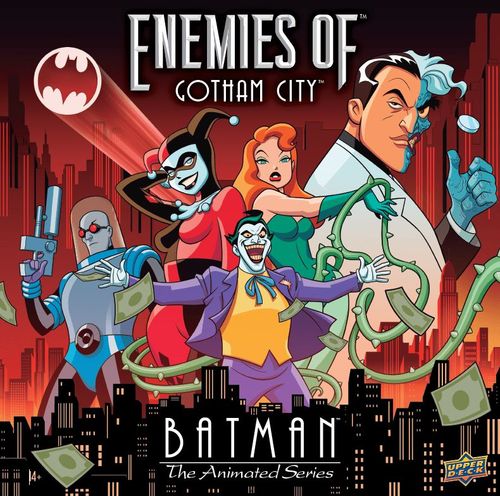
Enemies of Gotham City
Enemies of Gotham City Rulebook
Table of Contents
Table of Contents
Components
- 16 Plastic Figures: 12 Villains (The Joker, Mr. Freeze, Two-Face, Poison Ivy, and others) and 4 Heroes (Batman, Robin, Commissioner Gordon, Batgirl)
- 6 Expansion Plastic Figures (Knight on the Town Expansion required)
- 12 Villain Boards
- 6-Piece Gotham City Board
- Stacked Deck Board
- Arkham Asylum Cube Tower
- 24 Building Miniatures (6 of each type)
- First Player Token
- In 5 colors: 30 "Goon" Cubes, 12 Fire Toppers, Henchmen, Colored Figure Ring, "+50" Infamy Marker, Infamy Tracker
- 12 Ice Toppers, 12 Greenhouse Toppers
- 6 District Tokens
- 10 Score Tokens
- 40 $1 Money Tokens, 20 $5 Money Tokens, 5 $20 Money Tokens
- 12 Riddle Tokens (see FAQ)
- Lone Villain Components (see FAQ): Lone Villain Colored Ring, Lone Villain Henchmen, Lone Villain Infamy Tracker, Lone Villain "+50" Infamy Marker
- 6 Starting Power Cards
- 50 Power Cards
- 25 Weapon Cards
- 26 Event Cards
- 18 District Cards
- 10 Income Cards
- 1 Batman Rules Card ("The Bat" / "The Dark Knight")
- 5 Reference Cards
Before your first game, you will need to assemble the Arkham Asylum Cube Tower. To do so, follow the instructions found on page 21.
Setup
Assemble the 6-piece Gotham City game board as shown and place it in the center of the play area. Set the Arkham Asylum Cube Tower near the board and ensure it is on a stable surface within reach. Lastly place the Stacked Deck board near the game board; ensure that you use the side of the Stacked Deck that matches your player count: this can be found in the top left corner of the board.
The following setup is for a 2 to 4-player game. If you are playing a 5-player game, look out for the Batman icon next to each step (steps 7, 8 and 10). If you see this icon, it means that there are modified setup instructions found on page 6 for that rule (see "5-Player Setup" below). Follow this 5-player step instead of the step found on pages 3 and 4.
-
Find the Batman Rule Card and decide what difficulty you'd like Batman to be set to, either "The Bat" or "The Dark Knight" and set your choice face-up on the Batman Rule space on the board. For your first playthrough, it is recommended to set the Batman Card to "The Bat".
-
Place the Batman, Robin, Batgirl, and Commissioner Gordon figures near the board.
-
Each player collects 3 Money tokens. Place the remaining Money tokens (1's, 5's, and 20's) near the board to create a supply.
-
In random order, stack each player's Infamy Tracker on the "0" space on the Infamy Track.
-
Shuffle the 50 Power Cards together and place them face down next to the Docks spaces on the board, creating the Power Deck. Fill the six empty card spaces in the Docks with Power Cards.
-
Shuffle the Weapon Cards together and place them face down next to the Black Market spaces on the board, creating the Weapon Deck. Fill the three empty card spaces in the Black Market with face-up Weapon Cards.
-
Collect the 6 District Tokens. Place the "Uptown" District Token in the center slot of Uptown faceup. Then, place the "Uptown West" and "Uptown East" District Tokens facedown in the left and right slots of Uptown. Do the same for Downtown, placing the "Downtown" District Token faceup in the center slot and the "Downtown West" and "Downtown East," District Tokens facedown in the left and right slots of Downtown. This means that Uptown and Downtown are available districts while Uptown West and East and Downtown West and East are not available districts.
-
Randomly place a Score Token onto each available district, with the Building side faceup. Place the Buildings shown on the Score Token into any of the open spaces in each district. Then, flip the tokens over to show their score side. Create a Score Token supply by placing any unused Score Tokens near the board, score side up. Also, create a Building supply by placing any unused Buildings near the board.
5-Player Setup
-
Collect the 6 District Tokens. Place the "Uptown" District Token in the center slot of Uptown facedown. Then, place the "Uptown West" and "Uptown East" District Tokens faceup in the left and right slots of Uptown. Do the same for Downtown, placing the "Downtown" District Token facedown in the center slot and the "Downtown West" and "Downtown East," District Tokens faceup in the left and right slots of Downtown. This means that Uptown West and East and Downtown West and East are available districts while Uptown and Downtown are not available districts.
-
Randomly place a Score Token onto each available district, with the Building side faceup. Place the Buildings shown on the Score Token into any of the open spaces in each district. Only place buildings in Uptown and Downtown based on the Score Tokens in Uptown West and Downtown West. Place the first two buildings shown on the token in the West and place any remaining buildings in the East. Then, flip the tokens over to show their score side. Create a Score Token supply by placing any unused Score Tokens near the board, score side up. Also, create a Building supply by placing any unused Buildings near the board.
-
Create the Event Deck by separating the Event Cards into three piles based on the tier on their backs: I, II, or III.
- Draw and place a random "III" card face-down to start your Event Deck.
- On top of the "III" Event Card, draw and place 2 random "II" Event Cards.
- Lastly, on top of the "II" cards, draw and place 2 random "I" cards.
Place the Event Deck next to the board by the "Event" space. Place the remaining Event cards back in the box.
Game Overview
Enemies of Gotham City is a competitive area control game about Villains competing to earn the most Infamy. Earn Infamy by burning buildings, controlling Gotham City's districts, and fighting Batman. At the end of the final round, the Villain that has accrued the most Infamy will win the game.
This game is all about timing, positioning, and taking advantage of situations to outsmart your opponents. You will play as a Villain who has an Ability and a Main Weapon specific to them. These two unique traits set your Villain apart; you should try to use them as often as you can to get the most out of them.
At the start of each round, you will learn which district or districts will award Infamy at the end of the round to the players who control them. During each round, you and the other players will work against each other to have the most control in these districts or to improve your positioning for future rounds.
Game Flow
Each round is split up into five phases, during most of these phases you will have choices to make that will hopefully score you Infamy.
Event Phase
During this phase, an Event card will be drawn, showing you which district or districts are going to be scored at the end of the round. Additionally, the Event may have positive or negative effects for some or all of the players.
Prep Phase
During this phase, each player gets to choose a space to place their Henchman on the Stacked Deck board. This phase is crucial in planning out your turn! Where you place your Henchman determines the turn order for the round and provides you with a benefit. In general, it is better to go later in the round, in fact, going last is often the best move. However, the benefit you gain from the Stacked Deck is based on where you place your Henchman. Spaces with the most powerful benefits usually result in you going early, while spaces with the least helpful benefits usually result in you going later.
Action Phase
This phase is where you get to play out most of your turn. You will move your Villain around the board, play Power cards, gain money, use your Weapons, and hopefully take control of a district that is going to be scored. This is where most of the chaos ensues, so be prepared for your carefully laid plans to fall apart. It is important to be adaptable and set yourself up as best you can.
During this phase you may do up to five different actions: Use up to 2 Movement, Play a Power Card, Gain Income, Use Weapons, and Purchase a Power Card. You may do these actions in any order (except Purchase a Power Card, which must be your last action). You may also split the actions up; for example, you could use 1 Movement and then at a later point use another Movement.
Make sure to efficiently use as many of your Weapons as possible and make the most out of the Power Card you choose to play. Depending on the player count, there will only be five or six rounds, which means you will only ever play five or six Power Cards.
Think carefully about how you can benefit during the current turn, but also how you may be able to benefit in future turns with the card you play and the actions you take during this phase.
Arkham Phase
After the dust settles from the Action Phase, there is one more chance for players to manipulate the board, the Arkham Phase. Any Goons that were sent to Arkham Asylum during the round will now be dropped through the Arkham Asylum tower and may or may not fall out. If any of your Goons fall out of Arkham Asylum during this phase, you get to place them in any district, possibly changing the balance of power. This is your chance to potentially thwart an opponent's guaranteed points during the last phase of the round. It could also be your chance to sneak in and score a district that you originally weren't going to score.
Score Phase
This is the final phase of the round where players will score Infamy based on who has the most Control in the district or districts being scored. Afterwards, there is some general cleanup and maintenance. Once this is finished, you are ready to start the next round!
Key Concepts
The following are key concepts that will help you understand the rules in this rulebook. While you do not need to memorize everything about them, it is important to have an understanding of what they are and how they work.
Infamy
Infamy is how you win the game! Whoever has the most Infamy by the end of the final round is the winner. There are many ways to grow your Infamy in Gotham City. The most common ways are District Scoring, Event Cards, Power Cards, and triggering Abilities. Whenever you score Infamy, move your Infamy Tracker up the Infamy Track. When you get to the end of the Infamy Track, place the "+50" Infamy Marker on your Villain Board to show that your name should be feared in Gotham City! Then reset your Infamy Tracker back at the bottom of the Infamy Track. In the rare event you earn another 50 Infamy, flip your "+50" Infamy Marker to the "+100" side and reset your Infamy Tracker again.
Infamy Order
Some cards will ask you to check the Infamy Order, the player with the most Infamy is 1st in Infamy Order, the player with the second most Infamy is 2nd, and so on. When an Infamy Tracker lands on the same Infamy value as another Villain, place the Infamy Tracker on top of the other Villain's. The player who's Infamy Tracker is on top is ahead in Infamy Order.
Villains
Each player controls a Villain on the board. Whenever a card effect says "you" or "your" it is referring to the player's Villain. For example, if you are playing as Joker and he is in Midtown and a card says, "in your district," it would apply to Midtown.
Power Cards
Power Cards are what allow your Villain to alter the game, hinder your enemies, gain Infamy, and much more. They are the schemes, masterplans, and machinations your Villain carries out. All Villains start with the same starting hand of 6 Power Cards, but throughout the game, you will add more Power Cards to your hand. After a Villain uses a Power Card, it is removed from the game, so make sure you use them at just the right moment, because you won't get a second chance! Each Villain has a hand limit of 10 and must immediately discard Power Cards down to 10 if they ever exceed that limit.
(Example card: Remote Detonation - "Remove 2 Goons from an adjacent district. You may pay up to 3 Money to remove 1 additional Goon for each Money.")
Weapon Cards
Weapons empower your Villain and can be lethal in the right hands! Unlike Power Cards, Weapons can be used once every round and are not discarded (unless the Weapon says otherwise). A Villain may use all, some, or none of their Weapons during their turn. Weapons have a cost in the upper right corner; this cost only needs to be paid when purchasing the weapon from the Black Market, not when the Weapon is used.
Unlike Power Cards, a Villain's Weapon Cards are public knowledge and must be placed faceup at all times.
Unlike Power Cards, there is no limit to the number of Weapon Cards a Villain can have.
If all Weapon Cards in the Weapon Deck are gone, then no more Weapons can be gained from the Black Market.
At any point during your turn, you may discard any of your Weapons, placing them on the bottom of the Weapon Deck.
(Example card: Flame Thrower, cost 4 - "Burn a Building in your district.")
Heroes
Gotham City's only hope in fighting you off is its heroes. A Hero is any figure that is not a Villain; in the base game that means Batman, Robin, Batgirl, and Commissioner Gordon. How Heroes fight back depends on the Event, and in Batman's case, the Batman Rules Card.
Control
Control is how much a Villain is dominating a district. Each player's Villain figure is counted as 5 Control and each Goon is counted as 1 Control. Control is always checked when a district is being scored, but can also be checked for other reasons.
Fire (Fire topper) will count as Control ONLY at the end of the final round. A Building with a Fire topper counts as 1 Control in its district, while a Bridge with a Fire topper counts as 1 Control in both districts it is connected to.
Goons
What's a villain without their Goons? Goons are represented by cubes of a Villain's color. Each Goon exerts 1 Control in their district. Goons cannot move on their own; instead, Goons are moved either by Events or by their Villain or rival Villains with certain Weapons, Abilities, or Power cards.
Whenever any of your Goons are removed from the board, put them back into your supply.
Districts
The board of Gotham City is made up of 5 Districts in a 2 to 4-player game, Uptown, Mercey Island, Midtown, Downtown, and Tricorner. In a 5-player game, Uptown and Downtown are divided into Uptown West, Uptown East, Downtown West, and Downtown East. Districts are where all the action happens!
Districts are only considered adjacent if a Bridge connects them or if their borders are touching.
Buildings and Bridges
Buildings come in four different types: Banks, Police Stations, Warehouses, and Towers. Buildings should be placed in the slotted Building spaces in a district. Some districts have more spaces for Buildings than others. If there are no available spaces in a district, then no more Buildings can be added to that district unless a space is made available. Buildings can be moved to different districts or removed from the board by certain Power Cards and Abilities. If this happens, the Fire topper on the Building is returned to its Villain.
Bridges connect districts and are considered adjacent to the districts they connect but are not in either district. When a Bridge has a Fire topper on it, Villains must spend an additional Movement to cross it.
IMPORTANT: If a Building or Bridge has a Fire topper on it, it is still counted as a Building or Bridge. For example, if a Power Card says to gain Infamy for each Police Station in a district, and there are two Police Stations that are both on fire, the Buildings still count as two Police Stations, and so you would score 6 Infamy.
Burning
Some Power Cards, Weapons, and Turn Order spaces will allow you to Burn Buildings or Bridges. When you do so, place one of your Fire toppers on the Building/Bridge. Buildings and Bridges cannot have more than one Fire topper. After you Burn a Building/Bridge, the Fire topper remains remains there for the the rest of the game unless the Building is moved/removed or a card or ability says otherwise.
Every Villain Board has an Ability that triggers when certain Building Types or Bridges are Burned. Be sure to do the Ability every time it triggers.
Fire toppers will count as Control at the end of the final round. A Building with a Fire topper counts as 1 Control in its district, while a Bridge with a Fire topper counts as 1 Control in each district adjacent to it.
Make sure to burn Gotham City to the ground!
Fire toppers are finite! Once you're out, you're out!
How to Play
The game is played over several rounds; five rounds in a 5-player game or six rounds in a 2, 3, or 4-player game.
Each round is made of five phases:
- Event Phase
- Prep Phase
- Action Phase
- Arkham Phase
- Score Phase
(The two repeated words "remains remains" and "the the" above are as printed in the rulebook.)
Event Phase
Gotham City never rests and neither do its heroes and villains, whether it be Commissioner Gordon cracking down on crime, Catwoman pulling off a daring heist, or Rupert Thorne smuggling weapons into the Black Market.
At the beginning of each round, an Event Card is revealed and placed in the "Event" space on the board. Resolve the Event; most Events have several effects that might happen now, in later phases, or both.
If an Event says something like, "Batman: [District Card icon]", draw and reveal a District Card and place the Batman figure in that district. Sometimes multiple figuress will be called for; draw and reveal a District Card for each of them.
Every time an Event places Batman in a district, immediately resolve the effect of the Batman Rules Card in that district.
Batman Rules Card: When Batman appears, the Villains and their Goons are in trouble. However, the players can decide at the beginning of the game how much trouble they'd like Batman to cause by selecting which side of the Batman Card they'd like to use.
For an easier game or for first time players, it is recommended to use the "The Bat" side. For a more challenging game, try using "The Dark Knight" side.
Most Events will say, "Score Phase: [District Card icon] scores". This shows which district is being scored this round. To do this, draw and reveal a District Card and place it in the "Score" space on the board. This helps players remember which district is being scored. However, some Events will specify a different way to score; in this case, do not draw a District Card to determine where you will score.
Lastly, draw an Income Card and place it on the "Income" space of the board. This will show how players can gain Money during the Action Phase. Whenever a District Card is drawn for any other reason, after drawing it, discard it next to the District Deck."
Example of Event Phase
It's the beginning of the first round and all players have finished their setup.
- To start, the first player draws an Event Card. They drew the "I am the Night!" Batman Event Card! The first player follows the card one step at a time until they reach an effect that happens at a later phase, in this case, the Score Phase. (The card reads: "Batman: [District Card icon]. In Infamy Order, you must move all of your Goons out of Batman's district to an adjacent district or Arkham Asylum. Score Phase: [District Card icon] scores.")
- First, it says "Batman: [District Card icon]", so the first player draws a District Card; they drew Midtown. Batman is placed in Midtown. The Batman Rule Card says that when an Event places Batman in a district, remove a Goon in that district from the player who has the most Control. If multiple players are tied for the most Control in the district, they would each remove a Goon.
- The next step says, "In turn order, you must Move all of your Goons out of Batman's district to an adjacent district and/or Arkham Asylum." Each player does so, resulting in no Goons being left in Midtown.
- The last step starts with "Score Phase: [District Card icon] scores". Since it is not the Score Phase, this effect won't happen now, but the first player still draws a District Card to determine which district will be scored. They drew Downtown. The card is placed in the "Score" space on the Board so that players can reference what district is being scored during the Score Phase.
- After the Event Card, an Income Card is drawn and placed on the "Income" space of the Board. Income Cards don't trigger right away; they are activated when a player uses the "Gain Income" action.
The Event Phase is completed, players now move on to the Prep Phase.
(Note: the example's step 3 quotes "In turn order" while the card pictured in step 1 reads "In Infamy Order"; both are as printed.)
Prep Phase
What's a villain without a master plan? Stocking up on weapons, hiring new recruits, scoping out new opportunities, and deciding when and where to strike are all part of the Prep Phase.
Starting with the first player and moving clockwise, each player places their Henchman on one of the topmost available spaces in one of the rooms (columns) in the Stacked Deck. When you place your Henchman on a space in a room of the Stacked Deck, immediately resolve the room's effect.
Choosing which room to place your Henchman in is important. It not only decides what immediate benefit you will gain, but also where you fall in the turn order for the round. The Henchman farthest to the left will indicate which Villain goes first during the Action Phase, with each subsequent Henchman indicating the next player in turn order. This means that the player with the First Player Token will be first to choose where they place their Henchman, but they do not necessarily go first for the rest of the round; depending on where they place their Henchman, they could even go last!
In a 4 or 5-player game, rooms will have multiple spaces available. When determining turn order and more than 1 Henchman is placed in a room, the player who is highest in the row goes first.
Stacked Deck Rooms (left to right):
- (Weapon card back icon) You may purchase a Weapon from the Black Market.
- (Goon cubes icon) You may send up to 3 Goons from your supply to Arkham Asylum.
- (Fire icon) You may Burn any Bridge or Building.
- (Power card back icon) You may draw a Power Card from the top of the Power Deck.
Example of Prep Phase
- The first player (purple) has a plan for their turn, but it hinges on them going first this round. They choose the Purchase Weapon room, even though they don't need a Weapon. They take their Henchman and place it on the space of the Purchase Weapon room. They decide to purchase the Bazooka from the Black Market, placing the card below their Villain Board and returning Money equal to the cost of the Weapon to the supply.
- The next player (yellow) wants to Burn a Building and gain some Infamy. They place their Henchman in the topmost space in the Burn room. They decide to burn a Warehouse, because it activates their Ability. This immediately triggers their Ability and so they resolve it.
- The third player (red) would like to go last during the Action Phase so that no one can meddle with their plans. Even though they don't need another Power Card, they still place their Henchman in the topmost space of the "Draw a Power Card" room. They draw a Power Card from the Power Deck and will get to go last in the Action Phase, so long as the yellow player doesn't place their Henchman beneath the red player's.
- The last player (blue) would also like to burn a Building. Because this is a 4-player game, there are two spaces in each room, so their Henchman (blue) can go below the first Henchman (yellow) to go to this room. They place their Henchman in the bottom space of the Burn room and burn a Warehouse so that the yellow player has less to burn in the future.
This completes the Prep Phase; the players now have a newly established turn order and can proceed to the Action Phase.
Action Phase
You've done the planning; now it's time to execute. Gather income, use your power and weapons, and move through the underworld of Gotham City.
The Action Phase is where most of the, you guessed it, action happens! Using this round's new turn order, which is based on the Henchman in the Stacked Deck, players may perform several actions. A player may perform any or all of their actions if they are able, in any order they choose. After a player is finished performing all other actions, as their final action, they must perform the Purchase Power Card action.
The available actions are shown below:
Play a Power Card: You may play a Power Card from your hand. Always resolve all of the card's effects, if able. Then, remove the card from the game.
Use Movement: You start every Action Phase with 2 Movement that you may spend on your turn (some Weapons and Power Cards may increase this number). A Movement allows your Villain to move to an adjacent district. However, moving across a Bridge with a Fire topper will cost an additional Movement. If you do not have enough Movement to cross a Bridge with a Fire topper you cannot cross it.
Movement may be split; for example, a you could use Movement to move to an adjacent district, play a Power Card, Gain Income, and then use another Movement to move to a different district.
Stealing: If you use Movement to move into a district with another Villain(s), you must pay the Villain(s) 1 Money in Infamy Order, this is called Stealing. If you are unable to pay the Villain(s), then the unpaid Villain(s) gains 2 Money from the supply.
Note that if you are moved to a district by some other means, either by your action, another player's action, or an Event, it is not considered using Movement. In this case, other players would not be able to steal from you, as only Movement triggers stealing.
Gain Income: Gain Money based on the district your Villain is in and the Income Card's rules for the round.
Use Weapons: Every Villain starts with a Main Weapon that can be found on their Villain Board. More Weapons can be purchased during the Prep Phase or through certain Events and placed below your Villain Board.
You may use any or all of your Weapons during your turn. Like Movement, a you may choose to split up the use of your Weapons. Unless a Weapon says otherwise, Weapons can only be used once a round and are not discarded after use.
Purchase Power Card: Draw a Power Card in the Docks. To do this, pay Money equal to the cost listed next to its space in the Docks and add it to your hand. Then, slide the cards down to fill in the empty space. Do not fill the empty spaces in the Docks with new cards until the end of the round, during the Maintenance Phase.
IMPORTANT: This action is not optional and must be the last action performed during a Villain's turn.
IMPORTANT: You cannot end your turn in the same district you started in. If an action would cause this to be the case, you cannot do that action.
Example of a Turn
-
Based on the new turn order, the player furthest to the left in the Stacked Deck goes first. In this case, the purple Villain, Joker. Joker decides to start his turn by doing the "Gain Income" action. The Income card for the round says that Villains gain 3 Money for each Tower in their district, in this case there are 2 Towers, so Joker gains 6 Money. (The Income card pictured: "Blackmail the Wealthy - Income: Gain 3 Money per Tower in your district.")
-
Then Joker does the "Play a Power Card" action. His Power Card lets him place 3 Goons in his district. Additionally, the card says that he may pay up to 3 Money to place an additional Goon for each Money spent. Joker decides to spend all 3 Money, allowing him to place a total of 6 Goons in his district. (The card pictured: "Goons for Hire - Add 3 Goons to your district. Pay up to 3 Money to add 1 additional Goon for each Money. OR Burn a Building in your district. If you do, gain 4 Infamy.")
-
The Joker then uses 1 Movement to move to an adjacent district. Because another Villain is in that district, The Joker pays them 1 Money.
-
Next, The Joker uses his Main Weapon, found on his Villain Board, to force 3 Goons belonging to other Villains to leave his district. (The Joker's Main Weapon, Fake Revolver: "Move up to 3 Goons in your district to an adjacent district.")
-
After that, The Joker uses another Movement to move to another district where he then uses his other Weapon to Burn a Warehouse. (The Weapon pictured: Flame Thrower, "Burn a Building in your district.")
-
For his final action, The Joker performs the Purchase Power Card action. Since he doesn't want to spend any Money, he grabs the free card at the bottom of The Docks.
Tips and Tricks
- Don't be afraid to work with your fellow Villains, sometimes the leading Villain needs to be brought down a peg. Ha! Ha! Ha!
- Don't forget to take the Income action at the right time, more Money means more Infamy.
- Watch out for Batman, he can mess up your whole turn and ruin your day. But remember, he can also ruin your opponents' turns, if you play your cards right.
- Don't be afraid to cause a little anarchy, remember, we're bad guys! HAAAAA! Ha! Ha! Ha! Ha!
Arkham Phase (Details)
Gotham City's police force won't stand by and watch as you tear down their city. Some of your Goons are bound to get arrested, but will they be convicted? Gotham's legal system is notoriously corrupt. With the right legal defense; your Goons may walk free.
During the round, Goons that are "Sent to Arkham Asylum" are placed at the base of the Arkham Asylum Tower, waiting to be put on trial. Do not drop Goons into the tower until this phase. During the Arkham Phase, collect all the Goons that were sent to Arkham Asylum and drop all of them together into the Arkham Asylum tower; this is called a Trial.
The Goons that escape the Arkham Asylum tower after a Trial are placed back on the board. In turn order, each player places all of their escaped Goons into a single district of their choice. Escaped Goons may not be separated. You may not place your Goons in a district that contains a Hero.
Failed Escape Attempt: Goons can only successfully escape Arkham Asylum during a Trial; if at any other point Goons fall out of Arkham Asylum, leave the Goons at the base of the tower and drop them in at the next Trial.
Example of Arkham Phase
- The first player starts a Trial; they take all of the Goons who have been placed at the base of the Arkham Asylum tower over the course of the round and drops them into the tower. Several Goons fall out, and the Trial is now over.
- In turn order, players take their Goons who escaped the tower (if any) and place all of them in a single district of their choice.
- A minute later, a player bumps the table and a couple of Goons fall out of the tower. Because the Trial is over, these Goons will be left here until the next Arkham Phase and will be dropped in with any other Goons that are sent to Arkham Asylum in the next Trial.
Score Phase (Details)
Time to see which villain was able to lay claim to Gotham's spoils, at least for now.
During this Phase, reference the Score space on the board or Event card to see which district(s) is being Scored. Usually, this will be a single district, specified by the District Card on the "Score" space. However, some Events may have a different means of Scoring. Unless Batman is blocking the district that is being scored, there will always be at least 1 district being scored.
If multiple districts are being scored, score districts from north to south, starting with Uptown (in a 5-player game score West, then East), Mercey Island, Midtown, Downtown (in a 5-player game score West, then East) and lastly, Tricorner.
District Scoring
First, assess the total Control of each Villain present in the district being scored. The player with the most Control scores Infamy points equal to the 1st place score value (the number on the left) on the Score Token. The player with the second most Control scores 2nd place (the middle number). Lastly, the player with the third most Control scores 3rd place (the number on the right). Remember, in the final round, Fire toppers will count as Control! (See Control, page 8).
2-Player: In a 2-player game, when a district scores, only score 1st place. Effects that score specifically 1st or 2nd place still work as normal.
IMPORTANT: Players with no Control in a district cannot score it. If no one has Control in a district that is being scored then no one will score that district.
For example: If the red player has the most Control, and the green player has the 2nd most Control, they will score 1st and 2nd place respectively. However, since no other player has Control in this district, there is no 3rd place, and so no one scores 3rd.
Example of Score Phase
- Midtown is being scored and so each Villain adds up their total Control in Midtown.
- In this case, Red Claw (red) has the most Control with 9: 5 because she is in the district, and 4 from her Goons. Red Claw gains 7 Infamy because she is in 1st place for Control, and so she moves her Infamy Tracker up 7 spaces.
- Two-Face (blue) has the second most Control with 6: 5 because he is in the district, and 1 from his Goon. Two-Face gains 4 Infamy because he is in 2nd place for Control, and so he moves his Infamy Tracker up 4 spaces.
- Bane (yellow) has the third most Control with 4 because he has 4 Goons in the district. Bane gains 2 Infamy because he is in 3rd place for Control, and so he moves his Infamy Tracker up 2 spaces.
- Ra's al Ghul (purple) has 3 Goons in the district and so he has 3 Control, but since the 1st, 2nd, and 3rd score values have all been taken, Ra's al Ghul does not score any Infamy.
(The Score Token pictured for Midtown reads 7/4/2.)
Tied Scoring Examples
In the case of a tie for District Scoring - combine the score value of the tied place and the place(s) below it (depending on how many players tied), then divide the total by the number of players who tied (rounded down). Tied players score Infamy in Infamy Order.
- Example 1: If two players are tied for 1st, and the Scoring Token says "5/2/1," add 5 (1st place) and 2 (2nd place) to get 7, divide it by 2 (the number of tied players) and round down (from 3.5 to 3). Each player tied for 1st will score 3 Infamy. The player with the next most Control would score the 3rd place score since 2nd has already been taken.
- Example 2: If two players tie for third, and the Scoring Token says "5/2/1," add 1 (3rd place) and 0 together (4th place is always 0) to get 1, and then divide it by 2 and round down (from 0.5 to 0). Each player tied for 3rd will score no Infamy.
- Example 3: If three players tie for second, and the score tile says "5/2/1," add 2 (2nd place), 1 (3rd place), and 0 (4th place is always 0) together to get 3, and then divide it by 3 and round down. Each player tied for 2nd in this district will get 1 Infamy. No player would be awarded 3rd place as its score value was already taken.
- Example 4: If three players tie for first, and the score tile says "5/2/1", add 5 (1st place), 2 (2nd place), and 1 (3rd place) together to get 8, and then divide it by 3 and round down. Each player tied for 1st in this district will get 2 Infamy. No other players would be awarded Infamy since all score values have been taken.
Maintenance
- Once all phases have been completed, discard all cards on the "Event," "Income," and "Score" spaces on the board.
- Take any remaining Power Cards from the Docks and place them at the bottom of the Power Deck. Fill in all spaces at the Docks with new Power Cards, face-up.
- Take any remaining Weapon Cards from the Black Market and place them at the bottom of the Weapon Deck. Fill in all spaces at the Black Market with new Weapon Cards, face-up. If the Weapon Deck runs out then place all remaining cards in the Black Market, remember, Weapon Cards are finite!
- Remove any Hero figures if they are on the board and set them off to the side.
- Pass the First Player token clockwise to the next player.
- Remove all Henchmen from the Stacked Deck and return them to their owners.
End of Game
After you have resolved the final Event, add up each player's Money. In Infamy Order, players score 1 Infamy for every 3 Money they have.
The winner is the player with the most Infamy. If there is a tie, the player with the most money wins. If there is still a tie, the player whose Infamy Tracker is on top wins.
2 v 2 Variant
You want to burn down Gotham and prove you're the best villain of them all, but Batman's out there! You need someone to watch your back while you watch theirs. Team up with a villain and fight for control against another evil duo in 2v2!
In 2v2, you and another Villain will work together to score more Infamy as a group than the other duo you are up against. The rules from the standard mode stay the same with only one small change:
Villains in the same duo do not steal from each other when moving into each other's district.
FAQ
Is there a Power Card hand limit? Yes, the Power Card hand limit is 10 cards.
Do I lose Power Cards when I use them? Yes, once a Power Card is used, it is removed from the game.
Do I lose Weapon Cards when I use them? No, unless the Weapon says otherwise (e.g., "Discard this card to...")
Is there a limit to how many Weapon Cards I can have? No, there is no limit to the number of Weapons a Villain can have.
When a Power Card is taken from the Docks and the Power Cards slide down the row, do we refill the empty space at the end? No, you do not refill any cards removed from the Docks or the Black Market until you perform the end of round maintenance.
Do I have to perform every action during my turn? No, the only action you must perform is the "Purchase Power Card" action. However, you cannot end your turn in the same district you started.
Can I move through Batman's district? Yes, unless an Event says otherwise.
Can I use cards like Fight Batman if Batman has been removed from the board? No. Not until he is returned to the board through an Event.
If two or more players have the Pistol or another method of removing Goons that have escaped Arkham Asylum, what order do they remove Goons in? In turn order.
If Mr. Freeze replaces one of my "fires" (Fire topper) with an Ice, do I get the fire back? Yes, the fire (Fire topper) would return to your supply.
If a building with Ice on it is moved to a different district or removed from the board, what happens to the Ice? Just like Fire toppers, the Ice would go back to Mr. Freeze's supply.
If Jervis Tetch Replaces 1 of my Goons with 1 of theirs, does the Sword's effect trigger? Yes, Replacing a Goon counts as Removing it.
If a Power Card or Weapon moves Batman to a different district, does the Batman Rule remove Goons again? No, Batman only removes Goons when he is placed in a district by an Event.
Do I still have to pay another Villain when I move into their district if Batman is also in that district? Yes, Batman prevents the "Gain Income" action in his district, he does not block stealing.
What happens if I can't pay another Villain? If at any point you are required to pay another villain Money and can't or can only partially, that Villain collects 2 Money from the supply for every 1 Money you can't pay.
Can I make deals with other Villains? Yes, you may make deals with other Villains and those deals may involve the exchange of Money. However, deals are nonbinding.
Can I sell or trade my Weapons or Power Cards to another Villain? No, you may not give or trade any cards with other Villains, only Money.
What are the black Lone Villain components for? These are used by Lone Villains in the Knight on the Town expansion.
What are the Riddle Tokens for? Don't throw them away, you may need the Riddle Tokens later...
Arkham Asylum Cube Tower Assembly Instructions
Parts: Tray Back, Tower Front, Tray Front, Tray, Tower Body, Interior Bat Catchers, Roof.
Step 1: Fold Tower Body's sides inward. Set Interior Bat Catchers into the Tower Body, fitting their tabs through the slots in the Tower Body's sides.
Step 2: While the Tower Body is still folded, affix the Tower Front to the Tower Body by sliding it down the open side of the Tower Body so that the notches beneath the gargoyles fit to the notches on the Tower Body.
Step 3: Attach the Tray Front to the front of the Tray (the side with the smaller tabs) and attach the Tray Back to the back of the tray (the side with the larger tabs).
Step 4: Connect the ends of the Roof by sliding the notch of the Roof into the tab on the opposite side, forming a square funnel.
Step 5: Affix the Tower onto the back of the Tray. Allow the Tower's ramp to fold at an angle so that it leads into the Tray.
Step 6: Place the Roof on top of the Tower.
When you are finished playing Enemies of Gotham City, you only need to partially deconstruct the Arkham Asylum Tower for storage. Detach the Tower from the Tray and remove the Roof from the Tower. Set the Tower into the Tray as shown.
Quick Reference
Round Order
- Event Phase: Resolve the Event and determine all District Card draws. Remember to resolve effects that happen in later phases.
- Prep Phase: Starting with the first player and going clockwise, place your Henchman on an open space at the Stacked Deck and do that space's ability.
- Action Phase: You may perform each of the following actions: Use up to 2 Movement - Movement may be split between other actions. Play a Power Card. Gain Income - Activate the Income Card. Use Weapons - Weapon usage may be split between actions. Lastly, perform the Purchase Power Card action.
- Arkham Phase: Pick up Goons at the base of Arkham Asylum and drop them through the tower. Place Goons who escaped onto the board in turn order.
- Score Phase: Based on the Event, Score district(s), if possible.
Important Terms
- Burn: Place a Fire topper on the target Building or Bridge. A Fire topper cannot be placed on a Building or Bridge that already has a Fire topper on it.
- Control: The combined Control value (Goons + Villain figure) a Villain has in a district. If a Villain "Controls" a district, they have the highest Control value.
- Goon: A colored cube belonging to a Villain that represents 1 Control.
- Hero: A non-player figure (e.g., Batman, Robin, ...).
- Movement: Spend a Movement to move your figure to a district that is touching your district or to move across a Bridge to an adjacent district. If you are moving across a Bridge with a Fire topper, you must spend 2 Movement.
- Score: Determine how much Control each Villain has in the target district. Villains who qualify to Score gain Infamy based on the Score Token in that district.
- Villain: A Villain's figure (e.g., The Joker, Two-Face, ...).
Icons
- Bridge: a bridge connected to at least 1 district, not a Building.
- Building: a building miniature.
- Bank: a type of Building.
- Police Station: a type of Building.
- Tower: a type of Building.
- Warehouse: a type of Building.
- Money.
- Fire topper: placed on either a Bridge or Building.
- District Card icon: Draw a District Card.
- Batman Event, Robin Event, Batgirl Event, Commissioner Gordon Event, Catwoman Event, Thorne Event.