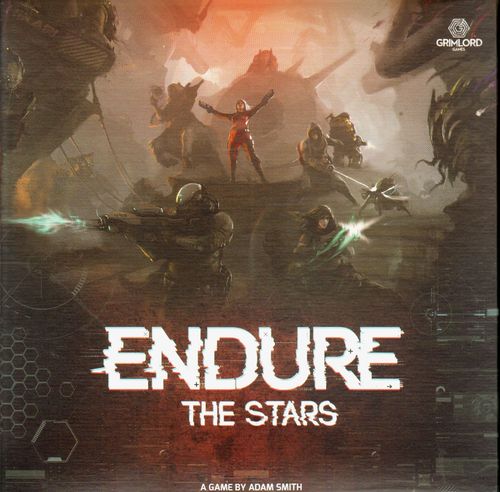
Endure the Stars
Endure the Stars Rulebook
Table of Contents
Table of Contents
Game Contents
- This rulebook
- 9 game tiles
- 5 Survivor miniatures
- 30 Swarmer miniatures
- 20 Jaeger miniatures
- 1 Titan miniature
- 6 dice
- 1 body damage die
- 1 directional die
- 130 cards, consisting of:
- 70 Item cards
- 30 Event cards
- 30 Titan cards
- 5 survivor dashboards
- 1 Titan dashboard
- 10 objective tokens
- 1 exit token
- 10 radar tokens
- 6 health tokens
- 6 resolve tokens
- 18 injury tokens
- 20 noise tokens
- 15 door tokens
Object of the Game
Endure the Stars is a cooperative action survival game that pits 1-5 players against the escaped genetic experiments that roam the derelict ship. The goal is to complete the mission objective and survive another day.
Players choose between 5 distinct classes each with their own strengths, weaknesses and special abilities that can make them a valuable asset in missions. But lurking in the ship are the GEPs, escaped experiments designed to survive and overcome.
Players can search the ship for weapons, armour and useful items to aid in their fight to survive, but be careful not to make too much noise when a GEP is around or you may attract some very unwanted attention.
Component Breakdown
Event cards - These cards represent the unstable nature of the ship and are drawn in the Resolution phase, read aloud and put into play immediately.
Equipment cards - Scattered around the ship are items that may prove useful to your team. These come in the form of armour, helmets, weapons and useful items.
Titan cards - The deadliest of the GEPs is known as the Titan and it fights in its own unique way. This deck represents its deadly arsenal of attacks. Cards are drawn from here to determine how the creature acts and reacts to players during combat.
Objective tokens - These tokens are used to mark the location of the current objective(s).
Exit token - This shows the specific exit that the players must leave by.
Radar tokens - These tokens represent a group of undiscovered GEP locations.
Noise tokens - When a character makes noise, whether accidental or on purpose, whatever generated the noise will indicate how far the noise has travelled with a number. Place a corresponding token at the origin of the noise.
Door tokens - These tokens represent open and unopened doors.
Health tokens - These tokens keep track of the amount of health the player has left on the Health track.
Resolve tokens - These tokens keep track of the amount of resolve the player has left on the Resolve track.
Injury tokens - These tokens are placed on the head, body and leg dashboard locations when a character suffers an injury.
Setup
Before playing the game, players must take the following steps:
Sort the pieces
Sort all card decks by their type and shuffle each one respectively. Separate all tokens and markers and place them into separate piles.
Choose a map
At the rear of this rulebook you will find the missions and campaigns (to be added when funded). Players must pick one, lay out the map tiles and place any doors, objectives, exits and radar tokens according to the mission parameters.
Choose your survivors
Now you know your mission or campaign you must decide who is going to embark on the mission. Most maps will specify the minimum amount of survivors that may be used. Bear in mind that some survivors are better for certain mission than others so choose wisely!
Claim character dashboards
Now that each player has chosen their survivor, all players take their corresponding survivor dashboards and select 1 random starting weapon. Then place your characters in the starting zone specified by the map.
Game Overview
Each game round consists of 3 main phases, played out in the following order:
Players phase
The player with the first player token takes their turn performing actions such as moving, attacking and searching the ship. Once they have finished the next player takes their turn and so forth, moving in a clockwise fashion around the board until all players have had their turn. Then the GEPs phase begins.
GEPs phase
Next is the GEPs phase. GEPs are either represented on the board by radar tokens or by miniatures, if the radar token has been revealed. Radar tokens are revealed and become GEP miniatures if it enters a player's field of view or a special ability reveals it. You are never sure what lurks on the game map until the tokens are revealed. Players may take it turns to resolve the GEPs actions or may elect one person to do so for the entire game.
There are 2 states the GEPs exist in, Passive and Alert. If a radar token or GEP miniature has not been alerted by a noise or seen a survivor, they will wander the map in a random direction. Players roll the directional die for each token/miniature and move it 1 zone in that direction. GEPs must always move if able to. Once something has got the attention of the GEPs, they enter an Alert state and head towards whatever their target is at a rate dependant on the GEP type (some move faster than others).
Resolution phase
Lastly is the Resolution phase. Remove any expired Event cards and noise tokens and draw 1 new event card, to be put into play immediately.
Pass the first player token clockwise around the table so that there is a new first player for the next round.
The Basics - Playing the Game
Line of sight
To reveal a radar token or to initiate an attack, you must first be able to see your intended target. The line of sight for all miniatures is straight lines that run parallel with the board, no matter the distance (unless abilities dictate otherwise). If you can see into part of a room, it is assumed you can see into the whole room.
Movement
Characters may move between zones on the board so long as the way is clear for them. Doors that are locked or solid walls may not be passed through (unless an item or ability permits this)
Noise
Noise plays a key role in Endure the Stars and can be generated in a variety of ways, including but not limited to:
- Firing weapons
- Event cards
- Voluntarily making noise
Once a noise has been made, place a noise token with the corresponding value in the zone in which it was made. Inactive noise tokens are removed from the board at the end of each game round in the Resolution phase. If a GEP/radar token is within the radius of the noise, they will head toward the space it originated from. Attracting the attention of GEPs can cause a lot of trouble, so pay attention to how much noise you're making!
Noise example
The Marine has attacked the Jaeger in the adjacent zone with his pistol, which has a noise rating of 3. A noise token with a 3 is now placed in the Marine's zone. Everything within a 3 zone radius is now drawn towards this zone, which means the radar token will now head there! Zone radius is calculated by counting zones that share at least one connecting edge, so all red areas in the image below are 1 zone away from the noise's origin. The orange areas are 2 zones away and the yellow is 3 zones away. Had the Marine moved into the Jaeger's zone and used the Medical laser instead, he would not have attracted the attention of the radar token as it has a noise rating of only 1.
Player's skills
All players in Endure the Stars have 3 class specific abilities at their disposal:
Passive ability - Remains in constant effect and does not require activation.
Active ability - Players may use an action once per turn to utilise their active ability.
Crisis ability - An incredibly powerful ability that may only be used once per game.
Abilities example
The Engineer's 3 unique abilities are listed on the right hand side of the dashboard. The first is the Passive ability, Power suit. The Engineer's Exo suit grants him increased strength, so he gets +1 to all melee damage when attacking. Next is the Active ability, Making it Last which allows him to get 2 uses from single-use items. Last of all is Improvised Exit which allows the Engineer to cut through walls, creating a new doorway.
Inventory
Each character's inventory consists of 5 spaces for equipment; however certain items may only be placed in specific slots. There 3 types of equipment: armour, weapons and items.
Armour - Only armour may be equipped to the body slot and only helmets to the head slot. Players may choose to carry several types of armour with them but may only have one equipped at any given time. Any negative effects of the armour (such as movement restriction) are applied no matter where it is in the inventory.
Weapons - Weapons are placed in the general inventory and can be used at any time the player is holding them.
Items - Items also are placed in the general inventory and can be used at any time the player is holding them.
The Survivors
With a crew of nearly 4000 people, the Hikari was home to a myriad of different people. Now that everything has fallen apart what remains of the crew have banded together into small groups of survivors, fighting to stay alive...
Captain - Successful expeditions throughout history have always had a strong and inspiring captain to lead their people and space was no different. Candidates for captaincy were put through some of the most rigours testing of all crew members, but the chosen few who passed were the absolute best.
Psychic - Humans do indeed have some amount of latent psychic abilities and those among us that showed promise at a young age were drafted into programs to maximise their potential. Psychics are able to read emotional states very well, and have been recruited as consultants on the G.E.P.E.C. program. Most Psychics also possess a degree of telekinetic abilities, able to generate enough force to move objects.
Marine - All manner of people and professions are required for a planet colonizing mission to be successful and people who are trained to kill are always needed somehow. The Marine class are expert marksman, able to pick their targets with deadly accuracy.
Medic - Medical science has advanced enormously, but for most there is still something to be said for a good old fashioned bedside manner. Doctors and nurses are still sent out on expeditions as both a human side to patient treatment and a precautionary measure in case technology fails.
Engineer - Having been tasked with the general maintenance and repair of the ship, the Engineer has an intricate working knowledge of all vital systems. Engineers are also expert tinkerers and can very often get the most out of items.
The GEPs
There are currently 3 known types of GEPs:
Swarmers - Originally designed for tunnelling below the planet's surface, these small creatures are weak, but incredibly fast and numerous. Swarmers may perform 3 actions per turn (max 1 attack action) and deal 1 damage for each successful attack.
Jaegers - Bred for long range reconnaissance, Jaegers are strong, enduring creatures capable of ripping a survivor to shreds. They require 2 damage to be killed, can perform 2 actions per turn (max 1 attack action) and deal 2 damage to players per attack.
Titans - Created to mine the planet for valuable research samples, this massive creature is a terrifying sight that has been specifically engineered to take things apart. A Titan is much stronger than your average GEP so its health is indicated on its own special character dashboard. The damage of its attacks may vary and is indicated on the attack card (see below for Titan Deck rules)
Resolve
All survivors have been pushed to their absolute brink, and the Resolve stat represents their ability to carry on. Certain events, actions or things that the survivors witness will call for them to test their resolve. If their resolve depletes, their behaviour becomes unpredictable and they become hard to control.
You must take a resolve test when the following occurs:
- Any time a Gep enters your line of sight (maximum once per turn)
- A game card tells you to
- A survivor dies in front of you
Each player begins the game with 10 Resolve. To test your Resolve, roll 2 D6 dice. If the combined total on the dice is higher than your current resolve rating, then you fail the test and lose 1 Resolve.
Players do not take an individual Resolve test for each GEP that enters their view. If the GEP(s) leave and re-enter a survivor's line of sight, a new Resolve test is triggered. If GEPs continue to enter a survivor's line of sight whilst others are already there, no new Resolve tests are triggered.
Resolve test example
A radar token has moved into the Psychic's line of sight and was hiding 2 Jaegers. The Psychic must now take a Resolve test. She rolls 2 D6 and the result is 12, which is higher than her current Resolve of 10. This is a fail and her Resolve is reduced to 9.
The Players Phase
Each player can perform 3 actions per turn. They may use these actions to do the following things:
Move
The player may move their character across the board one zone at a time. Each step uses one action. Players may not cross through solid walls or doors that are locked. If there are enemies in a zone a character is trying to leave, players must roll a D6 dice to see if they can escape. If the result is lower than their resolve, they may move freely.
Attack
The player may attack hostile forces using items in his inventory (see Combat)
Search
Players may search the ship for useful items that were left behind when everyone fled. You may search any room that is not occupied with a hostile creature. Rooms can be searched multiple times per turn. Draw 1 card from the item deck per search action.
Interact
Players may interact with the ship in a variety of ways such as collecting objectives and triggering events.
Activate ability
Players may choose to use one of their actions to trigger their active or crisis abilities. Active abilities may only be triggered once per turn and crisis abilities once per game and they may both be triggered on the same turn if the player wishes.
Trade
If players survivors are standing in the same zone they may trade weapons, items and in some cases mission specific items.
Make noise
Players may choose to generate a noise in the hopes of distracting hostile creatures. Remember that GEPs will head for the last thing that caught their attention!
The GEPs Phase
Players can take it turns to resolve the GEPs turn or may elect one person to do so for the entire game. The turn plays out almost identical to the players turn, with a few minor changes, mainly regarding GEP movement. There are 2 states the GEPs exist in, Passive and Alert.
Passive movement
If a radar token or GEP miniature has not been alerted by a noise or seen a survivor, they will wander the map in a random direction. Players roll the directional die for each token/miniature and move it 1 zone in that direction. GEPs must always move if able to.
Alert movement
If something has drawn a GEPs attention then it enters an Alert state and it now moves a specified amount of zones depending of the creature's type (different GEPs move at different speeds). GEPs have a priority list that denotes what can draw their attention, from most to least important:
- Distracting items
- Seeing a survivor
- Hearing a noise
GEP movement example
A docile GEP is within range of a noise which came from another room, the origin of which it does not have a line of sight to. It heads towards the space, but sees another survivor before it reaches its destination and begins to pursue its new target but cannot reach it this turn and is 2 zones away. In the players phase, the survivor throws a stun grenade, which distracts the GEP for one turn, giving the survivor enough time to disappear out of its line of sight. The effect of the grenade wears off, and with nothing to arouse the GEPs attention, it returns to Passive state.
Taking damage
If an enemy successfully lands a strike on your character there is a chance to deflect the blow if you are wearing armour. If you are not, or the armour fails to protect you, the next thing you must do is roll the body damage die for every hit you take. If the die result is a blank face, your survivor takes the amount of damage that the enemy deals. If the die result shows a body part, you receive the damage that the enemy deals as well as an injury to the specific body part. Place an injury token in the correct spot on your character dashboard and suffer any penalties as a result of the wound (see Core Rules).
Taking damage example
The Medic is attacked by the Swarmer. He's wearing the Bastion armour, which has an armour rating of +3. This means that he needs a score of 3 or more to deflect the blow. He rolls to see if he can deflect the hit. Let's say that he rolls a 2, which is a fail and now has to roll the body damage die. It lands on the leg icon, so he takes 1 damage from the Swarmer attack and suffers a leg injury, which reduces movement to 2 zones per turn.
The Resolution Phase
Lastly is the Resolution phase. Players remove from the game board any expired or non-relevant tokens and cards and draw 1 card from the Event Deck. Without a crew to maintain the Hikari, the ship has begun to fall to ruin. The Event deck represents the unstable nature of the ship. The card is put into play immediately and its effects last as long as is specified on the card. Event cards can cause blackouts, lockdowns and power failures to name just a few. This completes a game round.
Combat
When a character decides to enter combat the player must first choose the weapon they wish to attack with and announce their intended target. All weapon cards have 4 statistics:
- The range the weapon may fire
- The number of dice that you need to roll
- The value you need to get on a die to land a successful hit
- The noise that the weapon generates when used
Roll the amount of dice displayed on the card and if the die roll is equal to or higher than the number on the card, it's a hit and target takes 1 damage for each successful die roll. Damage to enemies does not persist pass the individuals attack (except in the case of bosses) so if the attack fails to kill the target, then it is assumed that the creature was wounded but survived the attack.
Weapon card example
The Engineer has an Assault Rifle, which has a range of 2, allows you to roll 2 dice and has an accuracy of 4+. He wishes to attack 2 Swarmers 2 zones away, so he rolls 2 dice and scores a 3 and a 6. The 3 is a miss, but the 6 is a successful hit and so kills 1 of the Swarmers.
Each die is counted as a separate shot and the results do not stack, so a 2 and 3 do not make a 5.
Ranged
When using ranged weapons, survivors may fire the weapon the distance stated on its card, so long as there is a clear line of sight to the target. If a player is in a space in which another player is firing into, then any die results that are a fail hit the player, not the enemy! In this event armour rolls are made as usual. If there is more than one character in the space then each player rolls 1 die and the player with the lowest outcome takes the hit. Perform this for every shot fired.
Melee
Characters equipped with melee weapons carry out attacks in the same manner, with the only difference being that there is no penalty if other characters are in the same space.
Armour
Players may equip armour that they find around the ship, which bestow the opportunity to deflect strikes made against them. To determine whether the armour deflects the blows, roll as many dice as damage about to be received. Each die that equals or exceeds the armour value on the dice absorbs the strike and does not cause damage to the player.
Titan Combat
Titans are incredibly dangerous and powerful creatures and entering into combat with one is quite different from fighting other GEPs. When attacking a Titan, players follow the standard rules for combat, however just like the player, for every successfully landed blow you must roll the body damage die and deal injuries accordingly. When it's the Titan's turn to attack, players draw 1 card from the Titan deck. Titan deck cards come in 2 different kinds; attacks & moods, which are all in one deck.
Titan attack cards
When it's the Titan's turn to attack, draw the top card from the Titan deck and place it in the "attack" space of the Titan's character dashboard. Then play out the actions on the card.
Titan mood cards
Part of what makes Titan's so dangerous is their unpredictability. Mood cards affect the Titan's power to attack, defend and move. If you draw a mood card, place it in the "mood" space of the Titan's character sheet, then immediately draw another card until an attack card is put into play. This is to ensure that the Titan attacks every turn. Mood cards stay in play until another mood card is drawn to replace it.
Titan combat example
Players draw the "Ram" attack card from the Titan deck, which explains that this attack affects all players in the Titans zone, does 1 damage and requires a roll of 4+ to hit. Remember that the damage value represents how many dice you roll, so 1 damage = 1 die roll. The Titan also has the mood card "Predatory" active which gives +1 die to all attacks, so as a result rolls 2 dice for each player it attacks. The attack card also has an extra effect, so if "Ram" is successful then all damaged players are pushed out of the zone, in a direction determined by rolling the directional die.
Core Rules
Winning and Losing
To win the game, players must complete all mission objectives that are detailed on the map setup. Endure the Stars is a cooperative game, so work as a team if you want to survive!
The game is lost if all players die before completing their objectives.
Event Deck
Without a crew to maintain the Hikari, the ship has begun to fall to ruin. The Event deck represents the unstable nature of the ship. All Event cards detail the nature and duration of the specific event and are played and discarded during the Resolution phase. Players must draw 1 Event card every Resolution phase and put it into play immediately. Any expired events are discarded and the next game round begins.
Status effects
Status effects are negative effects that can be triggered by events, creature attacks and various story related situations. They come in the following varieties:
Stunned - Stunning a miniature will cause it to lose all further actions for the rest of their turn.
Blinded - All players have their movement reduced to 1 and range reduced to 0.
Injuries
Injuries may be sustained by survivors and Bosses whenever they take damage and have the following effects:
Head - Combat range is reduced by 1 zone (cannot fall below zero)
Chest - Internal bleeding cause the injured miniature to roll a D6 at the start of their turn. A result of 1-3 is a success and nothing happens, but a 4-6 causes bleeding and the injured party takes 1 damage.
Legs - Movement is limited to 2 zones per turn.
Destroying walls
If a character possesses the right items or abilities, they may destroy walls to gain a tactical advantage or create another exit!
Turn Summary
First step - Choose the first player (first player token moves clockwise around the table)
Players Phase - The player activates his character and performs a combination of 3 of the following actions:
- Move
- Search
- Open a door
- Combat
- Take an objective
- Make noise
- Trade
- Do nothing
GEPs Phase - All GEPs and radar tokens activate and either:
- Move
- Attack
Resolution Phase - Resolve the following:
- Remove all noise tokens from the board
- Discard any expired status effect tokens
- Discard any expired Event cards
- Draw a new card from the Event Deck