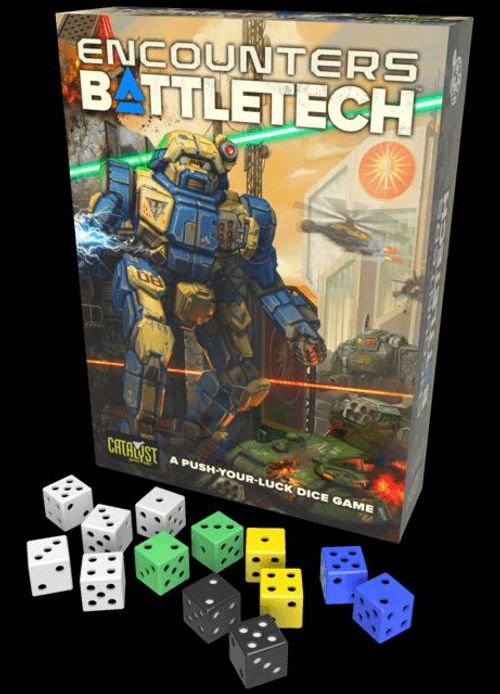
Encounters: BattleTech
Encounters: BattleTech Rulebook
Table of Contents
Table of Contents
Box Contents
- 36 Contract cards
- 72 Encounter cards
- 36 Equipment cards
- 8 oversized Combat Command cards
- 5 white dice
- 4 yellow dice
- 4 green dice
- 4 blue dice
- 4 black dice
- C-bill tokens
- Reputation tokens
- Noble Patronage Token
- Censure Token
Setup
Place the C-bill and Reputation tokens into a common pool accessible by all players.
Place the dice where they are in reach by all players. Note there are five colors of dice: white, yellow, green, blue, and black.
Separate the cards into their respective card types: Encounter cards, Equipment cards, Combat Command cards, and Contract cards. Shuffle each deck and place them where they are all available to all players.
Set aside the Censure and Noble Patronage Tokens. These will be given to players during the game.
Randomly deal each player a Combat Command card. These show the dice the player will roll on their turn, plus any special abilities that unit possesses.
Lay out the top five Equipment cards face up next to the Equipment Deck. This forms the Black Market. If at any time the Equipment Deck is empty, shuffle the Equipment discard pile to form a new Equipment Deck. Whenever an Equipment card is purchased, immediately reveal the top card of the Equipment Deck and add it to the Black Market.
Randomly determine the first player.
You are now ready to play!
Game Overview
Begin your turn by flipping over the top two Contract cards; select one to attempt and discard the other. Each Contract has different effects, including effects on dice, the Black Market, and Encounters. You may then attempt to fulfill that Contract by defeating Encounters. You defeat an Encounter by rolling your dice and using those rolled dice to defeat each Encounter in turn. Dice used to defeat an Encounter are locked on that Encounter, meaning they cannot be used to defeat additional Encounters this turn until they are unlocked. Once you have defeated an Encounter, if you still have unlocked dice remaining, you may choose to flip over an additional Encounter card below the previous one and attempt to defeat it by rerolling all remaining unlocked dice.
If you manage to lock all of your dice, that Contract has been fulfilled, and you may choose to either complete the Contract (which ends your turn) or extend the Contract. If you complete the Contract, you score Reputation and C-bills for defeated Encounters and completed Contracts. If you extend the Contract, draw the top Contract card and begin a new column of Encounters; all your dice are now unlocked.
At any time during your turn, you may exercise an Escape Clause to get out of your current Contract. If you do so, you collect C-bills from any defeated Encounters, but you do not earn any Reputation.
If, however, you cannot defeat an Encounter with your unlocked dice, then you Default on the Contract: you collect no Reputation, and only collect C-bills for completed Contracts.
Once your turn is over, play passes to the left. Play continues until one player has 10 Reputation at the end of their turn.
Turn Basics
At the start of your turn, flip over the top two Contract cards, select one, and discard the other. The chosen Contract card forms the first column. Flip over the top Encounter card and place it below that Contract card.
Roll all the dice in your dice pool. The dice pool is made up of the dice printed on your Combat Command Card, typically one color die and five white dice. You then select one or more dice that total up to the Encounter Value displayed on the card. Place these dice on the Encounter; depending on the Encounter Value and the results of the die roll, this could be anything from one die to all the dice rolled. These dice are considered locked and out of play (for now). Equipment can be used to affect dice to match values on the Encounters (see Equipment and the Black Market).
Example: The Direct Fire Lance has an Encounter Value of 4. When you rolled your dice, you got 1, 3, 4, 5, and 6. To defeat this Encounter, you can either lock the 4 onto it, or you can lock the 1 and 3 (total of 4) onto it.
You may now choose to either exercise an Escape Clause to take earned C-bills (this will end your turn) or push your luck and flip up the next Encounter card.
If you flip up the next Encounter, place it below the first Encounter, still in that first column. Reroll all unlocked dice, and once again try to match roll results to the Encounter Value. If you fail to match dice to the Encounter Value, you Default on the Contract, and your turn is over.
Your turn continues until one of three things happen:
- You lock all dice on defeated Encounters (complete or extend the Contract).
- You choose to end your turn and score all defeated Encounters (exercise an Escape Clause).
- You cannot match any dice to the Encounter Value (Default on the Contract).
Exercise an Escape Clause
At any time after you have defeated all revealed Encounters, but before you reveal the next Encounter, you may choose to exercise an Escape Clause by scoring all defeated Encounters and ending your turn.
Collect 1 C-bill for every defeated Encounter in the first column, 2 C-bills for every defeated Encounter in the second column, 3 C-bills for every defeated Encounter in the third column, and so forth.
Some Encounters also earn bonus C-bills; these are added to the card's standard C-bill value.
Collecting C-bills for Encounters is called Cashing Out.
You do not score any Reputation if you exercise an Escape Clause.
Complete or Extend the Contract
If you manage to lock all the dice (including any bonus dice from Equipment), you may choose to either complete the Contract, or extend the Contract.
Complete the Contract: If you complete the Contract, you score C-bills and Reputation. First, Cash Out: collect 1 C-bill for every defeated Encounter in the first column, 2 C-bills for every defeated Encounter in the second column, 3 C-bills for every defeated Encounter in the third column, and so forth. Second, score Reputation equal to the value on the first completed Contract card, the value +1 on the second completed Contract, the value +2 of the third, and so forth. Your turn is over.
Extend the Contract: If you choose to extend the Contract, flip over the top Contract of the Contract Deck to form the top of a new column of Encounter cards. Note that unlike at the beginning of your turn, you do not have a choice between two Contracts!
Recover all locked dice, including any bonus dice.
Continue play by rolling dice and locking them on revealed Encounters just as before. If all dice are locked again, you may either complete the Contract or extend the Contract into a third column, and so on.
Regardless of how many Encounters have been defeated or how many Contracts have been completed, if you fail to defeat a flipped Encounter, you Default on your Contract. See Default below.
Default on the Contract
If you Default on your Contract by being unable to defeat a revealed Encounter, then your turn is over. You will be paid C-bills for all defeated Encounters in completed Contracts, but you receive no C-bills for the Contract you were on when you Defaulted, and you receive no Reputation, even for completed Contracts.
Secure the Contract
If a player Defaults on their Contract, the next player can choose to start fresh (i.e., discard all of the Contracts and Encounters from the previous player's turn), or they can attempt to Secure the Contract to take advantage of the previous player's failure by keeping the Completed Contracts and the defeated Encounters and playing out their own turn.
To Secure the Contract, you must do the following:
- Discard the previous player's failed Encounter.
- Retain all unlocked dice except bonus dice. You may choose to use Equipment to add your own bonus dice, however. If any color dice were locked on Encounters, you may choose to replace those with your white dice or with your own color dice.
- Flip up a new Encounter in the same column for the current Contract, and roll any remaining dice to try defeating that Encounter and potentially completing the Contract.
All other rules for taking a turn apply normally. If a player successfully Cashes Out after they Secure the Contract, they collect C-bills starting with the Contract they Secured, since the initial player was already paid for the previous completed Contracts. The player who Secures the Contract does, however, score Reputation for all Contracts that were completed—even those completed by the previous player(s).
Attempts to Secure the Contract can only go around the table once. If every player attempts to Secure the Contract, and play returns to the original player who Defaulted on the current Contract, that player must begin their turn by discarding all current Contracts and Encounters and starting over fresh.
After failing to defeat an Encounter, you may choose to Burn the Contract to prevent the next player from attempting to Secure the Contract. To Burn the Contract, you must spend 2 Reputation, and the next player must start their turn fresh.
Equipment and the Black Market
Immediately before or after you begin a new Contract (i.e., at the beginning of your turn, or when choosing to extend the Contract) you may purchase one or more Equipment cards from the Black Market. Each Equipment card has a C-bill cost, which you must pay to buy that card. As soon as you purchase an Equipment card, flip over the top card of the Equipment Deck and place it face up in the Black Market. If you choose not to purchase an Equipment card, you may instead choose to discard one Equipment card in the Black Market and replace it with the top Equipment card from the deck.
At any time during your turn, you may use an Equipment card for its stated effect. The Equipment card is then exhausted (flipped facedown). Whenever you can purchase Equipment, you may pay the Maintenance cost of any exhausted Equipment card to flip it face up.
Equipment cards can be used even after dice have been rolled.
You cannot have more than four Equipment cards at a time, exhausted or otherwise. If you wish to purchase a fifth Equipment card or if you gain a fifth Equipment card due to some effect, you must first discard one of your other Equipment cards.
You are never required to use Equipment, even if using an Equipment card's effect would allow you to defeat an Encounter that would otherwise make you Default and end your turn.
Equipment card types are distinguished by the color of the Equipment card: yellow for Energy, green for Missile, blue for Ballistic, black for Melee, and white for Miscellaneous. Some Encounters or Contracts may interact with different colors of Equipment in different ways. Each Equipment type also has its own icon: a yellow icon for Energy, a green icon for Missile, a blue icon for Ballistic, and a black icon for Melee.
Many Equipment cards show multiple dice icons. This means that you can apply the effect to up to that many dice. The dice must match, however: for example, if a card shows two white dice and two yellow dice, you cannot modify three white dice, or two white and a blue die, etc. You do not have to affect any dice that you do not want to.
Some Equipment effects include:
- Set: this allows you to change dice to any number.
- Add +/− 1, +/− 2: This allows you to adjust a die's result by exactly the number on the card.
- Add +/− 1 or 2: This allows you to adjust a die's result by up to the number on the card.
- Lock: This allows you to lock one additional die (white or color) when defeating an Encounter. You must play this after rolling and placing dice on an Encounter.
- Reroll: This allows you to reroll dice after rolling but before attempting to place them on an Encounter.
- Add Dice: This adds the dice displayed to your dice pool for the rest of the turn.
- Cancel Encounter/Contract Effect: If a Contract or Encounter restricts the use of a certain Equipment type or has some other effect, this Equipment cancels that. Effects that affect Equipment do not apply to this.
Encounter Effects
Hazard Pay: Some Encounters say that certain types of Equipment cannot be used to defeat that Encounter. This means that you cannot use Equipment or dice of that color during the Encounter. However, if you have non-exhausted Equipment of that type, you will receive a Hazard Pay bonus of +2 C-bills if you are able to defeat the Encounter.
Field Hire: Some Encounters will join your team after they are defeated. In that case, keep the card after you Cash Out. You can discard it at any time to add +1 to a die roll. This does not count against Equipment limits and is not limited by effects that don't allow you to use Equipment.
Salvage: Some Encounters have "Salvage" listed in their effect box. If you Cash Out with one of those Encounters defeated, draw the top card from the Equipment Deck until you draw an Equipment card that has a maintenance cost; all other cards drawn are discarded. You may add this card to your collection of Equipment (for free); if it would put you over the four Equipment cards limit, you may discard it or one of your other Equipment cards. Salvaged Equipment comes into play exhausted.
Noble Patronage: A member of the nobility has chosen to support your unit. Take the Noble Patronage Token, even if another player currently holds it. While holding the Noble Patronage Token: At the end of your turn, if you Default on your Contract and thus would not gain C-bills, instead collect 2 C-bills, and give the Noble Patronage Token to the player with the fewest C-bills. If you have the fewest C-bills, keep this token. If there is a tie, you may choose which tied player gets this token.
Censure: You've attracted the ire of the Mercenary Review and Bonding Commission. This severely limits your available Contracts. Take the Censure Token, even if another player currently holds it. While holding the Censure Token: When you would select a Contract (either at the beginning of your turn or when extending a Contract), the player to your left looks at the top two Contracts and selects one for you. At the end of your turn, give the Censure Token to the player with the most Reputation. If you already have the most Reputation, keep this token. If there is a tie for the lead, you may choose which tied player gets this token.
Ending the Game
The first player to reach 10 Reputation immediately wins!
Frequently Asked Questions
Some Equipment allows me to modify dice numbers. Can I change a die result to a number less than one or greater than six?
No. Any effect that modifies a die result can only change that result to be a number shown on the die.
Can I declare that I am ending a Contract before revealing any Encounters for it?
Yes, but there are some exceptions that require you to defeat a minimum of one Encounter. The Garrison Duty Contract requires you to defeat at least one Encounter before you can end this Contract, and the Planetary Assault (Dieron) and Planetary Assault (Robinson) Contracts require you to reveal and defeat an Encounter immediately after declaring you are ending the Contract, and failing to defeat that additional Encounter will result in Defaulting instead of completing the Contract.
A card (or cards) disagrees with the rules. Which is correct?
Cards always take precedence over rules. If a card contradicts something in the rules, the card is correct.