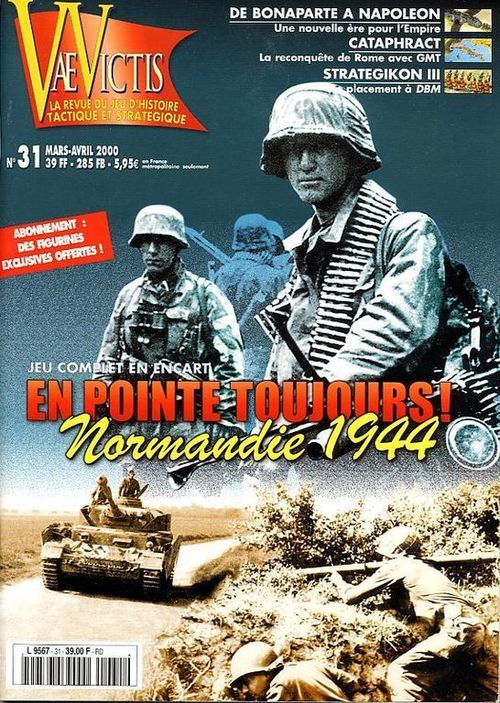
En Pointe Toujours II: Normandie 1944
En Pointe Toujours II: Normandie 1944 Rulebook
Table of Contents
Table of Contents
- Generalities
- Units and Organization
- Sequence of Play
- 3. Organization and Command
- 4. Line of Sight and Line of Fire
- 5. Terrain
- 6. Formation Activation
- 7. Unit Actions
- 8. Opportunity Fire
- 9. Movement
- 10. Hidden Units
- 11. Direct Fire
- 12. Artillery
- 13. Combat Results
- 14. Formation Morale
- 15. Assault
- 16. Vehicles
- 17. Infantry Against Vehicles
- 18. Special Rules
- Notes for All Scenarios
- Playing EPT I Scenarios With EPT II Rules
- Personal Thoughts
- Tables Referenced in the Text (Partial)
- Errata
Generalities
Game scale
One turn equals approximately ten minutes of real time. The distance between the centers of two adjacent hexes equals approximately 50 meters. Levels equal a change in elevation of between 10 and 50 meters. Each piece represents either a squad, a heavy weapons section, a leader and his staff, a vehicle, or a cannon.
Maps
The maps in En Pointe Toujours are geomorphic, that is to say, they can be arranged in different ways to form different terrain. For this module, four maps are included, and represent terrain characteristic of Normandy. A hexagonal grid is superimposed on the maps to regulate the movement and fire of the units. Half-hexes along the board edge are always playable.
In the future, VaeVictis will present new maps and terrain overlays for other theatres of operation.
Scenarios
Games in En Pointe Toujours are played using historical scenarios. Each scenario gives an order of battle, the maps used with their relative positions, and special rules for that scenario. Several factors (formation morale, visibility etc.) vary and are specified in each scenario. If not specified, visibility is assumed to be good.
Markers
En Pointe Toujours uses a large number of markers to indicate, for example, that a unit or formation is active, a unit has moved, etc.
To reduce clutter on the map, players may, by mutual agreement, keep track of an action mentally rather than by using markers.
To ensure a sufficient supply, an additional page of markers is included in this issue.
Units and Organization
Combat units
Units are represented by pieces carrying several symbols. Combat units include leaders, infantry units, heavy weapons, and vehicles.
Unit reduction
Each infantry unit possesses one or two combat steps. When a unit suffers a loss, it is flipped over to indicate its new status. Units that possess only one step are destroyed after their first step loss. Units may in addition exist in one of several operational states: normal, stopped, or neutralised. The last two states are indicated by markers.
Cannons: cannon pieces also represent their crews. Fire against a cannon is resolved exactly like fire against an infantry unit. A cannon piece has only one combat step.
Command posts
Leaders represent either the commander of a basic formation (usually a platoon), or a commander one echelon higher (usually of a company). For simplicity, the rules use the term CP (command post) to refer to all leaders.
They possess different symbols. If front side up, a leader indicates that the formation it commands has not yet been activated, and reverse side up indicates that it has already been activated (see 6). CPs possess only one combat step.
Elimination of leaders: if during a turn, a leader is killed before his formation has been activated, the formation may still be activated, but with a negative modifier (see table). In the Administrative phase (at the end of the turn), a subordinate takes command. The quality of the subordinate is determined by a die roll (see table). The eliminated leader's counter is returned to the map, adjacent to or stacked with a unit of its formation, with a marker indicating the morale modifier. A subordinate that gets killed is replaced in the same manner.
If the company commander is killed, one of the platoon leaders takes his place (player's choice) in the Administrative phase. This leader remains in command of its formation but must also take on the capacity of the higher-echelon leader.
Organization
In general, units are organized into formations (see 3). When a formation is activated, all of the units commanded by that formation may move. Formations are specified in each scenario, according to the historical orders of battle. In addition, each formation may exist in a morale state of normal, hesitant, or demoralized (see 14).
Sequence of Play
Each scenario consists of a certain number of game turns, each composed of four phases.
Support phase
Each player resolves any possible air and artillery missions planned for this turn (see 12) after consulting the Delay Table and resolving anti-aircraft fire.
Each player secretly records the target hexes for each artillery battery or demand for air support for the following turn.
Command phase
The two players verify that their units are in command. Units that are not in command (NC) receive an Out of Command marker; units back in command remove their marker.
Operations phase
During this phase, the two players alternate activation attempts for their respective formations and may undertake, under certain conditions, reaction activities.
Initiative segment: the two players each roll 1d6; the higher rolling player becomes the first to be active in this turn (the other player is called the inactive player). In case of ties, re-roll the dice. Depending on the scenario, the roll may be modified or initiative automatically given to one of the players.
Operations segment: during the Operations segment the players alternate activating their formations. The player that gains the initiative this turn can automatically activate the first formation (or pass if he wishes).
An activation for the active player consists of:
-
attempting to activate one of his formations (see 6), or
-
passing, if he does not wish to activate a formation.
-
If the activation attempt fails or he passes, the active player becomes the inactive player (= the other player taking the initiative). It's the time for the new player to try to activate one of his formations (or pass).
-
If the attempt succeeds, the active player may perform actions with units of the activated formation (see 7.1) and the inactive player may attempt opportunity fire (see 8). When all possible and wished for actions and reactions have ended, the active player may attempt a new activation or pass.
Activations continue until:
- there are no further possible activations; or
- the two players pass successively; or
- when the sole remaining player with formations left to activate rolls a 10 or more in an activation attempt (see 6.5).
Administrative phase
All of the following actions are performed in the order indicated:
- Artillery markers are removed;
- Smoke is removed or reduced;
- Fire, Move, Shut Down and Stopped markers are removed;
- CP units are returned to their not yet activated sides, killed leaders are replaced;
- Neutralised units may attempt to remove their Neutralisation markers;
- Determine if formations have become Hesitant; those that have reached their demoralization level must make a check;
- Repair checks for jammed weapons;
- Camouflage units.
At the end of this phase, the Turn marker is advanced one space.
3. Organization and Command
Formation organization
In general, a formation is composed of a leader and a certain number of attached units. Each formation corresponds to a particular colour that identifies it.
Example: a leader and three squads represent a formation, in this case, a platoon.
In general, the scenarios depict platoons, commanded by platoon leaders, who are in turn commanded by their company commander who may also have several support groups. Independent groups, such as tank platoons, may also be present.
The scenarios specify the organization and the chain of command for each company included.
Artillery
Off-board artillery (mortars and light, medium, and heavy artillery) have their own rules and their own phase.
Command distance
There are two levels of command in En Pointe Toujours!: from company commanders down to platoon leaders, and then from platoon leaders to their units.
At the beginning of each turn, the two players verify that:
- the leaders of the different platoons are within command range of their higher echelon. If they are, the leaders perform normally; if not, the activation of out of command formations suffers an adverse modifier (see table);
- the units comprising each platoon are within the command range of their own leader.
The command range from a platoon leader to his units is three hexes (unless the scenario specifies otherwise). All his units within this range are considered to be in command, regardless of line of sight or terrain. Units outside of their leader's command range are marked with an Out of Command marker and may not be activated with their formation (see 6).
The command range from a company leader to his platoon leaders is five hexes (unless the scenario specifies otherwise).
Conversely, units that were previously out of command and that are now within command range of their leader have their marker removed and may function as part of their formation.
A unit that is in command at the beginning of a turn remains so for the rest of the turn, even if it moves outside of its leader's command range.
Special case: a unit that is out of command but that is located adjacent to or stacked with a leader from another formation or the CP of the higher echelon may, in the Command phase and at the player's discretion, be temporarily attached to that formation. This unit may then operate with the new formation during that turn in the normal manner.
Out of command units
A unit that is out of command (NC) may not be activated with its formation. Instead, the player may attempt to activate independently and individually an out of command unit as if it were a separate formation (with a penalty, see the Activation Table). The unit checks for activation using its morale rating, modified by the Activation Table (-1). An out of command infantry unit that is activated is limited in the type of actions it may perform.
Independent platoons
If indicated in the scenario, certain units or formations may be considered independent; that is, they are not dependent on a company commander (or on a platoon leader for an independent unit). These formations do not suffer the penalties for being NC/isolated if they are outside of command range.
4. Line of Sight and Line of Fire
4.1 Definitions
A line of sight (LOS) between two units is an imaginary straight line connecting the centres of the two hexes occupied by the units. A line of fire (LOF) represents this same line, but is limited by the ranges of the units' weapons. When these lines are blocked by terrain features, they are said to be invalid: the target cannot be seen and the firer cannot hit it.
4.2 Small arms range
Any unit with a fire strength (infantry units, machine guns, etc.) has a fire range indicated on its counter.
The fire strength of a unit using direct fire is modified based on range (a unit fires at full strength out to normal range and at half strength beyond that out to double its normal range).
Exception: mortars are strictly limited to the range on their counter. Beyond this range, they may not fire.
4.3 Line of sight
For a line of sight to be valid, it must not pass through an obstacle. To determine if an LOS crosses an obstacle, the players trace a line from the center of the start hex to the center of the target hex (using a ruler or thread for example).
The LOS is blocked if it touches the actual obstacle outline: building, wall, woods, or higher-level elevation.
Adjacent units always have an LOS to each other, regardless of terrain.
Friendly or enemy units are not obstacles (but armoured vehicles represent a visual hindrance).
4.4 Obstacles
A hex containing an obstacle blocks the LOS between two units at the same level.
Each hex on the map is considered to be at a single elevation, the highest one in the hex.
Specifics:
- an obstacle does not block LOS between two hexes at the same level if the obstacle is located at a lower elevation.
- units do not block LOS.
- walls and hedges: walls and hedges, which are located on hexsides, do not block LOS to a hex directly behind them. They do block if they are not hexsides of the starting or ending hex.
- height of obstacles: walls/hedges and all visual hindrance hexes (brush, orchards, fields, etc.) block or hinder visibility only at the same level. They do not block or hinder visibility if either the firer or the target are at a higher elevation (but the protection offered by a wall or hedge applies all the same to a target located adjacent to one).
Blind hexes: an obstacle blocks the LOS to the hex directly behind it when a LOS is going over the obstacle from a higher elevation. The LOS continues from the next hex past the blind spot.
Plateau effect: the LOS between two units at different elevations is blocked by an intervening hex of equal or greater elevation than the higher one of them. For this rule, the tops of the trees in a forest hex or the roof of a multi-story building are considered to be one level above the elevation of the hex they occupy. Single-story buildings, visual hindrances, and walls/hedges do not raise the level of the hex they occupy in this way.
5. Terrain
5.1 Terrain types
There are four basic terrain types in En Pointe Toujours:
- Open terrain: trails, roads, watercourses, clear terrain;
- Light protection: brush, fields, walls, hedges, ruined wooden buildings;
- Medium protection: wooden buildings, bocage, ruined stone buildings, entrenchments, forest hexes;
- Strong protection: prepared positions, stone buildings.
Terrain effects on movement and combat are given on the Terrain Table.
All terrain effects are cumulative for fire and for hit checks against armoured targets.
5.2 Levels
Elevations and crests: There are four elevation levels; level 0 is the lowest, level 3 is the highest. Hills are represented on the map by brown-colored hexes, from light to dark, corresponding to levels 1-3.
Stories: All buildings occupying more than one hex automatically have a ground floor and an upper level. Changing level within a building costs 2MP, allowable in any of the building's hexes. A unit on the second floor of a building is considered to be at level 1, just as if it were on a level 1 hill hex.
Scenario special rules may state that particular buildings have one or more hexes with a level 2.
5.3 Visual hindrances
Certain types of terrain (brush, orchards, etc.), wrecks, vehicles, and smoke markers do not block LOS but hinder visibility and cause penalties to fire (see table).
If the visual hindrances between two units total greater than a modifier of +3, the LOS is blocked.
All visual hindrances in a hex are cumulative. Example: a brush hex occupied by a vehicle and including a smoke marker is at +3 (and the protection offered by the hex is also +3).
Visual hindrance terrain represented by symbols on the map (e.g. the individual "trees" of an orchard hex) is considered to be occupying the entire hex (unlike obstacles such as buildings). The LOS penalty is applied when it goes through the hex, not just the symbols. Exception: if the LOS goes exactly along the hex edge, the penalty is only applied if the adjacent hex is also a visual hindrance of some kind.
5.4 Special rules
Walls and hedges: Walls and hedges represent obstacles to LOS at the level they occupy (except to or from units located in the hex with the wall or hedge hexside).
The protection offered by a wall or hedge is cumulative with any protection offered by the hex it borders. Example: a unit located in a field hex bordered by a wall receives +2 protection.
The obstacle and protection offered by a wall or hedge is applied even if the LOS crosses exactly through a vertex point of the hexside or directly along the hedge or wall hexside. Also, protection is always applied even if the firer and the target are both adjacent to the same wall or hedge (each would benefit if fired on by the other).
Bocage: Bocage is treated like a wall/hedge but the MP cost and protection are different. A vehicle may only cross bocage by an opening depicted on the map, at a cost of +2 MP (for walls/hedges, these openings are not considered to exist).
Smoke: Artillery and combat units may place smoke markers. Artillery places 1 or 2 type markers depending on its size (see Artillery Table). Combat units all place type 1 markers.
- When active, an infantry unit, or a tank equipped with smoke pots, may place smoke in its own or any one adjacent hex. The unit or tank may also move half before or after.
- A cannon or a tank capable of firing smoke shells may fire at any hex in their LOS in accordance with the rate of fire rules.
Type 2 smoke blocks LOS on its level and one higher, while type 1 smoke only blocks its own elevation.
Hills: A unit located on a hill hex that takes fire from units at a lower elevation (even adjacent) receives a protection bonus of +1 (cumulative with other terrain in the hex). A unit on a level 1 hill hex would not get the bonus against fire coming from the upper level of a building.
Weather conditions (VV 32): This rule concerns fog, rain, falling snow, etc.
There are three levels of reduced weather visibility, numbered from 1 to 3. Each level alters visibility in the following manner:
- Level 1: +1 visibility reduction for every 6 hexes (+1 up to 6 hexes, +2 for 7 to 12, etc.);
- Level 2: +1 visibility reduction for every 3 hexes;
- Level 3: +1 visibility reduction for every hex (visibility is thus reduced to 3 hexes maximum).
These modifiers are cumulative with visibility reduction for different types of terrain.
Artillery correction: the die for artillery correction distance is modified by the level of reduced visibility (+1, +2, or +3).
Snow and mud:
- Snow: +1 MP per hex for non-tracked vehicles, except on cleared roads if the movement is along the road.
- Deep snow: +1 MP per hex for infantry and tracked vehicles except for building hexes and cleared roads. +2 MP for non-tracked vehicles.
- Mud: +1 MP per hex for infantry and fully tracked vehicles, +2 MP for all other vehicles except for building hexes and clear roads if the movement is along the road.
- Changing levels: +1 MP for all units changing level on a hill in snow or mud.
Rice paddies: Rice paddies are treated as marsh.
6. Formation Activation
Except for reaction, a unit may only move when the formation it belongs to is active. The term formation is used regardless of the types of units that make it up (squads, platoons, companies or isolated units).
Important: a higher-echelon CP (battalion or company), if present, may be activated in order to move its attached units, but its activation does not enable the activation of lower-echelon units. Example: an active company commander does not allow the platoons under his command to move, but only the units directly attached to him (usually heavy support weapons).
Formation activation
To activate a formation, the player designates the formation and must roll, with 2d6, a number less than or equal to the CP (or NC unit) morale, factoring in any modifiers.
A formation may only be activated once per turn, but players may re-attempt to activate a formation that has failed in previous attempts (the only penalty being that the player must turn over initiative if an attempt fails).
Automatic activation
The player that gains the initiative at the start of the Operations phase may automatically activate the formation of his choice as his first activation. After that, all formations must be activated using the die roll procedure.
Formations entering as reinforcements can always be automatically activated at the time of the player's choosing, as long as he is currently has the initiative. This is in addition to the automatic activation for the first formation in the turn. If this activation is used for a reinforcement formation, it counts as the free first activation.
Individual activation of units
A player may decide to activate an individual unit by itself (even CPs) by making an activation check against its morale. The unit must then immediately perform an action. A unit activated separately suffers a –1 modifier to its activation check (not cumulative with the NC penalty), unless it is a CP. A unit that is activated as part of its formation may not be activated separately in the same turn; conversely, a unit activated separately may not be activated as part of its formation in the same turn.
As long as a player has not already activated a formation in its entirety (through its CP), he can, if he wishes, attempt to activate the units of which it is composed separately (with the –1 modifier).
An infantry unit activated individually is limited in the type of actions that it can perform (unless independent).
Activation effects
If the activation check is successful, the chosen formation is activated. The units of this formation (CP included) may each carry out an action in any order the player wishes. When the player has completed his actions, he indicates that the activation is complete (by flipping over the CP, or placing an Activated marker on an NC unit). The same player may then attempt to activate another formation or pass.
If the player was unable to activate his formation, his opponent becomes the active player and in turn attempts to activate a formation (or pass).
Ending the Operations phase
The Operations phase may be ended in two ways:
- if the two players pass in succession, the Operations phase is automatically ended (Important: the phase does not end if the players fail activation attempts in succession, only if they pass by choice);
- if one of the players has activated all of his formations, the other may attempt to activate the rest of his remaining formations. The dice are rolled normally, but if the number rolled for an activation is greater than or equal to 10 (or another number specified in the scenario), then the Operations phase ends automatically, whatever the remaining number of formations not yet activated.
7. Unit Actions
When a formation is active, each unit in that formation may perform one action (except units reactivated by a CP). The player decides upon and performs these actions one after another, in any order he chooses.
Reminder: units of an activated formation are called active units, all other units for either player are called inactive units. The player activating a formation is the active player, the other is the inactive player.
7.1 Unit actions
An active unit may perform one (and only one) of the following actions:
- move using all or part of its MPs*#;
- fire at maximum strength#;
- move using one half or less of its MPs and fire at reduced strength (in either order)*#;
- move one hex (tactical movement)*#;
- make a rapid movement*;
- move using one half or less of its MPs and place smoke (in either order)*;
- move at half-movement and make an assault*;
- move half of its MPs and then set-up (for dismantled heavy weapons);
- dismantle a weapon and move half of its MPs (for set-up heavy weapons);
- construct an entrenchment*;
- command action (all types of CPs only, see 7.4);
- armoured assault: eligible vehicles move up to their full allowance (or up to half for vehicles that already have a Fire marker) and make an armoured assault;
- movement of cannons: light cannons may move one hex (fire forbidden this turn).
* these actions are not allowed for set-up heavy weapons. A dismantled heavy weapons unit functions as infantry.
# these are the only actions allowed to a unit that is NC or activated individually.
A neutralised active unit may not undertake any actions.
A Stopped unit may fire at half-strength but not perform any other actions.
A Shut Down tank is considered Stopped and may no longer fire that turn.
A Movement marker is placed on an active unit that performs a movement action, no matter what type of movement it is.
Fire and rate of fire checks
Each unit may fire automatically once per turn, either when it is activated, or in reaction to enemy fire or movement (see 8).
As soon as a unit takes its first "free" fire, it receives a Fire=Check marker. Thereafter, if the unit wishes to fire again (defensively or while activated), the player must announce that he will attempt it with this unit. He then checks against the rate of fire of the unit: with 2d6, he must obtain a roll less than or equal to the unit's rate of fire, applying any modifiers (+1 if Stopped or Hesitant, cumulative).
- if the rate of fire check succeeds: the unit makes its fire normally (with a new die roll against the target in the hex), this unit may attempt other fires later on;
- if the rate of fire check fails: the unit may not fire, and its marker is flipped to show No More Fire. This unit may make no other fires for the rest of the turn.
An activated unit may continue to fire as many times as it wishes as long as it continues to pass its rate of fire checks. However, a unit may only make one reaction fire in response to a single enemy fire or for each different hex of enemy movement (see 8.2).
A unit that possesses a Fire=Check or No More Fire marker may not move during its own activation. A unit that possesses a Movement marker fires at half strength.
Jams and ammunition depletion
For each fire after the first, heavy weapons risk jamming or running out of ammunition. If, during a rate of fire check, the player rolls a number as indicated below, the weapon is jammed or out of ammunition (depending on the type of weapon).
- Heavy machineguns and vehicle machine guns (if the main weapon) are considered to have jammed on an unmodified roll of 11 or 12, but may be repaired. At the end of each turn, during the Administrative phase, the owning player rolls 2d6: on a result of 8 or less, the weapon is repaired. Otherwise, the weapon remains jammed and a new attempt may be made in the following turn. A jammed weapon remains set-up but may be dismantled for movement.
While the weapon is jammed, only the fire strength of the crew may be used.
- Mortars, tanks, and cannons become ammo depleted on an unmodified roll of 12. Roll 1d6, with the result being the number of fires left to the unit (failed rate of fire checks do not count as a fire). The player must keep track of how many of the fires the weapon uses. When the last one is used, the unit is removed from the game (it is considered to have left the area; a tank does not become a wreck). A unit removed in this manner does not count for steps lost (for formation morale or victory conditions).
For this rule, the type of shell fired does not matter (explosive, smoke, or anti-tank), the player is free to choose the type for each fire.
- Antitank weapons: Bazookas, Panzerschrecks, and PIATs are removed on a rate of fire check die roll of 10 or more. The unit removed does not count as a step loss (as above).
Command actions
A CP that is not Stopped or Neutralised may perform a command action instead of a normal action. Armoured formation CPs may not undertake command actions. A command action consists of:
- reactivating one unit that does not yet have any Fire marker;
- on one unit removing a Fire=Check marker, or flipping a No More Fire marker to a Fire=Check marker (the unit is not considered to be reactivated); or
- removing a Stopped marker from one unit. The unit may then be activated if it has not already been.
- observing for an adjacent mortar (regardless of the number of times the mortar fires, the CP is considered to have made only one action).
A command action may only be applied to a unit that is stacked with or adjacent to the CP.
A higher-echelon CP may perform a command action on any unit below it in the chain of command (as long as it is stacked or adjacent).
8. Opportunity Fire
The actions of active units may enable the inactive player to perform the following reactions: opportunity fire and retreat before assault.
In addition, inactive units of the active player may also react to enemy fires by opportunity fire.
8.1 Opportunity fire
Opportunity fire simulates the great interactivity in tactical combat and support fire. Each player must give his opponent the time necessary to decide whether or not to perform opportunity fire. It is forbidden to do two actions in hasty succession so as to avoid enemy fire.
Opportunity fire follows all the rules of rate of fire (8.2); that is, a unit may always make its first fire of the turn automatically but must make a check thereafter.
Opportunity fire is limited to direct fire only (including mortars). The target must be in the LOF of the firer (or an observer for mortars).
Inactive player opportunity fire
Against a moving unit An inactive player unit may perform opportunity fire on an enemy unit during movement. Each unit may fire once per hex at the moment the unit enters it. The declaration to fire is made the moment the unit enters the hex, before it declares its intention to set-up heavy weapons or employ smoke for example. A tank may be declared a target each time it pivots, once per hexside.
An infantry unit that dismounts from a vehicle is subject to opportunity fire at the moment of dismounting and before it moves. The modifier is –1 (movement + vehicle protection).
Against a firing unit An inactive player unit may perform opportunity fire against an enemy unit (active or inactive) that fires.
Active player opportunity fire An inactive unit of the active player may perform defensive fire against an enemy unit that fires.
8.2 Declaring opportunity fire
Against movement Against a moving unit, the inactive player stops the movement of the active unit as soon as it enters a hex and declares his intention to fire. He may then attempt to fire with all desired units (after passing any necessary rate checks). After all fires have been resolved, the active player can continue his movement.
An inactive unit may only fire at the same unit once per hex entered.
As each new hex is entered (or per hexside pivoted for a tank), the inactive player may attempt defensive fire with any eligible units. Only the moving unit is attacked in the hex (any other units present in the hex are unaffected by the defensive fire).
Against fire Against an active unit that has fired, the player, after the original fire is resolved, declares his intention to return fire (opportunity fire must be declared immediately after the triggering fire). He may fire with any units he desires (after passing any necessary rate checks) against the original firing unit. Inactive units may only fire one time against the triggering firing unit (unless it is able to fire again after resolution of this opportunity fire, which will enable another response).
Only the unit that fired is subject to the opportunity fire (the other units present in the hex are unaffected, except in the case of a group fire).
Retreat before assault An inactive unit that is the target of an assault may attempt to retreat to avoid the assault.
A unit may attempt to retreat immediately prior to an enemy unit entering its hex. The inactive player interrupts the active unit's movement and retreats his unit to any adjacent hex not occupied by enemy units. A unit may only retreat once per turn. Set-up heavy weapons, cannons, armoured vehicles, and previously activated units may not retreat before an assault.
This retreat movement is considered movement and the unit receives a Move marker. This unit is considered to have been activated for the turn and may not carry out any further actions. Units that are Neutralised or Stopped may not retreat.
The assaulting unit then enters the hex and may continue movement if it has remaining MPs. It may attempt another assault against the same or different units.
9. Movement
Generalities Units expend movement points (MPs) to move from hex to hex, depending on the terrain in the hex.
A unit may expend all or part of its movement allowance during movement. MPs may not be saved from one turn to the next.
The Terrain Table lists the costs for movement according to unit type.
A unit that performs movement receives a Move marker.
Declaring intentions When announcing the intention to move a unit, the player must indicate if it will perform normal, tactical, or rapid movement. He may not then change the type of movement regardless of the results of fire against the unit. However, in the course of moving a unit a player may announce that it will make an assault, emplace heavy weapons, deploy smoke, make an antitank assault, etc. (as long as the unit has not yet expended more than half of its MPs).
Movement points An infantry-type unit (CP, squad, dismantled heavy weapons) normally possesses 4 MPs.
Specific cases
- Tactical movement: an infantry unit may perform tactical movement by moving only one hex; it is then less vulnerable to fire and less easily revealed. Tactical movement may not be combined with any other actions (such as set-up a weapon). Exception: a unit may make an assault using tactical movement if the target is adjacent (and may retain its Hidden marker as a result).
- Rapid Movement: an infantry unit may perform rapid movement with an allowance of 6 MPs. As a result it is more vulnerable to fire and revealed more easily. Rapid movement has no other penalties, but may not be combined with any other actions (fire, dismantle a heavy weapon, etc.). A dismantled heavy weapons unit may not make rapid movement.
Stacking There may never be more than three squads or their equivalent and two vehicles in a hex, but this limitation does not apply during movement.
CPs and heavy weapons (mortars, medium and heavy machineguns, AT weapons, etc.) count as one half of a squad for stacking.
Whenever direct or indirect antipersonnel fire is directed against a hex, all units stacked in the hex are attacked by that fire (with the exception of during opportunity fire).
If units become overstacked as a result of fire, the surplus units (owning player's choice) are moved to an adjacent hex at the end of the turn.
Road movement An infantry-type unit that begins its movement on a road or trail and moves only along a road or trail receives a bonus of +2 MPs (cumulative with rapid movement) for that turn.
10. Hidden Units
The utilization of hidden units and dummies allows the simulation of uncertainty over the exact nature and location of enemy units. The Hidden markers and dummy units are identical.
10.1 Hidden pieces
All units begin a scenario hidden, even in clear terrain, as do any units which appear as reinforcements. One Hidden marker (and one only) is placed on each stack.
During the game, when a stack of hidden units splits up, each new stack thus formed receives a Hidden marker. Similarly, when separate stacks of hidden units combine to make a new stack, all Hidden markers except one are removed.
Units or dummies that are hidden are less vulnerable to fire (fire strength x 1/2). Furthermore, stacks covered by a Hidden marker may not be inspected by the opposing player.
10.2 Dummies
According to the scenario players may possess a certain number of dummy units. When they are initially placed, they may be put in stacks consisting of only dummies or mixed with real units. A stack consisting solely of dummies does not receive a Hidden marker during initial deployment.
Dummies are removed when revealed; they may not be created during the course of the game. Dummies act like real units as long as they have not been revealed: they may be activated and moved.
10.3 Revealing units
A hidden unit or dummy is revealed for the following reasons:
- it fires while located in a valid LOS of an enemy unit; or
- it makes an assault in open terrain: the marker is removed before the assault; or
- it makes an assault in terrain with a protection of at least +1 (not counting walls/hedges). The marker is removed after the initiative check of the first round of the assault; or
- it moves normally within a valid enemy LOS in a hex that is within observation range. This range depends on the protection that benefits the target unit (see the Observation Table); or
- it moves rapidly, regardless of distance and protection; or
- it suffers a fire result other than No Effect (the effects are applied normally).
Remove the Hidden marker. For a stack, only those units to which one or more of the above applies are revealed.
Specific cases
- Tactical movement: a unit performing tactical movement does not lose its Hidden marker except in open terrain at a distance of less than 9 hexes.
- Observation and command actions: these actions do not cause Hidden markers to be removed (and the player is not required to indicate exactly which unit performed the observation or command action).
- Vehicles: a vehicle may be camouflaged if it remains stationary and does not fire at a distance of more than 16 hexes from an enemy unit. However, it loses its camouflage as soon as it is seen by the enemy (even if it does not move).
10.4 Camouflage
When a non-hidden infantry unit is situated outside of enemy observation range or out of the LOS of enemy units, the owning player may, at the end of the turn (in the Administrative phase), place a Hidden marker on the unit. A dummy unit cannot appear during the course of a game.
Note: In order to avoid revealing the location of a hidden CP when its formation is activated, players may place an Activated marker on or near any unit of that formation instead of flipping over the CP.
11. Direct Fire
Direct fire requires a valid line of site to a visible target hex. All units on the map may direct fire except mortars. They alone use the modifiers for artillery fire and may utilise observers, but the principles of direct fire are still applied.
Direct fire is always resolved against all units in the hex designated by the firer, except possibly during opportunity fire.
Direct fire procedure
The player designates the firing unit or units and a target within direct fire range. The LOS is verified after the fire is declared: if it is blocked, the fire is resolved normally (rate check, jamming or ammo effects, etc.) but there is no effect on the target hex. Otherwise, the fire is resolved fully.
Group fire
If part of the same formation, units that are stacked or adjacent may combine their fire on the same target. The units are considered to be active simultaneously. Exception: units performing a Move and Fire action may not fire as part of a group during the action. Vehicles can make group fires like other units, as long as they all belong to the same formation.
Each unit must make a separate rate of fire check and only those that pass may fire. Rate of fire check failure or jamming does not prevent other adjacent units from combining their fire; it is enough that they be adjacent when the fire is declared. If different units participating in a group fire have different total visual hindrance modifiers then apply the highest to the whole group.
Group fire limitations: To simulate the lack of communications or training of certain armies, the scenario or nationality rules may limit the ability for adjacent units to perform group fire.
Fire resolution
The procedure for resolution is as follows:
Calculate the attack factor The attack factor may be modified (by distance, status, etc.) in order to obtain the final attack factor for each unit. For group fire, the strengths are first modified individually and then added together.
Determine the result The attacker rolls 2d6 for each unit in the target hex. Each die roll is modified based on the Fire Modifiers, the result is cross-referenced with the total attack factor on the Combat Table, and the final result is determined (see 13).
The next lowest column is used for attack factors not appearing on the table. Example: a fire strength of 13 is resolved on the 12 column.
Results are applied immediately.
11.4 On-map mortars
On-map mortars act as indirect fire weapons (possibly with observers), but their fire is resolved as direct fire. They may fire smoke (value 1) into the target hex.
Mortars fire when activated, or as opportunity fire. A mortar may fire on a hex if either it has a valid LOS, or its formation CP does (or the higher-echelon CP) and is situated adjacent to the mortar. Resolution of mortar fire is done like normal fire, with the strength indicated on its counter. Note that only indirect fire modifiers apply.
Mortars possess a minimum range; below this, fire is not allowed. A mortar may only perform group fire with other mortars that are stacked with it or adjacent (but for observation, all mortars must be adjacent to an observer or have their own LOS to the target).
Remember: intervening visual hindrance hexes don't affect the fire of a mortar, but the LOS is blocked if the modifier due to visual hindrances is greater than +3.
Certain mortars of small size (the British 2-inch for example) don't have to be dismantled to move and can fire at half-strength after having moved.
12. Artillery
Off-board artillery fire is either high explosive or smoke indirect fire. All off-board artillery fires are resolved at the beginning of the turn during the Artillery phase.
Generalities
Only observer units may spot for artillery. Observers can be CP units or Artillery Observer units.
Planning fires: during the Artillery phase, the players secretly write down the target hexes for each battery. In the next turn, each player places markers on the target hexes and resolves the fires using the procedure below. The order of resolution is not important; all artillery fire is considered to occur simultaneously.
Indirect fire procedure
During the Artillery phase, the players place their markers and resolve artillery fire. In case of several fire missions affecting the same hex, the attack values are combined, after correction for each fire.
Procedure: the entire procedure is followed for each fire mission.
- Without indicating the target hex, the player checks to see if the artillery fire arrives this turn (see 12.4). If it is delayed, the procedure stops.
- The player places an Impact (or Smoke) marker in the target hex corresponding to the caliber used (light, medium, or heavy), and possibly verifies the observer's LOS (this verification may be made secretly, even if the observer is not camouflaged).
- The player checks for fire correction, applying any modifiers.
- If necessary, the marker is moved, and then the fire is resolved with the strength indicated for any affected hexes with a die roll for each unit in the hex(es).
Fire restrictions
In order to request a fire mission (i.e., secretly record a target hex) and place a fire marker on the following turn, a unit capable of directing this fire must have a LOS to the target hex. Requesting a fire mission does not count as an action and does not remove camouflage.
When the marker is placed, the player verifies the LOS and calculates the correction modifiers. An LOS is not required to place the marker (only to call for fire), but a penalty is applied to correction if there is not one. The same penalty is applied if the observer is eliminated before the mission arrives; resolve the mission anyway.
The scenario special rules may identify specific units in the order of battle that may direct the fire of particular batteries (some may direct several, others only one, etc.).
Canceling fires: The player may cancel a fire mission and not place a fire marker if the observer is still on the map. He may also in the same phase choose a different hex for the following turn. Once the marker is placed, the fire must be resolved.
Fire correction and delays
After resolving fire missions, each player may note a new hex for each battery. If a target hex stays the same, a favorable modifier is applied to the correction die roll.
Fire delay: Artillery fire may be delayed. Before placing the marker for a fire mission, the player rolls 2d6 and consults the Delay Table to determine whether the fire mission actually arrives that turn. If the mission is delayed, the fire is received on the following turn and the same procedure is repeated (a favorable modifier is applied for each turn of delay).
Artillery effects
An artillery marker placed at the beginning of a turn remains on the map for the rest of the turn. During the Operations phase, any unit that moves into a hex affected by an artillery mission is subject to attack (strength indicated on the table). A unit is attacked in every hex in the impact zone that it moves into.
Only moving units are affected by artillery fire during the Operations phase.
Terrain effects: the terrain modifiers applied for resolution of artillery or mortar fire are all those offered by the terrain in the target hex minus 1.
Smoke
Intended to mask movement, smoke reduces the lines of sight and fire (see 4). The firing procedure is the same as for explosive shells but instead of attacking, a number 1 or 2 Smoke marker is placed in the affected hexes. Each Smoke marker possesses a value indicating its duration in turns (1 or 2); it is removed or reduced by one during the Administration phase.
Effects on buildings
If the result on the Fire Results Table is at least one step loss (1 or E):
- off-board artillery fire of any type against a wooden building reduces it to ruins and may start a fire. A Blaze marker is placed in the hex on a 1d6 roll of 1 or 2.
- medium or heavy artillery against a stone building reduces it to ruins. A Blaze marker is placed on a 1d6 roll of 1 or 2.
The effects on the building do not cause further effects on units in the hex.
12.8 Pre-registered artillery fire
Pre-registered artillery fires (or air operations) are missions selected before the scenario begins, and take place in the Artillery phase of Game turn 1.
After the two sides have set up and before the start of the game, the players may select target hexes for artillery fire. The delay rule is still applied, with any modifications. Pre-registered artillery fires are given in the scenarios.
13. Combat Results
A direct or indirect fire attack affects all units in a hex, with a separate die roll for each unit (except opportunity fires, which only affect the unit concerned). There are five possible results:
- No effect (--);
- Stoppage check (S, S1, S2): unit checks its morale (normal or modified; e.g. S2 indicates that the unit's morale is reduced by 2 for the purposes of this test) and receives a Stopped marker if it fails (pass on roll equal to or less than modified morale). If the roll is equal to or greater than double the modified morale, or a 12, it is Neutralised instead;
- Neutralisation check (N, N1, N2): unit checks morale as above; if it fails it is Neutralised (pass on roll equal to or less than modified morale). If the roll is equal to or greater than double the modified morale rating, or a 12, the unit is Neutralised and suffers a step loss;
- Step loss (1): unit suffers a step loss and is automatically Neutralised;
- Eliminated (E): unit is eliminated.
Stopped units
A Stopped unit may not move and its fire ability is reduced.
Removing a Stopped marker:
- a unit that receives a Stopped marker may remove it by taking a step loss when its formation is activated;
- a CP may remove a Stopped marker as a Command action (unless the CP is Stopped);
- Stopped markers are removed at the end of the turn during the Administrative phase.
Effects of neutralisation
A Neutralised unit may not move or attack. A Neutralised unit that receives another Neutralised result must suffer a step loss and remain Neutralised. Stopped results have no effect.
To remove a Neutralisation marker, a unit must make a check during the Administrative phase. On 2d6, a number equal to or less than the unit's morale minus one removes the marker. An unmodified roll of 12 causes a step loss.
Modifiers: Presence of a non-Neutralised CP (own formation or higher echelon) in the hex: -2 to the die roll; CP adjacent instead: -1 to the die roll; adjacent to a non-Neutralised enemy unit: +1 to the die roll (not cumulative if more than one is adjacent). A CP may only receive a favorable modifier from a superior CP.
Instead of making a rally check, the player may choose to move the unit one hex. This hex may not be adjacent to an enemy unit.
Order of rallying: when two or more units of opposing sides are adjacent, the order of rallying is at the choice of each unit with the highest morale. Where equal, each player throws 1d6 per unit with equal morale. Example: a unit of morale 7 is next to a unit of morale 8. Both are neutralised. The player with the unit of morale 8 is free to try his rally before or after the other unit.
13.3 Fire losses
Examples:
- a unit of morale 7 suffers an N2. It must roll 5 or less with 2 d6 to pass. If it rolls 10, 11, or 12 it is not only Neutralised but also suffers a step loss.
- a unit of morale 6 suffers an S2. It becomes Stopped on a roll of 5, 6, or 7 and Neutralised on a roll of 8 or more.
14. Formation Morale
14.1 Hesitant formations
After a certain number of step losses (given in the scenario), a formation will become Hesitant. A marker is placed on the CP of this formation during the Administrative phase of the turn the triggering step loss occurs.
All units of this formation are considered Hesitant and their morale is reduced by 1 (including for activation).
Demoralised formations
After a certain number of step losses (given in the scenario), a formation will become Demoralised. The formation's morale must be checked during the Administrative phase of the turn the triggering loss occurs.
The player must obtain, on 2d6, a number less than or equal to the modified morale (M-1) of the formation CP.
- if the check passes, the formation remains Hesitant. The formation must check, using the same procedure, at the end of any turn in which one of the formation's units suffers another step loss (only one check maximum per turn whatever the number of losses);
- if the check fails, all units in the formation are considered to have left the combat area and are removed from the map.
A formation that triggers Hesitation and Demoralisation in the same turn checks with morale –1.
Each scenario lists the two values for Hesitant and Demoralised for each formation.
15. Assault
An assault occurs when an infantry unit or stack of units (they must be activated together and begin movement stacked) enters an enemy-occupied hex (the only case where opposing units may be in the same hex) and performs an Assault action. The assault is resolved immediately. A unit that has a Fire marker, is Stopped, Neutralised, or Hesitant may not make an assault, but may be forced to defend against one.
A unit may only make one Assault per Activation (but could receive a new action through its CP so as to make another Assault).
A unit must be able to pay the entry cost of a hex to make an assault. Opportunity fire against the assaulting unit is forbidden in the assaulted hex.
An Assault does not count as fire, and neither the assaulting unit or target unit receives a Fire marker.
Procedure
Determination of initiative: Each player rolls 1d6 for each unit and adds the morale of the unit and any modifiers. The number obtained for each unit represents the order of combat for that round; the unit with the highest number fires first against the unit of its choice and the units continue in descending order. Units with the same number attack simultaneously. The choice of the target is made at the moment when a unit actually attacks. An armoured vehicle engaged by infantry that enters its hex always fires last. A camouflage marker only affects the first round of assault.
Assault resolution (carried out for each unit that is involved): To resolve an assault, the player chooses a target. He rolls 2d6, applies any modifiers, and succeeds if the result is less than or equal to (not just less than) those listed on the Assault Table. Troop quality (shock, veteran, etc.) is given in the scenarios. Target units may be unaffected, suffer a step loss, or be eliminated.
When all assaults have been resolved, the defensive player has the option of retreating all or some of his surviving units. The choice of units is free. A retreated unit is placed in an adjacent hex free of enemy units and is automatically Stopped. The attacking player may then do the same (his units will also be Stopped).
The units in the hex must then continue resolving assault rounds until there are only units from one side remaining in the hex.
16. Vehicles
Each vehicle counter in the game represents a tank, half-track, truck, etc.
For the most part, vehicles use the same rules as infantry (formation activation, actions, fire rate, etc.), but they also are subject to several detailed specific rules.
16.1 Vehicle characteristics
Each type of vehicle has a corresponding characteristics card showing different information:
- Cannon: Long, medium or short. Indicating the length of the barrel, this characteristic affects hitting the target.
- AT: antitank strength used for AT fire.
- AP: antipersonnel strength used for fire against infantry.
- Rate: rate of fire value used for rate checks.
- Armour: armour value for the front and flanks. The value for the rear is flank minus 1 (minimum 0).
- Size: modifies the To Hit check when the vehicle is the target.
- Turret: modifies the To Hit check when the vehicle fires on a target located to its flank or rear.
- Special abilities: indicates that the vehicle has smoke shells or smoke pots for example, or may transport troops.
Vehicle CPs: an armoured vehicle platoon CP follows special rules. At the start of the game, each player secretly notes which vehicle will be the formation CP. A destroyed vehicle CP does not return as in Rule 1.3. Instead, another tank is secretly chosen at the end of the turn to be the new CP.
The penalties for OOC/isolated units and destroyed CPs (-3 for activation the turn the CP is destroyed) are applied normally for armoured vehicle formations. Exception: an OOC/isolated vehicle is not limited to which actions it may perform (unlike infantry).
Unless otherwise indicated, the command range for a vehicle CP is five hexes.
If the scenario designates a vehicle as independent, it does not suffer any OOC/isolation penalties.
16.2 Vehicle orientation
Each vehicle possesses a front, two flanks, and a rear. A vehicle must always be positioned in a hex so that its front (shown by the yellow arrow) is pointing to a hexside.
A vehicle may change facing during its movement at a cost of 1 MP per hexside. A vehicle may also change its formation when activated and carrying out fire, but only once per activation (without modification to fire). This free pivot may be several hexsides.
A vehicle may only move forward into its frontal hex, or move backward into its rear hex.
The cost to move backward is double the normal cost of the hex.
Fire modifiers
Turret: vehicles equipped with a turret (tanks) or an antiaircraft weapon may fire 360 degrees, regardless of their facing. However, they suffer a modifier to their To Hit check based on the speed of their turret (noted on their card). For AP fire and machineguns, there is no modification.
Casemate weapons: assault guns and fixed weapons may only fire the along the axis of their facing. They may only change facing when they are activated (only once if they fire) and may not, therefore, fire on a target to their flank or rear.
16.3 Infantry transport
Certain vehicles (with Transport listed on their card) may transport infantry or tow cannons.
Transport capacity: Each vehicle may transport:
- one squad or cannon;
- one AT team (or dismantled heavy weapon) and a leader.
Jeeps, Bren carriers (or similar) may only transport a CP, an AT team or dismantled heavy weapon, or a small cannon.
Mounting and dismounting: In order to mount a vehicle, the unit and the vehicle must be in the same hex, but the two do not need to have begun their activation in the same hex.
Mounting or dismounting costs 2 MP for infantry and half of its MPs for a vehicle. A unit may move and then mount, or dismount and then move in the same turn, but not mount and dismount in the same turn. Mounting and dismounting are considered as movement (Move marker).
A cannon may not move in the same turn that it is hooked or unhooked. A vehicle that tows a cannon spends +1 MP per hex.
A vehicle that has infantry mount or dismount may not fire during its activation.
Activation: An active infantry unit that mounts an inactive vehicle automatically activates it. The vehicle may then move. Similarly, an active vehicle that mounts an inactive infantry unit automatically activates it. The vehicle may then continue its movement.
Activating a transporting vehicle may be done by the CP of the transported unit or that of the vehicle (if the CP is within command range), with the morale of the vehicle or the passenger at the player's choice. If the vehicle and the transporting vehicle are both in the same formation, they are simply activated at the same time.
A mounted unit is placed under the vehicle counter. A dismounted unit is placed on top of the vehicle counter.
Riding on tanks (from VV 37)
If the scenario allows, infantry may begin or enter a scenario transported on a tank; each tank can transport 1 squad, or 1 heavy weapons team and a CP. Once such units dismount they cannot remount. The tank may not fire as long as the passengers are on board. If a tank is destroyed then any passengers test to survive at 6 instead of 7 (see 16.9).
If a tank plus passengers is fired at, then it is the tank that is treated as the target for anti-tank fire, and the passengers for other types of fire. Passengers receive no special protection from being mounted on a tank. Any fire at the tank or the passengers, no matter what the result, causes the passengers to dismount after the effects of the fire are resolved. This "emergency" dismounting results in the unit being automatically Stopped, and is subject to Opportunity Fire.
16.4 Armoured movement
An infantry unit may benefit from protection by a vehicle while moving as long as the vehicle and the infantry begin and end their movement in the same hex. In this case, the vehicle moves with the infantry but expends MPs normally (in order to determine if it may also fire) and may change facing to follow the infantry. The final modifier for armoured movement (vehicle protection minus movement) is –1, cumulative with terrain. As with transport, armoured movement may be performed during the activation of either of the unit's formations.
Vehicle protection: A vehicle (occupied or abandoned) or a wreck provide protection of +1 and represents a visual hindrance. Exception: trucks, jeeps, Bren carriers and the like do not give protection or provide a visual hindrance. They are also not replaced by a wreck when they are destroyed.
16.5 Antipersonnel fire
A vehicle or cannon that performs antipersonnel fire (against infantry) obeys all of the direct fire rules for infantry (rate check, Combat Result Table, Move = ½ fire, etc.). All direct fire modifiers are applied.
AP fire strength is indicated on the card (or counter for cannons) and may be reduced depending for range in order to simulate the fire of the vehicle's machineguns. Vehicles equipped with only machineguns (half-tracks for example) have a range indicated on their card and may fire at half strength at up to twice their range.
16.6 Fire against vehicles
In order to destroy an enemy vehicle, a vehicle must first make a To Hit check and then uses its antitank strength.
Procedure
To Hit check: the player determines the basic hit value based on distance, rolls 2d6 and applies any modifiers. The target is hit if the result is less than or equal to the basic value.
Fire result: Once it has been determined that the target has been hit, subtract the defense value of the target from the AT strength of the firer and roll 2d6 on the AT Fire Table, applying any modifiers.
The AT Table gives the final result:
- Destroyed: the vehicle is removed from the map and replaced with a Wreck marker for its type. Exception: Trucks are simply removed from the map with no marker.
- Immobilised: the vehicle may still fire, but may no longer move or pivot. An Immobilised marker is placed on the vehicle. At the end of the turn, the player must check against the vehicle's morale to see if the crew abandons the vehicle. If it fails, the vehicle is replaced by a wreck. An immobilised vehicle that suffers another Immobilised result is destroyed.
- Shut Down: the vehicle is buttoned up by the fire, but not destroyed. It receives a Shut Down marker and may not do anything (fire or move) for the rest of the turn. The marker is removed at the end of the turn.
- Nothing: the fire ricochets, to no effect.
Impact zone: When firing, determine the impact zone on the vehicle. If it is hit on the front, the frontal armour value is used. If hit on the flank, use the flank armour value. Hits on the rear use the flank value minus 1.
Specific AT modifiers
- Differential: the die roll may be modified as a function of the differential obtained:
- for each number below 0, add +1 to the die roll (if less than –3, the fire has no effect);
- for each number above 7, subtract –1 from the die roll.
- Caliber: Depending on the tube length and distance, a modifier may be applied.
16.7 Indirect fire against a vehicle
A vehicle may be destroyed or damaged by indirect fire from artillery or mortars. A To Hit check is not required.
The player that makes the attack rolls 2d6, modified for the type of vehicle (tank, open-topped vehicle, or lorry):
- if the result is less than the indicated number, the vehicle is Destroyed;
- if the result is equal, the vehicle is Immobilised;
- if the result is 1 greater, the vehicle is Shut Down.
Results are applied just as with AT fire.
16.8 Machinegun fire
Heavy machineguns may fire on vehicles with light armour, up to normal range only. The fire is treated like normal fire without a To Hit check. The AT value of a heavy machinegun is 0.
16.9 Passengers in a destroyed vehicle
Passengers in a vehicle that is destroyed must make a survival check with 2d6.
- if the result is less than or equal to 7, the unit suffers a step loss;
- if the result is greater than 7, the unit is destroyed. (for tank passengers use 6)
In addition, surviving passengers, or passengers that evacuate an Immobilised or Shut Down vehicle become Stopped. This evacuation is treated as dismounting for opportunity fire purposes.
17. Infantry Against Vehicles
17.1 Portable AT weapons
Portable AT weapons are bazookas, Panzerfaust, Panzerschreck and PIAT.
Portable AT weapons use the rate of fire indicated on their counter and a range of 2 hexes (Exception: Panzerfaust range is 1).
To use an AT weapon, the player must make a fire check with 2d6 and achieve a result less than or equal to the value indicated for the particular weapon:
- if the modified die roll is equal to the number indicated, the vehicle is immobilised;
- if the modified die roll is less than the number indicated, the vehicle is destroyed.
Panzerfaust
Panzerfausts are considered an intrinsic capability for all German infantry (or others if given in the scenarios). To avoid cluttering the map with Panzerfaust counters, The Fire check is also an Availability check.
If, during the Fire check, the colored die (unmodified) is equal to or less than the availability value for the scenario, the fire is effective and is resolved under the AT fire rules using the sum of the two dice. If not, the unit is not considered to have fired (does not receive a Fire marker and is not subject to opportunity fire).
A unit with a Fire = Check marker must make a rate check normally to attempt to fire a Panzerfaust and may make several checks per turn. The range of a Panzerfaust is one hex.
In all scenarios taking place in Normandy, only squads possess Panzerfausts and the availability value for the colored die is 1 or 2.
17.2 Assault against a vehicle
An infantry unit that makes an assault against a vehicle automatically gains the initiative. The "vehicle" column indicates the value needed to destroy a vehicle depending on the quality of the infantry. If the modified result is equal to the value, the vehicle is Immobilised (and must make a check at the end of the turn).
German units receive a special bonus because they used magnetic mines. Also, German units carrying Panzerfausts apply the corresponding modifier if the unmodified colored die for the assault is less than or equal to the scenario availability value.
Once the infantry assault is complete, a non-Shut Down vehicle reacts using the Line value (against infantry), unless the vehicles are German ones equipped with antipersonnel grenade launchers (Nw = Nahrverteidigungswaffe) that use the Veteran value.
Once the tank reaction is complete, the infantry returns to its original hex if the vehicle is not destroyed, or remains in the hex if it is.
17.3 Armoured Assault
Tanks and half-tracks (not unarmoured transport vehicles) may perform an armoured assault by entering directly into a hex occupied by an infantry unit during movement. The vehicle expends the MP cost for the hex +1 MP and automatically makes an attack against the occupants with its AP value divided by two (with normal terrain modifiers and a roll for each unit). Also, all the units in the hex must make a Stoppage check after the attack.
A vehicle making an assault may use its full movement allowance, without dividing by two, unless it already has a Fire marker at the start of its movement. Also, it receives a Fire = Check at the end of its movement, but it does not require a rate of fire check to make the assault.
Once the assault and the neutralisation checks are made, all surviving units in the hex may make an automatic reaction assault on the vehicle, with the armoured assault modifier.
Opportunity fire against a tank that enters a hex for an assault is resolved before the assault. However, opportunity fire may not be made by the units being assaulted once the vehicle enters their hex. A vehicle that is Immobilised or Shut Down as a result of opportunity fire just before the assault does not attack and is subject to infantry assault without the armoured assault modifier.
A vehicle may not voluntarily cease its movement in an enemy-occupied hex.
Multiple overruns: A vehicle may make several overruns as long as it possesses sufficient movement points, but it must first leave a hex if it wishes to overrun the same one again (overrunning by moving backwards is not allowed).
18. Special Rules
Entrenchments: Entrenchments represent the various types of terrain improvements for individual protection (foxholes, machinegun nests, etc.). They provide a favorable modifier in defense (against fire and assault) and require two turns for construction.
The marker has two sides: one for construction, one for completed. If the units that are constructing an entrenchment leave the hex before it is finished, the marker is removed from the map. Once constructed all units may benefit from entrenchments. They provide medium protection.
Sometimes prepared positions (bunkers, trenches, etc.) are given in the scenarios. They are placed as indicated in the scenario rules. Prepared positions may not be built during the course of a game. They provide strong protection.
Blazes: Blazes may occur as a result of artillery fire against buildings or from napalm bombardment. A Blaze marker is placed in the hex.
A Blaze marker acts as a Smoke marker for LOS purposes. It is forbidden to enter a blaze hex.
A unit located in a blaze hex becomes Stopped. At the beginning of the Administrative phase, it is placed in an adjacent hex (chosen by the owner) free of enemy units (even if they are only Neutralised ones), within stacking limits. If this is not possible, the unit is eliminated.
Special rules for cannons
Rotation: Cannons given an AA rating are capable of firing 360 degrees without modifiers. Light cannons (noted L on their counter) may fire in all directions with a To Hit penalty of +1/+1 (flank/rear). Other cannons may freely pivot one time when they are activated without modifiers, but they may only fire to their front.
Protection: AT and infantry guns receive a +1 benefit for protection (cumulative with terrain) when the fire is from their front.
Calibre: 6 pounders and PaK 40 cannons have a Long calibre.
Antitank rifles and recoilless rifles: These units do not function as portable anti-tank weapons, but use the standard anti-tank procedures (AT To Hit Table and AT Fire Table). Their counters show their Antitank/Anti-personnel values. Their rate of fire is used with both types of fire (AT and AP) and their range is a strict limit (no half-strength fire at up to double range).
Notes for All Scenarios
- Units that enter as reinforcements are always in command on their entry to the map.
- Heavy weapons can begin the game dismantled or set-up at the choice of the owner.
- All units (except vehicles) begin the game hidden.
- North is at the top of the map diagrams.
- In all scenarios for victory conditions a tank counts as 2 step losses, a half-track as 1.
Playing EPT I Scenarios With EPT II Rules
(Based on sections from the EPT I rules as modified by rules in VV 17, 21 and 29.)
- Ignore the offensive rate of fire value on the counters. The rate of fire value used in EPT II is the defensive one.
- Vietminh and French squads count as 1 squad equivalent for stacking, CPs and Heavy weapons as ½.
- French artillery gets the bonus of a –1 modifier for Artillery delay.
- Optional: Use the Command distances from EPT II (3 for lower echelon and 5 for higher echelon) instead of the distances specified in the EPT I scenarios.
- Recoiless rifles go out of ammo like mortars, cannons etc.
Vietminh Units
All Vietminh infantry units, except CPs and Heavy Weapons, represent a platoon rather than a squad. They possess 3 steps not 2. Such a unit keeps all its original capabilities after 1 step loss (use a marker from another game). It is turned over after a 2nd loss, and eliminated on a 3rd. An elimination result in assault or fire combat removes 2 steps.
Each Vietminh 3 step unit counts as 1 squad equivalent for stacking, but you may not stack more than two such units in a hex.
Vietminh mortars cannot make group fires except with units they are stacked with.
Parachute Drops
Parachute drops are resolved at the beginning of the Operations Phase by the owning player, who automatically is the first to become active that turn. The parachuted units must be used in the first activation of the owning player. Parachuted units receive a Moved marker.
The Dropzone marker is placed in a chosen hex, or in that indicated by the scenario. An axis of drop leading away from the marker in one of the six cardinal directions is then chosen. 1d6 is rolled to establish the direction of displacement of the dropzone. 1d6 is rolled to establish the distance (in hexes) of displacement of the Dropzone marker (see the Parachute table).
Each parachuted unit then rolls 1d6 to establish how far from the Dropzone marker along the axis of drop that it will land.
If it lands in a hex occupied by the enemy there is an assault. Paras that survive assault resolution are Stopped.
If it lands in a hex of jungle, steep hill, buildings or blaze then the player rolls 1d6. On a 1 or 2 it suffers a step loss and is Stopped, and on a 3-6 it is Stopped.
If it lands off-map then it may enter the map on the following turn by the hex closest to its landing, using all of its movement points.
Air Support
The number and type of available air missions is given in the scenarios. The procedure for calling for a support mission is the same as that for artillery, except that you do not need to specify in advance which particular hex is the target. Air support has its own delay table.
When an air mission arrives the owning player chooses which hex to place it in, the axis of attack (one of the six cardinal directions), and the altitude for the mission. The Scatter Table is consulted to find out how far the target marker scatters and in what direction. Modifiers for altitude of mission are applied to the distance roll.
If the enemy player has an anti-aircraft weapon capable of firing at the aircraft (see the symbols on the EPT I counters – some heavy machineguns) then these can try to prevent the mission if within range and LOS. The LOS towards an aircraft at Medium altitude is considered as going to hex at a higher Level than all those on the map (but the blind hex rules still apply). An aircraft at Low altitude is considered as at Level 3. An aircraft at High altitude cannot be affected.
To resolve AA fire roll 2d6 and apply a modifier of –1 against a target at low altitude. If the result is less than or equal to the fire strength of the AA unit then the mission does not go ahead.
A unit may only fire AA once in the Support Phase. It is not then prevented from being activated normally later in the turn.
Types of Air Mission
Ground Support (fighter-bombers) – these missions take place at Medium or Low altitude at the choice of the player. They affect the target hex and the two hexes beyond it along the axis of attack. The attack strength is 12 in each of these three hexes, and it is resolved as a Direct fire. If scatter places the target marker on an unoccupied hex then the marker is instead placed on the nearest occupied hex, enemy or friendly. If there is more than one equally close use the following priority system to establish which one is attacked: 1. Armoured vehicles; 2. Vehicles; 3. Least well protected other targets; 4. Randomly.
Bombardment – there are two types of bombardment: normal and napalm. These missions take place at Medium or High altitude at the choice of the player. They affect at full strength the target hex and the two hexes before it in the opposite direction to the axis of attack, plus at a reduced strength all the hexes 1 hex and 2 hexes away from these three. Bombardment is resolved as an Indirect fire.
Bombardment has the same effect on buildings as Heavy/Medium artillery. In addition napalm causes a Blaze marker to be placed in the three central attacked hexes (whatever their terrain), and smoke markers in the hexes 1 and 2 out from these.
Add this line to the Artillery/Bombs table (the source gives it as a single line, with the four columns 0, 1, 2, 3 of that table; the table itself is in the missing Charts and Tables file):
Napalm: 16 (Blaze), 9 (2), 4 (1), –
Human Wave Attacks
General
A human wave attack is a form of mass attack used by certain armies consisting of conscript or badly trained troops. Only those armies specifically entitled to may utilise this form of attack. Vietnamese Communist units (Indochina 1945–1954) may use human wave tactics.
Forming the wave
During the activation of a formation a player may designate units as forming a human wave. They must all be stacked with or adjacent to another unit of the wave, and at least one must be stacked with or adjacent to the CP of the formation. Also, at least one unit in the wave must be in LOS and within 4 hexes of an enemy unit (which can be still hidden). There must be at least 3 units plus CP in the wave when it is formed. Heavy weapons may not participate.
The player designates the target of the wave; he can designate up to 3 contiguous hexes.
He then takes a morale test using the morale of the formation commander. If the test succeeds then the wave attack is launched; if the test fails then the units can act normally but cannot form a wave. The CP of the formation must accompany the wave by remaining stacked with or adjacent to one of the participating units.
Resolving the wave attack
All the designated units advance simultaneously in the direction of the target, hex by hex. At each hex the defender is free to try opportunity fire. Each fire only affects one hex of the wave.
During their advance the units of the wave must remain adjacent or stacked with at least one other unit of the wave as far as possible. They must close up gaps caused by fire. They advance until they enter the target hex or hexes. They cannot advance further than this.
While in a human wave a unit receiving a Stopped result is converted to a step loss, unless that would eliminate the unit.
In assault combat a unit in a wave benefits from a –1 modifier (but not to the initiative test) during its activation.
Personal Thoughts
The following are the translator's personal clarifications and variant rules as printed in the source document (Mike Smith).
VV 40 contained an experimental rule for vehicles: At the end of the Administrative Phase a vehicle can decide to stay in movement and thus keep its Movement marker, if it has one, for the upcoming turn.
There are no rules for firing with infantry firepower or machineguns directly at units mounted in a halftrack (though with a machinegun you can fire at the vehicle instead). I play that the passengers cannot be fired at directly from the same level or from a lower one, but may be fired at from a higher level. They benefit from a +1 modifier in this case.
There are no rules for firing with units mounted inside a halftrack. I play that they cannot fire out while mounted. If you do allow it then there should be a reduction in firepower (halved?) and they can be fired at directly from the same or lower level while firing out (but get the +1 modifier as protection).
It is unclear to me whether or not the designer intended that you could dig foxholes in hexes such as buildings and thus get large cumulative modifiers with the additional +2. I play that you can build them in any hex (except marsh/paddy or water) but the protection they give is +2 only in Clear, Bridge, or Road hexes (i.e. those with an intrinsic protection of 0). In other hexes they give only an additional +1.
I also think that the plus modifier for foxholes (whether +2 or +1) should be reduced by 1 for moving units.
The game action of digging "foxholes" in a building represents to me the real-life actions of properly preparing it for defense – partially barricading windows and doors, loopholing external walls, mouseholing internal walls, and taking up mutually supporting fire positions within it or around it.
I play that if you attach a unit temporarily to a different formation using the special rule in 3.3 then when you try to activate that formation there is a +1 modifier to the 2d6 roll for activation. Do not apply this when a unit is temporarily attached to its own higher echelon CP.
Do you get the movement modifiers for firing at a unit that moved for the rest of the turn, or only in opportunity fires while the target unit is actually moving? I play the latter way.
I think that units that move should have a lower rate of fire. Apply a +1 modifier to any rate of fire checks for units that have a movement marker (cumulative with the other modifiers – stopped/hesitant).
Is there a blind hex in the hex beyond a Level 1 crest hex in a LOS coming down from a Level 2 (or 3) hex to a Level 0 hex, as with other obstacles such as woods and buildings? I play yes, unless the intervening crest is of the same hill, and the slope down which the LOS is being traced is "continuous" – i.e. drops one level in each hex traced downward. For example, on map A a unit in 1303 would have a line of sight to 1104 or 1405, but not one to 1105 or 1306.
Should you get any + movement modifiers when firing directly at passengers on a moving vehicle? I play not (because presumably passengers would be more vulnerable when a vehicle is stationery than when it is moving).
Tables Referenced in the Text (Partial)
The following short tables are printed in the text of the source document. The main Charts and Tables companion file is missing; these are reproduced as printed.
Neutralisation Test Table
To remove Neutralisation roll equal or less than Morale – 1.
Modifiers to dice:
- CP (non-Neutralised) in hex: -2
- CP (non-Neutralised) adjacent: –1
- Non-Neutralised enemy unit adjacent: –1 (apply once, not for each one)
An unmodified 12 causes a step loss.
Delay of Air Support
- Aviation: base value 6
- Bad weather: +1
- Per additional turn of delay so far: –1
- Ground Support: –1
Parachute Table
- DZ marker placement: 1d6 for direction; 1d6 for distance.
- Breeze: –2 modifier (to minimum of 0 displacement)
- Wind: no modifier
- Strong Wind: +2 modifier
- Unit placement: 1d6 distance along the axis of drop
Errata
- Except for German machine guns, all dismantled heavy weapons units have a fire strength of 1.
- The Smoke counters should be back-to-back 1 and 2.
- Two German grenadier counters have an incorrect reduced fire value. Replacements were included with VV 32.
- The machinegun counter with the American elite platoon should not be there and is not organic to that formation. Its morale on the back should be 8 not 7.
- Scenario 2: The British are Veterans and the Germans are Line. The German infantry platoon should have 3 squads not 2.
- Scenario 4: The Americans set up on Map C. The Hesitation/Demoralization level of the German Heavy Weapons platoon is 2/- .