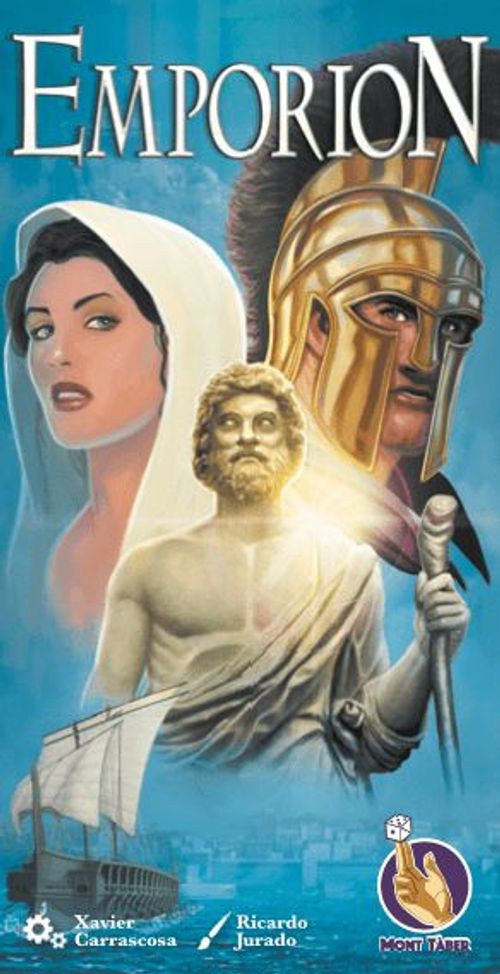
Emporion
Emporion Rulebook
Table of Contents
Table of Contents
Contents
- 110 cards divided into:
- 68 History cards: Culture (green), Trade (blue) and War (red)
- 18 Prestige cards
- 4 Special Prestige cards (yellow)
- 14 Goods cards (purple)
- 5 Action cards (Trade, Culture, War, Expedition and Reserve)
- 1 First player card
- 8 Empúrian drachmas
- 2 Player counters: Asclepios and Hygeía
Aim of the Game
The aim of the game is to collect cards with Victory Points (VP). These can be found on Prestige, Goods and some History cards.
Setting Up
- Choose who goes first: decide who goes first and give this player the First player card.
- Set up the Action area: place the 5 Action cards face up in a row in the centre of the table.
- Set up the piles: set aside all History start cards (these cards have a Greek alfa in the bottom right-hand corner on the face-up side of the card). Shuffle the remaining History cards and place them in a pile, this is the History pile. Shuffle the Prestige and Trade cards together and place them in a pile to make the Development pile. Place the two piles with the cards face down next to each other near the Action area.
- Set up the Port: take the 4 top cards from the History pile and place them face up at the top of the Action area.
- Deal the first cards: the player going first takes a Hoplitēs or Sophistes card from the History start cards and places it face up in his Realm. The other players also choose a Hoplitēs or Sophistes and place it face up in their corresponding Realms.
- Make the Polis: from the remaining History start cards take as many Sophistes, Hoplitēs and Macellum cards as there are players and place them face up in a row near their corresponding Action card.
- Place the 4 special Prestige cards: if you wish, place them in a row to one side of the Polis. If this is your first game, you can leave this step out and remove these cards from the game.
- Give out the drachmas: each player takes 2 drachmas.
- Divide the Spoils and player counters:
- With 2 players: each player takes any 2 of the remaining History start cards and places them face down in his Realm. Return unused History start cards to the box; they will not be used during the game. Then the player going first chooses a counter and the other player takes the other one.
Important note:
- Any History card face down in a player's Realm is known as a Spoils card.
- One or several of these can be used in the following rounds as wild cards for War, Culture or Trade resources (1 Spoils card = 1 resource). Spoils cards used as wild cards must be returned to the bottom of the History pile.
Game Play
The game is played in rounds and each player has one turn per round. Starting with the first player, the order of play is clockwise. When all players have had their turn, the round finishes and another starts. During their turn, players must do the following (in the order shown): choose an Action, carry out the Action and if necessary, complete a mandatory expedition.
A. Choosing an Action
The player places his or her counter on one of the cards in the Action area, bearing in mind the following:
- He or she may only choose an Action card with no counter on it. In games with 2 players, the Reserve Action may have two counters on it.
- An Action cannot be repeated. The player must move his or her counter to a different card from the one he or she started their turn on.
- The player may only choose an Action that can be carried out and he or she must carry out an Action.
If there is no Action that can be carried out, the player discards one of his or her reserved cards (see Reserve Action), removing it from the game and ending his or her turn.
B. Actions
1. Reserve a card from the Port
This allows a player to choose a card from the Port to be used in future rounds. To do this, the player puts his or her counter on the Reserve Action Card, takes the chosen card from the Port, puts it face up in his or her Realm and places one of his or her drachma on it.
Next, the player draws a card from the History pile and places it face up in the Port leaving 4 cards available again. A player may only do this if he or she has at least one available drachma. Each player may, therefore, have a maximum of 2 reserved cards at a time. Reserved cards do not count towards to the final total of cards in a Realm, nor do they bring any benefits until they become a definitive part of a player's Realm.
Example: Peter wants to reserve the Stoa card in the Port. He puts his counter on the Reserve Action card, takes the Stoa and puts it in his Realm placing 1 of his 2 drachmas on it. He then takes a card from the History pile and puts it face up where the Stoa card was in the Port. His turn ends.
Example of Reserve: In his or her previous turn the player chose the Reserve Action card, so he took a card from the Port and placed it in his or her Realm with a drachma on it. The player replaced the card from the Port with one from the History pile. In his or her next turn, the player chooses the War Action card. The player adds the previously reserved card since he or she has a Hippeis card, enabling the owner to take Prestige cards. The player removes the drachmas from the top of the reserved card.
Important note:
- If the player has reserved cards at the end of the game, then he or she will deduct 3 VP per card.
- In games with 2 players there may be 2 counters on the Reserve Action card at the same time.
2. Adding a card to the Realm
This allows a player to expand his or her Realm with a new card – History (Trade, Culture or War), Prestige or Goods.
a) Adding a History card from the Polis: If the cards in a player's Realm include the resources needed to incorporate a card from the Polis and the player has previously put his or her counter on the corresponding Action card, he or she takes that Polis card and lays it face up in his or her Realm. If the card he or she wants is a Trade card, the player must put his or her counter on the Trade Action card. If it is a Culture card, on the Culture Action card and if it is a War card, on the War Action card. The player can also use Spoils cards as resources if necessary.
Example: Arthur wishes to add a Hippeis card, which requires 2 Trade resources, to his Realm. He checks that the Macellum card in his Realm awards those resources. He then moves his counter to the War Action card, takes the Hippeis from the Polis and places it face-up in his Realm. His turn ends.
Example of War Action: The cost of the Hippeis card is 2 Trade resources. The player may take the Hippeis card from the Polis and add it to his or her Realm because his or her Macellum provides 2 Trade resources.
Example of Trade Action: The player may take the Emporoi card because he or she has the required resources in his or her Realm. The Emporoi card allows the player to add Goods from the Polis or previously reserved to his or her Realm.
b) Adding a Prestige or Goods card from the Polis: To do this, the player needs to activate a History card already in his or her Realm that allows him or her to acquire Prestige or Trade cards. If the said History card is a Trade card, the player must already have placed his or her counter on the Trade Action card; if it is a Culture card, the counter must be on the Culture Action card; and if it is War card, on the War Action card. In any case, the player must have in his or her Realm the resources necessary to get the desired card. The player may also use Spoils cards if his or her Realm doesn't have sufficient resources. If the player has the necessary resources, he or she takes the desired card from the Polis and lays it face up in his or her Realm.
Example: Simon wants to add a Goods card in the Polis to his Realm. Because he's already got one of these cards in his Realm, the cost of the new one will be 6 Trade resources. He checks he already has them in his Realm and moves the counter to the Trade Action card, enabling Creditor powers which allow him to take the said Goods and add them to his Realm. His turn ends.
Example of how to enable a power: The cost of a Goods card is 5 Trade resources plus 1 extra for each Goods card already in the player's Realm. The player already has a Goods card. The player may take another Goods as he or she has a Creditor card and also the 6 required resources.
c) Adding a previously reserved card as if it were in the Polis: Depending on the type of reserved card the player wants to add, he or she follows the instructions set out in a) and b) above.
Example: In her previous turn, Caroline reserved the PalaiaPolis card. In her current turn, she wants to make it a permanent part of her Realm so she checks if she has the resources in her Realm required by the card: 3 Culture and 7 Trade. Since she only has 5 Trade resources, she uses 2 Spoils cards as wild cards, therefore giving her a total of 7 Trade resources. Next, she moves her counter to the War Action card activating the Strategos power to obtain Prestige cards so she can add the PalaiaPolis card to her Realm. Her turn ends.
Important note:
- The cards in a player's Realm should be arranged in different rows according to their colour and vertically staggered so that the resources and powers awarded by each card in a row are visible to any player.
3. Expedition
The following steps allow players to add new cards to the Polis and obtain Spoils:
- a. The player moves from the Port to the Polis as many cards as the number of Expedition icons in his or her Realm, up to a maximum of 4. The player must use all his or her Expedition icons (up to a maximum of 4).
- b. The player adds new cards to the Port until there are 4 in total again. To do this, he or she uses cards from the History and/or Development piles, as follows:
- If the player has moved just one card from the Port to the Polis, he or she replaces it with a card from the History pile.
- If the player has moved more than 1 card, he or she replaces them with at least 1 card from each pile up to the total of 4.
- c. The player draws one card, without revealing it, from the History pile for every card that the player has put in the Polis and places them face down in his or her Realm. These cards are now Spoils and cannot be turned over. If the History pile is empty, Spoils cannot be gained.
Important note:
- If a player has to draw a card from the History pile and it is depleted, then he or she will draw it from the Development pile.
Example: Sophie chooses the Expedition Action and counts the Expedition icons in her Realm. As she has 2, she moves 2 cards of her choosing from the Port to the Polis. She next refills the Port with 1 card from the History pile and 1 from the Development pile. She also draws 2 cards from the History pile and lays them face down in her Realm. These 2 cards are 2 Spoils that can be used in future turns. Her current turn ends.
Example: Emily chooses the Expedition Action. Although she has a total of 6 Expedition icons in her Realm, she only moves 4 cards (that is the maximum) from the Port to the Polis. She next replaces them with 4 new cards, 1 from the History pile and 3 from the Development pile. She then draws 4 cards from the History pile and places them face down in her Realm. These 4 cards are Spoils. Her turn ends.
C. Mandatory Expedition
At the end of his or her turn, the player checks if there are any History cards in the Polis. If there are none, the player automatically carries out an expedition by moving the 4 cards in the Port to the Polis. He or she then places 4 new cards in the Port from the History pile. If there aren't enough, the player draws cards from the Development pile. Cards in the Port are replaced with at least 1 card from each pile and the player gains the corresponding Spoils.
Important note:
- Players do not obtain Spoils when carrying out a mandatory expedition.
End of the Game
The game is over at the end of a round when either of the following happens:
- a) A player has 18 cards in his or her Realm, not counting Spoils or reserved cards. When a player reaches 17 cards, he or she must let the other players know.
- b) A player needs to draw a card from the History pile but there are no cards left.
In both cases, the game ends when the player before the one with the First player card finishes his or her turn.
Important note:
- Once there are no cards left in the History pile (as is b above), the pile is deemed to be empty even if one or more Spoils are returned by any player during the same round. Thus, at the end of that round the game is over.
Scoring and Winning
The players score VP as follows:
- Players get VP as indicated on Prestige and Goods cards.
- Players get VP from bonuses on History cards.
- Players lose 3 VP per unused reserved card.
The winner is the player with the most VP. In the case of a draw, the winner is the player with the most Emporion cards. If no one has any or 2 players have the same number, the winner is the player with the most Prestige and Goods cards. If they draw again, both players are declared the winners.
Example of final score: Spoils (3); Goods: (3) 17 VP; Prestige: 15 VP; Culture: 4 VP; War: 15 VP; Spoils multipliers (2): 6 VP; Goods multipliers (1): 3 VP. Total: 60 VP.
Icons
Types of cards
Culture, Trade, War, Goods, Prestige, Spoils.
Resources/requirements
- Culture, Trade, War: A card awards (upper left-hand corner) or requires (lower right-hand corner) the number of resources of its type stated on the left of the icon.
- VP icon: Indicates the VP awarded at the end of the game, according to number stated on the left.
- Spoils icon: Indicates the Spoils payment (returned to the History pile) on the 4 special Prestige cards.
Powers
- Expedition: In an Expedition Action the player counts the number of icons of this type in his or her Realm and then moves from the Port to the Polis the same number of cards, obtaining also the same number of Spoils. If the number of icons is higher than 4, only 4 cards are moved and correspondingly 4 Spoils gained.
- Prestige: Allows a player to add a Prestige card to his or her Realm, from the Polis or from reserved cards, if the player has the required resources for the card.
- Good: Allows a player to add a Goods card to his or her Realm, from the Polis or the reserved cards, if the player has the Trade resources required for the card. For the first Goods card, 5 resources are needed and after that, 1 more for each Goods card in the player's Realm.
Bonuses/Multipliers
Each card in each player's Realm of the type indicated by its icon awards the number of VP stated on the card. All multipliers are accumulative (e.g. – 2 multipliers of "War x 1" award 6 VP in total if the player has 3 War cards.)
Goods
The more Goods cards a player has in his or her Realm, the more VP he or she scores. The number of VP earned is shown in each Goods card (5VP for 1 card, 10VP for 2, etc.). Goods are scored in sets of 5 cards. (e.g. - Harry acquires his sixth Goods card, which costs him 10 Trade resources. Once the game is over, he will collect 37 VP for the first set of 5 Goods cards and 5VP more for the sixth card.)
Historical Notes
The game liberally recreates the ancient settlement of Emporion, located in today's province of Girona, from its foundation in 575AD to the time of the Roman Empire. Most of the illustrations on the cards are taken from the Greek period, but some are from Roman times. Some cards have their name in Latin, others a phonetic transcription of their name in Ancient Greek to Spanish and others, their usual name in Spanish or another modern language.