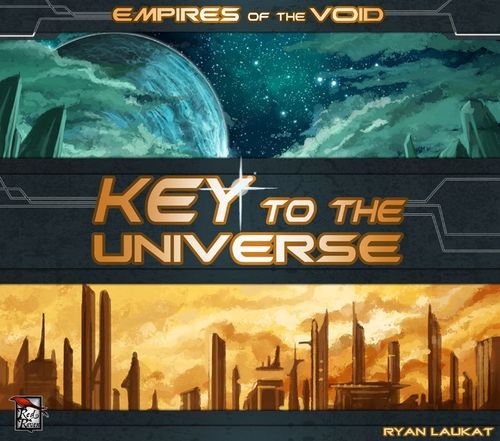
Empires of the Void: Key to the Universe
Empires of the Void: Key to the Universe Rulebook
Table of Contents
Table of Contents
- Updating Components
- Components
- Setup
- Reading the Alien Race Board, Planet Cards, and Technology Board
- Overview
- Planets
- Event Card
- Pre-Round Phase
- Actions
- Secondary Action
- End of Turn
- End of Round
- Scoring
- Game End
- Turn Order Variant
- Repair Bay
- Objective Board
- Trade Goods
- Ship Clarifications
- Technology Clarifications
- Planet Clarifications
- Race Clarifications
- Event Card Clarifications
- Tactics Card Clarifications
- New and Changed Rules
- Three-Player Game
- Two-Player Game
- Transcription Notes
Updating Components
To update your game to Key to the Universe, you will need to add some components and remove some components from the game. When removing components, a good idea is to store them all in a large plastic bag and keep the bag in the game box.
- Print out 4 copies of the new Technology Board and cut them out.
- Print out 4 copies of the Secondary Action Board (there are 2 per page) and cut them out.
- Print out the Objective Board and cut it out.
- (Optional) Print out the four new Alien Race Boards and cut them out.
- Remove 4 Starfighter Tokens for each color from the game. Store them in a safe place.
- Remove the technology tokens from the game. Store them in a safe place.
- Remove the following Event Cards from the game: Rebellion on Arcura, Rebellion on Corra, Tan Lock Radical Sect Captures Ambassador, Rebellion on Beta Com.
- Remove 3 of each of the following Neutral Alien ships from the game: Black Hole, Firebug, Shooting Star, Tempest, Moth. Store them in a safe place.
- Remove 1 Infestor ship token from the game and store it in a safe place.
- Do not use the Capital City cards promo.
NOTE: The game pieces in the "Components" section are listed not counting the removed components from this section.
Components
- 6 Dice
- 12 Home World Tokens
- Event Tokens (Worm Hole, Rebellion, Distress Call, Pirates, Event)
- 4 Player Order Tokens
- Objective Board
- 7 Galaxy Hexagons, 4 Home World Corners
- Victory Point Tokens
- Credit Tokens
- Neutral Alien Ships: 3 Black Holes, 3 Firebugs, 3 Shooting Stars, 3 Tempests, 3 Moths
- 3 Infestors, 8 Infestation Tokens
- Galactic Council Board
- Special Ships: 2 Millipedes, 2 Dragonflys, and 2 Freighters
- Alien Race Boards (8 Base Game, 4 Expansion)
- 15 Planet Cards
- Player Ship Tokens/Ally Tokens (in 4 sets): 8 Starfighters, 8 Centipedes, 3 Diplomats, 10 Starcruisers, 4 Sunhammers, 11 Ally Tokens
- 20 Event Cards
- 4 Secondary Action Boards
- 3 Score Cards
- 30 Diplomacy Cards
- 4 Technology Boards
Setup
-
Place the galaxy hexagon with the planet Pyrious in the center of the table. Place the six remaining galaxy hexagons randomly around the center hexagon. (Note: This is for a four-player game. Please see the two-player or three-player game sections on pages 20 and 21 of this rulebook for alternate setup and rules if you have two or three players.)
-
Roll the dice to decide the first player. Once the first player is decided, player order goes clockwise. The first player takes the Player 1 token.
-
Starting with the first player, each player chooses an alien race board and places it in front of him. Each player takes the home world of the race he chooses, along with a set of starships and ally tokens of one color. Each player takes one technology board and one secondary action board and places them next to his alien race board. Each player takes 7 credits and places them on his alien race board. Credit tokens have a variety of uses and only count as credits when they are on a player's alien race board.
-
The first player places his home world on a home world corner and places the home world corner in an open slot in the galaxy board. The second player must then place his home world and home world corner in the next available slot, in a clockwise direction. The third player skips one slot and places his home world and home world corner in the next corner, and the fourth player places his home world and corner in the next slot, in a clockwise direction. (A "slot" refers to one of the six open spaces where players may fit a home-planet board.)
-
Starting with the third player and going in clockwise order, each player may choose to rotate one galaxy hexagon. The hexagon must be adjacent to the player's home world, and must not have been previously rotated by any other player.
-
Set up the event deck. Take the three score cards and place them face down in three separate piles, A, B, and C. Shuffle the remaining event cards. On the A score card place 3 event cards, on the B score card place 3 event cards, and on the C score card place 3 event cards, all face down. Stack the A stack onto the B stack, then place both onto the C stack. This is the event deck. Place it next to the board.
-
Place the credit tokens, victory point tokens, planet cards, and neutral alien ships (those with an empty, starry background) in an easily accessible place next to the board.
You are now ready to play.
Reading the Alien Race Board, Planet Cards, and Technology Board
The labels printed on the alien race board are: Alien Race Name, Special Abilities, Base Income, Diplomacy Numbers, Ship Name, Ship Cost, Attack, Move, Ship Abilities, and Actions. The initiative level of each ship directly corresponds to its order on the player board, from right to left, and is also marked by the large number in the background behind the ship. (Ships with a star after the name are available to every race. To have access to other ships, you must be allied with a specific planet.) The printed legend reads: "A star indicates the action can only be used once per turn."
The labels printed on a planet card are: Planet Name, Trade Good, Temperament, Special Ability, Planet Description, Influence, Income, and Victory Points.
The labels printed on the technology board are: "1st Column: Techs players can research at the start of the game." and "Arrows point from the technology you must own to research the next." Each technology shows a Name, a Description, a Trade Good, a Credit Cost, and a Tech VP.
Overview
Gain the most victory points by the end of nine rounds of play by controlling planets, owning technologies, completing objectives, and influencing the galactic council. Victory points are a measure of how your alien race is viewed by the Tolmek, keepers of the Key to the Universe.
An important source of victory points is the expansion of your star empire through the acquisition of new planets. Planets give income, victory points, influence on the galactic council, trade goods, and special abilities. Each planet has a unique special ability.
The game takes place over nine rounds. Each round starts with an event card. Players then build ships and research technology in the pre-round phase. Finally, players take turns taking three actions and one secondary action. When the last player is finished taking his actions, the first player token is passed to the right and the new round begins. Below is a detailed description of each step in the round.
Planets
Planets may be obtained either through conquest or by diplomacy. If you successfully use diplomacy, the allied planet gives you all of its benefits. If you conquer a planet, the inhabitants are uncooperative, so you do not have access to the special ability or the influence.
If you successfully use diplomacy, you place one of your ally tokens on the planet to show that you are now allies. You remain allies for the rest of the game (even if another player takes the planet from you by attacking it). Also take the planet card and place an ally token on the card. Allied planets give their credits, victory points, influence, trade goods and special abilities to your empire.
If, on the other hand, you successfully conquer a planet, the native inhabitants are uncooperative. The planet gives you credits, victory points, and trade goods, but you do not have access to the influence or special ability. If you conquer a planet, put one of your enemy tokens on the planet (but not on the card).
If a player conquers a planet allied with another player, he places his enemy token on top of the allied player's token on the planet on the board. There will be two tokens on the planet at the same time. The conquering player takes the planet card (the allied player doesn't need to keep his token on the card, just the planet). The allied player gains no benefits from the planet until he regains control of it.
A player is considered to "own" or "control" a planet whether he be a conqueror or an ally. Controlling a planet will give the player access to a trade good. There are five trade good types (metals, crystals, life forms, gas, and artifacts), and they are important for researching certain technologies (which also reward players with victory points).
Event Card
At the start of the round, the first player draws a card from the event deck, reads the card, and follows the directions. Some events remain active until the event is resolved, and some events are a one-time effect.
If the event card is a score card, players score points as described in the section titled "Scoring" on page 14. When players have finished collecting victory points, draw a new event card and read it as normal.
Pre-Round Phase
After the event card has been read, all players build ships and research one technology. Players do both actions simultaneously, in any order.
Build
You may build as many ships as you can afford. Discard the required number of credits equal to the cost of the ships and place the ships on your home world. The number of ships a player may own is limited by the number of starship tokens. Players may save credits and carry them over from turn to turn. If two players have the ability to build the same alien ship, the player that controls the planet builds first (indicate ship ownership by placing ally tokens on the ships).
Research Technology
Research one new technology. Technologies add perpetual effects that advance your space empire and grant new abilities. You must pay the credit cost (listed in the technology details on the technology board). You must also have the prerequisite technology. Light blue arrows indicate that you must have one technology before the next. For example, you must have the Centipede Technology before you can research the Starcruiser Technology. If two arrows point to one technology, you only need to have one of the prerequisite technologies. Also, to research the technology, you must control the appropriate trade good. Some technologies require no trade good to research.
When you purchase a tech with a trade good requirement, you do not "pay" trade goods; you simply have to control a planet that has the trade good. There are five trade good types: metals, crystals, life forms, gas, and artifacts. If you do not control a planet with the trade good you need, you may negotiate and barter with other players in order to gain their permission to "use" a trade good they control. You may trade cards, credits, etc. in return for this favor. You may never trade victory points or planet cards. Once you have researched the technology, place a credit token from the general supply on the technology to indicate that you now own it. NOTE: This action may only be performed once per round.
Actions
On your turn, you have 3 actions to split between the following options. Actions may be performed more than once (unless otherwise noted) and in any order.
Move
Move one of your ships along the lines connecting the planets up to as many spaces as the ship's move value. Each planet on the board and each light circle is considered to be a "space" for the sake of movement. Ships can move through and stop on half light circles at the edge of the board.
On the board are also three types of obstacles: asteroids, mines, and ancient defenses (space monsters). If you choose to move ships past these obstacles, roll a die for each ship. If you roll a 4 or higher, the ship survives and may continue to move. If you roll below a 4, the ship does not survive and is destroyed. If you have the necessary technology or special ability that lets you ignore an obstacle, you do not need to roll. Obstacles do not count as spaces, except for the three spaces with asteroids on the center hexagon with the planet Pyrious.
The same ship may move multiple times in a turn using multiple MOVE actions.
Attack
Initiate combat on one space where you have ships. You may target a planet or an opponent's ships. When you initiate an attack, indicate the player or planet you are attacking. (Spaces may have ships from multiple players.) All ships on both sides roll an attack in ship initiative order, from right to left on the player board. (i.e. From initiative 1 to 5.) All ships roll one die and take one hit to destroy unless otherwise noted. For a ship to make a successful hit, you must roll at or above its attack number (the center number next to the ship, with no icon behind it). Casualties are taken after each initiative level has rolled. Players choose which of their own ships to destroy as casualties. To achieve a "win a battle" result, you must destroy all of an opponent's ships on one space. Conquering a neutral planet counts as a "win a battle".
EXAMPLE: Bob has a Sunhammer and a Starcruiser. Alex has a Starcruiser and two Starfighters. Bob rolls two dice for the Sunhammer first because it has the highest initiative. He rolls a two and a three, only scoring one hit. Alex decides to lose one of his two Starfighters. The next ships in initiative order are the Starcruisers. Bob rolls for his one Starcruiser and misses, while Alex rolls a successful hit with one of his Starcruisers. Bob decides to lose his only Starcruiser. That leaves him with the Sunhammer. The next ship in initiative order is Alex's one remaining Starfighter. He rolls and misses, and the battle ends with Bob keeping his Sunhammer and Alex keeping his Starcruiser and one Starfighter.
If you destroy any opponent ships on your turn, gain 1 victory point. Even if you use multiple actions and destroy multiple ships, you can never gain more than 1 victory point.
If you target a neutral planet, you only need one successful hit to conquer it. If you are successful, put one of your enemy tokens on the planet. Take the planet card. Conquered planets only give you their victory points, credits, and trade good (not their special ability or influence).
If an opponent controls the planet, targeting his ships in that space includes targeting the planet. If you successfully destroy all of that player's ships you may take control of the planet, regardless of whether or not any other players currently have any ships on that planet space. If the player has no ships but controls the planet, you must still use an attack action to take the planet from him (without having to make an actual attack roll).
When you take control of a planet that was previously conquered by an opponent, you may either Conquer it or Liberate it.
If you conquer it, place an enemy token on the planet. Take the planet card. The previous conqueror removes his enemy token from the planet. If the planet has an ally, place your token on top of the ally token.
If you choose to liberate the planet instead, the previous conqueror removes his enemy token from the planet and the planet becomes neutral again. You may use diplomacy to try to befriend it with a separate diplomacy action. However, if you have one diplomacy card of the planet type, you may spend the card as soon as you liberate the planet in order to befriend it and become allies if the planet does not already have an ally. (This does not require an action.)
If you choose to liberate a planet from a conqueror and the planet has an ally, you may not attempt diplomacy or spend a diplomacy card to befriend the planet. Liberating a planet that has an ally means that control of the planet returns to the allied player.
If you conquer a planet owned by a player that was allied with the planet, put your enemy token on top of the player's ally token on the planet. The allied player does not remove his ally token. Take the planet card from the allied player (he does not get any benefit from the planet even though he is still allied because he does not control it). If he is able to take control of the planet again, he will remove your enemy token, still be allied with the planet, and regain all benefits.
Conquering a player's home world works just like conquering any other planet that the player owns. If you conquer another player's home world, you gain 2 victory points at the end of your turn as long as you control it. That player still collects the credits listed at the top right corner on his player board, and may continue to build ships at his home planet.
If you are unsuccessful at conquering a planet or removing opposing ships from a space, you may spend additional actions to try again. (i.e. You may initiate an attack on the same space multiple times per turn using multiple ATTACK actions.)
Culture
Draw a card from the diplomacy deck. These cards are necessary in order to perform the diplomacy action. Your hand limit for diplomacy cards when the game starts is 3, but this can be increased by researching certain technologies. There are five diplomacy card types: Militaristic, Capitalistic, Scholarly, Mysterious, and Peaceful. The five card types coincide with the five different alien temperaments of the planets on the galaxy hexagons. Diplomacy cards may be traded between players at any time. (Trading when it is not your turn will save time and speed the game along.)
You may draw a card from the top of the deck, or you may choose to purchase one of the two face-up diplomacy cards next to the deck by paying one credit. If you take one of the face up cards, draw a card from the deck to replace it.
Your hand limit applies immediately after you gain a new diplomacy card. This means you can draw a fourth card if your hand limit is three, and then decide which card to discard.
Diplomacy cards also include special Tactics abilities that may be used instead of the diplomacy function. The number of cards required to use the ability precedes the ability description (this number includes the card with the Tactics ability). The cards must be of the same diplomacy type, but do not have to contain the same Tactics ability. When you use the ability, discard the cards. A Tactics ability does not require an action to use, and you may use it at any time (except if it only applies during your turn, such as when it gives you an additional action). Hint: This can be important later in the game when there are fewer planets to befriend.
Also, if another player takes control of one of your planets, draw a diplomacy card.
Mine
Spend an action to collect 2 credits.
NOTE: This action may only be performed once per turn.
Diplomacy
Attempt to befriend a planet and have it become your ally. In order to attempt diplomacy, you must have a Diplomat ship at the planet you are trying to befriend and the planet must be neutral and uncontrolled. You must also have at least one card of the same type as the temperament of the planet you are trying to befriend, and all cards played must be of this temperament. Roll three dice. The amount you must roll to be successful is determined by the number of diplomacy cards you play, as is shown on the alien race boards just above the Starfighter information. If you have one card, you must roll a 17 or higher to befriend the planet. If you have two cards, you must roll a 13 or higher. If you have three cards, you must roll an 8 or higher. If you have four cards, you must roll a 4 or higher.
If you succeed, discard the diplomacy cards played, place one of your ally tokens on the planet, take the planet card, and also place one of your ally tokens on the card so you remember that the planet is giving you its special ability and influence. If you fail, you do not discard any diplomacy cards and may try again by spending another action. Planets that are your ally give you their credits, victory points, influence, trade good, and special ability. Once a planet is allied with you, no other player may use diplomacy on that planet.
Secondary Action
After you have taken your 3 actions, you may perform one Secondary Action using the secondary action board. You may choose from the following actions:
Secondary Action Board
The labels printed on the secondary action board are: Rules Reminders ("Gain 1 VP when you destroy ships." "Draw if you lose a planet." "2 VP/turn for enemy Home Planets."); Repair Bay ("Rebuild at 1/2 cost." "Limit 1 ship."); Secondary Action Descriptions (ARM: "Purchase up to 5 Photon Bombs."; MOVE +: "Move 2 ships at +1 movement."; SMUGGLE: "Tech using a trade good from a planet where you have a Diplomat."; ENSLAVE: "Place a credit on a conquered planet card, that planet has +1 income."; COUNCIL: "Purchase up to 5 Ambassadors."); the row of Secondary Actions (Council, Move +, Smuggle, Arm, Enslave, Attack); Token Limit ("Limit 5 tokens total."); Photon Bomb/Ambassador Cost; and Capital City ("Keep Photon Bombs and Ambassadors here."). The cost strip on the board reads "0/1/3/6/8" for Bombs/Ambassadors; the cumulative totals for one through five tokens given under Council and Arm below are 0, 1, 4, 10 and 18.
Council
You may purchase up to 5 Ambassadors, which you may later spend to add to diplomacy rolls. The price is indicated in the Capital City area of the Secondary Action Board. The cost indicates how many credits you must pay to gain multiple Ambassadors in one action (the price does not depend on how many you already have). The cost for one is 0, for two is 1, for three is 4, for four is 10, and for five is 18 (add the cost for each one together).
Put one victory point token in the Capital City area for each Ambassador you purchase. These tokens do not count as victory points; they are only used to indicate how many Ambassadors you own. When you roll for diplomacy, you may spend the Ambassadors after you roll to increase the roll by 1 per Ambassador.
You may never have more than 5 Ambassadors/Photon Bombs tokens together at a time in the Capital City.
Move +
You may move up to two ships at +1 movement.
Smuggle
You may research a technology using a trade good that you don't control. To use the trade good, you must have a Diplomat ship on a planet space with that trade good. The planet can be neutral or controlled by another player.
You can also use this action to research a technology that does not have a trade good requirement or for which you already control.
Arm
You may purchase up to 5 Photon Bombs, which you may later spend to add to attack rolls. The price is indicated in the Capital City area of the Secondary Action Board. The cost indicates how many credits you must pay to gain multiple Photon Bombs in one action (the price does not depend on how many you already have). The cost for one is 0, for two is 1, for three is 4, for four is 10, and for five is 18 (add the cost for each one together).
Put one credit token in the Capital City area for each Photon Bomb you purchase. These credit tokens do not count as victory points; they are only used to indicate how many Photon Bombs you own. When you roll to attack, you may spend the Photon Bombs after you roll to increase the roll by 1 per Photon Bomb.
You may never have more than 5 Ambassadors/Photon Bombs tokens together at a time in the Capital City.
Enslave
Place a credit token on a planet card that you control and have conquered. That planet produces +1 income at turn end for the remainder of the game. No planets can have more than +1 income by being Enslaved multiple times. If you ever lose control of the planet, remove the credit token.
Attack
You may use your secondary action to attack, exactly as described in the previous section.
End of Turn
At the end of your turn, collect a number of credits equal to the sum of the amount at the top right corner of your alien race board plus those given by any planets you control (indicated by the green credits symbol on the planet cards).
End of Round
At the end of the round, pass the first player token to the player on the left.
Scoring
The events at rounds 4, 7, and the end of 9 are scoring events. Players collect victory points during a scoring event for these three areas: PLANETS, TECHNOLOGIES, and the GALACTIC COUNCIL. Players should keep their victory point tokens face down and secret.
PLANETS: The number of victory points a player receives for each planet he controls is indicated by the purple victory points symbol on each planet card. Be sure to remember to include your home world and other players' home worlds if you control them.
TECHNOLOGIES: The number of victory points a player receives for technologies depends on how many he has. If he has at least 3, he gains 1 victory point. If he has at least 5, he gains 2 victory points. If he has at least 8, he gains 3 victory points. If he has at least 10, he gains 4, and if he has at least 12 he gains 5.
GALACTIC COUNCIL: Players add up their influence from all allied planets (indicated by the blue influence symbol on the planet cards) and mark their positions on the Galactic Council Board. The player with the highest influence amount gains the higher victory point amount listed on the score card (on the left), while the player with the next highest influence number gains the lower victory point amount listed (on the right). If players are tied for first, add the two victory point totals together and split them evenly. If players are tied for second, split the second number evenly (rounding up). Players may not score on the GALACTIC COUNCIL if they do not have any influence, even if the number of players with influence is only one or none. The players' influence number is recalculated with each scoring round. (i.e. The scores on the Galactic Council Board are not "carried over" to the next scoring round.)
Game End
The game is over at the end of round 9. Players draw the last event card as soon as the ninth round ends and score for the third and final time. The player with the most victory points is the winner. The Tolmek find his alien race to be the most capable and worthy, and grant them the Key to the Universe, dawning a new era of advancement and prosperity.
Tiebreaker: If players are tied, the player with the most planets is the winner. If players are still tied, the player with the most influence is the winner, then most technologies, then most unspent credits.
Turn Order Variant
In the advanced rules, the turn order changes at the beginning of each round before the pre-round phase begins. The player with control of the most planets goes first, the player with the second most goes second, etc. In case of ties, the player with the lower number of influence goes first. If players are still tied, the player with the higher amount of unspent credits goes first. If players are still tied, use the turn order from the previous round.
Instead of building and researching technology simultaneously in the pre-round phase, players build ships and research in turn order.
Repair Bay
On the Secondary Action Board is the repair bay. When one of your ships is destroyed, you may place it here. Later you may rebuild the ship at half cost during a pre-round phase. You can never have more than one ship on the repair bay. If you lose control of a planet that lets you build an alien ship, and you have one of those ships on the repair bay, you must remove the ship from the repair bay. If you want to place a ship on the repair bay but you already have a ship there, you may discard the old ship and place the newly destroyed ship there.
Objective Board
The objective board is an additional way to earn victory points. (Printed as "additonal" in the source.) The objectives represent tasks with which the Tolmek will be particularly impressed if you complete. If you complete the requirements of an objective, immediately collect the victory points listed. Also place a victory point chip on the objective box to show that it has been completed. Once an objective has been completed, no one else may complete it. If more than one player completes the "Build a Sunhammer" objective at the same time, both players collect the victory points.
Trade Goods
If you want to research a technology that requires a trade good that you do not own, you may gain permission from another player to use a trade good he owns for a one-time use. You may trade cards, credits, non-binding promises, etc. If a player grants you the use of his trade good, it does not limit him from using that same trade good to research a technology in the same pre-round phase. Trade goods are never "exhausted".
Ship Clarifications
Diplomat: May carry with it any one ship of initiative 4 or 5 when it moves. Diplomats being carried cannot carry ships. The Diplomat may "pick up" and "drop off" ships as it moves.
Dragonfly: If you destroy an enemy ship and the Dragonfly is present at the location of the battle, you may collect one Photon Bomb.
Fire Bug: Gets one free attack roll before the battle begins against any opposing Starfighters that are involved in the battle. Each Fire Bug only gets one attack roll.
Freighter: Using the secondary action "Construction Ship", the Mining Guild of Astra may build ships on a non-planet space where the Freighter is located.
Millipede: Your ships may move between the two Millipede ships as if they were Worm Holes (adjacent spaces). The Millipedes themselves cannot do this.
Moth: Takes two hits to destroy. (Keep track of damage with a victory point token.) A Moth ship cannot be repaired. Thus, the damage remains until it is destroyed. The Moth ignores all board obstacles during movement.
Shooting Star: Rolls three dice and hits on 4+ but must pay a credit to fire. The ship can score multiple hits with one attack.
Sunhammer: Rolls two dice and hits on 3+. The ship can score multiple hits with one attack. If you research the "Sunhammer II" technology, the Sunhammer rolls three dice and hits on 3+. With this technology, the Sunhammer may move +1 s[ace amd ,au carry up to three ships of initiative 4 or 5. (The source text is garbled at this point and is reproduced as printed. In context it appears to read "+1 space and can carry up to three ships of initiative 4 or 5"; not verified against a clean copy.)
Technology Clarifications
Cloaking: If your ship has cloaking and that ship makes a successful hit, you may choose the casualty instead of your opponent. If your opponent has any ships with the detection ability, this negates your cloaking ability.
Detection: Negates any opposing ships' cloaking abilities in the space.
Docking Bay: Allows the Diplomat to carry four additional Starfighters.
Grappling Beam: This technology allows you to move three ships together with one move action. The ships must begin and end on the same space. You may do this multiple times per turn.
Plasma Drill: Collect the credit at the end of your turn.
Shield Generator: Planets you control now take one hit to conquer if you have no ships there. If you have ships on the space, this technology has no effect (in story terms, you must deactivate the shield so as not to endanger your fleet).
Space Port: When you research the Space Port technology, immediately place one of the space port tokens on a planet you control. When building ships, you may now place one of them per round on the planet with the space port. If an opponent takes control of this planet, destroy the space port and lose the technology. You may research the technology again if this happens. You may only own one space port. You may not destroy your own space port (if you wanted to build it somewhere else).
Tractor Beam: If your ship has the tractor beam ability, your opponent may not move ships away from your tractor beam without your permission unless they destroy the ship. This also applies if an opponent is just "passing through" the space. The "tractor beam" ability prevents the "retreat" ability.
Universal Translator: When using Tactics abilities, you may spend any type of diplomacy card (the cards do not all have to be the same type).
Warp Gate: Allows players to move all their ships at a cost of two actions. Players may not move ships between different Diplomats in the same "move all ships" action. During the "move all ships" action, if a ship is carried by a Diplomat, it may not make a separate individual movement. (i.e. It cannot move before or after the move with the Diplomat, or with another Diplomat.) It could, however, be picked up or dropped off along the way.
The Narkani Alliance's extra move action cannot be used as one of the two actions required by the warp gates "move all ships" action. The "move all ships" action may only be used once per turn.
Planet Clarifications
Arcura: In this case, a "conquer roll" is an attack roll against a neutral planet.
Beta Com: To "win a battle" you must destroy all of an opponent's ships on the space where the attack action is taking place. The ability only applies when there are enemy ships present. It is not considered a "battle" to successfully roll against a conquered planet.
Bindok II: A player that is allied with Bindok II has access to the "Retreat" ability. Any time the player is attacked by another player, before any dice are rolled the player may choose to pay one credit to move all his ships on the contested space to the nearest planet that player controls. (The player may choose one if the distance is equal.)
Emrok: Collect the "+1 credit" at the end of your turn.
Race Clarifications
7th Academy of Eehg: Technologies may be reduced to 0 cost (but never below that-- researching would never give a player credits).
Collective Five: Collect 1 VP even if you conquer the same peaceful planet a second or third time, etc.
The Collective Five state that they collect 5 credits per turn because it is one more than normal income (4).
Corporations of Meezle III: The Corporations (printed "Coorporations") have a new secondary action: Metropolis. If you take this action, you are building a large city on one of your planets. You may place a credit token on one of your allied planet cards. This planet now has +1 income for the remainder of the game. If you ever lose control of the planet, remove the credit token.
At the end of the game, you earn 1 victory point per 4 credits you have.
Crime Lords of Gobnub: When you lose control of a planet, do not remove your control token from the planet. The conquering player places his enemy token on top of your token, but leaves enough of it visible for you to see. You continue to collect credits from the planet, even though you don't control it.
Kingdom of Roth: If you conquer a peaceful or scholarly planet that is allied with another player, that player loses allied status.
Mining Guild of Astra: The Mining Guild has a new secondary action: Construction Ship. By using this action, you can build ships where either of your Freighter ships are located (as long as the ships are on a non-planet space). (Printed as "the you can build" and "on on a non-planet space" in the source; typos corrected here.)
Mystics of Siri: This race may, as an action, use their "Mind Control" ability to move any one ship belonging to an opponent located in a space where the Siri player has at least one ship. The Siri player can move the ship as far as its move value. The Siri player may only perform this action once per turn.
Narkani Alliance: Start with one Centipede ship, but not the Centipede technology.
The "+1 move action for 1 credit" ability is limited to once per turn. This ability may not be used as one of the two actions required by Warp Gates.
Nomads of Earth: Only Earth has access to the technology "Terraforming". When the player researches this technology, replace Earth with New Earth. They do not start with this technology, but may research it later in the game.
The Nomads of Earth state that they collect 3 credits per turn because it is one less than normal income (4).
Parasites of Sreech: This race has their own ship: the Infestor. The Infestor requires no technology to build. The ship has a unique action: Infest. As an action, you may attempt to infest a planet at which an Infestor is located. You may infest planets that are neutral/uncontrolled and planets controlled by other players. To infest a planet, you must roll 3 or higher with one die. If successful, put an "infested" token on the planet. You have access to the special ability of any planet you infest. You may not infest planets that you control, and if you take control of a planet that is infested, it loses the "infested" status.
If an opponent takes control of a planet that is infested, the planet remains infested. The only way for other players to remove an infestation is by targeting the infestation with an attack action using one or more ships, and they must make at least two successful hits in one action to remove it. If an opponent is allied with a planet you have infested, he still has access to the special ability. (You both have it.) If two players are building the same specialized "neutral alien" ships, indicate ownership with an influence or enemy token.
Errata: The Parasites of Sreech do not have access to the "Spore Pods" technology.
Designer's Note: It's best if you've played at least one game before trying the Sreech. It is very easy to get distracted with infesting and lose sight of the goal of the game: victory points! Remember, infesting gives no points whatsoever, so make sure to use it sparingly. However, it can be very powerful if used wisely.
Pirates of Cidran: After rolling for diplomacy, you may spend as many credits as you want to add to the diplomacy roll. Each credit increases the roll by one.
Event Card Clarifications
Gravitonic Anomaly: Ships move with the rotating hexagon unless it would place them in an asteroid field.
Distress Call from ...: If a player controls the planet as a conqueror, remove his control token from the planet and replace it with the distress call token. He regains control of the planet when he defeats the invaders. If a player is allied with the planet, place the distress call token on top of his ally token. He loses control of the planet as if another player had conquered it. If he defeats the invaders, he regains control of the planet and is still allied. If another player defeats the invaders, he becomes allied with the planet and the old ally must remove his ally token.
Gravitonic Anomaly: Ships move with the rotating hexagon unless it would place them in an asteroid field. (Printed twice in the source; the two entries are identical.)
Tactics Card Clarifications
Insurrection: If this ability is used on a player that does not control the planet but is allied to the planet, he must remove his token from the planet.
Peace Talks: If this ability is used on a player that has conquered a planet that has an ally, remove the previous allied player's ally token.
Retreat: This ability does not cancel an attack action. Thus, if you move all of your ships away when someone attacks a planet you control, he may take control of the planet without rolling.
New and Changed Rules
If you already know how to play Empires of the Void, read this section to know how to play with the new expansion materials without having to read the entire rulebook.
Event Cards
Draw the event card before the pre-round phase. If you draw a scoring event, everyone scores, then draw another event before continuing.
Pre-round Phase
Read the "Research Technology" section on page 10.
Move
You may now attempt to move past obstacles even if you do not have the technology that lets you ignore them. You must roll a die for each ship. On a roll of 3 or below, the ship is destroyed.
Attack
If you destroy any enemy ships on your turn, collect a victory point. You never collect more than 1 victory point, no matter how many ships you destroy.
Draw a diplomacy card if you lose a planet.
If you conquer another player's home world, you gain 2 victory points at the end of your turn for as long as you control it. You also score 2 victory points during scoring if you control it.
Culture
You may draw from the pile or purchase one of the two face-up cards for 1 credit. If you purchase a card, replace it with a card from the top of the deck.
Mine
Collect 2 credits.
Secondary Actions
Read the entire "Secondary Action" section starting on page 14.
Scoring
The number of victory points a player receives for technologies depends on how many he has. If he has at least 3, he gains 1 victory point. If he has at least 5, he gains 2 victory points. If he has at least 8, he gains 3 victory points. If he has at least 10, he gains 4, and if he has at least 12 he gains 5.
Repair Bay
On the Secondary Action Board is the repair bay. When one of your ships is destroyed, you may place it here. Later you may rebuild the ship at half cost during a pre-round phase. You can never have more than one ship on the repair bay. If you lose control of a planet that lets you build an alien ship, and you have one of those ships on the repair bay, you must remove the ship from the repair bay. If you want to place a ship on the repair bay but you already have a ship there, you may discard the old ship and place the newly destroyed ship there.
Objective Board
The objective board is an additional way to earn victory points. The objectives represent tasks with which the Tolmek will be particularly impressed if you complete. If you complete the requirements of an objective, immediately collect the victory points listed. Also place a victory point chip on the objective box to show that it has been completed. Once an objective has been completed, no one else may complete it. If more than one player completes the "Build a Sunhammer" objective at the same time, both players collect the victory points.
New Technologies, etc.
For information about new technologies, races, ships, etc, please see the sections titled "Ship Clarifications," "Technology Clarifications," "Planet Clarifications," and "Race Clarifications."
Noteworthy is this change for the Narkani Alliance: The "+1 move action for 1 credit" ability is limited to once per turn. This ability may not be used as one of the two actions required by Warp Gates.
Three-Player Game
When setting up for a 3-player game, leave an empty corner between each player so that all three home planets are spaced evenly.
When the first player chooses a corner in which to place his home planet, the next player skips one corner and places his home planet, and the next player does the same (as shown in the diagram).
The event deck is slightly altered from the 4-player game. Place 3 event cards on Score A, 4 event cards on Score B, and 4 event cards on Score C. Then stack them as normal.
All other setup rules are the same.
Two-Player Game
When setting up for a 2-player game, follow the diagram below. You will use every galaxy hexagon except for one (this can be any hexagon except for the Pyrious hexagon). Position the two home planet corners as shown. The first player chooses a corner first, and the second player places his home planet in the one remaining corner. Neither may be adjacent to the Pyrious hexagon.
(The setup diagram is not reproduced here.)
The hexagons the players may rotate prior to beginning the game are the hexagons directly above the players' home planets (adjacent to the Pyrious hexagon). The second player rotates his first, followed by the first player.
In the 2-player game, there are neutral ships guarding some planets. Use a set of ships from a color not being used by either player and place ships as shown on every planet in the top left and top right galaxy hexagons. Each planet should have one Starfighter and one Starcruiser.
Event Deck: Before creating the event deck, go through the event cards and take out all cards that apply to the planets that are on the hexagon not included on the board. Put these cards in the box.
In the 2-player game, shuffle the diplomacy cards as normal, then draw four and put them in a row face-up. It costs 0 credits to take a card from the face up cards if you trade it for a card in your hand.
Parasites of Sreech do not have the "Spore Pods" technology.
Transcription Notes
- The source's Event Card Clarifications print "Gravitonic Anomaly" twice; both entries are kept as printed.
- Printed typos corrected in the text above: "Phtoton" (Photon), "infuence" (influence), "additonal" (additional), "Coorporations" (Corporations), "ships as show" (shown), and "the you can build" and "on on a non-planet space" in the Mining Guild entry. The "s[ace amd ,au" fragment in the Sunhammer II entry is not corrected (see the note in place).
- The index and the playtester/design credits in the source are not transcribed. The setup and component diagrams are not reproduced; the text describing them is.