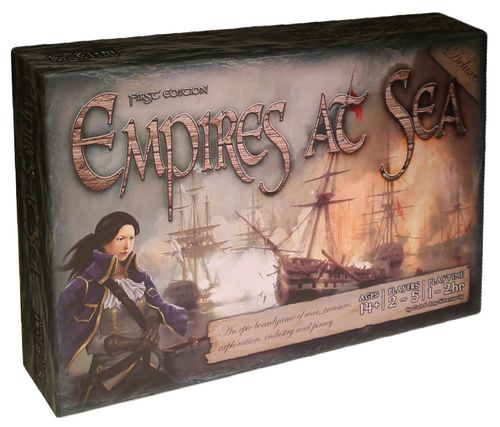
Empires at Sea: Deluxe Edition
Empires at Sea: Deluxe Edition Rulebook
Table of Contents
Table of Contents
The Objective
Empires at Sea is a game of exploration, industry and war, closely tied to the great naval battles between the mid 1600s and 1850.
Each Player takes control of one of the great maritime nations (Spain, Britain, France, the Dutch and the US). The objective is to build the largest empire: taking command of ports, producing resources, launching a powerful fleet, and, if you can, ridding the seas of those mangy Pirates.
The Components
Pieces assigned to each nation are in the following colors:
- American: white/grey
- French: blue
- British: red
- Spanish: yellow
- Dutch: orange
Port Cubes and Fort Tokens
- 50 Port cubes (10 per Nation)
- 20 Fort tokens
Ships
- 25 Transports (5 per Nation, has no masts)
- 20 Frigates (4 per Nation, has two masts)
- 10 Ships of the Line (2 per Nation, has three masts)
- 1 Pirate Ship of the Line (black)
Resources (Steel, Wood and Gold)
Large resources count as five units, small resources count as one unit.
- 15 Large Steel (grey)
- 15 Large Wood (wood)
- 30 Small Steel
- 30 Small Wood
- 40 Large Gold (in four colors)
- 40 Small Gold (in two colors)
Additional Components
- 54 History cards (18 per Era, Era indicated on back)
- 18 Weather cards
- 37 Port cards
- 76 Captain's cards
- 5 Empire Scoring / Table of War cards
- 2 Skull Dice (skull counts as 1)
Types of Cards
History, Weather, Captain and Port cards.
Game Setup
Player Setup
- Players choose their Nation. 2 Player games are between the US and Britain. 3 Player games include France; 4 Player games add Spain; and 5 Player games, the Dutch.
- 2 Player games are played on the Map of the Americas, using those Port cards indicated by a small ruby below the name of their continent.
- For 3 or more Players, game is played on the side of the Map which includes Europe and Africa.
- Players draw a Port card at random (from those for your size game), place it face up in front of them, and place one of their Ports on the corresponding Map icon to indicate control.
- Players each put a Transport adjacent (i.e., directly next to and NOT diagonal to) to their starting Port.
- Shuffle the Captain's cards and deal each Player six cards, which are held in the hand.
- Each Player starts with 2 Gold, 2 Wood and 2 Steel.
- It is useful to set small bowls filled with resources nearby each player.
Set Up History and Weather Cards
- Set aside History cards based on the number of Players (indicated on the front of the card).
- Shuffle the History cards and deal five from each Era (indicated on the back), such that cards from the first Era are on top, second Era cards in the middle, and third Era cards on the bottom. A five Player game is played with only 4 history cards per Era.
- Shuffle the Weather cards and deal fifteen cards face down on the table.
Final Setup Notes
- Place the Pirate Ship of the Line on the red "X".
- Turn order is clockwise, with the starting Player chosen by any means.
- At the end of an Era, the starting Player shifts one position in a clockwise direction.
How to Play
Empires at Sea is played in rounds. Each round starts by flipping over a Weather card and then a History card. The Weather cards will dictate how (and if) Ships can move. History cards describe the general setting for this turn. Follow the instructions on the cards to the extent possible. In some situations, History cards will have no effect.
Next, all Players collect resources based on the ports they control and any Industry cards they played in front of them. You collect one resource per resource icon on a card.
Then Players take turns. Each Player begins their turn by playing one Captain card out of their hand. Many Captain cards have a resource cost, which is shown in the top right corner of the card. Costs must be paid to play these cards. Cards without resource icons, or those with a clock (Captain's Orders, see page 5), can be played without cost. If a Player is unable or unwilling to play a card, they must discard one card in exchange for 3 Gold. You may not pass. Events and Captain's Orders are placed in the discard pile after use. Advancements and Industry cards are placed in front of you and last for the remainder of the game.
After playing their Captain card, Players can take up to 5 actions. History, Captain, or Weather cards that add action(s) or ship movement(s) modify the total permitted action count, and these additional actions can be used in any way outlined below. Each of the following counts as 1 action:
- Sailing: Players may move their ships in any ONE direction as many spaces as they want on the Map, until they reach a border, similar to a rook in chess. You may not move diagonally. Sailing is touch move, no undos. Ships can only sail adjacent to a Port, not on top of one.
- Trading: If a Player has a ship adjacent to a port, that Player may pay one resource to the bank for one resource of the type produced by that port. If the port is controlled by another Player, the owner of the port receives the traded resource, but the bank produces the resource given to the trader. Each unit traded requires 1 action.
- Buy a Port: If a player has a ship adjacent to an uncontrolled Port, they may buy rights to the Port by paying 1 Gold, 1 Steel and 1 Wood. They receive the Port card and place one of their Ports on the Map. This action ends a player's turn. Ports are considered part of a continent if it is connected to a labeled land mass, otherwise it is considered an island.
- Attack: If a Player has a ship adjacent to an enemy ship or Port, they may use an action to attack. This action ends a Player's turn.
At the end of the round, once all players have had their turn, it's time to bribe the Pirate.
Players secretly select an amount of Gold to bribe the Pirates (you may bribe zero), and then all Players reveal their bribe at the same time, placing their bribed Gold on the Treasure Chest near Pirate's Bay.
Whoever bribes the most can control the Pirate Ship of the Line and take up to 5 actions (more or less, subject to the Weather) to sail and attack the other Players.
In the event of a draw, the Pirates do nothing, though the Gold is still placed in the Treasure Chest.
To end the round, Players then refill their hands to six cards drawing from the Captain's Cards. Note that Captain's Orders can be discarded with no effect prior to drawing new cards. Players take cards in turn order. If the Captain Card deck runs out, reshuffle the discard pile and draw from this set of cards to continue the game.
Types of Captain's Cards
Advancements
Advancements have permanent effects that improves a Player's capabilities for the duration of the game. These cards are placed face up in front of you they are played. Advancements are indicated by a sextant in the bottom right corner.
Captain's Orders
Captain's Orders can be played at ANY time on ANY players turn, providing an immediate benefit when most needed. Cards are resolved instantantly. Captain's Orders modifying attack can only be applied to ships under command by that Player. Captain's Orders are indicated by a Clock in the upper right corner.
Events
Events have a one time effect, launching a new ship, claiming a port, or providing resources. Some Events have a cost, but not all. Note that a ship can only be launched if you have the corresponding game piece, and there is an available location directly adjacent to a Port you control.
Industry
Industry cards permanently grant you their specified resource(s) during the Resource Phase of each subsequent round. If an Industry card has a cost, this must be paid to play the card. Some Industry cards have no cost, and can be played in front of you for free. Industry cards should be kept in front of you after they are played.
Fortifications
- Ports can be turned into Forts or Naval Bases by the playing of certain Event cards.
- To make a Fort, take a Fort token and place it under the Port.
- To make a Naval Base, take two Fort tokens and place them under the Port.
- A Fort further fortified becomes a Naval Base, by adding a second Fort token.
- A nation can only have 2 Naval Bases. If a third is captured in an attack, remove one Fort token.
Modifiers
Any ship initiating the attack receives +1 attack (known as the "Weather Gage").
Frigates gain a +1 to attack. Ships of the Line (including the Pirate) receive +2.
Captain's cards such as Advancements or Captain's Orders, as well as some History cards, can provide additional combat modifiers. Note that Captain's Orders can be played at any time (e.g., after an enemy roll would sink your ship).
Combat
Single ship attacks begin by rolling one die and then adding any modifiers from History, Advancements or Captain's Orders. If this total is the same or higher than the defense (plus any modifiers) of the defending ship or port, the attacking Player wins.
If a Port is defeated in an attack, the defeated Player's Port cube is removed and returned to the owner. Then, the winner places their Port cube (if available) on the port and claims that Port card from the loser. Naval Base and Fort tokens are also transfered to the new owner. Ports, Forts and Naval Bases do not counter-attack.
If the attack is against a ship, the defending Player may also roll the die in a counter-attack. If the total counter-attack (including modifiers) is greater than the defense of the attacking Player's ship, the attacking Player's ship is sunk!
Both attack and counter-attack happen at the same time, so both ships can be sunk during combat.
If a ship is defeated in an attack or counter-attack by a Player, the ship is given to the Player who sunk it. At the end of a round, if a Player has no Ports, they may draw a Port card at random and take this Port at no cost. If they have no ships, they may launch a new Transport from any Port they control.
Fleet Attacks
Multiple adjacent ships can be used in an attack, without requiring an additional action. To do so, Players roll an additional die for each ship engaged in the battle and add this to the attack.
No additional ship modifiers or Advancements are applied.
A Ship of the Line may counter-attack up to two attacking ships. Frigates and Transports must chose one ship to counterattack. Targets must be indicated before the roll.
Piracy
- The Pirate is a Ship of the Line. It receives no bonus from Advancements, but Captain's Orders may be used by the controlling player to influence combat.
- Captain's Orders can be used by the bribe winner to aid the Pirate's attacks.
- Ports and Ships attacked by the Pirate are destroyed and returned to their rightful owner, not the Player who has won the bribe.
- If the Pirate is defeated, it is taken by the Player who sunk it. This counts as a Ship of the Line in the Empire Score at the end of the game. There is no longer a Pirate bribe phase.
- Pirate's Bay is located in South America and is treated as a Naval Base.
- If Pirate's Bay is attacked and defeated, the Gold from the Treasure Chest is given to the winner. Players may continue to bribe the Pirate. Pirate's Bay may be defeated multiple times.
How to Win the Game
Empires at Sea ends after all rounds of History are complete. Once complete, tally up the ships on the board, ships sunk, resources in inventory and ports under command to reach a final Empire Score.
| Ships | Resources | Ports |
|---|---|---|
| Transport: 2 Points | 2 Gold: 1 Point | Port: 2 Points |
| Frigate: 5 Points | 5 Wood or Steel: 1 Point | Fort: 5 Points |
| Ship of the Line: 10 Points | Naval Base: 10 Points |
The winner is hereby declared the High Admiral. Losing Players must salute the High Admiral as a greeting (in any context), until such time as a new High Admiral is appointed over the Empires at Sea.
Empire Scoring Card
Ships: Transports: 2 points. Frigates: 5 points. Ship of the Line: 10 points. Both ships captured and those on the map are counted.
Ports: Port: 2 points. Fort: 5 points. Naval Base: 10 points.
Resources: 2 Gold: 1 point. 5 steel or wood: 1 point. Any combination of steel and wood can be used.
Table of War Card
The attacking ship gains +1 to attack, plus the ship bonus indicated below.
- Ship of the Line: +2 attack, 8 defense
- Frigate: +1 attack, 7 defense
- Transport: no attack bonus, 5 defense
- Port: 5 defense
- Fort: 8 defense
- Naval Base: 9 defense