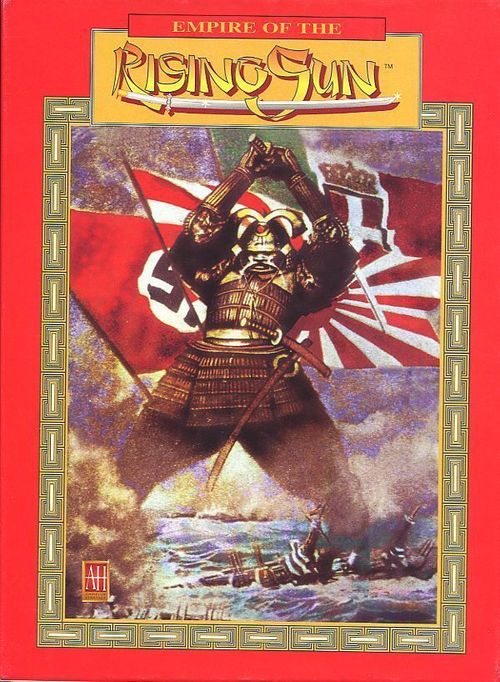
Empire of the Rising Sun
Empire of the Rising Sun Rulebook
Table of Contents
Table of Contents
- Introduction
- Components and Concepts
- Game Mechanics
- The Unit Counters
- Logistics
- Economy
- 32. The Year Start Sequence (YSS)
- 33. Calculation of Basic Resource Points (BRPs)
- 34. China and Russia
- 35. The BRP Spending Limit
- 36. BRP Shipments
- 37. The Murmansk Convoys
- 38. BRP Shipments to Britain
- 39. BRP Shipments to China
- 40. Key Economic Territories
- 41. Economic Warfare
- 42. Strategic Warfare
- 43. Japanese Bombing
- Politics
- 46. Declarations of War (DoWs)
- 47. Surrender of Major Powers
- 48. Restrictions on Chinese Forces
- 49. Nationalist-Communist Chinese Cooperation
- 50. Russo-Allied Cooperation
- 51. Loaned Units
- 52. Minor Countries
- 53. Minor Country Operations
- 54. Conquest of Minor Countries
- 55. Associated Minor Countries
- 56. Minor Allies
- Miscellaneous Rules
- Scenarios
- Appendix I - The Campaign Game
- Appendix II - The 1942 Scenario
- Appendix III - The 1944 Scenario
- Battle Scenarios
- Appendix IV - Pearl Harbor
- Appendix V - The Coral Sea Scenario
- Appendix VI - The Midway Scenario
- Appendix VII - The Leyte Gulf Scenario
- Variants
- The Doolittle Raid
- Examples of Play
- Terrain Effects Chart
- Questions and Answers
Introduction
1. General Description of the Game
1.1 RISING SUN is a two-player game based on the ADVANCED THIRD REICH rules system. RISING SUN can be played by more than two players by sharing control of one or both sides.
1.11 RISING SUN can be combined with ADVANCED THIRD REICH to recreate a game of the global conflict of the Second World War (the "Global War game"). A "Global War game" can be played as a two-player game, with teams of two or three players, or as a multi-player game, in which case each major power has distinct victory conditions (using the ADVANCED THIRD REICH multi-player victory conditions) and the players may negotiate directly with the enemy and with allied major powers. ADVANCED THIRD REICH is required to play a "Global War game". The research rules and the variants may be used when playing a "Global War game".
1.12 RULES REFERENCES: All the rules that apply to RISING SUN are in this rulebook. As RISING SUN is based on the ADVANCED THIRD REICH rules system, several of these rules also apply to ADVANCED THIRD REICH. Every rules reference is to this rulebook unless otherwise specified. References to the RISING SUN appendix are preceded by "RS", and references to the "Global War" appendix are preceded by "GW".
1.13 References to rules that apply to the "Global War Game" or to the research rules are printed in red.
1.2 RISING SUN is played in game turns that each represent three months. The Campaign game (RS Appendix I), which begins in Winter 1941, can last 21 turns, for a normal playing time of 10 to 12 hours. Players who want to play in a shorter time can use the 1942 scenario (RS Appendix II), which can be played in 8 to 10 hours, or the 1944 scenario (RS Appendix III) for 6 hours. The shortest of the battle scenarios (RS Appendices IV-VII) can be finished in half an hour. Many ambitious players will want to combine RISING SUN and ADVANCED THIRD REICH to play a "Global War game".
1.3 Each game turn of RISING SUN consists of two player turns, during which the players move their forces, attack enemy forces, build units and redeploy their forces behind friendly lines.
1.4 Many activities in RISING SUN involve the expenditure of economic resources. These resources are expressed in "Basic Resource Points" (BRPs). Acquiring BRPs through conquest and destroying enemy BRPs are the two key elements of the game.
Components and Concepts
2. Game Terms
2.1 In RISING SUN, terms have the exact meaning defined in the rules. In addition, conventions have developed concerning the use of acronyms, in conversation and in the rules. The following list gathers the definitions of the acronyms used in the rules:
- A: Attacker eliminated. A land combat result, see 15.4.
- Allies, Allied: The Allies are the United States, Great Britain, and the major powers and minor countries that are at war with the Axis. In a "Global War Game", China is not considered an Ally until the start of the Allied player turn following the declaration of war between the United States and Japan (60.1).
- Associated minor countries: a minor country that is associated with, but not completely allied to, a major power; see 55.
- ASW: Anti-Submarine Warfare. This term is used for strategic warfare (SW) units that operate against enemy submarines and for naval units assigned to anti-submarine functions.
- Axis: In RISING SUN, this term includes Japan and the minor countries that join it in the war against the Allies. In a "Global War game", the Axis refers to Germany, Italy and any country that joins them in the war against the Allies. Japan is not considered part of the Axis until the moment it goes to war against a major power other than China.
- BRP, BRPs: Basic Resource Point(s). The BRPs are the fundamental currency of the game, and they are used to measure the economic power of each country, see 33.
- CA, CA1, CA2, CA3: Counterattack by the defending units. A land combat result, see 15.4.
- CAP: Combat Air Patrol. Air units can fly CAP over naval combat groups and air bases during ongoing carrier battles to protect friendly units from enemy air attacks (27.5772A).
- China: for game purposes, China does not include Manchuria, Hong Kong, Taiwan or Hainan.
3. Game Components
3.1 RISING SUN consists of the following items:
- A. Two maps of 56x76 cm.
- B. Five counter sheets.
- C. The RISING SUN rulebook.
- D. The RISING SUN appendix.
- E. The "Global War" rulebook.
- F. The research rules.
- G. Tables and play aids.
- H. Scenario cards.
- I. Two dice.
- J. A supplementary copy of ULTRA.
4. Terrain and Maps
4.1 The maps represent Asia and the northern Pacific Ocean. A hexagonal grid is superimposed on the map to govern movement.
4.11 Front boundaries: A red line divides the map into three fronts: the Pacific, Asia and Southeast Asia. The importance of the fronts shows in many situations, notably the players' choice of options, weather and supply.
4.2 Grid coordinates: Each hex of the grid superimposed on the maps can be located using the grid coordinates.
4.3 Playable hexes: National borders (broken black lines) and geographic features have been rationalized to "fit" the hexagonal grid. The Himalaya hexes (4.31) are impassable to land units. All other hexes are playable.
4.31 Land movement, combat, SRs and the tracing of supply lines are not permitted through Himalaya hexes and "Outback" hexes. This prohibition does not apply to air operations.
4.4 Land and sea hexes: Land terrain is defined as the area in which the coastline borders any body of water. Hexsides must contain land on each side to allow movement or combat across them. Similarly, sea hexsides are defined as any hexside containing blue on each side of the hexes, provided that the blue does not come solely from a river. Naval movement is permitted only across sea hexsides. Red front lines that follow a coastline are treated as sea hexsides for the application of this rule. Lakes that do not completely cover a hexside have no effect on the game and are on the map for aesthetics only.
4.41 Hexsides that are partly sea and partly land are considered to be both land and sea for all applications.
4.42 Any entirely grey terrain is impassable to land units. This terrain is on the map for aesthetic purposes only.
4.43 Land movement:
4.431 Effects of terrain on land movement: Land units must end their movement when they enter terrain containing mountain, jungle or swamp (EXCEPTION: Partisans and the Japanese can move through jungle hexes; the Australians can move through jungle if Allied Variant no. 7 is being played). Armor units that enter these hexes have their mechanized component neutralized (23.2).
4.432 Except at a passage arrow (4.46), ocean and lake hexsides cannot be crossed by land units without naval assistance.
4.44 Units are not adjacent for the application of movement under a pass option, exploitation (15.62) or an SR when they are separated by sea hexsides (not river), including those containing passage arrows.
4.45 The ZoC (12) of armor units does not extend across sea hexsides, including those containing passage arrows, or across rivers.
4.46 PASSAGE ARROW: Red passage arrows allow land units to move or to conduct offensive or attrition combats across sea hexsides in both directions.
4.5 CITIES:
4.51 The term Cities includes capitals and ports.
4.52 Capitals (all cities marked by stars, including those of colonies) and objectives (all cities printed in red) cannot be selected for an attrition occupation (16.5). Infantry and replacement units defending in these cities against armor units in exploitation are not subject to an unfavorable DM (15.24 A). See 29.2 for details of the use of capitals as a source of supply.
4.53 Ports (all cities designated by a black or red circle) can accommodate naval units (27.1). Capital ports combine the functions of port and capital.
4.54 Other cities, indicated only by black dots, have no military importance except their ability to serve as a base for air units (26.11). They have no effect on combat.
4.6 FORTRESSES:
4.61 Singapore loses its fortress status for the rest of the game as soon as a Japanese unit occupies it.
4.62 Allied units defending Singapore against a seaborne invasion, while Singapore is a fortress, receive a DM of +2 in addition to the normal DM of +2 of defending units and the DM of +1 received by units attacked by a seaborne invasion (15.23 A, 15.23 B). Ignore Singapore's fortifications if it is attacked from its land side or by a paradrop (24.1) (EXCEPTION: Allied Variant no. 1).
4.7 ISLANDS: Islands that have beach hexes can be invaded only through those hexes.
4.71 Some very small islands are shown in grey on the map and are on the map for aesthetic purposes only. These islands are not playable, cannot be invaded and are not considered islands in game terms.
4.72 A one-hex island can be invaded, provided that it does not contain nine or more enemy naval factors or an enemy task force at the moment the invasion is resolved (27.432). An island covering more than one hex is not a one-hex island even if it has only one playable hex.
4.721 Although one-hex islands have a reduced capacity to serve as a base for air units (26.11) and naval units (27.112), and no intrinsic anti-aircraft defense, they are considered to have port capabilities for the application of naval activities.
4.73 Supply can be traced to a one-hex island even if it contains no port or beachhead (29.331). Units can also be SRed to, or out of, these islands (27.67).
4.74 ISLAND GROUPS: a number of adjacent islands form a group, as follows:
- A. Aleutian Islands (US): Adak, Attu, Kiska, Unalaska, Umnak.
- B. Caroline Islands East (Japan): Oruluk, Ponape, Truk; Caroline Islands West (Japan): Palau, Ulithi, Woleai, Yap.
- C. Ellice Islands (Britain): Funafuti, Niulakita, Niutao; Fiji (Britain): Vanua Levu, Viti Levu.
- D. Gilbert Islands (Britain): Beru, Makin, Tamana, Tarawa.
- E. Hawaiian Islands (US): Hawaii, Kauai, Maui, Necker, Oahu.
- F. Kurile Islands (Japan): Etorofu, Paramushiro, Uruppa.
- G. Marianas Islands (US and Japan): Guam (US), Saipan (Japan).
- H. Marshall Islands (Japan): Bikini, Eniwetok, Kwajalein, Majuro, Wojte.
- I. New Hebrides (Britain): Efate, Esperitu Santo.
- J. Society Islands (France): Bora, Tahiti.
- K. Solomon Islands (Britain): Bougainville, Guadalcanal, New Georgia, San Cristobal, Santa Isabel.
4.741 CONTROL OF ISLAND GROUPS: At the start of each scenario, each island group is controlled by a major power (EXCEPTION: the Marianas are shared between the American and the Japanese). Once the game has begun, control of island groups is governed by 11.23.
4.8 EFFECT OF TERRAIN ON LAND COMBAT: The Terrain Effects Chart lists the effects of terrain on combat.
4.81 The defensive strength of a unit attacked during an offensive option or a limited offensive operation is equal to its combat factor multiplied by its appropriate DM (15.22).
4.82 Defending units automatically receive a DM of +2 (that is, their combat factor is at least doubled) regardless of terrain (15.23A), this being subject to negative DMs (15.24).
4.83 Land units defending against a landing receive a DM of +1, even if they are simultaneously attacked by land units from an adjacent hex or by paradropped units (15.23 B) (EXCEPTION: this DM of +1 is cancelled if half of the troop factors making the landing are marines - 24.8). Beach hexes give no other advantage to the defender.
4.84 Land units receive a DM of +1 when they defend behind a river or a hexside with a passage arrow if all the attacking land units are on the other side. This DM is cancelled if the defending units are attacked by other land units that are on the same side of the river or passage arrow, or if a paratroop unit is dropped onto the defenders' hex (15.23 C).
4.85 Defending land units receive a DM of +1 when they occupy a mountain, swamp or jungle hex (15.23 D), or when they occupy a hex containing a fortification counter (15.23 F).
4.86 Defensive advantages are cumulative: a unit defending in a mountain hex behind a river, or in a hex containing both mountain and jungle, is quadrupled (DM +4); a unit defending in a fortified jungle hex against a landing is quintupled (DM +5). The effects of terrain on movement and combat are summarized in the Terrain Effects Chart. The interaction between positive and negative DMs is detailed in 15.22.
4.9 MAP BOXES: (Translator's note: the map boxes are the "boxes" found around the map.) All map boxes have unlimited stacking capacity for land units as well as an unlimited capacity to serve as an air or naval base, provided that those units are allowed to enter the box in question.
4.91 U.S. BOX: The U.S. box represents North America. Japanese units can never enter the U.S. box. Newly built American units are placed in the U.S. box (19.33) and American land units can be dismantled or recombined in it (19.34). American naval units can change base to, but not from, the U.S. box (27.25). Naval units can be deployed from the U.S. box to the SW box (42.4, 42.6), but otherwise units can only leave the U.S. box by an initial deployment (20.7) during the SR phase (EXCEPTION: 20.73). Naval units based in the U.S. box are subject to certain restrictions (27.17). The U.S. box is a source of unlimited Allied supply (29.214). The paths of naval activities from the U.S. box are traced on the map from any hex on the East side of the map. American naval forces in the SW box can protect these activities (20.843, 29.343). In a "Global War Game", there is a U.S. box representing the Pacific coast of the United States and Canada and another U.S. box (which is on the ADVANCED THIRD REICH map) representing the Atlantic coast of the United States and Canada (20.516).
4.92 SW BOX: The SW box is used to represent the Pacific sea lanes (for both sides) and the air war over Japan. Japanese and American submarines and ASWs, American SAC factors and Japanese interceptors are turned over to hide their strength and placed in the SW box during the SW unit allocation phase of the YSS and for each Spring, Summer and Fall (42.4, 42.6). Japanese air factors and Japanese and American naval units assigned to SW are openly placed in the SW box. Units can move into or out of the SW box only during the SW phase. American naval units in the SW box can protect an initial deployment (20.843), an SR (20.85), and supply (29.343) from the U.S. box and the South Pacific box to the map. Japanese and Allied raiders can also be subject to interception by naval forces in the SW box (44.4, 44.7).
4.93 AUSTRALIA BOX: The Australia box represents southern Australia (57.2, 57.6). Australian units, including one Fleet factor per turn, can be rebuilt (19.33, 27.85) and dismantled or combined (19.34) in the Australia box. Land and air units of both sides can pass to or from the Australia box via the southern Australian hexes of the map, during their movement, combat or SR (14.21, 20.511, 26.211, 57.2). Naval units can pass between the Australia box and the map via hexes NN7 (West map) and NN24 (East map), which are considered to be eight hexes from the southern Australian ports. Naval units based in the Australia box are subject to certain restrictions (27.18, 57.6). The Australia box can also be reached from the India box and the South Pacific box (20.511, 27.161, 57.23B). Combats can take place in the Australia box (57.3). The Australia box is a source of unlimited Allied supply (29.514) unless it is conquered by the Japanese (57.5).
4.94 SOUTH PACIFIC BOX: The South Pacific box represents the ports and sea lanes that lie farther south and east than the map representation. Japanese units cannot enter or operate in the South Pacific box. Allied units can perform SRs between the map and the South Pacific box and between the Australia box and the South Pacific box (20.153). Naval units based in the South Pacific box are subject to certain restrictions (27.16). The South Pacific box is a source of unlimited Allied supply. Naval activities are traced between the South Pacific box and the map via the hexes of the southeast corner of the map adjacent to the box (NN4, MM4, LL3, KK3 and KK2). SRs and seaborne supply traced between the South Pacific box and the map can be protected by the American naval forces that are in the SW box (20.85, 29.343).
4.95 SOUTH AFRICA BOX: The South Africa box is on the ADVANCED THIRD REICH map, and represents the Allied bases in the South and East of Africa. Axis units cannot enter or operate in the South Africa box. Allied units that perform an SR between Europe and India via the Cape of Good Hope in a "Global War Game" must stop in the South Africa box for one turn during their transit. Allied naval forces in the South Africa box can intercept Japanese raiders in the Indian Ocean (44.45).
4.96 INDIA BOX: The India box represents the off-map ports of western India (58.2, 58.7). Indian units can be built in the India box (19.33). Up to three British infantry or replacement factors can be built in the India box each turn. Other newly built British units arrive in the India box by SR one turn after their construction. British or Indian land units can be dismantled or combined (19.34) in the India box. Land and air units of both sides can pass to and from the India box via the Indian hexes on the West side of the map, during their movement, combat or SR (14.21, 20.512, 26.211, 58.2). Naval units can pass between the India box and the map via hex CC26 (West map), which is considered to be eight hexes from the western Indian ports. Naval units based in the India box are subject to certain restrictions (27.19, 58.7). The India box can also be reached from the Australia box or, in a "Global War Game", from the South Africa, Suez, Basra or Bushire boxes (20.512, 58.23B, 58.29). Combats can take place in the India box (58.3). The India box is a source of unlimited Allied supply (29.214) unless it is conquered by the Japanese (58.6).
4.97 RUSSIA BOX: The ADVANCED THIRD REICH and RISING SUN maps both have RUSSIA boxes. The Siberia portion of the ADVANCED THIRD REICH Russia box represents the portion of Russia that appears on the RISING SUN map, and the Urals portion of the ADVANCED THIRD REICH Russia box and the RISING SUN Russia box represent the part of Russia between the two maps. Axis units can never enter the Russia box. Units built in European Russia must be SRed to the Urals, then SRed the following turn to arrive on the RISING SUN map, while respecting the Trans-Siberian SR limit (20.154, 20.521C). Russian land units can be dismantled or combined (19.36) in the Russia box. Russian units cannot leave the Russia box except by SR.
5. Changes to the Maps
5.1 The RISING SUN map generally uses the same terrain representations as the ADVANCED THIRD REICH map, although the RISING SUN map is at a different scale since a larger area is shown on it. ADVANCED THIRD REICH players will note the addition of jungle and mountain/jungle hexes, as well as the impassable mountains (the Himalayas) and the "outback" on the RISING SUN map.
6. The Counters
6.1 Land unit counters have a number on the left which is the combat factor, followed on the right by a movement factor (EXCEPTION: Replacement counters, which cannot move, have only a combat factor).
(Counter illustrations in the original: infantry, armor, paratroop, partisans, marines, replacement.)
6.2 Army air force and naval air force unit counters also have a combat factor and a movement factor. Fleet and carrier counters have only a combat factor; their movement depends on the type of action in which they are engaged (27.361). Each country is supplied with partial counters (26.7, 27.7). Fast carriers, which are represented by an individual counter, cannot be dismantled into partial counters.
(Counter illustrations in the original: army air force, naval air force, fleets, carriers, CVE.)
6.3 SW counters (submarine, ASW, SAC and interceptors) have only a number, which is their combat strength.
(Counter illustrations in the original: submarine, ASW, SAC, interceptor.)
6.4 BRP counters are used on the BRP track found on each major power's scenario card. The year and season counters are used on the turn track found on the map. The numbered counters are used to select variants (69).
(Counter illustrations in the original: year, season, variant.)
6.5 Each major power has a limited number of air bases (26.12) and beachheads (28). Japan can build Fortifications (28.8) and the Americans can build artificial ports (27.113).
(Counter illustrations in the original: air base, beachhead, fortification, artificial port.)
7. The Scenarios
7.1 At the start of a game of RISING SUN, the players must choose the scenario they want to play. The players can select the Campaign Game, the 1942 or 1944 scenarios (RS Appendices I-III), or one of the short battle scenarios (RS Appendices IV-VII). Players who own ADVANCED THIRD REICH can also play the Global War Game. In each case, the historical situation at the start of the scenario is set out, along with the information and rules applicable to the scenario.
7.2 The information contained in each scenario is as follows:
7.21 Duration: Which defines the length of the scenario.
7.22 Situation: Which indicates which nations are at war and the alignment of minor countries at the start of the scenario. No BRPs are spent for these already-existing states of war.
7.23 Deployment order: Before starting to play, each nation involved in the scenario deploys its forces in the order indicated.
7.24 Movement order: Once the game begins, the order in which each nation will play is indicated.
7.25 Victory conditions: In each scenario the victory conditions are indicated.
7.251 The winner of a scenario is determined only at the end of the scenario, unless a player concedes victory before the end. In a multi-player "Global War" game, more than one major power can fulfill its victory conditions.
7.252 When victory is determined by possession of objective hexes at the end of the game, objectives in neutral countries are not counted for either side.
7.26 BRP level and Growth Rate: The starting BRP level for each major power is indicated. The source of these BRPs, including the base BRPs of each major power, is written in parentheses. The Growth Rate (33.2), which determines the annual rate of increase of BRPs, is indicated under the BRP level of each major power.
7.27 SR limit: The basic SR limit is indicated for each major power (20.1). Sometimes there may be a reference to the rules that govern a possible reduction of this basic SR limit.
7.28 DP allocation: Diplomatic Points (DPs) are not used in RISING SUN. In a "Global War" game, DPs are used in Europe and can be allocated to Japan in 1941.
7.29 FORCE POOL: The starting forces (At start forces) are placed on the map during the scenario's initial placement. The other forces are available as "buildable forces". In each scenario, the number of units of each type available to each major power is indicated between brackets [ ]. The number that precedes the brackets indicates the number of units added to the Force Pool relative to the previous period (or previous line).
7.291 Once units are available, they can be built during the player's construction phase. A player's units eliminated during the course of the game are returned to his force pool as "buildable units". (EXCEPTIONS: Paratroop units, Marines, Japanese army air force units turned into Kamikazes and CVEs cannot be rebuilt the turn in which they were eliminated (24.4, 24.82, 26.841, 27.822). Rebuilding fast carriers requires a certain delay (27.823). Elite Japanese naval air unit factors are rebuilt as normal naval air factors (26.182). Rebuilding naval air units is subject to the naval air personnel training limits (26.183). Dutch units (63.5) and Russian naval units (27.85) can never be rebuilt.)
EXAMPLE: The United States begins the Campaign game with 12 infantry factors, four replacement units, one 1-2 Marine unit, five air factors, 20 carrier-based air factors, four carrier fleets (CVs) in the Pacific and five Fleets of factor 9. During the Summer 1942 construction phase, three infantry factors, one 1-2 Marine unit, five air factors, three escort carriers (CVEs) and one factor-9 fleet are added to the American Force Pool. These units can be built in the Summer 1942 construction phase. In addition, in the Spring 1942 SR phase a CV is placed in the U.S. box without spending BRPs, and in the Summer 1942 SR phase an additional CV is placed in the U.S. box for free. The other additional American units can be built when they are added to the American Force Pool during the Winter 1942 and following construction phases.
7.292 Air Base counters: The number of air base counters (26.12) available to each major power is indicated.
7.3 Deployment Limits: A major power may be required to place a minimum number of specific units in certain places on the map. Additional forces can be added in these places while respecting the stacking limits. The stacking limits apply only to the initial deployment; once the scenario has begun, forces can move freely.
EXAMPLE: The United States must begin the Campaign game with two infantry factors, one replacement unit and two Philippine 1-2 infantry units in the Philippines. These units can be withdrawn or reinforced once the scenario has begun.
7.31 CONTROL: Indicates the territories that are controlled by the major powers at the start of the scenario. During placement, units may be placed only in controlled territories. A player cannot place his units in a territory controlled by another major power, even if it is an Ally. Thus, the United States and Britain cannot begin the game by placing units in China, although they may do so later in the game.
7.32 SW Surplus: At the start of the 1942 and 1944 scenarios, both sides can build SW units. The American begins the 1944 scenario with a surplus of six submarine factors from the previous year.
7.4 SCENARIO CARDS: Each scenario card contains a summary of information for each major power in each scenario. In addition, each scenario card has a track to indicate the BRP level using the 100, 10 and 0 counters. Players may write down the BRP level on a sheet of paper, as a precaution against a possible "bump of the table" scattering the marker counters.
7.5 Starting a game: Each player places his forces on the map, respecting the deployment order, and places his buildable forces in the Force Pool of his scenario card. Each major power's BRP counters are placed on the BRP track, and each air base, beachhead and each partial air or naval counter is made available.
7.51 Once all the starting forces have been set up, the SW unit construction phase begins for the 1942 and 1944 scenarios.
7.52 The game begins as indicated in the scenario's movement order.
8. Tables
8.1 The following tables are found on separate sheets to make them easy to consult during play:
- A. Combat Result Table
- B. Attrition Table
- C. Air Defense Table
- D. Air Attack Table
- E. Air Force Nationality DRM Chart
- F. Naval Interception Table (Pacific)
- G. Naval Search Table
- H. Naval Surprise Table
- I. Fleet Combat Table
- J. Naval Nationality DRM Chart
- K. Naval Reconstruction Table
- L. SW Ratio Table
- M. SW Effect Table
- N. Chinese Resistance Table
- O. Japanese Resistance Table
- P. British Resistance Table
- Q. Russian Resistance Table
- R. BRP Costs Chart
- S. Minor Country Forces Chart
- T. Unit Conversion Table
- U. Pearl Harbor Surprise Table
- V. SW Research Table
- W. Naval Combat Sequence of Play
- X. Patrol Sequence of Play
- Y. Year Start Sequence of Play
9. Sequence of Play
9.1 DETERMINATION OF BRP LEVEL AND ORDER OF PLAY:
9.11 CAMPAIGN GAME: In the Campaign game, the Japanese begins the game by moving in Winter 1941; the Allies are considered to have played. The Chinese moves in turn and completes the Winter 1941 turn. After the 1942 YSS, the Japanese moves first in the Spring 1942 turn (thus obtaining a double move relative to the American and the British, but not to the Chinese), after which the American, the British and the Chinese move together. The Japanese continues to move first for the rest of 1942. The Allies move first in 1943, thus obtaining a double move in Winter 1942-Spring 1943. After Spring 1943, the Allies move first for the rest of the game. BRPs do not count and the initiative does not change as in ADVANCED THIRD REICH.
9.12 1942 SCENARIO: In the 1942 scenario, the Japanese moves first in Summer, Fall and Winter 1942. The Allies move first in Spring 1943, thus obtaining the double move described in 9.11. After Spring 1943, the Allies move first for the rest of the game.
9.13 1944 SCENARIO: The Allies move first throughout the 1944 scenario.
9.14 GLOBAL WAR GAME:
9.141 JAPAN: Before its entry into the war, Japan moves after the Axis countries in Europe and the Allies, including the Russians and Americans who are still neutral. China moves after Japan. As soon as Japan goes to war with a major power other than China, Japan moves at the same time as the other Axis countries and Japan's BRPs are included in the Axis total for the determination of the initiative.
9.142 RUSSIA: A declaration of war between Russia and Japan does not cause the Russian BRPs to be counted for the Allies. Russian BRPs are counted for the Allies after Germany has declared war on Russia.
9.143 THE UNITED STATES: Before the United States' complete participation in the war, the United States' BRP level is recorded separately for Europe and the Pacific (33.821), and American BRPs are not counted in the Allied total. When the United States goes to war with Germany or Japan, the American BRPs for that theater of operations (only) are included in the Allied total. Once the United States is at war with Germany and Japan, all American BRPs are included in the Allied total unless the United States signs a separate peace with all the surviving Axis major powers following a bad election result in the United States (GW Appendix IV).
9.144 CHINA: Chinese BRPs are included in the Allied total only after the entry of the United States into the war against Japan. From that moment China moves with the Allies.
EXAMPLE: In a Global War Game, Japan declares war on the United States in Winter 1941, after which the Axis and the Allies carry out their Winter 1941 turn. Then the Chinese moves, ending the Winter 1941 turn. After the 1942 YSS, the Japanese BRPs are added to those of the Axis countries in Europe to obtain the Axis total in order to determine the initiative, and the Chinese BRPs and those of the United States on the Pacific side are added to the Allies. The BRPs of the United States on the European side are added to the Allied total only after Germany and the United States are at war.
9.2 SEQUENCE OF PLAY DURING THE PLAYERS' TURNS:
9.21 The detailed sequence of play must be consulted regularly by the players during the game. The broad outlines of each player turn are summarized below.
9.22 DECLARATIONS OF WAR (DoWs): In a Global War Game, each major power, at the start of its player turn, announces any declarations of war it wants to make for that turn and immediately pays the BRP cost associated with each declaration of war.
9.23 DECLARATION OF OPTIONS: Each major power announces its options for each front. Each major power pays 15 BRPs for each offensive option.
9.24 MOVEMENT: Once the options have been declared, the movement of units and patrols (27.319) begins. Supply is determined during the movement phase (29.4).
9.25 COMBAT: After all movement is finished, the combats are carried out. The combat of limited offensive and regular offensive operations is resolved before attrition combats. Exploitation movement and combat are resolved after attrition combats.
9.26 UNIT CONSTRUCTION: After the post-combat adjustments, including the removal of unsupplied units, "buildable" units may be built (19).
9.27 STRATEGIC REDEPLOYMENT (SR): During the SR phase, units may be SRed (20) and BRPs transited to subsidize friendly Nations (36).
9.3 MINOR COUNTRY TURNS: The turn of independent minor countries takes place only in Europe in a Global War Game, and is fully described in the ADVANCED THIRD REICH rules. In RISING SUN, there are no independent minor countries and therefore no independent minor country turn.
9.4 SECOND PLAYER'S TURN: The opposing side moves in its turn, repeating the phases of play described above.
9.5 SW RESOLUTION AND DEPLOYMENT: SW is resolved, after which the SW forces are deployed for the following turn (42.6).
Game Mechanics
10. Stacking
10.1 The basic stacking limit is two land units per hex, regardless of their combat factor. There are several exceptions to this general rule:
10.11 Marine units do not count against stacking limits and can be added to any legal stack. This exception applies even if the marine unit moves as an infantry unit, without making a landing (24.7).
10.12 Paratroop units do not count against stacking limits and can be added to any legal stack. This exception applies even if the paratroop unit moves as an infantry unit, without paradropping. This does not apply to a paratroop unit making a landing (24.5).
10.13 Up to five land units can stack on a beachhead counter (28.5).
10.14 Armor units can be overstacked in a breakthrough hex (15.7). This overstacking must disappear at the end of the attacker's SR phase, or the excess units of his choice will be eliminated.
10.15 A defender can temporarily overstack if he is forced to do so when retreating units during an enemy attrition phase (16.54). The defender must remedy this overstacking during his next movement phase. If he is unable to do so, he must eliminate the excess units of his choice (16.56).
10.16 There is no stacking limit for the map boxes (4.9).
10.2 Stacking limits do not apply to land units during movement, but they apply at the end of the movement phase.
10.21 Stacking limits do not apply to land units when they embark on fleets. A land unit cannot end its movement or combat phase embarked on a fleet.
10.3 The stacking of air or naval units, whether in the air or at sea, is unlimited. There are limits to the air and naval factors that can be based at air bases (26.1) and in ports (27.1).
10.4 There are certain restrictions on stacking together units of allied Nations in the same hex (49.4, 50.1). A stack that is not expressly forbidden is permitted.
11. Control of Hexes
11.1 The territories controlled by each major power at the start of a scenario are indicated in the Appendix relating to the scenario.
11.2 Once the game has begun, control of land hexes is determined as follows:
11.21 Control of an enemy or neutral hex is obtained by occupying it or passing through it. Each land hex is controlled by the last Nation to have had a unit on it or to have passed over it, taking into account 11.22, 11.23 and 11.5.
11.22 The conquest of a minor country gives the conqueror control of all the hexes of the conquered country, except hexes containing an enemy unit and hexes in the same supply zone (29.332) as an enemy unit. Thus the Japanese gains control of all the hexes of each East Indies island when he takes control of Batavia, Palembang and Balikpapan, just as he controls all the hexes of the Philippines after the capture of Manila, other than hexes containing enemy units and their supply zone.
11.221 If two or more major powers cooperate in the conquest of a country (54.7), the conqueror must decide, at the time of the conquest, which hexes each of the players will control. The conqueror determines control of hexes as he sees fit (EXCEPTION: the capital is always controlled by the conquering major power that was the first to enter it).
11.23 Control of island group hexes: To have control of all the islands of a group (4.74), a player does not need to occupy each island of the group, although he may do so. If, at the end of his combat phase, the phasing player has at least one unit on an island of a group and none of the other islands of the group is occupied by an enemy land, air or naval unit, an air base, beachhead, artificial port, fortification or rocket base counter, then all the islands of the group come under the phasing player's control.
EXAMPLE: The Marshall Islands group is composed of Kwajalein, Wotje, Bikini, Majuro and Eniwetok. A Japanese infantry occupies Kwajalein, and a Japanese air base has been built on Eniwetok. If an American force successfully invades Kwajalein and Eniwetok, eliminating the Japanese infantry and the air base, Wotje, Bikini and Majuro will come under American control without having to invade these islands.
11.24 Control of hexes cannot be transferred from a major power to an ally. The movement of a land unit through hexes controlled by an allied major power does not change control of those hexes. A major power can make SRs, place air bases or artificial ports, and trace a supply line through hexes controlled by its allies (20.2, 26.122, 27.113, 29.322).
11.25 Hexes controlled by the United States and Britain are controlled jointly by both countries. In a Global War Game, this applies only after the United States has declared war on the Axis.
11.3 When an "Ex" result occurs during a combat and the attacker loses all his land forces, or for any other reason is unable to occupy an attacked hex with at least one land unit (15.5), the attacked hex remains in the hands of the defender. Thus a hex does not automatically pass to the attacker's control when all the defenders are eliminated. An attacker must advance a land unit into a hex to gain control of it (EXCEPTION: island groups - 11.23, hexes defended by partisans - 25.5). Likewise, if a paratroop unit is dropped onto an enemy unit and both forces are eliminated, the defender keeps control of the hex.
11.4 Placing an enemy-controlled hex in the ZoC of a friendly armor unit does not change the status of the hex. A land unit must physically enter a hex to take control of it.
11.5 An isolated hex controlled by the non-phasing player, which is neither occupied by nor adjacent to a unit of that player at the start of the phasing player's turn, passes under the phasing player's control at the end of his post-combat supply determination phase, provided that it is adjacent to a supplied hex controlled by the phasing player. These hexes immediately receive supply if a supply line can be traced to them, although they cannot be used to trace a supply line through them until the following turn. Hexes acquired in this way cannot be used by the phasing player for air or naval units during the movement and combat phases, but pass under the phasing player's control and receive supply before his SR phase.
12. Zones of Control (ZoCs)
12.1 Armor units exert a ZoC into the six hexes adjacent to their own, except in certain cases described in 12.12.
12.11 ZoCs extend into clear terrain and across friendly fortresses and fortification hexsides into clear terrain hexes.
12.12 ZoCs do not extend across rivers, sea hexsides and passage arrows, nor across enemy fortresses or fortification hexsides, nor into or out of jungle, mountain, swamp or mountain/jungle hexes. Armor units that are in jungle, mountain, or jungle/mountain have no ZoC (4.431).
12.2 ZoCs affect enemy movement (14.63), unit construction (19.3, 25.23), paradrops (24.1) and supply lines (29.32).
12.3 An armor unit whose mechanized component is temporarily neutralized behaves like an infantry unit and no longer has a ZoC until its mechanized component is restored (23.2).
13. Selection of Options
13.1 OFFENSIVE OPTION: A major power must pay 15 BRPs for each offensive option it chooses (EXCEPTION: 13.8). A major power can thus spend 45 BRPs on offensive options in a single turn if it chooses the offensive option for all three fronts.
13.11 A major power that has chosen an offensive option for a front must carry out a land combat or conduct an offensive air or naval mission against enemy units on that front. This obligation is fulfilled even if enemy units intercept and prevent the accomplishment of the mission.
13.2 ATTRITION OPTION: The attrition option requires no BRP expenditure. A major power can select an attrition option for a front even if none of its units will engage in attrition combat on that front. Combat is not an obligation for the selection of an attrition option. A player will prefer to choose an attrition option rather than a pass option in order to be able to enter uncontrolled hexes during his movement phase, even if he will not be in contact with enemy land units at the end of his movement phase.
13.3 LIMITED OFFENSIVES: Limited offensive operations can only be conducted on a front where an attrition option has been chosen. Limited offensive operations require an expenditure of BRPs according to the forces used. A maximum of 14 BRPs can be spent on limited offensive operations on a front.
13.4 PASS OPTION: No BRPs are spent for a pass option.
13.41 A pass option must be selected on a front in the following circumstances:
- A. An allied major power chooses to conduct an offensive option on a front and the other major powers do not want to or are unable to do so. If one major power chooses an offensive option on a front, the others must do the same or take a pass option.
- B. If a major power finds itself unable to fulfill the obligations of an offensive option (13.11), it must pass instead and regains the 15 BRPs it paid for the offensive option.
13.5 More than one option on the same front: If a major power chooses an offensive option on a front, the major powers allied to it must join the offensive option or pass. A major power cannot select an attrition option on a front where another major power allied to it has selected an offensive option, even if no attrition combat is envisaged. In a multi-player game, if the allies cannot agree on the option to take on a front, the player who selects the offensive option prevails. His allies must then select an offensive option or pass on that front. This restriction applies only at the moment an alliance is activated.
13.51 When two or more major powers join to conduct an offensive option, each major power must pay 15 BRPs.
13.6 If two major powers conduct attrition options on a front, and both want to conduct limited offensive operations, no more than 14 BRPs in total can be spent. In a multi-player game, if the two major powers cannot agree on the limits of the forces they want to involve in limited offensive operations, taking into account the 14 BRP limit, then each can spend no more than 7 BRPs. If three major powers are involved, then they can spend only 4 BRPs.
13.7 OPERATIONS ACROSS FRONT BOUNDARIES:
13.71 The hex receiving the action determines the option required. Operations involving naval units are limited by the 20-hex range of naval units, rather than by front boundaries.
EXAMPLE: Japanese naval units based at Okinawa, in the Pacific front, can operate off French Indochina, in the Southeast Asia front, provided that an offensive option or an attrition option with limited offensive operations has been declared in the Southeast Asia front. Japanese naval units cannot operate off India, due to the 20-hex range limit.
EXAMPLE: Japanese land units in French Indochina can attack adjacent units in China during a Japanese offensive option in Asia, even if the Japanese has chosen an attrition or pass option in Southeast Asia. Likewise, Japanese units can be counted for attrition on the Asia front, even if the Japanese has selected an offensive or pass option in Southeast Asia. In both cases, the restrictions on movement during a pass option do not prevent Japanese units from moving to the Chinese border.
13.72 A unit can perform an action on two fronts by conducting an attack against units in several hexes located on different fronts (15.33). A unit in a hex containing a front boundary cannot attack units on two fronts separately; it can count toward the attrition total for both fronts or toward attrition on one front and make an attack on the other.
13.73 Armor units cannot exploit from one front into another, because the terrain along the front boundary between Asia and Southeast Asia prevents it (EXCEPTION: 15.658).
13.8 FREE JAPANESE OFFENSIVE OPTION: The Japanese can always take an offensive option against Allied units in Japan (Kyushu, Shikoku, Honshu and Hokkaido), without paying BRPs, regardless of the option chosen by the Japanese for the Asia front or the number of BRPs available for other uses.
14. OFFENSIVE Option - Movement
14.1 During an offensive option, a player can move all, some or none of his units. A player moves his air units first, then his naval units, then his land units.
14.11 VOLUNTARY ELIMINATION OF UNITS: Before the start of his movement phase, a player can voluntarily eliminate units belonging to him and return them to his Force Pool. Units that have been voluntarily eliminated cannot be rebuilt during the turn in which they were eliminated.
14.12 Air base counters cannot be voluntarily eliminated, but an air base can be "recycled" each turn (26.123).
14.2 All movement costs one movement factor per hex traversed. Movement factors cannot be transferred from one unit to another and cannot be accumulated from one turn to another. Land units must stop when they enter a jungle, mountain, swamp or jungle/mountain hex (EXCEPTION: Partisans and Japanese land units can move through jungle hexes; Australian units can move through jungle hexes if Allied Variant 7 has been played).
14.21 OFF-MAP MOVEMENT: Entering or leaving the map is not permitted during the movement phase, except for Base changes to the U.S. box (27.25), and movement to and from the Australia box or the India box (57.2, 58.2). Units cannot leave the map unless they have sufficient movement capacity or range to do so. Movement between map boxes during the movement phase is forbidden.
14.3 AIR UNITS: Air units can change base during their movement phase (26.2). Air interception missions (26.43) can be carried out after air units change base and before the movement of naval units and the determination of supply.
14.4 NAVAL UNITS: Naval units can conduct patrols or change base during the movement phase. These base changes are subject to interception by enemy air or naval units (27.21).
14.5 SUPPLY: Supply is determined during the movement phase, after air and naval movement but before land movement (29.4).
14.6 LAND UNITS: Land units can move up to the maximum of their movement factor with the following restrictions:
14.61 Land units that are not supplied cannot move (29.531).
14.62 Armor units that are partially supplied have their movement factor reduced to two (23.2, 29.52B).
14.63 The ZoC of a hostile armor unit affects movement. It costs a land unit one additional movement factor, for a total of two, to leave a hex that is in the ZoC of an armor unit, or to go from one such hex to another. There is no additional cost to enter a ZoC. ZoCs have no effect on naval or air movement.
14.64 Land units must pay an additional movement factor to carry out an overrun (14.81).
14.65 Land units can move together, for convenience and for the execution of overruns (14.8). A land unit can defer part of its movement to wait for another land unit to join it, then continue its movement, alone or with the other unit, up to the maximum of its movement factor.
14.66 Land units must stop when they enter a jungle, mountain, swamp or jungle/mountain hex (EXCEPTION: Partisans and Japanese land units can move through jungle hexes; Australian units can move through jungle hexes if Allied Variant 7 has been played - 4.431).
14.7 Land units cannot move onto or through hexes occupied by enemy land units except when carrying out overruns (EXCEPTION: paratroop units can be dropped onto enemy land units - 24.14).
14.8 OVERRUNS: Overruns can only be carried out during an offensive option. Overruns are carried out during the regular or exploitation movement phase, or following a sea transport. Units that are overrun are affected by positive and negative DMs (15.22).
14.81 Overruns are carried out by moving a maximum of two units (EXCEPTION: the presence of paratroop or marine units), one of which must be armor, onto an occupied enemy hex with a ratio of 6-1 or more. Each unit carrying out the overrun must expend one additional movement factor to enter the overrun hex. If the units carrying out the overrun do not have enough movement points, then the overrun cannot be carried out.
14.82 An overrun can be supported by available air units. The defender can provide defensive air support to his overrun units. This defensive air support can be intercepted by air units that are not engaged offensively and are within range of the overrun. These air combats are resolved immediately.
14.821 If defensive air support reduces the ratio to less than 6-1, the overrun cannot be carried out. During the combat phase following the aborted overrun, the units that could not carry out the overrun, including the supporting air units, must attack normally the enemy units that were defending the hex they were attempting to overrun. They can be assisted in this attack by other units.
14.822 Paratroop units cannot assist overruns.
14.83 Units that are overrun are eliminated. At the moment of the overrun, a die is rolled to determine the attacker's losses. On a result of "1" the phasing player suffers an exchange result (15.41). These losses can be taken by any unit, air or land, that took part in the overrun. The phasing player suffers no losses on any other die result. Both sides immediately remove losses during the movement phase.
14.84 After an overrun, the surviving units can continue their movement up to the maximum of their capacity, conduct normal combats and, if able, exploitation movement and combats during that turn. Air units that provided support for a successful overrun are turned over at the end of their movement phase.
14.85 Other units that have not yet moved can enter a hex that has been overrun without paying the additional cost required by 14.81.
14.86 Overruns are forbidden in the Southeast Asia front during Summer turns (31.1).
14.87 Overruns cannot result from a landing (27.43), which are resolved after regular movement and combat and before exploitation.
14.88 A unit in a jungle, mountain, swamp or jungle/mountain hex cannot be overrun. Units in a capital hex, an objective hex or a beachhead can be overrun if all the required conditions are met.
EXAMPLE: A Russian 4-3 armor unit and a 3-2 infantry, supported by five air factors, overrun a Japanese 1-2 infantry unit. The Russian player decides to overrun a second Japanese 1-2 infantry, but he can no longer use his 4-3 armor unit and the 3-2 infantry because they do not have enough movement points. So the Russian player moves a second 4-3 armor unit (14.85) into the hex that had contained the first Japanese 1-2 infantry, then conducts a second overrun using the second 4-3 armor unit and 8 additional Russian air factors.
14.9 MOVEMENT FROM ONE FRONT TO ANOTHER: Air and land units that move from one front to another must comply with the rules in force for the front they are entering, including the restrictions resulting from the option chosen for that front. Units that move near a front boundary to attack units across that front boundary, in offensive or attrition combat, are moved in accordance with the option used on the front where the enemy units are located.
15. OFFENSIVE Option - Combat
15.1 GENERAL: The combat phase of an offensive option proceeds as follows:
15.11 The attacker announces all his air and naval missions, except those launched from a carrier (26.311, 27.44) and the air missions that will take place during exploitation, and places his naval and air units accordingly. Counter-interceptions of defensive naval interceptions by air or naval units that are not engaged are not offensive missions, so they are not announced at this time.
15.12 Air interception missions (26.43) and air attacks from air bases against naval units in port (26.452) are resolved. Some air interception or patrol missions may have been carried out during the movement phase (14.3, 27.319). At this point, the attacker has not yet engaged in land attacks.
15.13 The defender announces his defensive air support (26.51) for his land units and the naval interceptions (27.5) of the attacker's naval missions. Forces that succeed in an interception can receive defensive air cover (26.52).
15.14 The attacker announces his interceptions of defensive air support by his land-based air units (26.44) and the naval counter-interceptions of defensive naval interceptions. Counter-interception forces can receive air cover (26.46). The combats resulting from counter-interceptions, then interceptions, including attacks by land-based air units on naval units at sea (26.453, 27.5631), are resolved.
15.15 Successful sea transport missions (27.42) are carried out, and all of the attacker's carrier air missions (26.311, 27.44), including air support (26.4212), interception of enemy defensive air support (26.445), and base attacks (26.45281B), are first announced and then resolved.
15.16 The attacker carries out the paradrops (24) that he wishes to make.
15.17 The attacker announces and resolves all the land attacks he wishes to make, in the order he wants, using the Combat Result Table (CRT). The attacker resolves his announced attacks and, if he wishes, advances the victorious units of a combat into the hex previously occupied by the enemy units (15.5), before beginning the next combat. Landings (27.43) are carried out after all regular land combats have been resolved. Once all attacks are made, the exploiting armor units are moved onto the breakthrough hex (15.62). All of the attacker's naval missions, patrols included, are completed and the naval units employed return to port. All of the defender's forces still on patrol also return to port.
15.18 The exploitation movement (15.65) of the exploiting armor units takes place. Offensive and defensive paradrops and air (but not naval) activities can be engaged by units that have not yet been activated. Exploitation attacks are resolved (15.66).
15.19 The combat capabilities of air, naval and paratroop units are described in more detail in the rules relating to those units.
15.2 LAND COMBAT DETAILS:
15.21 The attacker can attack with all, some or none of his land units that are adjacent to enemy units (or on top of them, for paratroop units) (EXCEPTION: replacement counters, even if adjacent to enemy units, cannot attack except in the case of a "CA" result). An attacker is never forced to attack except when he invades a defended hex, carries out a paradrop onto an enemy land unit, suffers a "CA" result from a counterattack by the defender, or an overrun attempt has been thwarted by defensive air support (14.821).
15.211 Attacks from the map to the map boxes, and vice versa, are not permitted. Land combats in the Australia and India boxes are resolved by attrition (57.3, 58.3).
15.22 DEFENSIVE MULTIPLIERS (DMs): A unit's attack strength is always equal to its printed combat factor. A unit's defensive strength is equal to its printed combat factor multiplied by its net DM. A unit's defensive strength can increase (15.23) or decrease (15.24) through the effects of terrain or other factors, but it cannot fall below the value printed on the counter(s). All positive and negative DMs are taken into account to determine the net DM of defending units (15.26).
15.23 POSITIVE DMs: Units receive a positive DM (their defensive strengths are increased) under the following conditions:
- A. Defending units automatically receive a DM of +2, regardless of terrain.
- B. Units defending against a landing receive a DM of +1, even if some of the attacking units are units paradropped onto the defending hex or attacking from a contiguous land hex (EXCEPTION: units defending against a landing do not receive the +1 DM if half of the attack factors are marines - 24.8).
- C. Units defending against an attack across a river or a passage arrow receive a DM of +1. This DM is cancelled if some of the attacking units do not attack across the river or passage arrow. Likewise, a paradrop onto the defending units cancels the terrain advantage of a river or passage arrow.
- D. Units defending in a jungle, mountain or swamp hex receive a DM of +1. Units defending in a jungle/mountain hex receive a DM of +2 (EXCEPTION: Japanese units attacked by Australians, Allied Variant 7, and Chindits, Allied Variant 8).
- E. Allied units defending in Singapore, while it is still a fortress, against a landing receive a DM of +2 in addition to the base DM of +2 and the DM of +1 against landings. Units in Singapore do not receive the +2 DM associated with fortresses if they are attacked from the land side of the city or by a paradrop (EXCEPTION: Allied Variant 1).
- F. Japanese units defending in a hex containing a fortification counter receive a DM of +1.
15.24 NEGATIVE DMs: Land units receive a DM of -1 in the following cases:
- A. Infantry and replacement units that are attacked by armor in exploitation, unless they are defending a capital, an objective or a beachhead. Partisans, marines, paratroopers and armor units (except in the case of 15.241) do not suffer the -1 DM when they are attacked by armor in exploitation.
- B. Nationalist Chinese units defending outside China, unless the Chinese resistance level is +1 or higher. Unlike ADVANCED THIRD REICH, minor country units in the Pacific theater are not subject to the -1 DM when they defend outside their territory.
- C. Western Allied infantry and replacement units during the turn of a Japanese surprise attack (66.2), and Nationalist Chinese land units if China's resistance level is -3 or lower.
15.241 Partisans are never subject to negative DMs. Armor units that are treated as infantry (23.2) because they are in jungle, mountain, swamp or jungle/mountain (4.431), or because of supply problems (29.52B, 29.531) or out of fuel (30.2D), are subject to negative DMs in the same way as infantry.
15.25 DMs, positive or negative, also apply to units that are overrun (14.8).
15.26 CUMULATIVE EFFECTS OF DMs: Units can be subject to positive and negative DMs for several reasons in a turn. These effects are cumulative, but no unit can defend below its printed combat value.
EXAMPLE: A 2-3 armor unit is attacked in clear terrain. It receives a DM of +2 (15.23A) - its defensive value is four.
A 3-2 infantry unit, in clear terrain, is attacked across a river by an armor unit in exploitation. It receives a DM of +2 (15.23A), a DM of +1 (15.23C) and a DM of -1 (15.24A), for a net DM of +2 - its defensive strength is six.
A Chinese infantry unit, in clear terrain in Burma, with a Chinese resistance level of zero, is attacked by an armor unit in exploitation. It receives a DM of +2 (15.23A), a DM of -1 (15.24A) and a DM of -1 (15.24B), for a net DM of zero. Its defensive value is 2, since a unit cannot defend below its printed combat value (15.22).
A Russian 4-3 armor unit and a Russian 3-2 infantry in clear terrain are attacked by armor in exploitation. Both Russian units receive a DM of +2 (15.23A), but the infantry unit receives a DM of -1 (15.24A), which gives a total defensive value for the Russian units of eleven.
15.3 All land units defending in a hex must be attacked collectively. The combat factors of the defending units are added together, as if there were only one unit. The attacker cannot attack them separately.
15.31 If the attacker has more than one land unit in a hex, he is not obliged to make them attack the same enemy hex. For example, one land unit can attack to the northeast while the other can attack to the southeast, or not attack at all.
15.32 A land unit cannot split its combat factor and make two or more different attacks. The combat factor must be used in full for one attack.
15.33 Attacking units in a single hex can attack several enemy hexes in a single attack. All attacking units must be adjacent to the defending units involved in the attack. In these attacks, air units providing offensive or defensive support can be placed in any of the attacked hexes. Likewise, a paratroop unit can be paradropped onto any attacked hex (24.2).
15.34 Attacking units from one hex can attack enemy units in several hexes that are on different fronts in a single attack (15.33), provided that the attacker has paid the BRP cost for the attack on both fronts, either by declaring an offensive option or by paying for a limited offensive operation for each front. A limited offensive on one or both fronts must include all the attacking units. It is therefore possible to pay twice the BRP cost for attacking units.
15.35 A land unit can be attacked only once during the regular combat phase (EXCEPTION: a "CA" result on the Combat Result Table and an attack by the Western Allies and the Russians against the same hex - 50.3). This does not prevent a second attack on a defending unit during the exploitation phase.
15.36 If, following a retreat due to an attrition option, the defender has more than two units stacked in an attacked hex, in excess of the stacking limit (10.1), only two of these units can defend. The defender determines the choice of these units. The excess units, which are not taken into account for the defense, are eliminated along with the other defending units on a "D" result, and, unless the attacker has a smaller force and at least one defending unit survives, are eliminated by an "Ex" result. The excess units are not taken into account to determine the attacker's losses following an "Ex" result or the ratio of a counterattack, although they will share the fate of the defending units if the defender must counterattack.
15.361 Rule 15.36 does not apply if the stacking excess is permitted (beachhead, marines, paratroopers).
15.37 Only two land units can attack from one hex (EXCEPTION: armor units on breakthrough hexes (15.663), marines and paratroopers). When all preparations for attack and defense are complete, each attack is resolved. The attacker calculates the strength of his attacking units, including supporting air factors and fleet factors in coastal bombardment. The defender calculates the strength of his defending units, including defensive air support and taking into account the net DM due to terrain and other factors (15.23, 15.24). The total of the attacking strengths is compared to that of the defending strengths, which gives a ratio (fractions are ignored), a die is rolled and the odds column given by the ratio is consulted on the Combat Result Table (CRT). The attacker cannot choose a column on the CRT that is weaker than the one given by the ratio. Attacks greater than five to one (5-1) are permitted, but it is the 5-1 column that is consulted to resolve the attack. Likewise, attacks below 1-4 are permitted, but in that case the result is automatically the elimination of the attacker without losses for the defender.
EXAMPLE: 20 factors attacking 10 is a 2-1 attack; 19 factors attacking 10 is only a 1-1 attack; 5 factors attacking 13 is a 1-3 attack.
15.4 COMBAT RESULTS TABLE (CRT):
Combat Results Table - 15.4
| Die | 1-4 | 1-3 | 1-2 | 1-1 | 2-1 | 3-1 | 4-1 | 5-1 |
|---|---|---|---|---|---|---|---|---|
| 1 | Ex | Ex | Ex | Ex | Ex | Ex | Ex | Ex |
| 2 | A | Ex | Ex | CA | CA2 | CA2 | CA3 | D |
| 3 | A | A | CA | CA |
15.41 COMBAT RESULTS:
A: ATTACKER ELIMINATED: All attacking air and land units are eliminated. Fleets that conducted coastal bombardments are eliminated at the rate of one fleet factor for every three used (27.415). Fleets that transported land units that failed their landing are not affected and return to their port. CVEs that provided land support are eliminated at the rate of one CVE factor for every three used (26.4213).
D: DEFENDER ELIMINATED: All defending units, including air units in defensive support, are eliminated.
Ex: EXCHANGE: The side with the fewer combat factors loses its force entirely. The larger side must lose at least an equal number of factors. The attacker must match the value of the defending units modified by their net DM if the exchange is due to the die roll by the attacker. If the exchange follows a counterattack, DMs are not taken into account since the defender does not receive the benefits of defense. Fleets that conducted coastal bombardments are eliminated at the rate of one fleet factor for every three used (27.415). CVEs that provided land support are eliminated at the rate of one CVE factor for every three used (26.4213).
EXAMPLE: A 3-2 infantry is defending and receives a net DM of +2, with 1 air factor in defensive support. The attacking strength is 10 factors. The combat ratio is 1-1 and an "Ex" result is rolled. The attacker must remove 7 factors to match the defender's losses. The attacker will have to remove more than 7 factors if he cannot match the defender's losses exactly, or if he wants to preserve attacking units (as here, where the attacking force is made up of two 4-3 armor units and one 2-2 paratroop unit).
CA: COUNTERATTACK: All defending units must immediately attack all the units that originally attacked them. The basic combat factors involved are compared, the die is rolled and the odds column determined is consulted on the CRT. During counterattacks no DMs are taken into account. The attacking and defending units use only their printed combat factor. If the die roll for the counterattack produces a "CA" result, the original attacker restarts his attack applying all DMs (in effect the original attack is restarted). When the defender counterattacks, an "A" result eliminates the original defender and a "D" result eliminates the original attacker. If the defender is obliged to counterattack at less than 1-4, he is automatically eliminated without needing to roll the die.
CA1: COUNTERATTACK AT A 1-1 RATIO: The defender counterattacks as above, but he consults the 1-1 column of the CRT regardless of the relative strength of the forces engaged.
CA2: COUNTERATTACK AT A 1-2 RATIO: The defender counterattacks as above, but he consults the 1-2 column of the CRT regardless of the relative strength of the forces engaged.
CA3: COUNTERATTACK AT A 1-3 RATIO: The defender counterattacks as above, but he consults the 1-3 column of the CRT regardless of the relative strength of the forces engaged.
15.42 Neither side can engage additional forces to support the counterattack, even if available forces are adjacent to the attacked hex.
15.43 No battle can end on a counterattack result. Each battle must end with an "A", "D" or "Ex" result.
15.44 If a 2-1 attack gives a "D" result following a 1-1 counterattack, CA1 (that is, a die roll of 4 followed by a 6), the original attacker's losses will be limited to the modified value of the defending units. The defender suffers no losses (as for an "Ex" result but without losses for the defender).
15.5 ADVANCE AFTER COMBAT: When the original defender's land units are eliminated as a result of combat, the surviving land units of the original attacker can advance, respecting stacking limits, into the hex or hexes previously occupied by the defender. The attacker decides which units, if any, he wishes to advance immediately after the resolution of the combat, and before the resolution of any other attacks.
15.51 Unsupplied land units cannot advance after a combat. Armor units in exploitation can be prevented from advancing after a combat in certain situations (15.67). Paratroop units that have been paradropped can only attack the units onto which they were dropped and thus cannot advance after combat (24.2).
15.52 The attacker can place a beachhead in a hex occupied after combat, if permitted (28).
15.53 If two or more allies have land forces that took part in an attack and are unable to agree on which of them will control the vacated hex, then neither of them can advance units into that hex.
15.54 The original defender can never advance after a combat, even if he wins a counterattack.
15.6 BREAKTHROUGH AND EXPLOITATION:
15.61 CREATING A BREAKTHROUGH: When the attacker's land units include at least one supplied armor unit, and at least one of the attacker's land units survives (it need not be armor) and advances into the defender's hex (a paratroop unit dropped onto the defensive hex does not fulfill this condition), a breakthrough results. A single attack against several hexes can create two or more breakthrough hexes.
15.611 Because armor units lose their mechanized capabilities when they enter jungle, mountain, swamp or jungle/mountain hexes (4.431), breakthroughs cannot occur in these hexes.
15.62 EXPLOITATION: Armor units that are, at the time of combat, adjacent to or stacked with units that created a breakthrough hex are eligible to exploit and can be placed on the breakthrough hex after the resolution of all land combats. Armor units in exploitation are placed on the breakthrough hex regardless of available movement points or stacking limits.
15.63 To be eligible for exploitation, an armor unit must have been supplied from an unlimited supply source during the phasing player's initial supply determination phase and must not have attacked during the combat phase in which the breakthrough took place. Armor units that attacked and created the breakthrough hex are ineligible for exploitation and cannot move or attack during exploitation.
15.631 PARADROPS: Paratroop units can carry out paradrops during exploitation even if no breakthrough has occurred and no armor unit is exploiting. A paratroop unit can also be dropped into a hex that was vacated during a regular land attack. A paratroop unit that attacked or was dropped during the regular combat phase cannot be dropped during the exploitation phase.
15.64 Units belonging to a major power that has chosen a pass option on a front in which an ally has created a breakthrough cannot exploit their ally's breakthrough, even if the units will only move over controlled hexes and will not be adjacent to enemy units.
15.65 EXPLOITATION MOVEMENT OF ARMOR UNITS: Once all regular combats on all fronts have been resolved, exploiting armor units can remain in the breakthrough hex or move from that breakthrough hex as explained below. Exploiting armor units can enter enemy-controlled hexes, or return to friendly hexes, or both, all while respecting the following conditions:
15.66 The first exploiting armor unit can move into a hex adjacent to the breakthrough.
15.67 A second exploiting armor unit can move one hex from the breakthrough hex, using a different route from the first exploiting armor unit, or it can use the same route as that used by the first armor unit and, if able, move one additional hex.
15.68 A third exploiting armor unit can move one hex from the breakthrough hex, using a different route from those taken by the first two exploiting armor units, or it can follow the route of the first, the second, or the first and second exploiting armor units and then, if able, move one additional hex.
15.69 This process is repeated indefinitely, until all exploiting armor units have moved. Movement from the hexes of other exploiting armor units is subject to the same movement restrictions as movement from the breakthrough hex. In no case can an exploiting armor unit exceed its movement factor. Terrain (4.431), the presence of enemy ZoCs and the carrying out of overruns limit movement during exploitation in the same way as during regular movement.
15.70 THE CHAIN OF EXPLOITING ARMOR UNITS: At the end of all exploitation movement, a chain of exploiting armor units must exist. Each exploiting armor unit must be adjacent to the breakthrough hex or to another exploiting armor unit, and exploiting armor units that have moved more than one hex must have followed the path of the other exploiting armor units.
15.71 A player is not obliged to move the exploiting armor units in succession, as long as a chain of exploiting armor units is formed at the end of the exploitation movement. Thus two exploiting armor units can move together to carry out an overrun (14.8). An exploiting armor unit can move several hexes, wait to be joined by another exploiting armor unit, then finish its movement (14.65). Two exploiting armor units can carry out an overrun, wait for a third exploiting armor unit to move to the hex they occupy, then continue their movement leaving the third armor unit to form the first link of the chain. Although the movement of armor units during exploitation is flexible, the chain of exploiting armor units must always be maintained and armor units cannot exceed their movement factors.
15.72 The chain created by the movement of the exploiting armor units cannot be broken by an advance following an exploitation combat (15.67). The elimination of exploiting armor units in combat, after the completion of exploitation movement, has no effect on the other exploiting armor units, even if the chain is broken.
15.73 EXPLOITATION ON ANOTHER FRONT: Exploiting armor units cannot cross a front boundary, because the boundary between the Pacific front and the Asia and Southeast Asia fronts runs between the coastlines and the sea, and the boundary between the Asia front and the Southeast Asia front is blocked by terrain that prohibits exploitation (EXCEPTION: units can exploit from Hanoi/Haiphong into the Chinese hexes to the northeast).
15.74 Exploiting armor units that move up to, but do not cross, a front boundary can make an exploitation attack across the front boundary only if an offensive option has been chosen for the other front, and cannot engage in an attrition combat or a limited offensive on another front.
15.66 (sic) EXPLOITATION ATTACKS: The only units that can engage in exploitation attacks are: exploiting armor units, paratroop units that are dropped during the exploitation phase (whether or not there are exploiting armor units on that front) and air units that provide support for these attacks. Other units, even if they have not attacked earlier in the turn, cannot attack during exploitation, not even armor units whose mechanized components are temporarily neutralized (23.2). Air units that provide support for exploitation attacks cannot have previously flown in the game turn, and paratroop units that are dropped cannot have previously made a paradrop, moved or engaged in combat during the player's turn.
15.661 All exploitation movement must be finished before exploitation attacks are announced and resolved. After movement, the attacker announces his air support missions. The defender in turn chooses the air units that have not yet flown to engage in defensive air support, the attacker decides which defensive air support unit he will intercept with his remaining (unused) air units, and all resulting air combats are resolved. Then the attacker carries out his paradrops and the exploitation land combats are resolved on the CRT.
15.662 No naval and air missions, other than land support, defensive air support and interceptions, can be carried out during exploitation.
15.663 ATTACKS FROM THE BREAKTHROUGH HEX: All exploiting armor units that remain in the breakthrough hex can attack into adjacent hexes. The normal limit of two attacking units from one hex is not applied in this situation.
15.67 (sic) ADVANCE AFTER COMBAT DURING EXPLOITATION: Exploiting armor units that are victorious in an exploitation combat can advance to occupy the defender's hex, respecting the chain of exploiting armor units, which cannot be broken (15.655). The advance after combat cannot leave a farther unit disconnected from the chain. Also, the chain can be reconstituted by a lateral advance after combat, but, at the end of the exploitation, the attacker must be able to trace a chain in the same way as after exploitation movement.
15.7 STACKING LIMITS: Overstacking is permitted only in breakthrough hexes, and only during exploitation movement and combat. After the resolution of combats, the advance after combat and SRs, the normal stacking limits apply to all exploiting armor units, including those in breakthrough hexes. If a breakthrough hex is overstacked after the end of SRs, the attacker must eliminate the excess units of his choice. Exploiting armor units that move from a breakthrough hex are subject to normal stacking limits in other hexes, including other breakthrough hexes, and they cannot be overstacked at the end of exploitation movement (EXCEPTION: beachheads - 28).
15.8 SUPPLY: In the game turn following exploitation, and only during that turn, exploiting armor units are automatically supplied and do not have to trace a supply line (29.552), but this special supply status is lost if the armor unit is SRed (29.554).
15.9 BREAKTHROUGH AGAINST VACANT HEXES: A breakthrough and exploitation can take place without a defending unit being eliminated, but only following a landing (27.43) on a hex by more than one armor unit. One armor unit is required to attack and occupy the undefended hex to create a breakthrough. Armor units held in reserve during the invasion can then exploit from the breakthrough hex. This procedure is permitted even if the invaded hex was under friendly control, and even if enemy units were adjacent to the hex. Breakthroughs against vacant hexes are otherwise forbidden.
16. ATTRITION Option
16.1 ATTRITION MOVEMENT: During attrition movement, land units move in the same way as during an offensive option (EXCEPTION: during attrition, overruns (14.8) are not permitted).
16.11 ATTRITION COMBAT: Attrition combat differs from offensive combat. At the end of the regular combat phase, the attacker totals the number of land factors that are in contact (if any) with adjacent enemy units on the front in question. Unsupplied units are included, as are units from other fronts that are in contact with enemy units located in the front undergoing attrition, unless those units take part in an attrition or offensive combat on their own front. Units that take part in a limited offensive attack (17), an attrition attack or an offensive attack on another front are not included in the attrition total, nor are replacements or units that are in contact only with enemy units on another front or across a sea hexside, unless a passage arrow is present. The attacker must count all eligible land units in his total.
16.12 Combats in the Australia and India boxes are resolved by attrition, independently of other attrition combats in Southeast Asia (57.3, 58.3).
16.2 All allied units participating in an attrition are counted together to make a single die roll. Likewise, all units engaged in an attrition combat against allied enemies are totaled and a single attrition die roll is made. The Communist and Nationalist Chinese are not considered allies unless the Chinese resistance level of the previous turn was +2 or higher (49.5); the Russians and the Western Allies are not considered allies. Thus the Nationalist and Communist Chinese generally conduct separate attritions.
16.3 ATTRITION TABLE: The attacker rolls a die and consults the appropriate column on the attrition table. The result indicates the number of land unit counters ("C") that the defender must lose and the number of hexes ("H") that he must concede to the attacker.
16.4 ATTRITION COMBAT RESULTS - THE COUNTERS:
Attrition Table (Asia) - 16.3
| Die | 1-10 | 11-20 | 21-30 | 31-40 | 41-50 | 51-60 | 61 + |
|---|---|---|---|---|---|---|---|
| 1 | 1C | 2C | 3C/1H | 4C/1H | 5C/2H | 6C/2H | 7C/2H |
| 2 | 1C | 2C | 3C | 4C/1H | 5C/1H | 6C/2H | 7C/2H |
| 3 | - | 1C | 3C | 4C | 5C/1H | 6C/1H | 7C/2H |
The defender first chooses the unit counters he will lose and returns them to his force pool. He cannot lose more units than the result shown on the attrition table. If he does not have enough land units on a front to satisfy the losses demanded by an attrition result on that front, then he loses all his land units and ignores the missing losses needed to complete the result given by the table. Naval and air units cannot be taken to satisfy attrition losses.
16.41 The land units removed to satisfy attrition losses must belong to a defending country that has at least one land unit in contact with the enemy somewhere on the attrition front, although the eliminated units do not need to be in contact with enemy units. Land units of a minor country associated with, or allied to, a defending major power can be taken as losses provided that at least one of its land units is in contact with the enemy. Partisans are considered to belong to the major power that pays for their construction and can be taken as losses. Attrition losses resulting from an attrition directed only against partisans can be taken from among the units belonging to the major power that built the partisans. Units that are in boxes (4.9) cannot be taken as attrition losses (EXCEPTION: attrition combats in the Australia and India boxes - 57.3, 58.3).
16.42 If defending allies cannot agree on the units to lose, then they divide the losses in two, the Nation having the most units in contact with the enemy on the front where the attrition takes place losing the most units in case of an odd result. Ties are resolved by a die roll.
16.5 ATTRITION COMBAT RESULTS - THE HEXES: Once the defender has eliminated the required units, the attacker selects one or more hexes, according to the result of the attrition die roll, that he wishes to occupy. The attacker cannot occupy a capital, an objective, a beachhead, a fortress, a fortification, a jungle, mountain, jungle/mountain or swamp hex, or a hex that can only be occupied across a river hexside or a passage arrow (EXCEPTION: partisans and Japanese land units can occupy a jungle hex as a result of an attrition).
16.51 If defending allies cannot agree on the hexes to occupy, they divide the result in two, the Nation that has the most units in contact with the enemy on the front where the attrition takes place choosing first. Ties are resolved by a die roll.
16.52 The hexes selected to be occupied must contain an enemy land unit and must be adjacent to an attacking land unit eligible to advance.
16.53 The attacker cannot select a hex where the defender has taken all the attrition losses required for a front, even if units remain in that hex after the removal of the required losses.
EXAMPLE: The Japanese player has two 3-2 infantry units and a 1-2 paratroop unit on an important hex. The Allied player makes an attrition die roll on the "21-30" column. If the die roll is "1" (a "3C/1H" result), the Japanese player can keep control of the hex by eliminating the three units in the hex.
16.54 The attacker must advance at least one adjacent land unit into each selected hex. If the attacker is unable or does not wish to advance into an occupied enemy hex, then he cannot select that hex for an attrition occupation. The defender retreats his units one hex from the selected hex. The defender cannot retreat into a hex that the attacker would vacate to accomplish his advance, nor into a hex occupied by enemy land, naval or air units or an air base, beachhead, artificial port, fortification or rocket base counter, nor into a hex where his units are forbidden, nor into another hex selected by the attacker for an attrition occupation. It is possible that the defender will be forced to overstack, to enter an enemy ZoC or an enemy-controlled hex. The defender must, if possible, overstack rather than enter an enemy ZoC; and must, if possible, enter an enemy ZoC rather than an enemy-controlled hex. Entering an enemy-controlled hex is permitted only if there are no other alternatives.
16.55 Once the attacker has designated all the hexes he wishes to occupy, following the attrition result, the defender vacates all the designated hexes simultaneously. Then the attacker occupies all the designated hexes simultaneously. This procedure is not conducted one hex at a time; all the hexes must first be vacated before the attacker can occupy a single one of these vacated hexes. The attacker is not obliged to select all or some of the hexes required by the "H" result of the attrition result; his forces can remain in their positions.
16.56 If the defender overstacks when he retreats, he has until the end of his next movement phase to satisfy the stacking limits. If he fails to remedy his overstacking, then he must eliminate the excess units of his choice.
16.57 Defending units are eliminated if they must retreat following an attrition combat and cannot do so because they are completely surrounded by enemy units, friendly units with which they cannot stack, forbidden hexes, including other hexes selected by an attrition occupation, or impassable hexsides.
16.58 Air or naval units that are based in hexes occupied by enemy units, as a result of an attrition combat, are moved to the nearest friendly base. Air units are eliminated if they are more than six hexes from an air base (26.24); naval units are eliminated if they are more than 20 hexes from a friendly port (27.26). Displaced naval units are subject to interception (27.262).
17. LIMITED OFFENSIVES
17.1 A major power taking an attrition option on a front can conduct one or more limited offensive operations with the following BRP costs:
17.2 LAND COMBAT: Engage in a land combat; one BRP per land combat factor.
17.3 AIR MISSIONS: Counter enemy air units, provide support for land attacks, intercept enemy defensive air support, attack enemy naval bases, or provide air cover; one BRP for each army air force factor or for three naval air factors (round up).
17.4 NAVAL MISSIONS: Conduct patrols, sea transport, landing and coastal bombardment missions, attack enemy bases, provide land support or intercept defensive air support; one BRP for three naval factors used (round up). There is no additional BRP cost for naval air factors used.
17.5 If a landing is carried out against a beach hex that is not defended, the attacker pays only the BRPs that the use of his naval units costs him. If the beach hex is defended and a combat takes place, then the attacker must also pay BRPs for the units that will attack the defender.
17.6 A maximum of 14 BRPs can be spent on limited offensive operations on a front, whether there are one or several major powers. Beyond this limit an offensive option is required.
17.61 If two major powers cannot agree on the limit of forces involved in limited offensive operations, then each of them can spend no more than 7 BRPs. If three major powers cannot agree, then each of them can spend no more than 4 BRPs.
17.7 The player indicates which units he will employ in limited offensive operations and pays the BRP cost at the moment of carrying out these operations. The attrition combat is resolved at the end of the regular combat phase, after all limited offensive operations have been carried out.
EXAMPLE: A player carries out a landing against a beach hex that is not defended (using a factor-9 fleet and a 1-2 infantry) and a land attack (using six land factors) on a front where an attrition option has been selected. During the combat phase, the player announces his naval mission and pays 3 BRPs. Before any land attacks of a limited offensive are announced, the defender must decide whether or not to engage defensive air support, as for an offensive option. If he does, the attacker can intercept with available air units by paying the required BRP cost. After the air combats, the attacker must announce his land attacks and pay 6 BRPs. If the attacker intercepts the defensive air support with more than 5 air factors, the number of land factors that can attack will be reduced accordingly, since a maximum of 14 BRPs can be spent on offensive operations on this front.
17.8 A limited offensive operation cannot be conducted on a front where an ally has selected an offensive option (13.5).
17.9 Landings are permitted during limited offensives, but not overruns, breakthroughs, exploitations or paradrops. Land units that engage in a combat during a limited offensive or that are merely adjacent to enemy units undergoing this combat are not counted for the attrition level of that front.
18. PASS Option
18.1 During a pass option, all offensive operations are forbidden. Only defensive air and naval operations are permitted. Movement is restricted as follows:
18.2 LAND UNITS: Land units can move only onto hexes already controlled. Land units cannot move into enemy-controlled hexes, even if they are empty and in a friendly ZoC. Land units that are adjacent to an enemy unit cannot move, even if the enemy unit is on another front. Land units cannot move into or through a hex adjacent to an enemy unit (4.44). The term "enemy unit" includes land, air and naval units, partisans, air base counters, beachheads, artificial ports, fortifications and rocket bases.
18.21 The land units of a major power that has chosen a pass option can enter a hex captured by an ally during the same movement phase if they respect the restrictions above.
18.3 AIR UNITS: Air units can only fly over land, sea or partial-sea hexes already controlled, or partially neutral hexes (26.21).
18.4 NAVAL UNITS: Naval units can change base only if no air or naval unit is capable of intercepting them (27.21).
18.5 OPERATIONS ON OTHER FRONTS: The restrictions above do not apply to air or land units that change front during their movement or that attack enemy units across front boundaries. The option selected on the front that the unit enters or attacks governs. A naval unit based on a front where a pass option has been selected can change base to a port on another front to carry out a mission from that new port, even though it is subject to interception during its base change. Likewise, during the combat phase, a naval unit can travel through sea hexes of a front with a pass option to conduct a sea transport, a landing or a coastal bombardment on another front. The hex receiving the naval action, including the landing port for sea transport or the hex targeted by a carrier air mission, must be on the other front (the one that does not have the pass option).
19. Unit Construction
19.1 Each major power can build units that are in its force pool, respecting the BRP spending limit (35) (EXCEPTION: paratroop units, marines, Japanese army air force units converted into Kamikazes and CVEs eliminated in the current turn (24.4, 24.82, 26.841, 27.822), units voluntarily eliminated (14.11) or eliminated through lack of supply (29.543) in the current player turn).
19.2 The BRP construction costs of units per combat factor are as follows:
- A. One BRP per factor of: Infantry, replacement, naval air, submarine.
- B. Two BRPs per factor of: Armor, partisan, ASW, SAC, interceptor.
- C. Three BRPs per factor of: army air force air, fleet, carrier, paratroop, marines.
- D. Five BRPs per counter of: Fortification.
19.3 Units must be built and placed in their country of origin on supplied hexes, not in an enemy ZoC, that are controlled by the major power doing the building at the start of its construction phase during its player turn. Units cannot be built on hexes that were retaken from the enemy before the turn following their recapture. Stacking limits must be respected during placement.
19.31 If two countries are not at war, units can be placed on a border despite the ZoC of a future enemy armor unit.
19.32 For unit construction conditions, Korea is an integral part of Japan.
19.33 Australian and Indian units can be built in Australian and Indian hexes or in the Australia and India boxes respectively. American units are built in the U.S. box. In a Global War Game, U.S. forces can be built in either U.S. box.
19.34 During the unit construction phase, the American and the British can build infantry and armor units of varying size according to the Unit Conversion Table. Once land units are built, they can be dismantled or combined in Pearl Harbor or in the U.S. box (for American units), in the India box (for British and Indian units) or in the Australia box (for Australian units).
19.35 The British can build up to three BRPs of infantry and replacement units (only) each turn in the India box and/or the Australia box. Additional infantry and replacement units as well as air, armor and naval units are considered to have been built in Britain and arrive in the India box in the SR phase of the next Allied player turn, after the BRP expenditure for their construction. In a Global War Game, the British can build up to three BRPs of infantry and replacement units (only) at Suez, Basra and in the India box and/or the Australia box (in total - not three factors in each location). There is no limit on the number of Indian units that can be built in India each turn. British air, naval and armor units must be built in Britain or, if permitted, in Canada.
19.36 In a Global War Game, the restriction of 19.34 also applies to the paratroop units of the Western Allies and to Russian land units. Russia can build up to three BRPs of infantry units (only) each turn in Siberia. Air, armor and paratroop units must be built in European Russia, then SRed to the Urals box, then to the RISING SUN map. In the Urals box Russian land units can be dismantled following the unit conversion table.
19.4 VOLUNTARY ELIMINATION OF BRPs: During the unit construction phase of a Global War Game, a major power belonging to a coalition that moves second in the current game turn can voluntarily eliminate BRPs in order to prevent the acquisition of an unwanted double move. This voluntary elimination of BRPs is not counted toward the spending limit for the major power (35).
19.5 SCORCHED EARTH: A major power that voluntarily eliminates BRPs can specify that the eliminated BRPs are those of a specific conquest or colony. The major power must have received the BRPs of the conquest or controlled colony in the preceding YSS. In so doing, if the conquest or colony is lost later in the year, no additional BRPs will be lost. The BRPs of a minor ally, associated, economically involved, or diplomatically member minor ally, as well as friendly key economic territories, cannot be designated in this way. Designating the BRPs of a specific conquest or colony has no effect on control of the latter or on their BRP values for the following years.
20. STRATEGIC REDEPLOYMENT (SR)
20.1 After unit construction, each major power can redeploy a certain number of its units, as well as those of its activated minor allies (56.3H), over an unlimited distance. BRPs can also be SRed from one major power to another (20.6). Partisans and units belonging to an associated minor country cannot be SRed. Each unit or 20 BRPs costs one SR. The SR capacity of each major power is indicated below. The number that follows the name of the major power is that major power's basic SR level. The possibilities for reduction of the basic SR level are then detailed. Each major power's SR level is recalculated each turn.
20.11 JAPAN: 9. For every three BRPs lost, to SW and raiders during the previous game turn, the Japanese SR level is reduced by one, up to a maximum reduction of four. In addition, each turn of interrupted oil supply reduces the Japanese SR level by one (30.4).
20.12 United States: The American receives one SR per 20 base BRPs. For every three BRPs lost to SW and raiders during the previous turn, the American SR level is reduced by one. The American SR level cannot be reduced below half of its normal value (round up).
EXAMPLE: In Summer 1942, the American base BRP is 205. This gives the American 10 SRs, but during the Spring 1942 SW resolution phase the Japanese submarines eliminated eight American BRPs, reducing the American SR level by two. The American SR level for Summer 1942 will therefore be eight.
20.13 United States - Global War: In a Global War Game the American has a worldwide SR level that is also derived from his base BRP total. Each turn, no more than two-thirds (round up) of the American SRs can be allocated to one theater of operations. This limit applies throughout the game, whether the United States is at war in one, both or neither of the theaters of operations, and also applies to the initial American deployment (20.724). The American worldwide SR level can be reduced by SW and Axis raiders as described in 20.12.
20.14 BRITAIN: 3. This limit applies to British SRs in the Pacific and is distinct from British SRs in Europe in a Global War Game.
20.15 RUSSIA: 3. This limit applies to Russian SRs in the Pacific and is distinct from Russian SRs in Europe and Siberia in a Global War Game.
20.16 CHINA: 2.
20.17 SRs are not transferable from one nation to another and cannot be accumulated from one turn to another. When a unit is escorted by sea by the fleet factors of an ally, the SR is counted against the nation that SRs the unit, not the nation that provides the sea escort.
20.2 RESTRICTIONS ON SRs: Units SRed by land can move only over controlled hexes, fully or partially supplied (including hexes controlled by an ally, but with his permission). Likewise, ports must be supplied before units can be SRed into or through them. Except in the restrictive cases of 20.22, units can be SRed into and through hexes acquired during the preceding movement and combat phases if the hexes are fully or partially supplied during the post-combat adjustment phase that precedes the SR phase.
20.21 Air units can be SRed from a base that is not supplied, but only to a fully supplied base. Likewise, naval units can be SRed from a port that is not supplied, but only to a fully supplied port. In both cases, the new base must be controlled by the major power carrying out the SR or an ally.
20.22 No SRed unit (land, air, naval, or air base counter) can pass into a hex adjacent to an enemy land, air or naval unit, partisans or an air base, beachhead, artificial port, fortification or rocket base counter during its SR, nor begin or end its SR adjacent to an enemy unit. A unit is not "adjacent to an enemy unit" if the enemy is not yet a declared enemy (see also 4.44). Units that are SRed by sea can pass through hexes containing enemy units (EXCEPTION: the Strait of Malacca - 20.4), although they cannot begin or end their naval portion of their SR in a port adjacent to an enemy unit (27.66).
20.23 Units can be SRed in any order, in order to prevent the risk of overstacking at the end of the SR phase. Any naval SRs exposed to interception by enemy units (20.8) must be indicated to the opposing side before any SR is carried out, after which they can be carried out in any order. Naval SRs that have the same destination port can be carried out at the same time to protect themselves from enemy interceptions. A unit that is SRed cannot be used to cover the SR of other units in the same SR phase (20.86) (EXCEPTION: 20.843).
20.3 Land units cannot cross sea hexsides during their SR without a sea escort (27.6) (EXCEPTIONS: passage arrows, SRs on the map, including the initial American deployment (20.76), and SRs between map boxes (20.53)).
20.31 Air units can SR over the sea only by the use of a sea escort or by tracing a path of a maximum of six hexes from a controlled air base to another supplied and controlled one. They can thus cross more than six sea hexes in this way by using a chain of air bases that are not more than six hexes apart. Naval air units can use controlled and supplied one-hex islands for this purpose. Air units can SR over partial land/sea hexes unless the land portion is under enemy control.
20.32 Paratroop units are SRed like land units. Their paratroop capability cannot be used during their SR.
20.4 Naval units that move by SR and fleets carrying out a sea escort are not limited in distance, although they cannot cross more than ten sea hexes without reaching a controlled and fully supplied port or a one-hex island (27.3611D; EXCEPTION: Aleutian Islands - 27.3612). Naval SR through the Strait of Malacca (EE17) is permitted only if Singapore is controlled by friendly forces. Naval SR cannot cross straits containing passage arrows if the land hexes of the strait are controlled by enemy or neutral forces (27.231).
20.5 OFF-MAP SRs: Off-map SRs of a Global War Game are governed by the rules applied in ADVANCED THIRD REICH.
20.51 In addition:
20.511 AUSTRALIA BOX: Land and air units can SR to and from the Australia box via the Australian hexes adjacent to the south edge of the map. Naval units can SR between the Australia box and Darwin or Cairns via hexes NN7 (West map) and NN24 (East map) on the south edge of the map. Allied units can SR between the Australia box and the India box, and between the Australia box and the South Pacific box without sea escort.
20.512 INDIA BOX: Land and air units can SR to and from the India box via the Indian hexes adjacent to the west edge of the map. Naval units can SR to and from the India box and Colombo or Madras via hex CC26 on the west edge of the map. Allied units can SR between the India and Australia boxes and between the India box and the ADVANCED THIRD REICH map, without sea escort.
20.513 SOUTH PACIFIC BOX: Allied units can SR to and from the South Pacific box via the sea hexes in the southeast corner of the map adjacent to the South Pacific box. Allied units can SR between the Australia box and the South Pacific box, and between the South Pacific box and the U.S. box, without sea escort. Initial deployments to the South Pacific box are governed by 20.723.
20.514 RUSSIA BOX: Russian units can SR to and from the Russia box via the Russian hexes on the west edge of the map. The Russia box corresponds to the western half (the Urals) of the Siberia box of ADVANCED THIRD REICH.
20.515 Russia can SR one unit per turn to or from Kamchatka via hex A5.
20.516 In a Global War Game, Western Allied units can SR between the U.S. box (Atlantic) and the U.S. box (Pacific).
20.52 SRs TO AND FROM THE MAP:
20.521 SRs ON THE MAP: Units SRed from a map box onto the map do not require a sea escort and do not increase the SR cost for the major power carrying out the SR unless the SRed unit continues its SR on the map beyond the following territories:
- A. From the South Africa box to a western port, Suez, Basra or Bushire.
- B. From the South Pacific box to a port.
- C. From the Urals box to the Russian hexes along the east edge of the ADVANCED THIRD REICH map or the west edge of the RISING SUN map.
- D. From the India box to an Indian hex, the South Africa box, Suez, Basra or Bushire.
- E. From the Australia box to an Australian hex.
20.522 SRs OFF THE MAP: A unit SRed off the map to a box costs one SR. The cost is deducted from the SR limit of the major power that controls the hex. SRs off the map to a box may require a sea escort (27.6) if the SR crosses the sea. A unit SRed into a box must end its SR in that box.
20.53 SRs BETWEEN MAP BOXES: Units SRed between map boxes do not increase the SR cost, do not require a sea escort and must end the SR phase in their destination box.
20.531 FLEXIBLE DEPLOYMENTS: Flexible-deployment SRs from the U.S. boxes to either the South Africa box or the South Pacific box count toward the American initial deployment limit.
20.54 INTERCEPTIONS PERMITTED: Naval SRs to and from a box are subject to interception (20.8). Interception of these SRs can only take place on a hex of the map. SRs between map boxes cannot be intercepted.
20.6 BRP SUBSIDIES: Each subsidy of 20 BRPs, or fraction thereof, from one major power to another counts as one SR for the subsidizing major power. BRP subsidies originate from any Allied-controlled, fully supplied hex of India and must be SRed normally to a hex of the subsidized country able to receive the SR (EXCEPTION: this requirement does not apply to BRP subsidies from the United States to Britain).
20.61 PROHIBITION ON INTERCEPTING BRP SUBSIDIES: BRP subsidies do not cross sea hexes and therefore cannot be intercepted (36.2).
20.7 INITIAL DEPLOYMENTS: Special rules apply to units that are in the U.S. box:
20.71 SRs from the U.S. (Pacific) box are called initial deployments. The number of initial deployments permitted is limited to half (round up) of the U.S. SR level.
20.711 Each subsidy of 20 BRPs, or fraction thereof, from the United States counts as one initial deployment, whether to subsidize Britain or China.
20.712 All units that SR from the U.S. (Pacific) box are counted as initial deployments. This includes naval units that were initially deployed and have returned to the U.S. box, as well as units that have been eliminated and are rebuilt in the U.S. box.
20.72 All units in initial deployment must SR to a port able to receive SRs (20.2) and must end their SR as follows:
20.721 If Pearl Harbor is not conquered: at Pearl Harbor.
20.722 If Pearl Harbor is conquered: the Aleutians, Christmas Island, the Society Islands or the nearest Allied port to Hawaii.
20.723 Whether Pearl Harbor is conquered or not, in the South Pacific box after a one-turn delay.
20.7231 If the United States has a flexible deployment capacity, certain units can make an initial deployment from the U.S. box to the South Pacific box without the one-turn delay.
EXAMPLE: Hawaii is under Japanese control. In Summer 1943 an American 3-2 infantry unit is built in the U.S. box. It can make an initial deployment to Tahiti or Dutch Harbor, arriving in the Allied player's Summer 1943 SR phase, or to the South Pacific box, arriving in the Allied player's Fall 1943 SR phase.
20.724 In a Global War Game the American has a worldwide initial deployment level equal to half (round up) of the current U.S. SR level. Each turn, no more than two-thirds (round up) of the American initial deployments can be used in a single theater. This limit applies throughout the game whether the American is at war in one, both or neither of the theaters of operations.
20.725 SRs from one American box to the other do not count as initial deployments in a Global War Game.
20.73 SEA TRANSPORT AND LANDING FROM THE U.S. BOX: The restrictions explained in 20.72 do not apply to units in the U.S. box used for sea transport or landing missions. While respecting the rules governing these missions (27.42, 27.43), sea transport and landings from the U.S. box are permitted even if an initial deployment by SR is also possible. For both types of mission, the U.S. box is considered a port from which the mission is launched. Naval units in the SW box cannot be used for sea transport and landing missions from the U.S. box, nor provide protection for these missions.
20.731 SEA TRANSPORT: Land and air units in the U.S. box can use sea transport to go to a port within 10 hexes of the east edge of the map or in the Aleutians controlled by the Western Allies at the start of the Allied player turn. Four fleet factors are required for each air or land factor transported.
20.732 LANDING: Land units in the U.S. box can land on a one-hex island or a beach hex that is within ten hexes of the east edge of the map or in the Aleutians. Six fleet factors are required for each landing land factor.
20.733 Units that use sea transport or land from the U.S. box count toward the American initial deployment limit (20.71). Fleets based in the U.S. box that are used for sea transport or landing do not count toward the American initial deployment limit, provided that the fleets end their turn in the U.S. box.
20.74 Naval units based in the U.S. box that deploy to the SW box during the SW deployment phase to be used against Japanese submarines are not counted toward the American initial deployment limit. Naval units that withdraw from the SW box must return to the U.S. box.
20.75 Units that make an initial deployment by SR cannot move farther than the territories specified by 20.72 in the turn of their initial deployment, even by paying an additional SR.
20.76 No sea escort is required for units that make an initial deployment by SR from the U.S. box to the Pacific, or for a BRP subsidy from the U.S. box to Britain or China.
20.8 INTERCEPTION OF SRs: Units that SR by land or by air cannot be intercepted. Units SRed by sea are subject to interception as described below.
20.81 Units that SR by sea (SR of naval units or SR involving a sea escort) can be intercepted by enemy air or naval units that have not been turned over (26.4531, 27.5). SRs to and from boxes, including initial deployments, can be intercepted in a sea hex on the map (20.5, 20.84). The player carrying out the SR can attempt to counter-intercept the intercepting enemy naval units (27.56). Naval combat is resolved normally (27.57).
20.82 If the naval units that are SRed or conduct the sea escort win their engagement with the intercepting enemy naval forces, the SR is successful. If they lose their engagement, or if the player carrying out the SR abandons his SR attempt, the SR fails and the naval units involved return to their port of origin (27.598), as do the land and air units that were SRed. Land and air units can be SRed anywhere, at no additional SR cost, but naval units that fail their SR cannot attempt a second SR. They end in their port of origin. These failed SRs count toward the SR limit of the Nation carrying them out. If the failed SR results in overstacking in the port of origin, the excess units are eliminated (27.5972).
20.83 If, as a result of a naval combat or an air attack, the number of surviving fleet factors falls below that required to escort an air or land unit, that unit is eliminated (27.622). If several units were escorted, the player carrying out the SR chooses the units to eliminate.
20.84 INTERCEPTION OF INITIAL DEPLOYMENTS: Units that make an initial deployment by sea can be intercepted by Japanese air and naval units in the following way:
20.841 Units that make an initial deployment by sea must trace a path from the east edge of the map to their destination port. Any Japanese naval or air interception must take place between the hexes of the east edge of the map and the destination port inclusive.
20.842 No sea escort is required for units that make an initial deployment (20.76). Just to keep track of the resolutions, each land or air factor that makes an initial deployment from the U.S. box is considered to be transported by two transport factors. These transport factors are not represented by counters. The number of transports is considered to be just that required for the initial deployment. If transports are eliminated or damaged, there is no surplus and at least some of the units involved in the initial deployment will be eliminated (20.846).
20.843 Naval units that are initially deployed from the U.S. box are counted on the defense side of the initially deployed units. American naval units in the SW box performing ASW functions are also counted, even if they have engaged enemy forces earlier in the turn while protecting seaborne supply from the United States. If these units are deployed in more than one Pacific port, the Allied player must indicate the routes that his naval units protect before the Japanese interceptions are attempted. After the combats, surviving undamaged naval units performing ASW return to the SW box and are counted for the SW resolution.
20.844 If Japanese naval forces succeed in an interception of an initial deployment, a naval combat takes place between the intercepting Japanese naval forces and the Allied naval forces defending the initial deployment. If the Allied forces lose the naval combat, the initial deployment is cancelled. If no naval force defends the initial deployment, the initial deployment is cancelled after one round of naval combat.
20.845 Japanese air interception of an initial deployment is resolved in the same way. There is no effect on the initial deployment unless all the naval units defending the initial deployment are eliminated or damaged enough for the U.S. transports to be affected. An initial deployment that suffers transport losses solely from Japanese air attacks can be continued by the Allied player or cancelled, at the Allied player's choice, even if some of the units involved have been lost.
20.846 Allied combat losses that cannot be absorbed by the defending naval units are taken from the transports carrying out the initial deployment of the units.
20.847 For each transport factor that is eliminated, the American immediately loses three BRPs. Units convoyed by transports that are eliminated or damaged are lost (27.622).
20.848 The rules relating to interception of initial deployments apply only to units that make an initial deployment by sea. If Pearl Harbor is eligible to receive Allied SRs, Allied air units can make an initial deployment to Pearl Harbor by air and are not subject to interception. Likewise, Allied air units that make an initial deployment to Dutch Harbor are not subject to interception.
20.85 INTERCEPTION OF SRs IN THE SOUTH PACIFIC: Interception of SRs between the South Pacific box and the map is conducted in the same way as interception of initial deployments (20.84). Allied naval units in the SW box are counted for the defense of these SRs, unless they have already been used to defend an SR to or from the U.S. box during the same SR phase. The American suffers BRP losses when transports are sunk (20.847 - this will happen only if the SR started from the South Pacific box, since a sea escort is required for SRs from map hexes to the South Pacific box).
20.86 Air and naval units can carry out defensive missions during the opposing game turn, whether they have been SRed or initially deployed, unless they were employed or built during that turn. Air and naval units cannot be used against enemy units during the SR phase in which they are themselves SRed or initially deployed (20.23) (EXCEPTION: 20.843).
EXAMPLE: The Allies have the initiative. An American air unit that makes an initial deployment to Pearl Harbor in Fall 1943 can provide defensive support or intercept Japanese naval units during the Japanese Fall 1943 turn, unless the American air unit was built in Fall 1943, during the Allied construction phase. It cannot intercept the Japanese naval units that intercept the sea escort of an Allied unit from Pearl Harbor to Midway during the Allied Fall 1943 SR phase.
20.9 VOLUNTARY ELIMINATION OF UNITS: At the end of the SR phase, a player can voluntarily eliminate units belonging to him.
The Unit Counters
21. Infantry
21.1 Infantry units have a movement factor of two and operate without reduction of the latter even if they are supplied only from a limited supply source (29.22).
21.2 Infantry units attacked by enemy armor suffer a DM of -1 unless they are defending a capital, an objective hex or a beachhead (15.24A).
22. Replacements
22.1 Replacement counters represent the training camps supplying new troops for the combat units. One of their main functions is to provide players with cheap units that they can eliminate when they suffer attrition combats.
22.2 Replacement counters, once placed on the map, cannot move except by SR or when they must retreat from a hex chosen by the opponent for an attrition result.
22.3 Replacement counters have a combat factor of one and defend accordingly against enemy offensive attacks. Replacement counters can attack only as a result of a counterattack result required by a CRT result. They cannot attack during their side's offensive phase, they do not count in the attrition total and cannot advance to occupy a hex conquered by attrition.
23. Armor
23.1 Armor units consist of an infantry component and a mechanized component. This mechanized component gives armor units unique capabilities, such as ZoCs (12), a greater movement factor and the ability to conduct overruns (14.8), create breakthroughs, and move and attack during the exploitation phase (15.6).
23.2 An armor unit can have its mechanized component temporarily paralyzed because of supply problems (29.52B), lack of oil (30.2D), weather (31.1) or because it enters a jungle, mountain, swamp or jungle/mountain hex (4.431). When this happens, the armor unit acts as infantry, with a movement factor of two, it has no ZoC, and loses its other capabilities related to armor units until the restoration of its mechanized component. Its combat factor is not altered, although armor units attacked by enemy armor in exploitation suffer the DM of -1 in the same way as infantry units (15.24A, 21.2).
EXAMPLE: A Japanese armor unit begins its movement in clear terrain and enters a jungle hex; it now has a movement factor of two, and has used one movement point. Since it is a Japanese land unit, it is not obliged to stop. If it enters a clear hex, it recovers its movement capacity of three (in which it has used two movement points), and it can move one more hex.
24. Paratroopers, Chindits and Marines
24.1 PARATROOPERS: To be paradropped, a paratroop unit must begin its player turn in a city or a fully supplied air base that is not in an enemy ZoC. The presence of a neutral armor unit (that is not yet an enemy) near the paratroop unit at the start of its player turn does not prevent the paradrop, even if the phasing player declares war on that neutral country. A paratroop unit cannot be paradropped if it moved during the movement phase, or if it moves by sea transport or lands during the combat phase. A paratroop unit that begins its player turn in a hex that does not contain a city or an air base cannot be paradropped during its player turn, even if an air base is placed in its hex during its player turn.
24.12 A paratroop unit can only be paradropped during an offensive option. Paradrops are forbidden during a limited offensive.
24.13 A paratroop unit can only be paradropped during the combat phase, either immediately before the resolution of land combat or immediately before the resolution of exploitation combat, whether or not there are breakthroughs or exploitation movement by armor units.
24.14 RANGE: Subject to 24.15, a paratroop unit can be paradropped onto any hex that is within four hexes of its base, including a hex containing enemy units. Like air units, a paratroop unit traveling to its drop point cannot fly over terrain hexes that are completely neutral, but it can cross hexes that are partly sea and partly neutral.
24.15 A paratroop unit cannot be dropped onto a hex where enemy forces have air superiority. The player carrying out the paradrop must have at least as many unturned air factors within range of the drop hex as the defender. This determination of air superiority is made after the attacker and the defender have engaged air units for offensive and defensive support respectively, and the interception of defensive air support by the attacker. Air units used for these missions do not count for the determination of air superiority. The defender's unused air factors cannot intercept the paradrop. An air combat can take place following a paradrop only if the defender's air factors engage in defensive air support in the drop hex and are intercepted by unused air factors of the attacker.
24.2 A paratroop unit that is paradropped can only attack the units that are in the drop hex itself. It cannot attack units in adjacent hexes, whether alone or in collaboration with other attacking units, even if the paratroop unit is dropped onto an empty hex or a hex occupied by a friendly unit. If an attack is directed against two or more hexes (15.33), a paratroop unit can take part in the attack by being paradropped onto one of the attacked hexes.
24.3 A paratroop unit cannot voluntarily move from its drop hex, except by SR, until the game turn following its paradrop. Paratroop units cannot advance after combat.
24.31 Paratroop units are fully supplied during the game turn following a paradrop, unless they are moved by SR (29.554), but they cannot be paradropped unless they are supplied from an unlimited supply source at the start of the player turn. The special supply status resulting from a paradrop is not in itself sufficient to allow a second drop.
24.4 Paratroop units cannot be rebuilt in the game turn in which they were eliminated.
24.5 Paratroop units ignore all stacking limits and are never counted to determine the number of units in a stack. They can either attack or defend in situations where other units would be overstacked. This rule applies if the paratroop unit is moved and used as infantry. It does not apply to a landing if the paratroop unit is part of the landing force. Only two embarked land units can attack in a landing (EXCEPTION: Marines - 24.7) and this cannot be increased to three by the use of a paratroop unit. This does not prevent the use of a paratroop unit dropped onto the landing hex, if the paradrop conditions are fulfilled.
24.51 CHINDITS: The British can build a Chindit unit if Allied Variant 8 is in effect, or by a "7+" result for British paratroop research in a Global War Game. The Chindit unit can be dropped onto a vacant or Allied-controlled hex, it is always at least in limited supply and eliminates one Japanese BRP each turn if it is in a hex in Burma or India that is not controlled by the Japanese. If the Chindit unit is not in a Japanese-controlled hex and takes part in an attack against Japanese units in a jungle or jungle/mountain hex, the DM of +1 normally received by Japanese units for being in jungle is cancelled.
24.6 MARINES: each American and Japanese (Special Naval Landing Forces) marine factor costs three BRPs.
24.7 Marines ignore all stacking limits and are never counted to determine the number of units in a stack. They can either attack or defend in situations where other units would be overstacked. This rule applies when marines are moved and used as infantry and when they are part of a landing force. A landing force can thus be made up of more than two embarked land units if the additional units are marines.
24.8 Enemy units attacked during a landing do not receive the DM of +1 usually received by units defending against a landing (15.23B) if at least half of the land factors engaged in the landing combat are made up of marines. Units attacking by land from a hex adjacent to the landing hex, paratroop units dropped onto the landing hex, and invasion units not taking part in the landing combat, including armor units held in reserve for exploitation, are not counted for this determination.
24.81 If invasion forces containing marines suffer losses during a landing, the marines are the first units eliminated to satisfy the required losses (27.4371).
24.82 Marine units cannot be rebuilt in the player turn in which they were eliminated.
25. Partisans
25.1 Partisans represent irregular forces and are therefore governed by special rules concerning their construction, supply, use and effect on hex control.
25.2 CONSTRUCTION: Partisans can be built as follows:
25.21 Partisans can be purchased and placed on the map by the British, the Americans, the Nationalist Chinese and the Japanese during their unit construction phase, at a cost of 2 BRPs per partisan counter. One Communist Chinese partisan counter can be built each turn for free. A maximum of one partisan counter can be built per turn in the same country (EXCEPTION: one Nationalist Chinese partisan counter and one Communist Chinese partisan counter can be built in China each turn). Partisans cannot be built in Japanese colonies, including Manchuria. America and Britain cannot build partisans until their entry into the war with Japan.
25.22 The partisans that can be built are as follows: by the United States: Philippines => 2, French Indochina => 1; by the British: Burma => 1; by the Nationalist Chinese: China => 2; by the Communist Chinese: China 1939-41 => 1, 1942 => 2, 1943 => 3, 1944 => 4, 1945 => 5, 1946-48 => 6 (EXCEPTION: the number of Chinese partisans can be reduced by Japanese Variant 1 or a Japanese intelligence policy result for Chinese occupation); by the Japanese: India, if Japanese Variant 2 applies or a Japanese intelligence subversion result in India: 1 or 2. Partisans can be rebuilt once they are eliminated, but the number of partisans on the map in a country must not exceed the limit for that country.
25.23 Partisans can only be placed in a country described above on a vacant, enemy-controlled hex or on a hex that contains another partisan unit built by the same major power. Partisans cannot be placed in an enemy ZoC. If none of these hexes is available, then no partisan can be built in that turn.
25.24 If the Nationalist and Communist Chinese want to build a partisan counter in the same hex and cannot resolve their disagreement, the faction that has a unit closest to the coveted hex builds its partisans first.
25.25 Partisans are eliminated if the major power that built them capitulates.
25.26 While respecting 25.23, partisans can be built after their country is reconquered by friendly, non-partisan forces. The partisans remain in their country after the liberation of their country, although the restrictions of 25.23 remain in effect.
25.3 MOVEMENT AND COMBAT: Partisans are controlled and moved by the major power that built them and must conform to the option, chosen by that major power, in force on their front during the combat phase. Partisans can always move regardless of hex control or the option chosen. Partisans are not obliged to stop when they enter a jungle hex (4.431).
25.31 Partisans cannot leave their country and cannot attack across its border, except when obliged to counterattack following a result given by the CRT. Partisans are not counted for attrition if they are in contact with enemy forces across their national border.
25.32 Partisans cannot move by sea and cannot be SRed.
25.33 Partisans can stack and attack with friendly units, respecting the restrictions of Nationalist-Communist Chinese and Russo-Allied cooperation (49, 50.4). Partisans cannot receive offensive or defensive air support. This does not prevent non-partisan land units engaged in a combat with partisans from receiving offensive or defensive air support. The available amount of air support will depend on the non-partisan factors involved.
25.34 Partisans attack in the same way as infantry, and can combine with non-partisan units to eliminate the positive DM of a defender attacked across a river or a passage arrow (15.23C).
25.35 Partisans are counted in the attrition total, they can be taken as attrition losses and can advance to occupy hexes after an attrition combat, except for 25.31. Partisans can occupy jungle hexes following an attrition advance (16.5).
25.4 SUPPLY: Partisans are always supplied and do not need to trace a supply line (29.551).
25.5 HEX CONTROL: A partisan counter controls only the hex it occupies, and only temporarily. As soon as a partisan unit moves to another hex, the hex it left reverts to the control of the major power that previously controlled it.
25.51 A hex controlled by partisans is controlled only by the partisans; it is not controlled by the major power that controls the partisans or by the major power that previously controlled the hex. Thus a port controlled by partisans cannot receive sea transport or SRs, and likewise a city controlled by partisans cannot serve as a base for air units.
25.52 An objective hex controlled by partisans is not counted in the total of either side to determine victory or for any other resolution.
25.53 Partisans can force air or naval units of a major power to change base by entering an undefended base hex or by an advance after combat into a defended base hex.
25.54 A capital controlled by partisans brings no BRPs to the major power that controls the partisans, although the major power that previously controlled the capital loses the BRPs that the latter brought it if it did not regain control of the capital during its next game turn and if it had received those BRPs during the preceding YSS. Control of a capital at the start of a scenario satisfies this requirement. Since partisans control only the hex they occupy (25.5), eliminating the partisans is enough to prevent the loss of BRPs. It is not necessary to occupy the capital to regain control of it.
25.6 ECONOMIC EFFECTS OF PARTISANS: For each partisan in Japanese-controlled territory, Japan loses one BRP per turn. These BRPs are deducted at the end of the Japanese combat phase. To inflict BRP losses on Japan, the partisans must be adjacent to a Japanese-controlled capital or a Chinese objective hex. Partisans behind friendly lines, adjacent to friendly non-partisan units or on a one-hex island do not count. This BRP loss does not apply to minor countries that have been reconquered from the enemy major power, whether by the partisans themselves or another major power.
25.61 For each Japanese partisan in India, the British lose one BRP. This penalty does not apply if India has been conquered by the Japanese.
26. Air Units
26.1 AIR BASES:
26.11 Each city, port and artificial port (27.113) can base five army air force air factors. A hex containing two cities can thus base 10 air factors. Each one-hex island can base one naval air factor. An unlimited number of air factors can occupy a map box (4.9).
26.12 AIR BASE COUNTERS: Each major power has air base counters: United States: 3, Japan: 3, Russia: 1, Britain: 1, China: 1.
26.121 Japan can place its three air base counters during the initial placement of the campaign game and the 1942 and 1944 scenarios. The British and the Chinese can each place one air base during the initial placement of the campaign game and the 1942 and 1944 scenarios. The United States cannot place an air base during the initial placement of the campaign game, it can place one air base at the start of the 1942 scenario, and it can place its three air bases at the start of the 1944 scenario. Once the game begins, each major power cannot place on the map more than one air base counter each turn. Air base counters can be placed on the map during the movement, unit construction and strategic redeployment phases, and never during the opposing turn.
26.1211 Air bases may have a specific location in each battle scenario.
26.122 Air base counters can be placed on any supplied hex that is under the control of the major power concerned or one of its allies, with the permission of that ally, even if the hex is in the ZoC of an enemy armor unit. Air bases cannot be placed in a jungle/mountain hex. There can be no more than one air base counter in a hex.
26.123 Once all of a Nation's air base counters are on the map, a player can place another air base counter only by simultaneously removing another air base counter already on the map, as the total number of bases cannot exceed the limit described in 26.12. This procedure is unrelated to SR and does not count toward the SR limit, but it is subject to the prohibition on placing more than one air base counter each turn (26.121).
26.124 After initial placement, air base counters can only be moved by SR. Each air base counter thus moved counts as one unit and requires a factor-9 fleet to cross the sea. The SR of an air base is unrelated to the recycling of an air base counter each turn (26.123).
26.125 In a Global War Game, the number of air base counters and the recycling capacity for the United States, Britain and Russia are distinct for each theater of operations.
26.13 An air base counter can base five army air force air factors. A hex containing an air base counter and a city can base 10 army air force air factors; a hex containing an air base counter and two cities can base 15 army air force air factors. A hex containing a one-hex island and a city or an air base counter can base five army air force factors and one naval air factor.
26.14 The Western Allies can use one another's air base counters without nationality rules except during the placement phase of an air base counter, where it can accommodate only air units belonging to the major power that placed the air base counter.
26.15 An air base counter is removed from the map if the hex it occupies has come under enemy control.
Air base counters that are cut off from supply by enemy action are removed in the same way as land units (29.541). In both cases, air base counters can be replaced on the map respecting 26.121.
26.16 If the recycling, removal or SR of an air base counter reduces the capacity of a hex to base air units below the number of air factors present in that hex, then the air factors must move or be SRed to another city or air base counter in the same phase or be eliminated. When an air base counter is overrun, the provisions of 26.24 apply.
26.17 TYPES OF AIR UNIT: There are two types of air unit: army air force units and naval air units. Naval air units are distinguished from the army air force by their ability to operate from carriers (26.1721), the accuracy of their attacks on enemy naval units, their limited rebuilding rate (26.18) and, for Japan, their unique ability to operate as kamikazes (26.8). References to air units apply to both types of unit unless otherwise specified.
26.171 ARMY AIR FORCE UNITS: Army air force units must be based in cities or air base counters (26.1). Army air force factors cannot operate from a carrier under any circumstances. Each army air force factor costs 3 BRPs to build.
26.172 NAVAL AIR UNITS: Only naval air units can operate from carriers. Naval air units can perform any offensive air missions, or engage in naval combat following a naval interception result. Each naval air factor costs one BRP to build.
26.1721 Each fast carrier factor can carry its equivalent in naval air factors. Carriers and naval air units move, fight and SR as a single unit. If the elimination of a carrier in combat results in an excess of naval air factors for the remaining carriers, then the excess naval air factors are eliminated (27.5857). Damaged carriers can carry, but cannot land or launch, naval air units.
26.1722 A naval air factor can be based on a one-hex island. Naval air units can also be based in a city or an air base.
26.173 DISTINCTION BETWEEN AIR UNITS:
26.1731 Each army air force factor represents approximately three times as many aircraft as a naval air factor. This is reflected in the following points:
- A. COST: Each army air force factor costs 3 BRPs; each naval air factor costs 1 BRP.
- B. BASING: Basing capacity is always expressed in terms of army air force factors. One army air force factor is equivalent to three naval air factors, so a city or air base can base 15 naval air factors, or one army air force factor and 12 naval air factors, or two army air force factors and nine naval air factors, and so on. One-hex islands can base one naval air factor, but they must contain a city, a port, an artificial port or an air base to base army air force factors or more than one naval air factor. Only naval air factors can be based on carriers.
- C. AIR COMBAT: When army air force and naval air factors engage in air combat, the army air force factors are converted into squadrons, each of which is equivalent in size to one naval air factor, at a ratio of 1:3. This takes place either before or after the resolution of the combat, depending on the circumstances that gave rise to the air combat (see 26.67).
26.1732 Army air force and naval air factors are equivalent in the following activities:
- A. ATTACKS ON ENEMY NAVAL UNITS: This reflects the specific training and equipment that characterize naval air units. Indeed, naval air units are considered three times as effective for attacking enemy naval units, at sea or in port, than army air force units. Also, unlike army air force units, naval air units can direct their attacks specifically against enemy carriers.
- B. ASSISTANCE WITH NAVAL INTERCEPTIONS: Land-based army air force and naval air factors are equivalent in producing a favorable modifier for naval interception (27.565).
- C. NAVAL SEARCH: Land-based army air force and naval air factors are equivalent in producing a favorable modifier for naval search (27.57731, 27.5841A).
26.1733 Army air force and naval air factors are not equivalent for the other activities such as air neutralization missions, providing offensive or defensive support, air supply and so on. For example, three naval air factors must be used to provide one factor of offensive support.
26.18 CONSTRUCTION AND TRAINING OF NAVAL AIR UNITS:
26.181 Naval aviation, and especially operations from carriers, requires a high level of training. This is reflected in the following rules.
26.182 JAPANESE ELITE NAVAL AIR UNITS: At the start of the campaign scenario, the 1942 scenario, and the Global War Game, all Japanese naval air units have a national air DRM of +1 (26.6B). These elite units are represented by distinct counters with a black silhouette on a yellow background and cannot be rebuilt once lost. When Japanese elite naval air factors are eliminated, the equivalent number of normal naval air factors (yellow on a black background) is substituted in the Japanese force pool as buildable units. In a Global War Game, the Japanese force pool increases before the outbreak of war through the addition of elite naval air factors, but once war is declared between Japan and the Western Allies, no elite naval air factors are added to the Japanese force pool.
26.183 NAVAL AIR REBUILDING RATE: The number of naval air factors that can be rebuilt each turn is limited for all major powers to the following amounts: Japan: 3, Britain: 1, United States (1942-1943): 3, United States (1944): 4, United States (1945): 5, United States (1946): 6 (EXCEPTIONS: Japanese Variant 6, Allied Variant 4. The rebuilding rate of Japanese naval air units is tripled once the kamikazes have been used - 26.84). These limits apply only to naval air units that have been eliminated, and do not apply to naval air units that are added for the first time to a major power's force pool.
26.1831 The construction or replacement of CVEs or their air component is not counted toward the naval air rebuilding limit.
26.184 REBUILDING RATE IN A GLOBAL WAR GAME: The naval air rebuilding rate per turn in a Global War Game is for Japan: 3, the United States: 2, Britain: 1. In a Global War Game the automatic increase of the American naval air rebuilding rate does not occur and the United States as well as Japan must conduct research to increase their naval air rebuilding rate. Britain cannot increase its naval air rebuilding rate.
26.19 CARRIER AIR EMBARKATION CAPACITY:
26.191 Each fast carrier can embark a number of naval air factors equal to its size in factors.
26.192 Army air force factors and kamikazes can never operate from carriers.
26.193 Naval air units based on fast carriers are stacked on their carrier, or are placed on the player's Naval Status Board.
26.194 Naval air factors can relocate or SR onto fast carriers having sufficient embarkation capacity. If one of the naval air factors is turned over, then the carrier is also immediately turned over. Likewise, newly built naval air factors can be placed on a carrier but this automatically turns the fast carrier over since the newly built naval air factors are themselves turned over. Once they are aboard a fast carrier, the naval air factors themselves are always face up even if they are newly built (27.599).
26.195 Naval air factors can relocate or SR from a fast carrier. If the carrier is turned over, the naval air factors leaving it become turned over after their departure.
26.196 Naval air factors can be freely transferred between carriers of the same naval force (27.5857). If they are transferred from a turned-over carrier to a carrier that is not, then that carrier becomes turned over. Naval air factors performing a CAP (but not an air raid) can also be transferred to a land base that is within a radius of three hexes, but they will be turned over if they do so (27.5857).
26.197 AIR OPERATIONS OF A CARRIER IN PORT: Naval air factors based on a carrier in port, including those hidden by a Task Force counter, are restricted to defensive operations over their base. They can defend their base against air attacks from air bases (26.4522) or from carriers (27.5772A), but cannot perform other combat missions. They cannot assist an interception (27.5651) or a search (27.57731, 27.5841A), and are not counted in the determination of air superiority for a paradrop (24.15) or air supply.
26.198 CARRIER AIR ESCORT:
26.1981 A CVE contains one intrinsic naval air factor, the replacement of which is not counted toward the American naval air training limit (26.183). These intrinsic naval air factors are not considered part of the American naval air unit force pool and are not represented by unit counters.
26.1982 A CVE and its naval air factor always operate together and are inseparable. CVEs and their naval air factors are limited to providing offensive support (26.4212) and cannot perform other air activities. The defensive value of the air component of a CVE is represented abstractly by the air defense value of the CVE itself (26.4542).
26.1983 Land combat losses for a CVE providing offensive support are taken in the same way as losses for a fleet providing coastal bombardment (27.4213).
26.1984 If a CVE is sunk, its air component is destroyed with it. If a CVE is damaged, its air component returns to port with it. The air component of a damaged CVE is replaced for free when the CVE returns to its base.
26.2 RELOCATION:
26.21 An air unit can relocate up to six hexes at the start of its movement phase. The new base need not be in the same front as the old base. It must have been controlled by the relocating side at the start of its movement phase. Thus, air units cannot relocate to new bases conquered by land units during the same movement phase. An air unit can relocate to a base that is not fully supplied, but it will not be able to perform activities from its new base unless supply is provided to it later (29.61B). Relocations cannot be intercepted. During a pass option, air units can only relocate over controlled hexes, sea or partial-sea hexes, or partially neutral land hexes (18.3).
26.211 Air units can relocate from the map to the Australia or India boxes, provided that they have sufficient range to leave the map via the connecting hexes on the map edge, if the box in question is under friendly control or contains a friendly land unit (57.22B, 58.22B). Air units cannot otherwise relocate off the map.
26.22 Air units have an operational radius of three hexes. An air unit can travel three hexes from its base to perform air missions during the combat phase of an offensive option or during a limited offensive. This operational radius is in addition to a relocation. An air unit can relocate six hexes during its movement phase, then fly three additional hexes to a target hex during the combat phase, then return to its base. The defender's air units can also travel three hexes to accomplish defensive tasks. Surviving air factors always return to the same base from which they began the combat phase (EXCEPTION: 26.25).
26.221 Air units can be transported by sea from one port to another (27.424). Air units cannot relocate during a turn in which they were transported by sea. The destination port becomes the new base of the air units. Offensive support and interceptions can be carried out normally from the new base, respecting the supply requirements (27.4241).
26.23 Air units cannot relocate over completely neutral hexes. Air units can fly over a partly sea, partly neutral land hex, provided that they do not cross a hexside that is exclusively neutral land. Air units can relocate over enemy-controlled territory, except during pass options.
26.24 Air units that are on bases that are occupied by enemy units are moved to the nearest controlled air base capable of accommodating them. If two bases are equidistant, the player owning the air units chooses. The new base must be within six hexes of the original base. If there is no base that satisfies these conditions, the air units are eliminated.
26.241 An air unit in the same hex as a friendly land unit is not displaced from its base when an enemy paratroop unit is dropped onto its base, unless the resolution of the land combat is in favor of the enemy paratroop unit.
26.242 Movement that dislodges air units cannot be intercepted. An air unit forced to move in this way can still perform missions from its new base, if it is not subject to air neutralization (26.43).
26.25 If a base is captured while its air units are absent on a defensive air mission, the provisions of 26.24 apply at the end of the combat phase. At that time, the defender's surviving air units are placed on their new base. The new base must be as near as possible and within six hexes of the original base.
26.26 Naval air units based on a carrier have an operational radius of three hexes from the hex from which they took off.
26.3 USE:
26.31 During an entire game turn, air units can only perform a single mission, offensive or defensive.
26.311 AIR MISSIONS FROM CARRIERS: Air units based on a carrier can perform only a single offensive air mission in a combat phase, although they can be employed several times in naval combats and patrol attack rounds during the course of a turn without exhausting their capacity for one offensive mission (27.3196, 27.599). Air units based on a carrier can also attack an enemy base as an offensive mission (26.45281B), possibly perform several sorties, or carry out a single offensive support mission (26.4212), or intercept a single defensive support mission (26.445), regardless of any offensive or defensive operations (27.5771) conducted during naval combat or air raids during a patrol (27.3196) in the same turn (EXCEPTION: CVEs cannot attack enemy bases or intercept defensive air support).
26.32 The surviving defenders of an air neutralization mission cannot perform offensive or defensive missions for the rest of the game turn, unless the attacker carries out his air neutralization mission with fewer factors than the defender and loses the resulting combat (26.4331). Newly built air units cannot perform offensive or defensive missions during the game turn in which they are built.
EXAMPLE: In Spring 1942, Japan moves first. The Japanese air units that perform offensive missions during the Japanese Spring player turn and the newly built Japanese air units will not be able to perform defensive missions during the Allied Spring player turn. The Allied survivors of air neutralization attacks (except for the exception of 26.4331) and the Allied air units that performed defensive missions during the Japanese Spring player turn will not be able to perform offensive missions during the Allied Spring player turn. In the Summer 1942 game turn, all units will be able to perform missions. During the Spring game turn, all air units can relocate and SR, which is permitted regardless of the offensive and defensive missions that have been performed, provided that all other criteria are fulfilled.
26.33 Any air unit that performs a mission, that is neutralized (except for 26.4331), damaged (27.5845), or that is newly built is turned over until the end of the current game turn (EXCEPTION: air units based on carriers).
26.34 The restrictions of 26.23 governing the movement of air units over neutral hexes also apply to air units performing offensive or defensive missions or SRs.
26.35 Air missions cannot be performed from the map to a map box (EXCEPTION: Japanese bombing of Australia and India - 43), nor from a map box to the map. Missions within the Australia and India boxes are permitted (57.3, 58.3).
26.4 OFFENSIVE AIR MISSIONS:
26.41 Offensive air missions can only be performed from supplied cities, air bases or (naval air factors only) one-hex islands or carriers during an offensive option or a limited offensive operation. Most offensive air missions (support, air neutralization, interception, attacks on naval units and air cover) are conducted during the combat phase. Four types of offensive air mission can be performed during the movement phase: air neutralization missions can be carried out immediately after the relocation of air units, attacks on enemy bases from carriers on patrol (27.319), in a Global War Game air supply can be performed before the determination of initial supply (29.42), and support can be performed for overruns (14.8). Air cover for base changes, seaborne supply and naval SRs are not considered missions and can therefore be carried out regardless of the option chosen (26.462, 29.344).
26.42 AIR SUPPORT: Air units that are within range of a hex attacked by land units can move to that hex and add their combat factors to those of the attacking land units. Likewise, air units can support overruns and exploitation attacks. Air units that provide air support for exploitation attacks cannot have previously provided support for overruns or attacks during the normal combat phase, whether against the same hex or not.
26.4211 Naval air units that provide air support do so at a ratio of 3 to 1 (26.1733). Thus three naval air factors provide one air support factor, six naval air factors provide two air support factors, and so on. If land combat losses are taken from naval air units, the 3/1 ratio is also used. Air support from naval air units can be used in addition to coastal bombardment, with the remaining fractions of each being added together.
EXAMPLE: Five infantry factors, supported by 12 naval air factors, land on a one-hex island defended by a 1-2 infantry unit. The land combat ratio is 9 : 3 = 3-1. The attacker rolls a die which gives "1", and an exchange result. If the attacker wants to preserve his landing units, he will have to remove nine naval air factors.
Five naval air factors and seven fleet factors provide air support and coastal bombardment, respectively, for a landing. The total of the attacking strengths is increased by four factors.
26.4212 AIR SUPPORT FROM CARRIERS: Naval air units based on carriers can provide air support for normal land attacks, including landings, as part of an offensive mission (27.312), as long as the carrier is within air range of the attacked units.
26.4213 AIR SUPPORT FROM CVEs: CVEs that provide air support can be eliminated following a land combat result in the same way as fleets that provide coastal bombardment (27.415). Thus, for three CVE factors providing support, only one CVE factor is removed to satisfy the land combat losses, even after an "A" result. The attacker can choose freely among the participating land, air and naval units when he must satisfy the required land combat losses (EXCEPTION: landing marines - 24.81, 27.4371).
26.422 The total number of air factors in support added to an attack cannot exceed three times the total number of land factors involved in the attack.
26.4221 Once air support has been engaged in a hex, the attacking player can decide not to attack that hex, but the air units that provide the support cannot be withdrawn. If the attacker chooses not to attack the enemy units in that hex, the air units that provide the air support are eliminated. Air units that provide air support are not eliminated when the attacker is unable to attack as a result of enemy action (26.4222, 26.4223), but a voluntary decision not to attack, or a decision to attack with insufficient land factors to comply with 26.422, results in the elimination of the excess air units providing support.
26.4222 Air support can be provided for landings. If the landing attempt is successfully intercepted by enemy action and returns from where it came, or is voluntarily abandoned by the attacking player, the air units providing support are not eliminated. These air units return to their base and are turned over.
26.4223 If interception of part of the invasion force or of the sea transport of land units results in a surplus of air support (26.422), the excess air units are not eliminated. These air units return to their base and are turned over.
26.423 Air units that provide air support are eliminated by an "A" result on the land combat table. If the attacker suffers an "Ex" result, he can choose to take his losses from his land units, air units or fleets in any combination, as long as he eliminates enough factors (EXCEPTION: landing marines - 24.81, 27.4371).
26.424 If a land attack is conducted against more than one enemy hex (15.33), the attacker can add air support to this attack if his air units are able to reach one of the attacked hexes.
26.43 AIR NEUTRALIZATION:
26.431 Land-based air units that are within range of several enemy air bases can attack the air units of those bases. Only defending air factors that are not turned over can take part in the resulting air combat, although the losses of the air combat can be taken from the turned-over air factors of the attacked hex (26.62).
26.432 If the attacker neutralizes a hex containing only enemy turned-over air factors, the size of the defending force is considered equal to zero when calculating the DRM in favor of the attacker due to size. When turned-over air units are neutralized, nationality modifiers are applied only if they favor the attacker (26.6).
EXAMPLE: Two Russian air factors neutralize four Japanese air factors. The Russian player receives a DRM of +2 for size. There is no national modifier. If the four Japanese air factors had neutralized two Russian air factors, the Japanese player would have received a DRM of +4 for size and a DRM of +1 for nationality.
26.433 After the air combat occurring during air neutralization is resolved, the surviving air factors of both sides return to their bases, are turned over and can no longer be used for the rest of the game turn.
26.4331 If an air neutralization is carried out on a defender's air force that is larger than the attacker's and the latter wins the combat result, the defender's surviving air factors are not turned over and are available for other use during the game turn. These factors are not considered to have been neutralized, and the restrictions applied to neutralized air units do not apply to them. The air factors that failed the neutralization are turned over after returning to their base. For multiple air combats (26.66), this exception is applied separately to each air combat.
(Note: the French translation is ambiguous about who "the latter" is here; rule 26.32 indicates that the defender wins the resulting combat.)
26.4332 When air attacks are carried out against naval units in port, an air neutralization combat can take place during each attacking sortie (26.4524).
26.434 NEUTRALIZATION ATTACKS FROM CARRIERS FORBIDDEN: Air attacks against air units by naval air units based on carriers are carried out using the procedure described in 27.584. Air neutralization attacks by naval air units based on carriers are not permitted.
26.44 INTERCEPTION OF DEFENSIVE AIR SUPPORT:
26.441 After the defender has engaged his air units in a defensive support mission (26.51), the attacker can use air units that are not turned over to intercept this support. Defensive air support can also be intercepted during overruns and exploitation attacks.
26.442 Interceptions take place in the hex where the defender has placed his defensive air support. The intercepting air units must be based within range of the targeted hex.
26.443 The attacker can intercept with a force that is larger than, equal to or smaller than the defensive support. All surviving intercepting air factors are turned over after the resolution of their air combat with the defender's air factors, regardless of the outcome of the latter.
26.444 If at least an equal number of attacking air factors intercept the air factors in defensive support, the defender's air factors are also turned over after the result of the air combat, regardless of the outcome of the latter. On the other hand, if the defender has more air factors and wins the result of the combat, the survivors can continue their defensive support mission or return to their base and be turned over, at the defender's choice. For multiple air combats (26.66), this exception is applied separately for each air combat.
26.445 AIR INTERCEPTION FROM CARRIERS: Naval air units based on fast carriers can intercept defensive air support as part of an offensive mission (27.312), as long as the fast carrier is within range of the hex where the defender has placed his defensive air support. If land-based air units and carrier-based air units join together to intercept the same defensive air support, the combat is resolved as a single air battle, except for 26.66.
26.45 AIR ATTACKS ON NAVAL UNITS:
26.451 GENERAL:
26.4511 Air units that are not turned over, within range of enemy naval units, can attack them whether they are in port or at sea.
26.4512 When naval air units attack naval units, the defender determines the strength of his fleets and of his CVEs present in his naval force, rolls two dice and consults the Air Defense Table (26.4542). If the naval units are in port, the port defense increases the die roll result.
26.4513 If naval air units are involved in the attack, they can select fast carriers as targets; in that case a second air defense die roll is made for each targeted fast carrier. Army air force units cannot select fast carriers as targets, and are never subject to the air defense die roll coming from fast carriers. The attacker determines the strength of his surviving air units, rolls two dice and consults the Air Attack Table (26.4543).
26.4514 The mechanics for resolving air attacks by land-based air units are described in rules 26.452 - 26.4534. Attacks by army air force units and by naval air units can be resolved differently, because naval air units can select fast carriers as targets.
26.4515 The mechanics for resolving air attacks by naval air units based on carriers are described in rules 27.582 - 27.586.
26.452 AIR ATTACKS FROM AIR BASES ON NAVAL UNITS IN PORT:
26.4521 Land-based air units that are not turned over and are within range of an enemy port can attack the naval units that are in that port. These missions are considered offensive air missions, and are resolved during the combat phase, immediately after air neutralization missions, and before any interceptions or naval missions by the attacked naval units.
26.4522 All enemy air units that are not turned over and are present in the attacked hex, including naval air factors based on carriers, must be neutralized by at least an equal number of attacking air factors. Naval air factors based on carriers hidden by a task force counter are revealed. Each army air force factor is equivalent to three naval air factors. The defender cannot withdraw his air units from the combat. The attacking air units performing the air neutralization cannot attack the enemy naval units in the target hex until a later air sortie. If there are more air factors in defense than in attack, the naval units in the target hex cannot be attacked, there is no port air defense die roll and the air attack is resolved as an air neutralization attack. After the resolution of the air combat, the defender's surviving air factors are added to the air defense factors of the attacked hex. Three naval air factors are equivalent to one air defense factor. The effects of the first air sortie are then determined (26.454). The attacking naval air units can combine with the army air force units to attack enemy fleets and CVEs (26.45221), or they can attack fast carriers (26.45222).
26.45221 EFFECTS OF ARMY AIR FORCE AIR ATTACKS: Losses sustained by a defending naval force during an air attack carried out by army air force factors are taken first by the fleets and CVEs, divided equally between them by 27.5882, the rest being taken by the most numerous type of naval unit. Fast carriers can be eliminated or damaged by army air force units only if there are not enough fleet factors to absorb the losses. The excess losses are then designated by the attacker on the fast carriers.
26.45222 EFFECTS OF NAVAL AIR ATTACKS: Naval air units that have not attacked the enemy fleets and CVEs can attack fast carriers. The procedure used in carrier battles is as follows: an air defense die roll is made for each fast carrier, then an air attack roll is made for each attack (27.585).
26.4523 After the end of the first air sortie, the attacker can launch a second sortie with his surviving air factors, including the air factors that neutralized enemy air units during the first sortie, provided that at least one enemy naval unit was sunk or damaged during the first sortie. If the first sortie was ineffective, no further sortie can be performed by those air units in that turn.
26.4524 The defender has the choice of engaging any surviving air factors in the port hex in the defense of the naval units that are in that port, against the second air sortie. If the defender engages his surviving air units in the defense of the port, the attacker must again neutralize the defender's air factors with at least as many attacking air factors, and the defender's air factors that survive the air combat are again added to the port's air defense. If the defender chooses not to engage his surviving air factors in the defense of the port, they are turned over, and are not subject to future neutralization attacks and do not take part in the defense of the port.
26.4525 Air factors that attacked enemy naval units during the first sortie can be used for air neutralization during the second sortie, and air units that neutralized enemy air units during the first sortie can be used to attack naval units during subsequent sorties. Air units that change targets in this way are considered as having performed only a single mission (26.31), as are the enemy naval and air units that are based in the same hex.
26.4526 After the effects of the second sortie are determined, the attacker can, if he wishes, carry out additional air sorties following the procedures described above. A number of air sorties can be performed; this number is limited by 26.4523. After all air sorties have been performed, all surviving attacking air units return to their bases and are turned over, as do all surviving air units of the defender.
26.4527 Air units that are near, but not in, a port under air attack cannot assist the air defense of the port. The attacker is concerned only with air units based in the port itself.
26.4528 AIR ATTACKS FROM CARRIERS ON ENEMY BASES:
26.45281 Naval air units based on a carrier can attack enemy ports or air bases in only three situations:
- A. During a patrol (27.319).
- B. As an offensive naval mission during the combat phase (27.312).
- C. During a naval combat in which enemy land-based air units are eligible to participate (27.5773).
26.45282 Carriers that are intercepted by enemy land-based air units while engaged in other naval activities cannot attack the hex in which the intercepting enemy air units are based other than as described above.
26.45283 Air attacks on naval units in ports by naval air units based on a carrier are described in 27.584.
26.453 AIR ATTACKS FROM AIR BASES ON NAVAL UNITS AT SEA:
26.4531 Naval units that move at sea during a naval activity are subject to possible air attacks when they move within range of land-based air units that are not turned over. Naval units can be attacked while protecting a supply line, during naval movement, missions, SRs, raider movement or while engaged in naval combat. Air attacks against enemy naval units at sea can be carried out by both sides, regardless of the option chosen.
26.4532 During any naval activity, the naval units involved move along a path of precise hexes. If a naval force moves into a hex within range of land-based air units that are not turned over, that force is subject to an air attack in that hex. The air attack consists of a single air sortie (EXCEPTION: if the naval force engages in naval combat - 26.4534). After the results of the sortie are determined, the surviving air units return to their base (but are not turned over), and the naval force moves into the next hex of its chosen path.
26.4533 All air units that are not turned over, including survivors of the previous attack against the same naval force, based on land within range of the next hex into which this naval force moves, can then make another air sortie against this naval force. This process can continue until the attacker runs out of units or cancels his attacks, or until the naval force completes its naval activity, withdraws, moves out of range or is eliminated. The attacking air units return to their base and are turned over.
26.45331 Land-based air units do not need to attack an enemy naval force at every opportunity. They can make an air sortie against a naval force, decline an air sortie in the next hex, then resume their attack against the naval force in the third hex of its movement. Likewise, a naval force that passes within range of air units, passes back out of range, then returns within range can be attacked each time it enters the range of enemy air units, provided that the naval force has remained in the same naval activity.
EXAMPLE: Japan has land units in Rabaul which it wants to use for the invasion of New Guinea. A Japanese naval force based in the Philippines makes a base change to Rabaul during the movement phase. It can be attacked by an American air unit that is not turned over and based within range of Rabaul as soon as it moves within its range, one air sortie per hex. The American air unit will be turned over after the completion of the base change, which is a naval activity.
If the American air unit does not attack during the movement phase, it will be able to attack during the combat phase the Japanese naval force that will carry out its invasion mission. Once this new naval activity is accomplished, the American air unit will be turned over.
Finally, if the American air unit has not previously attacked the Japanese naval force during its base change and its mission, it can attack the Japanese naval force that will be SRed to the Philippines. Each naval activity gives the American air unit the opportunity to attack the Japanese naval force, but the air unit can attack the naval force during only one of these naval activities.
The American air unit cannot attack other enemy naval forces during the same turn, even if they perform the same type of naval activity as the naval force already attacked. For example, if two different Japanese naval forces change base to Rabaul, only one of the two can be attacked by this air unit, except in Rabaul itself. Of course, if the air unit has several air factors, it can divide itself into two air units, and each can attack a different Japanese naval force.
26.45332 Each land-based air factor can attack only one enemy naval force each turn. Air units that attack a naval force can continue to do so even if the naval force combines with another to form a larger naval force. Naval units that interrupt their naval activity and return to their port cannot be attacked by enemy air units (26.4536).
EXAMPLE: Five Japanese air factors attack 18 American fleet factors. One American fleet factor is eliminated and three others damaged. The three damaged fleet factors return to port. The Japanese player can still attack the 14 intact fleet factors. The three damaged fleet factors cannot be attacked, nor can the 14 American fleet factors if they choose to interrupt their mission (26.4536).
26.45333 AIR ATTACKS AFTER NAVAL INTERCEPTIONS: Air attacks begin only after all naval interceptions and counter-interceptions are announced and resolved in interception order (27.5631).
26.4534 AIR ATTACKS FROM AIR BASES DURING NAVAL COMBAT: If the defending naval force engages in naval combat in a hex where it is also subject to an air attack carried out by land-based air units, the latter can participate in the naval combat (27.572), and even make several air sorties against the defending naval force. This reflects the fact that the movement of the naval force is slowed by naval combat. This is the only situation, other than an air attack against naval units in port, in which naval units can be subject to more than one air sortie in the same hex by land-based air units.
26.4535 RESOLUTION OF AIR ATTACKS FROM AIR BASES AGAINST NAVAL UNITS AT SEA: The following procedure is the one used to resolve all air attacks from air bases against naval units at sea, whether or not in conjunction with a naval battle.
- A. No surprise is obtained by the attacker (27.579). The air attack carried out by land-based air units during the naval battle is resolved after the resolution of the air raids carried out by naval air units based on carriers, and before the resolution of fleet combat.
- B. Any naval air unit assigned to CAP and the air units performing air cover (27.5772) can engage the attacking land-based air units, whether or not they engaged attacking enemy naval air units earlier in the round. If the air attack is not part of the naval combat, half (round up) of the defender's naval air factors are considered assigned to CAP.
- C. The air combat involving the attacker's air units engaged by the defender's CAPs and air cover is resolved. If these combats involve army air force factors, each army air force factor is converted into three squadrons when removing losses (26.672). Once the air combat is resolved, the army air force squadrons are converted back to air factors before the resolution of the attack against the defender's naval units.
- D. If the naval force is attacked during a naval battle, the attacking land-based air units can attack any enemy combat group that was spotted during that combat round. Only the CAPs and air cover assigned to that combat group can engage the attacking land-based air units and only the naval units of that group can make an air defense die roll. If the naval force is not attacked during a naval combat, a single air defense die roll is made for the entire naval force, based on the total number of fleet and CVE factors making up the attacked force (27.583). In both cases, fast carriers are not counted and the air units assigned to CAPs and air cover do not affect the air defense level of the fleet.
- E. After losses due to air defense are removed, a single air attack die roll is made for all attacking army air force air factors (27.585). The attacking naval air units can join this attack or attack the enemy fast carriers.
- F. The defending naval force's losses, due to the attacking army air force factors, are taken first by the fleets and CVEs, following the proportions of 27.5882, the remaining fraction being taken by the most numerous type of naval unit. Fast carriers can only be eliminated or damaged by army air force units if there are not enough fleet factors in the attacked naval force to absorb the losses. In that case, the attacker designates the fast carriers that will take the remaining losses.
- G. Attacking naval air units that did not attack the fleets and CVEs can attack the enemy fast carriers. The procedure used in carrier battles is as follows: an air defense die roll is made for each attacked carrier, then an air attack die roll is made for each attack (27.585).
26.4536 PROHIBITION OF AIR ATTACKS AGAINST NAVAL UNITS ON THE WAY BACK: Air attacks cannot be launched against naval units that have accomplished their activity, cancelled their activity or that are damaged and returning to port. This prohibition does not apply to submarine attacks (42.525).
26.4537 Air attacks against enemy seaborne supply lines are carried out in the same way as air attacks against enemy naval units. An air sortie can be launched against each hex of the seaborne supply line.
26.4538 Air attacks alone cannot prevent the accomplishment of a naval activity (EXCEPTION: interruption of seaborne supply - 29.36), unless the losses inflicted on the naval force reduce its size below that required for its activity.
EXAMPLE: 12 fleet factors escort a 3-2 infantry unit. Air attacks on the escort fleets do not prevent the SR unless a minimum of seven fleet factors are eliminated and damaged (six fleet factors are needed for the sea escort of a 3-2 infantry unit - 27.62). Of course, the loss of four or five fleet factors from an air attack may cause the player carrying out the SR to abandon it, preferring to avoid facing future air attacks.
26.4539 CARRIER BATTLES: All the rules relating to carrier battles are gathered in rule 27.57 and following.
26.454 RESOLUTION OF AIR ATTACKS AGAINST NAVAL UNITS:
26.4541 Air attacks against naval units are resolved using the Air Defense Table and the Air Attack Table.
26.4542 AIR DEFENSE TABLE: Before the effects of each air sortie are resolved, the defender rolls two dice to determine how many air factors are eliminated or abort their attack. The number of air defense factors is calculated as indicated in the Air Defense Table. The number before the "/" indicates the number of attacking air factors that are eliminated. The number after the "/" indicates the number of attacking air factors that must abort their attack. Air factors that abort their attack return to their base without losses, and do not take part in this air sortie, but will be able to attack in subsequent sorties (EXCEPTION: kamikazes do not abort their mission - 26.825).
26.4543 AIR ATTACK TABLE: Once the air defense die rolls are made, the attacker rolls two dice and consults the Air Attack Table. Only the air factors that have not been eliminated or have not aborted their mission are counted. The number before the "/" indicates the number of naval factors that are eliminated. The number after the "/" indicates the number of naval factors that are damaged.
Air Defense Table - 26.4542
Rows: Air DF (air defense factors); columns: two-dice roll.
| Air DF | 2 | 3 | 4 | 5 | 6 | 7 | 8 | 9 | 10 | 11 | 12+ |
|---|---|---|---|---|---|---|---|---|---|---|---|
| 1 | 0 | 0 | 0 | 0 | 0 | 0/1 | 0/1 | 1/0 | 1/0 | 1/1 | 1/1 |
| 2 | 0 | 0 | 0/1 | 0/1 | 1/0 | 1/0 | 1/1 |
Air Defense Factors (Air DF):
- 1 for each fast carrier (CVL, CV, CVB)
- 1 for each factor-9 fleet, including damaged factors (round up). Each CV factor is equivalent to three fleet factors
- 1 if the attacked units are in a hex containing an objective
- 1 if the attacked units are in a hex containing a fortification
- 1 if the attacked air units are in a hex containing an air base, not a city
- 2 if the attacked units are in a hex containing a city or a port (two for each city or port - 27.111)
- 2 if the attacked units are in a fortress
- 1 for each army air force factor or three naval air factors surviving the air neutralization attack during an air attack against a port (26.4522)
Die roll modifiers:
- +1 for each air defense factor above 10.
- -1 if the attacker obtains a surprise factor of 3 or more.
- +1 CVB
- -1 CVL
- +# result of air defense research
Results: The number before the slash "/" is the number of attacking air factors that are eliminated. The number after the slash is the number of air factors that abort their mission and return to their bases. Air factors that abort their mission can take part in future air sorties during the current combat phase.
Air Attack Table - 26.4543
Rows: AF (attacking air factors); columns: two-dice roll.
| AF | 2 | 3 | 4 | 5 | 6 | 7 | 8 | 9 | 10 | 11 | 12+ |
|---|---|---|---|---|---|---|---|---|---|---|---|
| 1 | 0 | 0 | 0/1 | 0/1 | 1/0 | 1/0 | 1/1 | 1/1 | 1/2 | 1/2 | 1/3 |
| 2 | 0/1 | 0/1 | 1/0 | 1/0 | 1/1 | 1/1 | 1/2 |
Die roll modifiers:
- +1 for each attacking air factor (AF) above 10
- +1 if the attacker obtains a surprise level of 4 or more
- +/-# air force nationality DRM
Results: The number before the slash "/" is the number of enemy fleet or air factors that are eliminated. The number after the slash is the number of enemy fleet factors that are damaged and return to their home port, or the air factors that are damaged and are turned over.
26.4544 Naval factors are immediately removed from the map. Damaged naval factors are turned over and, if at sea, return to their home port without risk of further interception (EXCEPTION: submarine attacks - 42.5265). A player can also cancel the naval activity of part or all of his naval forces at the end of each combat round. Naval factors that cancel their activity also return to their home port without risk of interception.
26.4545 Naval factors cannot be attacked when they return to their port, whether after the end or the cancellation of a naval activity, and whether damaged or not (EXCEPTION: submarine attacks - 42.5265).
26.4546 AIR ATTACKS AGAINST DAMAGED FLEETS: If, following previous air sorties against naval forces in port, a naval force is made up of damaged fleet factors and others that are not, the effects of subsequent air sorties must, if possible, be directed against the intact fleet factors. Intact fleet factors bear the brunt of the air attack first. Intact fleet factors are eliminated first, then damaged. Damaged fleets are eliminated only when all fleet factors present in the naval force have been damaged. Fleet factors that suffer additional damage are eliminated. This situation can only occur when all naval units in a port are subject to repeated air sorties during the same combat phase. CVEs are treated as fleet factors for the application of this rule, so damaged CVEs cannot be eliminated by additional damage until all fleet factors in the port have suffered damage. Fast carriers in ports are treated differently: they can only be eliminated by air attacks made from air bases if all fleet factors and CVEs in the port are eliminated first (26.45221), and they can be targeted separately by naval air units (27.584). Damaged fast carriers can be targeted by naval air units in subsequent air sorties even if other fast carriers in the port are intact.
EXAMPLE: Five Japanese air factors attack nine fleet factors in a port, eliminating two and damaging three. Of the seven surviving fleet factors, three are damaged. A second air sortie eliminates two and damages four fleet factors. Two of the intact fleet factors are eliminated and two are damaged, leaving five damaged fleet factors. Two of the damaged fleet factors suffer the additional damage and are eliminated, leaving three damaged fleet factors.
26.45461 AIR ATTACKS AGAINST CARRIERS: Air attacks against fast carriers by naval air units are directed specifically against the carriers (27.585). If a carrier suffers damage that exceeds its value, the excess damage is applied to the damaged factors of the carrier until the latter sinks (27.5854).
EXAMPLE: A CV (made up of three factors) is subjected to an air attack and a "2/3" result is obtained on the Air Attack Table. Two of the carrier's three factors are eliminated and the third is damaged, leaving two hits of excess damage. The CV is sunk.
26.46 AIR COVER (OFFENSIVE):
26.461 Land-based air units can provide air cover over naval units during any naval activity, including movements, patrols, offensive missions, interceptions, counter-interceptions, seaborne supply, naval SRs, sea escorts and raider movement. Each air unit can provide air cover for only one naval force each turn, but air units that provide air cover for a naval force that changes base can continue to provide air cover for the activity of that naval force as long as it remains within range, and even if that naval force joins other naval units at its new base to form a larger naval force before beginning its naval activity. Air units that provide air cover for a force on patrol during the movement phase can continue their air cover during the combat phase. Air units that provide air cover during their own turn perform an air activity and are turned over at the end of their activity and cannot perform other activities for that turn. Air cover is assigned to a naval force only when the latter begins its activity, that is when it announces its activity or when it succeeds in an interception die roll.
26.462 Land-based air units can provide air cover for base changes, seaborne supply, naval SRs and counter-interceptions of naval forces without paying BRPs, and regardless of the option chosen for the front.
26.463 Air cover operates over any hex within the range of the air unit involved. If enemy air units intercept the naval units or the seaborne supply line in a hex where air cover is provided, the covering air unit can engage some, all or none of the attacking air factors. Once the covering air unit has decided which attacking force it will engage, an air combat (26.6) is carried out, the covering air unit receiving a DRM of +1.
26.464 Once the air combat between the covering air units and the engaged attacking units is resolved, all surviving air factors attack the target, unless the attacking player voluntarily cancels the air sortie. Surviving covering air units do not take part in the resolution of the air sortie, but if other air sorties are launched by the attacker, they will be able to engage again, in the proportions chosen, the attacking air factors.
EXAMPLE: Five Japanese air factors attack a British naval force. Three British air factors provide air cover. The British player decides to engage three of the Japanese air factors. The British player narrowly wins the air combat, thanks to the DRM of +1 he received (26.463), and one Japanese air factor is eliminated. The remaining four Japanese air factors can then continue their air sortie or cancel it, at the Japanese player's choice. The three British air factors will be able to engage the surviving Japanese air factors if the Japanese player decides to launch a second air sortie.
26.465 Air cover does not operate against enemy naval units. Other air units must be held in reserve to intercept enemy naval units in interception.
26.466 COMBAT AIR PATROL: A combat air patrol can be launched by Task Forces containing carriers or by air bases subject to an air attack from carriers (27.5772A). The air combat involving a combat air patrol is resolved in the same way as that involving air units providing air cover (26.46). CAP air factors that survive the air combat increase the fleet's air defense level (27.5821).
Defensive Air Missions
26.51 DEFENSIVE AIR SUPPORT:
26.511 During the combat phase of an enemy offensive or attrition option, after the attacker has announced his air support missions, the defender's land-based air units that are not turned over and that are within range of any hex containing units involved in a land attack, including landings and paradrops that are not yet announced, can provide defensive air support to those units. Army air force factors performing defensive support are added to those of the defending land units for the determination of the land combat ratio. The added air factors are not affected by the DMs relating to the land units they support. Only their intrinsic combat factors are added to the defense.
26.5111 Land-based naval air units that provide air support do so at a ratio of 3/1 (26.1733). Thus three naval air factors provide one defensive air support factor, six naval air factors provide two defensive air support factors, and so on. If land combat losses are taken from naval air units the 3/1 ratio is also used.
26.512 The defender can in the same way engage land-based air units that have not yet flown during this game turn to provide defensive air support to units that are overrun (14.82), or during an exploitation (15.661). Defensive air support placed during normal movement or combat has no effect on exploitation combat, even if it is not intercepted and there is no longer an attack on the hex where it was originally engaged.
26.513 Defensive air support can only be granted to land units and cannot exceed three times the number of defending land factors present in a hex. Air units providing defensive support can be intercepted by enemy air units that are not engaged (26.44). A player cannot engage excessive defensive air support in anticipation of an enemy interception and an air combat that, after the removal of losses, would reduce defensive air support below the legal limit.
26.514 If the attacker engages air support and the defender defensive air support for the same land battle, there is no direct air interaction. Simply, each side adds its air factors to its land units.
26.515 Air units that provide defensive air support can be eliminated by a land combat result. If an "Ex" result leaves the defender with surviving factors, the defender can choose to take his losses from his air or land units, or both in any combination, while eliminating enough combat factors.
EXAMPLE: Eight Japanese land factors attack a Russian 2-2 infantry, which receives a DM of +2. Four Japanese air factors provide air support and three Russian air factors provide defensive air support, which gives a combat ratio of 12 against 7, that is 1/1. A "CA" result is obtained on the CRT, and the Russians must counterattack at 5 against 12 (1/3). They obtain an "A" result, and the Russian infantry and the three Russian air factors are eliminated. The Japanese land units can occupy the Russian hex and the Japanese air factors return to their base and are turned over.
26.516 Air units that do not perform defensive air support cannot be eliminated by an opposing land combat result. An air unit that is based in an attacked hex and that was not engaged in defensive air support does not take part in the land combat and is simply displaced (26.24) if enemy land units advance into the hex after combat.
26.517 Air units engaged in defensive air support perform a mission and are turned over even if the attacker does not attack their hex.
26.518 PROHIBITION OF DEFENSIVE AIR SUPPORT FROM CARRIERS: Naval air units based on carriers cannot provide defensive air support.
26.52 AIR COVER (DEFENSIVE):
26.521 The defender's intercepting naval units can be accompanied by air cover (26.46) if land-based air units that are not turned over are available. Defensive air cover functions in the same way as the air cover of the player whose turn it is. Air cover can also be provided for displaced naval units (27.26).
26.6 AIR COMBAT: When an air combat takes place, both sides roll a die to determine losses. The die result can be varied by the following modifications:
- A. The larger side receives a DRM of +1 for each factor more than the weaker side.
- B. Nationality modifiers are applied according to the Air Force Nationality DRM Chart. When a side is made up of units with different DRMs, the smallest modifier is used.
26.61 The loser of an air combat (the side that obtains the lower die roll after modification) must eliminate a number of air factors equal to the difference between the two modified die roll results. The winner of an air combat must eliminate half (round down) of the air factors removed by the loser (EXCEPTION: Kamikaze losses are ignored for this calculation - 26.831). If the loser has eliminated turned-over air factors, they are counted in his total. Thus, if the loser removes one factor, the winner removes nothing; if the loser loses two or three factors, the winner removes one factor; if the loser removes four or five factors, the winner removes two factors, and so on.
26.62 If the loser does not have enough air factors to satisfy the required losses, he loses what he has and suffers no additional penalty (EXCEPTION: the defender's turned-over air factors in a hex where an air neutralization takes place are used to satisfy the defender's losses, once all the defender's unturned air factors are eliminated. This elimination of turned-over air factors in an air combat occurs only during an air neutralization mission. If an air combat occurs in a hex that contains turned-over air factors (such as an interception of defensive air support over such a hex), the turned-over air factors are not involved in the combat and cannot suffer losses).
26.63 If in an air combat one side cannot satisfy the required losses, this will limit the losses required of the other side. Thus the number of air factors actually eliminated by the loser will limit the number to be lost by the winner, and the size of the winning force limits the number of air factors that the loser will have to eliminate.
EXAMPLE: One British air factor carries out an air neutralization on five Japanese air factors. The British modified die roll result is six, the Japanese is one. The Japanese loses three air factors, not five, by the application of 26.63. If the British had attacked with two air factors, the five Japanese air factors would have been eliminated.
Five British air factors carry out an air neutralization on two Japanese air factors. The British modified die roll result is six, the Japanese is two. The Japanese loses only two air factors, not four, and the British only one, not two, because the winner's losses are calculated by dividing by two the actual losses of the loser, which are limited by the number of the defender's air factors involved.
26.64 Ties are resolved as indecisive battles. A third die is rolled and each side loses the number of air factors indicated by that roll, but neither side can lose more factors than the weaker side has. If turned-over air factors are involved in an air neutralization attack whose result is a tie, they will be counted to determine the size of the weaker side, and thus the maximum number of air factors that can be lost in that air battle.
26.65 LOSSES IN MIXED FORCES: Air losses of a mixed force, such as different nationalities, army air force and naval air, elite and normal Japanese air units, and Kamikazes, must be distributed equally among the different types of units involved, the remainder being taken by the type of unit having the lowest DRM. Likewise, the air losses of a force coming from several air bases must be distributed equally among them, spreading the types of losses, the remainder being taken by an air base of the choice of the player directing them.
26.66 MULTIPLE AIR BATTLES: Air battles involving more than five air factors on each side are resolved by more than one die roll. The smaller force is divided into groups of five air factors, with the last group made up of the remaining air factors (normally fewer than five). The larger air force must then engage each air group of the opposing side with at least as many air factors. The surplus air factors belonging to the larger air force are allocated among the battles at the discretion of the player directing them. Subject to the foregoing, each player determines the composition of his air groups, including the allocation of air units of different nationalities and different types. Each air battle is then resolved separately.
EXAMPLE: 14 Japanese air factors carry out an air neutralization on 10 American air factors. Two air battles are engaged. Each group of five American air factors must be attacked by at least five Japanese air factors. The four remaining Japanese air factors can be allocated to one or the other battle or both at the convenience of the Japanese player.
26.67 AIR COMBAT BETWEEN ARMY AIR FORCE AND NAVAL AIR UNITS: Army air force factors fighting naval air factors "over land" enjoy the benefit of their numerical advantage of 3 to 1 (3:1), but army air force factors engaged in combat with naval air factors "over the sea" fight on equal terms as explained below:
26.671 AIR COMBAT OVER LAND: When army air force units are engaged in an air combat involving naval air units as a result of an air neutralization attack, the interception of defensive air support, or army air force units performing a CAP over their air base (27.5772A), each army air force factor is divided into three squadrons before the resolution of the combat. Each air squadron is equivalent to one naval air factor in air combat. The air combat rules, including 26.66, are then used to resolve the air combats. The losses of a force made up of army air force and naval air units are distributed in accordance with 26.65. Once the air combat is resolved, the army air force squadrons are re-formed into army air force factors at a ratio of 3:1. A single air squadron is lost, two air squadrons re-form an intact air factor, and one squadron plus one damaged squadron re-form a turned-over army air force factor. Army air force units are also divided into squadrons when their base is attacked by naval air units based on carriers (27.5845).
26.672 AIR COMBAT OVER SEA: When army air force units are engaged in an air combat involving naval air units as a result of an air attack by land-based units on naval units or performing air cover over a friendly naval force, the army air force factors are divided into squadrons only after the resolution of the air combat, for the purposes of taking losses. When determining the relative size of the opposing forces (26.6A), army air force and naval air factors are equivalent, to reflect the advantage held by naval air pilots in these circumstances. Once losses are determined for each side, each army air force factor is worth three air squadrons.
EXAMPLE: Two land-based American naval air factors carry out an air neutralization on one Japanese army air force factor. The Japanese army air force factor is converted into three air squadrons for the purposes of resolving the air combat. The air combat thus involves two American air factors against three Japanese air squadrons and the Japanese player receives a DRM of +1 for his size (26.6A). The American player rolls "3" and the Japanese "4", which is modified to "5". The two American naval air factors are eliminated and one Japanese air squadron as well. This leaves the Japanese player with two air squadrons, which re-form one army air force factor. The air neutralization attack has failed. If the American player had rolled "5" and the Japanese a "2", modified to "3", the American player would have lost one naval air factor and the Japanese two air squadrons, eliminating his army air force factor.
Six American army air force factors attack a Japanese naval force. Five Japanese naval air factors perform a CAP, and the Japanese engages four of the attacking air factors. The Japanese player receives a DRM of +1 for his size (5/4 - 26.6A) and another DRM of +1 because he is performing a CAP. The American player rolls a "2" and the Japanese a "5", modified to "7". Before the losses are taken, the four American army air force factors are converted into 12 air squadrons. The American loses five squadrons and the Japanese two naval air factors. The seven remaining American air squadrons re-form two army air force factors which, in combination with the two army air force factors that were not engaged by the Japanese, attack the Japanese naval force.
26.7 PARTIAL AIR COUNTERS:
26.71 Air counters can be divided into several counters of lower value of the same nationality at any time during the game, including during the opposing player's turn. Likewise, counters of low value can re-form counters of greater value at any time.
26.72 A player can never have more air factors than his force pool. Subject to this limitation, a player can build partial air counters. These units do not need to be grouped with other partial units to form a 5-3 air counter. They can SR and operate independently.
26.73 A player can begin a scenario with his air units divided into partial air counters.
26.74 Although a major power can have as many partial air counters in play as it wishes, the air counters in the same hex must re-form at the end of their turn if the opposing player finds that the partial air counters distract him needlessly.
26.75 For SR resolution, air counters of the same nationality and the same type in the same hex, five army air force factors and an indeterminate number of naval air factors, count as one unit. Partial air counters located in different hexes count as one unit each.
26.76 A player can conduct air missions without dividing his air units, by announcing the missions of his air factors. If the opposing player wishes, the player carrying out his missions will have to divide his air units to guarantee the accuracy of his calculations.
26.8 KAMIKAZES:
26.81 At the start of any air/naval combat round, when the Japanese assigns his air units for air raids, he can convert some or all of his land-based naval air units into Kamikazes, provided that all the conditions described below are met. Army air force units cannot be used as Kamikazes.
26.811 The Japanese can invoke the Kamikaze rule only when the following three conditions are met:
- A. The Allies have more BRPs than Japan (in a Global War Game, if the Allies have the initiative);
- B. The Allies control or invade one of the following islands: Marcus, Guam, Saipan, Iwo Jima, Taiwan, Okinawa, or one of the islands of the Philippines or Japan; and
- C. Japan controls fewer than 25 objectives.
26.812 All Japanese naval air units built after the Kamikaze rule is invoked enter the game as Kamikazes. Naval air units that were on the map before the Kamikaze rule was invoked can operate normally, but no naval air unit capable of operating from carriers can be built. All surviving Japanese elite naval air units are converted into regular Japanese naval air units when the Kamikaze rule is invoked.
26.813 Kamikazes are represented in the game using the Japanese elite naval air counters.
26.82 Kamikazes are distinguished from other normal air units by the following:
26.821 Kamikazes can only attack enemy naval units, whether in an offensive mission or in interception. They cannot perform other missions, and are turned over before the air combat if they are subject to air neutralization. Kamikazes cannot assist a naval interception (27.5651) or a naval search (27.57731, 27.5841A).
26.822 Kamikazes have an operational range of four hexes.
26.823 Kamikazes cannot operate from carriers (26.192). Naval air units on carriers cannot attack as Kamikazes.
26.824 Kamikazes have a nationality modifier of -2 in air combat (26.6). This DRM of -2 does not apply to air attacks against naval units (26.826).
26.825 Although Kamikazes can be shot down in the normal way, either by air units performing a CAP, or after an air defense die roll, they never abort their attacks. All Kamikazes that are not eliminated are counted in the air attack die roll - "abort" results are not taken into account. Kamikazes that survive the air combat with Allied air units performing a CAP can, if the Japanese player wishes, attack the enemy fast carriers.
26.826 Each attacking Kamikaze air factor is counted as two air factors when the air attack is resolved on the Air Attack Table.
26.827 Kamikazes are eliminated after the accomplishment of a single air sortie.
26.83 Kamikazes can attack in coordination with other air units. If one of the Kamikazes is engaged by Allied air units performing a CAP or air cover, all attacking Japanese air units will have the national air DRM of -2 in the air combat (26.6B), unless the forces engaged are large enough for all the Kamikazes to fight separately (26.66). Japanese air losses from the air combat with the enemy CAP and those from air defense are distributed equally between the Kamikaze and non-Kamikaze air units in accordance with 26.65. If only non-Kamikaze air units are engaged by the enemy CAP or air cover, the DRM of -2 does not apply.
26.831 Kamikazes eliminated in an air combat are ignored for the application of rule 26.61. Allied air units are never eliminated in an air combat against Kamikazes, although the number of Kamikazes engaged by the Allied air units performing a CAP modifies the air combat die roll.
EXAMPLE: Eight Kamikaze air factors and one army air force air factor based at Okinawa attack an American invasion Task Force composed of 26 fleet factors and 3 CVs. Five air factors from the CVs perform a CAP over the American Task Force. The American player decides to engage five of the attacking Japanese air factors, hoping to gain the advantage with his favorable air combat modifiers (-2 for the Japanese for the presence of Kamikazes (26.824), and +1 for the U.S. air units performing a CAP). The American rolls a "4", which is modified to "5", the Japanese rolls a "3" which is modified to "1". The Japanese player loses two Kamikazes and two army air force squadrons (rounded to one army air force factor), and the American loses one naval air factor (because the Japanese loses two army air force squadrons. No American aircraft is lost in combat with Kamikazes - 26.831). The Japanese player has seven Kamikazes left and no army air force factor.
The American player makes his air defense die roll. His Task Force has an air defense level of seven (three for his naval units and four for the surviving CAP factors - 27.5821). His air defense die roll is "3" (a 1/2 result), which eliminates one Kamikaze. The abort result is ignored. The Japanese player has six Kamikazes for his attack and decides to concentrate them on the American fleets. When the Japanese player makes his air attack die roll, he consults the "10+" row and gets an additional DRM of +2, because each Kamikaze counts for two factors. He rolls a "6" which is modified to "8", which gives a "4/5" result. Four fleet factors are eliminated and five are damaged. No Japanese air unit returns to base.
26.84 CONSTRUCTION OF KAMIKAZES: Kamikazes are built at a cost of one BRP per factor. The Japanese naval air rebuilding rate (26.183) is tripled once the Kamikaze rule is invoked.
26.841 CONVERSION OF ARMY AIR FORCE UNITS INTO KAMIKAZES: Japan can convert army air force factors into Kamikazes during its construction phase. Each army air force factor is converted into three Kamikazes. The army air force factors must have been present on the map at the start of the construction phase and cannot be rebuilt until the following turn. No BRP expenditure is required for the conversion of army air force factors into Kamikazes.
26.842 The total number of Kamikazes created by construction and conversion of army air force factors cannot exceed three times the normal Japanese naval air rebuilding rate.
27. Naval Warfare
27.1 NAVAL BASES AND STACKING:
27.11 Each port on the map can accommodate a maximum of 36 naval factors. Naval bases, indicated on the map by an anchor symbol, are important for naval construction (27.8), and have the same capacity as other ports.
27.111 A hex containing two ports is considered to contain a single port with a capacity of 72 naval factors. A hex containing two ports is treated as a single port for all resolutions (EXCEPTIONS: air defense - 26.4542 and air search - 27.578).
27.112 A one-hex island without a port can accommodate nine naval factors. A one-hex island with a port can accommodate 36 naval factors.
27.113 ARTIFICIAL PORTS: The American can build one artificial port in 1944 and two additional artificial ports in 1945. Artificial ports can be built during the Allied unit construction phase, at no BRP cost, in any fully supplied controlled port hex, one-hex island, or beachhead placed following a landing. The hex is then treated as a port (or a double, or a triple port if it is built in a hex containing one or two ports) for the rest of the game and can be used as a base for naval and air units. Artificial ports cannot be moved or destroyed once built. Japan cannot build artificial ports. In a Global War Game, the American capacity to build artificial ports depends on research.
27.114 The capacity of a port cannot be voluntarily exceeded. If overstacking occurs involuntarily during a failed attempt at a base change during the movement phase (27.211), the excess naval units cannot be used for the rest of the player turn. If overstacking is not remedied at the end of the SR phase, the excess naval units are eliminated. If overstacking occurs as a result of a failed naval SR, the excess units are eliminated (20.82, 27.5972).
27.115 An unlimited number of naval factors can be accommodated in a map box (4.9).
27.12 A naval unit is considered to be based on the front containing the part of the ocean contiguous to the port, even if the port itself is on another front.
27.13 Only Russian fleets can be based in Siberian ports. Russian fleets can be based only in controlled Russian ports.
27.14 CARRIERS: There are two categories of carriers in the game: escort carriers (CVEs) and fast carriers (CVLs, CVs, CVBs). Carriers can be based only on the RISING SUN map, and in the U.S., SW and South Africa boxes of ADVANCED THIRD REICH. British CVLs can be built in Britain, but must SR to the South Africa, U.S. or SW box in the turn in which they appear on the map. If they are engaged in combat by Axis air or naval units, they are treated as fleet factors and are not affected by enemy action unless all the fleet factors accompanying them are eliminated or damaged.
27.141 A CVE is represented by a single carrier factor. CVEs can be divided into smaller units or form larger units, up to a maximum size of 9 factors.
27.142 Unlike fleets or CVEs, fast carriers cannot be divided into smaller units or form larger units. Each fast carrier is represented by a counter that represents a specific ship.
27.143 CAPACITY: Each carrier factor can carry one naval air factor. The naval air factors carried by CVEs are not represented by counters, are limited in capacity and are not subject to the naval air construction restrictions (26.198).
27.144 USE: Fast carriers can perform all the functions associated with carriers. In particular, fast carriers can accompany any naval activity, if not forbidden, and can use their air component for air raids during patrols and for various offensive missions in the combat phase (26.311, 27.3196, 27.44). CVEs can also escort naval activities; however, they can never take part in patrols, interceptions or raids, nor pursue raiders, and the role of their air component is reduced to air support only (27.445). Carriers can also be assigned to an anti-submarine function in the SW box (42.463).
27.145 CARRIERS AND FLEETS: For accommodation in ports, naval reconstruction, SR and other resolutions associated with the size of naval forces, one carrier factor is equivalent to one fleet factor.
27.1451 A force involved in a naval combat fights with reduced efficiency if it contains a carrier (27.5913). The force containing the carrier receives a DRM of -1 for the naval combat die roll and its opponent receives a DRM of +1 for its die roll.
27.1452 A DRM of +1 is applied to the opposing search die roll for each friendly combat group containing a CVE (27.5781), to reflect the fact that a combat group containing a CVE is slower and therefore easier to locate and track. The number of these groups is revealed to the opponent when the search die roll is made.
27.15 TASK FORCE: Any naval force composed of at least 9 naval factors can operate as a Task Force, if a Task Force marker is available. A Task Force counter is placed on the map to represent the naval units. The units, including naval air factors based on carriers (but not SRed, transported or invasion land or air units), are removed from the map and placed on the owning player's Naval Status Board, and hidden from the opposing player. At the start of a game, the initial placement of naval units can be hidden by a Task Force counter. The placement of newly built units must be revealed to the opponent before a Task Force marker is placed on the map. The size of a Task Force cannot exceed the stacking capacity of the port in which the Task Force is based (27.11). Respecting the capacity limits of a port, several Task Forces can be based in one port.
27.151 Japan and the Allies each have six Task Force markers.
27.16 NAVAL UNITS BASED IN THE SOUTH PACIFIC BOX: Naval units based in the South Pacific box are subject to the following restrictions:
27.161 Fleets based in the South Pacific can conduct invasions of the Australia box permitted by 57.23B.
27.162 Naval units based in the South Pacific box can conduct coastal bombardments or carrier missions only in conjunction with an invasion of the Australia box.
27.163 Naval units based in the South Pacific box cannot attempt interceptions.
27.164 Naval units based in the South Pacific box can protect seaborne supply and SRs traced from the South Pacific box to the map.
27.17 NAVAL UNITS BASED IN THE U.S. BOX: Naval units based in the U.S. box are subject to the following restrictions:
27.171 Fleets based in the U.S. box can carry out sea transports and invasions as indicated by 20.73.
27.172 Naval units based in the U.S. box can conduct coastal bombardments or carrier missions only in conjunction with an invasion from the U.S. box.
27.173 Naval units based in the U.S. box cannot attempt interceptions.
27.174 Naval units based in the U.S. box can protect seaborne supply and SRs traced from the U.S. box to the map.
27.18 NAVAL UNITS BASED IN THE AUSTRALIA BOX: Naval units based in the Australia box can carry out all naval activities, including interceptions. These naval units appear on the map from hex NN7 (West map) or NN24 (East map), where the coasts of Australia meet the south edge of the map. These hexes are eight hexes from the ports of the Australia box (57.6).
27.19 NAVAL UNITS IN THE INDIA BOX: Naval units in the India box can carry out all naval activities, including interceptions. These naval units appear on the map from hex CC26, where the coasts of India meet the (west) edge of the map. This hex is eight hexes from the ports of the India box (58.7).
27.2 MOVEMENT:
27.21 Naval units, including naval units that intercepted enemy naval units during the opposing turn and that are therefore turned over (27.313), can change bases during the movement phase of an offensive or attrition option. A naval unit can move to a base that is not fully supplied, but cannot perform naval activity from this new base unless supply is provided to it later. Base changes are vulnerable to interception by enemy naval and air units. Naval units can change base during a pass option only if no enemy naval or air unit is able to intercept them (18.4).
27.211 Naval units that are intercepted while trying to change base and that are defeated in the ensuing naval combat return to their original base, even if this causes overstacking in the original base because other units succeeded in their base change (27.114). The excess naval units are turned over and cannot operate from their original base. If the overstacking is not remedied during the SR phase, the excess naval units are eliminated.
27.212 The new base must be within a radius of 20 hexes of the old base. Naval units can move to a new base that is on a different front from the old base, provided that it is within 20 hexes. The new base must have been controlled by the moving player's side at the start of his movement phase.
27.22 Naval base changes take place after the base change of air units and before the movement of land units.
27.23 Naval units can move through any sea hex. Naval units can move through hexsides that are partly sea, regardless of whether the land portion of that hex is controlled or occupied by enemy or neutral forces, except in the following cases:
27.231 Movement through a passage containing a passage arrow is forbidden unless both land sides of the passage are controlled by friendly (not neutral) forces. Entering a forbidden passage to carry out a naval activity is permitted if the naval units leave the passage by the same hexside from which they entered and do not cross the passage.
27.232 Movement and SR through Singapore is possible only if the city is controlled by friendly forces (20.4).
27.233 Naval units cannot enter rivers.
27.24 Naval units can move into and out of the Australia and India boxes (27.18, 57.6, 27.19, 58.7).
27.25 American naval units can change base to, but not from, the U.S. box during the movement phase. Naval units in the U.S. box can only head to a new base during the combat phase (following a sea transport) or the SR phase (as an initial deployment). During the SW deployment phase, naval units based in the U.S. box can enter the SW box. Naval units moving to or from the U.S. box enter and leave the map between hexes I2 and KK2, inclusive, of the East edge of the map.
27.26 DISPLACED NAVAL UNITS: Naval units of a base that is occupied by enemy land units are displaced to the nearest controlled port capable of accommodating them. If there is no port meeting these criteria within 20 hexes, the displaced naval units are eliminated.
27.261 Naval units can be displaced to the U.S., Australia, South Africa and India boxes.
27.262 INTERCEPTION OF DISPLACED NAVAL UNITS: The movement that displaces naval units to their destination port can be intercepted by enemy naval and air units that are not turned over. Displaced naval units that survive enemy naval and air interceptions, including naval units damaged or withdrawn from a naval combat, end their movement in their destination port, which is considered their "home port" (since their original home port is no longer under friendly control). Once the naval combat is resolved, displaced naval units are no longer subject to interception by enemy air units.
27.263 Displaced naval units can operate normally from their new port after their displacement, and can change base during their player turn.
27.3 USE OF NAVAL UNITS:
27.31 During an entire turn, naval units can perform one, but no more than one, of the following functions:
27.311 Protect a supply route (regardless of the option chosen - 29.34).
27.312 Conduct an offensive mission (Fleets: coastal bombardment, sea transport, invasion [landing], patrol - Fast carriers: patrol, attack an enemy port or air base, provide air support, intercept enemy defensive air support - CVEs: provide air support) during an offensive option or a limited offensive operation in a combat phase.
27.313 Intercept opposing naval units (during both player turns). A failed interception attempt does not count.
27.314 Carry out a sea escort (fleets only) or provide additional naval protection for naval SRs (during an SR phase).
27.315 Intercept raiders moving to the SW box, the Indian Ocean or the Japanese oil supply route.
27.316 Operate in the SW box against enemy submarines. While they are in the SW box, American naval units can play several roles (20.843, 20.85, 42.462, 42.5244, 44.41).
27.317 CVEs cannot patrol, intercept, pursue raiders or attack enemy naval units, ports or air bases.
27.318 After performing one of these functions, naval units are turned over until the end of the current turn.
27.319 PATROLS:
27.3191 During the movement phase, and before base changes (27.32), the naval units of a Task Force can move to a sea hex (the patrol hex) before attacking enemy bases during their movement phase, assisting land attacks and to increase their chances of counter-intercepting enemy naval activities during the following combat phase. The patrol hex, which functions as the base of the Task Force on patrol during the following combat phase, must be in a sea hex within a maximum radius of 20 hexes of the home base.
27.3192 Patrols are an offensive mission and are permitted only during an offensive option or as part of a limited offensive on the front containing the patrol hex.
27.3193 A Task Force cannot change base during a movement phase in which it performs a patrol mission.
27.3194 For the resolution of base capacity, a patrol is considered to be in its home port while it patrols. A naval force thus cannot change base into a port from which a patrol was sent if that port does not have sufficient capacity to accommodate both naval forces.
27.3195 PATROL SEQUENCE: Patrols and base changes are announced at the same time, but patrols are conducted before base changes. Patrols are conducted one at a time, after which all base changes are carried out. The patrol sequence is as follows:
- A. The player taking his turn announces all his patrols, including the patrol hexes, and all his base changes. The moving player is not engaged and does not announce his air raids at this time.
- B. If the player conducts more than one patrol, he designates a patrol that will be the first to move. This patrol will begin to move toward its patrol hex.
- C. If the defender wishes to intercept the patrol before it reaches its patrol hex, all naval interception attempts, counter-interceptions by naval units that are not engaged in patrols or base changes, and the combats resulting from these interceptions and counter-interceptions are resolved.
- D. If the patrol repels all interceptions, or is not intercepted, it arrives in its patrol hex. If the patrol is beaten in a naval combat, it returns to its port and is turned over. The defender's victorious naval force can remain in the interception hex or return to its port and be turned over, at the defender's choice.
- E. The phasing player secretly allocates the naval air units, based on the carriers on patrol, to CAP, to air raids against enemy naval units or against enemy bases.
- F. If the defender does not try to intercept the patrol while it is moving to its patrol hex, and wishes to intercept the patrol in its patrol hex, he announces his interception attempt, but will have to wait before making any naval interception die roll. The defender can postpone a naval interception if he wishes. If no naval interception by the defender is attempted, the phasing player carries out his air raids against the defender's bases.
- G. If the defender has announced his intention to attempt a naval interception, the phasing player rolls a die to determine whether he surprises the defenders of the bases that are within air range of the patrol hex.
- H. If the patrol obtains surprise, all air raids against the base defenders are resolved. Then the defender makes his naval interception die roll, which is modified only by air units that are not eliminated or damaged by the preceding air raids. The naval combat is then resolved.
- I. If the patrol does not obtain surprise, the defender makes his interception die roll before the phasing player resolves his air raids. The naval combat is then resolved, and the phasing player's air raids are resolved normally as described in the naval combat sequence.
- J. If the defender does not attempt a naval interception before the initial air raid, the phasing player can conduct a second air raid against any of the defender's bases that are within air range of the patrol hex. Steps E-J are repeated, the defender again having the option to attempt a naval interception in the patrol hex.
27.31951 INTERCEPTIONS OF PATROLS: A patrol can be intercepted before it reaches its patrol hex (27.3195C), after its arrival in the patrol hex and before the start of the air raid rounds (27.3195F) or automatically by the defender's naval forces that are in range if it remains in its patrol hex after completing its air raids (27.3195L). Also, the restriction of intercepting a given force only once applies to patrols. The defender cannot try to intercept a patrol in one place, then attempt an interception again with another naval force later. Naval forces that fail to intercept a patrol cannot attempt other interceptions during the same movement phase.
27.3196 A Task Force on patrol that reaches its patrol hex and conducts its air attacks during the movement phase as described above can later use any surviving naval air units for air support or to intercept defensive air support in the following combat phase, or else in naval battles resulting from counter-interceptions during the combat phase. Task Forces on patrol that do not launch air attacks can support land attacks in this way.
27.3197 A Task Force on patrol can also counter-intercept enemy naval forces during the supply portion of the movement phase or during the combat phase, its patrol hex being considered its base for the calculation of interception range (27.565). A patrol force can divide into several smaller forces to counter-intercept different enemy activities. Part of the patrol force can remain unengaged (27.56) in anticipation of future counter-interceptions.
27.3198 A defending Task Force that beats a patrol can, at the defender's choice, remain in the interception hex and attempt interceptions from that hex during the supply determination or the following combat phase. This is an exception to the rule that naval units can only intercept once each turn (27.313). This defending Task Force is considered on patrol and cannot be attacked as long as it remains in that patrol hex. If it intercepts an enemy naval activity during the combat phase, it can counter-intercept normally in any hex that is part of its interception route, including its patrol hex. A victorious defending Task Force that returns to its port during the movement phase is turned over.
27.3199 At the end of the combat phase, after the resolution of all other missions, each Task Force on patrol returns to its home base.
27.32 A naval unit can change base during its movement phase and perform one of the functions of 27.31 (EXCEPTIONS: patrols; naval units operating against enemy submarines remain in the SW box for the entire turn). A naval unit that has performed one of the functions of 27.31 during the movement or combat phase can be SRed during the SR phase. Fleets that provide a sea escort can also SR to the same port as the units they carry (27.64).
27.33 After the movement phase, a naval unit cannot change base again until its SR phase. Naval units that leave their base during the combat phase must return to the same base (EXCEPTION: sea transport - 27.422), as do all naval units that intercept an enemy naval activity. During the course of any combat phase, a naval unit cannot return to its base and leave it again, nor enter another port more than once (except to land units in the case of a cancelled mission), nor enter the sea portion of more than one hex designated for a sea transport or landing (unless there are no other routes to reach its destination) even if it does not take part in the action. Naval units that leave a base during the movement phase cannot voluntarily return to the same base during that phase (EXCEPTION: 27.3195L).
27.34 Naval units are turned over in their construction turn and cannot perform any function of 27.31 during the turn in which they are placed on the map.
27.35 Naval units that protect seaborne supply (29.34) move with the supply line they protect, then return to their home port. This is done during the movement phase, after the movement of naval units or at the end of the combat phase. Otherwise these naval units cannot leave their base unless they are SRed later in the turn.
27.36 RANGE: When determining the range of naval units, the hex of their port is not counted as the first hex, even if the naval units are considered to have entered the sea portion of their port for interception resolutions.
27.37 The range of naval activities is limited in the following proportions. These limits apply to fleets and carriers.
- A. No limit: Seaborne supply (29.33), naval SRs and sea escort (27.65), although these activities must reach a port or a one-hex island every ten hexes (27.3611).
- B. 20 hexes: Base changes (27.212), patrols (27.319) and offensive missions (27.411, 27.421, 27.433, 27.44) (EXCEPTION: a Japanese surprise air raid against Pearl Harbor - 67.2). This limit applies to the hex from which carriers can launch their air raids.
- C. 15 hexes: Interceptions and counter-interceptions (27.51, 27.56).
27.3611 The 10-hex restriction applies in the following cases:
- A. Sea transport is forbidden unless there is a controlled, fully supplied port or one-hex island controlled by friendly forces at the start of the player turn within 10 hexes of the landing port. The landing port can be used to fulfill this condition (27.421).
- B. Seaborne invasions (landings) are forbidden unless there is a controlled and fully supplied port or one-hex island within 10 hexes of the invaded hex (27.433).
- C. A seaborne supply line cannot cross more than 10 sea hexes without reaching a controlled and fully supplied port or one-hex island (29.311).
- D. Naval units moving by SR and fleets carrying out a sea escort cannot cross more than 10 sea hexes without reaching a controlled and fully supplied port or one-hex island (20.4, 27.65) (EXCEPTION: Magic SRs - 68.4).
27.3612 Because of the proximity of Alaska, this 10-hex limit does not apply to Allied units.
27.362 Lack of oil can reduce the range of Japanese naval units to 10 hexes (30.2B).
27.37 (sic) The restrictions of 27.23 concerning the movement of naval units also apply to other naval activities.
27.4 OFFENSIVE MISSIONS:
27.41 COASTAL BOMBARDMENT:
27.411 Coastal bombardment can be used by an attacker during an offensive option or a limited offensive operation to support a landing of land units, or to support an attack (other than an exploitation) by land units, including paradropped units, against Singapore or a one-hex island. Coastal bombardment cannot be used for attacks other than those described above, or for attacks across passage arrows unless the targeted hex is also a one-hex island. The presence of an enemy Task Force in the targeted hex does not prevent a coastal bombardment in an attack that is not a landing. The targeted hex must not be more than 20 hexes from the port where the fleets providing the coastal bombardment are based.
27.412 For every three fleet factors providing coastal bombardment, one combat factor is added to the strength of the land units for the determination of the combat ratio.
27.413 The total number of combat factors added to a land attack by coastal bombardment must not exceed three times the total number of land factors involved in the attack. This limit is separate from that imposed on air support (26.422).
27.414 The attacker can combine his support from naval air units or CVEs with coastal bombardment to assist his attacking land units. Support from naval air units can be used in addition to coastal bombardment, what remains of each being added together, respecting the limit of 3 to 1 (3:1) of air support and coastal bombardment.
EXAMPLE: A 3-2 infantry lands on a beach hex. A maximum of 27 fleet factors can provide it with coastal bombardment (adding 9 combat factors to the attack - 27.412). In addition, nine army air force factors or their equivalent in naval air factors can provide it with air support.
27.415 Fleets that provide coastal bombardment can be eliminated as a result of a land combat in the same way as other units. Thus, for three fleet factors providing coastal bombardment, only one is removed to satisfy land combat losses, even after an "A" result. The attacker can freely choose among his land, air or naval units to satisfy the required combat losses (EXCEPTION: Marines - 24.81).
EXAMPLE: Two landing 3-2 infantry units and 36 fleet factors providing coastal bombardment (6+12=18) attack an armor unit on a beach hex (2x3=6) at a ratio of 3/1 (three to one). If an "Ex" result is obtained, the defender loses his 2-3 armor unit and the attacker loses his two 3-2 infantry units, one 3-2 infantry unit and three fleet factors, or six fleet factors (at his choice).
If the defender has a 3-2 infantry and a 1-2 infantry, the ratio will be 1/1 (18 against 12). If an "A" result is obtained, the attacker will lose his two infantry and 12 fleet factors. The other 24 fleet factors return to their port. If an "Ex" result is obtained, the attacker can choose to lose his two 3-2 infantry units and six fleet factors, one 3-2 infantry and nine fleet factors, or 12 fleet factors. In all three cases, the defender's two infantry units will be eliminated.
27.42 SEA TRANSPORT:
27.421 Fleets can transport land and air units from one controlled port to another controlled port, regardless of fronts, provided that the distance traveled by the fleets conducting the sea transport during the combat phase between their home base, the embarkation port and then the landing port is not more than 20 hexes, and that the landing port is fully supplied or within 10 hexes of a friendly fully supplied port or one-hex island at the start of the player turn. Two fleet factors are required to transport each land or air factor (EXCEPTION: sea transport from the U.S. box requires four fleet factors for each land or air factor - 20.731). A unit cannot be transported by sea from one port to another if it was transported by sea from that other port.
27.422 Fleets are not obliged to be based in the embarkation port. During the combat phase, they can move from their base to the embarkation port, then, if the phasing player wishes, return to their home base. Fleets carrying out a sea transport can end the combat phase either in their home port or in the landing port. There can be several embarkation ports for a sea transport mission; but there can be only one landing port. To have several landing ports, independent missions are needed.
27.4221 If fleets on a sea transport mission are intercepted and lose the naval combat before arriving at the embarkation port, the transport fleets return to their home base. If the interception and defeat in naval combat occur after the embarkation of the land or air units, the transport fleets and the transported units return to the embarkation port, the transported units disembark, and the transport fleets return to their home base. Respecting the normal supply rules and the front options, the land units pay the movement factor cost to disembark (27.423) after a failed sea transport, but otherwise they can move and attack normally. Air units that are forced to return to their embarkation port after a failed sea transport are turned over.
27.423 LAND UNITS: Land units can move with their full movement potential during the player turn in which they are transported by sea. There is no embarkation cost, unless the embarkation port is in an enemy ZoC, in which case there is a cost of one movement factor to embark. This applies even if the land unit and the transport fleet begin the turn in the embarkation port. There is a cost of one movement factor to disembark, whether the landing port is in an enemy ZoC or not. Land units that are not supplied at the start of their turn cannot for that reason be transported by sea. Land units that have not spent all their movement factors can move after disembarking.
EXAMPLE: A 2-3 armor unit begins its turn near a port. It moves to the port hex (one movement factor), embarks (no cost), and disembarks in a distant port (one movement factor); it can then move one additional hex from its landing port.
27.4231 Land units can engage in combat after having been landed.
27.424 AIR UNITS: Air units can be transported by sea. The air unit must begin its player turn in the embarkation port. The landing port is treated as the new base of the air unit. A transported air unit cannot change base before or after a sea transport. The transport of an air unit is forbidden if the transport of the air unit causes overstacking of air factors in the landing port. The transported air unit can fly a normal distance from its landing port. There is no reduction in range to reflect the cost of disembarking, which applies only to land units.
27.4241 Air units that have been transported by sea can only provide air support or intercept enemy defensive air support during the combat phase in which they are transported. They cannot perform air neutralization, attack enemy naval units or perform other missions.
27.425 All sea transports must be finished before the resolution of land combats.
27.426 The embarkation and landing ports must have been under friendly control at the start of the turn of the player carrying out the sea transport.
27.427 Sea transport cannot be used to land forces on a beachhead counter, unless the beachhead hex contains a port.
27.43 SEABORNE INVASIONS (LANDINGS):
27.431 Landings can be directed at any beach hex, Singapore or one-hex islands. Land units defending against a landing receive a DM of +1, even if they are simultaneously attacked from an adjacent land hex or by a paradrop (15.23B), unless at least half of the landing forces are Marines (24.8). The defender also receives all the benefits of the other terrain present in the hex.
27.432 If the targeted hex contains nine or more enemy naval factors or an enemy Task Force at the time of the landing, the invasion cannot be carried out. Air attacks made earlier in the combat phase can eliminate enough defenders to make a landing possible. If no land unit is in a landing hex, a paratroop drop can make the defender's naval units evacuate and thus permit the landing. If the paradrop is not made, the invasion will be cancelled.
27.4321 (printed 274321) If the targeted hex does not contain enough naval factors to prevent the invasion, the invasion is permitted and the naval factors are displaced to the nearest friendly port if the landing forces gain control of the targeted hex (27.26). Before displacement, the enemy naval factors can attempt an interception (27.5).
27.433 Three fleet factors are needed to transport each invading land factor, regardless of distance (EXCEPTION: landings from the U.S. box require six fleet factors to transport each invading land factor - 20.732). The landing hex cannot be more than 20 hexes from the base of the naval units employed for the landing, and not more than 10 hexes from a fully supplied port or one-hex island controlled by the invading side at the start of its player turn (27.3611B; EXCEPTION: the Aleutian Islands - 27.3612).
27.4331 The number of land units that can take part in a landing is limited to the capacity of the landing fleets, but no more than two of these land units can take part in the initial attack on the target hex (EXCEPTION: Marines). Paratroop units dropped onto the target hex and land units adjacent to the target hex by land can join the landing forces for the attack on the beach hex, although this does not influence the DM obtained for defending against a landing (15.23B). The attacking units can receive coastal bombardment factors from fleet factors that were not engaged in transporting land units; they can also receive air support from air units that are within range of the target hex (26.42), including naval air units based on carriers.
27.4332 If fleets that originally transported invasion land units were engaged in a combat with intercepting enemy naval or air units and suffered losses resulting in the elimination of one or more land units, those excess fleet factors can be used for coastal bombardment in support of the invasion by the surviving land units.
27.434 Invasion land units must begin their turn in a fully supplied port or one-hex island. Unlike land units transported by sea, they cannot move to the embarkation port. The fleets that transport the invasion land units must begin the combat phase in the embarkation port. Fleets can change base to the embarkation port during the movement phase of the turn of the invasion.
27.435 If at least one of the invasion land units is an armor unit, and a unit of the initial attack survives to occupy the invasion hex, a breakthrough can be obtained in the invasion hex. Additional armor units in reserve aboard the invasion fleet can then exploit. Armor units adjacent to the invasion hex by land cannot exploit, unless the invasion hex was also attacked by land in conjunction with the landing. In that case, the required armor unit can come either from the invasion forces or from the units adjacent by land. Breakthrough and exploitation from an invasion hex are permitted even if the invasion hex is not defended (15.9).
27.436 Invasion land units that survive the landing must occupy the invasion hex. If the target hex was under enemy control and the landing is a success (at least one land unit of the initial attack survives and lands), a beachhead counter can be placed on the invasion hex (28.11). Land units aboard the invasion fleet that did not take part in the attack can also be placed on the beachhead, up to a limit of five units. If the target hex contained no enemy land unit, success is automatic and a beachhead can be placed (EXCEPTION: invasion of friendly hexes - 28.112). Movement into hexes contiguous to the invasion hex and attacks against enemy units in those hexes are possible only as a result of exploitation (15.62).
27.437 The attacker cannot take losses for an exchange among embarked units that did not take part in the initial attack or among the fleets transporting the invasion forces. Exchange losses can be taken among the fleets providing coastal bombardment (27.415). Land units that are not engaged are not affected by the result of the invasion combat.
27.4371 If an invasion force containing marines suffers losses, the marines must be eliminated before any other units, including air or naval units, to satisfy the required losses.
27.438 A beachhead hex that does not contain a port cannot be reinforced by SR or by sea transport (EXCEPTION: islands - 27.67). The attacker can reinforce this beachhead with land units by conducting invasions into this hex during subsequent turns. Air units can SR by air into this beachhead and an air base can be built in, but not SRed to, this hex.
27.44 CARRIER MISSIONS:
27.441 Naval air units based on fast carriers can conduct attacks against enemy bases as part of a patrol (27.319), and can conduct a variety of missions (26.311) during the combat phase.
27.442 Missions are assigned to the air units of the carriers during the combat phase after the resolution of all combats resulting from enemy interceptions. The type of naval mission (27.312) that a carrier performs during the combat phase does not limit the type of air missions that its air units can perform. During the combat phase, a carrier on patrol can only send air support and intercept defensive air support (27.3196).
27.443 Carriers and their naval air factors can each conduct only one mission per turn. Carrier-based air factors are eligible to conduct an offensive mission only if their carrier is at sea, performing an offensive mission, including a patrol. Air units aboard a carrier conducting an activity other than an offensive mission, such as a naval interception, cannot conduct offensive air missions, although they can conduct offensive or defensive operations during the naval combat (27.577).
27.444 Participation in one or more rounds of naval combat or patrol attacks does not exhaust the capacity of carrier-based air units to conduct an offensive mission during the combat phase. Conversely, carrier-based air factors, even those that conducted an offensive mission earlier in the turn, are never turned over (27.599) and always participate in a naval combat (27.57) or air combat (26.4522, 27.5772A) involving their carrier.
27.445 CVE MISSIONS: CVEs can only provide air support, and cannot intercept, conduct patrols, pursue raiders, nor with their air component attack enemy naval units, ports, air bases or intercept defensive air support (27.144).
27.5 INTERCEPTION:
27.51 When a player undertakes a naval activity, the opposing player can attempt to intercept it with his naval units (EXCEPTION: CVEs) based within a radius of 15 hexes of the interception point. Naval activities include seaborne supply attempts (with or without naval protection), the movement of naval units during their movement phase (base change, patrol), missions during the combat phase, SRs by sea (of SRed units and of the naval units themselves), the movement of raiders and the interception of enemy naval activities. Interceptions can be made only if the countries concerned are already at war; a player cannot declare war during the opposing player's turn in order to intercept afterwards.
27.52 (printed "27.1") At the defender's request, the attacker must indicate the exact path of hexes followed by the naval units carrying out a naval activity. The defender can then select the hex in which he will attempt an interception of this activity. He can select the hex in which the attacker's naval units are based (since they enter the sea portion of that hex as soon as they leave port), the destination hex, or any intermediate hex.
27.53 (printed "27.2") Naval interception of a given naval force can be attempted at only one point along the path chosen by that naval force to carry out its naval activity.
27.531 Each time a naval force attempts to carry out a naval activity, it can be intercepted, even if part or all of the force was intercepted earlier in the same turn while carrying out a different naval activity. A naval force that joins with other naval units in the course of a naval activity creates a new naval force, which is subject to naval interception even if part or all of its components were intercepted before their regrouping. However, if a naval force sails to a port containing a second naval force to regroup into a single naval force in that port, the naval force that remains in that port until the arrival of the first force cannot be intercepted separately. Naval forces can thus be assembled without being subject to interception until they are joined by the combined force.
EXAMPLE: Japanese Task Forces sail independently from Manila, Okinawa and Tokyo for a rendezvous south of Okinawa and carry out their mission. The American can attempt three different interceptions against the three Task Forces before their rendezvous and one after. If the Japanese combines his Task Forces by moving the Manila Task Force to Okinawa, then the two Task Forces to Tokyo, then sends the three Task Forces on their mission, the American can intercept the Manila Task Force, the combined Manila and Okinawa Task Forces and the three Task Forces, but the Okinawa and Tokyo Task Forces cannot be intercepted separately.
27.532 The defender's air units can attack the attacker's naval units in any hex along their movement, including in a hex where a naval interception takes place. If a naval and air interception takes place in the same hex, the intercepting air units participate in the result of the naval combat. The defender announces and engages his naval interceptions before resolving any air attacks against the attacker's naval activities. If the attacker's naval force turns back after suffering an air attack, the defender's intercepting naval force cannot engage the attacker's naval activity, returns to its port and is turned over.
27.54 Naval units, including those of a Task Force, can be divided into smaller units before interception attempts. Naval units based in the same hex can attempt separate interceptions against different enemy targets, but can attempt only one interception against the same enemy target. Some naval units can be kept in reserve to fight enemy counter-interceptions (27.65). If naval units from different bases attempt to intercept the same enemy target, they must select a common hex in which the interception will be attempted.
27.541 If two naval activities originating from the same port are intercepted in that hex by the defender, the two intercepted naval activities are engaged in a single naval battle against the interception force. Likewise, if two or more naval forces combine in a target hex, the interception in that hex gives rise to a single naval battle between the interception force and all of the attacker's forces present in the target hex.
27.542 If two naval activities cross paths in a single hex, they are considered to have passed through the hex at different times. A single interception in that hex can be directed against one or the other naval activity but not both. If the defender wishes to intercept both naval activities, he will have to intercept each naval activity separately and engage in two different naval battles.
27.543 If two naval activities trace a path with more than one contiguous hex in common, an interception in those common hexes results in an interception of both naval activities and a single naval battle. If the defender wishes to intercept only one of the naval activities, he must select an interception hex containing only the naval activity he wishes to intercept (EXCEPTION: seaborne supply lines to different supply zones).
27.55 During movement, the attacker must indicate all the base changes and patrols he will make before the defender decides whether he will make interception attempts and where. Likewise, during the combat phase, the attacker must announce all the naval missions he will make, including the destination of each mission and which land units, if any, will be aboard his fleets before the defender makes any interception decisions. All naval SRs are subject to interception and are indicated in the same way, then carried out one after another (20.23).
27.56 COUNTER-INTERCEPTIONS: The foregoing does not prevent the attacker from attempting to counter-intercept the defender's intercepting naval units with his naval units that are not engaged (EXCEPTION: CVEs) based within a radius of 15 hexes of the path chosen by the interception force. A naval unit is considered not engaged if it is not turned over and is not engaged in a naval activity at that point in the turn - thus a naval unit that wishes to attempt a counter-interception of an enemy naval unit that was intercepting a base change cannot itself change base during that turn.
27.561 The counter-interception takes place before the defender's naval units complete their interception. Counter-interceptions are made in the same way as interceptions. If the counter-interception takes place in the hex selected by the defender for his interception, only the counter-intercepting naval units will engage in naval combat with the intercepting naval units. The originally intercepted naval units cannot join this naval battle. If the intercepting naval units beat the counter-intercepting naval units, they can move to the designated interception hex and engage the intercepted naval units or cancel the interception and return to port, at the choice of the player who owns them.
27.562 Counter-interceptions can be made by naval units of allies of the nation conducting the intercepted naval activity, regardless of the option chosen by the allied player for that front. Unengaged air units belonging to the nation conducting the intercepted naval activity or to an ally, if they are within range, can attack the intercepting naval units regardless of the front options.
27.563 All naval and air counter-interceptions are announced after the defender has made all his interception die rolls, but before the resolution of any naval battles resulting from a successful interception. Naval combat is resolved in reverse order. The naval units that move last resolve their interception, including naval combat, first.
27.5631 COMBINED AIR AND NAVAL INTERCEPTION: The principle "last to intercept - first to sail" governs the sequence of air attacks as well as naval combat. At any point in a series of interceptions, one force is intercepted, and another intercepts it. The intercepting force sails first to the interception hex, possibly suffering an air attack en route. The intercepted force then moves to the interception hex and is also subject to an air attack en route. The naval combat, including air attacks in the interception hex itself, is then resolved.
27.564 In theory, a defender who has held naval units in reserve can counter-counter-intercept the attacker's counter-interceptions and so on, until one player or the other has no more unengaged naval units.
27.565 NAVAL INTERCEPTION TABLE (PACIFIC): To determine the success of a naval interception, the defender counts the number of hexes in his chosen interception path from his naval base to the interception hex, not counting the hex of his port. The success or failure of a naval interception is determined by rolling a die for each interception force and consulting the appropriate row of the Pacific Naval Interception Table. If the interception succeeds, a naval combat is triggered.
Naval Interception Table (Pacific) - 27.565
| Range | Result |
|---|---|
| 0-3 | Automatic |
| 4-5 | 1-5 |
| 6-7 | 1-4 |
| 8-9 | 1-3 |
| 10-11 | 1-2 |
| 12-13 | 1 |
| 14-15 | 0 |
Modifiers:
- -1 for each land-based air factor that is within range of the interception hex, whether or not it is used to attack the enemy naval force or seaborne supply line.
- -1 for each Magic point used (U.S. player only).
Results: A die roll equal to or below the required result gives a successful interception. An interception is forbidden beyond 15 hexes.
27.5651 EFFECT OF AIR UNITS ON NAVAL INTERCEPTIONS: For each friendly supplied, unturned, unengaged land-based air factor within range of an interception hex, a DRM of -1 is applied to the naval interception die roll. Army air force and naval air factors are equivalent for this condition (26.1732B). The air factors in question do not need to attack the intercepted naval activity, and are not turned over for assisting the interception attempt. A given air factor can simultaneously influence several interception attempts.
27.566 Naval units that fail their interception are not subject to counter-interception by enemy naval or air units, are not turned over and can be used for other functions during the rest of the game turn, but they cannot attempt further interceptions during the current phase. A naval unit that failed to intercept a base change can thus attempt to intercept an enemy naval activity during the following combat or SR phase.
27.567 Naval units that intercept an enemy naval force, but are not engaged in combat because the enemy naval force was eliminated, or cancelled its naval activity as a result of the preceding interception, are considered to have been engaged in combat and are therefore turned over.
27.568 Naval units based in the U.S. and South Pacific boxes cannot attempt interceptions. Naval units based in the South Africa box can only intercept Japanese raiders operating from Colombo (44.45).
27.569 If the Western Allies and the Russians wish to intercept the same enemy naval activity, the Western Allies have priority.
27.57 NAVAL COMBAT:
27.571 GENERAL: There are two forms of naval combat. Naval combat between fleets is a fleet combat; a naval combat involving carriers on one or both sides is a carrier battle.
27.5711 All naval forces engaged in a naval battle are placed in the interception hex. The first round of carrier air raids (if any) then takes place.
27.5712 After the conclusion of the first air raid, fleet combat can take place if one side obtains a surprise level of 5 or more (27.59). After all fleet combats are resolved, one or both of the naval forces involved can withdraw, provided that there was a combat (27.594). If neither naval force withdraws, a second round of air raids takes place.
27.5713 After the second round of air raids, a fleet combat can take place, and either side can withdraw. If neither side withdraws, a third round of air raids takes place.
27.5714 After the third round of air raids, a round of fleet combat is resolved (27.591), unless one side obtains a surprise level of 3 or more and declines fleet combat. This sequence of air raids and fleet combat is continued until one side withdraws or is eliminated, ending the naval battle.
27.5715 COUNTER-INTERCEPTIONS: If the phasing player counter-intercepts an intercepting naval force, the intercepting and counter-intercepting naval forces are placed in the counter-interception hex and the procedure described above (27.511 - 27.5714) is followed. The naval force that was originally intercepted does not participate in this naval battle.
27.572 LAND-BASED AIR FORCES: Eligible land-based air factors (27.5773) within range of a naval force involved in a naval battle can participate in the battle by providing air cover (26.46) for a friendly naval force, by intercepting an enemy naval force (26.453), by being attacked by carrier-based naval air units (27.584), or by searching (27.57731). In effect, air bases are treated as immobile naval units. Air units that take part in a naval combat cannot have intercepted other enemy naval forces during that turn. The participation of a land-based air unit in a naval combat is determined by the distance between its base and the interception hex. Land-based air factors cannot attack enemy air units or naval bases during the course of the naval combat.
27.573 SEGMENTS OF NAVAL COMBAT: Naval combat is made up of one or more rounds of combat, each of which is divided into a number of segments:
- A. Once the interception or counter-interception results in a naval combat, each player secretly divides his naval force into naval combat groups by placing their units on his Naval Status Board (27.576).
- B. Each player secretly assigns his carrier-based naval air units to offensive operations (air raids) and defensive operations (CAP) for this combat round (27.577) and allocates land-based air cover to friendly combat groups.
- C. Each player rolls a die for search and consults the Naval Search Table to determine whether the location and composition of the opposing naval force is successfully found (27.578).
- D. Each player announces the number and composition of his naval combat groups required by the opponent's search level (27.5781).
- E. The search results of both sides are compared and the Naval Surprise Table is consulted to see whether either side obtains a tactical advantage (27.579).
- F. Air raids against air bases are resolved (27.584), the player with the higher search result starting first.
- G. The side with the higher search result (the intercepting side if there is a tie) assigns its attacking air units to one or more eligible enemy combat groups (27.5812).
- H. For each target, the defender announces how many attacking air factors will be engaged by the air units performing CAP. The air combat is resolved (27.582).
- I. After the resolution of the air combat, an air defense die roll is made for the fleet and CVE factors in each target (27.583).
- J. The attacker selects his targets within each attacked combat group (27.585).
- K. The defender makes an air defense die roll for each attacked fast carrier (27.5851).
- L. All air attacks are resolved (27.5852).
- M. Segments G to L are repeated - The player who obtained the lower search result assigns his attacking air units to one or more eligible targets, his opponent then engages some or all of the attacking units with his air factors performing CAP, the fleets' air defense die rolls are made, the specific targets are selected, the carriers' air defense die rolls are made, then the air attacks are resolved (27.586).
27.574 COMPOSITION OF TASK FORCES: The composition of all Task Forces involved in a naval combat is initially hidden from the opponent. A player can obtain information on enemy naval units as a result of a successful search, and discover the exact composition of all the naval units he attacks, but otherwise the strength and composition of the forces engaged remain hidden.
27.5741 Naval battles involving forces that are not hidden by Task Force markers are resolved in the same way as larger naval battles, although the size and composition of the forces engaged can make certain segments of the naval combat unnecessary. For example, a naval force comprising fewer than 18 factors must form a single combat group, and a naval force without carriers and out of range of friendly land-based air units will have no air units to assign to attack or defense.
27.575 SEGMENTS OF COMBAT ROUNDS:
27.576 DEPLOYMENT OF NAVAL UNITS: Each side secretly deploys its naval forces in combat groups on its Naval Status Board. Fleets and carriers can be placed in the same combat groups, as can naval forces from different bases. This deployment is subject to the following restrictions:
- A. Each combat group must comprise nine naval factors, unless the naval force comprises fewer than nine naval factors.
- B. No combat group can comprise more than 36 naval factors.
- C. Each naval force can divide into five combat groups at most (EXCEPTION: A naval force comprising more than 180 naval factors can form a sixth or seventh combat group, this being due to the limit of 36 naval factors for each combat group).
EXAMPLE: A naval force comprising 20 fleet factors and five CVs, for a total of 35 naval factors. It can therefore form one large combat group or three smaller ones. The player can combine his fleets and carriers in different ways, while having a minimum of nine naval factors in each combat group.
27.5761 Once formed, the composition of each combat group can only vary as a result of combat losses or entry into a fleet combat, although the combat groups can be assigned different numbers at the start of each naval combat round (27.596). A naval force that participates in more than one naval battle in a turn can freely reconstitute its groups at the start of each naval battle.
27.5762 TRANSPORT (CARGO):
27.57621 AIR AND LAND UNITS: Air or land units that are transported by a naval force must be assigned to a combat group comprising enough fleet factors for the transported units. Air units that are transported or SRed can be divided before being assigned to combat groups. Air or land units cannot be transferred to another combat group to prevent their elimination if the fleets that were transporting them are eliminated or damaged.
27.57622 SUPPLY: Supply that is protected by a naval force must also be assigned to a combat group, although no fleet factors are required to transport it. The fleet factors of the designated combat group escort the supply line; to cut the supply line, all the fleet factors of the escort combat group (only them) must be damaged or sunk, and additional losses affect the seaborne supply line itself (29.36). The naval factors of the other combat groups are covering forces, but they do not directly protect the supply line from damage. If the designated combat group voluntarily withdraws from a combat, the supply line is cut.
27.57623 EFFECTS OF COMBAT ON TRANSPORT: A combat group transporting air or land units or escorting supply operates with reduced efficiency. In addition to the effects of the presence of these combat groups on the opponent's search die roll (27.5781), if the fleet factors performing transport are involved in a fleet combat, they suffer a DRM of -1 to their fleet combat die roll (27.5913).
27.5763 EFFECTS OF COMBAT GROUPS: For each combat group comprising nine or more combat factors, a naval force receives a DRM of +1 on its search die roll. If the result of a combat reduces the size of a combat group below nine naval factors, no modifier is received for that combat group. Thus a naval force dispersed into several combat groups increases its chances of a good search result (27.578), but a concentrated force will benefit from a larger CAP and likewise from its air defense, and if a fleet combat takes place, a force with a larger number of combat groups may be at a disadvantage (27.5914).
27.577 ALLOCATION OF AIR UNITS: Each player secretly assigns his carrier-based naval air units to offensive or defensive operations on his Naval Status Board.
27.5771 OFFENSIVE OPERATIONS:
- A. AIR RAIDS AGAINST ENEMY NAVAL UNITS: A player can allocate some, all or none of his available carrier-based naval air factors to air raids against enemy naval units at sea.
- B. AIR RAIDS AGAINST ENEMY AIR BASES: Carrier-based naval air units can also be designated for air raids against enemy land-based air units within range of the interception hex, instead of or in addition to air raids against enemy naval units at sea, but each air factor can attack only one target during each round of naval combat.
27.5772 DEFENSIVE OPERATIONS:
- A. COMBAT AIR PATROL: No more than half (round up) of the naval air factors of each combat group can be allocated to a defensive combat air patrol (CAP). CVEs do not participate in CAPs. Land-based air units can perform CAPs over their base without restrictions (27.57733). Carrier naval air units that are attacked in port can also perform CAPs without restrictions over their port. Air units cannot perform CAPs over a target other than their own combat group or air base (EXCEPTION: Air Cover).
- B. AIR COVER: Land-based air factors providing air cover to a friendly naval force can increase the CAP over any combat group belonging to that naval force. Air cover cannot be launched over a friendly air base, and air units providing air cover cannot defend their own base nor go on search or launch air raids against enemy targets (27.57732).
27.5773 AVAILABILITY OF LAND-BASED AIR UNITS: Unturned, supplied land-based air units are available to participate in a naval battle if they are based within range of the interception hex, if they are not engaged in land support, defensive air support, or the interception of defensive air support, and if they have not attacked an enemy naval force other than the one involved in the battle. Air units engaged in offensive or defensive air cover are eligible to participate if they were assigned to cover one of the naval forces involved in the battle.
27.57731 AIR SEARCH: Eligible land-based air factors, other than those that left their base to provide air cover, can take part in the search for the enemy, without losing their ability to defend their own base (27.57733) or to attack enemy naval forces (27.57734). Searching does not cause an air factor to be turned over. For each air base (city, port, artificial port, or air base counter) with an eligible air factor at the time of the search, the search die roll is increased by one (27.578). Naval air and army air force factors are equivalent for this condition (26.1732C).
EXAMPLE: Five unturned American army air force factors are based at Pearl Harbor, a double port. If a naval battle takes place within range of Pearl Harbor, the U.S. player will receive a DRM of +2 for his search roll. This advantage will be reduced or removed if his army air force factors are destroyed or damaged in the course of the battle.
The Japanese has built an air base at Truk, a double port, and there are three unturned naval air factors based on it. If a naval battle takes place within range of Truk, the Japanese will receive a DRM of +3 for his search roll. If one of these three Japanese naval air factors is eliminated, the Japanese will receive only a DRM of +2 for his search roll.
27.57732 AIR COVER: Air cover is assigned to a naval force at the start of its naval activity, and is attached to that naval force as long as it is at sea (26.461). Air factors providing air cover are allocated to one or more combat groups during the air unit allocation segment of each combat round (27.5772B). The units so designated cannot search, contribute to a CAP over their base if it is attacked, or attack enemy naval units. They can be damaged or eliminated by attacks on their own base during the course of the battle (27.5845), and are turned over when their mission is finished.
27.57733 COMBAT AIR PATROL (CAP): Available land-based air factors that are not assigned to air cover and carrier-based naval air units in port (26.197) can defend their hex if it is attacked by carrier-based naval air units. All, some or none of the air factors based in the hex can perform a CAP over the attacked hex. Air factors that perform a CAP over their base are not turned over, unless they attack enemy naval units during a different round of naval combat. They can be eliminated or damaged if their base is attacked by enemy air units (27.5845).
27.57734 AIR RAIDS FROM AIR BASES: After the carrier-based air raids are finished, available land-based air factors that did not perform a CAP during this round can attack enemy naval units involved in the naval battle (26.4535). Land-based air units can attack only one naval force during a given turn (26.45332), and are turned over when the force they attacked moves out of their range (26.4533).
27.57735 OTHER AIR MISSIONS: Land-based air units that are not eligible to participate in a naval combat cannot be damaged or otherwise affected by it, although they can be affected by offensive missions launched from a carrier outside a naval combat (26.311, 26.45281).
27.57736 Kamikazes, which have a range of four hexes, can attack enemy naval units before the latter are able to attack the Kamikazes' air base.
27.578 SEARCHES: After the carrier-based air units have been assigned to their tasks, each player announces his final search modifier, rolls a die and consults the Naval Search Table.
Naval Search Table - 27.578
| Search level | Results |
|---|---|
| 1-2 | Search failed. No enemy units located. |
| 3 | Bad weather. Two enemy combat groups remain hidden. Combat group 1 can attack. |
| 4 | Poor search orientation. One enemy combat group remains hidden. Combat group 1 can attack. |
| 5 | Moderate search result. One enemy combat group remains hidden. Combat groups 1 and 2 can attack. |
| 6 | All enemy combat groups are located. Combat groups 1 and 2 can attack. |
| 7 | Good visibility in several sectors. The number of fast carriers in enemy combat group 1 is revealed. Combat groups 1, 2 and 3 can attack. |
| 8 | Good search conditions. The number of fast carriers in enemy combat groups 1 and 2 is revealed. Combat groups 1, 2 and 3 can attack. |
| 9 | Good search conditions. The number of fast carriers in enemy combat groups 1, 2 and 3 is revealed. Combat groups 1, 2, 3 and 4 can attack. |
| 10 | Detailed search report. The number of fast carriers in enemy combat groups 1, 2, 3 and 4 is revealed. Combat groups 1, 2, 3 and 4 can attack. |
Die roll modifiers:
- +1 for each friendly combat group comprising at least nine naval factors.
- +1 for each friendly air base (27.57731) containing an unturned air factor.
- +1 for each enemy combat group containing CVEs or carrying units or supply (27.581).
- +/- 1 for each Magic point committed.
Modifier note: Combat groups that are engaged in fleet combat, or that have been reduced to a size below nine naval factors, do not modify the search die roll. Carrier-based air factors do not count as modifiers. The USA can use its Magic capability (68) to increase the effectiveness of its own search or to decrease that of the Japanese.
27.5781 During naval combat, each player's search die roll is increased by one for each opposing combat group comprising a CVE, or naval units carrying units for a sea transport or a seaborne invasion, or conducting a sea escort or seaborne supply. Each of these combat groups triggers only a +1 search modifier, even if it contains CVEs and conducts a penalizing activity in addition. If the composition of a player's combat group allows the opponent to obtain a favorable search modifier, he must reveal the size of the modifier when the search die roll is made.
27.5782 SEARCH RESULTS: After the search dice are rolled, both players then reveal the information about their combat groups required by their opponent's search results.
27.579 SURPRISE: The lower search level is subtracted from the higher to determine which side has obtained sufficient superiority to have a tactical advantage in the naval combat that follows. The effects of surprise operate as an exception to the general rules of naval combat described below.
EXAMPLE: The American search result is "14", and the Japanese is "8". The American player obtains a surprise level of "6".
27.5791 RADAR: Allied radar reduces the surprise level of Japanese attacks by 1. Japanese Variant 8 gives the Japanese a comparable advantage.
27.5792 Once all surprise effects in a naval combat round are determined, the player(s) can launch their air raids against the other, or fleet combats can take place.
Naval Surprise Table - 27.579
| Surprise level | Results |
|---|---|
| 1 | The air raids of task forces on patrol are resolved before the naval interception die rolls are made (27.3195). |
| 2 | The enemy CAP is surprised. There is no DRM of +1 for the air combat between the attackers and the air units on CAP. |
| 3 | Less effective enemy anti-aircraft defense. The defender adds a DRM of -1 to his air defense die roll. The attacker can avoid a fleet combat that he would otherwise begin. |
| 4 | Damage control problem. The attacker receives a DRM of +1 on his air attack die roll. The attacker receives a DRM of +1 on his fleet combat die roll and the defender receives a DRM of -1 on his. |
| 5 | Enemy CAP out of position. The air combat between the attacking waves and the CAP takes place only after the resolution of the air attacks. The attacker can initiate a fleet combat that would not otherwise have taken place. |
| 6 | Enemy air defenses in disarray. No fleet (27.583) or base (27.5844) air defense die roll is made. The attacker can engage his first and second combat groups together in a fleet combat, or he can choose the opposing combat group that he will engage in the fleet combat. |
| 7 | Enemy forces unprepared for the attack. Air or naval units damaged by air attacks or fleet combat are eliminated. |
| 8+ |
Radar: Surprise advantages obtained by the Japanese are reduced by 1 to reflect the effect of American radar. Japan receives the same benefit if Japanese Variant 8 is played.
Explanation: Compare the search levels of the two sides. Surprise effects are cumulative - each result includes the lesser effects. The surprise advantage goes to the player who obtains the higher search result, who is designated "the attacker" in this table. Surprise levels for carrier attacks against enemy bases are determined by a modified die roll (27.5841).
27.58 AIR ATTACKS DURING NAVAL COMBATS:
27.581 SEQUENCE OF AIR ATTACKS: Air attacks are resolved in the following order:
- A. Air raids from carriers against enemy land bases (27.584).
- B. Air raids from carriers against enemy naval units (27.582 - 27.5856).
- C. Air attacks from air bases against naval forces (26.453, 27.587).
27.5811 For each type of air attack, the player with the higher search result (the intercepting player in case of a tie) announces his air attacks, then resolves them in the order he wishes.
27.5812 SELECTION OF TARGETS BY ATTACKING AIR UNITS:
27.58121 Land bases can be attacked by any carrier within range, regardless of their combat group and the current search result. Only enemy combat groups that have been located during the search can be attacked, and only by carriers that are part of combat groups able to attack by the search result of that round, or by land-based air units within range of the interception hex in which the naval battle is taking place.
27.58122 Each attacking air factor, including carrier-based air factors from different groups, can attack the same target, or several targets can be attacked, as long as each air factor attacks only once during each combat round.
27.58123 The fast carriers of a combat group that has been engaged in a fleet combat can only attack the enemy naval units engaged in that combat, regardless of search results.
27.582 AIR RAIDS AND COMBAT AIR PATROL: For each target, the defender can engage some, all or none of the attacking air factors with his units assigned to CAP or air cover over the target. The player performing the CAP or air cover decides how many attacking air factors he engages, but the attacker decides which air factors are engaged. The air combat (26) is resolved, the air units performing the CAP or air cover receiving a DRM of +1. The favorable DRM for CAP or air cover engaged in an air combat does not apply if the attacker obtains a surprise level of 2 or more, and the air combat between the attacking air units and the defending air units on CAP takes place after the resolution of the air attacks if the attacker obtains a surprise level of 5 or more.
27.5821 EFFECT OF CAP ON AIR DEFENSE: Air factors performing CAPs that survive the air combat with attacking enemy naval air units are added to the fleet air defense level of their combat group (27.583). Land-based air factors providing air cover are not added to air defense, nor are air factors performing CAPs over a land base.
27.583 FLEET AIR DEFENSE: After the resolution of the air combat between the attacking air units and the CAPs, the defender makes a die roll for each attacked combat group or base, using the Air Defense Table (26.54). Fleets and CVEs are counted to determine the fleet air defense level of the target; fast carriers are not. Each CVE is the equivalent of 3 fleet factors for fleet air defense purposes. The fleet air defense level is increased by one for each surviving air factor performing a CAP (27.5821). If the attacker obtains a surprise level of 3 or more, the air defense die roll is reduced by one. If the attacker obtains a surprise level of 6 or more, no air defense die roll is made.
27.584 CARRIER ATTACKS AGAINST ENEMY BASES: Air attacks by carrier-based naval air units against enemy air bases and ports are resolved in the same way as air attacks against naval units, with the following modifications:
27.5841 The attacker's search die roll is not made, since the enemy target is fixed and its location known. All combat groups can launch attacks against the enemy base, regardless of any search result applying to the naval combat. When carrier-based naval air units attack a base, the surprise level obtained against the base is determined by the roll of a die. The attacker designates all his air raids before rolling the die to determine the surprise level for each of them. The surprise die roll is modified in the following cases:
- A. Minus one for each enemy air base containing an eligible air factor (27.5773) within range of the hex from which the attack is launched (27.57731; -1 per air base maximum);
- B. Minus one for radar (applicable only for Japanese attacks, unless Variant 8 has been played - 27.5791);
- C. Plus or minus the number of Magic points applied to modify the searches in this round. These Magic points may have been used to decrease the Japanese search level or to increase the American search level.
27.5842 Once all modifiers have been applied, the Naval Surprise Table is consulted and the surprise results applied.
27.5843 The defender engages some, all or none of the attacking air units with the air units he had placed on CAP over the attacked base (EXCEPTION: a surprise level of 5 or more).
27.5844 The defender then makes an air defense die roll, using the Air Defense Table (EXCEPTION: a surprise level of 6 or more). Air bases have a defensive strength identical to ports. Surviving CAP factors do not increase the air defense level of a land base.
27.5845 The attacker then resolves his air attack as described in 27.585, assigning his attacking air factors to the different targets before making his air attack die rolls. Army air force units are converted into air squadrons when they are assigned to CAP over their base, to reflect the reduced effectiveness of naval air units against land targets. Army air force and naval air units are attacked separately. Enemy damaged air and naval units are turned over, and if they are damaged again, they are eliminated (26.4546). Attacked fleets and air factors that are damaged cannot be eliminated as a result of additional damage until all undamaged units of that type have first been damaged. Enemy air units can be eliminated and damaged while they operate from their bases - this represents attacks on ground installations.
27.58451 If carrier-based naval air units attack an enemy base and inflict excess damage, the excess damage is applied to the damaged units. Enemy fleet or air factors that are damaged twice are eliminated.
EXAMPLE: Seven carrier-based naval air units attack a base containing six naval air units. The air attack die roll gives "8" for a "3 / 4" result. Three of the naval air units are eliminated and the other three damaged. The excess damage is applied to one of the damaged naval air factors, eliminating it, for a total of four eliminated factors and two damaged. If other carrier-based naval air units attack naval units in the same base, that attack will be resolved separately (27.5845).
27.5846 ORDER OF ATTACKS: Carrier raids against enemy bases are resolved before carrier raids against naval forces. The air raids of a Task Force on patrol that surprises an enemy base are resolved before the interception rolls are made (27.3194H).
27.585 CARRIER ATTACKS AGAINST ENEMY COMBAT GROUPS: Once all air combats with enemy CAPs have been resolved and all fleet air defense die rolls have been made, the attacker must select targets for his air attacks. Only the enemy naval units of the attacked combat group can be targeted by the air attack. Each fast carrier of an attacked combat group is a potential target, as are the enemy fleets and CVEs, and the attacker must announce how many air factors attack each enemy target. The attacker can use all his air factors to attack an enemy fast carrier, or spread his air factors and attack several fast carriers, or ignore the fast carriers and attack the enemy fleets and CVEs. Once the attacker has announced his attacks, he can no longer change them, nor use an air factor on more than one target.
27.5851 CARRIER AIR DEFENSE: Once the attacker has announced his targets, an air defense die roll is made for each attacked fast carrier. Each fast carrier has an air defense level of one. In addition to any modifier for surprise effect or air defense research, the air defense die roll of fast carriers is subject to the following modifiers: CVLs: -1, CVs: 0, CVBs: +1. If the attacker obtains a surprise level of 3 or more, the air defense die roll of fast carriers is subject to a DRM of -1. No air defense die roll is made for attacked fleets, since their air defense capability is already taken into account in the fleet air defense die roll that preceded (27.583).
27.5852 RESOLUTION OF AIR ATTACKS: After the resolution of all carrier air defense die rolls, each air attack is resolved by an air attack die roll, using the Air Attack Table. If the attacker obtains a surprise level of 4 or more, the air attack die roll is increased by one.
27.5853 EFFECTS OF AIR ATTACKS ON FLEETS AND CVEs: Air attacks on fleets and CVEs in carrier battles are resolved by a single air attack die roll against the attacked fleets and CVEs (26.4543). A separate air attack die roll is made for each enemy combat group in which enemy fleets are chosen to be attacked. Losses are distributed among the fleets and CVEs according to 27.5882.
27.5854 EFFECTS OF AIR ATTACKS ON FAST CARRIERS: A fast carrier is damaged if it receives a number of hits equal to or greater than its value. Lesser damage is considered repaired at sea and is not taken into account. A fast carrier sinks if all its factors are eliminated, either directly or because additional damage is applied to the damaged factors of the carrier and thus exceeds its damage control capacity (26.4546). Thus:
- A. A CVL is damaged on a result of 1 / 1, and sinks on a result of 1 / 2 or more.
- B. A CV is damaged on a result of 1 / 2 or 1 / 3, and sinks on a result of 2 / 3 or more. A result of 1 / 4 or 2 / 2 will also sink a CV (26.4535F, 27.592C).
- C. A CVB is damaged on a result of 1 / 3 or 2 / 3, and sinks on a result of 2 / 4 or more.
27.5855 ADDITIONAL HITS: Additional hits against a carrier are not taken into account. Naval air units that targeted a specific carrier cannot inflict damage on other units during this combat round.
27.5856 SURPRISE: If an air attack obtained a surprise level of 7, all enemy naval units that would normally be damaged are sunk.
EXAMPLE: Eight American naval air factors attack a Japanese combat group comprising two CVs, one CVL and 18 fleet factors. No surprise is obtained and there is no CAP. The Japanese fleet air defense level is two (18 fleet factors). The Japanese air defense die roll is an "8"; one American naval air factor is eliminated and another aborts its attack. Six American naval air factors are able to attack.
The American player designates four of his naval air factors to attack a CV and two others to attack the CVL.
The Japanese player makes an air defense die roll for each attacked carrier, each having a defense level of one.
The first American attack of four air factors is against a Japanese CV. The air defense die roll is "6", which has no effect on the attacking air units. The American air attack die roll is a "10" (a 2/4 result). Since the Japanese CV has only three carrier factors, the excess damage sinks the CV.
The second American attack is made with two air factors against the Japanese CVL. The air defense die roll is "9", reduced to "8" (27.5851), (a 0/1 result), which forces one American air factor to abort its mission. The die roll of the second American air attack is a "9" (a 1/1 result). The Japanese CVL is damaged and must return to port.
27.5857 MISSING CARRIERS: Naval air factors performing a CAP or returning from an air raid can land on any undamaged carrier of their naval force. Naval air factors performing a CAP can also land on any land base, respecting stacking limits, within a radius of three hexes of where the naval battle took place, but they are turned over if they do so. Land-based air factors cannot change bases, whether to another land base or a carrier, during a naval battle.
27.586 ATTACKS OF THE SECOND PLAYER: The attack procedure described above is repeated by the player who had the lower search result, following the sequence 27.581 (both sides carrying out their naval air raids against enemy land bases, then naval air raids against enemy naval units, and finally air attacks from land bases on naval units). Naval air raids are considered simultaneous unless one side obtains a surprise result of 8 or more.
27.587 AIR RAIDS FROM LAND BASES: When both sides have resolved their air raids from their carriers, air attacks from land bases are resolved as described in 26.4535. All air units assigned to CAP, including those that engaged enemy naval air units in the current combat round, can fight the attacking land-based air units in air combat. Air defense die rolls are made and the air raid from the land base is carried out. The player who obtains the higher search result attacks first (the intercepting player in case of a tie).
27.588 LOSSES:
27.5881 Eliminated naval factors are immediately removed from the map. Damaged naval factors return to their home ports, are repaired automatically at no BRP cost (27.84), and are turned over.
27.5882 Naval losses of a force of mixed type, of different nationalities or fleets and CVEs, must be distributed equally among the different types of units engaged, the remainder of the losses being taken by the unit having the most factors involved in the combat (roll a die in case of a tie). For attacks on damaged naval units see 26.4546.
27.5883 A player can also stop the naval activity of one or more combat groups at the end of each combat round. All the undamaged naval units of a combat group must remain or withdraw from a battle together. Naval factors that withdraw, damaged or not, are not subject to enemy naval or air interceptions (EXCEPTION: submarine attacks - 42.525).
27.5884 FLEET COMBAT: During the first two rounds of a naval battle, no fleet combat occurs unless one side obtains a surprise level of 5 or more and chooses to engage in a fleet combat after both sides have resolved their air raids. At the end of the third round of naval combat, including rounds without air raids, after the resolution of the air raids for that combat round, fleet combats are carried out unless one side has obtained a surprise result of 3 or more and chooses not to engage in fleet combat. A fleet combat can also take place from the third round of a carrier battle, unless one side obtains a surprise level of 5 or more and chooses to engage its opponent in a fleet combat, this fleet combat having to take place during the third round and those following, unless one side obtains a surprise level of 3 or more and chooses not to begin the fleet combat in that round. Once the fleet combat has begun, it continues regardless of the surprise level unless all the forces of one of the engaged sides are eliminated or have withdrawn.
27.591 RESOLUTION OF FLEET COMBATS: Fleet combats comprise one or more rounds, which can be separated by air attacks. When a fleet combat occurs during a naval battle, each player engages all the naval units of his first combat group in the fleet combat (EXCEPTION: a player who obtains a surprise level of 6 or more can engage his first and second combat groups in the fleet combat, or he can choose which enemy combat group will be involved in the fleet combat, but not both). A player cannot engage only part of a combat group, nor engage a group other than the first in a fleet combat, unless he obtains a surprise level of 6 or more for that round. In each round of a fleet combat, each side rolls two dice and consults the Fleet Combat Table. Each fleet combat die roll is subject to modifications due to the nationalities of the naval units engaged, the composition of the naval forces engaged and surprise. The number before the "/" indicates the number of enemy fleet factors that are eliminated. The number after the "/" indicates the number of enemy fleet factors that are damaged (EXCEPTION: if a player obtains a surprise level of 7 or more, enemy fleets that should only have been damaged in the fleet combat are eliminated).
27.5911 Fleet combat die rolls are made simultaneously. The size of the forces engaged is calculated before any fleet combat losses for the current round (EXCEPTION: Fleet combat is resolved sequentially if one of the players obtains a surprise level of 8 or more). CVEs count as fleet factors to determine the value of an American force engaged in a fleet combat.
27.5912 NAVAL DRMs FOR NATIONALITIES: DRMs are applied to fleet combats in accordance with the nationalities of the combatants. If a force is composed of two or more nationalities, the lowest DRM applies.
27.5913 If a force involved in a fleet combat contains fleet factors performing sea transport, a seaborne invasion, seaborne supply or sea escort, or a carrier, it receives a DRM of -1 for its fleet combat and its opponent a DRM of +1.
27.59131 If a player obtains a surprise level of 4 or more, his die roll for this round of fleet combat receives a DRM of +1 and that of his opponent a DRM of -1 (for this round only).
27.5914 EFFECTS OF COMBAT GROUPS ON FLEET COMBATS: At the start of each round of fleet combat, each side must engage all the naval units of its first combat group in the fleet combat (EXCEPTION: a player who obtains a surprise level of 6 or more can engage his first two combat groups in the fleet combat, or he can choose which of the enemy combat groups he engages in the fleet combat, but not both). Thus fleets that are concentrated in a single combat group before the start of a naval engagement will have an advantage in a fleet combat, because they will engage in the combat at the same time, whereas a force dispersed in different groups will take several rounds of fleet combat to join the battle fully.
27.5915 FLEET COMBAT LOSSES: Fleet combat losses are removed as explained in 27.588.
Fleet Combat Table - 27.591
Rows: FF (fleet factors); columns: two-dice roll.
| FF | 2 | 3 | 4 | 5 | 6 | 7 | 8 | 9 | 10 | 11 | 12+ |
|---|---|---|---|---|---|---|---|---|---|---|---|
| 1-3 | 0 | 0 | 0/1 | 0/1 | 1/0 | 1/0 | 1/1 | 1/1 | 1/2 | 1/2 | 1/3 |
| 4-6 | 0/1 | 0/1 | 1/0 | 1/0 | 1/1 | 1/1 | 1/2 |
Die roll modifiers:
- +1 for each set of three fleet factors above 30 (round up)
- +/- # nationality DRM (27.5912)
- +/- 1 if the naval force engaged in the combat includes carriers or fleets carrying units or supply (27.5913)
- +/- 1 if a surprise level of 4 or more has been obtained (27.59131)
Result: the number before the slash is the number of fleet factors that are eliminated. The number after the slash is the number of enemy fleet factors damaged, which return to their home port.
EXAMPLE: 19 Japanese fleet factors engage 14 American fleet factors. The Japanese rolls two dice and consults row 19-21 of the Fleet Combat Table. The American rolls the dice and consults row 13-15 of the Fleet Combat Table. If the Japanese rolls an "8", three American fleet factors are eliminated and four are damaged. If the American rolls a "9", two Japanese factors are sunk and four are damaged.
27.592 EFFECTS OF FLEET COMBATS:
- A. CONCEALMENT: Naval units engaged in a fleet combat are placed on the map and are no longer hidden from the enemy, and are thus always exposed to enemy air attacks for subsequent combat rounds, regardless of search results. This also applies to carriers belonging to a combat group involved in a fleet combat.
- B. SEARCH: Naval units involved in a fleet combat cannot search for enemy forces and therefore do not modify the search die roll.
- C. CARRIERS: Fast carriers accompanying fleets do not take part in fleet combats and can be eliminated as a result of a fleet combat only if the fleet combat losses exceed the number of fleet factors accompanying the carriers. If fast carriers are involved in a fleet combat without being accompanied by fleets, no fleet combat die roll is made by the carriers and all losses caused by the combat are taken by the fast carriers. Hits are inflicted on the fast carriers at the choice of the attacking player. CVEs are considered fleet factors during fleet combat and a naval force comprising fleet factors and CVEs suffers losses in the same way as a naval force of different nationalities (27.5882). Fast carriers surprised in a fleet combat can only attack the enemy naval units engaged in that fleet combat regardless of search results (27.58123).
27.593 BREAKING OFF A FLEET COMBAT: Intercepting or counter-intercepting naval units (but not naval units that are intercepted while carrying out naval activities) can break off a fleet combat without making the fleet combat die roll. These naval units are subject to a fleet combat die roll by the enemy fleet, and the losses inflicted are divided by two (round up). Naval units that break off a fleet combat in this way are considered to withdraw from the fleet combat and must return to port.
27.594 WITHDRAWAL FROM A NAVAL COMBAT:
27.5941 WITHDRAWAL FORBIDDEN: If neither side launches an air raid against the other and no fleet combat takes place, neither side can withdraw and another round of naval combat must take place. In this situation, the opposing forces fail to establish contact and the battle continues. Thus when neither side has carrier attacks or land-based air unit attacks before the third round of a naval combat, naval battles will involve at least one round of fleet combat, as in ADVANCED THIRD REICH.
27.5942 WITHDRAWAL PERMITTED: At the end of any round of naval combat in which some form of fleet combat takes place, each side can withdraw one or more combat groups from the naval battle, including a combat group engaged in a fleet combat. Withdrawing forces are no longer subject to future attacks by enemy naval or air units (EXCEPTION: submarine attacks - 42.525). The loser of the previous round of naval combat announces his intentions first (in case of a tie, the moving player).
27.5943 MANDATORY WITHDRAWAL: Damaged naval units must immediately withdraw from a fleet combat and return to port. Apart from that, players are never obliged to withdraw from a fleet combat. The ADVANCED THIRD REICH rules relating to naval resistance do not apply to RISING SUN.
27.5944 SUBMARINE ATTACKS: Submarine attacks are carried out immediately after naval units receive their damage. Otherwise submarine attacks are carried out after the resolution of fleet combats, before the combat groups withdraw.
27.595 ADDITIONAL ROUNDS OF NAVAL COMBAT:
27.5951 If a naval battle continues after the first round of fleet combat, a second round of combat takes place. A naval battle ends when a force is completely destroyed or withdraws.
27.5952 At the start of each additional round of combat, each side must engage its first combat group in the fleet combat. Between rounds of fleet combat, fleets are subject to naval air attacks from the units engaged in that naval battle and from land-based air units eligible for these attacks. This process continues until all the naval units engaged in the naval battle have joined the fleet combat or withdrawn.
27.596 COMBAT GROUPS: The composition of combat groups cannot change between combat rounds, although their position on the Naval Status Board can change before each combat round. Combat groups engaged in a fleet combat are placed on the map and are considered a single combat group for the resolution of air attacks, air defense and withdrawal from a naval combat.
27.597 EFFECT OF NAVAL COMBAT:
27.5971 After the resolution of a naval combat, the surviving intercepting forces return to port and are turned over (EXCEPTION: patrols - printed "37.3198", i.e. 27.3198). A victorious intercepted naval force can continue its naval activity or choose to interrupt this activity and return to its port(s).
27.5972 When a naval force carrying air or land units returns to port, the land and air units must be disembarked in that port. If overstacking of any type of unit occurs as a result of this disembarkation, it must be resolved at the end of the player's SR phase, or the excess units will be eliminated. Overstacking of naval units can occur in a failed SR; as they cannot attempt a second SR (20.82), the excess units will be eliminated.
27.5973 If naval combats and interceptions, including air attacks, reduce the number of fleet factors performing a sea transport, invasion or sea escort of units below the required number, the excess units are eliminated to reflect the loss of transport capacity of the naval force. Damaged fleet factors are not counted when determining the transport capacity of the naval force. Units cannot be saved by interrupting the activity, and the units are lost even if the naval losses occur in an embarkation or destination port hex. Air units can be reduced to apply the losses. Even if the transport capacity of a force is sufficient, units assigned to a combat group comprising fleets can be lost if this combat group is attacked during a fleet combat (27.5762).
27.598 EFFECT OF A DEFEAT: The loser of a naval battle (the side that withdraws from the battle or that has been completely destroyed) must immediately return to port; all activities in which it was involved and that are not finished are cancelled for this turn. Naval units that attempt to change base return to their original base, but they are not turned over and can operate without problem from that base if they are able to do so.
27.599 EFFECT ON CARRIER-BASED NAVAL AIR UNITS: Carrier-based naval air units are never turned over, regardless of the status of their carrier. Thus they can be used in each successive carrier combat round, for an offensive mission during the combat phase, and can always be used against enemy naval or air interception units.
EXAMPLE: Three Japanese carriers, with their nine naval air factors, leave to bombard an American naval base. They are intercepted and win the ensuing naval combat. The surviving naval air units complete their missions. The carriers, now turned over, are then SRed and are intercepted by other American forces. The naval air units can participate in the ensuing naval combat (assuming some remain).
27.6 SEA ESCORT:
27.61 Fleet factors must provide a sea escort for a land unit or, in certain cases, an air unit (20.31) attempting to SR across the sea (EXCEPTIONS: crossing passage arrows and SR from map boxes).
27.62 For each air or land factor SRed across the sea, two fleet factors are required for the sea escort. A 1-2 infantry unit thus requires two fleet factors; a 3-2 infantry six fleet factors; and a 5-3 armor unit ten fleet factors.
27.621 No sea escort is required for the supply of BRPs.
27.622 Naval SRs, including initial deployments, can be intercepted (20.8) (EXCEPTION: initial deployments to the South Pacific box). If the number of fleet factors providing a sea escort for a land or air unit falls below the required number (27.62), the unit is eliminated.
27.623 A player can, at no SR cost, assign more fleet or carrier factors than the minimum required to ensure the success of the SR. The naval units that provide this additional protection for naval SRs must be based in the same port as the fleets they protect and they are turned over at the end of the SR phase.
27.624 Units wanting to benefit from a sea escort must be able to reach the port where the escort fleets are based by an SR at the start of the SR phase.
EXAMPLE: A 3-2 Australian infantry is at Darwin. The Allied player wishes to SR the 3-2 infantry from Darwin to the Philippines. At least six fleet factors are needed for the sea escort. These fleet factors are not necessarily based in the Philippines at the start of the SR phase. If they are, they can SR to Darwin, but cannot provide a sea escort to the 3-2 infantry at Darwin until the next turn. In anticipation, the Allied player could have moved the required fleet factors to Darwin during the movement phase, then used them as a sea escort in the same turn.
If Japanese naval units intercept the sea escort of the 3-2 infantry unit from Darwin and win the resulting naval combat, the 3-2 infantry returns to Darwin and can be SRed anywhere in Australia (unless the Allied has fewer than six surviving fleet factors, in which case, regardless of who won the combat, the 3-2 infantry unit will be eliminated).
27.63 Fleets used for sea escorts cannot be used for other tasks during the same turn, although they can change base during the movement phase before providing the sea escort.
27.64 Fleets that provide a sea escort can themselves be SRed, but only to the same destination as the escorted units. Fleets conducting a sea escort can also end the SR phase either in the port where they were based at the start of the SR phase, or in the port where the escorted units were SRed. In the latter case, the SR cost for the escort fleets, as well as that of the escorted units, is counted toward the major power's SR limit.
27.65 There is no limit on the distance over which a unit can have a sea escort, other than that if a unit is SRed into a map box (20.5) it must end its SR in that box. Also, an SR by sea cannot cross more than 10 sea hexes without reaching a controlled and fully supplied port or one-hex island (27.3611D; EXCEPTION: the Aleutian Islands - 27.3612). In theory, the Allies can thus SR a unit from Hawaii to Australia, or even to India, although in practice the requirement for a chain of ports or one-hex islands will not be met and in some cases these SRs will be too dangerous because of the possibility of enemy interceptions.
27.66 Hostile units in a hex adjacent to Singapore do not prevent the SR or sea escort of units through, into or out of Singapore. Naval units, whether providing a sea escort or moving themselves by SR, cannot enter hex EE17 (West map) if Singapore is controlled by enemy forces (20.4). Otherwise, enemy land units and hex control do not prevent naval SRs except across passage arrows, although SRs by sea cannot end in a hex adjacent to enemy units.
27.67 The sea escort portion must begin and end in a controlled, supplied port or island (EXCEPTION: units can be SRed into and out of controlled islands unable to base fleets, which are not connected to another piece of land by a passage arrow, by a fleet based somewhere. This exception does not apply to terrain that is not islands without a port).
27.7 PARTIAL NAVAL COUNTERS:
27.71 Fleet and CVE counters can be divided into several counters of lower values of the same nationality at any time during the game, including during the opposing game turn. In the same way, counters of lower values can recombine into a larger one at any time. Fast carriers cannot divide or recombine.
27.72 A player can never have more naval factors in play than is given by his force pool. Taking this restriction into account, a player can build naval counters of lower values.
27.73 A player can begin a scenario with his naval units divided into partial naval counters (that is, of lower values than the factor-9 counter).
27.74 Although a major power can have as many partial counters in play as allowed, naval counters that are in the same hex must be combined at the end of their owner's turn if the opposing player finds that it is unnecessary to distract him with partial counters.
27.75 Fleet counters of the same nationality in the same hex, up to a limit of nine factors, count as one unit for limit conditions, including SRs. Partial naval counters in different hexes count as one unit each. When the rules stipulate "a factor-9 fleet", this refers to nine fleet factors of the same nationality, as partial naval counters can be combined into a single counter, a factor-9 fleet counter.
EXAMPLE: A stack comprising fleet counters of factor 6, 2 and 1 of the same nationality can combine into a factor-9 fleet counter, but 4 Australian fleet factors and 5 American fleet factors cannot combine into a factor-9 fleet even if they are in the same port.
27.751 Fleets and carriers can be SRed together. A player can SR up to nine naval factors of the same nationality, combining fleet and carriers, using a single SR.
27.76 A player can conduct naval missions without dividing his naval units, when he announces the missions of his naval factors. However, if the opposing player wishes, the phasing player must divide his counters to demonstrate the accuracy of his calculations.
27.8 CONSTRUCTION:
27.81 Naval units can only be built in naval bases, which are indicated on the map by an anchor.
27.811 AVAILABLE UNITS: Apart from the rules governing the construction of units, there are no other restrictions on the number of naval factors that can be built in a single turn from available units.
27.8111 FLEETS AND CVEs: When a factor-9 fleet or CVEs become available, a player can choose to build some or all of the fleet or CVE factors (EXCEPTION: in a Global War Game, before the declaration of war with the United States, reinforcements from the Japanese force pool must be factor-9 fleets). Each fleet and CVE factor costs 3 BRPs to build.
27.8112 FAST CARRIERS: When a CVL or CV is available for construction, the player must build the complete unit. Fast carriers cost 3 BRPs per factor to build: a CVL costs 6 BRPs, a CV 9 BRPs, and a CVB 12 BRPs.
27.82 REBUILDING NAVAL LOSSES: The rebuilding capacity of each major power is limited by the indications of the Naval Reconstruction Table.
27.821 The American begins the Global War Game with a rebuilding rate of six. These can be used to rebuild in both American boxes. Japan and America can increase their naval rebuilding rate through research.
27.822 FLEETS AND CVEs: Fleets lost in combat can be rebuilt immediately. CVEs lost in combat cannot be rebuilt in the turn in which they were eliminated. The number of fleet and CVE factors rebuilt each turn is limited by the naval rebuilding rate (27.82).
27.823 FAST CARRIERS: CVLs take one year to rebuild, CVs take two years, and CVBs three years. The construction cost (CVL: 6 BRPs, CV: 9 BRPs, CVB: 12 BRPs) is paid during the construction phase in which construction of the carrier begins, and the unit concerned is placed on the map in the construction phase, one, two or three years later as the case may be.
27.824 For each fast carrier under construction, the rebuilding rate of the major power owning the carrier is reduced by one until the completion of the fast carrier. A player must thus choose between building a fast carrier or building fleets and CVEs. The number of fast carriers cannot exceed, at any time, the current naval rebuilding rate of the builder.
27.825 A player can suspend the construction of a fast carrier in order to rebuild fleets or CVEs. If the construction of a fast carrier is suspended, its completion is delayed accordingly.
27.826 CONSTRUCTION OF ADDITIONAL FAST CARRIERS: Japan and America can build CVLs, CVs and CVBs in excess of their available buildable forces at the start if variants or research allow them to. Fast carriers that become available as a result of variants or research are treated as available buildable units, they can be built immediately, and are placed on the map in the turn of their purchase.
27.83 BRITISH UNITS: British naval units require an additional construction turn before being placed in India, to reflect the time needed to bring them from England (19.35).
27.84 REPAIR OF DAMAGED NAVAL UNITS: Damaged naval units are automatically repaired, at no BRP cost, in the phase in which they were damaged, immediately after their return to port at the end of the naval and air combat in which they were damaged. After repair, naval units are considered newly built naval units. They remain turned over for the rest of the game turn, but they can be SRed and are counted in the determination of an enemy invasion of their hex. An unlimited number of naval factors can be repaired each turn. These repairs are not counted toward the rebuilding limit of 27.82.
27.85 Dutch and Russian naval units can be repaired if they are damaged, but cannot be rebuilt if they are eliminated. One Australian fleet factor can be rebuilt each turn in the Australia box.
28. Beachheads and Fortifications
28.1 Each major power is allotted a number of beachhead markers (28.3). A beachhead marker can, at the attacker's choice, be placed on the following hexes:
28.11 INVASIONS: a beach hex or a one-hex island occupied following a successful landing, if the following conditions are met:
28.111 The hex was occupied by a unit surviving the landing or a paratroop unit dropped onto the hex in conjunction with the landing and
28.112 The hex was controlled by an enemy major power or a minor country when it was invaded, whether or not it contained an enemy unit defending it; or was a friendly hex that the player could not fully supply during the initial supply determination phase of his game turn. A partially supplied hex can be chosen because the placement of a beachhead provides unlimited supply (29.218). A beachhead cannot be placed for supply conditions in a supply zone (29.332) that contained a hex that was capable of receiving seaborne supply during the preceding initial supply determination phase, even if the presence of enemy naval or air units makes this supply unlikely.
28.12 RIVER CROSSING: A river hex or one with a passage arrow occupied during an offensive option or a limited offensive operation, provided that no attacking unit was already on the other side of the river or passage arrow, adjacent to the hex in question (EXCEPTION: dropped paratroop units). Beachheads can also be placed in this situation when the defending units receive a DM of +1 for the river or passage arrow, or when they do not obtain this DM of +1 only because they are simultaneously attacked by dropped paratroopers.
28.13 OVERRUNS: A hex penetrated as a result of an overrun (14.8), provided that the overrun was conducted across a river or a passage arrow. In this case, a beachhead counter can be placed on the map immediately at the conclusion of the overrun.
28.2 The attacker places the beachhead on the map immediately after the advance after combat of his first land unit into the hex. He can then continue to advance other eligible units into the beachhead hex, up to the stacking limit of the hex. An attacker who chooses not to place a beachhead counter in a hex eligible for it cannot change his mind once the decision is made and change his mind later in his turn.
28.3 NATIONALITY: Each major power has the following number of beachhead counters: Japan and America: 3, Britain and Russia: 1. In addition to the conditions required in 28.1, a major power can place one of its beachheads on the map only if at least one of the surviving attacking units that entered or occupies the defended hex belongs to the major power or one of its minor allies or associated minor countries.
28.4 REMOVAL OF BEACHHEAD COUNTERS: A beachhead counter can be removed when the player who placed it wishes, even to use it on another hex. A player can wait for the result of a combat or the prevention of an invasion before removing an existing beachhead.
28.41 A beachhead must be removed when:
- A. The hex has come under enemy control.
- B. It is not fully supplied at the end of the post-combat supply determination phase that follows the turn of its placement.
- C. No enemy unit is within three hexes of it by land at the end of its owner's turn, and its removal would not worsen the player's supply situation.
28.42 Any unit that is overstacked at the end of the turn as a result of the removal of a beachhead is eliminated. The choice of eliminated units is made by the player owning the units.
28.5 STACKING: Up to five land units (plus paratroop and marines) can occupy a beachhead (EXCEPTION: more than five armor units can occupy a beachhead during the combat phase if it is also a breakthrough hex - 15.7). Only two units can attack from a beachhead during an offensive option or a limited offensive operation (EXCEPTION: paratroopers and marines). The five units are counted as being in contact with the enemy during an attrition option. If a beachhead is adjacent to two fronts, some units can make an offensive attack on one front, while the rest are counted for an attrition on the other front. The five units are counted against an enemy offensive attack, the five units counterattack if required.
28.6 Beachhead hexes cannot be selected for an attrition occupation (16.5). Infantry and replacement units defending a beachhead are not subject to negative DMs when they are attacked by armor units in exploitation (15.24A).
28.7 A beachhead placed by a landing is an unlimited supply source during the post-combat supply determination phase, during the turn of its placement (29.218).
28.8 FORTIFICATIONS:
28.81 Japan can build one fortification each turn during the unit construction phase at a cost of five BRPs per fortification, on any supplied jungle, jungle/mountain or one-hex island hex that was controlled by Japan at the start of its turn. The existence of a fortification is indicated by placing a fortification counter on the hex where it is built. Fortifications are eliminated if their hex is occupied by an enemy unit.
28.82 Japanese units defending a hex containing a fortification receive a DM of +1 (15.23F).
28.83 Fortifications are limited supply sources for the units in them only (29.225).
28.84 In a Global War Game, Japan must obtain the ability to build fortifications through research.
Logistics
29. Supply
29.1 GENERAL:
29.11 To varying degrees, all units, apart from partisans, need to receive supply. Units that are not supplied have their capabilities diminished and can be eliminated (29.5).
29.12 Hexes must also be supplied to allow the construction of units, air bases, artificial ports and the operations of naval and air units, as well as SRs (29.61).
29.13 Supply is traced from supply sources, along a land and/or sea supply line to the units or hexes to be supplied (29.3). Some supply sources are unlimited and can supply units of all types, while others are limited and can supply only certain types of units (29.2).
29.14 The supply status of units and hexes is determined twice during each player turn (29.4). The initial supply determination is carried out during the movement phase, after the movement of naval and air units but before that of land units (29.42). The post-combat supply determination is carried out after the post-combat adjustment phase, immediately before the construction and SR phase (29.43).
29.15 Units that are out of supply are isolated. Hexes that are out of supply are unsupplied. Units and hexes can be partially supplied if they are able to obtain supply from a limited supply source.
29.16 Units that are isolated at the end of the initial supply determination phase cannot move or perform missions during the movement or combat phase of their game turn. Land units, air bases and beachheads that remain isolated at the end of the post-combat supply determination phase are eliminated. Air and naval units are never eliminated by isolation.
29.2 SUPPLY SOURCES:
29.21 UNLIMITED SUPPLY SOURCES:
29.211 An unlimited supply source is capable of supplying all types of units.
29.212 Tokyo, Seoul, Truk, Brunei and Palembang are unlimited supply sources for Japanese units.
29.213 Pearl Harbor, Dutch Harbor, Colombo, the hexes of India on the west edge of the map and, subject to 4.31, the hexes of Australia on the south edges of the map, are unlimited supply sources for all Western Allied units.
29.214 The U.S., Australia, South Pacific and India boxes are unlimited supply sources for all Western Allied units. Supply can be traced from these boxes (4.9).
29.2141 Australia and India cease to be supply sources if they are conquered by the Japanese (57.5, 58.6).
29.2142 Singapore, until its capture by the Japanese, is an unlimited supply source for all Western Allied units, including the units of the Western Allies' minor countries, in Singapore only.
29.215 Chungking is an unlimited supply source for all Nationalist Chinese units.
29.216 The Russian hexes on the west edge of the map are unlimited supply sources for Russian, Nationalist Chinese and Communist Chinese units only.
29.2161 All objectives controlled by the Russian in Siberia are unlimited supply sources for Russian units inside them only.
29.217 The capital of an unconquered minor country is an unlimited supply source for all units of that minor country (but only a limited supply source for units belonging to other countries, including an allied major power - 29.224).
29.218 A beachhead placed by a seaborne invasion is an unlimited supply source during the post-combat supply determination phase of the player turn in which it is placed. Beachheads no longer act as supply sources in subsequent turns, although a seaborne supply line can be traced to a beachhead (29.33).
29.22 LIMITED SUPPLY SOURCES:
29.221 A limited supply source is capable of supplying only infantry land units. A limited supply source is incapable of supplying naval and air units or mechanized and paratroop land units.
29.222 All Chinese objective hexes are limited supply sources for the side that controls them.
29.223 Yenan is a limited supply source for Communist Chinese units.
29.224 Manila, Saigon, Bangkok, Rangoon, Kuala Lumpur, Kuching, Batavia, Palembang, Balikpapan, New Delhi, Ulan Bator and Kyzyl are limited supply sources for the major powers that control them (EXCEPTION: Palembang is an unlimited supply source for the Japanese - 29.212). Singapore, if captured by Japan, is a limited supply source.
29.225 Fortifications are limited supply sources for the units in them only.
29.23 When a hex is a supply source only for the units in that hex, those units can move out of that hex once their supply status has been determined.
EXAMPLE: A land unit in Singapore at the start of a player turn is supplied and can move out of Singapore. Naval and air units in Singapore can perform missions and intercept enemy naval activities. Russian land units that begin their turn in a Russian objective hex can move out of their hex, but Russian units that are not supplied cannot move into the hex to be supplied from the hex.
29.24 RESTRICTIONS ON SUPPLY SOURCES:
29.241 Western Allied units cannot be supplied from Russian supply sources, and vice versa (EXCEPTION: Nationalist Chinese units - 29.216). This prohibition extends to colonies and minor countries associated, allied or otherwise controlled by the Western Allies and Russia (50.5).
29.242 Japanese units cannot obtain supply from Russian supply sources.
29.3 SUPPLY LINES:
29.31 A supply source can supply an unlimited number of units and hexes, unless a limitation is specified (29.2142, 29.2161, 29.225).
29.32 A unit or hex is supplied (although it need not be fully supplied - see 29.52) if it can trace a supply line from a supply source. A supply line consists of a line of controlled hexes, free of enemy ZoCs, from a supply source to a unit or hex. The supply source, the unit or the hex to be supplied can be in an enemy ZoC, provided that all the hexes of the supply line are free of enemy ZoC (EXCEPTION: supply cannot be traced from a beachhead even when it is a supply source (29.218), if it is in an enemy ZoC).
29.321 A unit or hex adjacent to a supply source cannot trace a supply line from that supply source if the supply source and the unit or hex are in the ZoC of the same armor unit. A supply line can be traced from the supply source to another hex (or other hexes), then to the unit or hex to be supplied. If the supply source has been fortified, the enemy ZoC does not extend into the hex containing the supply source and this restriction does not apply. Likewise, a supply line can be traced through a hex containing a fortification.
29.322 A supply line can be traced over hexes controlled by the major power tracing the supply line, one of its allied or associated minor countries, or one of the allied major powers as well as its allied or associated minor countries. A major power cannot prevent an ally from tracing a supply line over the hexes they control.
29.323 Supply lines cannot be traced through enemy partisans. A supply line can be traced through a hex containing a friendly partisan only if that hex was controlled by the side providing the supply before the partisans occupied it.
29.324 A supply line can cross a passage arrow without risk of interception. This is not considered seaborne supply (29.33).
29.325 A supply line, whether on land or sea (29.33), can be of unlimited length, but it cannot leave the map; it must be traced over the hexes of the map.
29.33 SEABORNE SUPPLY:
29.331 Supply lines can be traced over the sea. A seaborne supply line begins in a supplied port, then is traced over sea hexes and ends in a port, a one-hex island or a beachhead placed following a seaborne invasion. A seaborne supply line cannot exceed 10 sea hexes without reaching a port or a one-hex island (27.3611C; EXCEPTION: the Aleutian Islands - 27.3612). A land supply line can also be traced from a port, a beachhead or a one-hex island in which a supply line ends. The requirement that the entire land portion of the supply line be controlled hexes free of enemy ZoC (29.32) does not prevent units in a port or beachhead under an enemy ZoC from receiving seaborne supply, but the ZoC prevents any continuation of the supply line passing through the port or beachhead.
29.3311 A seaborne supply line cannot be traced through a strait containing a passage arrow, unless both hexes linked by the arrow are controlled by the power tracing the line or one of its allies.
29.3312 ZoCs affect only the land portions of a supply line.
29.332 SUPPLY ZONES: Each area of contiguous controlled hexes that can be supplied from the same port, beachhead or one-hex island is considered a single supply zone. The supplying player can trace only a single seaborne supply line to a port or beachhead in each supply zone.
29.333 There is no limit to the number of units that can be supplied by sea. Seaborne supply from a limited supply source (29.22) provides only partial supply.
29.334 It is presumed that the phasing player will supply all the units and hexes he controlled, even partially supplied or unsupplied zones if it is possible for him to do so. It is up to the opposing player to state his intention to break the seaborne supply line. The opposing player can ask the phasing player to indicate exactly which hexes his seaborne supply line will pass through, so that he can decide whether he will attempt to intercept the seaborne supply line (29.35).
29.335 ISLAND GROUPS: Each island group (4.74) is considered a single supply zone. Consequently, a player will trace only a single seaborne supply line to each island group he partially or completely controls. Seaborne supply to an island group must, if possible, end in an island occupied by a unit belonging to the player providing the supply. If the seaborne supply succeeds, all the islands of the group controlled by the player providing the supply are supplied without the need for an additional seaborne supply line.
29.34 PROTECTION OF SEABORNE SUPPLY:
29.341 Fleets are not necessary to provide seaborne supply. However, since seaborne supply can be intercepted, a player can, if he wishes, designate fully supplied, unturned naval units based in a port from which the supply line has been traced, to protect that supply line. Naval units based in ports other than the one from which the supply line was traced cannot protect the supply line, although they can attempt to counter-intercept any enemy interception of the supply line.
29.342 Naval units can be designated to protect seaborne supply lines during the initial supply determination phase or during the post-combat supply determination phase, at no BRP cost and regardless of the option chosen.
29.343 All American naval units in the SW box are counted for the defense of Allied seaborne supply lines from the U.S. and South Pacific boxes to the Pacific (42.462). If more than one seaborne supply line has been traced, the Allied player must indicate which naval units protect which supply lines before Japanese air or naval attacks on the supply lines are attempted.
29.344 Unturned air units can also be designated to provide air cover for seaborne supply lines. Air units that provide air cover for a seaborne supply line are not considered to be performing a mission, and no BRP expenditure is made, but these units cannot do anything else during that game turn and they are turned over for the rest of the turn once supply is finished.
29.35 INTERCEPTION OF SEABORNE SUPPLY:
29.351 After the player carrying out his supply has assigned naval and air units to the protection of his seaborne supply lines, these can be intercepted by enemy unturned naval or air units during the supply determination phase, in the same way as other naval activities.
29.352 The intercepting player can attempt naval interceptions (27.5) in one of the hexes that make up the supply line (29.334). If his naval interception die roll succeeds, the player carrying out the supply can attempt to counter-intercept the enemy intercepting forces with available naval forces (27.56), and can also use unturned air units to attack the intercepting naval units that are within their range (26.453). If the intercepting naval force wins the naval combat against the counter-intercepting force, it can move to the indicated interception hex and intercept the supply line or interrupt the interception and return to port, at the player's choice.
29.353 If the player carrying out his supply has designated naval forces to protect his seaborne supply line (29.34), a naval combat can take place between the intercepting naval forces and the naval forces designated to protect the supply line. The naval combat is resolved normally. If the naval forces designated to protect the supply line lose the naval combat, they return to port.
29.3531 At the start of a naval battle involving a naval force designated to protect a seaborne supply line, one combat group (only) must be designated as the group that contains the supply itself (27.57622). Only the fleet factors of this combat group directly protect the seaborne supply line from damage (29.354).
29.354 If the combat group designated to protect the supply line does not have enough fleets to absorb the fleet combat losses, or withdraws from the fleet combat, or if the supply line was undefended, the seaborne supply line is cut.
29.355 Air units can also intercept seaborne supply lines. The procedure followed is the same as that used to intercept naval units (26.453). If air cover has been provided for the supply line, the air combat takes place between the air factors providing the air cover and some or all of the intercepting air factors (26.46) before the intercepting air units attack the supply line. If a naval force has been designated to protect the seaborne supply line, it is attacked normally by the intercepting air units. As with interceptions by naval forces, losses from air attacks are first inflicted on the naval forces protecting the seaborne supply. If losses are taken by the supply line itself, it is cut (29.36).
29.36 CUT SUPPLY LINE: A supply line is cut when it suffers damage from an enemy air or naval interception. If this happens, the supply line is cut and no supply is provided to the units and hexes that were to receive supply through that seaborne supply line. A player can also voluntarily abandon a seaborne supply attempt at the end of a round of naval combat. Cutting a supply line does not result in the loss of BRPs, but it can result in the elimination of isolated land units.
29.37 SEABORNE SUPPLY TO THE AUSTRALIA AND INDIA BOXES: If Australia or India has been conquered by Japan, the Allied units in the Australia or India box must trace a supply line from another supply source. Seaborne supply to the Australia or India boxes from other map boxes can only be intercepted by Japanese air or naval units that are in the box to which the supply line is traced.
29.4 SUPPLY DETERMINATION:
29.41 The supply status of units and hexes is determined twice during each game turn. This determination applies only to units and hexes controlled by the phasing player. The supply status of controlled units and hexes does not change during the opposing turn.
29.42 Supply status is first determined during the movement phase, after the movement of air units, counter-air attacks and the movement of naval units.
29.43 The supply status of units and hexes that are isolated or partially supplied at the end of the initial supply determination phase is also determined at the end of the post-combat adjustment phase. At that time, supply can be traced to units that have been isolated by enemy attacks and to hexes that were under enemy control until their conquest during the movement phase and combat phase of the supplying player, as well as to territories that did not initially receive seaborne supply because of the absence of a port or beachhead.
29.44 During the post-combat supply phase, supply cannot be traced to territories other than those described in 29.43. A player cannot attempt to supply a supply zone by sea during the initial supply determination phase, then try again to supply that supply zone during the post-combat supply determination phase, nor defer a seaborne supply to a supply zone until the post-combat supply determination phase if the seaborne supply could have been traced during the initial supply determination phase.
29.45 Units and hexes that are supplied either during the initial supply determination phase or during the post-combat supply determination phase of a player turn remain supplied until the end of the initial supply determination phase of that player's next turn. Thus, a land unit that is supplied during the initial supply determination phase can move into an unsupplied hex without this affecting its supply status. Unturned air and naval units that are supplied during either supply phase can intercept enemy naval activities during the opposing game turn. Unturned air and naval units can also protect their own seaborne supply lines, provided that they operate from bases that were supplied in the preceding turn.
29.5 SUPPLY OF UNITS:
29.51 SUPPLIED UNITS: Units that obtain their supply from an unlimited supply source are fully supplied and are at full capacity. Throughout these rules, when a supplied unit is referred to, this means from an unlimited supply source.
29.52 PARTIALLY SUPPLIED UNITS: A limited supply source supplies only the infantry component of land units and does not supply any other kind of unit. Units that obtain supply from a limited source suffer the following restrictions:
- A. Marines, infantry and replacements are not affected.
- B. Armor units lose their mechanized component and act as infantry units. Their movement factor is reduced to 2, they have no ZoC, cannot create a breakthrough or exploit, and are subject to a DM of -1 if they are attacked by enemy armor units during an exploitation (15.24A). Their combat factor is not affected. A 4-3 armor unit will thus be treated as a 4-2.
- C. Paratroop units cannot be dropped.
- D. Naval and air units are not supplied, nor are air bases and beachheads (see 29.532).
29.53 EFFECTS ON UNSUPPLIED UNITS:
29.531 Land units cannot move during the movement phase, and while they can attack, they cannot advance after a combat. Armor units act as infantry, have no ZoC and cannot create a breakthrough or exploitation. Land units are counted in the total for attrition, but cannot advance into a hex conquered by attrition. Land units cannot SR.
29.532 Air and naval units, including submarines, cannot perform missions, interceptions or any other activity from an unsupplied base. Naval and air units can move to and from an unsupplied base, but cannot SR to these bases (29.61F). Air units in unsupplied bases that are subject to air neutralization are turned over before the resolution of the air combat.
29.54 ELIMINATION OF UNSUPPLIED UNITS:
29.541 Land units (EXCEPTIONS: Chinese units, land units in ports or one-hex islands, Japanese units in jungle hexes, and Australian units in jungle hexes if Allied Variant 7 has been played), air bases and beachheads that are unsupplied during the initial supply determination phase will be eliminated at the end of the post-combat supply determination phase if they remain unsupplied. Hex control is not affected by their elimination.
29.542 The restoration of supply to isolated units must take place during a supply phase to take effect. Supply cannot be traced to units or hexes at any other time.
EXAMPLE - SUPPLY BY LAND: Summer 1943, Japan, moving second, isolates a group of British and Chinese land units. During the Allied initial supply determination phase of Fall 1943, supply cannot be traced to these units. Consequently, the units will suffer the handicaps described in 29.531.
If the Allied counterattacks of the Fall 1943 turn break the encirclement, the units will receive supply during the Allied post-combat supply determination phase of Fall 1943, and their capability will be completely restored.
If a supply line cannot be traced to the encircled units during both supply phases of the Allied player during his Fall 1943 turn, the British units will be eliminated at the end of the Allied post-combat supply determination phase of Fall 1943, and the Chinese units, although they are not eliminated, continue to suffer the handicaps described in 29.531.
EXAMPLE - SEABORNE SUPPLY: During the Japanese SR phase of Summer 1944, Japan SRs air factors within range of New Britain, with the intention of cutting the supply of an American 2-2 infantry at Rabaul and an American 1-2 infantry in the beach hex southeast of Rabaul.
During the Allied initial supply determination phase of Fall 1944, the Allied player tries to supply Rabaul by sea, but the Japanese air units are too strong and the supply line is cut. The two American infantry units are isolated. The American 2-2 infantry unit in Rabaul is not at risk of elimination (it is in a port), but the 1-2 infantry unit will be eliminated at the end of the Allied post-combat supply determination phase of Fall 1944. A landing would not save the unit, because if the Allied invaded New Britain, he could not place a beachhead there (28.112), and another seaborne supply cannot be attempted before the following game turn (29.44).
29.543 REBUILDING OF ISOLATED UNITS: Units that have been eliminated through isolation cannot be rebuilt in the same game turn.
29.544 UNITS NOT ELIMINATED BY ISOLATION: Air and naval units, Chinese units, land units in ports or one-hex islands, Japanese units in jungle and mountain/jungle hexes, and Australian units in jungle hexes if Allied Variant 7 has been played, are never eliminated by isolation. These units survive indefinitely, although they continue to suffer the handicaps linked to isolation.
29.55 UNITS THAT ARE AUTOMATICALLY SUPPLIED:
29.551 Partisans and Japanese units in Japan are always supplied.
29.552 Armor units in exploitation, even if they cannot move during the exploitation, are automatically supplied during their turn following their exploitation. These units cannot exploit during that turn unless they are supplied normally (24.31).
29.553 Paratroop units that have been dropped are automatically supplied during the turn following their paradrop. These units cannot be paradropped during that turn unless they are supplied normally (24.31).
29.554 Armor and paratroop units that are SRed in the same turn as their exploitation (29.552) or paradrop (29.553) are no longer automatically supplied and must be supplied normally.
29.555 Beachheads placed by a landing are supplied, and are unlimited supply sources during the turn of their placement (28.7, 29.218).
29.556 Chindits (Allied Variant 8) are always at least in limited supply.
29.6 SUPPLY OF HEXES:
29.61 Certain activities cannot be performed in or through hexes that are not supplied:
- A. Air bases and artificial ports can only be built in fully supplied hexes.
- B. Air units can only perform missions and interceptions, modify an interception, search or surprise die roll, or protect a convoy route, from a fully supplied hex.
- C. Naval units can only protect supply lines, perform missions and interceptions and provide sea escorts from fully supplied hexes. Naval activities also require fully supplied ports or one-hex islands along their route (27.3611).
- D. Units can only be built in fully supplied hexes.
- E. Land units can only be SRed out of, into or through partially or fully supplied hexes.
- F. Air and naval units can SR out of an unsupplied or partially supplied hex, but only into or through fully supplied hexes or sea hexes.
29.62 Land units can move into an unsupplied hex, advance into such hexes after a combat, be transported by sea into or land in an unsupplied hex without thereby being unsupplied during that player turn. In most cases, these activities will involve entering unsupplied hexes, as these hexes will have been controlled by the enemy. The capture of these hexes does not result in their being supplied.
30. Oil
30.1 Japan's oil supply comes from Palembang and Brunei. No Japanese fleet is required to provide a sea escort for Japan's oil supply. Japan's oil supply is interrupted if the Allies control both Palembang and Brunei while they are at war with Japan or while the oil embargo is in effect. Allied units, including armor units, adjacent to Palembang or Brunei do not cut the oil supply line. Submarine warfare and "raiders" can also trigger oil effects (42.5234). No more than one oil effect can be triggered each turn.
30.11 An oil embargo triggers oil effects two turns after its imposition (printed "deux jours" - two days - in the French text; the example that follows shows two game turns). Thus, if an oil embargo is imposed in Spring 1941, Japan will feel the first effect of the oil blockade in Fall 1941.
30.12 In the campaign game, an oil embargo on Japan is considered to have been imposed in Summer 1941, before the start of the scenario. Therefore, Japan begins the scenario with one oil effect triggered. Japan must gain control of Palembang or Brunei to prevent further oil effects.
30.12 (second rule with this number in the source) In a "Global War Game", the United States can impose an oil embargo on Japan before the declaration of war, when U.S.-Japan tension reaches 24 (GW Appendix II). An oil embargo can be imposed at any time during a turn, including during a Japanese turn in reaction to Japanese actions. Japan must gain control of Palembang or Brunei, or reduce U.S.-Japan tension below 24 to counter the effects of the oil blockade and prevent additional effects. If Japan declares war on the British and gains control of Palembang or Brunei, U.S.-Japan tension will increase by one point each turn to reflect the political effects of the Allied attempt at an embargo.
30.2 OIL EFFECTS: The conditions described in 30.1 are determined at the start of each Japanese turn. If the oil supply is interrupted, one of the oil effects must be carried out by Japan each subsequent turn of interruption, until all five are in effect. The Japanese player decides the order of execution, choosing one additional effect each turn, and cannot change his decision once made. The effects are:
- A. The die roll of the effects of American strategic warfare (42.533) is increased by two points, and the die roll of the effects of Japanese strategic warfare for bombers (42.533) is decreased by two points (this will apply only if Japan has developed strategic bombers through its research).
- B. The range of all Japanese naval activities is reduced to 10 hexes, and the die roll for Japanese strategic warfare effects linked to submarines (42.5221) and the die roll of Japanese submarine attacks (42.528) is decreased by two.
- C. Japanese naval units cannot move, conduct missions, SR, protect seaborne supply or provide a sea escort, except to intercept an Allied invasion of Japan or Okinawa, as well as seaborne supply, sea transport or a naval SR to those two islands. Japanese naval units can operate in the SW box. The die roll for the effects of American strategic warfare linked to submarines (42.5222) is increased by two and the die roll of Japanese submarine defense (42.527) is decreased by two.
- D. Japanese land-based air units are turned over and cannot move, perform offensive or defensive missions or SRs, and Japanese armor units, including those that exploited the previous turn, are treated as infantry units (15.241, 23.2), except for air and armor units that are in Japan or during a Japanese game turn in which an offensive option has been chosen by the Japanese and the Allied turn follows afterwards, only on the selected front. A limited offensive does not take this restriction into account only for the air and armor units performing the limited offensive.
- E. Japan loses 5 BRPs of its base each turn, thus removing 5 BRPs from its current BRP level.
30.3 The effects of 30.2A (strategic bombing), 30.2B (Japanese submarines) and 30.2C (American submarines) affect, once triggered, the resolution of strategic warfare (SW) in all subsequent SW resolution phases until the moment they are cancelled (30.5).
30.4 In addition to the effects described above, the Japanese SR level drops by 1 each turn of interrupted oil supply (20.11). These effects are cumulative and without limit. A lack of oil can eventually eliminate Japan's SR capacity.
30.5 If the oil supply is restored, one of the five effects described in 30.2A-E is cancelled at the start of each Japanese game turn, until all the effects are cancelled. In addition, Japanese SRs increase by 1 each turn, cancelling the effects of 30.4. If effect 30.2E is cancelled, the reductions of Japanese BRPs for its BRP base and level do not take place, but the Japanese does not regain the BRPs already lost.
31. Weather
31.1 To reflect the effects of the monsoon during Summer turns:
- A. Swamp, jungle and jungle/mountain hexes in the Southeast Asia front cannot be entered by land units during the movement or combat phase, including paradrops, nor by land units that attack or have been attacked other than by attrition. Unit construction and SRs are permitted in these hexes.
- B. Armor units on the Southeast Asia front have their mechanized components paralyzed (23.2).
31.2 In a Global War Game, the effects of the Russian winter do not apply to Japanese units in Siberia.
Economy
32. The Year Start Sequence (YSS)
32.1 The YSS comprises: the calculation of BRPs (33), the construction of SW weapons (42.2) and deployment (42.4). Some variants can be played by both sides equally.
32.2 The YSS takes place between the end of each Winter turn and the start of each Spring turn. No YSS precedes the start of a scenario. The initial BRP level for the major powers involved in the scenario has already been calculated and is described in the scenario appendix.
33. Calculation of Basic Resource Points (BRPs)
33.1 THE BRP BASE: The BRP total is calculated separately for each major power at each YSS. At the start of each scenario, the major powers have a BRP base, which represents the resources of their national economy. In the campaign game, and the 1942 and 1944 scenarios, the BRP level of the Americans and the British represents the resources of those two countries that were allocated to the Pacific theater. In a Global War Game, the BRP level for the American, the British and the Russian represents the global resources of those countries, each country allocating BRPs to each theater of operations as it sees fit.
This BRP base can increase or decrease as the game proceeds (EXCEPTION: China).
33.2 BRP GROWTH: If at the end of a Winter turn, a major power still has BRPs from the current year, these BRPs are multiplied by the major power's growth rate, fractions are rounded down, and the result is added to the major power's BRP base. The remaining BRPs are lost (EXCEPTION: the 1940 YSS - 33.4).
33.21 China, which has a growth rate of 0, never increases its BRP base. China can improve its economic situation by recapturing Chinese objectives from the Japanese (34.1).
33.3 REDUCTION OF THE BRP BASE: If a major power does not have enough BRPs to absorb the losses inflicted by strategic warfare (42) or raiders (44), the excess losses reduce the major power's BRP base for the next YSS (EXCEPTION: 33.83). BRP losses due to these causes do not affect the major power's BRP base if it has enough available BRPs to cover the losses when they occur or, if it obtains additional BRPs to cancel the BRP deficit before the next YSS. BRP losses from other causes do not affect the BRP base of major powers (33.7).
33.4 The BRP base for each major power is calculated during each YSS as described above, with one exception for 1940, for which there is no BRP growth. In a "Global War Game", each major power will have the same BRP base in 1940 as in 1939, the only exception being the base of the United States (33.82). In the 1940 YSS only, each major power multiplies the unused BRPs of 1939 by its growth rate, rounds fractions down and adds the result to the 1940 BRP total. This does not change the major power's BRP base.
33.5 CALCULATION OF THE BRP TOTAL: The total number of BRPs for each major power is calculated by adding to its BRP base the following BRP values:
- A. conquering territories from enemy major powers (40).
- B. conquering minor countries and colonies (54).
- C. activating minor allies (56).
- D. associating minor countries (55).
And by subtracting the following BRP values:
- E. colonies under enemy control (54.4).
- F. economic territories under enemy control (40).
- G. the BRP deficit, not belonging to the BRP base, of the previous year (33.3, 33.7).
- H. BRPs that are voluntarily eliminated (33.6).
33.51 If a major power receives BRPs for a conquest during the preceding YSS, or for a minor ally activated during the preceding year, and that conquest or minor ally is captured during the second half of a Winter turn, the BRPs they bring are nevertheless counted in the BRP total of the major power that held them for the next year, although these BRPs must be deducted if the major power does not regain their control during the following Spring turn (54.31). Consequently, if a major power makes a conquest in the first half of a Winter turn, which is then captured in the second part of the Winter turn, both sides will receive the BRPs during the following YSS.
33.52 Each BRP base of the major powers, the conquests, the minor allies and the associated minor countries are described in the appendix provided with each scenario. If a minor country controlled by a major power at the start of a scenario is captured by enemy forces, that major power loses the BRPs of that minor country if it does not recapture it in its next game turn.
33.53 BRPs are not gained between YSS. For example, if the Japanese conquers Burma in Summer 1942, he will not receive the BRPs for that country until the 1943 YSS.
33.6 VOLUNTARY ELIMINATION OF BRPs: In a "Global War Game", after all BRP calculations have been made, and all expenditures for the construction of strategic warfare weapons have been made, the major powers belonging to the side that moved last in the preceding Winter turn can voluntarily eliminate BRPs to prevent an unwanted double move. This voluntary elimination of BRPs is identical to the elimination of BRPs during the unit construction phase of a game turn (19.4). The BRPs are deducted from the major power's BRP total, but not from its BRP base. The major powers belonging to the side that had the initiative in the Winter turn preceding the YSS cannot eliminate BRPs during the YSS.
33.61 BRPs eliminated during a YSS can be specified as coming from a given conquest or colony (19.41).
33.62 Voluntary elimination of BRPs during a YSS is not permitted in the campaign game, and the 1942 and 1944 scenarios; it would be pointless (the initiative is not affected by the BRP level of the opposing sides).
33.7 BRP DEFICIT: If a major power receives BRP losses from causes other than those listed in 33.3, such as Japanese bombing (43) or the loss of a minor ally, colonies or economic territories, and that major power does not have enough BRPs to absorb the losses, the deficit, unless covered by a contribution of new BRPs, is subtracted from the major power's available BRPs during the next year. The major power's BRP base is not affected.
EXAMPLE: In Fall 1943, China has 4 BRPs. Japan occupies Chungking, causing an immediate loss of 10 BRPs to China (40.4). China's BRP level is reduced to zero and China retains a deficit of 6 BRPs, which will be withheld from the BRPs available to China for the year 1944, unless China receives a shipment of BRPs to erase its deficit. If Chungking remains in Japanese hands, China will have to subtract an additional 10 BRPs from those allocated to it for the year 1944. This BRP reduction will not affect the Chinese BRP base, which will remain at 60.
33.8 THE UNITED STATES: The conversion of the American economy to war production was one of the determining factors of the Allied victory in the Second World War. The American economy is therefore treated differently from the other major powers, to reflect this spectacular increase in American production.
33.81 The United States begins the campaign game with a BRP base of 165 in Summer 1942. The United States begins the 1942 scenario with a base of 185 BRPs in Summer 1942. The United States begins the 1944 scenario with a base of 325 BRPs in Spring 1944. The United States begins the "Global War Game" with a base of 150 BRPs in Europe and 75 BRPs in the Pacific in Fall 1939.
33.82 AMERICAN ECONOMIC EXPANSION: The American BRP base and BRP level increase by 20 BRPs each turn, throughout the game. These BRPs are added to the base and to the BRP total each turn, at the same time as the major powers receive BRPs for the activation of minor allies.
33.821 "GLOBAL WAR": In a "Global War Game", before the entry of the United States into the war in both theaters of operations, BRPs are separate for each theater. Before the entry of the United States into the war, the American BRP base and total increase by 10 BRPs each turn in each of the theaters. After the United States is at war with the Axis in Europe, the base and total BRPs in Europe increase by 20 BRPs each turn, and after the United States enters the war against Japan, the base and total BRPs of the United States in the Pacific increase by 20 BRPs each turn. Once the United States is at war in both theaters, the BRP base and total increase by 40 BRPs per turn until the end of the game. The American economy thus increases by 20, 30 or 40 BRPs per turn, depending on the state of war of the United States in one, both or neither of the theaters of operations (see also GW Appendix V).
33.83 In addition to the increase of the BRP base each turn (33.82), the United States calculates BRP growth normally during the 1943 YSS and following. Before its full participation in the YSS, the American BRP total at the start of each year is simply the number of BRPs remaining from the preceding Winter turn, regardless of the current American BRP base. The American BRP base cannot be reduced by SW or raiders until the full participation of the United States in the YSS.
33.84 EFFECT OF UNITED STATES EXPENDITURES: The effect of United States expenditures in Europe before its entry into the war in a "Global War Game" is explained in the ADVANCED THIRD REICH rules. Comparable rules apply to pre-war expenditures in the Pacific (GW Appendix V).
In the Campaign game and the 1942 and 1944 scenarios, BRP expenditures and losses are deducted from the American BRP level in the same way as for other major powers. The U.S. BRP base is not affected by these expenditures, although in rare cases the United States BRP level may be low enough to reduce the U.S. BRP base (33.3).
EXAMPLE: In a campaign game the U.S. BRP base at the time of the 1942 YSS is 165, and the BRP level is 175 (165 plus 10 BRPs for the Philippines). During the YSS, the American calculates no growth. The American spends 17 BRPs on SW units and submarine factors. The BRP level is reduced to 158.
In Summer 1942 (as printed), the United States adds 20 BRPs to its base and level, spends 30 BRPs on unit construction and loses 10 BRPs for the Philippines and 5 BRPs to Japanese submarines. The BRP base increases to 185 and its BRP level falls to 133.
In Summer 1942 (as printed; apparently the following turn), the United States adds 20 BRPs to its BRP base and level, spends 50 BRPs on an offensive and on unit construction and loses 3 BRPs to Japanese submarines. The United States BRP base rises to 205 and its level falls to 100.
In Fall 1942, the United States adds 20 BRPs to its BRP base and level, spends 20 BRPs on unit construction and loses 6 BRPs to Japanese submarines. The U.S. BRP base rises to 225 and its BRP level falls to 94.
In Winter 1942, the United States adds 20 BRPs to its BRP base and level, spends 36 BRPs on unit construction and loses 2 BRPs to submarines. The U.S. BRP base rises to 245, and its level falls to 76.
In the 1943 YSS, the BRP base of the United States increases by half of the 76 remaining from the year 1942, thus arriving at 245+38=283. The United States can spend 28 BRPs on SW construction which gives us 283-28=255 BRPs to begin the year 1943.
34. China and Russia
34.1 CHINA: In each scenario China has a base of 60. If a Chinese objective hex comes under Japanese control, China immediately loses 10 BRPs. BRP losses for Chinese objectives can occur only once per year - there is no additional penalty if an objective is captured by the Japanese, recaptured by the Chinese, then lost again during the same year. In addition, during each YSS, China loses 10 BRPs for each Chinese objective that is under Japanese control, and Japan receives 5 BRPs for each Chinese objective it conquers. At the start of each scenario, Japan controls 4 Chinese objectives, reducing China's annual BRPs from 60 to 20.
34.2 RUSSIA: In the campaign game, and the 1942 and 1944 scenarios, Russia enters the war in Summer 1945 with unlimited BRPs.
In a "Global War Game", Russia immediately loses 10 BRPs for each Russian objective hex in Siberia that comes under Japanese control. During each subsequent YSS Russia deducts 10 BRPs from its BRP total, and Japan receives 5 BRPs for each Russian objective hex conquered.
35. The BRP Spending Limit
35.1 After the BRP total of each major power has been determined in the YSS, the cost of expenditures for SW weapons (42), if any, are deducted from the total. Major powers that moved last in the preceding turn can voluntarily eliminate BRPs during a "Global War Game" (33.6).
The resulting number is divided by two, rounding down. The figure obtained represents the maximum number of BRPs that the major power can spend in a game turn during the current year. The BRP spending limit must be noted for future reference.
35.2 The BRP spending limit applies from the start of each scenario.
35.3 IGNORE INVOLUNTARY LOSSES: Involuntary BRP losses resulting from enemy actions, such as economic warfare or the loss of a minor ally, conquests, colonies or economic territory, do not count toward a major power's BRP spending limit.
EXAMPLE: The British have a spending limit of 20 BRPs. The Japanese have the initiative. During the Japanese game turn, Burma is captured by Japan, which costs the British 10 BRPs. The British can nevertheless spend 20 BRPs during his player turn (if, of course, the British has enough BRPs).
35.4 PROHIBITION ON SPENDING BEYOND THE LIMIT: A player can never voluntarily engage in an action that would exceed his spending limit or that would reduce his BRP total below 0. However, a player can spend BRPs that he will inevitably lose later in the same game turn, even if this will clearly result in a BRP deficit.
EXAMPLE: In Winter 1944, Japan has only 15 BRPs. The Allies have captured the Philippines. If Japan does not recapture the Philippines, the 10 BRPs that Japan received during the preceding YSS will be lost. Although it is clearly impossible for Japan to recapture the Philippines, Japan can spend 15 BRPs on an offensive option, because the inevitable loss of the 10 BRPs will not take place until the end of the Japanese combat phase. Japan will suffer a loss of 10 BRPs for the following year.
Japan can also spend his remaining 15 BRPs on an offensive option even if he knows that he will suffer BRP losses from American submarines and bombers during the SW resolution after the end of the Japanese turn. In that case, the deficit resulting from SW will reduce the Japanese base during the following YSS.
36. BRP Shipments
36.1 GENERAL: The shipment of BRPs from one major power to another takes place during the SR phase. The receiving power cannot spend these BRPs on unit construction before the next turn because it receives them after the unit construction phase.
36.2 MECHANICS: When a major power announces its intention to send BRPs to an ally, it immediately deducts these BRPs from its total. The BRPs are SRed to the receiving power, each shipment of 20 BRPs, or fraction thereof, counts as one SR which is borne by the sending power (within the limit of its SR capacities, 20.6, 20.711). The BRPs are added to the BRP total of the receiving power during its SR phase. All BRP shipments, whether they come from the U.S.A. or Britain, are considered to originate in India. BRP shipments do not require a sea escort and cannot be intercepted, although the various routes to China can be closed by Japanese military actions (39).
36.21 (printed "39.21") If a major power has a BRP deficit when it receives a BRP shipment, the BRPs are used to fill this deficit. Deficits that would affect the BRP base of the receiving power (33.3) have priority over deficits that do not affect the base.
36.3 RESTRICTIONS ON BRP SHIPMENTS:
36.31 A major power cannot send more than 40 BRPs per turn. In 1942, the U.S.A. cannot send more than 20 BRPs per turn.
36.32 A major power cannot spend more than half of its annual BRP total, after deduction of SW expenditures, on BRP shipments.
36.33 A major power cannot send BRPs if the expenditure exceeds the authorized limit (35).
36.34 In the campaign game and the 1942 and 1944 scenarios, the United States can send BRPs to the British, and the United States and Britain can send BRPs to China. No other BRP shipment is authorized.
36.35 In a "Global War Game", the United States and Britain can send BRPs to China. BRP shipments cannot be made to Russia via Siberia.
37. The Murmansk Convoys
37.1 In a "Global War Game" carriers are permitted in the U.S. and SW boxes, but because of the extreme climatic conditions in the Arctic, carriers cannot be assigned to protect the convoys to Murmansk.
38. BRP Shipments to Britain
38.1 BRP shipments from the United States to Britain increase the BRP level in the same turn in which they are deducted from the United States BRP level, and cannot be intercepted.
38.2 In a "Global War Game", the United States cannot send BRPs to Britain until this is permitted by the U.S.-Axis tension table (GW Appendix III).
39. BRP Shipments to China
39.1 FRENCH INDOCHINA: If French Indochina is not controlled by Japan, BRPs can be SRed from India, pass through Burma and French Indochina to China (62.4). A maximum of 10 BRPs can be sent to China via French Indochina each turn.
39.2 THE BURMA ROAD: BRPs can be SRed by land from India to China via the Burma Road each turn. The Burma Road is closed if there is no land route (with SR conditions) from India to Mandalay, if Japan controls Mandalay or Kunming, or has a unit adjacent to either city, or if there is no land route between Mandalay and Kunming.
39.3 THE ROOF OF THE WORLD: A maximum of 10 BRPs can pass over the Himalayas from India to China each turn. One unturned Western Allied army air force air factor must be used to send each BRP to China. The number of army air force factors, and also the number of BRPs flown to China each turn, is limited by the capacity of the air bases from which the BRPs are flown and those that receive them.
39.31 FROM LEDO TO KUNMING: The most efficient route for sending BRPs to China by air is from Ledo to Kunming. Each BRP sent by air to China costs one BRP per army air force factor used, paid by the major power to which it belongs. When the cost of the BRP sent is taken into account, two Western Allied BRPs are spent for each BRP sent to China. To send more than five BRPs per turn, an Allied air base must be placed at Ledo and a Chinese air base must be placed at Kunming.
39.32 OTHER ROUTES: The Allies can send BRPs by air to China even if they are unable to use Ledo and Kunming for this, but the absence of cities in southwest China limits the number of BRPs to 5 per turn. In addition, the cost of flying BRPs over the Himalayas to China by a route other than that from Ledo to Kunming is 2 BRPs per air factor. This makes the Western Allies spend 3 BRPs for each BRP sent to China if the Ledo to Kunming route is not used.
39.4 Only the United States and Britain can send BRPs to China. BRPs sent to China are added to the Chinese BRP level in the Chinese SR phase of the game turn in which they are sent.
39.5 In a "Global War Game", the United States can send BRPs to China only if U.S.A. tension is sufficiently high (GW Appendix II).
40. Key Economic Territories
40.1 Certain territories are essential to the economy or administration of the major power that controls them. The loss of these territories results in the immediate loss of BRPs for the major power that originally controlled them. The major power and its allies do not have a turn to recapture the territory before suffering the BRP loss. The BRP loss can occur only once per year. There are no additional penalties if the territory is captured then lost again during the same year. During each subsequent YSS, in which the major power or its allies no longer control the territory, the same number of BRPs is subtracted from the total of the major power that controlled that territory, for the year.
40.2 The loss of the following key economic territories triggers an immediate BRP loss, described in 40.1, for the named countries:
40.3 JAPAN: Tokyo: 25 BRPs, Osaka and Kagoshima: 10 BRPs for each city. An atomic attack (45.34) against these cities eliminates these BRPs in the same way as Allied control.
40.4 CHINA: For each objective in China: 10 BRPs (34.1).
40.5 BRITAIN: For Calcutta and Dacca: 5 BRPs each (58.4).
40.6 RUSSIA: For each objective in Siberia: 10 BRPs (34.2).
40.7 Japan receives 5 BRPs for each Chinese, Russian or Indian objective that it controls during a YSS.
41. Economic Warfare
41.1 Apart from the elimination of enemy units and the conquest of enemy territories, Japan and the United States can eliminate enemy BRPs by other means.
41.2 The main method of eliminating enemy BRPs is strategic warfare (Strategic Warfare, SW) - the use of submarines (by the Japanese and the American) and strategic bombing (the American only). The procedure for strategic warfare is detailed below (42). Both sides can also send Raiders to attack enemy transports (44).
41.3 In addition, Japanese army air force air units can bomb China, Australia and India (43). The Allies can also employ the atomic bomb against Japan (45).
42. Strategic Warfare
42.1 OVERVIEW: Some scenarios begin with existing Strategic Warfare (SW) units (7.32). SW units can be built in addition during each YSS. Submarine attacks against enemy naval units can occur in different phases during the players' turns. SW is resolved during the SW resolution phase, at the end of each game turn. When a year is finished, new SW units are built and the process is repeated.
42.2 CONSTRUCTION OF STRATEGIC WARFARE MATERIEL:
42.21 The construction of American and Japanese SW materiel is limited to 10% of their BRP total for the year (round down).
42.211 In the campaign game, Japan and the United States can begin by building SW units in the 1942 YSS. In the 1942 scenario, the construction of SW units is done at the start of the scenario. In the 1944 scenario, the construction of SW units is done at the start of the scenario.
In a "Global War Game", Japan and the United States can build SW units during the first YSS after the U.S.A.-Japan tension reaches 30. This does not affect the United States' ability to build SW units for use against Germany.
42.212 Britain, China and Russia cannot build SW units in the Pacific. (EXCEPTION: In a "Global War Game", Russia can develop strategic bombers through research and use them against Japan).
42.213 In a "Global War Game", the American and British SW unit counters must be used for American and British construction. If the Allied player records his construction instead of using counters, he must differentiate American and British SW units. British SW units cannot be used in the Pacific.
42.22 THE COST OF BUILDING SW UNITS: Each submarine factor costs one BRP to build. Each anti-submarine warfare (ASW), strategic bomber (SAC) and interceptor factor costs 2 BRPs to build.
42.23 Japan and the United States can build submarines, ASWs and interceptors; only the United States can build Strategic Bombers (SAC). In a "Global War Game", Japan can develop strategic bombers by means of research.
42.24 Newly built SW units are placed, with the SW units that survived the previous year, face down in the SW box.
42.25 Instead of placing SW counters in the SW box, players can note their SW factors on a sheet of paper to prevent their opponent from deducing their composition from the counters used. Although the type of units built can be hidden until the moment of their use, the number of BRPs used to build SW units must always be revealed during the YSS.
42.26 If the BRP total of each side is close enough that the construction of SW units could determine which side will move first in the coming Spring turn in a "Global War Game", or if one side's expenditures on SW construction could influence the other player's behavior, the players can ask to write down their expenditures on a sheet of paper to reveal them simultaneously.
42.27 SW unit construction takes place before the start of the Spring turn. The BRPs used to build SW units are not counted toward the BRP spending limit (35.1).
42.3 ALLOCATION OF STRATEGIC WARFARE FORCES:
42.31 After the SW unit construction phase, SW forces are allocated equally over the four game turns of the coming year.
42.32 The number of factors available each turn is calculated by dividing the number of factors of each type of SW unit by four, rounding fractions down. This is done separately for submarines, interceptors, SACs and ASWs. The excess factors are distributed to the Spring turn, then the Summer turn and so on.
42.321 In a "Global War Game", American and British SW units in Europe must be distributed equally throughout the year in accordance with 42.31.
EXAMPLE: Japan builds 17 submarine factors and three interceptors in the 1943 YSS. Five submarines are available for the SW of Spring 1943, and four for the three following turns of 1943. One interceptor will be available in Spring, Summer and Fall 1943. No interceptor will be available in Winter 1943.
42.33 LIMITATION OF AMERICAN SW DEPLOYMENT IN A GLOBAL WAR GAME: In a Global War Game, as soon as the Americans are at war in both theaters of operations, no more than two-thirds of the American SW factors can be deployed in one theater of operations. Before the entry of the United States into the war in both theaters, the construction and deployment of American SW factors are separate for each theater of operations, depending on the relevant BRPs and, for a neutral theater, the tension level. After the surrender of Germany or Japan this limitation does not apply to the remaining theater. American SW forces allocated to a particular theater during the YSS must remain in that theater for the entire year. SW units that survive from the previous year can be transferred from one theater to the other while respecting the limit on SW factors, which must not be more than two-thirds of the units of all types in a theater of operations. The obligation that all American submarines be deployed in the Pacific box (42.42) indirectly limits American submarine construction, any surplus having to be eliminated.
42.4 DEPLOYMENT OF STRATEGIC FORCES DURING THE YSS:
42.41 Once the number of SW factors of each type available for their use during the Spring turn is determined, Japan and the United States deploy their SW force for the Spring turn.
42.42 Submarines and ASWs cannot be left unused and must be deployed in the SW box as being under construction, regardless of their efficiency level.
42.43 American SAC factors can be deployed for SW against Japan only if the Allies control an air base that is within SAC range (42.532) of an objective controlled by the Japanese in Japan.
42.44 SAC factors can be built, but not deployed during a YSS, even if the conditions for their use are not met. SAC and interceptor factors are then left unused until the conditions are met for their use. Unused SAC and interceptor factors cannot be used before the following year (42.7).
42.45 In a Global War Game, if U.S.-Axis tension reaches 37, the United States can build SAC factors during the YSS and use them against Germany even during its neutrality.
42.46 DEPLOYMENT OF JAPANESE NAVAL UNITS AND AIR FACTORS TO THE SW BOX DURING THE YSS:
42.461 Once the players have secretly noted the deployment of their SW units to the SW box for the following turn, they can then deploy air and naval units as follows:
42.462 FLEETS: Japan and the United States can place their fleets in the SW box during the SW unit deployment phase of the YSS to provide additional protection against submarines. Unlike Advanced Third Reich, players are not limited in the placement of factor-9 fleets in the SW box. Partial counters, resulting from a reduction of factor-9 fleets, can serve to fill the losses suffered by submarine attacks (42.525) and can combine with carriers (42.5123, 42.5241) for anti-submarine functions. American fleets in the SW box can be used to protect seaborne supply and SRs from the U.S. box and the South Pacific as well as for the interception of Japanese raiders. These fleets cannot perform other missions or functions while they are in the SW box.
42.463 CARRIERS: Japan and the United States can both place carriers in the SW box for anti-submarine functions. In a Global War Game, Allied carriers can also be deployed for anti-submarine functions in the Atlantic.
42.464 RESTRICTIONS ON NAVAL DEPLOYMENT TO AND FROM THE SW BOX: Japanese naval units deployed to the SW box for anti-submarine functions must be based in Japan or Truk. American naval units deployed to the SW box for anti-submarine functions must be based at Pearl Harbor or in the U.S. box. Naval units assigned to anti-submarine functions can be withdrawn from the SW box during the SW deployment phase of subsequent turns or YSS, and must return to Japan or the U.S. box, respectively. The deployment of naval units to and from the SW box does not count toward the SR limit and cannot be intercepted.
42.465 JAPANESE ARMY AIR FORCE FACTORS: Japan can likewise place army air force factors in the SW box to increase their air defense against American bombers. These air factors must be based in Japan, they cannot perform other missions or other functions while they are in the SW box, and return to the air bases in Japan if they are withdrawn from the SW box during the SW deployment phase of a subsequent turn or YSS.
42.47 REVELATION OF SW DEPLOYMENTS: Once all units have been secretly deployed to the SW box, both players reveal their naval deployment by turning face up all the submarine, ASW and naval counters that are in the SW box. Task Force markers cannot be used to hide naval deployment in the SW box. The deployment of SACs and interceptors is not revealed until the SW resolution phase (42.5111).
42.5 RESOLUTION OF STRATEGIC WARFARE:
42.51 GENERAL:
42.511 During the game turn following the deployment of SW units, the players can use submarines to attack enemy naval units (42.525). Surviving submarines return to the SW box and take part in the SW resolution normally.
42.5111 During the SW resolution phase each turn, both players reveal one quarter of their deployment of SAC and interceptor factors that are in the SW box if the Allies control a fully supplied air base within range of Japan (42.532). Otherwise the SACs and interceptors remain hidden. Submarines, naval units, ASWs and Japanese army air force air factors used for air defense are not hidden and will thus be known.
42.512 The offensive effect of SW units (submarines and SAC factors) on enemy BRPs is determined by a die roll on the Strategic Warfare Effects Table (42.513), which is modified by the ratio of offensive to defensive SW units (42.5122) and other factors shown on the Strategic Warfare Effects Table.
42.5121 To determine BRP losses due to SW, one must start by calculating the maximum number of BRPs that can be eliminated by the offensive of the SW units. The potential effectiveness of submarines is determined by the distance between their base and their target (42.5211).
42.5122 THE SW RATIO TABLE: Once the maximum number of BRPs that can be eliminated by submarine warfare and strategic bombing is determined, two dice are rolled and the Strategic Warfare Effects Table is consulted. The die roll is modified taking into account the ratio of offensive to defensive SW units (round in favor of the weaker force), as indicated in the SW Ratio Table.
SW RATIO TABLE
| Ratio | 1:1 | 4:3 | 5:3 | 2:1 | 7:3 | 8:3 | 3:1 |
|---|---|---|---|---|---|---|---|
| Modifier | - (none) | +1 | +2 | +3 | +4 | +5 | +6 |
Explanation: Add the number indicated to the die roll of the SW Effects Table. All ratios above 3:1 are treated as 3:1. The table assumes a surplus of offensive factors - if there are more defensive SW factors, the "+" becomes a "-", and the die roll on the SW Effects Table is reduced by the same amount.
42.5123 The ratio of offensive to defensive SW units is determined before any SW factor is eliminated. Naval units, air units protecting convoy routes and Japanese army air force factors assigned to SW functions are counted for the determination of this ratio. Nine fleet factors are equivalent to one ASW, and three land-based air factors are equivalent to three fleet factors (9 fleet factors = 3 air factors = 3 carriers = 1 ASW). Fast carriers and CVEs are equivalent for the purposes of ASW equivalence. Fast carriers that are not fully loaded with their naval air units and damaged carriers or CVEs have no ASW value. The anti-submarine value of fleets, fast carriers, CVEs and air factors is combined for the determination of the SW ratio. Each Japanese army air force factor in the SW box is treated as an interceptor.
42.513 THE STRATEGIC WARFARE EFFECTS TABLE: Two dice are rolled and the Strategic Warfare Effects Table is consulted. The result, which is a percentage, is used to determine the effectiveness of SW for this turn. A separate die roll is made for each form of SW employed.
SW EFFECTS TABLE - 42.513
| Dice | 2 | 3 | 4 | 5 | 6 | 7 | 8 | 9 | 10 | 11 | 12+ |
|---|---|---|---|---|---|---|---|---|---|---|---|
| Result (%) | - | 10 | 20 | 30 | 40 | 50 | 60 | 70 | 80 | 90 | 100 |
Die roll modifiers:
Japanese submarines:
- 1939-1942: -1; 1943: -2; 1944: -3; 1945-1946: -4
- -2 oil effect 30.2B
- -1 for each Magic point used
American submarines:
- 1939-1943: -1; 1944: 0; 1945-1946: +1
- +2 oil effect 30.2C
- +1 for each Magic point used
- +2 Allied Variant no. 5; -2 Japanese Variant no. 5
American bombers:
- Range: 1-2: 0; 3: -1; 4-5: -2; 6: -3; 7-8: -4; 9: -5; 10+: -6
- 1939-1942: 0; 1943: +1; 1944: +2; 1945: +3; 1946: +4
- +2 oil effect 30.2A
Explanation: Two dice are rolled. The result indicates the percentage of damage inflicted by all SW factors during the turn (round fractions up).
Effects on BRPs: Each submarine factor operating at a range of 1 to 5 hexes can eliminate 4 BRPs, at 6-10 hexes: 3 BRPs, 11-15 hexes: 2 BRPs, 16 or more hexes: 1 BRP (42.5211). Each SAC factor operating against Japan can eliminate 4 BRPs (42.531).
Range: The range refers to the distance in hexes from the Allied air bases used to bomb Japan (42.533). The maximum range at which strategic bombing is permitted increases each year: 1939-1942: 4; 1943: 6; 1944: 7; 1945: 9; 1946: 10.
Global War: Ignore the annual modifiers, which are replaced by research results on torpedoes, ASWs, submarines and strategic bombers. Japan and the U.S.A. begin the Global War Game with a modifier of +1 and -1 respectively, for their SW effects die roll for submarines. These modifiers reflect the superiority of Japanese torpedoes.
42.514 The details of the resolution of strategic bombing and submarines are described below. In all cases, the percentage result of the SW Effects Table is applied to all the offensive SW units involved in the turn in question, whether or not they are destroyed by the defensive SW units.
42.515 Once the effects of each side's offensive SW units are determined, the surviving SW factors are set aside for the following year.
42.52 SUBMARINE WARFARE:
42.521 Japanese submarines can be directed only against American BRPs, not British ones. American submarines can only be directed against Japanese BRPs. Neither side can eliminate BRPs of the other until Japan is at war with the U.S.A. Both sides can use submarines against enemy naval units before the SW resolution (42.525).
42.5211 SUBMARINE EFFECTIVENESS: The maximum number of BRPs that a submarine factor can eliminate is determined by the distance between the submarine's base of operations and the enemy convoy route. Players select a submarine activity to intervene on the path of an enemy convoy (the path including the departure and arrival ports), and calculate the distance from its nearest submarine base to the hex of submarine activity. Each submarine factor operating at a distance of 1 to 5 hexes can eliminate 4 BRPs, 6 to 10 hexes 3 BRPs, 11-15 hexes 2 BRPs, 16 hexes or more 1 BRP.
42.5212 SUBMARINE BASES: Submarines can be based in any controlled and supplied port hex, or a one-hex island. While this one-hex island or port must be fully supplied, their control is determined at the time of the SW resolution. The port or one-hex island need not be controlled for the entire game turn. If the Allies control Singapore, they must receive supply from an outside source to qualify as submarine bases.
42.5213 JAPANESE CONVOY ROUTES: At the start of each SW resolution phase in which Allied submarines or raiders operate, the Japanese must trace a convoy route from Palembang or Brunei, or if neither is under Japanese control, from a port in the supply zone (29.332) containing the Japanese possession (42.5232) (outside its home territory) that is most important in BRPs (which in practice should be Hanoi) to Kagoshima, Osaka or Tokyo. This route, which reflects the movement of tankers, can be of any length, but can only use the hexes permitted for naval activities. Thus, this route cannot be traced from Palembang to Singapore, then pass by land to Pusan and then to Japan.
42.5214 AMERICAN CONVOY ROUTES: American convoy routes are automatically traced from the U.S. box to Pearl Harbor and the South Pacific box, and are considered to occupy all the hexes of the East edge of the map. The effectiveness of Japanese submarines is therefore determined by the distance from the nearest Japanese submarine base to Pearl Harbor, the East edge of the map (including the U.S. box) or the South Pacific box.
42.522 SW EFFECTS DIE ROLL MODIFIERS:
42.5221 JAPAN: Each die roll for the effects of Japanese SW is subject to the following modifiers: through and during 1942: -1; during 1943: -2; during 1944: -3; during 1945 and 1946: -4; oil effects 30.2B: -2; Magic: -1 per point used. These modifiers are cumulative. These automatic modifiers are not taken into account in a Global War Game, research is used instead.
42.5222 UNITED STATES: The die roll for the SW effects for American submarines is subject to the following modifiers: through and during 1943: -1; during 1944: 0; during 1945 and 1946: +1; oil effects 30.2C: +2; Magic: +1 per point; Allied Variant 5: +2; Japanese Variant 5: -2. These modifiers are cumulative. These automatic modifiers and variants are not taken into account in a Global War Game, research is used instead.
42.5223 PROTECTION OF CONVOYS BY LAND-BASED AIR UNITS: Unturned air units that are land-based within range of a hex of opposing submarine activity (42.5211) contribute to anti-submarine warfare (42.5123, 42.5241). Army air force and naval air factors are equivalent in these conditions.
42.523 EFFECTS OF SUBMARINE WARFARE:
42.5231 BRP LOSSES: The SW effects die roll result, modified as explained above, is applied to the maximum number of BRPs that can be eliminated by submarines (42.5211), which gives the number of enemy BRPs eliminated.
42.5232 LIMITATION ON JAPANESE BRP LOSSES: The number of BRPs that Japan can lose to submarines and raiders (44.7) each turn is limited to one quarter of the Japanese possessions outside its home territory (round up). Japanese conquests in China, Hong Kong and Siberia are not counted. This determination of territories is made during each YSS and applies regardless of Allied reconquest during the year. This limit does not prevent submarines and raiders from being able to trigger oil effects (42.5234).
EXAMPLE: Japan receives 100 BRPs for its non-Chinese conquests during the 1944 YSS. Japan cannot lose more than 25 BRPs to submarines and raiders during each turn of 1944.
42.5233 EFFECTS OF SW: For each group of three BRPs eliminated by submarines and raiders, the Japanese or American SR level is reduced by one (20.11, 20.12).
42.5234 EFFECTS OF OIL SHORTAGE: Each turn during which 15 or more Japanese BRPs are lost as a result of attacks by American submarines and Allied raiders, an oil shortage effect (30) is triggered, to reflect the destruction of the Japanese oil fleet. During each turn in which American submarines and Allied raiders eliminate fewer than five Japanese BRPs, an oil shortage effect is removed, provided that Japan controls Palembang or Brunei.
42.52341 An oil shortage effect is triggered if American submarines and Allied raiders eliminate 15 or more Japanese BRPs, unless 42.5232 is in effect (which limits Japanese BRP losses to one quarter of the value of its overseas conquests).
42.52342 Japan can suffer only one additional oil shortage effect each turn (30.1). American submarines and Allied raiders cannot trigger an additional oil shortage effect if the Allies have already cut the Japanese oil supply by taking control of Palembang and Brunei.
42.524 ELIMINATION OF SUBMARINES DURING SW RESOLUTION:
42.5241 During the game, one submarine factor is eliminated for each ASW factor in the SW box. 9 fleet factors are equivalent to one ASW factor, and each land-based or carrier air factor is equivalent to three fleet factors (9 FF = 3 carriers = 1 ASW). Fast carriers and CVEs are equivalent for ASW conditions. Fast carriers that are not full in naval air factors, damaged fast carriers and CVEs have no ASW value. The anti-submarine value of fleets, fast carriers, CVEs and air factors are combined. Fleet, carrier and air factors that are assigned to anti-submarine activities are not eliminated. ASW factors that eliminate submarine factors are eliminated.
42.5242 Fleets, carriers and air factors eliminate submarine factors before ASW factors are used. ASW factors that are not used because all the submarine factors have been eliminated, either by fleets or air factors or by other ASW factors, survive and can be reused in the following year. In the same way, surviving submarine factors can be used the following year (42.7).
42.5243 Fleets, carriers, air factors and ASW factors eliminate only submarines in the SW box at the time of the SW resolution. They have no effect on submarines that attack enemy naval units before the SW resolution or that would be used in other phases (turn ?).
42.5244 American naval units in the SW box can defend the seaborne supply lines that start from the South Pacific box and the U.S. box toward the Pacific (29.343), initial deployments and SRs from the South Pacific (20.843, 20.85), against naval and air attacks. American naval units that engage Japanese air and naval units while defending against such attacks can still be employed against Japanese submarines (42.5123, 42.5241).
42.5245 In a Global War Game, if British and American ASW factors are in the SW box, losses are divided equally between them, the excess going to the side with the most ASW factors in the SW box.
42.525 SUBMARINE ATTACKS AGAINST ENEMY NAVAL UNITS:
42.526 GENERAL:
42.5261 All enemy naval activities, regardless of location, are subject to submarine attacks.
42.5262 A naval force subject to an attack by enemy submarines makes an anti-submarine defense die roll (42.527). Submarines that are not eliminated or forced to abort their attack by the anti-submarine defense die roll then make a submarine attack die roll (42.528) and the results are applied.
42.5263 MECHANICS:
42.5264 ALL SUBMARINES CAN ATTACK: All submarines deployed in the SW box can attack enemy naval units without losing their ability to eliminate enemy BRPs. A player can assign some or all of his available submarines to any given attack. Apart from submarines eliminated by the enemy anti-submarine defense die roll, submarines that attack enemy naval units return to the SW box after completing their attacks and can attack enemy convoys normally during the SW resolution phase.
42.52641 The rules concerning submarine attacks against enemy naval units apply only in the Pacific and have no effect on British submarines based at Malta or German submarines operating in the Atlantic.
42.5265 WHAT CAN BE ATTACKED: Submarines can attack any enemy naval activity, in the same way as air units. In addition, submarines can attack damaged enemy naval units that withdraw from combat.
42.5266 AUTOMATIC SUBMARINE ATTACK: Submarine attacks can be made against enemy naval units at any range, without the need for a naval interception die roll. Submarines are not subject to counter-interception.
42.52661 WHEN SUBMARINE ATTACKS ARE MADE: submarine attacks against damaged naval units are made immediately after they suffer damage, before they return to port and before air attacks against other enemy combat groups are resolved during this round of naval combat. Submarine attacks against intact naval units engaged in a naval combat are made after the fleet combat is resolved, and before the naval units withdraw to their port. Other submarine attacks are made at the same time as land-based air raids against naval units at sea.
42.5267 SUBMARINE TARGETS:
42.52671 Submarine attacks against naval forces not engaged in a naval combat are directed against the entire naval force.
42.52672 Submarine attacks against naval forces engaged in a naval combat are directed against a combat group rather than the entire naval force.
42.52673 Submarine attacks against damaged naval units are directed against those naval units. Naval units that belong to different combat groups cannot combine to increase their anti-submarine defense level.
42.5268 The composition of an attacked naval force or combat group is revealed only if at least one attacking submarine factor is able to attack after the enemy anti-submarine defense die roll.
42.5269 Once submarines have been engaged in the attack on an enemy naval force, the defender makes an anti-submarine defense die roll, using the Air Defense Table. The attacker then assigns the surviving attackers to specific targets and makes a submarine attack die roll for each target, using the Fleet Combat Table. The results are applied and the surviving submarines return to the SW box, where they are counted for the SW resolution, but cannot be used to attack enemy naval units until the following year.
42.527 SUBMARINE DEFENSE: a naval force that has not divided into combat groups as a result of a naval combat defends against submarine attacks as a whole. If a naval force has divided into combat groups, each combat group defends against submarine attacks separately. Damaged naval units withdrawing from the naval combat defend themselves on their own.
42.5271 SUBMARINE DEFENSE LEVELS: the defensive capacity of naval units against submarine attacks is determined by their submarine defense level. Every nine fleet factors, including damaged fleet factors, are worth one submarine defense level; each undamaged fast carrier comprising its full naval air factors and each intact CVE is equivalent to three fleet factors (9 FF = 3 fast carriers or CVEs). Fast carriers and CVEs are equivalent for submarine defense conditions. All naval forces subject to a submarine attack have a submarine defense level of at least one, including fast carriers that are damaged or that do not have their naval air factors in full and damaged CVEs. Fractions are rounded up, in the same way as for air defense, in contrast with the SW resolution, where fractions are ignored. ASW units cannot leave the SW box and thus never take part in the defense of an attacked naval force. Land-based air units are not taken into account.
EXAMPLES: A naval force comprising 18 fleet factors and 3 CVs carrying their 9 naval air factors has a submarine defense level of 3.
A combat group comprising eight fleet factors and a CVL carrying its complement of 2 naval air factors has a submarine defense level of 2. If the CVL carried only one naval air factor, the combat group would have a submarine defense level of 1.
A damaged carrier returning to its port without being accompanied by fleet factors has a submarine defense factor of 1.
42.52711 UNDEFENDED SEABORNE SUPPLY LINES: undefended seaborne supply lines have a submarine defense level of one, provided that there is at least one friendly fleet factor, fast carrier, CVE or ASW factor in the SW box.
42.5272 Once the submarine defense level has been determined, the defender rolls two dice and consults the applicable row of the Air Defense Table. Each submarine defense level corresponds to an air defense level.
42.5273 RISING SUN MODIFIERS: if research is not used, the submarine defense die rolls are modified as follows:
42.52731 JAPAN: 1939-1943: none; 1944-1945: +1; 1946: +2; Japanese Variant 5: +2; oil effect 30.2C: -2.
42.52732 UNITED STATES: 1939-1942: +2; 1943: +3; 1944: +4; 1945: +5; 1946: +6; Magic: +1 per point.
42.5274 GLOBAL WAR GAME MODIFIERS: if research is used, the automatic annual modifiers and Japanese Variant 5 do not apply. Instead, each player receives a DRM of +1 for each ASW research result he has achieved and incurs a DRM of -1 for each opposing submarine research result achieved.
42.5275 SUBMARINE DEFENSE RESULTS: the number before the "" indicates the number of submarines that are eliminated. The number after the "" indicates the number of submarines that interrupt their attack and return to the SW box. Submarines that are not eliminated or that do not interrupt their attack carry out their attacks.
42.528 SUBMARINE ATTACKS:
42.5281 SUBMARINE TARGETS: Submarine attacks can be concentrated on one or more fast carriers or on fleets and CVEs, in the same way as naval air unit attacks (27.585). A submarine attack die roll is then made for each target, using the Fleet Combat Table.
42.5282 RISING SUN MODIFIERS: if research is not used, the submarine attack die roll is modified as follows:
42.52821 JAPAN: 1939-1946: +1; oil effect 30.2B: -2.
42.52822 UNITED STATES: 1939-1943: -1; 1944: 0; 1945-1946: +1; Magic: +1 per point; Allied Variant 5: +2.
42.5283 GLOBAL WAR GAME MODIFIERS: if research is used, the automatic annual modifiers and Allied Variant 5 do not apply. Instead, each player receives a DRM of +1 for each torpedo research result obtained.
42.529 EFFECTS OF SUBMARINE ATTACKS:
42.5291 GENERAL: submarine attack results are applied in the same way as those of air attacks.
42.5292 FLEETS: losses inflicted by submarines on intact fleets can, at the defender's choice, be taken from the SW box, provided that there are enough fleet factors available in the SW box. Losses inflicted on undefended seaborne supply lines must be taken from the fleet factors present in the SW box. If there are not enough fleet factors in the SW box to cover the losses inflicted on an undefended seaborne supply line, the seaborne supply line is interrupted (29.36).
42.52921 Fleets in the SW box that are eliminated or damaged by submarine attacks on the map return to port (42.464) and do not take part in the SW resolution. The activity that was subject to the submarine attack is not affected.
42.5293 CARRIERS: losses inflicted by submarines on CVEs and fast carriers cannot be absorbed by naval units in the SW box.
42.5294 DAMAGED NAVAL UNITS: naval units damaged by air attacks or fleet combats that are damaged a second time by a submarine attack are eliminated. Naval units damaged by a submarine attack cannot be attacked again by submarines while returning to port.
42.5295 All attacking submarines that are not eliminated by enemy defenses return to the SW box. Submarines that have attacked enemy naval units are counted for the SW resolution normally, but cannot be used to attack enemy naval units until the following year (42.7).
42.53 STRATEGIC BOMBING:
42.531 Each American SAC factor employed against Japan can eliminate up to four Japanese BRPs.
42.532 To employ SAC factors against Japan, the Allies must control a fully supplied air base such that Tokyo is within range of the strategic bomber. This air base must be fully supplied by a supply source of a Western Ally, not Chinese or Russian. Control is determined at the time of the SW resolution. The air base does not need to have been controlled for the entire game turn.
42.5321 The range of SACs increases over the duration of the war, as described in the Strategic Warfare Effects Table (42.513): 1939-1942: 4 hexes; 1943: 6 hexes; 1944: 7 hexes; 1945: 9 hexes; 1946: 10 hexes.
42.533 The Strategic Warfare effects die roll for American strategic bombers is subject to modification according to the year (1939-1942: 0; 1943: +1; 1944: +2; 1945: +3; 1946: +4) and their distance from the nearest objective in Japan (1-2 hexes: 0; 3 hexes: -1; 4-5 hexes: -2; 6 hexes: -3; 7-8 hexes: -4; 9 hexes: -5; 10 hexes: -6). In addition, the United States receives a DRM of +2 if oil effect 30.2A is in effect. These modifiers are described in the SW Effects Table (42.513). All these modifiers are cumulative.
42.534 Throughout the game, one SAC factor is eliminated for each Japanese army air force factor and each interceptor factor in the SW box. Japanese army air force factors are not eliminated. Interceptor factors that eliminate SAC factors are eliminated at the same time.
42.5341 In a Global War Game, if British and American SAC factors are in the SW box, losses are divided equally between them, the excess going to the side with the most SAC factors in the SW box. The same rule applies if British and American interceptors are in the SW box.
42.535 Japanese army air force factors in the SW box eliminate SAC factors before interceptor factors are employed. Interceptor factors that are not used because all enemy SAC factors have been eliminated, either by Japanese army air force factors in the SW box or other interceptor factors, survive and can be employed in the following year. In the same way, surviving SAC factors can be employed the following year (42.7).
42.536 During a turn in which the Japanese army air force factors and interceptors in the SW box fail to eliminate all the Allied SAC factors deployed for the SW of that turn, the Japanese army air force factor closest to Tokyo is removed from the map. This air factor is immediately converted into an interceptor factor, which is then exchanged for one of the surviving SAC factors. Japanese army air force factors converted into interceptors in this way are removed from the Japanese force pool; they can rejoin the Japanese force pool, during a subsequent Japanese unit construction phase, at a rate of one factor per turn, provided that no mandatory conversion of Japanese army air force factors into interceptors was required during the SW resolution phase of the previous game turn.
EXAMPLE: In the 1944 YSS, Japan builds 12 submarine factors and five interceptors. The United States builds eight ASW factors and eight SAC factors. In Spring 1944, three Japanese submarine factors are opposed to two ASW factors supported by an American factor-9 fleet.
The Japanese controls Wake, which is 13 hexes from Pearl Harbor, so the Japanese submarine factors can eliminate no more than six BRPs (2 BRPs x 3 subs); an American Strategic Warfare die roll of 10 (modified to six because of the year 42.5222) means that the submarines are only 40% effective - three American BRPs are lost. Three of the Japanese submarine factors and the two American ASW factors are eliminated; the American factor-9 fleet survives.
Five American SAC factors and three Japanese interceptors operate in Spring 1944. The United States has a fully supplied air base on Iwo Jima, six hexes from Japan (DRM of -3). The ratio of bombers to interceptors is 5:3, so the American Strategic Warfare die roll for the bombers is modified by +2. The Americans also receive the DRM of +2 for the year. The die roll is 7-3+2+2=8, so the American bombers are 60% effective and 12 Japanese BRPs are eliminated. The three Japanese interceptors and three of the American SAC factors are eliminated. In addition, the Japanese air factor closest to Tokyo is removed, taking with it an excess SAC factor (42.536), leaving one American SAC factor available for use in 1945.
42.6 DEPLOYMENT OF STRATEGIC WARFARE FORCES DURING THE YEAR:
42.61 After the SW has been resolved in Spring, Summer and Fall, each player deploys his SW forces, including Japanese naval units and air factors, to SW for the following turn, in the same way as during the YSS (42.4). The forces available for deployment can be one factor fewer than those available in the previous turn, because fractions are allocated to the Spring turn first, then in Summer, and so on (42.32).
42.62 As with the deployment of SAC factors during the YSS, the American player does not need to deploy SAC factors in SW. SAC factors that are left unused are not in danger, but also inflict no damage and do not eliminate Japanese interceptors. Unused SAC factors survive and can be employed the following year (42.7). Submarines and ASW must be deployed to the SW box (42.42).
42.7 SURVIVING SW FORCES:
42.71 SW forces that survive the SW resolution are placed, face up, in the SW box and can be employed the following year.
42.72 SW forces cannot be employed more than once in the same year. This also applies to SW forces that were left unused and thus inflicted no damage on enemy SW forces or the BRP level. Thus SAC factors cannot be left unused in Spring and Summer, then used in Fall and Winter to overwhelm the Japanese air defense.
42.8 In addition to the SW resolution effects set out above, the SR levels of the major powers can be reduced by losses suffered in SW (20.11, 20.12).
43. Japanese Bombing
43.1 In any Japanese combat phase, Japanese army air force units within range of any Chinese objective hex, the Indian hexes on the western edge of the map or the Australian hexes on the southern edge of the map, can bomb these enemy targets. Allied air units within range of these targets, including Allied air units in the Australia or India boxes, can oppose the Japanese air units.
43.11 No more than five Japanese army air force factors can be employed, per country, to bomb China, India or Australia in any turn. Thus a total of 15 Japanese army air force factors can be employed for bombing in any turn.
43.2 Japan must declare an offensive option or conduct a limited offensive operation on the front in question to carry out such bombing. The bombing Japanese air units are considered to be on a mission, and are turned over at the end of the Japanese player turn and cannot conduct any other mission, nor perform other functions during that game turn. In the same way, the Allied air units that oppose the Japanese bombing cannot be employed again and are turned over at the end of the Japanese game turn. Air units of both sides that have already been employed and turned over cannot be employed to bomb or oppose the bombing.
43.3 Allied air units that oppose the Japanese bombing engage in air combat with an equal number of Japanese bomber factors. The combat is resolved normally (26.6), the Allies receiving a modifier of +1 for the air battle die roll. If the Allied air factors outnumber the Japanese air factors, the Allies will also receive a favorable modifier for the air combat (26.6A). Japan never receives a favorable modifier for the air combat die roll for its size, because the surplus Japanese air factors do not engage in the air combat (although they eliminate enemy BRPs - 43.4).
43.4 If there are more Japanese air factors bombing an enemy target than Allied air factors opposing them, China or Great Britain (depending on the target) subtracts one BRP from its total for each excess Japanese air factor. The remaining Japanese air factors engage the Allied air factors opposing them (43.3). These BRPs are eliminated at the end of the combat phase. For the Japanese bombing to be effective, the Allies must be in possession of the target for BRP conditions. If the BRPs of the target have already been lost during the current year because they were captured by Japan, no additional BRPs can be lost by bombing. This restriction does not apply to previous BRP losses due to bombing.
43.5 If a major power incurs a BRP deficit as a result of Japanese bombing, the BRPs are subtracted from the BRP total of that major power during the following year, but its BRP base is unchanged.
43.6 BRPs lost to Japanese bombing are not counted in the calculation of the Chinese and British SR levels.
44. Raiders
44.1 GENERAL: Japan never reached a strategic position that would have allowed it to employ its surface forces effectively against Allied shipping. Particularly in a Global War Game, the Allies must use this weapon. The Allies can also employ raiders to attack Japanese shipping south of the China Sea and accelerate the destruction of Japanese merchant shipping.
44.11 Raider activities are carried out after both players have completed their turns, immediately before and during the SW resolution phase.
44.12 Before inflicting damage on enemy shipping, raiders must first escape into the eastern Pacific, the Indian Ocean or the South China Sea, as the case may be, by evading enemy naval and air units.
44.13 Once in the eastern Pacific, the Indian Ocean or the South China Sea, raiders can meet and engage enemy naval forces assigned to protect convoys. Only after the resolution of this combat do the raiders inflict losses on enemy shipping.
44.14 At the end of the SW resolution phase, the raiders return to port.
44.15 BRP losses inflicted by raiders have the same effects as BRP losses inflicted by submarines. (EXCEPTION: British BRP losses due to Japanese raiders do not affect the British SR level).
44.2 MOVEMENT OF JAPANESE RAIDERS INTO THE SW BOX OR THE INDIAN OCEAN:
44.21 After the end of both player turns, immediately before the start of the SW resolution phase, unturned Japanese naval units in Pearl Harbor, Tahiti and Colombo can try to leave by the eastern and western edges of the map into the SW box and the Indian Ocean, respectively. Raider activity is permitted only if these ports are fully supplied during the Japanese player turn.
44.22 Raiders can be employed without any BRP cost, and movement into the SW box and the Indian Ocean can be attempted by Japanese naval units regardless of the option previously chosen by Japan for the Pacific and Southeast Asia fronts, provided that the naval units have not engaged in a mission or naval activity (27.3) during the current game turn. In the same way, unused Japanese air factors can provide air cover for the movement of raiders, regardless of the previous choice of options.
44.23 Each raider group cannot comprise more than nine Japanese naval factors. Each turn, two raider groups can try to move into the SW box from Pearl Harbor, one raider group can try to move into the SW box from Tahiti and one raider group can try to move into the Indian Ocean from Colombo. Each raider group moves separately to its destination.
EXAMPLE: Japan has 18 fleet factors and four CVs in the port of Pearl Harbor, and one CV and three CVLs in that of Colombo. Japan can raid with two groups of nine fleet factors from Pearl Harbor and nine carrier factors from Colombo, for a total of 18 fleet factors in two separate raid groups in the SW box and one CV and three CVLs as a single group in the Indian Ocean. Japan could also leave some of its fleet factors at Pearl Harbor and send its four CVs out of Pearl Harbor in their place, forming a raider group of one CV and six fleet factors, or two CVs and three fleet factors.
44.3 INTERCEPTION OF RAIDER MOVEMENT INTO THE SW BOX AND THE INDIAN OCEAN:
44.31 THE SW BOX: the movement of raiders from the eastern edge of the map into the SW box can be intercepted by an unturned Allied air unit within range of such movement and by any unturned Allied naval units based on the Pacific front. Each raider group must be intercepted separately.
44.32 THE INDIAN OCEAN: the movement of raiders from the west edge of the map into the Indian Ocean can be intercepted by unturned Allied air units within range of such movement and by any unturned Allied naval units based on the Southeast Asia front.
44.33 Air and naval interception of raiders moving into the SW box and the Indian Ocean is carried out normally (26.453, 27.5), subject to the modifications set out below (44.34).
44.34 All raider interception die rolls are subject to the following modifiers: +1 if the raider group consists of 1-3 naval factors; -1 if the raider group consists of 7-9 naval factors.
44.35 The naval combat resulting from the successful interception of raiders trying to move into the SW box or the Indian Ocean is resolved normally. If the Allies win the naval combat, the raiders must return to port. If the Japanese wins the naval combat, the raiders can, at the option of the Japanese player, either return to port or enter the SW box or the Indian Ocean.
44.4 INTERCEPTION OF RAIDERS IN THE SW BOX AND THE INDIAN OCEAN:
44.41 THE SW BOX: raiders that succeed in entering the SW box are immediately subject to interception by the American fleets and carriers present in the SW box. A die is rolled to resolve each interception attempt. American naval units can be divided into smaller units to increase the chances of interception, provided that each interception force comprises at least as many naval factors as the raiders it is trying to intercept. The Allied player cannot combine his naval units into larger groups and make fewer die rolls. A modified die roll of "1", "2" or "3" is required for interception. This die roll is subject to the modifiers set out in 44.34, above. In addition, the interception die roll for an American naval force comprising fewer than nine naval factors is subject to a DRM of +1, although any interception by a naval force comprising a fast carrier carrying at least one naval air factor receives a DRM of -1.
EXAMPLE: The Japanese sends 4 raider factors into the SW box. The Allies have two factor-9 fleets in the SW box. The Allied player can attempt interceptions with each of his factor-9 fleets, a die roll of "1", "2" or "3" being required for interception. The Allied player can also attempt the interception with two groups of factor 4 and two groups of factor 5, with a die roll of "1" or "2" being required for interception.
44.42 If there is more than one raider group in the SW box, the Allied player must announce which raider is intercepted by which naval units, before the interception die roll is made.
44.43 Once all the interception die rolls are made, the resulting naval combats are resolved normally.
44.44 If the Allies win the naval combat, the raiders must leave the SW box and return to their port. If the Japanese wins the naval combat, the raiders remain in the SW box.
44.45 THE INDIAN OCEAN: Japanese raiders that succeed in entering the Indian Ocean can be intercepted by Allied naval units based in the India box. The same procedure is followed as for Japanese raiders in the SW box.
In a Global War Game, Japanese raiders operating in the Indian Ocean can also be intercepted by Allied naval units based at Suez, Basra, Bushire and in the South Africa box. Naval units intercepting from the South Africa box receive a DRM of +1 on their die roll.
44.46 Allied air units in the United States box and the India box do not participate in the combat resulting from the interception of Japanese raiders in the SW box and the Indian Ocean, respectively.
44.5 THE EFFECT OF RAIDERS IN THE SW BOX AND THE INDIAN OCEAN:
44.51 Once all combats between the raiders and the intercepting Allied naval units have been resolved, the United States loses one BRP for each raider fleet factor and naval air factor in the SW box and Great Britain loses one BRP for each raider fleet factor and naval air factor in the Indian Ocean.
44.52 American naval units that engage in naval combat with raiders in the SW box still count for ASW, although combat with raiders may well eliminate or damage the American naval units below the level required for ASW requirements. American fleet fragments can recombine into factor-9 fleets after the fleet combat with the raiders is over (27.71).
44.6 THE RETURN OF RAIDERS:
44.61 Successful or not, raiders always return to their home port.
44.62 The return of raiders is not subject to interception by Allied air and naval units.
44.7 ALLIED RAIDERS:
44.71 Similarly to Japanese raiders, unturned Allied naval forces within range of the route of a Japanese sea convoy (42.5213) can raid by choosing an interception hex along the convoy route and making a naval interception die roll for each raid group.
44.72 The ports employed by Allied raiders must have been fully supplied during the Allied player turn. If the Allies control Singapore, they must receive supply from an outside source to qualify as a raider base.
44.73 The Allies can send out one raider group from each port. The number of Allied naval factors in each raider group is limited only by the capacity of the port, although Japanese BRP losses due to raiders and submarines are limited to 25% of their conquests outside their home territory (42.5232).
44.74 Available Japanese air and naval units based on the map can counter-intercept Allied raiders in any hex, including the interception hex chosen by the Allied player. Each raider group must be counter-intercepted separately. The naval combat resulting from the counter-interception is resolved normally.
44.75 Allied raiders that defeat the Japanese counter-interception and reach the convoy route can then be counter-intercepted by Japanese naval units, located in the SW box, assigned to convoy protection. The Japanese naval units in the SW box can try to counter-intercept some or all of the Allied raider groups by making interception die rolls (44.41), modified by the size of the raider force (44.34) and any Japanese air units within range of the Allied interception hex (27.5651). Each raider group must be counter-intercepted separately, but the Japanese player can divide his forces in the SW box to try several counter-interceptions if he wishes.
44.76 The naval battles resulting from the counter-interception of raiders by Japanese forces in the SW box are resolved in the order chosen by the Japanese player. Any combat is considered to take place in the hex of the Allied interception. Unturned land-based air units of either side that are within range of that hex can participate in the naval combat normally.
44.77 Allied raiders that are not counter-intercepted and that reach the convoy route (44.74), or that win the naval combat resulting from an interception (44.75), eliminate Japanese BRPs as set out in 44.51.
44.78 AIR ATTACKS ON JAPANESE CONVOYS: Once all naval combats resulting from the counter-interception of Allied raiders are complete, unturned Allied land-based air factors within range of a Japanese convoy route can attack it. Each eligible Allied air factor can attack a hex along the convoy route. Unturned land-based Japanese air factors within range of an attacked hex can oppose the Allied air attacks. Army air force and naval air factors of both sides are equivalent in this situation (26.672). The procedure is identical to Japanese bombing (43.3, 43.4). The Japanese air factors that oppose the Allied attacks engage an equal number of Allied air factors in air combat and receive a DRM of +1 in the air combat. Excess Japanese air factors gain a favorable DRM in the air combat. Each excess Allied air factor eliminates one Japanese BRP, subject to the limitation on Japanese BRP losses (42.5232). Air factors that conducted missions during the counter-interception combat (44.73, 44.75) are not entitled to attack or defend the convoy route itself.
45. The Atomic Bomb
45.1 Historically, the atomic bomb was unavailable for use by the Allies until the end of the war in Europe, but it was a major factor in triggering a Japanese surrender. The United States receives two atomic bombs in Summer 1945, one in Fall 1945 and two in Summer 1946.
45.2 USE: There are two methods offered to the Allied player:
45.21 STRATEGIC: Each atomic bomb must be dropped on the target hex by a SAC factor. The target must be in Japan and within range of a SAC from a supplied air base controlled by the American.
45.211 The Allied player announces his intention to launch each atomic attack against a specific target hex at the end of the game turn, before the SW resolution. The elimination of interceptor / SAC factors then takes place and the Allied Strategic Warfare die roll is made, modified as described in 42.533. The Japanese player then rolls two dice for each atomic attack. If the die roll is equal to or lower than the modified Allied Strategic Warfare die roll made previously, the atomic attack succeeds. If the Japanese die roll is higher than the modified Allied Strategic Warfare die roll, the atomic attack fails.
Example: In Spring 1946 (a DRM of +4), eight American SAC factors in the SW box operate from Iwo Jima, six hexes from Tokyo (a DRM of -3). They are opposed by two Japanese interceptors and four Japanese army air force factors (for a SW ratio of 8:6, or 4:3, for a DRM of +1). The net modifiers for the SW die roll are +2. The American player rolls an "8", which is increased to 10. After the Japanese player deducts the BRPs from this conventional bombing, he makes two die rolls, one for each atomic attack. The first is "8" and the second is "11". The first atomic attack succeeds, but the second fails.
45.22 TACTICAL: An atomic bomb can be dropped on an enemy-controlled hex adjacent to a land unit, or a hex that is the target of a seaborne invasion, immediately before the resolution of regular combat or exploitation combat, or at the end of the combat phase.
45.3 EFFECT OF THE ATOMIC ATTACK: A successful atomic attack results in the placement of an atomic attack marker on the target hex, with the effects described below. Atomic attacks that fail because of delivery problems or enemy interception have no effect.
45.31 LAND UNITS: One land unit (at the attacker's choice) in the target hex is eliminated and the rest are subject to a DM of -1 until the start of the next defending player turn.
45.32 AIR AND NAVAL UNITS: The attacker makes two die rolls, using the "10+" row of the Air Attack Table, adds them together and applies the result obtained against any enemy air and naval units in the target hex. Air and naval units that are damaged are turned over until the start of the next defending player turn. Damaged naval units can be eliminated according to 26.4546.
45.33 POLITICAL EFFECTS:
45.331 PERMANENT EFFECTS: For each atomic attack, the Japanese Resistance level is permanently reduced by one point.
45.332 TEMPORARY EFFECTS: In addition to the permanent effects described above, the Japanese Resistance level receives a modifier of -2 for each atomic attack marker in Japan. This political effect lasts until the atomic attack marker is removed.
45.34 ECONOMIC EFFECTS: If the target hex is a key economic sector, the BRPs for the sector are immediately lost (40.3).
45.4 REMOVAL OF ATOMIC ATTACK MARKERS: During the unit construction phase of each game turn after a successful atomic attack, the Japanese player removes one atomic attack marker of his choice. The temporary effects associated with this atomic attack marker are then cancelled.
45.5 In a Global War Game, the obtaining of the atomic bomb by the United States, Germany and Russia is determined by research. The additional rules relating to atomic warfare (such as launching by rocket or submarine) apply to both theaters.
Politics
46. Declarations of War (DoWs)
46.1 The campaign game and the 1942 and 1944 scenarios begin with Japan at war with the Western Allies. Russia enters the war in Summer 1945. Consequently, no DoWs take place in RISING SUN.
46.2 In a Global War Game, all ADVANCED THIRD REICH rules relating to BRP expenditure and DoW requirements apply in the Pacific.
46.3 JAPAN: the Global War Game begins with Japan at war with China. Japan cannot attack British possessions in the Far East or the Dutch East Indies before it is at war with Great Britain; nor can it attack any American possessions before it is at war with the American. Japan can declare war, at a cost of 35 BRPs, against Great Britain or against both Great Britain and the United States. Japan cannot declare war on the United States alone. A Japanese attack on British possessions in the Far East or the Dutch East Indies does not automatically trigger war between Japan and the United States, although it increases U.S.-Axis tension. A Japanese DoW against the United States automatically triggers war between Japan and Great Britain.
46.31 Japan can declare war on Russia, at a cost of 35 BRPs, at any time. The outbreak of war between Japan and Russia affects U.S.-Axis and U.S.-Japan tensions, but does not automatically cause either country to go to war with another major power, regardless of the situation in Europe.
46.4 GREAT BRITAIN AND FRANCE: Great Britain and France cannot declare war on Japan. Great Britain cannot attack French Indochina before the Western Allies are at war with Japan.
46.5 THE UNITED STATES: In a Global War Game, the United States must pay 35 BRPs to be at war with the European Axis and another 35 BRPs to be at war with Japan. A German or Japanese DoW against the United States eliminates the need for an American DoW against the power in question. An American DoW against Japan automatically places Great Britain, India, Australia and the Dutch East Indies at war against Japan.
46.6 RUSSIA: Until it is at war with Germany, Russia cannot declare war on Japan unless the number of Japanese land factors in Manchuria is less than that required for the German garrison on the eastern front (determined by the Russian diplomatic result).
46.7 A DoW cannot be made if it would result in a war between the Axis partners (Japan, Germany and Italy) or possibly, the Allied partners (Great Britain, Russia, China, France and the United States).
47. Surrender of Major Powers
47.1 In the Campaign Game and the 1942 and 1944 scenarios, the United States, Great Britain and Russia never surrender.
In a Global War Game, Japanese actions against Great Britain and Russia can inflict BRP damage and trigger resistance modifiers that will help Germany bring about the surrender of those countries. See R26 for the effects of a British or Russian surrender in the Far East.
47.2 JAPANESE SURRENDER
47.21 At the end of each game turn, the Japanese Resistance Table is consulted. If the net result is zero or less, Japan surrenders and the Pacific war is over. Refer to the Japanese Resistance Table.
47.3 CHINESE SURRENDER
47.31 China cannot be defeated and never surrenders, but the Chinese Nationalist government can disintegrate under Japanese pressure. At the end of each Chinese player turn, the Chinese Resistance Table is consulted and the results implemented. Refer to the Chinese Resistance Table.
48. Restrictions on Chinese Forces
48.1 The Chinese war effort was hampered by corruption and political and military infighting, all to the advantage of Japan. These weaknesses are reflected in the following restrictions on the activities of Chinese forces.
48.2 Chinese units, including partisans, cannot make a land attack at less than 1:1, except following a counterattack dictated by the CRT. This prohibition extends to landings by loaned Nationalist Chinese land units, and includes attacks by Communist Chinese forces.
48.3 Chinese units cannot be voluntarily eliminated (14.11).
48.4 Except for loaned Chinese units (51), Nationalist Chinese land units cannot move or attack outside China. Communist Chinese units cannot move or attack outside China or Manchuria.
49. Nationalist-Communist Chinese Cooperation
49.1 Friction between the Nationalist and Communist Chinese during the war limits cooperation between them as described below. The restrictions described in 49.2 to 49.5 apply unless the Chinese Resistance level of the previous Chinese player turn is +2 or higher.
49.2 FORBIDDEN HEXES: Nationalist units cannot enter a hex controlled by the Communist Chinese and Communist units cannot enter hexes controlled by the Nationalist Chinese. Passage through these hexes during movement is forbidden and units are eliminated if they are forced to retreat into these hexes after an attrition combat (16.57). Chinese units caught in a forbidden hex, following a drop in the Chinese Resistance level, are immediately eliminated.
49.3 Nationalist and Communist units can enter hexes that are under Japanese control. Once the Nationalists or the Communists gain control of a Japanese hex, the other side is forbidden to enter it.
49.4 STACKING: The Nationalists and Communists cannot stack together.
49.5 ATTACKS: Nationalist and Communist units cannot combine to attack the same enemy hexes. A separate attrition die roll is made, by and against the Nationalist and Communist forces.
49.6 If Communist China is activated as a Russian minor ally, the provisions of rule 50 also apply to Nationalist and Communist Chinese forces, unless the Chinese Resistance level of the previous Chinese player turn is +2 or higher.
50. Russo-Allied Cooperation
50.1 Russia and the Western Allies were mutually suspicious of each other's war aims. Russian and Western Allied units cannot stack together. In addition, the following restrictions on Russo-Allied cooperation apply:
50.2 Russia cannot provide naval or air support to any Western Allied land attack, air or naval missions, and vice versa. Russian fleets and Western Allied fleets cannot transport each other's land units and air units for invasions, escort or sea transport. Russian air units cannot modify the interceptions, search or surprise die roll of the Western Allies.
50.3 Russian and Western Allied land units cannot combine to attack the same hex. If both wish to attack the same hex, the side that is able to bring the greater number of combat factors to bear in the attack (this will not necessarily be the side with the better odds) will attack first (a die is rolled if both sides have the same number of factors). If the first attack fails to eliminate the defending Japanese units, the other side can try a second attack. Any Japanese defensive air support that escapes the first attack remains in place for the second attack and cannot be withdrawn or reinforced before the second attack.
50.4 The above restrictions also apply to the Russian and Western Allied associated minor countries, minor allies and partisan units. For example, Communist partisans cannot stack with Western Allied partisans or other Western Allied units, nor can the two combine to attack the same hex or hexes in a single attack. Western Allied partisans have the same restrictions.
50.5 Russian supply sources, including the capitals of captured minor countries controlled by Russia, cannot supply Western Allied units (EXCEPTION: Nationalist Chinese units - 29.216). Russian fleets and air units cannot be based in ports and cities controlled by the Western Allies, nor use them during SR. Russian air units cannot be based on a Western Allied air base counter, and the Russian cannot stack land units and fleets on a Western Allied air base counter. These restrictions also apply to Western Allied supply sources supplying Russian units and the use of Russian ports and cities by Western Allied fleets and air units.
50.6 Western Allied units cannot enter Russia.
51. Loaned Units
51.1 Nationalist Chinese units can be loaned to the British. And Australian units can be loaned to the United States.
51.11 Units are loaned during the SR phase, although there is no SR cost for such transfers.
51.12 Units can be loaned even when they are isolated or adjacent to an enemy unit.
51.13 Once loaned, units can only be SRed by the recipient. The SR capacity of the lending country cannot be used to SR the loaned units. To be moved by SR, loaned units must meet the usual criteria for SR (20.2). A loaned unit can be moved by SR during the turn of the loan. In that case, the SR will be borne by the lender or the recipient, depending on whether the unit was SRed before or after the loan.
51.14 The recipient controls the loaned units as if they were its own, paying for offensive operations in which they take part. If they are eliminated, the loaned units return to the lending country's force pool, which must pay the BRP cost for their reconstruction. The units are then under the control of the lending country until they are loaned again. Hexes gained by loaned units are controlled by the recipient (in effect, the country that controls the units at the time the hex is gained).
51.15 Loaned units can be reclaimed during any Allied SR phase, the transfer of control being carried out in the same way as the initial loan. The lender does not require the permission of the recipient to reclaim his units, but in case of disagreement between the lender and the recipient, this could result in the inability of reclaimed units to SR onto hexes controlled by the recipient (20.2).
51.2 CHINA:
51.21 If permitted by the current Chinese Resistance level, Nationalist Chinese units can be loaned to Great Britain during any SR phase. No more than five Chinese factors can be under British control at any time.
51.22 Nationalist Chinese units can move and attack outside China only if they are on loan. Loaned Nationalist Chinese units cannot move or attack outside China or the Southeast Asia front.
51.23 If the Chinese Resistance level drops enough that loaned Nationalist Chinese units are unable to retain their status, they must move or SR into China in the movement or SR phase of the next Allied player turn or be eliminated, and cannot make any offensive or attrition attacks before they have entered China.
51.3 AUSTRALIA:
51.31 Australian units can be loaned to the United States once both countries are at war with Japan. There is no limit on the number or type of Australian units that can be loaned.
52. Minor Countries
52.1 The RISING SUN rules concerning minor countries are much simpler than those of ADVANCED THIRD REICH, because there were few when war broke out in Asia, most being independent minor countries.
52.2 At the start of the Campaign Game and the 1942 and 1944 scenarios, each minor country on the map is aligned with one side or the other.
At the start of a Global War Game, the only minor country involved in the war is Communist China, which is at war with Japan. The other minor countries enter the war at the same time as the major powers that control them.
53. Minor Country Operations
53.1 At the start of each scenario, all minor country units are deployed on the map in their country by the major power that controls the minor country.
53.2 The forces available to each minor country are set out in the Minor Country Forces Chart. Some minor countries, like colonies, have no armed forces.
53.3 Minor countries are classified into several categories:
- A. INDEPENDENT MINOR COUNTRIES: Communist China (if Russia is not at war with Japan).
- B. MINOR ALLIES: India and Australia (Great Britain). Communist China (Russia, if Russia is at war with Japan - 56.14).
- C. ASSOCIATED MINOR COUNTRIES: Dutch East Indies (Great Britain). The Philippines (the United States). Thailand (Japan).
- D. COLONIES: French Indochina (France). Hong Kong. Burma, Malaya, Singapore, Sarawak, Nepal. Bhutan (Great Britain). Mongolia. Tannu Tuva (Russia). Manchuria. Korea. Taiwan (Japan).
53.4 The political status of a minor country usually depends on the triggering of an event, such as the entry into war of the major power that controls it with another major power. These events are set out in the specific rules for each minor country.
53.5 UNIT CONSTRUCTION: Different rules govern unit construction for minor countries, depending on their status (55, 56). Minor country units must be rebuilt in a controlled and supplied hex of the minor country in question that is not in an enemy ZoC, or in the Australia or India boxes (19.3).
53.6 SUPPLY: Minor country units receive unlimited supply from their capitals (29.217). They can also be supplied by allied major powers.
53.7 GEOGRAPHIC RESTRICTIONS: Minor country units can be subject to geographic restrictions, depending on their status (55, 56).
54. Conquest of Minor Countries
54.1 CONQUEST: Minor countries are defeated when a hostile unit, including partisans, occupies their capital (EXCEPTION: India - 58.5). They do not have a turn to try to retake it. All units belonging to a minor country, wherever they are, are removed from the map at the end of the attacker's combat phase. By immediately retaking the capital of a minor country, a major power would prevent the loss of the minor country's BRPs, but the minor country's units would still be permanently removed from the game.
54.11 Special rules govern the conquest of Australia (57.4) and India (58.5).
54.2 HEX CONTROL: The normal hex control rules (11.21, 11.23) apply when a minor country is defeated.
54.3 BRPs FOR MINOR COUNTRIES: a defeated minor country brings its printed BRP value on the map to the major power that controls its capital during each YSS. If, after a YSS, an opponent gains control of the capital, the major power that previously controlled it has a turn to drive the opponent out of the capital and regain control. If it does not succeed, it loses the BRPs derived from the minor country at the end of the combat phase in which it fails to regain control.
54.31 If a major power loses control of the capital of a defeated minor country during the second half of a Winter turn, both sides receive the BRPs for the minor country during the following YSS. The major power previously controlling the minor country would lose the BRPs at the end of its next combat phase, if it fails in its attempt to retake the capital. Likewise, the major power that captured the capital in Winter would lose the BRPs if it loses control of the capital. Although one side or the other must eventually lose the BRPs for the defeated minor country, the major powers include them in their BRP totals to determine the initiative and spending limits.
EXAMPLE: Great Britain conquers Thailand in Winter 1944. Japan occupies Bangkok in the second half of the Winter 1944 game turn. Great Britain and Japan receive 10 BRPs for Thailand in the 1945 YSS, because Great Britain has a turn to retake Bangkok. Unless control of Bangkok continues to alternate between the two sides, one side or the other will deduct the 10 BRPs for Thailand during 1945.
54.4 COLONIES: For conquest conditions, hex control and BRPs, colonies are considered to be minor countries that were conquered before the start of the game. A major power conquers a colony and obtains its BRPs in the following YSS by capturing the capital of the colony and holding it until the YSS. Hong Kong and Singapore are conquered when they are occupied.
54.41 The normal hex control rules (11.21) apply each time the capital of a colony changes hands.
54.42 JAPANESE COLONIES: Japan loses BRPs for the following colonies conquered by the Allies: Manchuria, (Harbin and Mukden): 25 BRPs; Korea (Seoul): 10 BRPs; Taiwan (Taipei): 5 BRPs.
54.43 BRITISH COLONIES: In a Campaign Game, and the 1942 and 1944 scenarios, Great Britain loses BRPs for the following colonies conquered by Japan: Hong Kong: 5 BRPs; Burma (Rangoon): 10 BRPs; Malaya (Kuala Lumpur): 10 BRPs; Singapore: 5 BRPs; Sarawak (Kuching): 10 BRPs. The BRPs for the colony are deducted from the British BRP total at the time the colony is lost. The BRP value of the colony is also deducted from the British BRP total during each subsequent YSS as long as it no longer controls the colony.
54.44 In a Global War Game, Great Britain receives BRPs for its colonies at the start of the game. These BRPs are included in the British BRP base. If Great Britain loses a colony, the BRPs for the colony are deducted from the British BRP total at the time the colony is lost. The BRP value of the colony is also deducted from the British BRP total during each subsequent YSS in which it does not control the colony, although its BRP base is unchanged. France loses 10 BRPs for French Indochina only if it is conquered by Japan before France is defeated by Germany.
EXAMPLE: In Spring 1942, Japan conquers Burma and Great Britain fails to retake it. Great Britain loses 10 BRPs in Spring 1942 and deducts 10 BRPs from its total at the 1943 YSS. Japan would gain 10 BRPs for Burma in the 1943 YSS. If Great Britain has reconquered Burma during the following year, Japan would lose the BRPs for Burma and Great Britain would no longer deduct the BRPs for it in the following YSS.
54.45 If a major power gains control of a colony that was under the control of another major power, it receives the BRPs for the colony during each subsequent YSS in which it retains control. These BRPs are lost if an enemy major power takes control of the capital of the colony and the major power owning the colony fails to regain control of the capital of the colony by the end of its next combat phase.
54.5 NEWLY ACQUIRED MINOR COUNTRIES AND COLONIES: In each scenario, Japan, Great Britain, Russia (and France - in the Global War Game only) control certain colonies at the start of the game. Other minor countries come under the control of major powers during the course of the game. For each scenario, the conquered countries, associated countries and minor allies and controlled colonies are listed in the Appendix dealing with that scenario. The YSS for the starting year of these scenarios has already taken place and the BRPs for these minor countries have already been added to the totals for the major powers involved in the scenario. If these minor countries are lost, the BRPs are deducted as described above (54.3). The BRPs for colonies are deducted in the following YSS only if the colony was controlled by the major power owning it at the start of the war (54.4).
In a Global War Game, India and Australia are activated as British minor allies at the start of the Allied player turn after the declaration of war between Japan and Great Britain.
54.6 A major power does not lose BRPs when an associated minor country is lost unless the major power received the BRPs for that minor country during the previous YSS. A major power always loses BRPs when a minor ally is lost, because it would have received BRPs for the activated minor ally (56.3F) and during each subsequent YSS.
54.7 COOPERATIVE CONQUESTS: Whenever two or more allied major powers have participated in the conquest or reconquest of a minor country or colony, the BRPs obtained by this action can be shared during the following YSS in any way agreed at the time of the conquest. Once the proportions have been agreed, they cannot be changed in the following YSS. If the allies are unable to agree, the BRPs are shared equally, fractions being lost.
54.8 A major power that conquers a territory cannot transfer the BRP production of the territory to an ally, nor can it transfer the control of any objectives or other hexes of that territory to an ally (11.24). These changes can only be made during a cooperative conquest (11.221), or following a reconquest.
55. Associated Minor Countries
55.1 If a minor country is associated with a major power, the following rules apply:
- A. The major power controls all hexes controlled by the associated minor country.
- B. The units of the associated minor country are moved by the major power controlling the country.
- C. The units of the major power that controls the country and those of the associated minor country can stack together.
- D. The controlling major power and the associated minor country move together, choosing the same options for the fronts.
- E. The land units of the associated minor country must remain in or adjacent to their country. They can attack enemy units adjacent to their limited territory, but cannot leave the territory after the combat. The air and naval units of the associated minor country cannot be based outside their country, although they can operate freely from their bases in their country.
- F. The controlling major power receives the BRPs for the associated minor country in the following YSS (unless the associated minor country is defeated beforehand).
- G. An associated minor country can rebuild one infantry unit each turn. The BRP cost of this construction is paid by the major power controlling the minor country. Associated minor country units must be rebuilt in a controlled, supplied hex in the minor country that is not in an enemy ZoC. The air and naval units of an associated minor country are permanently eliminated and cannot be rebuilt.
55.2 THE PHILIPPINES: the Philippines are an American associated minor country. In a Global War Game, the United States does not receive the BRPs for the Philippines until the YSS after the declaration of war between the United States and Japan. The Philippine forces are placed on the map at the start of the Campaign Game and for the Global War Game.
55.3 THAILAND: In the Campaign Game and the 1942 and 1944 scenarios, Thailand begins the game as a Japanese associated minor country. In a Global War Game, Thailand becomes a Japanese associated minor country when war breaks out between Japan and Great Britain. Until then, Thailand is neutral and cannot be crossed by either side. The Thai forces are placed on the map at the start of the Campaign Game, the 1942 and 1944 scenarios and for the Global War Game.
55.4 THE DUTCH EAST INDIES: the Dutch East Indies are a British associated minor country. In a Global War Game, Great Britain does not receive the BRPs for the Dutch East Indies until they are activated as a British associated minor country at the start of the Allied player turn after the declaration of war between Great Britain and Japan. The Dutch forces are placed on the map at the start of the Campaign Game and for the Global War Game. See also rule 63.
56. Minor Allies
56.1 In the Campaign Game, Australia and India are activated as British minor allies at the start of the Spring 1942 Allied player turn, and Communist China is activated as a Russian minor ally at the start of the Fall 1945 Allied player turn. In the 1942 and 1944 scenarios, Australia and India are already activated as British minor allies.
56.11 In a Global War Game, minor countries are activated as minor allies of major powers in three circumstances:
56.12 AUSTRALIA: Australia becomes a British minor ally at the start of the Allied player turn after the declaration of war between Japan and Great Britain.
56.13 INDIA: India becomes a British minor ally at the start of the Allied player turn after the declaration of war between Japan and Great Britain.
56.14 COMMUNIST CHINA: Communist China becomes a Russian minor ally at the start of the Allied turn after the declaration of war between Japan and Russia.
56.15 Minor countries, other than those listed in 56.12 - 56.14, can never be activated as minor allies of a major power.
56.2 Minor countries are activated as minor allies at the start of the player turn of their allied major power.
In a Global War Game, the additional BRPs obtained for the activation of a minor ally do not affect the determination of the initiative during the activation turn.
56.21 Before their activation, India and Australia are inactive British minor allies. Their BRPs are not counted in the British total, and their forces are subject to certain territorial restrictions (57.11, 58.11). Their BRPs are added to the British total when they are activated, to represent their increased mobilization in the face of the Japanese threat.
56.22 Communist China is alone at war with Japan, despite Russian neutrality.
56.3 ACTIVE MINOR ALLIES: The activation of a minor country as a minor ally has the following consequences:
- A. The allied major power controls all hexes controlled by the minor ally and is considered to have controlled those hexes at the start of its player turn.
- B. The units of the minor ally are moved by the allied major power.
- C. The units of the allied major power and those of the minor ally can stack together.
- D. The allied major power and the minor ally move at the same time, choosing the same front options.
- E. The territorial restrictions for operations of the minor ally's units are modified (56.4).
- F. The allied major power receives the BRPs for the minor ally at the start of its player turn. These BRPs continue to be added to the totals of the major ally during each YSS, subject to rule 56.32.
- G. The units of the minor ally can be rebuilt, the major ally paying the necessary BRP cost.
- H. Once a minor ally is activated, its units can be moved by SR. These SRs count toward the SR limit of the major ally.
56.31 Minor allies are automatically at war with all enemies of their major ally when they are activated.
In a Global War Game, no DoW expenditure is paid. Likewise, minor allies can be attacked without DoW cost by major powers at war with the major ally.
56.32 In all scenarios, the major powers receive the BRPs of their minor allies and lose BRPs for those that are conquered by the enemy.
56.33 The reconstruction of minor ally units must be placed outside enemy ZoCs on a controlled and supplied hex in their country, or in the Australia or India boxes (19.3).
56.4 GEOGRAPHIC RESTRICTIONS: Once activated, only the following territories are permitted to the units of minor allies:
- A. AUSTRALIA: No restriction.
- B. INDIA: the Southeast Asia front, including the India box.
- C. COMMUNIST CHINA: China and Manchuria.
56.5 Air and naval units must always be based in accordance with the above restrictions, but can operate freely from their bases.
56.6 Before their activation, British units can enter and operate in India and Australia freely. Russian units cannot enter hexes controlled by Communist China before Russia is at war with Japan.
57. Australia
57.1 In the Campaign Game, Australia is activated as a British minor ally worth 25 BRPs at the start of the Spring 1942 Allied player turn. In the 1942 and 1944 scenarios, Australia is already activated as a British minor ally.
In a Global War Game, Australia is activated as a British minor ally at the start of the Allied player turn after the declaration of war between Japan and Great Britain.
57.11 Before their activation, Australian units are placed on the map, but are limited to Australia and British possessions on the Pacific Front.
In a Global War Game, Australian units can only be transferred to Europe after Australia is activated as a British minor ally (the Australian forces that fought in the Mediterranean are already represented in the British force pool).
57.2 THE AUSTRALIA BOX: the part of Australia that does not appear on the map is represented by the Australia box.
57.21 Units can enter the Australia box in different ways:
57.22 DURING THE MOVEMENT PHASE:
- A. LAND UNITS: By leaving the map via an Australian hex on the south edge. Movement via "outback" hexes is forbidden (4.31).
- B. AIR UNITS: By moving from an Australian hex toward the south edge of the map, provided that the Australia box is under Allied control or, if not, that there is at least one Allied land unit already in the Australia box.
- C. NAVAL UNITS: By changing base to the Australia box, provided that the Australia box is under Allied control.
57.23 DURING THE COMBAT PHASE:
- A. ARMOR AND AIRBORNE UNITS: By exploitation movement or paradrop from an Australian hex on the south edge of the map.
- B. LANDING: The Australia box is considered to contain three beach hexes when it is invaded. The defender allocates his defending land units accordingly and can send defensive air support with any air units in the Australia box. The Australia box can be invaded only by units in Cairns, Darwin, New Caledonia or the South Pacific box.
- C. SEA TRANSPORT: sea transport to the Australia box is permitted only if the Australia box is under Allied control.
57.24 DURING THE SR PHASE: By SR from an Australian hex or, by sea, from the South Pacific box or India. SR to and from the Australia box is permitted if the box is under Allied control, regardless of the presence of enemy units in the box.
57.25 The Australia box has an unlimited basing capacity for air and naval units, subject to the condition that if an enemy unit is in the Australia box, at least one Allied land unit must also be present.
57.26 Units already in the Australia box can likewise move, make a sea transport or an SR onto the map. Land units moving out of the Australia box can enter enemy-controlled hexes if the moving player controls the Australia box.
57.27 Air units based on the map cannot perform missions in the Australia box (EXCEPTION: Japanese bombing - 43), and air units in the Australia box cannot perform missions on the map.
57.28 Land attacks from the Australia box onto the map, or from the map to the Australia box, are forbidden.
57.3 COMBAT IN THE AUSTRALIA BOX: For attrition combats, the Australia box is considered a separate front. If both sides have units in the Australia box, the combat is always resolved by attrition (EXCEPTION: a landing on Australia - 57.23B). Attrition losses must be taken from the units that are in the Australia box. The hex-gaining results achieved in the attrition combat have no effect. No limited offensive operation involving land units is permitted (EXCEPTION: sea transport to Australia - 57.23C). Air units can counter enemy air units, at a cost of one BRP for each air factor so employed. For offensive operation conditions (57.23B, 57.23C), the Australia box is considered to be part of the Southeast Asia front.
57.31 Sea transport and SR by sea into, and landings on, the Australia box can be intercepted by naval and air forces based in the Australia box. Any naval activity traced into or toward the Australia box is considered to pass through three hexes within the air range of each air unit based in the Australia box. The interception of these naval activities by forces based in the Australia box is automatic and is considered to take place within the air range of the Australia box. Interception from outside the Australia box must enter the Australia box via NN7 (the West map) or NN24 (the East map) and cross eight additional hexes to reach the interception hex. The normal air and naval combat rules are followed. For the conditions of air effects on search modifiers during naval combat, the modifier of each side is equal to the lower of these two numbers: air factors or eligible land units in the Australia box.
57.4 CONQUEST OF AUSTRALIA: Australia is defeated if, at the end of any Allied combat phase, there are still ten Japanese land/air factors in the Australia box more than Allied land/air factors. Reconquest by the Allies is carried out in the same way, by comparing the land/air units in the Australia box at the end of each Japanese combat phase.
57.41 If Australia is defeated by Japan, control of the Australia box passes to Japan, all Australian units are removed from the map and Great Britain immediately loses 25 BRPs. Other Allied units in the Australia box are not affected. In a Global War Game, the British Resistance level is also reduced by two.
57.5 SUPPLY: The Australia box and the non-outback Australian hexes along the south edge of the map are unlimited supply sources for Allied units, unless Australia has been defeated by Japan.
57.6 NAVAL OPERATIONS FROM THE AUSTRALIA BOX: Naval units can operate to and from the Australia box via hexes NN7 (the West map) and NN24 (the East map), which are both considered to be eight hexes from the ports in which naval units are based when they are in the Australia box.
58. India
58.1 In the Campaign Game, India is activated as a British minor ally worth 25 BRPs at the start of the Spring 1942 Allied player turn. In the 1942 and 1944 scenarios, India is already activated as a British minor ally.
In a Global War Game, India is activated as a British minor ally at the start of the Allied player turn after the declaration of war between Japan and Great Britain.
58.11 Before their activation, Indian units are placed on the map, but are limited to India, Burma, Malaya and Singapore.
58.2 THE INDIA BOX: The part of India that does not appear on the map is represented by the India box.
58.21 Units can enter the India box in different ways:
58.22 DURING THE MOVEMENT PHASE:
- A. LAND UNITS: By moving from an Indian hex to the off-map sector of the west edge of the map and south of the Himalayas.
- B. AIR UNITS: By relocating from an Indian hex on the west edge of the map south of the Himalayas, provided that the India box is under Allied control or, if not, that there is at least one Allied land unit already in the India box.
- C. NAVAL UNITS: By changing base to the India box, provided that the India box is under Allied control.
58.23 DURING THE COMBAT PHASE:
- A. ARMOR AND AIRBORNE UNITS: By exploitation movement or paradrop from an Indian hex on the west edge of the map south of the Himalayas.
- B. LANDING: The India box is considered to contain three beach hexes when it is invaded. The defender allocates his defending land units accordingly, and can send defensive air support with any air units in the India box. The India box can be invaded only by units in Colombo, Madras, Suez, Basra or Bushire.
- C. SEA TRANSPORT: Sea transport to the India box is permitted only if it is under Allied control.
58.24 DURING THE SR PHASE: By SR from an Indian hex or, by sea, from Colombo, Madras, the Australia box or the ADVANCED THIRD REICH map. SR to and from the India box is permitted if the box is under Allied control, regardless of the presence of enemy units in the box.
58.25 The India box has an unlimited basing capacity for air and naval units, subject to the condition that if an enemy unit is in the India box, at least one Allied land unit must also be present.
58.26 Units already in the India box can move in the same way, use sea transport or SR onto the map. Land units moving from the India box can enter enemy-controlled hexes if the moving player controls the India box.
58.27 Air units based on the map cannot perform missions in the India box (EXCEPTION: Japanese bombing - 43), and air units that are in the India box cannot perform missions on the map.
58.28 Land attacks from the India box to the map, or from the map to the India box, are forbidden.
58.29 In a Global War Game, the India box in RISING SUN and the India box in ADVANCED THIRD REICH are equivalent. Allied units can thus enter the India box from South Africa, Suez, Basra and Bushire, in accordance with the ADVANCED THIRD REICH rules.
58.3 COMBAT IN THE INDIA BOX: For attrition combat conditions, the India box is considered a separate front. If both sides have units in the India box, the land combat is always resolved by attrition (EXCEPTION: a landing in India - 58.23B). Attrition losses must be taken from the units present in the India box. Hex gains obtained in the attrition combat have no effect. No limited offensive operation involving land units is permitted (EXCEPTION: Sea transport to India - 58.23C). Air units can counter enemy air units, at a cost of one BRP for each air factor employed. For offensive operation conditions (58.23B, 58.23C), the India box is considered to be part of the Southeast Asia front.
58.31 Sea transport and SR by sea into, and landings on, the India box can be intercepted by naval and air forces based in the India box. Any naval activity traced into or out of the India box is considered to pass through three hexes within the air range of each air unit based in the India box. The interception of these naval activities by forces based in the India box is automatic, and considered to take place within the air range of the India box. Interception from outside the India box must be made into the India box via CC26 (the West map) and cross eight additional hexes to reach the interception hex. The normal air and naval combat rules are followed. For the conditions of air effects on search modifiers during naval combat, the modifier of each side is equal to the lower of these two numbers: air factors or eligible land units in the India box.
58.4 CALCUTTA AND DACCA: If Japan gains control of Calcutta or Dacca, Great Britain immediately loses five BRPs per city and the value of India is reduced accordingly. Each city is a conquest worth five BRPs to Japan.
58.5 CONQUEST OF INDIA: India is defeated if, at the end of any Allied combat phase, there are at least ten more Japanese land/air factors in the India box than Allied land/air factors. Reconquest by the Allies is carried out in the same way, by comparing the land/air units in the India box at the end of each Japanese combat phase.
58.51 If India is defeated by Japan, control of the India box passes to Japan, all Indian units are removed from the map and Great Britain immediately loses 15 BRPs (the other 10 BRPs for India being represented by Calcutta and Dacca). Other Allied units in the India box are not affected.
In a Global War Game, Great Britain loses an additional 10 BRPs (for a total of 35 BRPs) if India is defeated by Japan. The British Resistance level is also reduced by two points.
58.6 SUPPLY: The India box and the Indian hexes along the west edge of the map are unlimited supply sources for Allied units, unless India has been defeated by Japan.
58.7 NAVAL OPERATIONS FROM THE INDIA BOX: Naval units can operate from and to the India box via hex CC26 (the West map), which is considered to be eight hexes from the ports in the India box.
58.8 CEYLON: Ceylon is considered part of India for all game conditions.
59. Communist China
59.1 Communist China comprises the portion of China north of hex row M and west of the scenario start line. Communist China is an independent minor country at war with Japan. Communist China becomes a Russian minor ally at the start of the Allied player turn after the declaration of war between Russia and Japan.
59.2 Communist China makes its moves at the same time as Nationalist China and can undertake offensive options or limited offensives against Japan, regardless of the option chosen by Nationalist China or another Allied major power on the Asia front (EXCEPTION: if Communist China is a Russian minor ally, their options must be identical).
59.3 Yenan is a supply source for regular Communist Chinese units. Communist Chinese units can also use Russian supply sources, if Russia is at war with Japan. Supply can be traced through hexes controlled by Nationalist China, but not through hexes controlled by Japan. Communist Chinese partisans do not require supply.
59.4 Communist China can build one regular infantry unit and one partisan per turn. Communist Chinese infantry units can be built in any supplied hex in China controlled by Communist China at the start of the Chinese turn. Communist Chinese partisans can be built in any hex in China controlled by the Japanese.
59.5 BRP EXPENDITURES: In a Campaign Game, the 1942 scenario or the 1944 scenario, there is no BRP cost associated with Communist Chinese attacks and unit construction.
If Japan gains control of Yenan in a Global War Game, Russia (at war with Japan or not) must pay the BRP expenses of Communist Chinese activities.
59.6 The Nationalist-Communist cooperation restrictions of 49 apply unless the Chinese Resistance level is "+2" or higher.
59.61 Communist Chinese units cannot operate outside China and Manchuria.
59.7 The loss of Yenan to Japan does not result in the conquest of Communist China. Communist China never surrenders. In a Campaign Game, the 1942 scenario or the 1944 scenario, Yenan is considered an objective for the determination of victory conditions.
59.8 For the determination of victory conditions in a Global War Game, hexes controlled by Communist China are considered to be controlled by Russia.
60. Nationalist China
60.1 Nationalist China is a major power that becomes an Allied major power at the start of the Spring 1942 Allied player turn or, in a Global War Game, at the start of the Allied player turn after the declaration of war between Japan and the United States.
60.2 At the end of each Chinese player turn, the Chinese Resistance Table is consulted and the results are implemented (47.3). At the start of the Campaign Game, the 1942 and 1944 scenarios, and the Global War Game, the Chinese Resistance level is zero.
60.3 The BRP base of Nationalist China is 60 BRPs, but Nationalist China loses 10 BRPs for each Chinese objective under Japanese control (34.1, 40.4). Unless there is a change of hands of a Chinese objective hex, China's BRP level for the YSS is thus 20 BRPs. The Chinese BRP level at the start of the Campaign Game and the 1942 scenario is less than 20 BRPs, to reflect the losses already incurred during the year in which the game begins.
60.4 The Allies can grant BRPs to Nationalist China by a variety of routes (39).
60.5 The Nationalist-Communist cooperation prohibitions (49) apply to Nationalist and Communist Chinese units unless a Chinese Resistance Table result of "2" is in effect.
60.51 Nationalist Chinese units cannot operate outside China unless the Chinese Resistance level is "+2" or higher (EXCEPTION: loaned Chinese units - 51.22).
60.6 For the determination of victory and strategic war aims, hexes controlled by Nationalist China are considered to be controlled by the Western Allies.
60.7 THE FLYING TIGERS: Chinese resistance was considerably reinforced by the presence of the American Volunteer Group ("the Flying Tigers"), commanded by the retired U.S. Army Air Corps officer Claire Chennault. This small but effective force is represented by two army air force factors, which employ the American nationality air DRM, but are considered Nationalist Chinese for all other conditions, including base creation and offensive operation and construction costs. In the Campaign Game and the 1942 and 1944 scenarios, these units are part of the starting Nationalist Chinese forces.
In a Global War Game, they are added to the Nationalist Chinese force pool as available forces, as permitted by the U.S.-Japan tension level.
61. British Asian Colonies
61.1 Burma, Malaya, Sarawak, Hong Kong and Singapore are British colonies. Hong Kong and Singapore are worth five BRPs each; Burma, Malaya and Sarawak are worth 10 BRPs each. Japan receives the BRPs for these colonies if it controls their capitals (Sarawak: Kuching; Burma: Rangoon; Malaya: Kuala Lumpur; Hong Kong, Singapore). Great Britain loses the BRPs for these colonies if they are conquered by Japan.
61.2 Seaborne supply, naval activities and naval SRs through the Strait of Malacca are not permitted, unless Singapore is controlled by Allied forces.
62. French Indochina and Other French Asian Colonies
62.1 French Indochina is a French colony worth 10 BRPs. Historically it was occupied by the Japanese before the declaration of war in the Pacific and thus at the start of the Campaign Game, and the 1942 and 1944 scenarios, French Indochina is controlled by Japan.
62.2 At the start of a Global War Game, French Indochina is a French colony worth 10 BRPs. Before France is defeated by the Axis, Japan cannot enter French Indochina without a declaration of war against the Western Allies. For U.S.-Axis tension conditions (GW Annex III), a Japanese invasion of French Indochina before the surrender of France is treated as an attack on British possessions in the Far East, as well as an occupation of French Indochina (for a total increase of each of the U.S.-Axis and U.S.-Japan tensions of Six).
62.3 If France is defeated by the Axis, French Indochina automatically comes under Vichy control, without the die roll required for French North Africa, Syria and Lebanon in ADVANCED THIRD REICH. The diplomatic results for Vichy France have no effect on French Indochina. The other French possessions in the Pacific automatically come under Free French control.
62.4 SENDING BRPs THROUGH FRENCH INDOCHINA: The United States can SR BRPs to Nationalist China through Burma and French Indochina, before or after the conquest of France by the Axis, provided that an available SR route does not pass next to Japanese units in China (39.1).
62.5 JAPANESE OCCUPATION OF FRENCH INDOCHINA: In a Global War Game, once French Indochina is under Vichy, Japan can occupy part or all of French Indochina without a declaration of war, simply by announcing its intention to do so and sending units by SR into, or otherwise occupying, Saigon (62.51) or Hanoi (62.52). Japanese occupation of French Indochina has no effect on the ADVANCED THIRD REICH diplomatic die rolls.
62.51 Japanese occupation of all of French Indochina gives Japan the BRPs for French Indochina in the following YSS and increases U.S.-Axis and U.S.-Japan tensions by two.
62.52 Occupation of the northern part of French Indochina (the hexes adjacent to the Chinese border) does not give Japan the BRPs for French Indochina and does not increase U.S.-Axis or U.S.-Japan tension. This limited occupation would, however, block American BRP subsidies to China through French Indochina.
63. Dutch East Indies
63.1 The Dutch East Indies are a Dutch colony worth a total of 45 BRPs. Each of the three main territories that make up the colony can be conquered and controlled separately, for BRP conditions, by gaining control of the objective city in each of them (Sumatra: Palembang; Java: Batavia; southern Borneo: Balikpapan). Each territory is worth 15 BRPs.
63.2 Palembang and Brunei are oil production centers, whose control determines whether Japan has a sufficient oil supply (30.1).
63.3 In the Campaign Game, the Dutch East Indies become a British associated minor country at the start of the Spring 1942 Allied player turn.
63.4 At the start of a Global War Game, the Dutch East Indies are an inactive British associated minor country. The Dutch East Indies are activated as a British associated minor country at the start of the Allied player turn after the declaration of war between Japan and Great Britain.
63.5 Dutch units cannot be rebuilt once they are eliminated. All Dutch units are eliminated when Palembang, Batavia and Balikpapan are occupied by Japan.
64. Manchuria
64.1 The Japanese conquest of Manchuria began in 1931 and was more or less completed in 1933. The Japanese establishment of the puppet state of Manchukuo was not recognized by many countries. While Manchuria should legally be part of China, for game conditions it is considered a colony of Japan worth 25 BRPs and is not considered part of China.
64.11 Harbin and Mukden are both considered the capitals of Manchuria. Both must be conquered and held by the Allies to conquer Manchuria. Japan can avoid losing the BRPs for Manchuria by regaining control of Harbin or Mukden at the end of the combat phase of the Japanese player turn after their capture by the Allies. If he fails to do so, he must regain both cities to reconquer Manchuria.
64.2 THE MANCHURIAN GARRISON: Japan begins the campaign game, the 1942 and 1944 scenarios, and the Global War Game with one 2-3 armor unit, one 1-3 armor unit, two 3-2 infantry, two 2-2 infantry and two 1-2 infantry units and five army air force factors in Manchuria. In Spring 1944, Japan can remove units worth a maximum of ten BRPs from this force for use outside Manchuria. The remaining units must remain in Manchuria to deter a Russian attack. The Japanese garrison forces must remain in Manchuria for the duration of the Japanese turn and cannot be employed against China.
64.21 In a Global War Game, Japan can freely reduce its garrison in Manchuria or employ its Manchurian garrison forces against China, but in so doing it allows Russia to remove an equal force from Siberia (65.5). Japanese garrison forces that do not remain in Manchuria during the Japanese turn, or that are employed against China, are considered to have been removed from Manchuria.
65. Siberia
65.1 Siberia includes all Russian territory appearing on the RISING SUN map.
65.2 SUPPLY: Russian units and hexes in Siberia obtain supply from the Russian hexes on the western edge of the map (29.216).
65.3 ECONOMIC VALUE: In a Global War Game, Russia loses ten BRPs for each of the following cities: Vladivostok and Irkutsk if they are captured by Japan (34.2, 40.6).
65.4 EFFECTS ON RUSSIAN RESISTANCE: For each Russian objective in Siberia captured by Japan, the Russian Resistance level is reduced by one point.
65.5 SIBERIAN GARRISON: Russia begins the Global War Game with at least five army air force factors, two 3-3 armor, three 3-2 infantry, three 2-2 infantry and three 1-2 infantry units in Siberia. Of these, one 3-3 armor and three 3-2 infantry units must remain in Siberia until the start of a Siberian transfer to European Russia (65.6). The remaining units must remain in Siberia unless Japan withdraws comparable forces from Manchuria. For example, if Japan has withdrawn two army air force factors and three infantry factors from Manchuria, Russia could SR two army air force factors and three infantry factors to Europe. If Japan has withdrawn either armor unit from Manchuria, Russia could SR the 3-3 armor to Europe. A later increase of the Japanese garrison in Manchuria need not be matched by Russia.
65.6 SIBERIAN TRANSFER: Subject to 65.61, during the SR phase of any Russian player turn after the declaration of war between Germany and Russia, Russia can initiate a Siberian transfer by SR of one 3-3 armor and three 3-2 infantry units from the Siberia box to the Urals box. These units can be placed on the map at the start of the movement phase of the next Russian player turn, as described in ADVANCED THIRD REICH rule 65.5.
65.61 A Siberian transfer cannot be initiated or continued unless:
- A. Russia and Germany are at war;
- B. Russia and Japan are not at war; and
- C. Japan is at war with the Western Allies or an oil embargo is in effect against Japan.
65.62 If Russia and Japan are at war once a Siberian transfer has begun, the transfer of units to Europe can be completed, but only as normal SRs. Russia cannot place these or other units in European Russian cities at the start of its movement phase and must build its additional forces normally, paying full BRP expenditures. War between Russia and Japan does not prevent the normal transfer of units between Europe and Siberia by SR (20.15, 20.514).
Miscellaneous Rules
66. Allied Unpreparedness
66.1 The initial Japanese attack, in December 1941, obtained a complete strategic and tactical victory, despite indications of an imminent Japanese attack. This misjudgment of Japanese intentions and capabilities by the Allies was a significant factor in Japan's early successes.
66.2 In a Campaign Game, the following effects are applied during the Japanese player turn of Winter 1941:
- A. LAND UNITS: All Western Allied infantry and replacement units (but not the Chinese) are subject to a DM of -1.
- B. AIR UNITS: All Western Allied land-based air units are turned over.
- C. NAVAL UNITS: American naval units surprised in Pearl Harbor by a Japanese attack cannot intercept the attacking Japanese Task Force. Once the attack on Pearl Harbor is over, the surviving undamaged naval units in Pearl Harbor can intercept other Japanese naval activities. British, Australian and Dutch naval units can intercept Japanese naval activities normally.
- D. SEA TRANSPORT: Japanese land units that carry out a sea transport do not pay the movement cost to disembark.
- E. INVASIONS: Japanese units that invade undefended beaches can move and attack inland as if they had been moved by sea transport.
- F. LACK OF INTELLIGENCE: Magic SRs (68.4) are forbidden.
66.3 PEARL HARBOR: Special rules apply to Pearl Harbor (67).
66.4 In a Global War Game, the effects set out in 66.2A-F apply during the first Japanese player turn in which Japan attacks Great Britain, the United States or both, provided that the U.S.-Japan tension does not reach 40 at the start of the Japanese player turn in which Japan attacks. If the United States declares war on Japan, or if the U.S.-Japan tension is 40 or more, the Japanese loses the surprise advantage and these rules do not apply.
67. Pearl Harbor
67.1 The Japanese attack on Pearl Harbor on December 7, 1941, was an important event that transformed the world political situation. There is still debate as to the real impact on the strategic situation in the Pacific, especially since the American carriers were not at Pearl Harbor when the attack occurred. During the turn in which Japan declares war on the United States, the following rules apply with regard to Pearl Harbor:
67.2 RANGE: As the first patrol mission of the turn, Japan can send a special task force comprising up to six fleet carriers (CVs) and 9 fleet factors to attack Pearl Harbor by air regardless of the normal 20-hex limit on the range of offensive naval operations. The normal range limits on landings (27.3611B, 27.433) still apply.
67.3 SURPRISE: When Japan attacks Pearl Harbor, the American player secretly rolls two dice for each of the three American carriers in the Pacific at the time of the attack to determine their location at the time of the Japanese attack (67.4). The Japanese player also rolls a die to determine the level of surprise achieved against Pearl Harbor (67.52). In a Campaign Game, the "34-36" column of the Pearl Harbor Surprise Table is used.
In a Global War Game, the column used is determined by the level of U.S.-Japan tension at the start of the Japanese player turn during which Japan attacks and the number of Magic points that the United States is willing to reveal for this roll.
67.31 The lower the U.S.-Japan tension level, the greater the chances that the United States will be unprepared at Pearl Harbor, and the greater the chances that one or more American carriers will be at Pearl Harbor. Magic points offset the effect of a low U.S.-Japan tension level.
67.4 THE AMERICAN CARRIERS: Historically the American carriers were delivering aircraft to Midway and Wake when the Japanese attacked, and were thus neither exposed to the air attack, nor in a position to intercept the Japanese strike force. Each American carrier is part of a Task Force comprising one CV and six fleet factors. The location of the American carrier Task Forces is determined according to the Pearl Harbor Surprise Table.
67.41 In the Campaign Game, two American carriers can be considered to be on missions and one in the American box, or a die roll on the Pearl Harbor Surprise Table can be made. Players must choose which rules they wish to use before the start of the scenario.
67.5 THE INITIAL JAPANESE AIR RAID: Once the American player has secretly determined the location of his carriers, the Japanese player launches an air raid against Pearl Harbor, using all his available naval air units.
67.51 During the first Japanese air raid against Pearl Harbor, all American air units in Pearl Harbor, including naval air units on carriers that are surprised in Pearl Harbor, are turned over and neither the naval units in Pearl Harbor, nor the American carrier groups on patrol or on missions can intercept the attacking Japanese Task Force.
67.52 The initial Japanese surprise level against Pearl Harbor is determined by rolling a die, modified as indicated above the appropriate column of the Pearl Harbor Surprise Table. In a Campaign Game, the Japanese player receives a modifier of +4 to his surprise die roll.
In a Global War Game, the modifier depends on the column used, which in turn depends on the U.S.-Japan tension level and the Magic points used for the turn of the attack (67.3).
American air units in Pearl Harbor and radar have no effect on the initial Japanese surprise level. After the surprise die roll is made, the Naval Surprise Table is consulted to determine the effectiveness of the Japanese air raid. The attack is then resolved as set out in 27.584, the Japanese player assigning his attacking air units against the American army air force squadrons, fleets, carriers or naval air factors in Pearl Harbor, as he wishes. The naval air and army air force units in Pearl Harbor are attacked separately.
67.7 (there is no 67.6 in the source) A SECOND JAPANESE AIR RAID: Once the first air raid is resolved, the Japanese player must decide whether he wants to withdraw or launch a second air raid. If the Japanese player launches a second air raid, he must assign his naval air units to offensive and defensive operations (27.577) before the American player tries to intercept the attacking Japanese Task Force. The American carrier Task Force on patrol can intercept automatically. The American carrier Task Forces on missions intercept on a die roll of "1", "2" or "3". The American carrier Task Forces in the American box and Pearl Harbor itself cannot intercept. The American player is not obliged to try to intercept the attacking Japanese Task Force. Each American carrier Task Force conducting a mission makes a separate interception die roll.
67.71 If one or more American carrier Task Forces intercept the Japanese Task Force, a carrier battle is triggered. The Japanese player cannot change the assignment of his air units after being intercepted by American carriers. A cautious Japanese player may want to assign some of his naval air units to CAP or to attack enemy naval units, rather than launching a second raid against Pearl Harbor, while a bold Japanese player may engage all his air units for a second air raid on Pearl Harbor.
67.72 Both players then make a search die roll (27.578). If undamaged air factors survived the first air raid, the American search roll is increased accordingly. The American player can also use Magic points to increase his search roll or reduce the Japanese search roll. Each American carrier Task Force must form a separate combat group. The carrier combat, including a second air raid against Pearl Harbor, is then resolved. All American air units that were not eliminated or damaged by the first Japanese air raid can perform a CAP over Pearl Harbor during the second air raid. The Japanese surprise level against Pearl Harbor is determined normally (27.584). The unfavorable modifiers due to American unpreparedness apply only during the first air raid against Pearl Harbor.
67.8 ADDITIONAL AIR RAIDS FORBIDDEN: After a second air raid is completed, the Japanese player cannot launch additional air raids against Pearl Harbor, although carrier combats that have been begun must be carried through to their conclusion. All attacking Japanese naval units return; either to Japan, to Truk, or they remain on patrol, and all surviving American carrier Task Forces return to Pearl Harbor. Undamaged American naval units in Pearl Harbor, including the American carrier Task Forces that engaged the attacking Japanese Task Force in naval combat, can intercept Japanese naval activities normally.
68. MAGIC - The American Decoder
68.1 During the war, American cryptographers were astonishingly successful in breaking the Japanese navy's operational codes, although periodic changes of the Japanese codes and call signs made it difficult to predict accurately the extent to which Japanese intentions could be discerned at any given time. The code name of this American operation was "Magic".
68.2 DETERMINATION OF MAGIC CAPABILITIES: To reflect the effect and unpredictability of Magic intercepts, at the start of each game turn the American player randomly draws four of the eight Magic counters (EXCEPTION: Japanese or Allied Variant 3). Half of the counters are worth one and the other half are worth nothing. Thus the most likely American Magic level is two Magic points, but the American player could receive four points in all or none at any given turn. At the end of each turn, the drawn counters are revealed to the Japanese player, then placed, face up, with the other Magic counters for the next draw.
68.21 In a Global War Game, the United States draws Magic counters in the turn in which the American goes to war with Japan. The American player draws three of the eight Magic counters per turn, but Japan and the United States can affect the number of counters drawn and thus change the likely level of American decoding, through research. The Japanese and American research results for decoding are not announced until the declaration of war between Japan and the United States, when the American player draws the Magic counters.
68.3 USE OF MAGIC POINTS: Each Magic point can be used only once, to produce a favorable DRM in the following way:
- A. Increase the probability of an American naval interception by decreasing the American naval interception die roll (27.565).
- B. Increase the American search die roll (27.578) and any American surprise roll against Japanese bases (27.3195G, 27.5841) in a single round of a naval battle or patrol, or decrease the Japanese search die roll and any Japanese surprise die roll against Allied bases in a single round of a naval battle or patrol. A Magic point can be used to either help the Americans or hinder the Japanese, but not both at the same time. The effect of each Magic point lasts only for one round.
- C. Increase the American submarine effectiveness die roll, or decrease the Japanese submarine effectiveness die roll, by modifying the SW die roll (42.513).
- D. Increase the American submarine defense die roll (42.527).
- E. Increase the American submarine attack die roll (42.528).
68.31 DIE ROLL: If the American player has more than one Magic point available in a given turn, he can use them in different ways, but each point can only be used once and is spent once used (EXCEPTION: Pearl Harbor - 68.32). Magic points can be combined to achieve a greater effect. The use of Magic points must be announced before the die roll that it is to modify is made. The Japanese player must give the American player the opportunity before making a die roll.
68.32 PEARL HARBOR: If Japan attacks Pearl Harbor, the American player can reveal some or all of his Magic points to modify the column used on the Pearl Harbor Surprise Table. These Magic points are not actually spent and can be used later in the turn. Magic points cannot be used in the first round of the Japanese attack, either to modify the initial Japanese surprise roll against Pearl Harbor, or to affect the location of the American carrier groups. In subsequent rounds, Magic points can be used normally, including to modify the interception roll of an American carrier group on a mission (67.7, 68.3A), or to affect the search in any naval combat resulting from a Japanese attack and the surprise level of a second Japanese air raid against Pearl Harbor (67.7, 68.3B).
68.4 STRATEGIC REDEPLOYMENT: In addition to the modification of die rolls as set out in 68.3 and 68.31, the United States can SR up to nine naval factors for each Magic point. Magic SRs are made during the Japanese player turn, immediately after the announcement of Japanese air and naval missions. Magic SRs must begin and end in ports or one-hex islands on the Pacific front (including Cairns - 27.12) that are not within range of unturned land-based Japanese air units. These SRs cannot be intercepted by Japanese air or naval units and do not count toward the American SR limit. Magic points cannot be used to SR naval units into hexes that will be the target of a Japanese invasion or air attack, or for the first turn of a Japanese attack (66.2F). Magic points used to SR units in this way can only be used to increase American interception rolls (68.3A) or modify the effectiveness or surprise of the American or Japanese search (68.3B) during naval combat during the Japanese player turn.
69. Variants
69.1 Ten variants are provided for the use of each side in the Campaign Game, and the 1942 and 1944 scenarios. The variants are drawn secretly at the start of the scenario and revealed when they are applicable. Players can employ as many variants as they wish, as long as they agree before the game begins.
69.2 Variants are not used in a Global War Game in which research is used.
Scenarios
Appendices I - VII describe the information and special rules that apply to the various scenarios that can be used. A full explanation of the various categories of this information is contained in rule 7.
The Campaign Game (Appendix I) depicts the war in the Pacific, from the Japanese attack on Pearl Harbor in December 1941 to the end of the war. The 1942 scenario (Appendix II) begins after Japan has made its initial conquests. The 1944 scenario (Appendix III) depicts the last years of the war. The Pearl Harbor, Coral Sea, Midway and Leyte Gulf scenarios (Appendices IV - VII) depict individual battles and are especially recommended for players wishing to familiarize themselves with the rules on naval combat.
The victory conditions are set out for two-player games only. If more than two players are available, they should play in teams.
The Force Pools list the units where "Arm", "Inf", "NAF" and "AAF" are indicated.
Research can be used in the Campaign Game or the 1942 scenario. Research is not used in the 1944 scenario or the battle scenarios.
Variants can be used in the Campaign Game, and the 1942 or 1944 scenarios. Variants are not used in the battle scenarios.
Minor allies and associated minor countries are listed for each scenario. All units belonging to these countries are placed on the map as indicated.
Appendix I - The Campaign Game
Introduction: the Campaign Game can be considered the basic scenario, although players learning the game would be better advised to play the battle scenarios first (Appendices VI - VII) to familiarize themselves with the essential rules on naval combat.
The Campaign Game uses every rule and, as the name indicates, covers every phase of the war. The Campaign Game is also the backdrop against which the other scenarios are to be seen. By using the Campaign Game as a guide, it is possible to develop additional scenarios.
Duration: Winter 1941 - Winter 1946
Situation: Japan is at war with the United States, Great Britain, China and the Dutch East Indies. Russia is neutral until Summer 1945.
Deployment Order: Great Britain, the United States, Japan, China.
Movement Order: Japan begins the game in Winter 1941, with a free offensive option on the Pacific and Southeast Asia fronts. The United States and Great Britain have already moved. China then moves, to complete the Winter 1941 turn. After the 1942 YSS, Japan moves first throughout 1942. After Japan has made its Winter 1942 move, the Allies, including China, make their Winter 1942 move, then move first in Spring 1943 and continue to hold the initiative for the rest of the game regardless of the Japanese and Allied BRP totals (the American BRPs employed in Europe guarantee the initiative to the Allies).
Allied Unpreparedness: the rules governing Allied unpreparedness on the first turn of a Japanese attack apply during the Japanese player turn of Winter 1941 (66).
Pearl Harbor: if Japan attacks Pearl Harbor in Winter 1941, the rules concerning Pearl Harbor apply (67).
Russia: Russia is neutral at the start of the scenario. Japan cannot declare war on Russia. Russia remains neutral until Summer 1945. On that turn, Russia can enter Japanese-controlled territories, attack Japanese units and conduct offensive options on any front, all without BRP cost.
The Russian forces in the Far East consist of one factor-9 fleet, two 4-3 armor units, two 3-3 armor units, three 3-2 infantry, three 2-2 infantry and three 1-2 infantry units and five army air force factors, plus two additional units of choice. Russia can conduct offensives and build three additional units, of any type up to the limit of its Global War force pool, each turn for the rest of the game.
Mongolia: Mongolia and Tannu Tuva are controlled by Russia. Russian forces can deploy in and move in Mongolia and Tannu Tuva. Japanese forces cannot enter Mongolia or Tannu Tuva until Summer 1945.
Effects of German surrender: at the start of the Spring, Summer and Fall game turns of 1946, the United States and Great Britain receive two factor-9 fleets, one 5-3 army air force unit and one 3-3 infantry unit coming from Europe. The American units are placed in the American box and the British units are placed in the India box.
Victory Conditions:
CAMPAIGN GAME VICTORY CONDITIONS
| Level | Value | Condition |
|---|---|---|
| Allied Decisive | 10 | Japan surrenders in Fall 1944 |
| Allied Tactical | 7 | Japan surrenders in Spring 1945 |
| Allied Marginal | 3 | Japan surrenders in Fall 1945 |
| Allied Empirique (as printed) | 1 | Japan surrenders in Spring 1946 |
| Status Quo | 0 | Japan surrenders in Summer 1946 |
| Japanese Empirique (as printed) | 1 | Japan surrenders in Fall 1946 |
| Japanese Marginal | 3 | Japan surrenders in Winter 1946 |
| Japanese Tactical | 7 |
Explanation: The number in the center of the table indicates the value of each victory level for tournament conditions.
JAPAN
BRP level (Winter 1941): 5
BRP level (1942 YSS): 160 + (Base: 120; Associated minor country: Thailand: 10; conquests: 30 + (Peking, Nanking, Shanghai, Canton: 20; French Indochina: 10; plus any conquests achieved in Winter 1941)
Growth rate: 40%
SR limit: 9. See 20.11 for possible reduction due to SW.
Air bases: 3. All can be deployed at the start of the scenario.
Beachheads: 3. Japan begins the scenario with a beachhead at Canton and one at Foochow.
Force Pool:
CAMPAIGN GAME - JAPANESE FORCE POOL - Naval and Air Units
| 9FF | CV | CVL | NAF | AAF | |
|---|---|---|---|---|---|
| At start | [8] | [6] | [3] | [25] | [15] |
| Spring 1942 | [8] | [6] | 1[4] | 5[30] | 5[20] |
| Summer 1942 | [8] | [6] | 1[5] | 2[32] | [20] |
| Spring 1943 | 1[9] | [6] | 2[7] | 4[36] | [20] |
| Spring 1944 |
Land units
| 2-3 | 1-3 | 1m2 | 1n2 | 3-2 | 2-2 | 1-2 | |
|---|---|---|---|---|---|---|---|
| At start | [3] | [3] | [1] | [1] | [10] | [10] | [25] |
| Spring 1942 | [3] | [3] | [1] | 1[2] | [10] | 5[15] | [25] |
| Spring 1943 | [3] | [3] | [1] | 1[3] | [10] | [15] | 5[30] |
Deployment Limits: At least one 2-3 armor unit, one 1-3 armor, two 3-2 infantry, two 2-2 infantry and two 1-2 infantry units and five army air force factors in Manchuria. In Spring 1944, Japan can remove ten BRPs from this force in Manchuria (64.2). Otherwise these units must remain in Manchuria and cannot be removed before Russia attacks Japan.
Control: Japan, Manchuria, Korea, Taiwan, China east of the start line, French Indochina, Thailand, Hainan, Okinawa, Iwo Jima, Saipan, Marcus, the West Caroline Islands, the East Caroline Islands, the Marshall Islands, the Kuriles.
Thailand: Thailand is a Japanese associated minor country, with two 1-2 infantry units. Japanese units cannot begin the scenario in Thailand, but can move into Thailand during Winter 1941. Japanese air bases can be built in Thailand only after the initial supply determination phase of the Japanese player turn of Winter 1941.
Oil Effects: Japan incurs an oil effect in Winter 1941 and at the start of each subsequent Japanese player turn until it gains control of Palembang or Brunei (30.12).
THE UNITED STATES
BRP level (1942 YSS): 175 (Base: 165; Associated minor country: the Philippines: 10)
Growth rate: 50%
SR limit: One SR for every 20 BRPs in the current American base. See 20.12 for possible reduction.
Air bases: 3. None can be deployed at the start of the scenario.
Beachheads ("Bridgeheads"): 3.
Artificial Ports: 3. One artificial port can be built in 1944 and two additional artificial ports can be built in 1945 (27.113).
Deployment Limits: Six infantry factors, three army air force factors, 27 fleet factors in Pearl Harbor; one replacement in Dutch Harbor; one replacement in American Samoa (Tutuila); one replacement and one naval air factor at Midway; one 1-2 Marine unit at Wake; two infantry factors, one replacement and two 1-2 Philippine infantry units in the Philippines; two army air force factors at Lingayen (Philippines); four infantry factors, one CV and four naval air factors in the American box.
American carriers: Three American CVs and their nine naval air factors, together with 18 American fleet factors, are divided into Task Forces. Two of these Task Forces begin the scenario at sea on missions and one begins the scenario in the American box, or die rolls can be made on the Pearl Harbor Surprise Table (67.4) to determine their location. If they are at sea, they can try to intercept a Japanese Task Force attacking Pearl Harbor as set out in rule 67. A fourth American CV and its three naval air factors begin the scenario in the American box. The fifth and sixth American CVs and their naval air factors are placed in the American box, at no BRP cost, during the Spring and Summer 1942 SR phases, and can be deployed during the turn following their placement.
The Philippines: the Philippines are an American associated minor country worth 10 BRPs. The Philippine forces (two 1-2 infantry units) must begin the scenario in the Philippines.
Force Pool:
CAMPAIGN GAME - U.S. FORCE POOL - Naval and Air Units
| 9FF | CV | CVL | CVE | NAF | AAF | |
|---|---|---|---|---|---|---|
| At start | [5] | [6] | - | - | [20] | [5] |
| Summer 1942 | 1[6] | [6] | - | 3[3] | [20] | 5[10] |
| Winter 1942 | 1[7] | [6] | 3[3] | 4[7] | 10[30] | 5[15] |
| Summer 1943 | 1[8] | 3[9] |
Land units
| 1n2 | Inf | R | |
|---|---|---|---|
| At start | [1] | [12] | [4] |
| Summer 1942 | 1[2] | 3[15] | [4] |
| Winter 1942 | 1[3] | 3[18] | [4] |
| Summer 1943 | 1[4] | 3[21] | [4] |
| Winter 1943 | 1[5] | 3[24] | [4] |
| Summer 1944 | 1[6] | [24] | [4] |
Control: The Hawaiian Islands, Johnston, Midway, Wake, Guam, the Philippines, the Aleutian Islands, the American Samoa Islands.
GREAT BRITAIN
BRP level (1942 YSS): 20 (Base: 20)
Growth rate: 40%
SR limit: 3.
Force Pool:
CAMPAIGN GAME - BRITISH FORCE POOL
| 9FF | CVL | NAF | AAF | Arm | Inf | R | |
|---|---|---|---|---|---|---|---|
| At start | [1] | [1] | [2] | [2] | [2]- | [3] | [2] |
| Spring 1942 | 1[2] | 1[2] | 3[5] | 1[3] | [2] | 3[6] | [2] |
Air bases: 1. This air base can be deployed at the start of the scenario.
Beachheads ("Bridgeheads"): 1.
Deployment Limits: One CVL and two naval air factors at Ceylon; three infantry factors and nine fleet factors at Singapore; one 2-3 armor unit and two army air force factors in India; one replacement at Hong Kong.
India: India is activated as a British minor ally worth 25 BRPs at the start of the Spring 1942 Allied player turn. Four Indian infantry factors must begin the scenario in India or Burma. The remaining six Indian infantry factors can begin in India, Burma, Malaya or Singapore.
Australia: Australia is activated as a British minor ally worth 25 BRPs at the start of the Spring 1942 Allied player turn. Four Australian infantry factors, two army air force factors and six fleet factors must begin the scenario in Australia. The remaining six Australian infantry factors can begin the scenario in Australia or in any British possession on the Pacific front.
The Dutch East Indies: The Dutch East Indies are activated as a British associated minor country at the start of the Spring 1942 Allied player turn. The three Dutch 1-2 infantry units must begin the scenario in Batavia, Palembang and Balikpapan, respectively. The Dutch army air force factor and two fleet factors can be deployed in any port of the Dutch East Indies.
Control: India, Ceylon, Burma, Malaya, Sarawak, Singapore, Hong Kong, the Solomon Islands, the Gilbert Islands, the Ellice Islands, the New Hebrides, Fiji, Australia, Nauru, Samoa, Santa Cruz, Christmas, Andaman, Tonga, New Caledonia, the Wallis Islands, the Society Islands and the eastern half of New Guinea.
CHINA
BRP level (Winter 1941): 5.
BRP level (1942 YSS): 20 (Base: 60; deduct 10 for each of Peking, Nanking, Shanghai and Canton).
Growth rate: None.
BRP subsidies: Great Britain and the United States can grant BRPs to China according to rule 39.
SR limit: 2.
Force Pool:
CAMPAIGN GAME - CHINESE FORCE POOL
| Nationalist AAF* | Nationalist 2-2 | Nationalist 1-2 | Nationalist R | Nationalist 1-2 (Partisan)! | Communist 2-2 | Communist 1-2 (Partisan) | |
|---|---|---|---|---|---|---|---|
| At start | [2] | [8] | [12] | [10] | [2] | [4] | [1] |
| Spring 1942 | [2] | [8] | [12] | [10] | [2] | [4] | 1[2] |
| Spring 1943 | [2] | [8] | [12] | [10] | [2] | [4] |
* The Flying Tigers (60.7) ! Partisans
Air base: 1.
Communist China: Communist China fights independently of Nationalist China. One Communist 2-2 infantry unit and one 1-2 partisan unit can be built each turn.
Deployment Limits: Communist Chinese units must begin in Communist China. Communist Chinese partisans can begin in any Japanese-controlled hex in China that is not occupied by a Japanese unit or in a Japanese ZoC.
Control: China west of the Chinese start line.
Appendix II - The 1942 Scenario
Duration: Summer 1942 - Winter 1946
Situation: Japan is at war with the United States, Great Britain and China. Russia is neutral until Summer 1945.
Deployment Order: Japan, Great Britain, the United States, China
Strategic Warfare: During the 1942 YSS, Japan spent 19 BRPs on SW construction and the United States spent 17 BRPs on SW construction. Once both players have secretly decided the type of SW units built, strategic warfare is resolved during Spring 1942. Neither side is supposed to have naval or air units in the SW box. Both sides then assign naval and air units to the SW box during Summer 1942 and the game begins.
Movement Order: Japan moves first in Summer, Fall and Winter 1942. After Japan has made its Winter 1942 move, the Allies, including China, make their Winter 1942 move, then move first in Spring 1943 and continue to hold the initiative for the rest of the game regardless of the Japanese and Allied BRP totals (the American BRPs employed in Europe guarantee the initiative to the Allies).
Russia: as in the Campaign Game.
Mongolia: as in the Campaign Game.
Effects of German surrender: as in the Campaign Game.
Victory Conditions: as in the Campaign Game.
JAPAN
BRP level (Summer 1942): 100
BRP level (1942 YSS): 171 (Base: 120; Associated minor country: Thailand: 10; conquests: 60 [Peking, Nanking, Shanghai, Canton: 20; French Indochina: 10; Hong Kong: 5; Singapore: 5; Malaya: 10; Sarawak: 10; minus 19 for SW)
Spending limit in 1942: 85
Growth rate: 40%
SR limit: 9. See 20.11 for possible reduction due to SW.
Force Pool:
1942 SCENARIO - JAPANESE FORCE POOL - Naval and Air Units
| 9FF | CV | CVL | NAF | AAF | |
|---|---|---|---|---|---|
| At start | [8] | [6] | [3] | [25]* | [20] |
| Unbuilt | - | - | 1[4] | 5[30] | - |
| Summer 1942 | [8] | [6] | 1[5] | 2[32] | [20] |
| Spring 1943 | 1[9] | [6] | 2[7] | 4[36] | [20] |
| Spring 1944 |
* 20 Elite, 5 normal
The unbuilt units are eliminated before the start of the scenario and their rebuilding is subject to the carrier and naval air rebuilding rates.
The rebuilding of Japanese CVLs begins in Spring 1942. The earliest completion date is therefore Spring 1943, at no BRP cost, assuming that construction is uninterrupted. This will reduce the naval rebuilding rate for other naval units accordingly (27.824). Naval air factors are rebuilt as normal naval air factors.
Land units
| 2-3 | 1-3 | 1m2 | 1n2 | 3-2 | 2-2 | 1-2 | |
|---|---|---|---|---|---|---|---|
| At start | [3] | [3] | [1] | [2] | [10] | [15] | [25] |
| Spring 1943 | [3] | [3] | [1] | 1[3] | [10] | [15] | 5[30] |
Air bases: 3. All can be deployed at the start of the scenario.
Beachheads: 3. Japan begins the scenario with a beachhead at Canton and one at Foochow.
Deployment Limits: At least one 2-3 armor unit, one 1-3 armor, two 3-2 infantry, two 2-2 infantry and two 1-2 infantry units and five army air force factors in Manchuria. In Spring 1944, Japan can remove ten BRPs from this force in Manchuria (64.2). Otherwise these units must remain in Manchuria and cannot be removed before Russia attacks Japan.
Control: Japan, Manchuria, Korea, Taiwan, China east of the Chinese start line, French Indochina, Thailand, Hainan, Okinawa, Iwo Jima, the Marianas Islands, Marcus, the West Caroline Islands, the East Caroline Islands, the Marshall Islands, the Gilbert Islands, New Britain ("Nouvelle Angleterre" in the French text), New Ireland, Manus, Nauru, the Kurile Islands, all Dutch islands and territories, the north coast of eastern New Guinea west of Buna (included), Bougainville, Wake, the Philippines, Hong Kong, Singapore, Sarawak, Malaya, Burma, Andaman.
Thailand: Thailand is a Japanese associated minor country, with two 1-2 infantry units.
THE UNITED STATES
BRP level (Summer 1942): 115 (Base: 185)
BRP level (1942 YSS): 158 (Base: 165; Associated minor country: the Philippines: 10; minus 17 for SW)
Spending limit in 1942: 79
Growth rate: 50%
SR limit: One SR per 20 BRPs in the current American base. See 20.12 for possible reduction.
Force Pool:
1942 SCENARIO - U.S. FORCE POOL - Naval and Air Units
| 9FF | CV | CVL | CVE | NAF | AAF | |
|---|---|---|---|---|---|---|
| At start | [4] | [5] | - | - | [20] | [5] |
| Unbuilt | 1[5] | 1[6] | - | - | - | - |
| Summer 1942 | 1[6] | [6] | - | 3[3] | [20] | 5[10] |
| Winter 1942 | 1[7] | [6] |
Land units
| 1n2 | Inf | R | |
|---|---|---|---|
| At start | [1] | [12] | [4] |
| Summer 1942 | 1[2] | 3[15] | [4] |
| Winter 1942 | 1[3] | 3[18] | [4] |
| Summer 1943 | 1[4] | 3[21] | [4] |
| Winter 1943 | 1[5] | 3[24] | [4] |
| Summer 1944 | 1[6] | [24] | [4] |
The unbuilt units are eliminated before the start of the scenario and their rebuilding is subject to the carrier and naval air rebuilding rates.
The rebuilding of American carriers begins in Spring 1942. The earliest completion date is therefore Spring 1944, at no BRP cost, assuming that construction is uninterrupted. This will reduce the American naval rebuilding rate for other naval units accordingly (27.824). A factor-9 fleet can also be rebuilt, subject to the American naval rebuilding rate.
Air bases: 3. Only one air base can be deployed at the start of the scenario.
Beachhead: 3.
Artificial Ports: 3. One artificial port can be built in 1944 and two additional artificial ports can be built in 1945 (27.113).
Deployment Limits: Six infantry factors, one 1-2 Marine unit; five army air force factors, 9 fleet factors, two CVs and 10 (sic) one naval air factor in Pearl Harbor; one replacement at Dutch Harbor; one replacement at American Samoa (Tutuila); one replacement and one naval air factor at Midway; one replacement, three fleet factors, one CV and three naval air factors in the U.S. box. Other American forces can begin the scenario in any controlled Allied sectors on the Pacific front, including the South Pacific box.
American carriers: the sixth American CV and its three naval air factors are placed in the American box, at no BRP cost, during the Summer 1942 SR phase and can be initially deployed in the turn following its placement.
Control: The Hawaiian Islands, Johnston, Midway, the Aleutians, American Samoa.
GREAT BRITAIN
BRP level (Summer 1942): 30 (Base: 20; Minor allies: Australia: 25; India: 25; subtract 40 for defeated colonies).
BRP level (1942 YSS): 20 (Base: 20)
Spending limit in 1942: 10
Growth rate: 40%
SR limit: 3.
Air bases: 1. This air base can be deployed at the start of the scenario.
Beachhead: 1.
Deployment Limits: All British and Indian units begin the scenario in India.
India: India is a British minor ally worth 25 BRPs.
Australia: Australia is a British minor ally worth 25 BRPs. The Australian forces begin the scenario in Australia or in any British possession on the Pacific front. All, some or none of the Australian forces can begin the scenario on loan to the United States.
Force Pool:
1942 SCENARIO - BRITISH FORCE POOL
| 9FF | CVL | NAF | AAF | Arm | Inf | R | |
|---|---|---|---|---|---|---|---|
| At start | - | - | - | [2] | [2]- | [3] | [2] |
| Unbuilt | 1[1] | 1[1] | 2[2] | [2] | [2] | [3] | [2] |
| Summer 1942 | [1] | [1] | [2] | [2] | [2] | [3] | [2] |
The unbuilt units were eliminated before the scenario begins and their rebuilding is subject to the naval and carrier rebuilding rates. The rebuilding of a British CVL has not begun. The earliest completion date is therefore Summer 1943, assuming that construction is uninterrupted, reducing the British naval rebuilding rate for other naval units (27.824). A factor-9 fleet can also be rebuilt, being subject to the British naval rebuilding rate.
Control: India, Ceylon, the Solomon Islands except Bougainville, the Ellice Islands, the New Hebrides, Fiji, Australia, Samoa, Santa Cruz, Christmas, Tonga, New Caledonia, Wallis, the Society Islands, Port Moresby and Daru.
CHINA
BRP level (Summer 1942): 15
BRP level (1942 YSS): 20 (Base: 60; deduct 10 for each of the following cities: Peking, Nanking, Shanghai and Canton)
Spending limit: 10
Growth rate: None.
BRP subsidies: Great Britain and the United States can grant BRPs to China under rule 39.
SR limit: 2.
Force Pool:
1942 SCENARIO - CHINESE FORCE POOL
| Nationalist AAF* | Nationalist 2-2 | Nationalist 1-2 | Nationalist R | Nationalist 1-2 (Partisan)! | Communist 2-2 | Communist 1-2 (Partisan) | |
|---|---|---|---|---|---|---|---|
| At start | [2] | [8] | [12] | [10] | [2] | [4] | 1[2] |
| Spring 1943 | [2] | [8] | [12] | [10] | [2] | [4] | 1[3] |
| Spring 1944 | [2] | [8] | [12] | [10] | [2] |
* The Flying Tigers (60.7) ! Partisans
Air bases: 1.
Communist China: Communist China fights independently of Nationalist China. One Communist 2-2 infantry unit and one Communist 1-2 partisan can be built each turn.
Deployment Limits: Communist Chinese units must begin in Communist China. Communist Chinese partisans can begin in any Japanese-controlled hex in China that is not occupied by a Japanese unit or in a Japanese ZoC.
Control: China west of the Chinese start line.
Appendix III - The 1944 Scenario
Duration: Spring 1944 - Winter 1946
Situation: Japan is at war with the United States, Great Britain and China. Russia is neutral until Summer 1945.
Deployment Order: The United States, Great Britain, Japan, China
1944 YSS: After all forces are set up, the construction and assignment of SW units are carried out. The United States begins with a surplus of six submarine factors.
Movement Order: The Allies move first throughout the scenario.
Russia: identical to the Campaign Game.
Mongolia: identical to the Campaign Game.
Effects of German surrender: identical to the Campaign Game.
Victory Conditions: identical to the Campaign Game.
JAPAN
BRP level (1944 YSS): 255 (Base: 120; Associated minor country: Thailand: 10; conquests: 125 [Peking, Nanking, Shanghai, Canton: 20; Hong Kong: 5; Singapore: 5; Malaya: 10; French Indochina: 10; Burma: 10; Borneo: 10; the Dutch East Indies: 45; the Philippines: 10])
Growth rate: 40%
SR limit: 9. See 20.11 for possible reduction due to SW. In Winter 1943, Japan lost 9 BRPs to the Allies in SW.
Force Pool:
1944 SCENARIO - JAPANESE FORCE POOL - Naval and Air Units
| 9FF | CV | CVL | NAF | AAF | |
|---|---|---|---|---|---|
| At start | [6] | [2] | [6] | [25] | [15] |
| Unbuilt | 2[8] | 4[6] | 1[7] | 10[35] | 5[20] |
| Spring 1944 | 1[9] | [6] | 2[9] | 5[40] | [20] |
The unbuilt units were eliminated before the scenario begins and their rebuilding is subject to the carrier and naval air unit rebuilding rates. The rebuilding of one CV began in Summer 1942 and the rebuilding of the second began in Winter 1942. The earliest completion dates for these carriers are Summer 1944 and Winter 1944, respectively, at no BRP cost, assuming that construction is uninterrupted, while reducing the Japanese naval rebuilding rate (27.824). Only two factor-9 fleets can also be rebuilt, subject to the Japanese naval rebuilding rate. Ten naval air factors available in Spring 1944 were eliminated by enemy attacks and can be rebuilt, being subject to the Japanese naval air rebuilding rate. All Japanese elite naval air factors have been eliminated and only normal Japanese naval air units are employed.
Land units
| 2-3 | 1-3 | 1m2 | 1n2 | 3-2 | 2-2 | 1-2 | |
|---|---|---|---|---|---|---|---|
| At start | [3] | [3] | [1] | [3] | [10] | [15] | [30] |
Air bases: 3. All can be deployed at the start of the scenario.
Beachhead: 3. Japan begins the scenario with a beachhead at Canton and one at Foochow.
Fortifications: Japan begins with fortifications in Wake, Truk, Rabaul and Palau. Japan can build one fortification per turn (28.8).
Deployment Limits: At least one 2-3 armor unit, one 1-3 armor, two 3-2 infantry, two 2-2 infantry and two 1-2 infantry units and five army air force factors in Manchuria. In Spring 1944, Japan can remove ten BRPs from this force in Manchuria (64.2). Otherwise these units must remain in Manchuria and cannot be removed before Russia attacks Japan. At least three infantry factors in New Guinea and at Rabaul.
Control: Japan, Manchuria, Korea, Taiwan, China east of the Chinese start line, French Indochina, Thailand, Hainan, Okinawa, Iwo Jima, the Marianas Islands, Marcus, the West Caroline Islands, the East Caroline Islands, the Marshall Islands, New Britain ("Nouvelle Angleterre" in the French text), New Ireland, Manus, Nauru, the Kurile Islands, all Dutch islands and territories, the north coast of eastern New Guinea west of Madang (included), Wake, the Philippines, Hong Kong, Singapore, Sarawak, Malaya, Burma, Andaman.
Thailand: Thailand is a Japanese associated minor country, with two 1-2 infantry units.
THE UNITED STATES
BRP level (1944 YSS): 325 (Base: 325)
Growth rate: 50%
SR limit: One SR per 20 BRPs in the current American base. See 20.12 for possible reduction.
Force Pool:
1944 SCENARIO - U.S. FORCE POOL - Naval and Air Units
| 9FF | CV | CVL | CVE | NAF | AAF | |
|---|---|---|---|---|---|---|
| At start | [8] | [8] | [6] | [9] | [50] | [20] |
| Unbuilt | 1[9] | 4[12] | - | - | 10[60] | - |
| Spring 1944 | [9] | [12] | 2[8] | 9[18] | [60] | 5[25] |
| Summer 1944 | 1[10] | 3[15] |
Land units
| 1n2 | Inf | R | |
|---|---|---|---|
| At start | [3] | [18] | [4] |
| Spring 1944 | 1[2] | 6[24] | [4] |
| Summer 1944 | 1[6] | [24] | [4] |
The unbuilt units were eliminated before the scenario begins and their rebuilding is subject to the carrier and naval unit rebuilding rates. The rebuilding of one American CV began in Spring 1942, the rebuilding of a second and third American CV began in Fall 1942 and the rebuilding of a fourth American CV began in Spring 1943. The earliest completion dates are therefore Spring 1944, Fall 1944 and Spring 1945, respectively, at no BRP cost, assuming that construction is uninterrupted, while reducing the American naval rebuilding rate for other naval units (27.824). Only one factor-9 fleet can also be rebuilt, subject to the American naval rebuilding rate. Ten naval air factors available in Spring 1944 were eliminated by enemy attacks and can be rebuilt, respecting the American naval air rebuilding rate.
Air bases: 3.
Beachhead: 3.
Artificial Ports: 3. One artificial port can be built in 1944 and two additional artificial ports can be built in 1945 (27.113).
Deployment Limits: Three army air force factors in India. All other American units must be on the Pacific Front or in Australia. At least one 1-2 marine unit, 6 infantry factors, 9 fleet factors, two CVs, two CVLs, ten naval air factors and five army air force factors at Pearl Harbor. At least three infantry factors in each of the following locations: New Guinea, the Solomon Islands and Australia. At least one 1-2 marine unit in the Gilbert Islands.
Control: The Hawaiian Islands, Johnston, Midway, the Aleutians, American Samoa, the Solomon Islands, the Gilbert Islands.
GREAT BRITAIN
BRP level (1944 YSS): 30 (Base: 20; Minor allies: Australia: 25; India: 25; subtract 40 for defeated colonies).
Growth rate: 40%
SR limit: 3.
Force Pool:
1944 SCENARIO - BRITISH FORCE POOL
| 9FF | CVL | NAF | AAF | Arm | Inf | R | |
|---|---|---|---|---|---|---|---|
| At start | 1[2] | 1[2] | 3[5]- | [3] | [2]- | [6] | [2] |
Air bases: 1. This air base can be deployed at the start of the scenario.
Beachhead: 1.
Deployment Limits: All British and Indian units on the Southeast Asia front. At least three Australian infantry factors in New Guinea and Australia.
India: India begins the scenario as a British minor ally worth 25 BRPs. Ten Indian infantry factors are available at the start.
Australia: Australia begins the scenario as a British minor ally. Ten infantry factors, six fleet factors and two air factors are available at the start. Australian units can begin the game on loan to the United States.
Control: India, Ceylon, the Ellice Islands, the New Hebrides, Fiji, Australia, Christmas, New Caledonia, Wallis, the Society Islands and New Guinea east and south of Lae (included).
CHINA
BRP level (1944 YSS): 20 (Base: 60; deduct 10 for each of Peking, Nanking, Shanghai and Canton).
Growth rate: None.
BRP subsidies: Great Britain and the United States can grant BRPs to China under rule 39.
SR limit: 2.
Force Pool:
1944 SCENARIO - CHINESE FORCE POOL
| Nationalist AAF* | Nationalist 2-2 | Nationalist 1-2 | Nationalist R | Nationalist 1-2 (Partisan)! | Communist 2-2 | Communist 1-2 (Partisan) | |
|---|---|---|---|---|---|---|---|
| At start | [2] | [7] | [11] | [10] | [2] | [4] | [3] |
| Spring 1944 | [2] | 1[8] | 1[12] | 4[10] | [2] | [4] | 1[4] |
| Spring 1945 | [2] | [8] | [12] | [10] | [2] |
* The Flying Tigers (60.7) ! Partisans
Air bases: 1.
Communist China: Communist China fights independently of Nationalist China. One Communist 2-2 infantry unit and one Communist 1-2 partisan unit can be built each turn.
Deployment Limits: Communist Chinese units must begin in Communist China. Communist Chinese partisans can begin in any Japanese-controlled hex in China that is not occupied by a Japanese unit or in a Japanese ZoC.
Control: China west of the Chinese start line.
Battle Scenarios
The following battle scenarios are designed to introduce players to the subtleties of naval combat. Although they are only tactical in nature, they have the advantage of being quick and easy to play.
Three of the four battle scenarios allow players to secretly vary their initial forces. These changes are followed by "(x2)" or "(x3)", which indicates that the player can make the adjustment more than once, the related bonus or penalty being applied accordingly.
Unless otherwise indicated, all Japanese naval air factors are non-elite, all Allied forces are American and all Task Force markers can be used. Air base counters cannot be used unless specifically permitted.
The Allies set up their forces first in all battle scenarios.
Appendix IV - Pearl Harbor
"This is not a drill"
Introduction: The Pearl Harbor scenario recreates the Japanese surprise attack on Pearl Harbor, and thus introduces the mechanics of carrier attacks against naval bases, and perhaps naval combat.
Duration: The Japanese combat phase of Winter 1941.
Situation: Japan has taken an offensive on the Pacific front and launched a surprise attack against the Pearl Harbor naval base. The American carrier group can try to engage the attacking Japanese forces.
Control: the United States controls the Hawaiian Islands.
Special Rules: Normally, the location of the three American fleet carriers (CVs) is determined by die rolls on the Pearl Harbor Surprise Table (67.4). Players can apply this rule if both agree, but instead they may wish to apply the following special rule:
American carrier locations: The American player secretly assigns his CVs to a port, to the American box, to a mission or to patrol before the scenario begins. The location of each CV triggers the following victory point bonuses or penalties: port: +3; American box: +1; mission: none; patrol: -2.
"Magic" capability: The American player secretly determines his "Magic" capability. The American player can choose to have a "Magic" capability of zero to four, but loses one victory point for each level of "Magic" capability.
First round of surprise: Rather than rolling a die and adding the appropriate modifier from the Pearl Harbor Surprise Table to determine the surprise level of the initial attack against Pearl Harbor, the Japanese player simply chooses the desired surprise level, thus incurring a victory point penalty equivalent to the surprise level chosen. Thus a surprise level of 3 would incur a penalty of 3 victory points, a surprise level of 6 would incur a penalty of 6 victory points, and so on.
Japanese forces:
- 9 fleet factors
- 6 CVs (Akagi, Hiryu, Kaga, Shokaku, Soryu, Zuikaku)
- 18 elite naval air factors
United States forces:
- 45 fleet factors
- 3 army air force factors
- 3 CVs (Enterprise, Lexington, Saratoga)
- 9 naval air factors
Deployment Limits - Japan: Japan deploys all its starting forces in a single Task Force, three hexes from Pearl Harbor.
Deployment Limits - United States: 27 fleet factors and 3 army air force factors must be based in Pearl Harbor. Three Task Forces, each comprising a CV and 6 fleet factors, have their starting location secretly determined by the American player before the start of the scenario, as explained above. No air base counter can be used.
Victory conditions: Victory is determined by comparing the victory points earned by each of the sides. The side that obtains the most victory points at the end of the scenario is the winner. The difference in victory points determines the victory level; decisive: 10; tactical: 7; marginal: 3; empirique (as printed): 1; status quo: 0.
Victory Points - JAPAN:
- +3 each American CV sunk
- +1 each American army air force factor eliminated
- +1 each American fleet factor eliminated
-
initial surprise level at Pearl Harbor (subtracted)
Victory Points - United States:
- +1 each group of three Japanese naval air factors eliminated
- +1 each Japanese fleet factor eliminated
- +4 each Japanese CV eliminated
- +3 each American CV in a port
- +1 each American CV in the United States
- -2 each American CV on patrol
- -1 each level of "Magic" used
Appendix V - The Coral Sea Scenario
"Destroy a carrier?"
Introduction: Galvanized by "victory disease", Japan resolved its indecision as to whether to break the Allied lines of communication to Australia or invade Midway, by trying - and failing - to accomplish both goals. The Coral Sea scenario involves relatively few forces, is balanced and is a good introduction to carrier combat.
Duration: The Japanese movement and combat phase of 1942.
Situation: Japan has taken an offensive on the Pacific front. All territories and units are considered fully supplied during the game.
Control: Japan controls all hexes in or north of row "VONT" (as printed) and the Allies control all hexes south of row GG.
Special Rules: the Japanese player must try to invade Port Moresby. Patrols and counter-interceptions are permitted in support of this operation, but not other types of missions. The Japanese player, if he wishes, can waive the interception die roll for any or all of the American interception attempts, after the American player has allocated Magic points to increase his chances of interception. The American interception is then automatic.
Magic capability: The American player secretly determines his Magic capability. Historically the United States begins with a Magic capability of two, but the American player can choose to have a Magic capability of zero to four. The U.S. player gains victory points if he begins with a Magic capability of less than two and gives some if he has a Magic capability of more than two.
Japanese forces:
- 12 fleet factors
- 2 CVs (Shokaku, Zuikaku)
- 1 CVL (Shoho)
- 6 elite naval air factors
- 2 naval air factors
- 2 army air force factors
- 1 Marine unit 1-2
- 2 infantry units 1-2
- 4 submarine factors
Allied forces:
- 12 fleet factors
- 3 Australian fleet factors
- 2 CVs (Lexington, Yorktown)
- 6 naval air factors
- 2 Australian army air force factors
- 1 Australian 1-2 infantry unit
- 1 Magic point
Deployment Limits - Japan: One 1-2 infantry unit begins in Lae. Two army air force factors, one 1-2 Marine, one 1-2 infantry unit, the Shoho and its naval air factors begin at Rabaul. The Shokaku, Zuikaku and their elite naval air factors begin at Truk. The Japanese fleet factors can begin in Truk or Rabaul.
Deployment Limits - Allies: One 1-2 Australian infantry in Port Moresby, three Australian fleet factors and two Australian army air force factors in Australia. All American units are based at Noumea.
Victory Conditions: Victory is determined by control of Port Moresby and the losses suffered by each side. The side that has the most victory points at the end of the scenario is the winner. The difference in victory points determines the victory level: decisive: 10; tactical: 7; marginal: 3; empirique (as printed): 1; status quo: 0.
Victory Points (for both sides):
- +3 Control of Port Moresby
- +3 Each enemy CV sunk
- +2 Each enemy CVL sunk
- +1 Each enemy fleet factor sunk
- +1 For each group of two enemy naval air factors eliminated
- +3 No Magic capability (United States only)
- +1 Magic capability of one (United States only)
- -1 Magic capability of three (United States only)
- -3 Magic capability of four (United States only)
Variable starting forces: Players can slightly vary their starting forces, with a corresponding victory point bonus or penalty. These changes must be secretly noted before the initial setup and hidden by Task Force markers. Most of the changes will be revealed during the course of the game. The following options are available:
JAPAN:
- -5 Add a CVL and two naval air factors
- -2 Add three fleet factors (x2)
- +3 Subtract a CV and three elite naval air factors
- +2 Subtract three fleet factors (x2)
UNITED STATES:
- -5 Add a CV and three naval air factors
- -2 Add three fleet factors
- +3 Subtract a CV and three naval air factors
- +2 Subtract three fleet factors
Appendix VI - The Midway Scenario
"Pearl Harbor avenged!"
Introduction: the Battle of Midway, which resulted in the collapse of Japanese naval aviation, arose from the ambitious Japanese plan to seize the important base of Midway and engage in a decisive showdown with the American carriers that had escaped the attack on Pearl Harbor.
Duration: The Japanese movement and combat phase of Summer 1942
Situation: Japan has taken an offensive on the Pacific front. All territories and units are considered fully supplied during the game.
Control: the United States controls Midway and the Aleutian Islands.
Special Rules: the Japanese player must try to invade Midway. The Japanese player, if he wishes, can waive the interception die roll for any or all of the American interception attempts, after the American player has allocated his Magic capability to increase his chance of interception. The American interception is then automatic.
Magic capability: the American player secretly determines his Magic capability. Historically the United States begins with a Magic capability of three, but the American player can choose to have a Magic capability of zero to four. The American player gains victory points if he begins with a Magic capability of less than three, and loses two victory points if he begins with a Magic capability of four.
Japanese forces:
- 54 fleet factors
- 4 CVs (Akagi, Hiryu, Kaga, Soryu)
- 1 CVL (Zuiho)
- 12 elite naval air factors
- 2 naval air factors
- 2 army air force factors
- 1 Marine unit 1-2
- 1 infantry unit 1-2
- 4 submarine factors
- One air base counter
United States forces:
- 24 American fleet factors
- 3 CVs (Enterprise, Hornet, Yorktown)
- 10 naval air factors
- 1 army air force factor
- 1 replacement
- One air base counter
- 3 "Magic" points
Deployment Limits - Japan: One 1-2 infantry unit, one 1-2 Marine unit, one air base and two army air force factors at Wake. All carriers and fleet factors in Guam, Truk or Japan.
Deployment Limits - United States: One replacement, one air base, one naval air factor and one army air force factor at Midway, all naval units at Pearl Harbor.
Victory Conditions: victory is determined by control of Midway and the losses suffered by each side. The side that has the most victory points at the end of the scenario is the winner. The difference in victory points determines the victory level: decisive: 10; tactical: 7; marginal: 3; empirique (as printed): 1; status quo: 0.
Victory Points (for both sides):
- +3 Control of Midway
- +3 Each enemy CV sunk
- +2 Each enemy CVL sunk
- +1 Each enemy fleet factor sunk
- +5 No Magic capability (United States only)
- +3 Magic capability of one (United States only)
- +1 Magic capability of two (United States only)
- -2 Magic capability of four (United States only)
Aleutians option: At the same time as it attacked Midway, Japan launched a diversionary attack on the Aleutians. If this part of the Japanese attack is included in the scenario, Japan receives two victory points if it gains control of an island of the Aleutians, the United States receives two victory points if it retains control of each island of the Aleutians and the following forces are added:
ADDITIONAL JAPANESE FORCES (in Japan):
- 9 fleet factors
- 2 CVLs (Junyo, Ryujo)
- 4 naval air factors
- 1 infantry unit 1-2
ADDITIONAL AMERICAN FORCES (at Dutch Harbor):
- 6 fleet factors
Variable starting forces: players can vary their starting forces slightly, with a corresponding victory point bonus or penalty. These changes must be secretly noted before the initial setup and hidden by Task Force markers. Most of the changes will be revealed during the course of the game. The following options are available:
JAPAN:
- -3 Add a CVL and two naval air factors
- -1 Add three fleet factors (x2)
- +2 Subtract a CV and three elite naval air factors
- +1 Subtract nine fleet factors (x2)
UNITED STATES:
- -4 Add a CV and three naval air factors
- -2 Add an army air force factor at Midway
- -2 Add six fleet factors
- +3 Subtract a CV and three naval air factors
- +1 Subtract six fleet factors
Appendix VII - The Leyte Gulf Scenario
"... The wonders of the world..."
Introduction: the desperate Japanese plan at Leyte Gulf to use their carriers as bait in order to attack the American landing forces with their still powerful surface fleet came close to success. In the resulting battle, which was the largest and most chaotic in history, the Imperial Japanese Navy was practically destroyed and Japan's fate sealed.
Duration: the Allied movement and combat phase of Fall 1944.
Situation: the United States has taken an offensive on the Southeast Asia front.
All territories and units are considered fully supplied during the game.
Control: the United States controls New Guinea and the Caroline Islands, Japan controls all other territories that are in the game.
Special Rules: the American player must try to invade the island of Leyte. Land combat is not resolved, but the ratio of the American attack on Leyte affects the assignment of victory points. No other invasions are permitted. American air attacks on hexes outside the Philippines are not permitted. The Japanese player can declare Kamikazes at the start of any round of naval combat (during air assignment).
Magic capability: Magic is not used in this scenario.
Japanese forces:
- 54 fleet factors
- 1 CV (Zuikaku)
- 3 CVLs (Chitose, Chiyoda, Zuiho)
- 10 naval air factors
- 5 army air force factors
- 1 infantry 2-2
- One air base counter
United States forces:
- 63 fleet factors
- 8 CVs (Enterprise, Essex, Franklin, Hancock, Hornet, Intrepid, Lexington, Wasp)
- 8 CVLs (Belleau Wood, Cabot, Cowpens, Independence, Langley, Monterey, Princeton, San Jacinto)
- 18 CVEs
- 40 naval air factors
- 2 infantry units 3-2
- 8 submarine factors
- One artificial port
Deployment Limits - Japan: One 2-2 infantry unit in Leyte. All army air force factors in the Philippines. The naval factors can begin in Japan, Saigon, Singapore or Brunei. No more than half (round up) of the available naval air factors can be based on carriers.
Deployment Limits - United States: the American units begin in the Marianas Islands, the Caroline Islands or New Guinea.
Victory Conditions: if the United States fails to mount a 1-1 attack on Leyte, the game is an automatic Japanese decisive victory, regardless of VP adjustments for variable forces; otherwise, the victory levels for each side are determined by the number of operational objectives achieved at the end of the game. The player achieving the highest victory level is the winner; if both sides achieve the same victory level, or if neither side achieves at least an empirical victory, the game is a status quo. The winner's victory level determines the number of victory points awarded for tournament conditions: decisive: 10; tactical: 7; marginal: 3; empirique (as printed): 1; status quo: 0.
Victory Levels:
- Japanese Decisive: 4 Japanese objectives
- Japanese Tactical: 3 Japanese objectives
- Japanese Marginal: 2 Japanese objectives
- Japanese Empirique: 1 Japanese objective
- U.S. Decisive: 5 American objectives
- U.S. Tactical: 4 American objectives
- U.S. Marginal: 3 American objectives
- U.S. Empirique: 2 American objectives
Japanese objectives:
- A. Sink two American fast carriers (one for each additional carrier sunk).
- B. Sink nine American fleet factors and/or CVEs (one for each additional group of nine fleet factors or CVEs sunk).
- C. Sink at least one American fleet factor of the Leyte invasion force.
- D. Sink or damage at least one American fast carrier with a kamikaze attack.
- E. Prevent an invasion attack at 2:1 on Leyte.
AMERICAN objectives:
- A. Sink three Japanese fast carriers (one for each additional carrier sunk).
- B. Sink 18 Japanese fleet factors (one for each group of nine fleet factors sunk).
- C. Lose no fast carrier.
- D. Lose no fleet factor, sunk or damaged, of the Leyte invasion force.
- E. Make an invasion attack at 3:1 on Leyte.
Variable starting forces: players can vary their starting forces slightly, with a corresponding victory point bonus or penalty. These changes must be secretly noted before the initial setup and hidden by Task Force markers. Most of the changes will be revealed during the course of the game. Japanese army air force factors must be placed in the Philippines, additional Japanese naval air factors must comply with the Deployment Limits. The following options are available:
JAPAN:
- -3 Add a CV and three naval air factors
- -2 Add a CVL and two naval air factors
- -2 Add an army air force factor (x2)
- -2 Add three naval air factors (x3)
- -1 Add three fleet factors (x3)
- -1 Add a Japanese Naval nationality DRM of +1
UNITED STATES:
- -2 Add an American Air nationality DRM of +1
- -1 Add an American Air Defense DRM of +1
- -1 Add an American Naval nationality DRM of +1
- -1 Add a "Magic" point (x2)
- +2 Subtract two CVs and six naval air factors (x2)
- +2 Subtract three CVLs and six naval air factors (x2)
- +2 Subtract six CVEs (x2)
- +1 Subtract six fleet factors (x3)
Variants
Appendix VIII - Japanese Variants
- Japan varies its occupation policy in China. No Nationalist partisans and two fewer Communist Chinese partisans than normal can be built in China.
In addition, Japan can immediately build three pro-Japanese Chinese 1-2 infantry units at the normal BRP cost and can build one additional Chinese 1-2 infantry unit for each group of ten Chinese land factors eliminated once this variant is played. Fractions are carried over from turn to turn. These units can be built in any supplied city in China or Manchuria controlled by the Japanese at the start of their turn, and can only operate in these countries and cannot be rebuilt if they are eliminated.
The "Chinese puppet" units must be built at the first opportunity. Chinese losses cannot be accumulated for future turns, although fractions are carried over and taken into account for the next turn.
Playable at the start of the Campaign Game, the 1942 scenario or the Global War Game.
Not applicable to the 1944 scenario.
- Serious unrest in India. Japan can build two Indian partisans in India or in the India box, at the rate of one per turn, whether or not Japan and Great Britain are at war.
In addition, Japan can immediately build three pro-Japanese Indian 1-2 infantry units at the normal BRP cost and can build one additional Indian 1-2 infantry unit for each group of five Indian land factors eliminated once this result is achieved. Fractions are carried over from turn to turn. These units can be built in any supplied city in India or Burma controlled by the Japanese at the start of their turn, and can only operate in these countries and cannot be rebuilt if they are eliminated.
The "Nationalist Indian" units must be built at the first opportunity. Indian losses cannot be accumulated for future turns, although fractions are carried over and taken into account for the next turn.
Playable at any time. Not applicable to the 1944 scenario.
- The Imperial Japanese Navy improves security. The number of Magic counters drawn each turn is decreased by one for the rest of the game.
Playable when war breaks out between Japan and the United States, or at the start of a subsequent game turn, immediately before the American player draws his Magic counters.
Not applicable to the 1944 scenario.
[This variant can be played to neutralize Allied Variant 3 and can be neutralized by Allied Variant 3.]
- A Japanese naval air attack damages the Panama Canal, with the following effects:
- A. In a RISING SUN Campaign Game, the fifth and sixth American CVs are placed in the American box in Fall and Winter 1942.
- B. In a Global War Game, the fifth and sixth American CVs are placed in the American (Pacific) box on the third and fourth American player turns after war breaks out between Japan and the United States or U.S.-Japan tension reaches 45.
In addition, no naval SR is permitted between the two American boxes until the canal is repaired, namely the third American player turn after the attack.
Playable for immediate effect when Japan declares war on the United States. Can be played in a Global War Game only if U.S.-Japan tension is less than 40 when Japan attacks. Not applicable to the 1942 and 1944 scenarios.
- Japanese ASW techniques have improved. American submarine effects die rolls are reduced by two; Japanese submarine defense die rolls are increased by two.
Playable during any SW resolution phase or when American submarines attack a Japanese naval activity.
- Improved Japanese naval air training: Japan can rebuild four naval air factors per turn.
Playable during the Japanese unit construction phase of Spring 1942 or later, or at the start of the 1942 scenario. Not applicable to the 1944 scenario.
- Japan improves its ship-building capacity. The Japanese naval rebuilding rate is increased by one.
Playable during the Axis (as printed) unit construction phase of Spring 1942 or later, or at the start of the 1942 scenario. Not applicable to the 1944 scenario.
- Japan develops effective radar. Japan receives the same radar benefits as the United States - all American surprise advantages are reduced by one.
Playable during any combat taking place in 1943 or later, or at the start of the 1944 scenario.
- The Japanese army extends its influence in government. One 3-3 armor unit and two 3-2 infantry units are added to the Japanese Force Pool as buildable in Spring 1943, or are deployed at no additional BRP cost at the start of the 1944 scenario.
Playable during the Japanese unit construction phase of Spring 1943, or at the start of the 1944 scenario.
- Premature Japanese super-carrier program. Add one CVB and four naval air factors to the Japanese Force Pool as buildable in Spring 1944 and a second CVB and four naval air factors as permitted to be built in Fall 1944.
Playable during the Japanese unit construction phase of Spring 1944.
Appendix IX - Allied Variants
- The Gibraltar consultants improve the defenses of Singapore. The hexside toward the shore (northwest) of Singapore is a fortress. Allied units defending against an attack on Singapore from the land hexside receive an additional DM of +2.
Playable at the start of the Campaign Game or the Global War Game. Not applicable to the 1942 and 1944 scenarios.
- Additional British forces deployed from the Middle East. Add three infantry factors and one army air force factor to the British starting forces.
Playable at the start of the Campaign Game or the Global War Game. Not applicable to the 1942 and 1944 scenarios.
- More effective American decoding operations. The number of Magic counters drawn each turn is increased by one for the rest of the game.
Playable when war breaks out between Japan and the United States, or at the start of a subsequent game turn, immediately before the American player draws his Magic counters.
Not applicable to the 1944 scenario.
[This variant can be played to neutralize Japanese Variant 3 and can be neutralized by Japanese Variant 3.]
- Improved American naval air training. The American naval air rebuilding rate is increased by one.
Playable during the Allied unit construction phase of Spring 1942, or at the start of the 1942 scenario. Not applicable to the 1944 scenario.
- The Americans remedy the defective torpedoes. American submarine effects and submarine attack die rolls are increased by two.
Playable during any SW resolution phase or when American submarines attack a Japanese naval activity.
- Improved American anti-aircraft fire control. All American air defense die rolls receive a DRM of +1.
Playable in Fall 1942 or later.
Not applicable to the 1944 scenario.
- The Australians increase their jungle warfare skills. Australian land units can move through jungle hexes without stopping, and are not eliminated if isolated in jungle hexes and, if all attacking land units are Australian, the DM of +1 received in defense by Japanese units in the jungle is neutralized.
Playable in Spring 1943 or later.
- Extended Chindit operations. One British 1-2 Chindit unit is added to the British Force Pool as buildable. The Chindit can be paradropped onto vacant or Allied-controlled hexes, it always has limited supply and eliminates one Japanese BRP each turn that it is in a Japanese-controlled hex in Burma or India. If the Chindit is in a Japanese-controlled hex and takes part in an attack against Japanese unit(s) in a jungle or jungle/mountain hex, the DM of +1 normally received by Japanese units for being in the jungle is neutralized.
Playable during the Allied unit construction phase of Spring 1943, or at the start of the 1944 scenario.
- More flexible American deployment. In 1942, one unit can deploy to the South Pacific box each turn without the usual one-turn delay; in 1943 two units can thus deploy each turn; and in 1944 and later three units can thus deploy each turn.
Playable during the SR phase of any Allied player turn once Japan and the United States are at war, or at the start of the 1942 scenario. Not applicable to the 1944 scenario.
- American super-carriers are launched earlier. Add one CVB and four naval air factors to the American Force Pool as buildable in Spring 1944, a second CVB and four naval air factors as buildable in Fall 1944 and a third CVB and four (sic: "quatre un") naval air factors as buildable in Spring 1945.
Playable during the American unit construction phase of Spring 1944.
The Doolittle Raid
AN OPTIONAL RULE FOR RISING SUN
During the design of RISING SUN, the significance of the famous Doolittle raid triggered a memorable discussion. One point of view was that the Japanese had already decided to invade Midway before the raid and that their reasons for doing so must be found in the game itself. The other point of view was that the raid triggered a series of events that led the Allies to victory in the Pacific. To allow players to explore this second point of view, the following optional rule is included. It can be used if all players agree to its use before the start of the game.
Introduction: The American player can try the Doolittle raid at the start of the raider phase of any turn during which Japan makes its moves before the Allies. Only one raid can be attempted per game.
Mechanism: A single American carrier, one army air force factor and six fleet factors conduct the raid. Additional fleet carriers and fleet factors can escort the raid, but the entire raid force cannot consist of more than 36 naval factors and must form a single combat group if it is intercepted. The escort forces can engage in combat normally if the raid is intercepted, but the carrier carrying the army air force factor cannot. The raid force must be based at Pearl Harbor. To carry out the raid successfully, the American Task Force must trace a path of not more than 20 hexes between Pearl Harbor and any hex six hexes from Tokyo. If Japanese naval and air forces intercept the raid before it is launched and defeat the American Task Force in naval combat, the raid is interrupted.
Consequences: if the raid is successful, no Japanese BRPs are lost, the American army air force factor is eliminated and the American naval forces return to Pearl Harbor. This reflects the fact that historically the Doolittle raid had no military effect. However, to reflect the psychological effect of a successful raid, the Allies move first for the rest of the game. In the RISING SUN Campaign Game and the 1942 scenario, the Allies would thus obtain a double move immediately after a successful raid, while in a Global War Game the Allies would take the initiative in the Pacific theater, regardless of BRP totals. The Japanese would still move after the Allies in the Pacific, even if the European Axis-Japan BRP total were higher than that of the Allies, Germany and Italy would still move first in Europe.
Examples of Play
Air Attack on Cairns - 1942
In Summer 1942, the Japanese sends a patrol to attack Australian forces in Cairns. The Japanese Task Force consists of 18 fleet factors, 6 CVs and 18 elite naval air factors. There are six Australian fleet factors and two Australian army air force factors in Cairns.
ROUND 1
The Allies do not try to intercept the Japanese patrol on its way to its patrol hex (27.3195C). Once it has reached its patrol hex, three hexes from Cairns, the Japanese secretly assigns all his naval air factors to the attack on Cairns (27.3195E). The Allies still do not try to intercept the Japanese Task Force.
The Japanese then rolls a die to determine if, and to what extent, they have surprised the Australian forces in Cairns (27.5841). The Japanese player rolls a "5", which is reduced to "3" (-1 for radar [27.5841B] and -1 for the Australian air unit in Cairns [27.5851B, as printed]). The surprise level of 3 results in the loss of the DRM of +1 normally associated with the combat air patrol (CAP) (27.582) and causes him to incur a DRM of -1 on his air defense die rolls (27.583).
The two Australian army air force factors perform a CAP over their base (27.57733). The two army air force factors are converted into six squadrons before they engage the attacking Japanese naval air factors (26.671). The Australian player decides to engage five attacking Japanese naval air factors with his six army air force squadrons assigned to the CAP.
The Allied air combat die roll of "3" is increased to "4" (+1 for size) and the Japanese air combat die roll of "3" is increased to "4" (+1 for having elite naval air units). The air combat is a tie. A die is rolled to determine losses (26.64). A "3" is rolled. The Australians lose three army air force squadrons, which convert into one army air force factor, and the Japanese lose three naval air factors.
Before the 15 surviving Japanese naval air factors attack Cairns, the Allies make an air defense die roll. The air defense level is four (2 for the port, 1 for the objective hex and 1 for the fleet factors). The Allied player rolls a "10", which is reduced to "9" (-1 because of surprise), for a "2/1" result, which eliminates two Japanese naval air factors and forces one Japanese naval air factor to abort its attack. 12 Japanese naval air factors complete their attack.
The Japanese player assigns five naval air factors to attack the surviving Australian army air force factor, while he keeps eight naval air factors to attack the six Australian fleet factors.
The Japanese air attack die roll for his five naval air factors attacking the Australian army air force factor is "9", which is increased to "10" (+1 for elite air units), for a "3/4" result, which eliminates three Australian army air force squadrons, destroying the Australian army air force factor (26.671).
The Japanese air attack for his eight naval air factors attacking the six Australian fleet factors obtains a "9", which is increased to "10" (+1 for elite air units), for a "4/5" result, which sinks four fleet factors and damages five others. The excess damage (three hits) is applied to the two damaged fleet factors and results in their elimination (26.4546).
The first round ends with the Japanese losing five elite naval air factors and the Australians losing two army air force factors and six fleet factors. No additional Japanese attack against Cairns is required.
Interception at Macassar - 1944
Introduction
The United States attempts an invasion of Batavia and Palembang from Ambon, supported by a large force based at Darwin. The Japanese makes a supreme effort to resist, relying on a network of naval air bases at Kendari, Balikpapan and Surabaya to assist their naval interceptions from Truk, Palau and other bases in the Carolines (Figure 2). If the American player had first sent a patrol to try to eliminate these Japanese naval air units, the battle would have developed in a different and unpredictable way. But the Americans are confident and do not fear a battle, while the Japanese will never have a better chance to inflict a defeat on the increasingly powerful American Navy.
Order of Battle:
| UNITED STATES | JAPAN |
|---|---|
| 39 fleet factors | 43 fleet factors |
| 9 CVs | 6 CVs |
| 3 CVLs | 4 CVLs |
| 33 naval air factors | 10 elite naval air factors |
| 1 infantry 2-2 | 12 naval air factors |
| 1 marines 1-2 | 3 land-based naval air factors |
| 10 submarine factors | 5 submarine factors |
| 3 Magic points |
ROUND 1
Combat groups and air unit assignments (Figure 3)
The American plan is simplicity personified. Aware of its complete naval air superiority, the American player places most of his forces (seven CVs, one CVL, 23 naval air factors, 13 fleet factors and the landing units; one 2-2 infantry and one 1-2 Marine unit) in his first combat group. The second American combat group is made up of two CVs, two CVLs, 10 naval air factors and 17 fleet factors, while the third American combat group is made up of nine fleet factors (the smallest size permitted - 27.576A). Combat groups one and two perform an imposing CAP (eight and five naval air factors, respectively), in the hope of defeating the Japanese air attacks or, at least, of weakening Japanese naval aviation.
In what experts would later consider to have been a thoughtless decision, the Americans assign no naval air units to attack the Japanese air bases of Kendari, Balikpapan and Surabaya. If they had done so, the air raids against the land bases would have been resolved before the air raids of both sides against enemy naval units. This error of not eliminating an important Japanese search modifier will pose serious problems later.
The Japanese divides his forces into four combat groups, hoping to maximize their search potential and catch part of the larger American force. The first Japanese combat group is the bait, made up of two CVLs without naval air and 10 fleet factors. The Japanese hope is that the Americans will discover these two fast carriers and mistakenly believe that they have discovered a large Japanese force (search results 7 to 11 reveal the number, but not the type, of fast carriers in various combat groups). Most of the Japanese offensive power is concentrated in combat group two (three CVs, four elite naval air factors and five regular naval air factors, 11 fleet factors) and combat group three (two CVs, two CVLs, six elite naval air factors and four regular naval air factors, 14 fleet factors). The fourth Japanese combat group consists of one CV, three regular naval air factors and seven fleet factors. Three regular Japanese naval air factors perform a CAP over combat groups two and three and the remaining Japanese carrier-based naval air units are reserved for attacks.
Search Rolls
The Americans allocate one Magic point against the Japanese search roll and one Magic point to support their own search roll. The American search die roll of "2" is increased to "6" (+3 for combat groups; +1 for Magic). The Americans locate the four Japanese combat groups and can attack with their first two combat groups. The Japanese search roll "3" is increased to "10" (+3 for land-based air units; +4 for combat groups; +1 because an American combat group carries units; -1 for Magic). The Japanese learns how many fast carriers are in each American combat group and can attack with all their combat groups.
The difference between the Japanese and American search results is 4, but the surprise level is actually 3 (-1 because of American radar). The Americans do not receive the DRM of +1 for the air combat involving the CAP (surprise level 2) and the American air defense die rolls are subject to a DRM of -1 (surprise level 3), although it is offset by Allied Variant 6.
Japanese Air Attacks
The Japanese decides to concentrate all his naval air attack on American combat group two, which promises to be an easier target than American combat group one (the Japanese search result told them how many fast carriers are in each American combat group). The Japanese announces that 10 elite naval air factors and six regular naval air factors attack American combat group two.
The American player decides to engage four of the attacking Japanese air factors with his five naval air factors assigned to CAP. The CAP over American combat group one cannot contribute to the defense of American combat group two. The Japanese player engages the American CAP with his elite naval air units (27.582). The American air combat die roll is "2" increased to "3" (+1 for size) and the Japanese air combat die roll is "4" increased to "5" (+1 for elite). Two American naval air factors and one elite Japanese naval air factor are eliminated.
The 15 surviving Japanese naval air factors then face an American fleet air defense level of five (2 for the 17 fleet factors, 3 for the surviving CAP - 27.5821). The American air defense die roll is "5", for a "1/1" result, which eliminates one elite Japanese naval air factor and forces one regular Japanese naval air factor to abort its mission. Eight elite and five regular Japanese naval air factors continue their attack.
The Japanese assigns his remaining 13 naval air factors to three separate targets in American combat group two: six elite Japanese naval air factors attack an American CV; four regular Japanese naval air factors attack the American CVL; and two elite and one regular Japanese naval air factors attack the 14 (sic; 17 elsewhere in the text) American fleet factors.
In the first attack, the American carrier air defense die roll is "6", which has no effect. The Japanese air attack die roll is a disappointing "3", increased to "4" (+1 for elite), which gives a result of "1/3", which only damages the American CV (27.5854B).
In the second attack the American carrier air defense die roll is "9", reduced to "8" (-1 for a CVL), which gives a result of "0/1", which forces one Japanese naval air factor to abort its attack. Three regular Japanese naval air factors complete their attack. The Japanese air attack die roll is "7", for a "1/2" result, which sinks the American CVL.
In the third attack against the 17 American fleet factors, no additional air defense die roll is made. The Japanese air attack die roll is "7", for a result of "1/2", which eliminates one American fleet factor and damages two others.
The Japanese completes his first round of attacks by engaging his five submarines in an attack against the damaged American CV, which has a submarine defense level of one. Using the Air Defense Table, the American submarine defense die roll is "6", increased to "10" (+4 for the year), which gives a result of "1/0", which eliminates one Japanese submarine. Using the second row of the Fleet Combat Table, the four remaining Japanese submarines make a fleet combat die roll of "6", increased to "7" (+1 for the year) for an ineffective result of "1/1".
American Air Attacks
The American ambitiously decides to engage Japanese combat groups one and two. Ten American naval air factors attack Japanese combat group one and ten other American naval air factors attack Japanese combat group two.
Japanese combat group one is a dummy group that has no CAP. The Japanese makes a fleet air defense die roll of "9", for a result of "1/1", which eliminates one American naval air factor and forces a second to abort its mission. Eight American naval air factors continue their attack.
Four American naval air factors attack each Japanese CVL. The first carrier air defense die roll is "8" reduced to "7" (-1 for CVLs) which gives a result of "0/1", forcing one American naval air factor to abort its mission. The three remaining American naval air factors make an air attack die roll of "5", which gives a result of "1/1", damaging the Japanese CVL. The second carrier air defense die roll is "11" reduced to "10", for a result of "1/0", which eliminates one American naval air factor. The three remaining American naval air factors make an air attack die roll of "3", for an ineffective result of "1/0".
Five American submarine factors attack the damaged Japanese CVL, which has a submarine defense level of one. Using the Air Defense Table, the Japanese submarine defense die roll is "8", increased to "9" (+1 for the year), which gives a result of "1/0" which eliminates one American submarine. The four American submarines make a fleet combat die roll of "7" for a result of "1/0", which is ineffective.
The other ten American naval air factors attack Japanese combat group two. The three Japanese naval air factors performing the CAP engage two attacking American naval air factors. The Japanese air combat die roll of "2" is increased to "4" (+1 for the CAP, +1 for size), but the American air combat die roll is "5". One Japanese naval air factor is eliminated. The Japanese fleet air defense level is four (two for the 11 fleet factors and two for the surviving CAP) and the air defense die roll is "7", for a result of "1/2", eliminating one American naval air factor and forcing two other American naval air factors (to abort).
The seven surviving American naval air factors attack a Japanese CV. The Japanese carrier air defense die roll is "11", for a result of "1/1", eliminating one American naval air factor and forcing one American naval air factor to abort its mission. The five American naval air factors make an air attack die roll of "5", for a result of "1/3", damaging the Japanese CV.
The five remaining American submarine factors attack the damaged Japanese CV. The Japanese submarine defense die roll is "5", increased to "6" (+1 for the year) and has no effect. The American submarines make a fleet combat die roll of "7" for a result of "1/1", which is ineffective.
Scorecard
In the first round, the Japanese lost three naval air factors, including two elite, and had one CV and one CVL damaged. The Americans lost six naval air factors, one CVL and one fleet factor and had one CV and two fleet factors damaged. Both sides used all their submarines and the Americans used two of their three Magic points.
Round 2
Regrouping of combat groups and air assignments (Figure 4)
The Japanese reorders his second and third combat groups. The Americans do not reorder their combat groups. Neither side can change units from one combat group to another.
Figure 4
The Japanese sends four elite naval air factors as CAP over combat group two and attacks with his 15 carrier-based naval air factors.
The Americans are more cautious, sending six naval air factors as CAP over their first combat group and two naval air factors as CAP over their second combat group. 19 American naval air factors are assigned to attack Japanese naval units. Again, the Americans ignore the three land-based Japanese naval air factors.
Search Rolls
The Americans allocate their last Magic point to support their own search roll. The American search die roll of "5" is increased to "9" (+3 for combat groups; +1 for Magic). The Americans locate the four Japanese combat groups, learn how many fast carriers are in the first three Japanese combat groups and can attack with all their combat groups. The Japanese search die roll of "3" is increased to "11" (+3 for land-based air; +4 for combat groups; +1 because an American combat group carries units). The Japanese again learns how many fast carriers are in each American combat group and can attack with all their combat groups.
The difference between the Japanese and American search results is 2, but the surprise level is actually 1 (-1 because of American radar).
There is thus no surprise effect and the American air defense die rolls receive a DRM of +1 because of Allied Variant 6.
Japanese Air Attacks
The Japanese concentrates all his naval air factors on the second American combat group. The Japanese wants to avoid the main American force in the hope of increasing his search advantages by reducing the second American combat group below nine naval factors. If the Japanese had obtained a slightly higher search result, they would have discovered the weakness of the third American combat group and would probably have attacked it too.
The Japanese attack is made with five elite naval air factors and 10 regular factors which meets two American naval air factors performing a CAP. The American player decides to engage two attacking Japanese air factors and the Japanese player chooses to employ elite naval air factors in the air combat. The American air combat roll of "3" is increased to "4" (+1 for the CAP) and the Japanese air combat roll of "3" is increased to "4" (+1 for elite). The air combat results in a tie. A die roll determines the losses of both sides. The result is "3", but neither side can lose more than they had engaged, so two American naval air factors and two elite Japanese naval air factors are eliminated.
The 13 surviving Japanese naval air factors then face an American air defense level of two (for the 14 fleet factors). The American air defense die roll of "5" is increased to "6" (+1 for Allied Variant 6), which gives a result of "1/0", which eliminates one regular Japanese naval air factor. Three elite and nine regular Japanese naval air factors continue their attack.
The Japanese assigns his remaining 12 naval air factors to the attack on the 14 American fleet factors. No carrier air defense die roll is made. The Japanese air attack die roll of "9" is increased to "11" (+2 for size), which gives a result of "5/7", eliminating five American fleet factors and damaging seven.
American air attacks
The Americans, for their part, simply want to attack the largest Japanese target. 19 American naval air factors attack Japanese combat group two. The four Japanese naval air factors performing the CAP engage three attacking American naval air factors. The Japanese air combat roll of "4" is increased to "7" (+1 for the CAP, +1 for size, +1 for elite), but the American air combat roll is "6". Only one American naval air factor is eliminated, although the Japanese loses no naval air factors and consequently has an air defense level of six (two for the 14 fleet factors and four for the surviving CAP) against the 18 remaining American naval air factors. The Japanese air defense die roll is "11", for a result of "2/3", eliminating two American naval air factors and forcing three American naval air factors to abort their mission.
Eight of the 13 surviving American naval air factors attack a Japanese CV. The Japanese carrier air defense die roll is a dishonorable "2", which has no effect. The American air attack die roll is also a pathetic "2", which gives a result of "1/3", which damages the Japanese CV.
The other five American naval air factors attack the 14 Japanese fleet factors. No carrier air defense die roll is made. The American air attack die roll is "8", which gives a result of "2/4", eliminating two Japanese fleet factors and damaging four more.
Scorecard
In the second round, the Japanese loses three naval air factors, including two elite, and two fleet factors, with one CV and four fleet factors damaged. The Americans lose five naval air factors and five fleet factors, with seven fleet factors damaged. In addition, the second American combat group, having been reduced twice, withdraws at the end of the second round of naval combat, taking with it two more American fleet factors. The naval air of American combat group two lands on American combat group one and continues the battle. The American has used his three Magic points.
Summary
After two rounds, the Japanese has lost four elite naval air factors and two regular naval air factors, two fleet factors, and had two CVs, one CVL and four fleet factors damaged. The Americans have lost 11 naval air factors, one CVL and five fleet factors and have had one CV and seven fleet factors damaged. One American combat group has also withdrawn.
To a great extent, the Japanese is winning hands down, except that he began the battle with fewer naval air units and must still obtain the advantage of surprise if he wants to achieve a real victory. The Japanese cannot afford to withdraw, because then the American invasion will succeed. And, as is generally true at this point in the game, the United States can replace its losses, while Japan cannot. So both sides continue.
Round 3
Regrouping of combat groups and air assignments (Figure 5).
The Japanese again reorders his second and third combat groups, holding his first combat group (one CVL and 10 fleet factors) ready for fleet combat. The Americans do not reorder their combat groups.
The Japanese sends one elite naval air factor as CAP over combat group two and one elite naval air factor
Figure 5
as CAP over combat group three, and attacks with his remaining 14 carrier-based naval air factors. With the fate of the Empire at stake, this is no time to be cautious! The Americans send six naval air factors as CAP over their first combat group and attack with 16 naval air factors. For the third round in a row, the American ignores the three land-based Japanese naval air factors.
Search Rolls
The American search roll of "4" is increased to "6" (+2 for combat groups) and can attack with its two combat groups. The Japanese search roll of "2" is increased to "10" (+3 for land-based air units; +4 for combat groups; +1 because an American combat group carries units). The Japanese again learns how many fast carriers are in each American combat group and can attack with all his combat groups.
The difference between the Japanese and American search results is 4, reduced to 3 (-1 because of American radar). The Americans do not receive a DRM of +1 for the air combat involving the CAP (the surprise level is 2) and the air defense effect of Allied Variant 6 is offset.
Japanese air attacks
The Japanese concentrates his 14 naval air factors on the attack of the first American combat group, because the fleet combat will arrive after the resolution of the air attacks.
The Japanese attack of five elite naval air factors and nine regular is met by six American naval air factors performing a CAP. The American player decides to engage three attacking Japanese air factors and the Japanese player chooses to employ regular naval air factors in the resulting air combat. The American air combat roll of "3" is increased to "6" (+3 for size) and the Japanese air combat roll is "1". One American naval air factor and three regular Japanese naval air factors are eliminated.
The 11 Japanese naval air factors then face an American air defense level of seven (two for the 13 fleet factors and five for the surviving CAP). The American air defense die roll is "6", for a result of "2/1", which eliminates one elite naval air factor and one regular Japanese naval air factor and forces one regular Japanese naval air factor to abort its mission. Eight Japanese naval air factors continue their attack.
The Japanese assigns his remaining eight naval air factors to the attack of the 13 American fleet factors. The Japanese air attack die roll is "5", for a result of "2/4", eliminating two American fleet factors and damaging four more. The American 1-2 Marine unit is eliminated, as the remaining seven American fleet factors have insufficient transport capacity for more than two land factors.
American air attacks
The Americans also attack the first Japanese combat group, with 16 American naval air factors, to avoid a one-sided fleet combat.
The first Japanese combat group has faith in the Imperial dream, but no CAP. The Japanese air defense level is two (for the 10 fleet factors). The Japanese air defense roll is "7", for a result of "1/0", eliminating one American naval air factor.
Five of the 15 surviving American naval air factors attack the Japanese CVL. The Japanese carrier air defense die roll is "5", reduced to "4" (-1 for CVLs), which has no effect. The American air attack die roll is "8", which gives a result of "2/4", sinking the unlucky CVL.
The other 10 American naval air factors attack the 10 Japanese fleet factors. The American air attack die roll is "6", which gives a result of "3/4", eliminating three Japanese fleet factors and damaging four more.
Fleet Combat
The three surviving fleet factors of Japanese group one and the seven surviving fleet factors of American group one (only - 27.591) engage in a fleet combat. The Japanese fleet combat die roll of "6" is increased to "7" (because the American fleets are encumbered by carriers and transports - either is sufficient to trigger the modifier - 27.5913), which gives a result of "1/0", which eliminates one American fleet factor. The American fleet combat die roll of "7" is reduced to "6" (also because the American fleets are encumbered), which gives a result of "1/2", which eliminates one Japanese fleet factor and damages the other two.
Scorecard
In the third round, the Japanese loses one elite naval air factor and four regular, one CVL and four fleet factors, and has six fleet factors damaged. The Americans lose two naval air factors, three fleet factors and one 1-2 infantry unit, and have four fleet factors damaged. The first Japanese combat group has been destroyed.
Summary
After three rounds, the Japanese has lost five elite naval air factors and six regular, one CVL and six fleet factors and has had two CVs, one CVL and ten fleet factors damaged. The Americans have lost 13 naval air factors, one CVL and eight fleet factors and have had one CV and 13 fleet factors damaged. One Japanese combat group has been eliminated and one American combat group has withdrawn.
The Americans still have 20 naval air factors, while the Japanese has dropped to 11, plus their three land-based naval air factors. But one of the American land units has been eliminated and the other (the 2-2 infantry unit) is carried by only seven fleet factors. The Japanese must continue, although he is probably paying a high price to stop the American invasion.
Round 4
Regrouping of combat groups and air assignments (Figure 6).
The Japanese keeps the same order of combat groups, although with the elimination of their first combat group, all the others are promoted one level. The Americans keep their carrier force as combat group one, in case a bad search result limits their attacks.
The Japanese sends three regular naval air factors as CAP over combat group one and one regular naval air factor as CAP over combat group two, and attacks with the remaining seven naval air factors, the Japanese hope being to parry the American air attacks against their fleets of combat group one and win the fleet combat that will follow the resolution of the air attacks. The Americans send six naval air factors as CAP over their first combat group and attack with 14 naval air factors. Again, the Americans ignore the three land-based Japanese naval air factors.
Search Rolls
The American search roll is "4" and is increased to "6" (+2 for combat groups). The Americans locate the four Japanese combat groups and can attack with their two combat groups. The Japanese search roll of "6" is increased to "13" (+3 for land air; +3 for combat groups; +1 because an American combat group carries units). The Japanese learns the exact composition of the American combat groups and can attack with all his combat groups.
Figure 6
The difference between the Japanese and American search results is 7, reduced to 6 (-1 because of American radar). Radar prevents the Japanese from obtaining the important advantage of a surprise level of seven (enemy damaged naval units are eliminated). The surprise level achieved gives the Japanese some advantages in the air attacks, or allows them to engage in a fleet combat more effectively (but not both).
Japanese air attacks.
The Japanese concentrates all his naval air factors to attack the second American combat group, to avoid the CAP of the first American combat group.
American combat group two has no CAP. The Americans make an air defense die roll of "2", which has no effect. The Japanese jubilation is short-lived, as the air attack die roll for the seven attacking Japanese naval air factors is "3", for a result of "1/3", which eliminates one American fleet factor and damages three more. The Japanese decides to use their surprise advantage in the fleet combat, but their air attack receives no surprise benefits.
American air attacks
The Americans again target the first Japanese combat group. 14 American naval air factors attack the second Japanese combat group (as printed). The Japanese player decides to engage three attacking American naval air factors. The Japanese air combat roll of "2" is increased to "4" (+1 for the CAP, +1 for elite) and the American air combat roll is "3". One American naval air factor is eliminated.
The 13 surviving American naval air factors then face a Japanese air defense level of five (two for the 11 fleet factors and three for the surviving CAP). The Japanese air defense roll is "8", which gives a result of "2/1", which eliminates two American naval air factors and forces one American naval air factor to abort its mission. Ten American naval air factors continue their attack.
The ten remaining American naval air factors attack the 11 Japanese fleet factors. The American air attack roll is "7", which gives a result of "3/5", eliminating three Japanese fleet factors and damaging five.
Air attacks by land-based units
Since the Japanese has already decided to cease the naval combat at the end of this round, he finally engages his three land-based naval air factors in an attack on the surviving fleet factors of the second American combat group. The five American fleet factors have an air defense level of one and make an air defense die roll of "7", which gives a result of "0/1", forcing one Japanese naval air factor to abort its mission. The two Japanese naval air factors continue their attack, with an air attack die roll of "8", which gives a result of "1/1", which eliminates one American fleet factor and damages another.
Fleet Combat
The fleet combat begins now, because in the previous round the first Japanese combat group was completely destroyed (27.59). The seven American fleet factors of the first American combat group are engaged by the three surviving Japanese fleet factors of Japanese combat group one and the nine fleet factors of Japanese combat group two (a surprise level of six permits the Japanese to engage two combat groups rather than one, as would normally be the case).
The Japanese fleet combat die roll of "7" is increased to "9" (the American fleets include carriers and transports, and surprise level 4), for a result of "2/3", which eliminates two American fleet factors and damages three. The American fleet combat die roll of "6" is reduced to "4" (for the same reasons), which gives a result of "1/1", which eliminates one Japanese fleet factor and damages another. The American 2-2 infantry unit is eliminated.
Scorecard
In the fourth round, the Japanese loses four fleet factors and six fleet factors are damaged. The Americans lose three naval air factors, four fleet factors and the 2-2 infantry unit, and seven fleet factors are damaged.
Summary
After four rounds, the Japanese has lost five elite naval air factors and six regular, one CVL and ten fleet factors and has had two CVs, one CVL and 16 fleet factors damaged. The Americans have lost 16 naval air factors, one CVL, 12 fleet factors, one 2-2 infantry unit and one 1-2 Marine unit, and have had one CV and 20 fleet factors damaged.
The Japanese withdraws, given that the American invasion force has been eliminated.
The Japanese has lost 47 BRPs of units and the Americans have lost 63 BRPs of units. The Japanese thus wins a strategic victory, given that the American invasion failed. However, the final result is not completely favorable to the Japanese, as he cannot replace losses of this magnitude, while the large American Force Pool and the great American production allow the United States to rebound more quickly.
In hindsight, both sides could have played better, but the main American error was to ignore the Japanese land-based air units. By diverting some of his naval air units to attack the Japanese air bases, the American could have significantly reduced the Japanese search advantage. Seeing how the battle unfolded, with Magic offsetting the Japanese edge from the start, the Americans were lucky. In the fourth round, their luck ran out - but the result could have been much worse!
Terrain Effects Chart
| Terrain | Effect on movement, supply, basing units, SRs | Effect on combat |
|---|---|---|
| Beach | Can be invaded by land units | Defending units receive a DM of +1 against a landing, unless half of the units engaged in the landing are Marines |
| Capital | Can be used as a base for air and naval units, limited or unlimited supply sources. | Cannot be selected for attrition occupation; infantry and replacement units are not subject to a DM of -1 if they are attacked by armor units in exploitation. |
| Capital-Port | Can be used as a base for air and naval units, limited or unlimited supply sources. | Cannot be selected for attrition occupation; infantry and replacement units are not subject to a DM of -1 if they are attacked by armor units in exploitation. |
| City | Can be used to base air units. | None |
| Clear | None | None. Defending units receive a DM of +2 |
| Passage arrow | Land units can cross them in both directions. | Cannot be selected for attrition occupation; defending units receive a DM of +1 against attacks made across a passage arrow hexside. |
The effects refer to movement and combat. The defensive strength of a land unit during an offensive or limited offensive is equal to its strength printed on the counter multiplied by the DM. Defending units receive a DM of +2 (their combat factor is at least doubled) regardless of terrain, subject to negative DMs (15.24).
Questions and Answers
(This section is in English in the source document, where it is headed "Bonus: the questions and answers (untranslated)". It is transcribed here verbatim.)
Cumulative Rule Clarifications to ERS, last modified November 12, 1998
Note: The collection of Q&As and clarifications has become quite large over the years. To make it a bit more manageable, the official modifications to the A3R/ERS rules are packaged in a separate file for easier reference. There are also separate Q&A files for A3R, ERS, Global War and Research/Variants. This file deals with ERS.
RISING SUN
Counters
Japanese partisans: Are there specific counters provided for pro-Japanese Indian partisans? A: No. A counter must be improvised. (Winter 1995)
Japanese rockets: If the research rules are used, Japan may research rockets. Are specific counters provided for Japanese rockets? A: No. Use German rocket counters. (Winter 1995)
Map
Map: Does Truk contain two objectives? A: No. There should be one red and one black port in Truk, as there is in Pearl Harbor. Similarly, Naha (Okinawa) and Agana (Guam) should be red, not black, to reflect their objective status. (Winter 1995)
Map: Is Port Moresby a jungle/mountain hex? A: Yes. (Winter 1995)
4.62: Is Singapore an island? A: No. Units defending in Singapore against an attack from the landward side do not receive any defensive benefits. (Winter 1995)
47.67: Is Hong Kong part of China? A: No (at least, not until 1997). (Winter 1995)
Map: Is hex GG24 a beach? The example in 29.542 refers to "the beach hex southwest of Rabaul, but it's hard to see the beach on the mapboard. A: There were several production errors on the mapboard, and this is one of them. GG24 was supposed to be a beach, but it was omitted from the mapboard. Our policy has been to "endure the unendurable" and accept the mapboard, warts and all. So there is no beach southwest of Rabaul. (Winter 1995)
Map: May sea activities to and from Manila be conducted through hexes V9 and W9, northeast and east of Manila? A: No, Manila is on the west coast of Luzon. (Winter 1995)
Map: Is movement permitted between hexes R17 and R18 on the western map, or is it blocked by the Himalayas? A: It is blocked. Ground movement between R17 and R18 is not permitted. (Winter 1996)
Mapboard Boxes
4.97: What happens if the Japanese gain control of all of Siberia? Is Russia then shut out of Asia forever? A: Russian units may only leave the Russia box by SR. Russian units may SR from the Russia box to Communist Chinese territory if Communist China is a Russian minor ally, so it is theoretically possible for Russia to reconquer Siberia even if Russian units may not SR directly into Siberia. (Winter 1996)
Hex Control
11.22: Exactly which islands come under Japanese control when the Dutch East Indies are conquered? A: Besides Sumatra, the Dutch part of Borneo and Java: Bali, Sumbawa, Flores, Timor, Tanimbar, Aroe, Netherlands New Guinea, Buru, Ceram, Biak, Halmahera and the Celebes. Palawan is part of the Philippines. (Winter 1997)
Movement
14.2: Do Japanese ground units have to stop when they enter jungle/mountain hexes? A: Yes. (Winter 1996)
Combat
15.41: Two fleet factors and four naval air factors combine to provide two factors of shore bombardment and ground support. The combat result requires elimination of two factors. What are the attacker's options? A: Apart from eliminating ground units, the attacker could eliminate either two fleet factors or one fleet factor and three naval air factors. (Winter 1997)
Attrition
16.11, 48.4: Are Nationalist Chinese units adjacent to Japanese units in French Indochina or Burma counted in the attrition total for the Southeast Asian front? A: Not unless they are lent or a +2 Chinese resistance result is in effect. (Winter 1995)
16.2: If Communist China has activated as a Russian minor ally, do Nationalist China and Communist China/Russia make separate attrition die rolls? A: No. Once Communist China has activated as a Russian minor ally, Nationalist Chinese and Russian options on the Asian front must be in harmony, and if both select an attrition option, one attrition die roll is made. Similarly, Japan would make a single attrition die roll against both Nationalist China and Russia. (Winter 1995)
Unit Construction
13.8, 19.3: Is Karafuto (the southern half of Sakhalin) part of Japan for the purposes of the free Japanese offensive and unit construction? A: No. (Winter 1996)
19.3: May units be constructed in isolated Siberian objectives? A: No. These are treated in same manner as ICs (see ADVANCED THIRD REICH rule 19.32). (Winter 1995)
19.35: May British units be constructed if India is conquered by Japan? A: Not unless and until the Allies reconquer it. (Winter 1995)
19.24, Unit Conversion Table: May American ground units be broken down or combined in Pearl Harbor? A: Yes. The Unit Conversion Table refers only to the locations at which ADVANCED THIRD REICH units may be exchanged for RISING SUN units. The U.S. may break down and combine RISING SUN ground units in both Pearl Harbor and the U.S. box. (Winter 1995)
Strategic Redeployment
20.1, 27.15: Must a player indicate how many SRs are being used to SR a task force, thereby giving his opponent an indication of its size? A: No, nor is a player required tell his opponent the total number of SRs he used in his turn. The normal practice is for both players to keep track of the number of SRs used, then to compare this to the number of available SRs, in order to avoid oversights. An alert player who sees four of the opponent's six available SRs will realize that a task force which was SRed consists of no more than 18 naval factors, but it won't always be possible to make such deductions. (Winter 1996)
20.21, 26.195, 27.61: May naval air units fly off a carrier at sea to an air base during the SR phase? A: No. (Winter 1996)
20.54, 20.81, 57.31, 58.31: May SRs from the India and South Pacific boxes to the Australia box, and SRs from the Australia box to the India box, be intercepted? A: No. SRs between mapboard boxes may not be intercepted. SRs to a mapboard box may only be intercepted in an on-board sea hex. (Winter 1996)
Armor
14.8, 15.61, 15.62, 23.2: May an armor unit in rough terrain overrun an enemy unit in an adjacent, clear hex, create a breakthrough, or move to a breakthrough hex created by another armor unit? A: No to all three questions. An armor unit in a swamp, jungle, mountain or jungle/mountain hex acts as an infantry unit. The simplest way to picture the effects of this rule is to imagine all armor units in rough terrain as being replaced with infantry units. (Winter 1995)
Chindits
24.51: Must Britain select an offensive option to airdrop a Chindit? A: No. A Chindit may be airdropped as a limited offensive option costing one BRP. (Winter 1995)
19.33, 24.4, 24.51: Is a Chindit rebuilt as an Indian unit? A: Yes, although a Chindit may not be rebuilt in the turn it is eliminated. (Winter 1995)
19.33, 24.4, 24.51: Can a Chindit be constructed for the first time in India? If so, does it count against the three-factor British building limit between Basra/Suez and the India box? How many BRPs does a Chindit cost to build? A: As an "Indian unit," a Chindit may be built in India, and does not count against three-factor British limit, which applies only to British infantry and replacements. Chindits, like Marines and Airborne, cost 3 BRPs for a one-factor unit. (Winter 1998)
Partisans
25.22: May Russia build partisans in Siberia? A: No. (Winter 1995)
25.23: May partisans be placed in an enemy ZoC at the start of a scenario? A: No. Thus Chinese partisans may remain out of play until an opportunity for their placement arises. Partisans which are not placed at the start of a scenario must be constructed normally, at a cost of two BRPs per partisan, in the turn they are actually placed on the board. (Winter 1995)
25.6: Do Japanese partisans in India have to be next to New Delhi to inflict BRP damage on Britain? A: No. (Winter 1995)
25.6, 25.61: Do Japanese partisans have to be behind British lines to inflict a BRP loss? A: Yes. Although 25.61 isn't as precise as 25.6, the same guidelines apply. To inflict BRP damage, Japanese partisans in India may not be behind friendly lines, adjacent to a friendly non-partisan unit, or on a one-hex island. Partisans in India do not have to be adjacent to an Indian objective hex to cause BRP damage. Japanese partisans in the India box always inflict BRP damage, unless the India box is Japanese-controlled. (Winter 1998)
Air
26.15, 29.541: Is the Nationalist Chinese airbase eliminated if isolated? A: Yes. The exception in 29.541 applies only to Chinese ground units. (Winter 1996)
26.1731B: How many fleet factors are required to sea transport or sea escort three naval air factors? A: Two. Three naval air factors are equivalent to one army air factor for such purposes. (Winter 1995)
26.182: If the Japanese have unbuilt naval air units when war breaks out, are these later built as regular, rather than elite, units? A: Yes, although if this is any indication of the level of Japanese planning, they will likely be converted to kamikazes soon enough. (Winter 1996)
26.194: May naval air units stage onto a carrier, then participate in a patrol or combat mission from that carrier? A: Yes. (Winter 1996)
26.194: A Japanese task force intercepts an American naval activity and returns to port, inverted. Later in the same game turn, American carriers attack the inverted Japanese task force in port. Are the Japanese naval air units on the carriers inverted or uninverted? A: Uninverted. Naval air units associated with a carrier are never inverted. These are distinguishable from land-based naval air units, because they do not appear on the board if their carriers are concealed by a task force marker. (Winter 1996)
26.194, 26.197: Is air based on carriers in port inverted if it is damaged by an air attack against the port? A: Yes. Carrier-based air is normally never inverted, but in this case it is inverted by the damage just like army air. Thus, it would not continue flying CAP for subsequent rounds of the base attack after being damaged. However, once the attack is over, the carrier-based air would uninvert, and the carrier on which it was based would invert (if not inverted already). If the carrier were forced to fight later in the turn (perhaps as a result of being displaced by ground units), the surviving naval air on the carrier would be available for defense. (Winter 1998)
26.195, 42.463: May fast carriers be deployed to the SW box without their full complement of naval air factors? May naval air factors on a fast carrier transfer to port in the SW deployment phase in which the fast carrier deploys to the SW box? A: No to both. (Winter 1995)
26.197: What happens to naval air factors if their carrier is sunk in port? A: Nothing, unless their presence in the port would exceed air stacking limits at the end of the enemy attack. If their port is attacked by enemy air units, naval air factors are considered to be based in the port itself, not on their carriers. They are therefore attacked separately and their fate is unrelated to that of their carrier. (Winter 1995)
26.197: If a port is attacked, are there any differences between NAF based in the port itself and NAF based on fast carriers in that port? A: Both may fly CAP over the port freely, and both are attacked in the same fashion by port-striking air units. NAF based in a port may be counteraired, while NAF based on fast carriers may not. NAF based in a port may aid friendly interception and search die rolls, while NAF based on fast carriers may not. NAFs based on a carrier which are damaged by air attack uninvert after the port attack is over, while NAF based in a port remain inverted for the rest of the turn. (Winter 1998)
26.452, 26.45281, 27.319: May land-based air units and carrier-based naval air units combine to attack an enemy base? A: No. Both may attack the same enemy base in the same turn, but the attacks are resolved separately, the land-based air attack being resolved first.
26.4535, 27.5821, 27.5851: If army air factors attack a fast carrier unaccompanied by fleet factors, does the defender make an air defense dice roll? A: No. There is no fleet air defense dice roll, because there are no fleet factors, naval air factors flying CAP only contribute to the fleet air defense level against attacking carrier-based naval air factors, and fast carriers themselves only make an air defense dice roll when specifically targeted by enemy naval air units. (Winter 1996)
26.464, 27.585: After combat with air flying CAP, may the surviving attackers abort their attack? A: No. They must select a target in the combat group they chose to attack. The example after 26.464 is wrong. (Winter 1997)
26.66, 26.67: Two Japanese army air factors counterair one Australian army air factor, two American army air factors and four American naval air factors. All the Allied air units are inverted. How is the attack resolved. A: All the army air factors, for both sides, are broken down into squadrons. Six Japanese army air squadrons then attack three Australian and six American army air squadrons and four American naval air factors. The Allied force is split into one group of five squadrons/naval air factors and a second group of eight squadrons/naval air factors. The Allied player may assign his air units to these groups in any manner he wishes. The Japanese player then assigns his attacking air in any manner he wishes. The two air combats are then resolved, and the surviving army air squadrons are recombined into army air factors. (Winter 1996)
26.67: When are army air squadrons recombined into air factors and their ultimate losses resolved? A: When all combat involving the army air units is resolved for the battle in question. For example, three army air factors flying CAP over their air base are treated as nine army air squadrons. Their base is attacked by enemy naval air units and they lose two air squadrons in air combat, leaving seven army air squadrons. The attacking naval air units then bomb the base, eliminating another two air squadrons and damaging three others. The defender has then lost four air squadrons and has had three damaged, leaving him with two undamaged air squadrons for the next round of attacks.
It is incorrect to convert back to army air factors every time the army air units engage in combat. In this example, this would mean the attacker loses one army air factor in the initial air combat and a second army factor in the bombing raid, with the third being damaged (inverted).
Since the army air units operate as squadrons throughout each battle, it is necessary to remember that a single army air squadron is too weak to modify a search die roll or attack enemy naval units, although it can still defend itself and combine with other army air units to attack enemy naval units. (Winter 1995)
26.671, 27.5845: If two army air factors are bombed by naval air units, and incur a "2/4" result, what is the final effect? What if one of the attacked army air factors was American and one was Australian? A: One army air factor is eliminated and one is inverted. If the attacked force consisted of mixed nationalities, the defender would choose which army air factor was eliminated. (Winter 1995)
26.671: When are army air squadrons rounded to whole AAF? A: After the end of the current combat. If AAF are involved in a naval battle or base attack, their army air squadrons would only be rounded to whole AAF after the final round of the battle. (Winter 1998)
26.1732, 26.671: Are army air factors converted to air squadrons when resolving air attacks against enemy naval units in port? A: No. Army air factors are no more effective against enemy naval units in port in RISING SUN than they are in ADVANCED THIRD REICH. (Winter 1995)
Naval
27.113: May more than one artificial port be constructed in a hex?
A: No. (Winter 1995)
27.113: Can the Allies construct an artificial port on a hex they just occupied or do they have to wait until next turn? 8
A: As long as the hex is controlled and fully supplied, the Allies can build an AP there during unit construction. Placing an AP is somewhat like placing an airbase or BH, so the hex doesn't have to have been controlled since the start of the turn. (Winter 1998)
27.15: If part of a task force intercepts an enemy naval activity, such that fewer than nine naval factors remain in port, is the task force marker removed until the intercepting naval units return to port?
A: Yes. The intercepting player must tell his opponent what forces remained in port. (Winter 1997)
27.15, 27.576: Does a CV without its naval air count as 3 factors for a task force? Would a carrier with 1 naval air factor count as 1?
A: Carriers always count face value (CVB=4, CV=3, CVL=2) for determining sizes of TFs and combat groups, regardless of how many NAFs are aboard. The Japanese used a TF full of "empty" CVs at Leyte Gulf. (Winter 1998)
27.26, 27.319: May displaced naval units be intercepted by a patrol?
A: Yes. (Winter 1996)
27.319: May naval units which are not in a task force carry out a patrol? Is the patrol aborted if losses reduce the naval force below the minimum nine naval factors required for a task force?
A: No to both. Only task forces may conduct patrols. However, once a task force begins a patrol, it may continue even if losses cause it to lose its task force status. (Winter 1995)
27.319: May task forces from different bases combine to carry out a patrol in the same hex?
A: Yes. (Winter 1995)
27.319: May the same base be attacked by two different patrols?
A: Yes, except for Pearl Harbor in the turn of the initial Japanese surprise attack. Patrols are resolved sequentially; once the first patrol completes all its air strikes, the second patrol is resolved. Similarly, a base may be counteraired, then attacked by a patrol, or attacked by a patrol, then by a normal naval mission. (Winter 1995)
27.319: May patrols be conducted by task forces based in the South Pacific or U.S. (Pacific) boxes?
A: No. (Winter 1997)
27.44, 27.319: What is the difference between making carrier attacks against bases in the patrol phase and in the combat phase? Do I still get to make as many attacks as I want in the combat phase? Can I attack more than one base with the same NAF in the combat phase, assuming that all the bases are within range of my target hex?
A: Patrols attack enemy bases during the movement phase. They can attack any base within range of the patrol hex for as many rounds as desired, as long as NAFs remain and at least one attack in the previous round inflicted damage to enemy air or naval units. Subject to this restriction, the same NAFs could attack different hexes in different rounds. Patrols may not attack bases again during the combat phase, unless they are involved in naval combat. NAFs based on patrols may intercept DAS or fly ground support during the combat phase. Note that units which go on a patrol mission may not change base during the movement phase. Carrier attacks on bases during the combat phase would be part of a naval mission declared at the start of the combat phase. Note that the missions of carrier-based air in the combat phase are not actually declared until after all naval combat arising from interception of naval missions. Thus, a force of carriers is declared to be on a mission in a certain hex at the start of the combat phase, but the actual mission(s) of the NAFs carried by that force is not declared until after any potential interception combat. NAFs in such a force may fly a single mission, either base attack, ground support, or DAS interception. NAFs may be assigned to attack any base within range of their hex, but may not switch targets to a different base in later rounds (unlike patrols). NAFs may attack for as many rounds as desired, as long as the previous round's attack scored damage. The number of NAFs assigned to base attacks may not be changed after carrier air missions have been declared. Note that units going on a combat-phase carrier mission may change base during the movement phase, unlike units on a patrol mission. (Winter 1998)
27.3191: May patrols be made off the board to attack the Australia or India boxes?
A: No. (Winter 1996)
27.3196: May a patrolling task force which counter-intercepts an interception of a supply line during the movement phase remain in its patrol hex for the combat phase?
A: Yes. It may provide ground support and intercept enemy defensive air support during the ensuing combat phase, but may not again counter-intercept enemy interceptions during the combat phase. If defeated in naval combat during the movement phase, it returns to base and is inverted. (Winter 1997)
13.7, 17.4, 27.3192: A patrolling task moves to a hex two hexes from Cairns and launches an airstrike. The patrol hex is on the Pacific front and the target hex is on the Southeast Asian front. Is the cost of the offensive operation paid for the Pacific front, the Southeast Asian front, or both?
A: The Pacific front. 17.4 states the cost of such an operation is one BRP for every three naval factors in the patrolling task force, and that "[t]here is no additional BRP cost for the naval air factors used." This is consistent with 27.3192, which states that the offensive operation is considered to take place on the front containing the patrol hex. (Winter 1996)
27.3195F: Are interceptions of a patrol in the patrol hex announced after the patrolling force has allocated its air units?
A: Yes. (Winter 1995)
27.3195F: A patrolling task force reaches its patrol hex and prepares to launch an air strike against a target base. The defender announces his intention to intercept the patrolling task force in its patrol hex, using naval units in the target base. The attacker achieves surprise. Are naval air units on carriers in the defender's force allowed to fly CAP over the target base?
A: Yes. The air strike is resolved before the defender's naval force leaves port, and all naval air units in the defender's naval force fly CAP over their port. (Winter 1995)
26.453, 26.52, 27.3195H, 27.57732, 27.5845: A patrolling task force achieves surprise and launches an air strike against an air base. Air combat with the defending air factors flying CAP is resolved, then the surviving attackers inflict losses and damage on the base. Does this 9 reduce the number of defending air factors available to provide air cover for an interception of the patrolling task force, or to bomb the patrolling task force?
A: Yes, because neither air activity would take place until after the air strike was resolved. Air attacks from land-based air units are resolved during the combat phase, as detailed in 26.452. (Winter 1995)
27.3195H: A patrolling force prepares to launch an air strike against a target base. A defending naval force based in the target base intercepts the patrolling task force before it launches its air strike. The intercepting force is defeated and returns to its base, and the air strike is resolved. Are defending naval units which were damaged in the naval battle repaired before the air strike is resolved?
A: Yes. But if surprise were achieved, and the patrolling force's first air strike damaged defending air or naval units, these would remain damaged until all air strikes were resolved, even if undamaged naval units from the target base engaged in naval combat with the patrolling force in between air strikes. (Winter 1995)
27.3195L: If the defender automatically intercepts a patrolling force which remains in its patrol hex after it has completed its air strikes, does this take place in the movement phase or the combat phase?
A: The movement phase. The victorious force may remain in the patrol hex and operate during the ensuing combat phase. (Winter 1995)
27.3196: During the combat phase, does a patrolling task force which counter-intercepts an enemy naval interception return to its patrol hex? May it then use any remaining naval air factors to intercept enemy defensive air support?
A: Yes to both, unless the patrolling force loses the naval battle with the intercepting enemy naval force, in which case it returns to its original port and is inverted. (Winter 1995)
27.3196: May a patrolling task force provide shore bombardment during the combat phase?
A: No. (Winter 1995)
27.3196: May a patrolling task force launch an air strike against an enemy base during the combat phase?
A: No. (Winter 1995)
20.4, 27.232: May a Japanese-controlled Singapore be invaded by the Allies from the west?
A: Yes. (Winter 1996)
26.311, 27.44: May carriers attack enemy bases as an offensive mission during the combat phase rather than during the movement phase as a patrol?
A: Yes. (Winter 1995)
27.3195, 27.3196, 27.432: May air attacks during the movement phase reduce enemy naval forces in an invasion hex and thus permit invasion? May naval air units used for such attacks also be used to support the invasion?
A: Air strikes from a patrolling task force during the movement phase may reduce the defender's naval force and permit invasion during the combat phase. Naval air units which survive such air strikes may be used for ground support as well. If the air strikes were conducted during the combat phase, however, each naval air factor could be used only once. (Winter 1995)
27.361, 27.3611: Can a unit performing a sea transport or invasion mission move more than 10 hexes without touching a supplied port or one-hex island?
A: Yes. The restriction of 27.3611 requires a supplied port or one-hex within 10 hexes of the target of such a mission, but the force conducting the mission need not actually pass through said port. (Winter 1998)
27.3612: To what extent are the Aleutians exempt from the 10-hex requirements set out in 27.3611A-D?
A: The 10-hex requirements for the Aleutians are deemed to be met by the presence of Alaskan ports off the western edge of the mapboard. Thus Allied units may be sea transported or invade any Aleutian island from any Allied-controlled port or one-hex island within 20 hexes of the target, or may be SRed to any Aleutian island through Hawaii and Alaska. Similarly, sea supply is traced to the Aleutians from Alaska. (Winter 1997)
27.421, 27.62: Are two fleet factors required to transport each naval, as opposed to army, air factor?
A: No. Each naval air factors is equivalent to one army air squadron, or one-third of an army air factor. Thus two-thirds of a fleet factor is required to sea transport or sea escort each naval air factor, with any fractions rounded up. Thus one fleet factor is required to sea transport one naval air factor, and two fleet factors are required to sea transport two naval air factors. (Winter 1997)
27.445: Must CVEs be in an invasion hex in order to provide ground support?
A: No. They may be up to three hexes away, like any other carrier. (Winter 1997)
27.5711: Do all rounds of naval combat occur in the interception hex?
A: Yes. (Winter 1995)
27.577, 27.579, 27.5857: May a player send his carrier-based air units on offensive missions simply to get them off their carriers because of an anticipated enemy air strike?
A: Yes, but this is by no means a foolproof tactic. Carrier-based air units are not obliged to carry out their assigned offensive operations, although once they must complete their attacks once they are engaged by enemy air units flying CAP (27.585). But only air units which fly CAP may divert to nearby land bases if their carriers are sunk or damaged - air units assigned to offensive operations must land on an undamaged carrier in their naval force (27.5857). If unable to do so, they are eliminated. In addition, if the opponent achieved an "8+" surprise result, his airstrikes would be resolved before your air units even left their carriers. (Winter 1996)
27.578: May the Japanese search level be zero or less, due to Magic?
A: Yes, although this would require an unlikely set of circumstances, including a very poor Japanese search die roll. When this happens, Magic has allowed the Americans to feed the Japanese disinformation, leading their naval forces into a trap. (Winter 1996)
27.578: Result "8" on the Naval Search Table on page 42 of the rulebook differs from that in the Naval Search Table in the player aids. Are the number of fast carriers in combat group 3 revealed on an "8" result? 10
A: No. The Naval Search Table in the player aids is the correct one. The Naval Search Table in the rulebook was retyped by Avalon Hill during production. (Winter 1996)
27.578, 27.592: Are naval units engaged in fleet combat considered to be the first combat group when applying search results?
A: No. Naval units engaged in fleet combat are placed on the board and are not counted when modifying search die rolls or implementing search results. After a search result of "3", a player could launch air strikes with carriers in his first concealed combat group, as well as with any carriers caught in fleet combat (27.592C). (Winter 1996)
27.578: Are the number and types of ground units carried by each combat group ever revealed by enemy search?
A: Only after a "12+" search result. In the absence of such a high search result, the exact contents of a combat group may only be determined by attacking it. (Winter 1998)
27.578: Once fleet combat is underway, does each player still make a search die roll each round?
A: Yes. The result could affect fleet combat as well as air strikes. (Winter 1995)
27.578: Are the number and types of ground units carried by each combat group ever revealed by enemy search?
A: Only after a "12+" search result. In the absence of such a high search result, the exact contents of a combat group may only be determined by attacking it. (Winter 1998)
27.579: What happens to the naval air factors on a carrier which is sunk after an "8+" surprise result?
A: Naval air units assigned to air strikes are eliminated. Naval air units assigned to CAP would engage the attacking air units after they complete their air strike, then would land elsewhere as per rule 27.5857. (Winter 1995)
27.579: How is a "first strike" airstrike ("8+" on the Naval Surprise Table) resolved?
A: An "8+" surprise result recreates the situation at Midway, where Japanese bombers were caught fueling and arming immediately before takeoff. Since the defender will usually not be concerned with how many naval air factors were based on each carrier, first strike air attacks are resolved by assuming that, for each attacked combat group, all the defender's naval air factors were evenly distributed among all the defender's carriers, and that each carrier contributed equally to any CAP. It is then easy to determine how many of the defender's naval air factors are in jeopardy for each carrier sunk. The attacker may then target carriers which are more fully loaded with planes. For example, if the defender has ten naval air factors based on five CVs, and two of the naval air factors are assigned to CAP, three of the five CVs are considered to have two naval air factors each and the other two CVs have one naval air factor each. If two of the CVs are sunk, four naval air factors are lost with them. (Winter 1997)
27.5791, 27.5841B: Does radar reduce the surprise level for Japanese air attacks against all Allied units?
A: Yes. (Winter 1997)
27.58: May attacking naval air units abort their air strike after seeing the strength of their target, including its CAP?
A: No. (Winter 1995)
27.592, 27.596: Naval units engaged in fleet combat are placed on the board. Are such naval units still considered to be a combat group?
A: Yes. All naval units engaged in fleet combat merge into a single combat group, although such combat groups have no effect on search die rolls and are not considered to be numbered combat groups when determining the effects of naval searches. If one side withdraws from or loses all the naval units it had engaged in the fleet combat, all the opposing side's survivors from the fleet combat remain in a single combat group for the remainder of the naval battle. (Winter 1995)
27.592C: May carriers caught in fleet combat launch airstrikes against enemy naval units involved in that fleet combat even if their search result for that round is "1"?
A: Yes. (Winter 1996)
27.592C: A combat group consisting of three fleet factors and two CVs incurs a "2/4" result in fleet combat. What happens?
A: Two fleet factors are eliminated, one is damaged, and one CV is damaged. (Winter 1996)
Supply
29.213: May Western Allied supply sources supply Nationalist Chinese units?
A: Yes. (Winter 1995)
29.222: Is Chungking a limited supply source for Western Allied units?
A: Yes. (Winter 1995)
29.32: May Russia trace supply to Kamchatka from the north edge of the board?
A: Yes. (Winter 1995)
29.33: May a two-hex island such as New Ireland or Palawan be supplied if there is no bridgehead on the island?
A: No. (Winter 1995)
29.541, 29.544: Are isolated Japanese ground units in a jungle/mountain hex eliminated?
A: No. The exception in 29.541 should include a reference to jungle/mountain hexes. (Winter 1996)
29.541, 53: Do Thai and pro-Japanese Chinese and Indian units have the advantages associated with Japanese ground units with respect to moving through and surviving isolation in jungle hexes?
A: No. (Winter 1996)
Oil
30.2C, 42.46: May Japan deploy naval units to the SW box while oil effect 30.2C is in force?
A: Yes. (Winter 1995)
BRP Grants to China
39.3: Are BRP grants over the Hump prohibited if Japanese units are adjacent to either the air base from which the Allied air units are flying or the Chinese air base to which they are flying? 11
A: No. The air base from which the air units operate must be under Allied control and fully supplied, while the destination air base must be under Chinese control. It is not required that either air base be eligible to receive SR. Similarly, the air route of the grant may also be traced through hexes adjacent to Japanese units, but not through hexes under Japanese control. (Winter 1996)
39.3: Must BRPs flown over the Hump to China be SRed to Chungking once they are landed in China?
A: No. (Winter 1996)
39.4: Japan and the U.S. are not at war; Japan has occupied northern French Indochina. The U.S. grants BRPs to China in Fall 1940, then the Japanese cut the Burma road. Does China receive the BRPs during its Fall 1940 SR phase?
A: Yes. The BRPs reach China during the American Fall 1940 SR phase, but are only added to the Chinese total during the Chinese Fall 1940 SR phase, so they may not be spent by China until the Chinese Winter 1940 player turn.
Strategic Warfare
27.232, 42.5211: May Allied submarines pass by a Japanese-controlled Singapore to attack the Japanese convoy route?
A: No. (Winter 1995)
42.46, 42.5292: May American fleets in the SW box be used to absorb losses to British fleets inflicted by Japanese submarine attacks? If not, may Britiain place fleet factors in the SW box for this purpose?
A: No to both. (Winter 1997)
42.5214: Is hex B8 on the "eastern edge of the mapboard" for the purpose of determining the effectiveness of Japanese submarines against American convoy routes?
A: Yes. (Winter 1995)
29.334, 42.52711, 42.5292: May a player intercept a large number of undefended enemy supply routes, in order to try to eliminate or damage all the enemy fleets in the SW box, thereby disrupting some of the sea supply lines? May the defender decline to use his naval units in the SW box to defend such supply lines? Who determines the order in which the attacks are conducted?
A: There is no limit to the number of sea supply lines which may be attacked by submarines each turn, other than the number of submarine factors available, but the defender need not commit any naval units from the SW box to the defense of such sea supply lines. The sea supply line then has no submarine defense level (an exception to 42.52711) and none of the defender's fleets are at risk. The attacker announces how many submarine factors are attacking which sea supply lines, then the defender announces which undefended sea supply lines, if any, he is defending with naval units in the SW box. The attacker then determines the order in which the submarine attacks are carried out. (Winter 1996)
42.5292: If submarines inflict losses on fleet factors, may the defender choose to take some of his losses from the fleets and the remainder from fleets in the SW box?
A: Yes. (Winter 1996)
29.434, 42.52711, 42.5292: The Japanese have occupied Pearl Harbor. The U.S. traces a sea supply line from the U.S. box to Hawaii and a second sea supply line from the South Pacific box to Tahiti. The U.S. naval forces in the SW box are split between the two supply lines to defend against an anticipated interception by two Japanese task forces. In addition, Japanese submarines attack several undefended sea supply lines. What happens?
A: The interceptions by the task forces are resolved first. Any American fleets in the SW box which are not eliminated or damaged in the resulting naval battles are used to protect the undefended sea supply lines against submarine attack. (Winter 1996)
42.532, 42.533, R20.11: May the Allies bomb Japan if they have a base within range of Osaka or Kagoshima, but not Tokyo?
A: Yes. 42.532 should say "any Japanese key economic area". (Winter 1995)
42.461, R20.14: May British, US, or Chinese army air factors be sent to the SW box to defend India, Australia, or China from Japanese SAC? If so, must the air factors start in and return to the country they are defending?
A: Yes to all of these questions. British and US air may only be used to defend China if supply can be traced to Chungking from a western Allied supply source outside China. Air used to defend China may only enter the SW box from hexes inside China. Air used to defend India or Australia may move to the SW box from either an on-map hex or the off-map box of the appropriate country. (Winter 1998)
Japanese Bombing
43.1: May Colombo be bombed by Japanese army air factors?
A: No. (Winter 1995)
Raiders
44.41: May fast carriers combine with fleet factors to create a 9-factor naval force to intercept raiders in the SW box or the Indian Ocean?
A: Yes. (Winter 1996)
44.41: Nine Allied naval factors engage nine raiding Japanese naval factors in naval combat. After the first round of naval combat, the Allies naval force is smaller than the Japanese raiding force. May the Allies fight another round of naval combat?
A: Yes. The requirement that Allied naval forces which attempt to intercept raiders be at least as big as the raiding force (and no bigger than nine naval factors) applies only to the initial interception attempts. (Winter 1996)
Japanese Surrender
45.332, Japanese Resistance Table: Is a Japanese objective hex which contains an atomic attack marker controlled by the Allies for the purposes of Japanese resistance level determination?
A: Yes. This would lower Japanese resistance by one, but would not be as effective as the actual occupation of such a hex. (Winter 1995) Australia and India 12
27.3611B, 27.361B, 57.23B, 58.23B: Do seaborne invasions of Australia and India from the listed ports (Australia: Cairns, Darwin, New Caledonia and the South Pacific box; India: Colombo, Madras, Suez, Basra and Bushire) satisfy the 10-hex requirement 27.3611B? May an invasion bridgehead placed by seaborne invasion from one such port be supplied from one of the other ports? Are the Australian and Indian beaches always considered to be defended, even if the Japanese have already invaded or have moved units from the mapboard into the Australia or India box?
A: It might be more accurate to say the invasion and supply of invading units in Australia and India are an exception to the usual 10-hex requirement. In any event, units may invade and be supplied from the listed ports. If the Japanese successfully invade the Australia or India box, they are considered to control one of the three beaches and subsequent seaborne invasions may be made against an undefended beach. Otherwise the Allies allocate their ground units in the Australia or India boxes to the three beaches as set out in 57.23B and 58.23B, even if the Japanese have units in the box as a result of overland movement. (Winter 1996)
58.23B: If Britain has only one or two units in the India, making it unable to garrison all three beaches, may Japan invade the empty beach? Having established a beachhead in India, may Japan invade this "friendly" beach again in subsequent turns?
A: Yes to both questions. Japan must control the India box before it may SR or sea transport units to the India box, but it may always re- invade a Japanese-controlled beach. (Winter 1998)
57.23C: May Allied units be sea transported from Suez, Basra or Bushire to the India box? May Allied fleets base change or sea transport from those ports to the India box?
A: Sea transport is permitted out of these ports to the India box. Such units must end their turn in the India box and may not be SRed onto the mapboard. The fleets used must remain in the port of origin or SR to the India box from unspecified ports between the mapboards. Similarly, Allied fleets may base change out of Suez, Basra or Bushire, but only to such unspecified ports, and must then be SRed to the India box. (Winter 1996)
57.24, 58.24: May Japanese air units SR to the Australia or India box if there are Japanese units in the box, even if the box is still controlled by the Allies?
A: No. (Winter 1995)
4.9, 26.4528, 57.3, 58.3: May carriers launch air attacks against enemy air and naval units in the India or Australia boxes?
A: Yes. In both cases, the BRP cost would be charged to the Southeast Asian front. (Winter 1996)
26.173, 57.4, 58.4: Are naval air factors counted when determining the conquest of India or Australia?
A: Yes. Three naval air factors are equivalent to one army air factor. (Winter 1996)
40.7, 58.4, 58.8: Does Japan receive 5 BRPs if it controls Colombo, in Ceylon?
A: No. (Winter 1995)
Communist China
16.2: If Communist China is a Russian minor ally, are separate die rolls still made for Russian-Communist China and Nationalist Chinese forces?
A: Yes, unless the Chinese Resistance from the previous turn was +2 or greater. (Winter 1996)
59: Isn't that a Nationalist Chinese flag flying over the Communist China heading?
A: Yes. (Winter 1995)
59: Who gets the BRPs for Chinese objectives controlled by the Communist Chinese?
A: If Communist China has activated as a Russian minor ally in a Global War game, Russia receives five BRPs for each Chinese objective controlled by Communist China. Prior to Communist Chinese activation, no one receives the BRPs for Chinese objectives under Communist Chinese control. (Winter 1995)
Nationalist China
29.213: May Nationalist Chinese forces draw supply from Western Allied supply sources, such as the India box?
A: Only if they are lent. (Winter 1996)
47.3, Chinese Resistance Table: Do non-Chinese Allied units in hexes O25 and P24 (the Indian side of the Himalayas) count as being "in China" for the purpose of modifying the Chinese Resistance level?
A: No. These hexes should be considered Indian for all purposes. (Winter 1995)
47.31, Chinese Resistance Table: Do unbuilt Nationalist Chinese partisans count for Chinese resistance?
A: No. (Winter 1996)
48.4, 60.51: May unlent Flying Tigers fly missions outside China if the Chinese resistance level is below +2?
A: No.
51.22: May Nationalist Chinese units lent to Britain make attacks inside China?
A: No. Lent Nationalist Chinese units may only conduct offensive operations or attrition on the Southeast Asian front. Otherwise Nationalist China could lend units in China to Britain, so that the British could pay for their attacks. (Winter 1996)
60.1: May Nationalist Chinese air units fly defensive air support for British units in Hong Kong during the initial turn of the Japanese attack?
A: No. Nationalist China is not Allied until the start of the following Allied player turn. (Winter 1995)
60.2: What is the Chinese Resistance Level in Winter 1941?
A: Chinese resistance is zero at the start of every scenario. (Winter 1998)
2, 60.51: Is Manchuria considered part of China for the purpose of determining where Nationalist and Communist partisans may operate?
A: No. Manchuria is no longer part of China for game purposes. (Winter 1997)
60.7: May the Flying Tigers attack Japanese naval activities before China is Allied? 13
A: No, other than naval activities to or from China itself. Japanese sea supply, sea transport, invasions, naval SRs and convoy routes are thus not subject to interference from the Flying Tigers until the start of the first Allied player turn following the Japanese attack on the Western Allies.
27.433, 42.5212, 42.532, 45.21, R21.33: When may Chinese cities be used by the Western Allies for: a) invasion support; b) submarine bases; c) strategic bomber bases; d) atomic attack bases?
A: The city must be controlled by Nationalist China, the U.S. or Britain and must be fully supplied from a Western Allied, not Chinese, supply source. The one exception is that a hex used to launch an atomic attack must be controlled by the U.S. or Britain (42.532, R.21.33). Thus, if supply could be traced from a Western Allied supply source, a Chinese-controlled Foochow could be used as a naval base to facilitate the invasion of Japan or more effective submarine warfare, or as an air base for conventional strategic bombing attacks on Japan, although American or British control of Foochow would be required before an atomic attack would be allowed. (Winter 1995)
Dutch East Indies
63: May Dutch air and naval units intercept Japanese attacks against British possessions in the first turn of a Japanese attack?
A: No. (Winter 1996)
63.1: Is the western half of New Guinea part of the Dutch East Indies?
A: Yes. (Winter 1995)
Manchuria
64.2: May Japanese units garrisoning Manchuria be used to attack Allied, including Chinese, units which enter Manchuria? Does the reduction of the garrison have any adverse consequences for Japan?
A: The Japanese Manchurian garrison may be used to attack any enemy units which enter Manchuria. The ZoCs of Japanese armor units in Manchuria extend into China, but otherwise Japanese forces in Manchuria may not participate in fighting in China itself. If the Japanese garrison is below the level required by 64.2 at the end of a Japanese player turn, Russia may enter the war against Japan at the start of the next Allied player turn, just as it normally does in Summer 1945. (Winter 1996)
Allied Unpreparedness
66.2E: May Japanese units also move after invading undefended one-hex islands?
A: Yes. (Winter 1995)
Magic
68.4: Must a player indicate how many Magic points are used to Magic SR a task force?
A: No, as this would give his opponent an indication of the size of the task force. The number of Magic points used is revealed when they are used to modify American interceptions or search rolls for the task force, or at the end of the turn (68.2). (Winter 1996)
68.4: When are Magic SRs forbidden? Do carrier-based port attacks during the combat phase prevent them?
A: Rule 68.4 leads to some confusion, especially the part that forbids Magic SRs to destinations "which are the target of a Japanese... air attack..." After all, Magic SRs happen in the sequence of play before combat-phase carrier-based air attacks are even declared! In the interest of clarity, 68.4 is now amended to remove the reference to "air attack" in its second-to-last sentence. Thus, Magic SRs may only be made between ports which are not within range of uninverted Japanese land-based air, and may not be made to a destination which is the target of a Japanese invasion, nor during the first turn of a Japanese surprise attack. (Winter 1998)
Scenarios
Appendix I (Campaign Game): May Indian infantry factors be used to satisfy the requirement that three British infantry factors deploy in Singapore?
A: No. (Winter 1995)
Appendix I (Campaign Game): Must Australia and India begin the game with one 3-2, two 2-2 and three 1-2 infantry units, or are other combinations allowed?
A: Other combinations of ten infantry factors are allowed, subject to the restriction of the counter mix. (Winter 1996)
Appendix I (Campaign Game): May Nationalist China begin the game with its airbase on the board?
A: Yes. (Winter 1996)
Russia: Once Russia enters the war in Summer 1945, must Russian units be built in European Russia, as in a Global War game?
A: No. The Russian unit construction rules in Rising Sun are a simplified version of the Global War rules. Russia may build three ground or air units in Siberia each turn. This replaces the Global War construction of up to three infantry factors in Siberia and the SR of additional units from Europe. No additional unit construction is permitted. (Winter 1996)
Campaign Game, Global War game: The RISING SUN Campaign Game permits the Dutch naval and air units to begin the game in any port in the Dutch East Indies, while in the Global War game they are restricted to the Dutch objectives. Is this inconsistent?
A: Yes. Although "foolish consistency is the hobgoblin of small minds", players should use the Global War restrictions in their RISING SUN Campaign Games, as every RISING SUN game should be a rehearsal for Global War. (Winter 1995)
Example of Play
Round 4, Fleet Combat: The text says Japanese Combat Group 2 has nine fleet factors. Is this an error?
A: Yes. Something strange happened to this combat group in the course of the battle. It began the battle with two CVs, two CVLs and 14 fleet factors. In round 2 it was attacked by American air, and one of its CVs was damaged and two of its fleet factors were eliminated and another four damaged, leaving one CV, two CVLs and eight fleet factors. But it is depicted in Figure 5 as have 11 fleet factors, and then in Figure 6 as having only six fleet factors, when in fact it still has eight fleet factors. The accompanying text is one fleet factor off - it gives the group as having nine fleet factors when in fact it has eight. (Winter 1995)