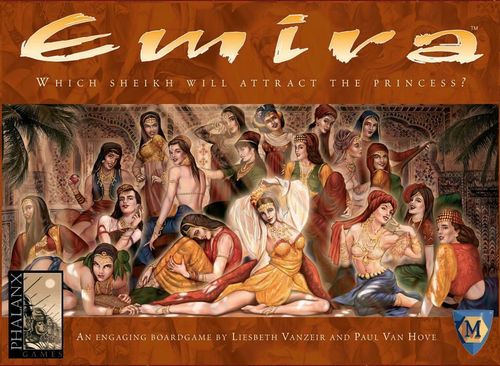
Emira
Emira Rulebook
Table of Contents
Table of Contents
1.0 Introduction
To achieve your goal, you might need to improve your appearance, increase your status, or even enlarge your palace. Of course, a sheik needs gold to do all this! So, you must invest in the lucrative spice trade to earn more gold.
Each princess not only has her own preferences: she also has skills that she can bring to your palace. The four valued skills are: Intelligence, Housekeeping, Cooking, and Romance. Each sheik has his own secret preferences for which skills he wants and needs for his palace.
The first sheik that can attract the required number of appropriate Emira (depending on his secret preference and the number of players) is the winner!
2.0 Components
Each copy of Emira contains:
- 1 game board
- 5 player boards
- 15 wooden discs in the 5 colors (3 each of green, white, red, blue, and black)
- 1 first player marker
- 16 goal cards (4 for 3 players, 5 for 4 players, 7 for 5 players)
- 54 event cards
- 28 Emira cards
- 20 status cards
- 23 camels
- 20 palace sections
- 2 "+1" status cards
- 39 appearance counters (9x beauty, 9x manners, 9x attire, 12x "+1")
- 90 gold coins (20x 10, 15x 50, 30x 100, 15x 500, 10x 1.000)
- 12 yellow tokens "small spice supply"
- 12 yellow tokens "large spice supply"
- 2 special "Xenia" markers
- 1 bag
- 5 rules summaries (incl. a palace track used in the advanced version)
- 1 rules booklet
2.1 The Game Board
Place the game board in the center of the table. It shows several different boxes:
- The Emira card box: Place the Emira cards here.
- The princess in play box: Place the "active" Emira card for the current game turn here.
- The undecided princess box: Place any "undecided" Emira card here.
- The status cards box: Place the status cards here.
- The status card in play box: Place the "active" status card for the current game turn here.
- The appearance marker box: Place the currently available appearance counter here.
- The palace section box: Place the currently available palace section here.
- The camel box: Place the currently available camel here.
- The large spice supply box: Place the currently available large spice caravan here.
- The small spice supply box: Place the currently available small spice caravan here.
2.2 The Player Board
Each player takes his own player board and places it in front of himself. Your player board has several different boxes:
- Your permanent spice supply: You receive a fixed base income every turn based on your own private spice supply.
- Your spice trade: There are 4 tracks for any spice caravan tokens you acquire.
- Boxes for your appearance counters. The 4 different types of appearance counters—beauty, manners, attire and the "+1" counters—are placed here.
- The oasis: Place any camels you purchase on your oasis. Below your oasis is the camel track.
- The palace: You can expand your palace by adding additional palace sections here.
2.3 The Playing Cards
Emira contains 120 cards: event cards, Emira cards, goal cards, and status cards.
2.3.1 The Event Cards
There are 54 event cards in Emira. You purchase event cards during the game. When you play an event card, the event described on the card must be resolved (e.g., "Golden Times"). All event cards are described in section 7.2.
(Each card shows a title and the event text.)
2.3.2 The Emira Cards
There are 28 Emira cards in the game. Each card has the name of a princess, what she is looking for in a sheik, her skills, and possibly a special ability. All of the princesses are described in section 7.3.
(Each card shows: Title, First Preference, Second Preference, Skill, Special Ability.)
2.3.3 The Goal Cards
There are 3 sets of goal cards in Emira (16 in total): one set each for 3, 4, or 5 player games. Each goal card tells you what your winning conditions are for the game. The goal cards are listed in section 7.1.
(Each goal card shows the number of players, the standard winning conditions, and special winning conditions.)
2.3.4 The Status Cards
Each of the 20 status cards in Emira has a purchase cost, and an amount of additional status for the owner (purchase cost, title, number of status points). There are also 2 special "+1" status cards marked "Acting" and "Singing," which are earned by attracting specific princesses. There is a list of the different status cards in section 7.4.
2.4 Game Markers
Emira includes a variety of game markers, as detailed below.
2.4.1 First Player Marker
This wooden marker shows who is the starting player for the current game turn.
2.4.2 The Palace Sections
Place your purchased palace sections on your player board to expand your palace.
2.4.3 The Camel Markers
Place your purchased camel tokens into the oasis. The camels give a discount on bids.
2.4.4 The Appearance Counters
There are 4 different kinds of appearance counters available in Emira: beauty, manners, attire, and special "+1" bonus markers. You can purchase them and add them to the boxes on your player board.
2.4.5 The Spice Trade Tokens
Emira includes tokens for large and small spice caravans. When you buy a caravan, it is placed on one of the spice trade tracks of your player board. Spice caravans increase your income.
2.4.6 The Wooden Discs
Use the wooden discs at the beginning of the game to determine each player's color (each color has a different starting bonus). During the game, you will use your discs on your player board.
2.4.7 The Special "Xenia" Markers
There are 2 special markers that are only used when the Emira card "Xenia" is in play.
2.4.8 Gold Coins
Emira uses gold coins (20x 10, 15x 50, 30x 100, 15x 500, 10x 1000).
2.5 Rules Summaries
You can use your rules summary to help keep track of the progress during each game turn. It also shows the preferences and skills of the princesses. Additionally they include the palace track used in the advanced version of the game.
3.0 Starting Play
Place the game board in the middle of the table.
Sort all the camels, palace sections, "+1" appearance counters, and spice caravans and place them next to the game board, together with the 2 "+1" status cards ("Singing" and "Acting"), a status card with the value 350 gold, and 1 appearance counter of each type (beauty, manners, and attire). Place 1 wooden disc of each color in the bag and mix them. Each player draws one disc, and takes the matching player board and second disc (the third disc is only used in the advanced version).
Each sheik (color) has a unique advantage:
- The green sheik takes a camel and places it in the oasis on his player board.
- The white sheik takes a palace section and adds it to the palace on his player board.
- The red sheik takes the 350 gold value status card from next to the board and places it face up in front of him. Note: If there is no red sheik in a 3 or 4 player game, shuffle this status card back into the status card deck.
- The blue sheik takes the "attire" appearance counter from next to the board and adds it to his player board. Note: If there is no blue sheik in a 3 or 4 player game, this counter is placed in the bag with the other appearance counters.
- The black sheik has a larger permanent spice supply. It earns him an extra 50 gold each turn, and is already marked on the black player board.
Determine the starting player randomly. Place the first player marker in front of the starting player.
Prepare the status card deck:
- Remove the 4 "3 point" cards and shuffle the rest of the deck.
- Remove the top 6 cards. Shuffle the "3 point" cards with the remaining cards.
- Place the larger deck face-down on the game board and place the 6 cards removed earlier on top of the deck.
Place 1 of your 2 wooden discs on the "50 gold coins" box of your camel track. You will use the other disc during the bidding phase.
Mix the goal cards for the number of players in the game. Each player draws 1 goal card. Keep your goal secret from the other players!
Shuffle the event cards and deal 3 of them face-down to each player. Each player examines his 3 event cards and secretly chooses 1. The other 2 are returned to the deck. Shuffle the deck again, and place it face-down on the game board.
Note: Remove the 3 "Restoration" event cards before shuffling. These are only used when playing the Advanced Game.
Shuffle the Emira cards and place them face-down on the game board.
Note: The special abilities of the princesses Albina and Firyal are only used in the advanced version.
Place the remaining appearance counters into the bag (there are 8 of each type, plus 1 extra "attire" counter if there is no blue sheik in the game). Do not put the "+1" markers in the bag.
Finally, give each player 750 gold coins.
4.0 General Course of Play
These are the rules for 4 and 5 player games. If there are only 3 players, there are some rule changes described in section 6.0.
Emira is played in game turns. There are 8 phases in each turn:
- 4.1 Play event cards
- 4.2 Receive income from spice trade and supply
- 4.3 Prepare the game board
- 4.4 Bidding and actions
- 4.5 Purchase event cards
- 4.6 The princess chooses her sheik
- 4.7 Upkeep
- 4.8 First player changes
4.1 Playing Event Cards
Beginning with the first player and going clockwise, each player may play 1 event card (this is not mandatory). If an event card shows a symbol, no other event card with the same symbol may be played later during that same turn. This prevents cumulative or contradictory effects from occurring. Once your event card is resolved, it is removed from the game unless it says otherwise. Keep these permanent event cards face-up in front of you. You can find more about event cards in section 7.2.
Note: During the first game turn you cannot play any event cards.
4.2 Income from Spice Trade and Supply
You receive income from your personal spice supply every turn (as shown on your character board). You gain additional gold income by investing in the spice trade. When you purchase a spice caravan, place it on the appropriate spice trade track (see section 4.4.1). You receive the amount of gold shown for each spice caravan you own. After you receive your income from a spice caravan, move the caravan marker 1 box to the left on the track.
If a spice caravan is already in the leftmost box, you receive the income one last time, and then the caravan is removed from your board and returned to the supply.
Note: You do receive income on the first turn too!
4.3 Prepare the Game Board
Draw the top Emira card and place it face-up on the "in play" box. Then turn over the top status card. Draw 1 random appearance counter from the bag and put it on the game board. Place 1 palace section, 1 camel, 1 small spice caravan, and 1 large spice caravan on the appropriate spaces of the game board.
4.4 Bidding and Actions
During this phase you will carry out 1 action. Each different type of action can be performed by only one player each game turn. To determine which player will choose the first action, you will bid gold. The highest bidder chooses, pays for, and performs any action. Then, the remaining players bid for the right to choose from the remaining actions, and so forth.
Note: You never have to declare in advance which action you are going to take!
The first player bids first. Bidding is done in clockwise order. When your turn to bid comes up, you must bid at least 10 gold more than the current highest bid or pass. If you pass, you cannot make a bid later in this bidding round. The bidding continues as long as any player is willing to raise the bid at least 10 gold. When all but one player has passed, the highest bidder pays his bid to the bank and immediately chooses and pays for one of the available actions (i.e., any action that has not already been taken during the current turn).
After you take your action, place your wooden disc on the game board to show that you have taken your action. You may not participate in any further bids this turn. The player to the left of the winning bidder begins the next round of bidding.
Players who have already taken an action cannot bid in any other rounds during the current turn. The winner of each bid may not choose to take an action that has already been taken that turn by a previous bid winner. Bidding rounds continue until every player has purchased and taken one action.
If you are the last player to take an action, you do not have to bid for it. You only pay the normal cost of the action.
4.4.1 The Different Actions
There are 6 actions to choose from each turn:
- Buying a small spice caravan
- Buying a large spice caravan
- Improving your appearance
- Improving your status
- Buying a palace section
- Buying a camel
Buying a Spice Caravan
When you buy a spice caravan, take the marker from the game board and place it in the rightmost box of one your spice trade tracks on your player board. During the income phase of each turn, you will move this marker one space to the left. This will determine how many turns you will receive income from the caravan before it is exhausted.
You may purchase a small or large spice caravan. In addition, when you purchase you may choose to make it a slow or fast caravan. Each game turn there is only 1 small and 1 large spice caravan available for purchase. When you buy a caravan, take the one of your choice (if both are still available), and decide if you want to make it fast or slow. Place the caravan in the appropriate track on your player board and pay the corresponding costs to the bank. The cost for each type of caravan is shown on your player board next to the spice trade tracks.
You may purchase more than 1 caravan of the same type (on different turns). You may place more than 1 caravan on the same spice trade track.
A Small Spice Caravan (Slow and Fast)
You must pay 450 gold for a small slow caravan. For 8 turns, it will pay you 150 gold each turn during the income phase.
You must pay 550 gold for a small fast caravan. For 4 turns, it will pay you 300 gold each turn during the income phase.
A Large Spice Caravan (Slow and Fast)
You must pay 750 gold for a large slow caravan. For 8 turns, it will pay you 250 gold each turn during the income phase.
You must pay 900 gold for a large fast caravan. For 4 turns, it will pay you 500 gold each turn during the income phase.
Note: The profit for the fast spice caravans is somewhat smaller; however, the gold is delivered faster.
Improving Your Appearance
There are 3 types of appearance counters in the game (beauty, manners, and attire) available for purchase. Each turn, 1 is drawn randomly from the bag and added to the game board. Each appearance counter costs 350 gold. When you buy one, place it in the matching space of your player board. You may have more than 1 counter of each type. Simply stack matching counters on top of each other. Each appearance counter gives you 1 attraction point. When you have 1 counter of each type, you automatically receive a free "+1" marker, which gives you 1 additional appearance point. You receive 1 of these "+1" markers for each complete set of 3 different appearance counters you collect.
If no one purchases the appearance counter on the game board during the turn, it is returned to the bag at the end of the bidding phase.
Improving Your Status
Each turn, 1 status card is put "in play" on the game board. If you purchase this card, your status improves by the amount shown on the card. The cost for the status card is also shown, and varies from 300-1500 gold. You must pay this cost to the bank.
If no one buys the status card during the turn, it is placed face-down at the bottom of the deck at the end of the bidding phase. It may re-enter play later in the game. The status cards are listed in section 7.4.
Buying a Palace Section
Each new palace section costs 500 gold (paid to the bank). Palace sections are important for two reasons. First, some princesses prefer a big palace. Second, you must have enough palace sections to provide a home for all of the princesses in your household (see section 4.6).
Note: You are not limited to only 8 palace sections (even though only 8 are shown on your player board). You can always add more palace sections.
Buying a Camel
A camel costs 150 gold (paid to the bank). It gives you an advantage on future bids. Each camel you own gives you a discount of 50 gold on your bids! So, if you have 1 camel, and bid 250 gold, you would only pay 200 gold if you have the winning bid. Camels never reduce the cost to take an action.
Note: You do not receive money back from the bank if your final bid after camel discounts is less than 0!
Note: If all of an item (status cards, appearance, palace or camel tokens, etc.) have been purchased, then no one can buy any more of them during the game.
4.4.2 General Rules for Bidding and Taking Actions
-
If all players pass during a bidding round, the player who started the bidding (by passing) may choose an action without having to pay for a bid. You only pay the cost of the action. You may not bid 0 gold (this would be considered a "pass"). The minimum bid is always 10 gold.
-
You do not have to take an action (even if you win the bid). You may have calculated the costs wrong and not have enough money to pay upkeep.
Example: The blue sheik realizes after winning the bid that he cannot afford the upkeep of 250 gold for the 5 princesses in his palace if he buys a new palace section.
-
There are 2 special cases where you can choose not to take an action, and instead take 150 gold from the bank: first, if you have less than 500 gold in cash; or, second, if you have 4 or more princesses in your palace and you have no spice caravans on your player board. Any number of players can make this choice during the turn. You do not have to bid for this action.
-
You can bid for a turn (even if you are the last player to play that round) so you have less than 500 gold in cash. This would allow you to take no action and get 150 gold from the bank.
-
If no one buys a particular action during the turn, do not place a second marker of that type on the game board during the next turn. In each game turn, there is only 1 large caravan, 1 small caravan, 1 palace section, 1 camel, 1 appearance counter, and 1 status card available for purchase.
4.5 Purchase Event Cards
Beginning with the first player and continuing clockwise, each player may choose to purchase 1 event card.
You have two options:
- You may pay 150 gold to the bank to draw the top 2 event cards, choose 1 to keep, and place the other face-down at the bottom of the deck.
- You may pay 250 gold to the bank to draw the top 3 cards, choose 1 to keep, and place the other 2 face-down at the bottom of the deck.
Note: Remove event cards played during the "play event cards" from the game. Do not put them back under the event card deck.
4.6 The Princess Chooses her Sheik
This is the moment when the face-up princess chooses which palace household she will join. She will only choose a sheik if he has enough space in his palace for her to live.
Note: Only 2 princesses can stay in the basic palace you start with. Each additional palace section adds enough space for 1 additional princess.
Looking only at the sheiks that have enough space in their palace for her, the princess chooses the one that best suits her first preference (see section 7.3). If 2 or more sheiks are tied for that preference, she chooses the tied sheik that best fits her second preference. If 2 or more sheiks are still tied, the princess is "undecided" and she is placed in the undecided space on the game board.
Example: Thara chooses the sheik with the best appearance. There are 2 sheiks tied for the best appearance. So, she chooses the one with the biggest palace between those two.
Note: As soon as there is a change that makes one of the sheiks the most attractive one for an undecided princess, she will immediately join his palace! If the preference is gold, this could happen at any time. Otherwise, it will only happen during the bidding phase of a future turn, when the sheiks take actions that change their attractiveness.
All of the princesses and their abilities and preferences are listed in section 7.3.
If you now have the required number of princesses with the required skills in your palace, and you can pay your upkeep for the turn (during the upkeep phase), you win the game—but only after the turn ends. The turn must be completed before you can declare victory!
General Rules:
- You can never refuse a princess who chooses to join your palace!
- The special abilities of the princesses must be applied immediately.
- The special abilities of the princesses Albina and Firyal are only applied in the advanced rules.
- You may keep your gold hidden from the other players. But, when a princess whose preference is gold is in play, you must reveal your gold when it is time for her to choose her sheik!
4.7 Upkeep
You must pay upkeep for your palace every turn. You must pay 50 gold for each princess who is living in your palace (yes—even during the 1001 Nights—food, clothing, and luxury was expensive!).
If you cannot pay your full upkeep costs, there will be a tumult in your palace and 1 princess will leave! You pay all the remaining money, shuffle all of your Emira cards and have another player select one at random. This princess is placed face-down at the bottom of the Emira deck. She may re-enter play later. You lose any advantage or disadvantage you received from this princess immediately. See also section 7.3.
Exception: See "Xenia" in section 7.3.
Note: Some princesses demand extra money during upkeep!
4.8 First Player Changes
If you are the first player, pass the first player token to the player on your left at the end of the turn. A new game turn begins with the new first player.
5.0 Winning the Game
Your goal card tells you your winning conditions for the game. The first player to complete the goal shown on his card at the end of a game turn is the winner!
To fulfill your goal, you can use the skills of the princesses you have attracted to your palace. The 4 skills are: Intelligence, Housekeeping, Cooking, and Romance. If you can fill all the skills shown on your goal card, you will not need as many princesses in your palace to win the game.
Certain princesses have more than 1 skill, but such a princess can only use 1 skill at a time (see the overview in section 7.3).
In order to win, you will need at least the number of princesses shown in the left column of the chart below in your palace. You will also need to fill a specific mix of skills as shown on your goal card. If you cannot collect the right combination of skills, then you will need to attract the number of princesses shown in the right column of the chart. These totals depend on the number of players in the game. A list of the goal cards is in section 7.1.
| Players | Minimum | Maximum |
|---|---|---|
| 5 players | 4 | 6 |
| 4 players | 5 | 7 |
| 3 players | 6 | 8 |
Note: If there is an undecided princess or if the event card Double Trouble was played, it is possible that 2 players will fulfill their victory conditions on the same turn! In this rare case, it's a tie game and both players share the win!
6.0 Rules for 3 Player Games
When you set up the game, put the following pieces back in the box: 4 each of the small and large spice caravans, 2 appearance counters of each type, and 7 camels. Also, remove the following status cards from the deck: 1 x 300 gold, 1 x 350 gold, 1 x 400 gold, 2 x 800 gold, and 1 x 1400 gold. Use all of the Emira cards. When you build the status deck at the beginning of the game, pull off 3 cards (instead of 6) before shuffling in the 3-point cards.
The rules for 3 player games are very similar to the 4- or 5- player rules:
- The preparation phase (section 4.3) only takes place every other (odd-numbered) game turn. During this phase, turn over 2 Emira cards.
- The purchase event cards phase (section 4.5) only takes place on even-numbered game turns.
6.1 Odd Game Turn Sequence
Use the following phases (changes to the 4/5 player game are noted):
- Play event cards.
- Receive income from spice trade and supply.
- Prepare the game board: Draw 2 Emira cards. The order of these princesses is important. The top card is princess 1 and active this turn, the other card is princess 2. Otherwise, prepare the game board just like the 4- and 5-player game.
- Bidding and actions.
- No purchase of any event cards is possible.
- The first princess chooses her sheik.
- Upkeep.
- First player changes.
6.2 Even Game Turn Sequence
- You may not play any event cards.
- Receive income from spice trade and supply.
- Prepare the game board: Do not draw an Emira card—instead princess 2 (see 6.1) is now active. Do not add any markers to the game board; instead all actions taken in the previous game turn are not available this turn! Exception: If someone bought the palace section on the previous turn, add a new one.
- Bidding and actions.
- Purchase event cards.
- The second princess chooses her sheik.
- Upkeep.
- First player changes.
Note: Put all unpurchased appearance markers back into the bag at the end of the bidding phase of the even-numbered game turn. The same is true for a status card: If no one bought it during one of the two game turns, place it at the bottom of the status card deck at the end of the bidding phase of the even-numbered game turn.
If no one buys the palace section during a game turn, do not add another one the next game turn. Only add a palace section the turn after someone buys the one on the board.
6.3 Event Cards in the 3 Player Game
The following event cards work slightly differently in a 3-player game:
Double Trouble: 3 princesses come into play. You must choose, before looking at the cards, whether there will be 2 active in the odd-numbered turn and 1 active in the even-numbered turn, or whether there will be 1 active in the odd turn and 2 active in the even turn.
Quiet Days: Only 1 princess comes into play. You must choose, before looking at the card, whether she will be active in the odd turn or in the even turn. Draw the princess in the preparation phase of the odd-numbered turn.
Changing Her Mind: You must choose, before looking at the cards, if you will change the preferences of the princess for the even game turn or the odd game turn. If Double Trouble is also in play, and there are 2 princesses active for the chosen game turn, before looking at the cards you can choose either one of the princesses.
7.0 Card Lists
7.1 Goal Cards (16x)
5 players (7x)
- 1 princess "Intelligence," 1 princess "Housekeeping" and 1 princess "Romance"
- 1 princess "Intelligence," 1 princess "Cooking" and 1 princess "Romance"
- 1 princess "Housekeeping," 1 princess "Cooking" and 1 princess "Romance"
- 2 princesses "Intelligence" and 1 princess "Housekeeping"
- 2 princesses "Intelligence" and 1 princess "Cooking"
- "2 + 1" princesses with these abilities: "Intelligence" and "Romance"
- "2 + 1" princesses with these abilities: "Housekeeping" and "Cooking"
4 players (5x)
- 1 princess "Intelligence," 1 princess "Housekeeping," 1 princess "Cooking" and 1 princess "Romance"
- 2 princesses "Intelligence," 1 princess "Housekeeping" and 1 princess "Cooking"
- 1 princess "Intelligence" and "2 + 1" princesses with the abilities: "Housekeeping" and "Romance"
- 1 princess "Romance" and "2 + 1" princesses with the abilities: "Intelligence" and "Cooking"
- "2 + 1 + 1" princesses with the abilities: "Housekeeping," "Cooking" and "Romance"
3 players (4x)
- 2 princesses "Intelligence," 1 princess "Housekeeping," 1 princess "Cooking" and 1 princess "Romance"
- 2 princesses "Housekeeping" and "2 + 1" princesses among the abilities: "Intelligence" and "Cooking"
- 2 princesses "Intelligence" and "2 + 1" princesses among the abilities: "Housekeeping" and "Romance"
- "2 + 2 + 1" princesses among the abilities: "Intelligence," "Cooking" and "Romance"
7.2 Event Cards (54 - 3 copies of each card)
- Bazaar: During the preparation phase, you search the bag and select 1 appearance counter of your choice to add to the game board for this turn. Return the remaining counters to the bag.
- Better Breed: Move your disc 1 space to the right on your camel track. This increases the discount you get for each camel you own. The first time you play this event, the discount becomes 70 gold per camel, the second time 100, then 150.
- Camel Breeding: Each player receives 1 free camel for every 2 camels he owns. Note: If there are not enough camels left for everyone, this card has no effect.
- Camel Epidemic: Each player loses 1 camel for every 3 camels he owns.
- Changing Her Mind: Examine the top Emira card. You can choose to leave the princess' preferences as shown on the card, swap her first and second preferences, or return that princess to the bottom of the deck.
- Court Influence: Examine the top 3 Emira cards and return them to the top of the deck in any order you wish.
- Double Trouble: Draw 2 Emira cards during the preparation phase this turn. Do not change the order of the princesses. The first princess drawn chooses her sheik first; then the second one makes her choice.
- Golden Times: In the income phase this turn, each player gets a +20% bonus to his income. This includes both your personal spice supply and any income from caravans.
- Good Looking: Choose 1 type of appearance counter. You receive a "+1" marker for each set of 3 counters of this type. Place the "+1" markers on top of this card and keep it until the end of the game.
7.3 Princess Cards (28x)
Special Abilities for the Princesses
General Note on Special Abilities: In all cases, the ability of each princess only applies for as long as she is in your palace. If a princess leaves your palace for any reason, you no longer receive the benefit (or suffer the penalty!) that princess brought to you. For princesses with one-time disadvantages you get nothing back. Those princesses are Samira, Zahrah, Hind and for the advanced rules Albina and Firyal. For Suleika, Janan and Xenia, the effect wears off, but you don't get money back.
Multiple Skills: There are 4 princesses with 2 skills, Noor, Hind, Janan and Xenia. You can choose which skill the princess has at any time (only 1—not both!). You do not have to declare which skill she has until you have enough princesses to win the game!
Albina: When she first joins your palace, you must move the disc on your palace track one space to the left. The value of the palace decreases by -0.5 points.
Halimah: As long as she is in your palace, you receive the "+1" status card for "Singing."
Noor: You must reveal your gold to the other players as long as she lives in your palace.
Rasha: As long as she is in your palace, you receive the "+1" status card for "Acting."
| Name | Preference 1 | Preference 2 | Skills | Special Ability |
|---|---|---|---|---|
| Albina | Appearance | Status | Intelligence | Grand Festivity |
| Halimah | Appearance | Status | Housekeeping | Singer |
| Asima | Appearance | Status | Cooking | |
| Noor | Appearance | Palace | Intellig./Housek. | Mistrust |
| Rasha | Appearance | Palace | Cooking | Actress |
Zainab: If she is in your palace, during the draw event cards phase, you pay only 100 gold (instead of 150) to choose from 2 drawn cards, or 200 (instead of 250) to choose from 3 drawn cards.
Samira: When she first joins your palace, you must discard 1 appearance counter of your choice (if you have any), and return it to the bag. This can force you to also lose a "+1" counter. You cannot lose the free "manners" and "beauty" counters that you receive from Layla or Nadia, because they belong to the princesses and not the sheik.
Zahrah: When she first joins your palace, you must discard 1 status card of your choice (if you have any). If you have no 1-point cards, you must discard a 2- or 3-point card! You may not lose the special "Acting" or "Singing" cards that you receive from Halimah or Rasha because they belong to the princesses and not the sheik.
Layla: As long as she is in your palace, you receive the "manners" appearance counter from beside the game board. This can help earn you a "+1" counter.
Nadia: As long as she is in your palace, you receive the "beauty" appearance counter from beside the game board. This can help earn you a "+1" counter.
Firyal: When she first joins your palace, you must move the disc on your palace track one space to the left. The value of the palace decreases by -0.5 points.
Hind: You cannot act during the game turn after she joins your household (i.e., you cannot influence the actions but can only "react" to actions):
- Phase 1: You cannot play an event card.
- Phase 2: You receive your income and move your caravan markers as usual.
- Phase 3: The game display is set up in the usual way.
- Phase 4: You always pass during the bidding and cannot perform an action nor take the extra 150 gold.
- Phase 5: You cannot purchase an event card.
- Phase 6: You can attract the next princess.
- Phase 7: You must pay your upkeep costs.
- Phase 8: The first player changes normally.
Farah: You only pay 50 gold for a new camel (instead of the usual 150 gold).
Adara: New spice caravans only cost you the amount of gold shown on this chart:
| Slow | Fast | |
|---|---|---|
| Small | 400 gold | 500 gold |
| Large | 650 gold | 800 gold |
Suleika: Each time a new princess joins your palace while Suleika is living there, you must pay her a special one-time upkeep of 100 gold in addition to your normal upkeep for that turn.
Janan: She is expensive and requires an upkeep of 100 gold instead of 50 gold.
Zafirah: She has her own money—you never pay upkeep for her!
Xenia: She demands a special gift of 250 gold every 3rd game turn. When she first arrives in the game, she chooses the richest sheik. He must pay her the 250 gold gift that turn. Then, place the 2 special markers on her card. During the upkeep phase of each turn, remove one of these markers. If there is no marker on her card at the beginning of the upkeep phase, you must pay her 250 gold gift again, and then put the 2 special markers back on her card.
After the first gift, you may refuse to give her a gift when it is due. However, if you refuse to pay, she leaves your palace to join the palace of the richest of the other sheiks. This sheik must immediately pay the 250 gold gift and then put the 2 special markers on her card. Xenia can change hands many times this way during the game!
Note: If Xenia enters play or joins another harem and that player cannot pay his upkeep because of her, Xenia and only Xenia leaves and is removed from the game. Do not mix your Emira cards and select one at random. But, this only happens for the first "gift" she demands of you! If you cannot pay on a later third turn, you must send her to your richest opponent. You cannot send her out of the game!
Badra: You only pay 400 gold for a new palace section (instead of the usual 500 gold).
Sidi Suleiman: He joins the palace where the most princesses live. He has no second preference. When he joins your palace, he "steals" one of the princesses, leaving your palace with that princess immediately. Remove Sidi Suleiman and the "stolen" princess from the game. You choose which of your princesses leaves with Sidi Suleiman.
Note: The palace does not have to be big enough to accommodate Sidi Suleiman because he immediately leaves again! Therefore, it is impossible to keep him out of your palace by keeping your palace too small to accommodate him! Sidi Suleiman does not require upkeep because he does not stay.
7.4 Status Cards (20 + 2 "+1" cards)
- 1 status point: 3 x 300; 4 x 350; 3 x 400 gold coins in costs.
- 2 status points: 1 x 700; 1 x 750; 2 x 800; 1 x 850; 1 x 900 gold coins in costs.
- 3 status points: 1 x 1,200; 1 x 1,300; 1 x 1,400; 1 x 1,500 gold coins in costs.
- 1x "+1" status card "Singing," 1x "+1" status card "Acting."
8.0 Advanced Rules
Experienced players who want a more challenging game should play with these "advanced rules."
8.1 Starting Play
Each player takes a third wooden disc of their color and a rules summary. Turn your rules summary over so the side with the palace track is face-up. Place the wooden disc on the space marked "0."
The position of your disc on the palace track affects the value of your palace when you try to attract a princess. This value is improved by the "Restoration" event cards and reduced by the special abilities of the princesses Albina and Firyal.
Example: A sheik owns 3 palace sections. He plays a "Restoration" event card and moves his disc one space to the right. Now when a princess chooses her sheik, his palace is worth 3.5 points instead of 3.
8.2 General Course of Play
The normal order of play remains the same, except you can now play an event card on the first turn.
Phase 7 (Upkeep) is also changed. If you cannot pay the full upkeep costs for your princesses, there is a big tumult in your palace. It is possible that more than one princess will leave your palace. Shuffle all of your Emira cards and have another player select them at random, one by one, until you can afford to pay the upkeep for all the remaining princesses. The princesses who leave are shuffled together and placed face-down at the bottom of the Emira deck. They may re-enter play later in the game.
8.3 Winning the Game
Your goal card tells you your winning conditions for the game. The first player to complete the goal shown on his card at the end of a game turn is the winner!
You can also determine a "score" for each player in the game, based on what you have at the end of the game. This score is used to break ties, if two players both fulfill their victory conditions on the same turn (because of an indecisive princess or the "Double Trouble" event card), and can also be used to rank all the players in the game.
Every princess in your palace is worth 2 points. Having your desired combination of skills is worth 3 points, even if you do not have enough princesses to win the game.
If there is a tie, the tied players compare their other achievements in the game. You score 1 point for each appearance counter, status point, and palace section you own. You also score 1 for each camel, and add the points you have on your palace track. If there is still a tie, then the tied player with the most money is ranked higher.