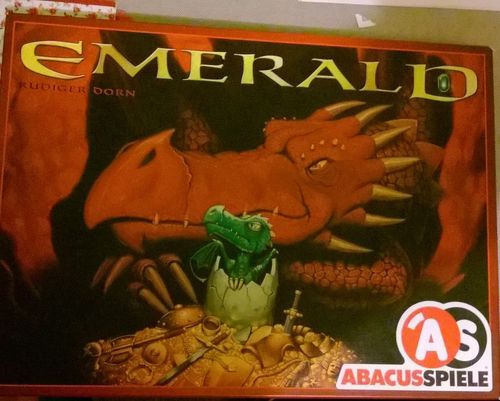
Emerald
Emerald Rulebook
Table of Contents
Table of Contents
Components
- 1 game board
- 1 die (numbered 1 to 3)
- 1 dragon piece
- 1 rail (track) for the dragon guard
- 25 knights (5 each in 5 player colors)
- 1 rulebook
- 24 gem cards (6 each of ruby, emerald, garnet, and turquoise)
- 25 gold cards (5 each with values 1 to 5)
- 4 bonus cards (1 per gem type)
- 1 bonus card ("4 different gems")
- 2 promo cards (not needed for the game)
- 4 dragon treasure cards (value 5 each)
Setup
-
The game board is placed in the middle of the table, within easy reach of all players. It shows the castle with 4 towers and the main building as starting spaces for the knights, and a path that leads to the dragon's treasure chamber. The first 6 spaces of the path lead through meadows, the last 9 spaces lead through a cave passage.
-
The die is set out ready to use.
-
The gold cards are shuffled well.
-
The gem cards are shuffled well.
-
To the right and left of each cave space are the spaces for the gold and gem cards. Onto these spaces, as marked on the board, 2 or 3 cards are placed on top of each other in alternation. The top card of each pile is turned face up. Two gold cards and two gem cards will be left over; these are returned to the box face down without looking at them. They are not needed for this game.
-
Each player chooses a color and receives knights according to the number of players:
Players Knights 5 4 knights 3 and 4 5 knights 2 8 knights (4 each of 2 colors) Surplus knights are not needed for the game. They go back in the box.
-
Now 1 knight of each color in play is placed on every starting space. The colors of the starting spaces are only for clarity and have nothing to do with the colors of the knights. With 2 and 5 players, the main building is left empty.
Gameplay
The players move their knights along the path toward the treasure chamber. Along the way, they can collect gold and gem cards on the cave spaces. If they reach the treasure chamber, they receive further valuable treasures. In doing so, the knights must be wary of the dragon. If the dragon meets a knight, it catches him. The knight is out of the game unless he can bribe the dragon with a gold card.
The player who has the most gold at the end of the game wins.
The starting player begins. When a player has finished their turn, play passes to their left-hand neighbor.
Moving Knights
When it is a player's turn, they may move one or two of their knights. However, they may not move the same knight twice in one turn. Knights are moved from their starting space directly onto the path. Every space on the path counts as one step. Knights cannot switch to a different starting space.
The player must move the knight exactly as many steps as there are knights standing in total on the space, or on the starting space, from which it begins its move. The moved knight itself is included in this count.
Example: On the space where the black knight starts, there are 3 knights in total. The black knight must therefore go 3 steps.
Knights always move only forward, toward the treasure chamber, never backward toward the castle. The last meadow space and the first cave space are directly adjacent to each other. Moving from one to the other counts, quite normally, as one step.
Any number of knights may stand on the spaces of the path. Several knights of the same color may also stand on the same space.
Tip: You should plan your move carefully. For example, if you move one of your knights onto a space with another of your own knights, you increase the second knight's number of steps by one.
Taking a Card
Each cave space has a total of 5 gold and gem cards assigned to it.
If a knight's move ends on a cave space next to which at least one card lies, the player must take a face-up card that lies next to that space. If a face-down card lies beneath that card, it is now turned face up.
If the player must take a card, their turn ends immediately.
Tip: You may move two knights in a turn, but you must end your turn early if you take a card. So you should move first with a knight whose move ends on a meadow space, or on a cave space next to which no card remains.
Gold Cards
Players take gold cards into their hand face down. They count at the end of the game according to their value. They can also be used to bribe the dragon.
Gem Cards
Players lay gem cards face up in front of themselves, clearly visible to everyone. They each count as 1 gold piece at the end of the game.
You cannot bribe the dragon with gem cards!
Bonus Cards
Bonus card "4 different gems": The player who is the first to have four different gems in front of them receives this bonus card. They get it immediately when they take their fourth different gem, and cannot lose it afterward. It counts as 4 gold pieces at the end of the game.
The four remaining bonus cards are not awarded until the end of the game. The player who has the most gems of one type receives the corresponding bonus card in addition. Each of these cards counts as 4 gold pieces.
The Dragon
Moving the Dragon
If a knight's move ends on a space next to the rail, or on the space where the dragon stands, the dragon then moves. If a card still lies next to that space, the player must take it first.
The player who moved the knight rolls the die and moves the dragon exactly as many spaces as the die shows.
The dragon always moves in the direction its head is pointing. If it reaches the last space next to the rail, it is immediately turned around and now moves on in the opposite direction. It is always moved back and forth over the spaces next to which the rail lies.
Turning the dragon around does not require a die roll.
Catching Knights
The dragon catches knights only after it has moved.
If the dragon's move ends on a space where no knight stands, nothing further happens.
If the dragon's move ends on a space where one knight stands, the dragon catches that knight.
If the dragon's move ends on a space where several knights stand, the player who moved the dragon must decide which knight is caught. Knights standing on the same space as the dragon but not caught by it may be moved normally on their turn.
Note: If only knights belonging to the player who moved the dragon stand on the space, the dragon catches one of these knights.
The player whose knight is caught must now decide whether or not they want to bribe the dragon. If they decline, or cannot bribe the dragon, their knight is placed on the nest in the rear part of the treasure chamber and is out of the game.
Note: Knights caught by the dragon are indeed placed on the nest in the treasure chamber, but of course they do not receive a dragon treasure card.
Bribing the Dragon
A player can prevent their knight from being taken out of the game by bribing the dragon with a gold card from their hand.
The value of the gold card does not matter for this. The card is then removed from the game. The knight then remains standing on the space next to the dragon and can be moved normally on the next turn.
You can only bribe the dragon with gold cards. You cannot bribe the dragon with gem cards, dragon treasure cards, or a bonus card.
Shifting the Rail
After the dragon has moved, the rail is shifted one space toward the treasure chamber. When the rail reaches the last space before the chamber, it stays there for the rest of the game and is not shifted any further. From then on, the dragon moves only on the four spaces immediately in front of the treasure chamber.
Note: It can happen that the dragon ends its move on the space next to the rail that is farthest from the treasure chamber. If the rail is then shifted, the dragon is no longer next to the rail at first. It remains standing on its space, however. Only when a knight's move again ends on a space next to the rail, or on the space with the dragon, does the dragon set off again and move quite normally next to the rail.
The Treasure Chamber
Behind the last cave space lies the treasure chamber. Entering the chamber counts as one step.
If a knight reaches the treasure chamber, they may let any surplus steps lapse, and are placed on one of the four spaces.
The player takes a dragon treasure card and lays it face up in front of themselves. This ends their turn!
Knights standing in the treasure chamber are out of the game.
End of Game
The game ends immediately when:
- a player takes the last dragon treasure card, or when
- a player has only 1 knight left in the game.
Awarding the Remaining Bonus Cards
Now the remaining four bonus cards are awarded. The player who has the most gems of one type receives the corresponding bonus card in addition. Each of these cards counts as 4 gold pieces.
If no player has the sole majority of a gem type, the corresponding bonus card is not awarded.
Scoring
Now each player adds up the gold they have won:
- Gold cards count 1 to 5 gold pieces according to their value.
- Dragon treasure cards count 5 gold pieces each.
- Gem cards count 1 gold piece each.
- Bonus cards count 4 gold pieces each.
The player with the highest total wins.
In case of a tie, the player with more dragon treasure cards wins. If there is still a tie, the player with more gems wins.
Two-Player Special Rule
In the two-player game, knights are basically moved exactly as in any other game. However, since each player owns knights of two colors, the following restriction applies: a player may move knights of only one color in a single turn.