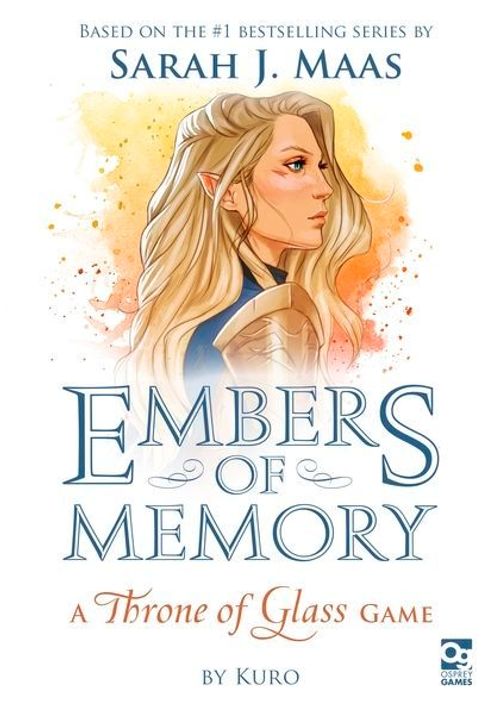
Embers of Memory: A Throne of Glass Game
Embers of Memory: A Throne of Glass Game Rulebook
Table of Contents
Table of Contents
Introduction
Welcome to Embers of Memory, a Throne of Glass game! This rulebook will guide you through how to play, starting with the core principles of the game:
Cooperation
You and the other player are always working together, trying to beat the game itself. Either you both win or you both lose – nobody wins on their own.
Characters
You always play as a character, which affects how you play. At the start of each game, you each choose one of the two character cards from the memory deck and place it in front of you.
Silence
You cannot discuss tactics with the other player while you are playing the game. Instead, you communicate through your choice and placement of cards in the game.
Chapters
When you first start playing, you will play the prologue (page 10). When you beat the prologue, you will continue to chapter one (page 16), and the rules will change. Each time you beat the game, you will progress to a new chapter until you have completed the entire game.
Captivity Deck
When you first start playing, leave the captivity deck sealed in the box. When you start chapter one, you'll be instructed to open and take cards from the captivity deck. As you progress through the deck, the rules of the game will change.
If a card in the captivity deck contradicts this rulebook, follow the rules on the card.
Memory Deck
The memory deck contains everything you need to play. To start with, this should be 35 memory cards and 2 character cards. As you progress through the chapters, some cards will be added to the memory deck and others will be removed.
The Memory Deck
This section lists the cards in the memory deck and explains what the symbols on them mean. Read it to familiarise yourself with the cards.
Character Cards
Character cards represent the character you are playing as. When you start playing the game, you each take a character card from the memory deck and place it in front of you. In the prologue, you will play as Aelin and Rowan.
Memory Cards
Memory cards represent recollections of the people in Aelin's life who she can draw strength from. When you play memory cards into the play area, you remind Aelin of the people who love her. When you take memory cards from the play area, you strengthen Aelin's resolve and she is able to resist her captors for a little longer.
Each memory card has four important elements:
- Clear segments
- Blocked segments
- Suit
- Strength
1. Clear Segments
The memory of the characters is best seen through the clear segments. As explained overleaf, this matters when you play the card.
2. Blocked Segments
Each memory is partly clouded or obscured, as represented by the blocked segments. This also matters when you play the card.
3. Suit
Each memory is linked to a suit, which is represented by a symbol and a colour. The suit matters most when you relive memories, as explained later.
The suits are:
- Chains: memories of sacrifice.
- Daggers: memories of subterfuge.
- Flames: memories of heritage.
- Glass: memories of Adarlan.
- Stags: memories of strength.
4. Strength
Each memory is marked with a strength. This is its power to bolster Aelin's resolve. The strength of a memory matters when you relive memories and when you strengthen Aelin's resolve.
Each suit has two cards with strength 1, two cards with strength 2, and one card each with strengths 3, 4, and 5.
Adding Memories
This section explains how to play the memory cards into Aelin's Mind.
During the game, you will add cards to an area in the middle of the table. This is Aelin's Mind. When you add a card to the Mind, you must obey the following four rules:
1. Overlap One or More Cards
When you add a card, it must partly or fully overlap at least one other card. You aren't allowed to slide cards underneath other cards.
2. Match Overlapping Segments
When you add a card, any segments that overlap another card must match. That means you can only place clear segments on top of clear segments, and blocked segments on top of blocked segments.
3. Overlap at Least One Blocked Segment
When you add a card, it must overlap at least one blocked segment. As explained on the last page, the segment on the overlapping card must also be blocked.
4. Keep the Orientation the Same
When you add a card, you must place it in the same orientation as all the other cards in the Mind.
Reliving Memories
This section explains how to relive Aelin's memories when you add cards to the Mind.
As you play the game, you'll often want to relive a memory. Doing so will give Aelin a vision from her past, urging her to hold on and see things more clearly. This will become more important as you progress through the game. The effects of reliving a memory are explained later.
You relive a memory when you add a memory card to the Mind and you create a group where the following three statements are all true:
1. All Cards Are Connected by Overlap
All the cards in the group must be connected by overlap (or a chain of overlapping cards). Adjacent cards do not connect a group. There can be cards in between overlapping cards in the group, as long as they are at least partly touching.
(The printed page 8 shows three example groups.)
2. All Cards Are of the Same Suit
All cards in the group must be of the same suit. Cards of different suits do not count as part of the group.
3. The Total Strength Is Exactly 7
The total strength of all the cards in the group must be exactly 7. The strength cannot be greater than 7.
Cards that are connected to the group by overlap and are of the same suit must be included in the group, even if ignoring them would create a group with a strength of 7.
(The printed page 9 shows three example groups.)
You only ever relive a memory when you add a card to the Mind. If you create a group where all the statements are true by removing a card from the Mind (or in any other way), you do not relive a memory.
Prologue
To prepare for the trials ahead, Aelin will need to learn to still her mind and focus.
The first time you play Embers of Memory, you should play this prologue to familiarise yourself with the core concepts.
Part One: Gather Your Thoughts
A long time ago, in Wendlyn. A princess who cannot control her powers. A Fae prince who teaches her.
Setup
- Give each player a character card.
- Shuffle the memory deck and place it in front of you.
- Deal one card face up into the middle of the table. This is the main play area – the Mind.
- Deal three cards face down and put them aside. This is the Resolve.
- Deal four cards face up in a row in front of the players. This is the memory row.
How to Play
Take turns, starting with Rowan. On your turn, follow these three steps in order:
- Add a card to the Mind. Choose one of the cards in the memory row and add it to the Mind. The rules for how to add cards to the Mind are explained on page 6.
- Add another card or discard a card. Choose one of the other cards in the memory row. Either add it to the Mind or discard it, placing it in a face-up discard pile near the deck.
- Draw two cards. Draw two cards from the deck and add them to the memory row. The row should contain four cards again.
Reliving Memories
If you relive a memory, flip one of the cards in the Resolve face up. The rules for how to relive a memory are explained on page 8.
Game End
If all three cards in the Resolve are face up, you win. If the deck is empty at the start of your turn or you cannot play a card on your turn, you lose.
Stop reading the rules here. If you lost the game, try again from the beginning. If you won the game, continue to the next part of the prologue. Don't pack away the game you've just played, as you'll continue with your progress in part two!
Part Two: Clear Your Mind
This is part two of the prologue. Only play it after successfully completing part one.
She took in the world with stunning clarity, smelled it and tasted it and breathed it. It was rising up, wildfire crackling in her veins and in her fingertips. "Let it out. Don't fight it."
Setup
- Leave the character cards and all the cards in the Mind in place from part one.
- Move all the cards in the memory row and the deck into the discard pile.
- Arrange the three cards in the Resolve in a vertical column. Each Resolve card forms the first card in a strength row.
How to Play
Take turns, starting with Aelin. On your turn, follow these two steps in order:
- Take a card from the Mind. Choose any visible card in the Mind. A card is visible only if it has at least one segment that isn't covered by another card. Pick it up, being careful not to move any of the other cards in the Mind.
- Strengthen the Resolve. The topmost strength row that is incomplete is the current row. Add the strength of your chosen card to that of all the cards in the current row:
- If the total is greater than 7, discard the chosen card.
- If the total is less than or equal to 7, add the card to the current row. Place it to the left of the leftmost card in that row.
- If the total is exactly 7, that row is now complete. From the next turn on, the next row down will be the current row.
Splitting the Mind
By taking a card, you might have split the Mind. All cards in the Mind must be connected by a chain of overlapping memory cards. If there are sections that aren't linked by overlapping cards, the Mind is split. When checking if the Mind is split, only count visible cards as part of a chain. A card is visible if at least one segment is not covered by another card.
When you split the Mind, Aelin chooses one section to keep, even if it is Rowan's turn. All the visible cards that are not in that section are discarded. Discarding the visible cards may reveal a Mind that is also split: if so, Aelin again chooses a section to keep.
Game End
If all three strength rows are complete, you win. If you are unable to take a card from the Mind on your turn, you lose.
Stop reading the rules here. If you lost the game, start the prologue again from the beginning. If you won the game, congratulations! Aelin has calmed her mind, but now the real work begins. Open the captivity deck and follow the instructions on the top card. (Remember to read both sides.)
Embers of Memory
The flavour fiction that opens the chapter (printed page 15) is omitted from this transcription. It contains no rules.
Chapter One
This section explains how to play the full game. You should only play it after completing the prologue. If you haven't already opened the captivity deck, do so now.
Overview
Aelin has been taken captive by Maeve, the dark queen of the Fae. Tormented by the sadistic Cairn, not even her memories are her own. Her only companion is Fenrys, who is forced to witness her suffering. Trapped by a blood oath, he can do little to help except to say . . . "I am here. I am with you."
In Embers of Memory, one of you will play as Fenrys, searching for the right memories to strengthen Aelin's resolve. The other will play as Aelin, drawing from these memories to survive. The game takes place over three rounds, or days, as Aelin rests between rounds of interrogation. If Aelin can withstand her torment for that long, she nears a little closer to escaping Maeve's grasp and returning to her loved ones. But if she breaks, it is not just she who is in mortal danger.
Each time you play, you must choose either Aelin or Fenrys. You can choose to play the same character in each game, or swap.
Fenrys
Fenrys's role is to draw as many cards as he wants from the memory deck into the memory row. He then plays the cards from the memory row into the central play area – Aelin's Mind – or discards them. In doing so, Fenrys is providing Aelin with memories she can use to bolster her resolve. His task hangs in a delicate balance: he needs to bring up the right memories, but if he pushes too hard, the deck will run out and Aelin will burn out.
Aelin
Aelin's role is to take a card each turn from the Mind and add it into her strength rows, trying to create groups of exactly 7 in strength. Each day she must complete all four rows anew, as her captivity wears down her resolve. The longer she remains in Maeve's grasp, the harder she must work to be steadfast.
Captivity Deck
The captivity deck tracks Aelin's progress during her capture by Maeve. Every time you win a game, you will move the story on and unlock new challenges and abilities. The following rules explain how to use the captivity deck.
Advancing Through the Chapters
When you win a game of Embers of Memory, draw the top card from the captivity deck to introduce the next chapter. Read both sides of the card. If you wish to keep playing immediately, follow all the instructions on the reverse of the chapter card. If you wish to stop playing, return the chapter card to the top of the captivity deck with the reverse side up. When you next play, follow the instructions shown.
Archiving Cards
If you look at the bottom of the captivity deck, you should see the archive card, which marks the end of the captivity deck. When you are asked to archive a card, find the card in the memory deck and place it at the bottom of the captivity deck, below the archive card. You can check the cards in the archive at any time.
New Cards
As you progress through the captivity deck, you'll gain access to new cards. You'll be told to add the new cards to the memory deck, which simply means that you add them to your pool of cards. You don't need to shuffle the new cards into the deck.
In chapter one you'll gain new character cards and demon cards (explained on page 20). You'll also get rule and reference cards.
Rule cards introduce new rules, often hindering but sometimes aiding you in your struggle. The rule cards in the memory deck always take precedence over the rules in this rulebook.
The reference cards remind you of all the active rules. When the rules change, you'll get new reference cards that reflect the changes.
Resetting the Deck
If you accidentally drop or shuffle the captivity deck, or you wish to start again from chapter one, you'll need to reset the captivity deck. All the cards in the captivity deck have a unique number in the bottom right corner. Find all the numbered cards and order them from lowest to highest. If you want to keep the contents secret, get someone who isn't playing to order the cards for you.
Setup
If this is your first time playing, archive the Aelin and Rowan character cards from the prologue.
- Choose characters. Choose which character to play and take the matching character card.
- Take reference and rule cards. Take any reference cards with your character's name on and keep them near you. Take the shared reference card (if there is one) and keep it where both players can see it. Keep any rule cards nearby to refer to. If you don't need the references, put them aside while you play the game.
- Remove demons. Find the five demon cards and put them aside for now. Demons are explained in more detail on page 20.
- Shuffle the memory deck. Shuffle all the remaining cards in the memory deck and place the deck in front of Fenrys, to his left. There should only be memory cards left in the memory deck.
- Create the Mind. Deal one card face up in the middle of the table to create the Mind.
- Aelin readies her Resolve. Deal four cards to Aelin. Without showing Fenrys, Aelin places them face down in a vertical column to form the start of the four strength rows. This is her Resolve. Make sure there is space to the left to add cards to the strength rows.
- Shuffle demons into the deck. Take the demons you set aside earlier, and shuffle them into the memory deck.
- Connect. You are now ready to play. Fenrys goes first. Look into each other's eyes and think: "I am here. I am with you."
Remember: You cannot discuss tactics with the other player while you are playing the game.
Fenrys's Turn
As Fenrys, you are responsible for adding cards to the Mind and reliving memories, as you did in part one of the prologue.
Step 1: Observe (Draw Cards)
Draw a card and place it next to the memory deck. This is the memory row. You may then draw another card and place it next to the previous card, extending the memory row. You may keep drawing cards for as long as you want, each time placing them next to the previous card. You'll want to strike a balance between giving yourself enough options and not getting through the deck too quickly.
Once you've decided to stop drawing cards, add any demons to the demon row and move on to Step 2: Blink.
Demons
Along with memories of those she cares about, Aelin's mind is full of demons. Demons represent the people who have hurt Aelin and her friends, whether they are her current captors or antagonists from her past.
After Fenrys has finished drawing cards, he moves any demons to a row below the memory row – this is the demon row. Exactly where you place the demon row doesn't matter, as long as it is separate from the memory row.
Tainted Memories
Whenever you would discard a memory card that matches the suit of a demon in the demon row, that memory is tainted instead. Place the memory card underneath the demon card so you can no longer see it. Tainted memories may be corrupted and lost forever if you don't save them. You cannot check the tainted memories underneath the demons.
Aelin Breaks!
If no more cards are left in the deck at the start of Fenrys's turn, you've run out of time. You lose.
Step 2: Blink (Play Cards)
Choose any card in the memory row and add it to the Mind. Remember that when you add cards to the Mind, you need to obey these four rules:
- Overlap one or more cards.
- Match overlapping segments.
- Overlap at least one blocked segment.
- Keep the orientation the same.
For more details on adding cards to the Mind, go back to page 6. Once you've added a card to the Mind, choose another card in the memory row. Add that card to the Mind or discard it. Repeat this step for every card in the memory row, in any order. Remember that any card of the same suit as a demon in the demon row is a tainted. You must place it underneath the demon instead of discarding it.
Once there are no more cards in the memory row, Aelin takes her turn.
Reliving Memories
When you add cards to the Mind, you may be able to relive a memory. Remember that to do so, you need to create a group where the following statements are all true:
- All cards are connected by overlap.
- All cards are of the same suit.
- The total strength is exactly 7.
You must also have just played a card into the Mind. For more details, go back to page 8.
When you relive a memory, it can help Aelin in two different ways. The benefits depend on the suit of the group you have created:
- The demon is banished. If there is a demon of the matching suit in the demon row, discard it and any tainted memory cards underneath it.
- Aelin shows her strength. If there is at least one card in the Resolve of the matching suit, Aelin may turn one of those cards face up.
Each time you relive a memory, it is possible that both, neither, or just one of the above benefit comes into effect.
Aelin Breaks!
If you cannot add any cards to the Mind, you've run out of time. You lose.
Aelin's Turn
As Aelin, you take cards from the Mind to strengthen your Resolve, as you did in part two of the prologue.
Step 1: Acknowledge (Choose a Card)
Choose any visible card in the Mind. A card is visible only if it has at least one segment that isn't covered by another card. Pick it up, being careful not to move any of the other cards in the Mind.
The topmost strength row that is incomplete is the current row. Add the strength of the chosen card to that of all the cards in the current row (include the Resolve card, even if it is face down):
- Total strength is greater than 7: Discard the chosen card.
- Total strength is less than or equal to 7: Add the card to the strength row, placing it to the left of the leftmost card in that row. If the card is of the same suit as the Resolve card, you may turn the Resolve card face up.
Adding cards to her strength rows helps Aelin survive the day. But sometimes, discarding cards can be a useful way to communicate with Fenrys or to help him relive memories.
Splitting the Mind
All the cards in the Mind must be connected. Cards are connected when there is a chain of overlapping memory cards. If not all the cards are connected, the Mind is split.
When checking if the Mind is split, only count visible cards as part of a chain. A card is visible if at least one segment is not covered by another card. The Mind usually splits when Aelin chooses a card that connects two or more sections, but it can also happen if Fenrys covers a connecting card when he adds a card to the Mind, making it no longer visible.
When the Mind is split, Aelin chooses one section, even if it is Fenrys's turn. All the visible cards that are not in that section are discarded. Discarding the visible cards may reveal a Mind that is also split: if so, Aelin again chooses a section to keep. Remember, memories that match the suit of a demon in the demon row are tainted instead of discarded, so you must place them underneath the demon. The active player then continues their turn.
If you relive a memory and split the Mind at the same time, relive the memory first. Then choose which section of the Mind to keep.
Aelin Breaks!
If there are no cards left in the Mind, you've run out of time. You lose.
Step 2: Speak
Add up the total strength of the current strength row, including the Resolve card. If the total is 7, announce it to Fenrys by saying, "I am here". That strength row is now complete, and the row below becomes the current row.
When you complete the fourth row, announce it to Fenrys by saying, "I am with you". Aelin has successfully strengthened her Resolve. The day now ends.
If you haven't yet completed the fourth row, Fenrys takes his turn.
Day's End
When Aelin has strengthened her Resolve and announced "I am with you", the day ends. Set up for the next day in the following way:
- Memories are discarded or tainted. Discard all the memory cards in the Mind and in the strength rows, including the Resolve cards. Any cards that match the suit of one of the demons in the demon row are tainted, so place them underneath the demons.
- Tainted memories are corrupted. The demons completely corrupt Aelin's tainted memories. Remove all the memory cards from underneath the demons and return them to the box. They'll be available in the next game. Then discard all the demons in the demon row.
- A new day begins. Shuffle all the cards in the discard pile into the deck. Deal one card to create the Mind and deal four cards to Aelin to ready her Resolve. For more details, go back to steps 5 and 6 on page 18. If you deal a demon to the Mind or to Aelin, deal a replacement card and shuffle the demon back into the deck.
Aelin Breaks!
If there aren't enough cards to set up for a new day, you've run out of time. You lose.
Game End
Aelin Survives
When the third day ends, you've helped Aelin survive for a little longer. You win – congratulations!
The Story Continues
Take comfort in your victory for now, but Aelin's struggle isn't over. Draw the top card from the captivity deck to introduce the next chapter. Remember to read both sides of the card. If you wish to keep playing immediately, follow all the instructions on the reverse of the chapter card. If you wish to stop playing for now, return the chapter card to the top of the captivity deck with the reverse side up. When you next play, follow the instructions shown.
Aelin Breaks
Aelin's will is strong, but those who torment her are relentless. If any of the following happen, Aelin's resolve breaks and you lose:
- There are no cards in the deck at the start of Fenrys's turn.
- Fenrys cannot add any cards to the Mind.
- There are no cards left in the Mind.
- There are not enough cards to set up for a new day.
You're now ready to play Embers of Memory. Good luck!
Glossary
This section lists all the terms and concepts used in the game. It is for reference only. Each entry includes the number of the page where you can find out more about the rule.
- Archive: When you have to archive a card, you place it at the bottom of the captivity deck. All the cards underneath the archive card in the captivity deck are "in the archive". (17)
- Captivity deck: The deck that advances the story when you beat a chapter of the game. Leave it unopened when you start playing the prologue. Don't look at the cards in the captivity deck unless you are asked to. (17)
- Chapter: A set of cards in the captivity deck that changes the rules of the game. You unlock the next chapter by beating the game. (17)
- Character: The card you keep in front of you to show which character you are playing as. (4)
- Corrupted memories: At day's end, tainted memories are corrupted. You remove them from the game until the next time you play. (24)
- Day: A full round of the game. You have to survive three days to win the game. The day ends when you've strengthened Aelin's Resolve, at which point you reset for a new round. (24)
- Demon: The memory of someone who haunts Aelin and will taint and corrupt her good memories. When you would discard a memory card that matches the suit of a demon in the demon row, you place the card underneath the demon instead – it is now tainted. (20)
- Discard pile: A single pile where all cards are discarded throughout the game. You can look at the cards in the discard pile at any time.
- Matching: When two cards are of the same suit, they are matching.
- Memory: The main cards in the game, which Aelin uses to strengthen her Resolve. Each card has a strength and a suit. It also has blocked and clear segments. (4)