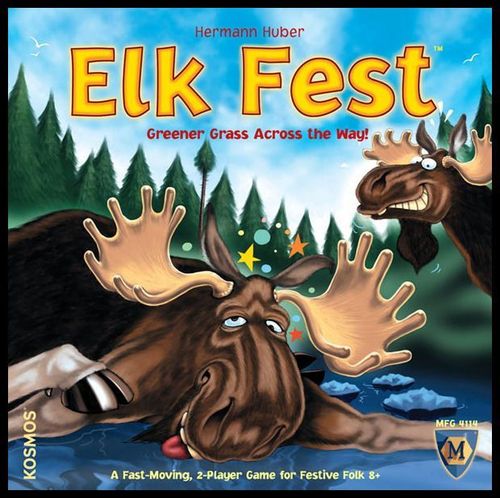
Elk Fest
Elk Fest Rulebook
Table of Contents
Table of Contents
Game Overview
A beastly duel of dexterity for 2 players, ages 8-up
Game designed by: Hermann Huber Published by: Kosmos. Non-literal rules translation by: Richard Grant Small Format: Idris Hsi
The Goal
The first player to reach the opposite riverbank with his or her elk is the winner.
Game Contents
- 2 elks (Jule, light, and Ole, dark)
- 2 riverbanks (light and dark)
- 6 gray stepping-stones
- 8 rubber tabs
Game Preparation
- Before the first game, stick 4 of the rubber tabs on the bottom of each riverbank. This will keep it from slipping around on the table.
- The players sit on opposite sides of a smooth playing surface. One takes Jule, the light-colored elk; the other takes Ole. Each takes the matching riverbank and 3 stepping-stones.
- Both players lay their riverbanks on the table. The farther apart these lie, the longer the game lasts. The publisher recommends a spacing of about 50 cm/18 inches.
- Elks are placed on the riverbanks. It doesn't matter which way they face.
- Each player lays 3 stepping-stones in a row to the RIGHT of the riverbank, as shown in the German rulebook. Space them so they can be flicked without colliding.
- Before the game, the contestants should agree on whether to allow a player, during his or her turn, to cross to the other side of the table so as to flick stepping-stones from any direction.
Game Play
Game play consists of flicking the stones and moving the elks. This can be done in any order, as outlined below.
1. Flick the Stepping-Stones
- The youngest player begins by flicking, with a finger, ONE stepping-stone from his/her side of the board. The idea is to flick the stone close enough to the riverbank that the elk can reach it with his front hooves.
- The second player now flicks TWO stepping stones from his/her side. From now on, each player will continue making two flicks per turn. (Except in the case of certain Disastrous Occurrences, noted below.) A player can flick the same stone twice, or two different stones one time apiece.
- In the opening turns, each player must flick all 3 stones from their starting place beside his/her riverbank. From then on, a player may flick ANY free stone (that is, a stone without an elk's hooves on it), including stones that originally belonged to the other player.
2. Move the Elk
- At any time during his/her turn -- before, in the middle of, or after flicking stones -- a player can move an elk. The elk's front and rear hooves must always rest on stones or on the riverbank.
- Movement must always be stone-to-stone -- no "jumping" allowed -- as illustrated in the German rule book. (In other words, after a move, the elk's rear hooves must rest where previously the front hooves lay.)
- An elk can move as many times during a turn as possible, as long as its hooves can reach a neighboring stone.
- At the end of a move, the elk must be firmly balanced with his hooves out of the water. (Otherwise, see "Elk Gets Wet" below.)
3. If Things Go Badly
Elk Gets Wet
If a player causes either elk to fall down, his/her turn ends immediately. This applies also if the player knocks a stepping-stone from under an elk's hooves, so that the creature is standing with his feet in the icy river. In such cases, the elk is returned to its previous position, as nearly as possible. The next player may make THREE stone flicks.
Stone Crashes to the Floor
If a player flicks so powerfully that a stone falls off the table, his/her turn ends immediately. The stone is returned to the right-hand side of the riverbank of the player who caused this disaster. The other player may make THREE flicks on the following turn. (If the players have agreed beforehand, he/she may cross to the other side to flick the stone just returned to the table.)
Game End
The game ends as soon as an elk can set his front hooves firmly on the opposite riverbank.
Game Variant
When you feel like playing a number of rounds in succession, try this variant using victory points. The starting player moves continuously -- flicking stones and moving his or her elk, as usual -- for as long as it takes to reach the opposite riverbank. Every flick costs one point. The expenditure of points is recorded. Then the second player begins from the other side, and the game continues through as many rounds as desired. At the end, whoever has spent the fewest points in crossing and recrossing the river is the winner, and he or she should give some serious thought as to whether a career-change to Elchfahrer might not be in order.