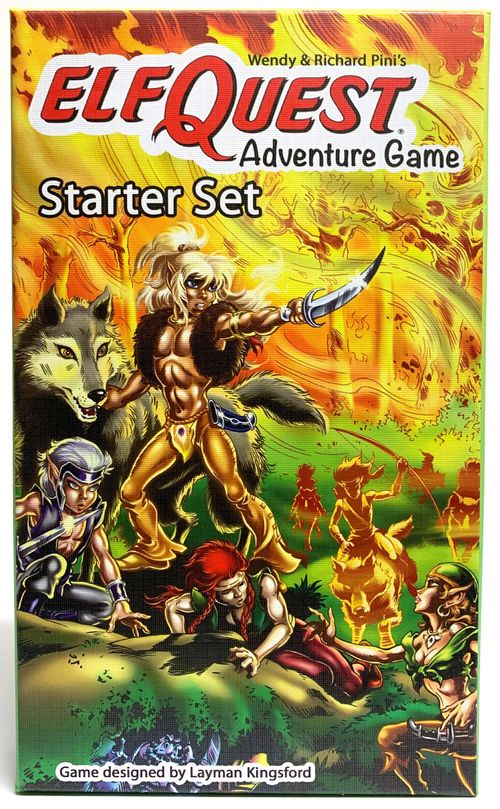
ElfQuest Adventure Game
ElfQuest Adventure Game Rulebook
Table of Contents
Table of Contents
Components
- 21 character cards (3 versions of 7 different characters)
- 64 small cards (63 "Hand" cards, 1 Boon)
- 6 large cards (1 Home, 5 Scenarios)
- 33 Event Cards
- 72 Success/Growth tokens
- 72 Wood Cubes (24 red, 18 blue, 18 green, 12 yellow)
- 1 wood pawn
- 12 six-sided dice (3 white, 9 black)
- Rule book
Choosing Your Tribe
This game is always played with FOUR characters whether you have one player or more.
Select the "START" version of each of the four character cards you have chosen for your tribe and set aside the Growth 1&2 cards for now.
Layout the eight small "START" hand cards for each character and set aside the Growth 2 cards for now.
Setup
Setup (for your first game)
- Set out the Father Tree Holt home card.
- Set out a "pool" of attribute cubes.
- Set out a "pool" of Success/Growth tokens.
- Set out the first Scenario card with the season tracker side up.
- Set out and shuffle the Scenario 1 Event cards.
- Place the pawn on Season 1 of the scenario card.
- Place four chosen character cards on the table.
- Place the matching hand cards next to each character card. Take the number of cubes indicated on each character and hand card and place them next to their character cards.
- Place all the 6-sided dice within easy reach of all players.
Object of the Game
As an on-going cooperative game, the object of the players' efforts is to keep their characters alive and to progress through the scenarios and their attending events.
The starter set comes with five scenarios. The first, "Forest Life", is a series of randomized events. The next four scenarios are intended to be linear and follow the story as told in the Original Quest issues 1-2.
You can certainly randomize all events if you are willing to do away with the story-telling aspect and want to vary additional gameplay until new scenarios are available in expansion sets.
Game Play
The game is measured in Seasons. One season consists of one action taken by each of the four characters. Once each character has taken an action, move the pawn to the next season on the current scenario card.
If you run out of seasons during a scenario before completing all the events for that scenario, you keep playing but EACH character loses 1 attribute cube and 2 success tokens for every additional season used.
Turn Sequence (Events)
-
After setup, flip over the top Event card.
The Solo symbol denotes a SOLO event meaning only one character may attempt it and it must be completed by that character.
The Tribal symbol denotes a TRIBAL event. Any number of characters may attempt it. Different characters or more/fewer characters may complete the event if it is not finished on the first attempt.
-
The character(s) attempting the event collectively add one die to the dice pool for every cube they currently possess that matches the color/symbols depicted on the event (red, green, blue and yellow cubes) plus the number of white dice shown on the card. The white dice are used on the FIRST attempt only.
-
Place one success token on the event for every result of 5 or 6 on the dice.
-
You may re-roll one non-successful die once every time a TRAIT on participating character/hand card matches a trait on the event card.
-
If you accrue the necessary number of successes to complete the task (plus any other requirements such as discarding cubes) every participating character claims the reward. Flip over the next event. If you do not complete the event, you may attempt it in the current season with different characters or in a subsequent season with the same or different characters.
-
Every other character that has not taken an action during the current season may attempt the revealed event (whether it is a partially-completed tribal event or is newly-revealed) OR may undertake a Home Card TASK.
-
Home card TASKS all operate like solo events except that the results are not cumulative.
-
When the season ends, roll 1 die to see if there is a penalty for the revealed task being incomplete (as depicted in the grey crescent). This happens even if the event was just revealed and has not been attempted yet.
-
When a SCENARIO is completed, turn it over and all characters gain the depicted reward. Reveal the next scenario and its first event card. All characters remain in their current condition.
Card Anatomy
There are five types of cards in the game: Event, Character, Hand, Home and Scenario cards.
Event cards carry these elements: the Solo or Tribal symbol; the Base Dice (usable once); the possible Penalty for non-completion; the dice provided by attribute cubes; the Reward for completion; the requirements to complete (in the black crescent on the left side); and the Traits that allow dice re-rolls.
Event Cards
The core of this game revolves around the completion of events, though forgoing the replenishing benefits of Home Card Tasks is not recommended. Finding the balance between undertaking events and tasks is a big part of strategic decision making in this game.
Solo or Tribal
A solo event can only be attempted by one character. A tribal event may be attempted by one or more characters.
Base Dice
For each base-dice symbol on the event you get to use one white 6-sided dice ONCE during the first attempt on this task. If the event is not completed, you do not get to use these dice again on subsequent attempts.
Penalty
If you do not complete the revealed event by the end of the current season, you must roll a die. If the result is listed in the grey crescent on the right side of the event card, that penalty needs to be enacted.
For example, on the Hunting Trip event card a result of 1 on the die roll means that one participating character needs to discard an attribute cube (they get to choose which color).
Attribute Dice
Along with the base dice, all participating characters get to roll an additional number of dice equal to the number of cubes they currently possess that match the icons listed on the event:
- red cube = Physique cube
- green cube = Savvy cube
- blue cube = Grace cube
- yellow cube = Magic cube
These dice are usable on every attempt of the task, even when the white base dice have already been used on a previous attempt.
For example, on the Hunting Trip event card every character who is participating in the event adds one die to the attempt for every green and every red cube they currently possess. Their current number of available cubes may be lower than their maximum if they previously had to discard cubes.
Reward
At the bottom of each event card is the reward that all characters who participated receive for having completed it. A character must have contributed at least one die to the attempt (it need not have been successful) and/or one attribute cube to pay for the completion cost. The use of a Sending hand card does not qualify that character as a participant.
Traits
On each event card is a list of traits. Every time one of those traits is matched on a participating character's hand and character cards, it allows ONE of the unsuccessful dice in the current dice pool to be re-rolled one time.
For example, on the Hunting Trip event card Forest, Hunt and Travel are the re-roll traits. If Cutter and Redlance are the two characters attempting to complete the event they have a total of 14 re-rolls available to them since those three words appear fourteen times between all of their hand cards and character cards.
Requirements to Complete
Depicted in the black crescent on the left side of event cards are the number of successes needed from dice rolls in order to complete the event. Keep track of the number of successes you have gained by placing unused success tokens from the pool on the event card. Many events also require that one or more cubes be discarded by the participating characters. These cubes may be discarded from one character or the participating characters may divide the burden.
Character Cards
Each character card shows the Basic Traits at the top, the Bonus dice to Tasks, the Max number of Hand Cards, and the Attribute Cubes (Physique, Savvy, Grace and Magic cubes).
Each character is portrayed on a series of cards depicting them at their various stages of growth. The "Start" version of each character is the one they begin the game using, even if they are brought in during a game that is in progress in order to replace a previous character that has been killed.
The basic traits at the top of the card each allow for the re-rolling of one die when engaged in a task or event that has a matching trait.
For example: The Provide task on the Home card would let Cutter re-roll one of his dice because his character card has the Forest trait on it.
The Bonus Task Dice are granted every time a character undertakes a task on the Home card. In Cutter's case (above) he gets one additional die when engaging in a Community or Train task and two extra dice when doing a Provide task.
The Attribute Cubes depicted on the character card (and on some Hand cards) are acquired when the character enters the game. If a character is entering the game to replace a lost or dead character they gain these cubes once.
A character can never have more cubes than the total number provided by their character card and hand cards.
A character, in their starting version, can not have more than 8 Hand Cards. Once they reach their Growth 2 stage they will earn an additional hand card. With future expansions there will be new hand cards that characters can acquire and swap out for their existing hand cards.
Hand Cards
Each Hand card represents an item possessed by the character, an ally that aids them, or their skills and demeanor (personality). Some Hand cards provide additional attribute cubes or additional dice on certain tasks/events and/or a number of dice re-roll traits. Some hand cards may also have additional abilities or provide other types of benefits.
Hand card elements: the Card Type symbol; the Dice Re-roll Traits; the Bonus Effect; the Craft Requirements (relevant with future expansions); the Bonus Die (add ONE die to your pool during an event or task that has one or more of the traits on this card); and the Attribute Cube (add it to your character's total).
For example, the Sending card provides Magic Sending as its re-roll trait and has the bonus effect: "+2 free success tokens to any Elf's task or event." The Sending hand card is flipped over (see below) to provide 2 successes to any other elf's task or event.
Flipping Hand Cards
The information on the face of the Hand cards (such as additional dice and cubes, traits, etc.) is not the only use for hand cards. The cards themselves can be used as resources to generate additional dice.
When you flip over a Hand card to its plain side you gain 3 dice to add to your current dice pool. The card you flip MUST have at least one trait in common with the event or task you are currently attempting. When a card is in its flipped state it no longer provides cubes, traits, dice, abilities or bonuses of any kind.
Another option, admittedly a desperate one, is to permanently discard a Hand card. If you do, you gain 6 extra dice to your dice pool. This is called sacrificing a card and the sacrificed card must have at least one trait in common with the task or event at hand.
Home Cards
If a character is not participating in the revealed event card they may take on a task from the Home card as their one action for the season.
During the game you will find it necessary for characters to utilize the benefits from undertaking Tasks since they garner the replacement of used resources: success tokens, attribute cubes and flipped hand cards.
Tasks may only be undertaken by one character at a time. Each provides three base (white) dice. Characters also add additional dice to the pool depending upon what their character card depicts.
Once you have assembled your dice pool, roll the dice. You may re-roll a number of dice equal to the number of times your character's traits match the traits of the task. Consult the chart on the Home card as to the reward(s) you may have gained.
Home Card Tasks
The Father Tree Holt Home card lists these tasks, with the traits that go with each and the dice-coloured cubes that add bonus dice:
- Care: Heal, Nurture, Plant. Dice: green (Savvy) and blue (Grace) cubes and yellow (Magic) cube. Reward: Recover one attribute cube per three successes.
- Community: Culture, Diplomacy, Mating. Dice: blue (Grace) and yellow (Magic) cubes. Reward: Un-flip one Ally or Boon card per three successes.
- Make: Craft, Forest, Trade. Dice: red (Physique) and green (Savvy) cubes. Reward: Un-flip one Item card per three successes.
- Provide: Harvest, Forest, Plant or Animal, Forest, Hunt or Animal, River, Fish. Dice: red (Physique) and green (Savvy) cubes. Reward: Gain one Success token per success.
- Rest: Forest, Meditate, Relax. Dice: blue (Grace) and yellow (Magic) cubes. Reward: Un-flip one Demeanor card per three successes.
- Train: Learn, Teach, Adult, Elder [2], Ancient [3]. Dice: green (Savvy) and yellow (Magic) cubes. Reward: Un-flip one Skill card per three successes.
Task Rewards
Care Tasks: For every three successes on the dice one attribute cube may be regained to one character or hand card.
Community Tasks: For every three successes on the dice one Ally or Boon card may be un-flipped by any one character.
Make Tasks: For every three successes on the dice one Item card may be un-flipped by any one character.
Provide Tasks: For every success on the dice gain one Success token. You may share these tokens with anyone.
Rest Tasks: One Demeanor card may be un-flipped for every three successes on the dice.
Train Tasks: For every three successes on the dice one Skill card may be un-flipped by any one character. Note that the Elder trait provides 2 re-rolls and Ancient provides 3 re-rolls of the dice.
Scenario Cards
Each Scenario has a deck of unique Event cards that accompany it. Some scenarios require the event deck to be shuffled while others need them to be stacked in a specific order.
The front of the card lists the number of seasons you have to complete all the associated event cards. If you run out of seasons before completing all the events, you keep playing but EACH character loses 1 attribute cube and 2 success tokens for every additional season used.
The back of the scenario card is revealed once you've completed all the tasks. Every character in your tribe gains the depicted reward.
Attribute Cubes
Attributes abstractly represent a character's physical, mental, social and magical qualities. These cubes are also the measure of a character's health and survivability.
If all of a character's cubes are discarded and they are required to discard one more, the character dies and is removed from the game forever. All associated tokens and cards are discarded, though allies and items can be taken by another character if they are not at their maximum number of hand cards. A new character is chosen and enters the game with all its "Start" cards.
Attribute cubes are used to pay for completing many events representing the physical, mental, social and magic stress and exertion required to get through life and its travails.
At anytime when engaged in a task or event you may discard a cube and gain 2 success tokens.
Success Tokens
Success tokens can be discarded from your character card to the event or task you are currently working on and count as one success each.
Growth Tokens
Growth tokens are usually earned from completing events. Once you have gained eight you may discard them and switch your starting character card for the "Growth 1" version. When you have earned another nine you may switch to the "Growth 2" version plus gain the "Growth 2" hand card.
Character Roster
The Wolfriders are the central focus of ElfQuest, a shy and secretive tribe of forest dwellers who have allied themselves with the wolves of the world of Two Moons. The character descriptors below are the trait lines printed under each character name in the rulebook. The character biographies are flavour text and are omitted.
- Cutter (Chief, Hunter, Warrior). Blood of Ten Chiefs. Basic traits: Young, Elf, Wolfrider, Forest.
- Skywise (Stargazer, Advisor, Hunter, Warrior).
- Nightfall (Huntress, Warrior, Archer, Scout).
- Redlance (Tracker, Gatherer, Herbalist, Guardian).
- Strongbow (Archer, Hunter, Warrior, Keeper of the Way).
- Moonshade (Tanner, Keeper of the Way, Gatherer, Huntress).
- Pike (Howlkeeper, Hunter, Berry-Keeper, Layabout).
The Story (by Scenario)
The story, as depicted in this game and its planned expansions, is broken up in to segments called Scenarios. Each scenario covers a slice of the ElfQuest story taken directly from the published comics or it contains random events and happenings, sometimes taken from the comics as well or may be made up of new or abstract story elements (non-canon, of course). The rulebook recommends reading the comics, which at the time of printing were free on the ElfQuest.com website.
Forest Life (Scenario 1)
Life in the deep forest can be both tranquil and dangerous. Seasonal weather can bring both harsh winter freezes and summers full of abundant food and game with no great predictability. Tribes of short-lived and fearful humans come and go constantly threatening the safety of the elves. Accidents can bring grievous injury or even death all while the elves strive to live in the Now like their bonded wolf friends.
Madcoil (Scenario 2)
A unique crisis befalls the Wolfriders as a magically-mutated monster invades the forest and starts killing the inhabitants with no distinction between animal, human and elf. It's going to take concerted effort and inventive unity for the small elven tribe to survive this threat and put an end to it.
Neighboring Humans (Scenario 3)
For some time now, a tribe of persistent humans has dwelt near the Father Tree Holt. Antagonism between the Wolfriders and the Gotarra-worshiping humans is perpetual and loss of life to both sides is becoming constant. The single-minded shaman of the tribe has made it his life's goal to rid the world of the forest demons at any cost. One of the Wolfriders is captured and the tribe needs to mount a rescue before their elfin kin is sacrificed and hope the crazed humans don't do anything too rash.
Troll Caverns (Scenario 4)
Cutter's father, Chief Bearclaw, had discovered the existence of Trolls living in caverns under the forest. Trade relations between the elves and trolls have become regular and mutually-beneficial with the elves providing fresh meat, pelts and other food stuffs in exchange for durable metal items and weapons. Now that the humans have forced the elves to flee they have no choice but to seek sanctuary in the troll tunnels that have never been seen before.
The Burning Waste (Scenario 5)
After negotiating with the troll king, Greymung, the elves are led through distant tunnels to a promised new land of light and wonder that the surface-dwelling elves can make as their new home. Sadly, the tricksome trolls have misled the elves and trapped them in a desert of blasted sand and scorching sun. The Wolfriders have no choice but to cross that inhospitable terrain in the hopes of finding sanctuary elsewhere.
What Comes Next?
After completing these five scenarios, make a note of what cubes, cards, success and growth tokens your characters all currently possess. Future expansions will progress the story further with new scenarios and new elements of game play.
Iconography
- Flip over hand card
- Sacrifice hand card
- Discard 1 Success token
- A cube of any color
- Discard 1 cube of any color
- Discard a Growth token
- Success on dice (5 or 6)
- Skill Card
- Item Card
- Ally Card
- Demeanor Card
- Savvy Cube (green)
- Grace Cube (blue)
- Physique Cube (red)
- Magic Cube (yellow)
- Success token
- Growth token
- One six-sided die (d6)
Rules Clarifications and Errata
The following is from the publisher's official "EQ Adventure Game FAQ" (Cheeky Dingo Entertainment, rules clarifications dated 5-17-15). Its card errata are applied in the notes below; where the FAQ says the corrected printing is in its own image, the corrected symbol is noted in brackets.
Card Errata
- Misprinted traits: the trait printed as CARE should read NURTURE. The FAQ marks this on the Forester and Comforter cards.
- Indolent (misprinted icon): the success-token icon on the bottom line of the card ("When flipped, this card only provides you with 2 dice") is misprinted. The correct icon is a six-sided die.
- Bountiful Summer (event card): the printed penalty and reward symbols were misprinted. The FAQ shows the corrected card: the Bountiful Summer reward reads "gain 4 success tokens to your Home card".
- The FAQ also reproduces print-and-play corrected card images. These are image-only and are not transcribed here.
Traits
Each trait on a HAND or CHARACTER card that matches a trait on the EVENT or TASK that character is attempting provides the ability to re-roll one die in your pool that has not succeeded. If you want a VERY challenging method of play, don't use any re-rolls (or maybe just one per trait, not one for every time a trait is printed on a card). If the same trait appears multiple times on a card, each time it appears provides a die re-roll.
Despite the current version of the Father Tree Home card and statements made on the current demo video, traits always provide dice re-rolls. The FAQ states the new Father Tree Home card would be uploaded to the website and eventually re-printed for the first expansion.
Each TASK on the home card will depict which attribute cubes provide dice so that they work in the exact same way as a solo event.
Development note: the home card tasks were depicted with the attribute icons in most playtest versions; they were removed in the final design to avoid visual clutter.
Event Failure / Non-completion
When you do not complete an event, at the end of the season you roll one die and apply its result (if any) as depicted on the grey crescent on the right side of the event card. The penalty only applies ONCE no matter how many characters were involved in the attempt. The penalty must be fulfilled by character(s) involved in the attempt. So, for example, if one cube must be discarded players must choose which one of the participating characters must take the hit and lose one cube. The penalty does not apply to everyone involved but penalties may be split among one or more involved characters if possible.
Event Rewards
When an event is successfully completed every character who contributed to it, even if they helped in a previous season and are not helping at the time of completion, is eligible to receive the indicated reward, if any.
Turn Order
It does not matter whether you attempt the revealed event before or after attempting tasks on the home card.
If a character(s) does not join in to help a TRIBAL event attempt but chooses to attempt it after others have failed to finish it in the current season, that character(s) may attempt it that same season (but does not get to roll any white dice).
Dice Rolling and Tribal Events
When working on a TRIBAL task players can choose to each roll their own dice or all the dice may be rolled by one player on behalf of everyone participating in the attempt. The white dice are rolled once only, no matter how many characters are participating (though they do qualify for re-rolls).
You may choose to roll all dice in one pool or allow each player to roll the dice they are contributing. If the event is not completed in the current season, roll one d6 at the end of the season to see if there is a penalty.
When attempting the failed tribal event in a subsequent season, you need not use the same characters or even the same number of characters. When it is completed, all characters who participated in the event from past and current seasons gain the reward even if they did not contribute during the season that the event was completed.
Flipped Hand Cards
When a hand card is flipped over, either to gain three dice for an event or as a result of some penalty, you no longer have access to anything it provides be it dice, attribute cubes or traits.
Two Edge's Invention Card (Kickstarter exclusive card)
Each of the two traits on this card need to be chosen at the beginning of each new SCENARIO. The traits may be the same or different. They stay the same for the duration of the scenario.
Inability to Pay a "Price"
If a character is ever required to discard a specific cube or to flip over a specific card or to discard tokens and they do not have the required resources to do so, then two of something similar must be discarded/flipped etc.
For example: If Skywise is required to discard a green cube and has none, he must instead discard two cubes of any other combination of colors. Or if he has no success tokens to discard then he would have to flip a card or discard a cube instead.
Wolf Ally Cards
All wolf ally cards are considered to have the animal trait.
Sending Skill Card
Flipping over the Sending card can be done at any time on anyone's turn. The elf flipping the Sending card is NOT considered to be participating in the event unless they have contributed dice to the event and therefore do not qualify to receive any rewards from that completed event.
Freak Accident Event Card
Roll three dice. That's it. No re-rolls. Thematically, Sending should not be used by other characters to help.
Count up the number of successes you rolled and apply the effect as depicted on the card:
- No successes: permanently discard a hand card.
- One success: flip over two hand cards.
- Two successes: flip over one hand card.
- Three successes: discard two success tokens from your personal stash.