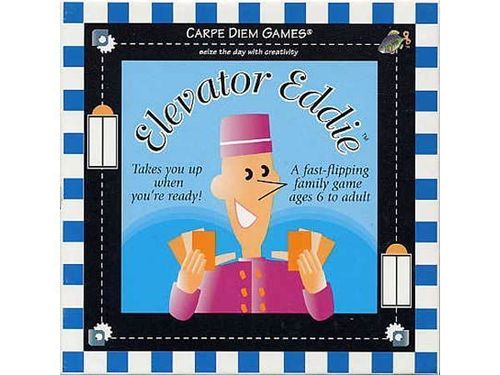
Elevator Eddie
Elevator Eddie Rulebook
Table of Contents
Table of Contents
Components
- 8 'floor' tiles
- 72 'monster' cards – 5 stop, 5 go, 62 numbered (with values between 0 and 8).
Object of the Game
Each player has a pile of cards in front of him. These cards are used to move any of the four lifts upwards and downwards. The first player to use up all his cards is the winner.
Preparation
The 'floor' tiles are mixed and placed face-down in a pile. The top tile is turned over and placed in the middle of the table. On each 'floor' tile there are four lifts each of which has been given a number between 0 and 8, or is marked GO or STOP. The number indicates at which level of the building the lift is currently at (for example 3 means the lift is at the 3rd floor).
The 62 monster cards are shuffled and distributed to the players as follows:
- For 2 players – 36 cards each
- For 3 players – 24 cards each
- For 4 players – 18 cards each
The cards are placed in a pile face down in front of the player without being looked at.
Playing the Game
Each player takes the first three cards from his/her pile (with four players only two cards are taken). There is no turn order – all players play simultaneously. Each player tries to find places on the board to lay as many of his cards as possible. Cards can be placed on the lifts shown on the 'floor' tile so that the number is one higher or one lower than the starting number on the tile (e.g. you can play a 2 or a 4 on a 3). Note that you can only play a 7 on an 8, and a 1 on a 0.
When a card is played it is placed so that it covers the number on the tile card with the number on the card being in the same alignment as the number on the 'floor' tile. Further cards can be laid on top of this one following the rule that they must be one higher or one lower in value than the figure shown. It is important to try and keep an eye on the whereabouts of all four lifts since the cards laid by the other players may allow, or prevent you from playing yours. Cards should be played as quickly as possible before an opportunity is lost.
When a card is played, another card is drawn from the player's pile so that the hand is made up again to a total of 3 cards (2 cards in a 4 player game). The process is simple, play a card, draw another one to replace it, play a card, replace it….and so on. A player is permitted to play more than one card, one after another, and then make his hand up to three (or two) again.
Players keep laying cards one on top of another, following the one up or one down rule for as long as they can. If a player cannot lay one of his cards he must wait and watch to see whether another opportunity to play comes up.
Stop and Go Cards
A STOP card can be played on top of any card with the exception of another STOP card. In this event the lift stops moving. The only card that can be placed on a STOP card is a GO card – this allows the lift to start moving again. Any numbered card, or a STOP card, can be played on top of a GO card (another GO card cannot be played).
Examples of Play
Tim plays a 5 on top of the left hand lift (at level 4) and then follows that with a 4. He draws two cards from his pile. Lisa plays a 3 on the top lift (at level 2) and then plays a 7 on the right hand lift (at level 8). She also draws two new cards to make up her hand.
Tim then plays a 2 on the top lift (at level 3). He plays a 3 on the left hand lift (at level 4). Lisa plays a GO card on the bottom lift (STOP). Tim lays his 2 on Lisa's GO card. Lisa draws one card into her hand. Tim draws 3.
No Opportunities for Play
In the event that none of the players are able to continue laying cards the game is blocked. The 'floor' tile and all cards already played are moved to one side and a new 'floor' tile turned over and play resumed.
If a Wrong Card Is Laid
If a player is seen making a mistake (e.g. playing a 6 on a 2) then he takes the card back into his hand. If a mistake is made but no-one notices then play continues as normal.
Game End
The game ends when the first player has played all his cards. This player is the winner.
In the event that all 'floor' tiles are used before a winner is found then the tiles are mixed again and a new pile made. The top tile is, once again, turned over and play recommences.