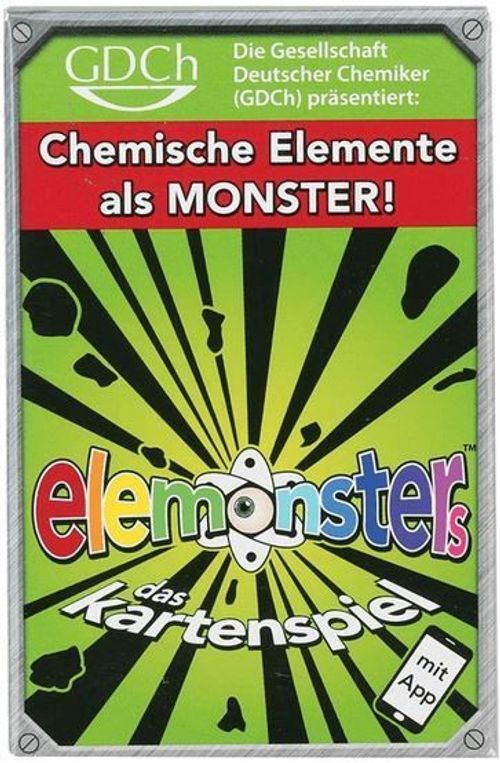
Elemonsters: Das Kartenspiel
Elemonsters: Das Kartenspiel Rulebook
Table of Contents
Table of Contents
Contents
The set contains 72 cards:
- 48 element cards
- 18 multiplier cards: 8 × 2-fold, 6 × 3-fold, 4 × 4-fold
- 4 connection type cards
- 2 symbol cards
Card Anatomy
The numbers below refer to the legend printed on the element card.
- Chemical symbol and atomic number
- Name of the element
- Column in the periodic table
- Symbol and colour of the element group (see no. 12)
- Thermometer with a bar for melting point and boiling point. The figures on the scale show the 1000-degree steps in degrees Celsius (see also nos. 20 and 23)
- Row in the periodic table
- Light spectrum of the element
- (Chemical) attack value (electronegativity)
- Electron shell: yellow circle = electron, black circle = gap. An atom wants its shell either completely full or completely empty, and therefore readily gives up electrons or accepts them. This is what allows connection pairs to form.
- (Chemical) defence value
- Description of the element
- Name of the element group (called the "series")
- Atomic weight
- Share in a 70 kg human body
- Name of the monster family
- Flame colour, if any
- Alchemical symbol, if any
- Monster picture and monster name
- Material picture
- Melting point (blue) and boiling point (red)
- Symbols for further properties: biologically important (essential), poisonous, precious metal, neutral, radioactive, magnetic, flammable, hard, material, semiconductor, corrosive, radiation protection
- The asterisk means "native". This means it occurs in nature in pure form.
Goal of the Game
Form as many connections as possible and collect points for them.
Setup
Two-player beginner variant: Take the multiplier cards out of the set and set them aside.
You also need a pen and paper for the score.
Start of the game: Place the four connection type cards face up in a row in the middle of the table. Shuffle the remaining cards.
Each player is dealt five cards. The rest are placed face down as the draw pile.
Turn Structure
A turn consists of up to four actions, carried out in exactly this order:
- Draw a card
- (optional) Duel
- (optional) Lay a connection
- Discard a card
In addition, a player may use at most one special action.
Draw a card: The player draws one card from the draw pile (and, if the card triggers a special action, carries it out).
Duel: The player picks one of his hand cards, lays it face up in front of him, and names one of the values on the card (for example, atomic weight). The opponent looks through his cards to see whether he can beat that value. If so, he also lays down the card, names the corresponding value, and may then take both cards. If the opponent cannot beat the value, he must hand one card to the attacker.
As a rule the higher value wins, with one exception: for the discovery date, the older the better. A further exception: if the attack value is named, the attacked player must answer with the defence value.
Lay a connection: For connection pairs, the electron shell (no. 9 of the legend) is decisive. There are four categories of connection, shown on the connection type cards. If the player holds a matching pair, he may lay it at the corresponding category (see the example picture). Special case: pairs with four electrons each can be laid in every category except noble gases.
Players lay their card pairs out at the categories vertically, from opposite sides, so that which player owns which pair is clearly visible.
Several connections may be laid in a single turn. Afterwards the points are calculated (see below) and added to the score.
Discard a card: A turn ends with the player discarding one card onto the discard pile. If the player has fewer than five cards in hand, he does not have to discard.
When the draw pile is used up, the discard pile is shuffled to form the new draw pile.
Special Actions
The symbols (no. 21 of the legend) on the cards are needed for special actions. The player carries them out at the appropriate point in his turn, depending on the action. As a rule the player places the card whose action he wants to use in front of him and announces the action.
Note: certain actions can also be carried out during a duel, to defend against the opponent.
Duel Attack
Demand second card: If an attack in a duel has been defended, the player can use this card to force the opponent to play a second card. This card must also beat the named value. Otherwise the attacker receives both cards.
Attack with two values: If this symbol is used, the player may name two values on his card. The opponent must then beat both values with one card.
Specify metals: With this card the player can force that either only metals or no metals may be used in the duel. (The two options are shown on the card as the coloured metal and non-metal symbols.)
Reprogram values: The player may specify that the lowest value counts instead of the highest, or vice versa.
Duel Defence
Protection against skull attack: If a fellow player attacks with a poisonous (giftig) card, the player may defend with this card. If the card has more hearts than the attacker has skulls, the demand for a second card can be blocked.
Extra life: If this is the last card the fellow player loses in a duel, he may draw as many cards from the draw pile as he has hearts on this card.
Duel Won
Card magnet: If the player has won a duel, he may take a card from the opponent blindly (instead of the card the opponent would have sacrificed).
Forced exchange: If the player has won a duel, he may use this card to force the opponent to choose another card and exchange it for one of his own.
Draw a Card
Card decay: If this card is drawn, all players must immediately discard at least one card. Any player with more than five cards in hand discards enough cards that only four remain.
Defence against radioactive card decay: If a radioactive card is drawn and the player holds this card, he can protect himself from having to discard cards.
Exchange cards: If this card is drawn, the player may draw as many cards from the draw pile as there are neutral symbols on it. He then sorts out just as many cards and places them on the discard pile.
Lay a Connection
Draw extra cards: If this card is laid in a connection, the player may draw as many cards from the draw pile as there are crowns on the card.
Dissolve connection: With this card the player may take an already laid connection back into his hand, provided he lays a new connection in exchange. The points of the dissolved connection are subtracted from the points of the newly laid connection. This can be useful if the player wants to use a particular card that is already laid again in the game.
End of the Game
As soon as all cards have been used up, the game ends. After the player who drew the last card has completed his turn, the other player may still take one final turn.
Then the minus points on the hand cards are added up and subtracted from the score.
Alternative end: It is also possible to agree on a maximum score (for example 20). As soon as a player reaches this score, the last round begins.
Scoring
Each pair scores as many points as stated on the connection type card:
- Alloys and ions: 1 point per pair
- Molecules: 2 points per pair
- Noble gases: 3 points per pair
In addition, some symbols in connections count as bonus points:
- Crown: 2 points each
- Pair with two materials: 1 point (per pair)
- Heart or neutral symbol: 1 point each
Each card left in hand scores one minus point at the end of the game.
In addition, some symbols on hand cards count as extra minus points:
- Skull: 1 minus point each
- Radioactive: 2 minus points each
- Each radiation-protection symbol cancels out one radioactive symbol on the hand cards.
Example of scoring:
- Silver and copper in the connection type alloy (Ag Cu – Britannia silver): alloy 1 point, 3 crowns 6 points, 1 heart 1 point, 2 materials 1 point. Sum: 9 points.
- Left over as hand cards: uranium, bismuth and beryllium:
- 3 hand cards: 3 minus points
- 1 × radioactive: 2 minus points
- 1 × radiation protection: cancels 2 minus points
- 2 skulls: 2 minus points
- Sum: 5 minus points
Further examples are on the website or in the app.
More Than Two Players
The rules for more than two players are essentially the same, except that additional connection type cards are needed. A layout sheet for these can be downloaded and printed from the website.
Advanced Version with Multipliers
With the simplified rules only a fraction of all possible chemical connections can be represented, since each element can appear only once. To make other connections possible, such as water (H₂O), which consists of two hydrogen atoms and one oxygen atom, the multipliers come into play.
Looking at the electron shells of hydrogen and oxygen, we see that hydrogen has one gap and oxygen has two gaps:
H ↔ O
In a molecule, simply put, gaps are shared. So that the oxygen (on the right) can share both of its gaps, we need two hydrogen atoms (on the left):
2 × H ↔ O
In card form this looks like this: two hydrogen cards form a molecule with oxygen.
Similarly with nitrogen and fluorine, except that in this case the fluorine must be tripled to match the three gaps of nitrogen: 3 × F ↔ N.
Further examples can be found on the multiplier cards and in the app.
Multipliers can only be used in molecules and ionic connections. In scoring, each multiplier card used counts for 2 points.
Setup for the advanced game: Shuffle the multiplier cards into the deck, and each player is dealt seven cards.
All other rules remain essentially the same, except that multipliers cannot be used in a duel.