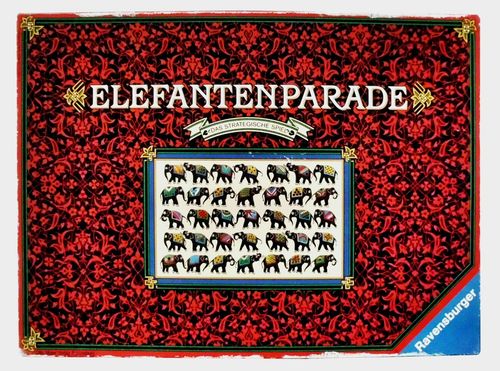
Elefantenparade
Elefantenparade Rulebook
Table of Contents
Table of Contents
Components
- 1 game board
- 8 elephants in 4 different colours
- 17 logs (tree trunks)
Object of the Game
Collect as many logs as possible, from the forests (brown squares) and from the elephant houses.
Setup
Each player has 2 elephants of the same colour.
- With 2 players, only 4 elephants are in play.
- With 3 players, 6 elephants are in play.
- With 4 players, all 8 elephants are in play.
Each player in turn places their elephants on the starting squares, which are the squares closest to the departure pavilion in the corner of the board.
Logs are placed as follows:
- 2 logs are placed on each brown square (the forest squares).
- 3 logs are placed on the largest elephant house, in the middle of the board.
- 2 logs are placed on the medium elephant house.
- 1 log is placed on the smallest elephant house.
Playing the Game
The youngest player begins. Play then continues clockwise.
On each turn, a player chooses one of two options:
A) Normal Movement
The player moves 3 elephants. Usually the player moves both of their own elephants and one elephant belonging to an opponent.
One of the elephants is moved forward 3 spaces, another is moved forward 2 spaces, and the third is moved forward 1 space. A "space" means an empty location when moving toward the goal. The order in which the elephants are moved is entirely free.
Example of normal movement (as shown in the rulebook):
- A first elephant is moved forward 2 spaces.
- A second elephant moves forward 3 spaces.
- A third elephant is finally moved forward 1 space.
B) Elephant Parade
Instead of making a normal movement, a player may call for an "Elephant Parade". In practice, an Elephant Parade means moving every elephant forward by one space.
Example of an Elephant Parade: every elephant on the route advances one space.
Rivers (Blue Squares)
Blue squares (the basins) can only be crossed if an elephant is already present there, that is, if an elephant is already in the water.
When an elephant has arrived on a blue square, it cannot move again until all the elephants that were following it have passed it. It can then move normally. An unfortunate elephant standing in the water can nevertheless get out if a player calls for an Elephant Parade. In that case it advances one space like all the other elephants and so leaves the water.
An elephant that would enter the water as a result of an Elephant Parade is blocked, just as if it had arrived by a normal movement.
Forests (Brown Squares)
If an elephant lands exactly on a brown square, the player takes the two logs found there and places them in front of them. Elephants that later arrive on a square whose logs have already been taken gain nothing.
The Arrival Square
The first elephant to reach the central square goes into the largest elephant house and gains the 3 logs in it. The second elephant to reach the centre goes into the medium house and gets 2 logs. The third elephant goes into the small house and gets a single log.
An elephant does not need to land exactly on the central square by an exact count. Any surplus movement points are simply lost.
End of the Game
The game ends when the third elephant reaches the centre, even if not all the logs offered on the brown squares have been taken. The winner is the player with the most logs. All the other players must congratulate the winner by sounding their trumpets, and then it is time for a rematch.