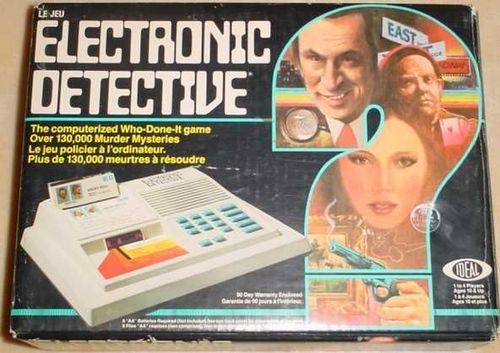
Electronic Detective
Electronic Detective Rulebook
Table of Contents
Table of Contents
Object of the Game
Be the first player to correctly solve the crime.
Materials
- Electronic Detective Console
- Suspect Cards Sheet
- Case Fact Sheet Pad
- Keying Guide
- Instruction Booklet
- Instruction Soundsheet (Record)
Getting Set to Play
- Insert 6 new "AA" batteries. See diagram. (Use of alkaline batteries will result in longer battery life.)
- Insert 4 bumper "feet" on the underside of the Console.
- Separate the 20 Suspect Cards. Place them in numerical order in the storage compartment on the Console.
- Each player takes a Case Fact Sheet and a pencil.
- A player is chosen to go first. Play passes to the left.
Levels of Difficulty
The game can be played at three different "levels of difficulty":
- "Master Detective" (the most difficult)
- "Sleuth" (less difficult)
- "Gumshoe" (least difficult)
One level of difficulty is chosen for each game and is entered into the computer (see Keying In the Crime). All players play at the chosen level. At level 1 each player is allowed only one "Private Question" in each turn; at level 2 each player gets two "Private Questions" in each turn, and at level 3, three "Private Questions". ("Private Questions" are explained under The Crucial Private Questions.)
How the Game Plays
While Electronic Detective is great fun to play, you must fully understand the game's instructions and rules. To help you, (1) the back panel of the game box describes its outstanding features, and (2) the following is a condensed description of how the game plays.
Think of Electronic Detective as a mystery which can be solved by one person alone or by several players interacting with each other.
The "setting" is 20 characters together in a large city. One is murdered and the remaining 19, now Suspects, flee to different parts of the city. The object of the mystery is to find which one of the 19 Suspects is the Murderer.
Players use the computer to "grill" Suspects for two kinds of information.
- An Alibi tells where the Suspect fled and (sometimes) who else was there.
- "Private Questions" (from each Suspect's Card) provide other vital facts.
Here are the pieces to the mystery.
-
Characters: 10 males (numbered 1-10) and 10 females (numbered 11-20). Numbers are on the Suspect Cards.
-
Six "places": A. Art Show, B. Box at Theater, C. Card Party, D. Docks, E. Embassy, F. Factory.
-
A different "location" for each of the places (3 on the West Side and 3 on the East Side): Uptown, Midtown and Downtown on each of the West Side and the East Side.
Note: The location of each place will change with each crime.
-
Suspects will have fled as follows:
- four of the locations will each have four Suspects;
- one location will have three Suspects;
- one location will have the victim only.
The Murderer will never be where either weapon is hidden, nor where the body was found.
-
Suspects will be located as follows:
- there are never more than two males and two females at any one location; and
- the two Suspects of the same sex at any location will always have one odd number and one even number.
-
Thus each Suspect has a different combination of "characteristics":
- sex - male or female;
- location (where he or she fled) - West Side or East Side and Uptown, Midtown or Downtown;
- number - odd or even.
-
To solve the crime you must do two things:
There are two more important things you must remember.
-
The location of a "place" (the Art Show, etc.) will help you identify the Murderer. For example, the Murderer is a male and you have deduced that:
- he's located East Side, Midtown; and
- the Card Party is East Side, Midtown; and
- Suspects 5 and 8 are at the Card Party; then
logical reasoning tells you that either Suspect 5 or 8 is the Murderer. You must now narrow it down to one person.
-
To determine which Suspect is the Murderer, you must find if the fingerprints on the Murder Weapon belong to an odd-numbered or even-numbered Suspect. To do this you must know the following:
- if the Murder Weapon is a .38 or .45;
- where the Murder Weapon is located;
- who was at that location.
Because only a Suspect of the same sex as the Murderer, who was at the location of the Murder Weapon, can tell you whether the fingerprints on the Murder Weapon belong to an odd or even numbered suspect. No other Suspect can answer this question. See Solving the Crime, rule 4.
You will learn how to find and use all of this information on the following pages.
The Case Fact Sheet
In crime stories the detective always explains how he solved the murder. Here, it's all up to you. Your first job is to collect the facts. You do this by using the computer to question the Suspects. You use the Case Fact Sheet to record everything that you find out about the crime. From these facts you make the deductions that lead you to the Murderer. The Case Fact Sheet is therefore very important, so it has been carefully organized to set out the clues as helpfully and logically as possible.
It is divided into FOUR SECTIONS.
- "THE MURDER FACTS." Here you record vital facts such as the Murderer's sex, the murder weapon's caliber, where the Murderer fled and the crucial information about fingerprints.
- "WHO WAS WHERE." Here you record the whereabouts in the city of the murder victim, weapons and the various Suspects. As you have already learned, the city is divided into Uptown, Midtown and Downtown, and further divided into West Side or East Side. Thus you can also record what part of town each "place" (Art Show, Theatre, Docks, etc.) is in. For example you may discover that the Docks are Midtown on the West Side.
- "WHO SAID WHAT"? This is your work sheet area. Here you record and cross reference Suspects' Alibis and answers to Private Questions. Cross reference is very important. If, for example, Suspect 7 says he was with Suspect 10 then everything you find out about Suspect 7 should also be recorded for Suspect 10 (and vice versa).
- "WHO DID IT"? Here you may write your solution to the crime prior to making an accusation.
A completed Case Fact Sheet is illustrated in the booklet; the following pages explain how to find all the information recorded on it, and the Solving the Crime section explains why only Suspect 5 could be the Murderer in that particular crime.
Fold your Case Fact Sheet between Sections 2 and 3 (as shown) so that the other detectives do not see the information which you record.
How to Use the Computer
The following pages contain detailed explanations of how to use the computer to: (1) key in the crime; (2) question suspects; (3) help solve the crime; (4) make an accusation.
Keying In the Crime
- TURN GAME ON. Press the "ON" key (3 "bongs" will sound).
- DECIDE LEVEL OF PLAY DIFFICULTY and press:
- Key #1 "Master Detective" (most difficult) OR
- Key #2 "Sleuth" (less difficult) OR
- Key #3 "Gumshoe" (least difficult)
- PRESS KEY #1, 2, 3 or 4 for the NUMBER OF PLAYERS.
- PRESS "ENTER."
- BANG! BANG! Gun shots, with a "silencer". The crime is committed. A funeral dirge plays.
The Display Window will now automatically show the victim's NUMBER and LOCATION of the body.
EXAMPLE: The victim is #16 (Joan Fineflugle). The location is "A" (Art Show). The display reads 16 A.
- This information is read aloud.
- Next:
- Ask another player to verify the information in the Display Window.
- All players record this information on their Case Fact Sheets (Section 1: the victim's number and name, and the place where the body was found).
- All players draw a large "X" through the entire section where the body was found (Fact Sheet, Section 2, "Who Was Where?"). No Suspects or weapons will be found there during the investigation.
- The remaining 19 characters who have fled from the scene of the murder are now Suspects and will be questioned by the players (the Detectives).
- REMOVE the victim's Suspect Card from play.
Questioning Suspects
- Each player may now "grill" any one Suspect in a turn. The Suspect will first give an ALIBI, then answer PRIVATE QUESTIONS.
- Suspects always tell the truth - with one critical exception (which you will see when you read Rule 4 under Solving the Crime).
- Players have access to all Suspect Cards during play. They should be kept in numerical order at all times.
- The same Suspect may be further questioned by any player in subsequent turns, and a player may question the same Suspect more than once.
- The murder VICTIM cannot be interviewed. 00 000 00 (meaning I don't know) will appear on the display if you try to question the victim.
To Ask the Suspect's Alibi
- Place the Suspect Card on the tray in front of card storage.
- Press SUSPECT key.
- Press the SUSPECT'S NUMBER.
- Press ENTER.
EXAMPLE: You are questioning Suspect #7, Ripp Rapp.
Immediately after you press ENTER, the Display Window lights up with a code representing the Suspect's ALIBI. Match these numbers and/or letters with the colored sections directly below the Display Window. In this case the display reads 1 b 11, which means:
I was on the West Side (1) at the Theater (B) with Suspect #11 (Ivy Little).
The chart below the Display Window reads:
- "I was with these suspects" (the Suspect numbers)
- "I was at the.....": A Art Show, B Theatre, C Card Party, D Docks, E Embassy, F Factory
- 3 "I was Uptown", 4 "I was Midtown", 5 "I was Downtown"
- 1 "I was on the West Side", 2 "I was on the East Side"
The player questioning the Suspect reads the alibi out loud. A second player looks at the Display Window and verifies this information.
Alibi information varies. In this example the Suspect has revealed 3 facts. Other Suspects' alibis may consist of only one or two facts.
All players record this information on their Fact Sheets. In the case illustrated, you mark BOTH Suspect #7 (Ripp Rapp) and Suspect #11 (Ivy Little) at the Theater - PLUS locating the Theater on the West Side. This is the information you received from Ripp Rapp's Alibi.
The Crucial Private Questions
- AFTER the Suspect's Alibi is known the player is allowed to ask PRIVATE QUESTIONS in the SAME TURN.
- The NUMBER of questions the player may ask in a turn depends on the LEVEL of DIFFICULTY the game is being played at:
- #1 Master Detective - 1 question;
- #2 Sleuth - 2 questions;
- #3 Gumshoe - 3 questions.
- Each Suspect Card has 5 Private Questions, but the computer will only answer the number of questions you are allowed in a turn.
- To ask Private Questions:
- Press PRIVATE QUESTION.
- Press the QUESTION'S NUMBER.
- Press ENTER.
- A direct answer will appear in the Display Window. Match this to the question and answers on the Suspect Card. It is not necessary to refer to the colored chart below the Display Window (which is for Suspects' Alibis and victim's location only).
- Only the player asking the Private Question sees the answer.
- The sequence above must be followed for each Private Question which you ask in the same turn.
- If you should try to ask a Suspect more Private Questions than allowed, a "bong" will sound and END will appear on the display. You must now press END TURN before the next Suspect can be questioned.
- PRESS END TURN when you have finished asking questions and recording your information. If you do not press END TURN, END will appear on the display when the next Suspect is questioned and will continue to appear until END TURN is pressed.
- The next player, to the left, now questions a Suspect.
NOTE: Enclosed is a special sheet with all the Suspects' Private Questions listed. It also has a complete "Keying Guide." This is a handy reference booklet.
Solving the Crime
To solve the crime, you MUST KNOW ALL "THE MURDER FACTS" (Section 1, Case Fact Sheet). Only one Suspect fits all the facts - the Murderer! Some facts may be determined by Suspects' Alibis and by Private Questions. Other facts can be deduced by pure logical reasoning. You do this as follows:
- Private Questions tell you (a) the MURDERER'S SEX, (b) whether the MURDER WEAPON was a .38 or .45, and (c) whether the FINGERPRINTS on the murder weapon belonged to an ODD or EVEN NUMBERED SUSPECT (see Rule 4 below).
- You can find WHERE THE MURDERER FLED TO from Private Questions and from Suspects' Alibis.
- Or you can deduce the Murderer's identity by obtaining information about other Suspects. For example, you find that the Murderer was an odd-numbered male. If you then determine that their respective locations establish the innocence of all odd-numbered males but one, you can deduce who the murderer is, and where he fled to.
To solve the crime you must always remember the following important rules. (A full list of rules is under Summary of Rules.)
-
There will never be more than one odd-numbered and one even-numbered Suspect, of the same sex, at any single location.
-
The Murderer will never be at the location where the body was found (because the Murderer fled from the scene of the crime).
-
The Murderer will never be at the location of either weapon (because the Murderer avoids being near any possible evidence).
-
VERY IMPORTANT, BE SURE YOU CAREFULLY READ THE FOLLOWING. THIS INFORMATION IS CRITICAL TO SOLVING THE CRIME. Fingerprints on the Murder Weapon must be identified as belonging to an odd or even numbered Suspect. This information can only be given by a Suspect: (a) of the same sex as the Murderer; (b) who fled to the location of the Murder Weapon.
All other Suspects who fled to the location of a weapon may (or may not) lie. This is the ONLY instance where a Suspect can lie.
Suspects who fled to locations where there is NO weapon will answer "I don't know" (00 000 00 on the Display Window).
In the following example, it is immediately apparent that Mickey O'Malley, Suspect #5, is the Murderer. Why? Because he is the only Suspect who fits all the Murder Facts - an odd-numbered male located Midtown on the East Side. (The chart on the next page explains how you obtained this information.)
Example Case Fact Sheet (as illustrated): victim Joan Fineflugle, body found at place A. Murderer: male, East Side, Midtown; weapon used: .45; fingerprints: odd #. Who Was Where: Art Show crossed out (body); Theatre (B) - men 2, 7, women 11, 16, West Side Midtown, .45 weapon location; Card Party (C) - men 5, 8, women 14, 19, East Side Midtown; Docks (D) - men 4, 9, women 13, 18, West Side Downtown; Embassy (E) - men 3, 6, women 12, 17, West Side Uptown; Factory (F) - men 1, 10, woman 15 (second woman slot crossed out), East Side Uptown, .38 weapon location.
NOTE: The above Case Fact Sheet shows all possible information given by the computer (there are over 130,000 such combinations in Electronic Detective). However, sharp detectives will have this solution long before all the facts are given.
How to Find Information That Is Needed to Solve the Crime
| What you need to know | How to find it out |
|---|---|
| 1. Sex of Murderer? | Find a Suspect whose card has question #2 - "DID A MALE DO IT?" |
| 2. Caliber of Murder Weapon? | Find a Suspect whose card has question #4 - "WAS THE MURDER WEAPON A .38?" |
| 3. Location of Murder Weapon? | Find a Suspect whose card has question #5 - "WHERE WAS THE .38 HIDDEN?" or #6 - "WHERE WAS THE .45 HIDDEN?" |
| 4. Were fingerprints on the Murder Weapon those of an odd or even numbered Suspect? | Ask a Suspect (a) of the same sex as the Murderer, and (b) who fled to the location of the Murder Weapon. |
| 5. Where the Murderer could not have fled. | The Murderer could not have fled to: a. the location of the body; b. the location of either weapon; c. place A, B, or C if any Suspect answers NO to Question #8; OR d. place D, E or F if any Suspect answers YES to Question #8. |
| 6. The location of the 3 "places" the Murderer could have fled to. | If you have not received enough "location" information through Suspects' Alibis, questions #1, 3, 9 & 10 will help you pinpoint the location. |
Players record information on Case Fact Sheets, weigh the Suspects' statements and logically follow the tangled web of evidence. When you place the correct facts together you're ready to accuse the culprit.
Making an Accusation
- A player may make ONLY ONE accusation during the game. The accusation must be made at the beginning of a turn.
DO NOT TELL OR SHOW YOUR ACCUSATION TO OTHER PLAYERS.
- Press ACCUSE.
- Press the SUSPECT NUMBER.
- Press ENTER.
FALSE ACCUSATION: "NO" flashes and BANG! BANG! You're out of the game. An incorrect accusation automatically ends a turn.
CORRECT ACCUSATION: Police sirens sound. You win! The Display flashes the Murderer's number and "YES".
If ALL players, BUT ONE, have accused incorrectly, the FINAL player MUST make an accusation at the BEGINNING of his NEXT TURN.
If ALL players make INCORRECT accusations the COMPUTER WILL AUTOMATICALLY give the CORRECT ANSWER and play the funeral dirge for all the "dead" Detectives who have lost the game!
Note: An Accusation will automatically END TURN.
Summary of Rules
Rules of Game Play
The Police Commissioner has imposed certain rules of conduct which you must follow when playing Electronic Detective. These are all included on previous pages and are summarized here for your convenience.
- All Detectives have access to all Suspect Cards during the game and may question any Suspect in a turn.
- A Detective may return to question a Suspect he, or another Detective, has previously questioned.
- The murder victim cannot be questioned.
- Each Suspect's Alibi must be read out loud.
- Answers to Private Questions may only be seen by the Detective who asks them.
- Only one Suspect may be questioned during a turn.
- A Suspect may only be asked questions that appear on his card.
- A Detective may make only one Accusation in the game.
- An Accusation must be made at the beginning of a turn, before any Suspect has been selected for questioning.
- If only one Detective is left alive he must start his next turn by making an Accusation.
Computer Behavior
The Computer abides by the following rules:
- To solve the crime you must know if the fingerprints on the Murder Weapon belong to an odd or even numbered Suspect. Suspects who can give that information must: (a) be of the same sex as the Murderer; and (b) have fled to the location of the Murder Weapon.
- Suspects at the Murder Weapon location who are of the opposite sex to the Murderer may or may not lie about the fingerprints. This is the ONLY instance in which a Suspect can lie.
- Suspects at locations where there is no weapon will answer "I don't know" (00 000 00 on the Display Window) to the fingerprint questions.
- No one will ever be at the location where the body was found (because the Murderer fled from the scene of the crime).
- You cannot question the victim (00 000 00 will appear in the Display Window).
- The Murderer will never be at the place where either weapon was found.
- There will be four Suspects at each of the 4 place locations. They will always be: one odd-numbered male and one even-numbered male; plus one odd-numbered female and one even-numbered female.
- There will be three Suspects at a fifth place. They will always be either two males and a female or two females and a male.
- If the computer is asked too many Private Questions in one turn (see "Levels of Difficulty") a "bong" will sound and the Display Window will show "END" until the END TURN key is pressed.
- The computer knows what questions are on each Suspect's card. Any other questions will be answered by EE on the Display Window.
- If the "END TURN" key is not pressed at the completion of a turn, when the next Detective starts his turn the letters END will appear on the Display Window until "END TURN" is pressed.
- If keys are pressed in a wrong sequence (EE appears on the Display Window) it is necessary only to start the sequence again. The computer will ignore the previous mistake. HOWEVER, YOU MAY NOT MAKE A CORRECTION AFTER PRESSING ENTER.
- Making an accusation automatically ends a turn. "END TURN" need not be pressed.
- If all players have made incorrect accusations the computer will finish the game by automatically showing the correct answer (and playing the Funeral Dirge).