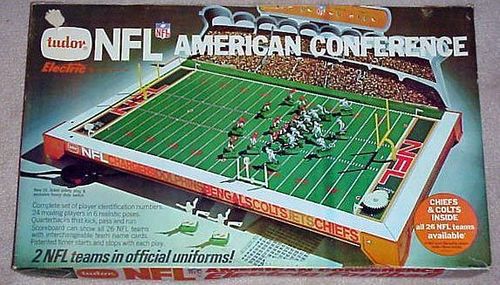
Electric Football
Electric Football Rulebook
Table of Contents
Table of Contents
- Preface
- Note to Coaches
- Before the Start of the Game
- Definitions
- Game Timing
- Coin Toss
- Timed Actions
- Players, Substitutes, Equipment, General Rules
- General Rules
- Free Kicks
- Ball in Play, Dead Ball, Scrimmage
- The Running Game
- Forward Pass, Backward Pass, Fumble
- Fumbles and Blocked Kicks
- Scrimmage Kicks
- Opportunity to Catch a Kick, Fair Catch
- Scoring
- Penalty Enforcement
- Overtime Procedures
- Emergencies, Unfair Acts
- Officials
- Keeping Score
- Allowances for Beginners
Preface
These rules govern playing electric football with the methodology of professional football during the upcoming season. Member clubs or leagues may amend rules from time to time, pursuant to your league's applicable procedures, constitution or bylaws.
Because inter-conference games are played throughout the preseason, regular season, and postseason in your leagues, all rules apply uniformly to all electric football conferences.
There are also many moments in American football that are dynamic but in electric football are static. In each instance, consider the rule and act in accordance to the rules of National Football League and fair play.
Note to Coaches
You have now put together your Tudor Games Electric Football set. Now is the time to play it "just like football". This rulebook will give any electric football coach or league that wishes to play electric football like American football an opportunity to so.
I read an entire professional football rule book (every rule, section and article) and put it into a version for electric football. This rulebook highlights the laws, rules, timekeeping measures of professional football. We want coaches to play it. The game can be played with a scoreboard clock.
In this gameplay, just as it in football, the defensive coach has to defend the field. The offense does not give away the play until it is time to execute. The offensive coach controls the time, assigns blocking schemes and requires an array of passing skills. Special teams are important and included. Played to scaled distances, kick returns are possible also. The game moved along quickly and it started with this simple yet profound component. That is, "the OFFENSE knows how and where it wants to attack". Read the rule book, examine each procedure and try it.
Before the Start of the Game
The Field
Field Assembly: Ensure all parts, including goal posts, down marker, ten yard marker are assembled correctly. The motion generator is mounted under the field to provide constant movement.
Field Speed: Test the motion generator for player speed. Field speed will allow for a player with Speed Cleats to travel in tight circle without falling over.
The Ball
Supply: Each team requires 6 footballs but can share footballs if one team does not have any.
Using the Football from Scrimmage: The felt or rubber football is typically used only for passing and for kicking. For all other plays, the offensive and defensive coach are aware of which player is the RUNNER.
Definitions
- DEAD BALL: The time between downs starting when offensive or receiving team fails to act, play conclusion by a RUNNER tackle, tilting, out of bounds, turn around, touchdown or declaration. The next down is at the furthest line gained.
- BLOCKED PLAYER: Any player touching an opposing team's player.
- DOWN: A period of action that starts when the ball is put in play and ends when the ball is declared dead.
- FIRST DOWN: The first in a series of 4 scrimmage downs. Awarded again if 10 yards are gained from the previous first down spot.
- SCRIMMAGE DOWN: A down that starts with a snap. Not a kick.
- INBOUNDS: The area between the sidelines and the end lines (back of end zones). Anything not completely within it, goes or recovered outside it during the down is out of bounds.
- INBOUNDS LINES: The hash marks on the field and parallel to each sideline.
- KICKER: The player punting or kicking the ball.
- KICKOFF: A placekick made from the kicking team's 35-yard line to start each half or after a score. Kicking team is the offensive team.
- PUNT: Kicking the ball to the opponent during the scrimmage down. If the offense did not gain 10 yards in 3 downs, they usually punt the ball away or kick a field goal (distance permitting), on 4th down.
- NEUTRAL ZONE: The horizontal area from the offensive line, one yard rearward or a ball. Only the center is within it starting the scrimmage down.
Game Timing
A game consists of four periods (quarter), two quarters per half. Coaches may agree before the start of the game on a certain number of PLAYS PER QUARTER that may be as few as eight (8) or as many as fifteen (15). All non-try/penalty plays or returns will advance a play per quarter. Inside two-play warning, all non-try/penalty plays that end inbounds will advance a play per quarter. When no plays remain following the play, the period is over.
If the game is timed by a clock, the number of minutes allowed per quarter may be as few as eight (8) or as many as fifteen (15). Clock will start on all RUNS, RETURNS, FIELD GOAL or PASS attempts. Clock stops if RUNNER goes out of bounds, incomplete pass, fair catch, score, time-out or penalty.
After each quarter both teams switch sides of the field.
Coin Toss
Toss a coin to decide which team receives the ball first. The winner choices are to receive or kick off, end zone to defend or defer. The second half begins with a choice to the team that lost the coin toss, unless the winner of the coin toss chose to defer in the first half.
Timed Actions
Timed actions are counted up (one-thousand-one, one-thousand-two, and so on). Timed actions are as follows:
- Rush kick (field on): 1 second
- Recover kicked ball (field on): up to 3 seconds
- Offensive Formation setup/snap: 40 seconds total
- Defensive Formation setup: up to 10 seconds after offense setup
- CREATING THE PLAY: remaining play clock
- REACT/PASS DEFENSE, recover ball: 5 seconds
- COMPLETE PASS ACTION (starts after PASS DEFENSE): 10 seconds
- Kick attempt time (starts when KICK play pauses): 5 seconds
If a referee is not present, the team not acting will count for the team acting.
To save time, adjustments are made as if player are moving. (e.g., to tackle, recover kicked ball)
Players, Substitutes, Equipment, General Rules
Number of Players
The maximum number of players on a team is 48 and INBOUNDS at any time is 11. All players will be complete. Modifications will leave figures in tact with base magnets only holding TTQB's base steady during passes and kicks.
Substitutes and Player Placement on the Field
Only a same number Triple Threat Quarterback (TTQB) for a PASS/SCRAMBLE is substituted in during any down. Offense must have only 11 players before setup and all players in formation before the snap, will be:
- at least a BASE WIDTH APART; void of STACKED PLAYERS.
Penalty is an illegal substitution 5 yards from the previous spot.
Exception: Quarterback, Runner, Punter, Holder and Kicker.
Jersey Numbering System
All player jersey numbers are pre-cut and ready to use. NFL players use the following number plan for the players.
- 1-19: Quarterbacks, Punters, and Kickers
- 20-49: Running Backs and Defensive Backs
- 50-79: Centers, 60-79 Offensive Guards and Tackles
- 10-19 and 80-89: Wide Receivers
- 40-49 and 80-89: Tight Ends and H-backs
- 50-79 and 90-99: Defensive Linemen
- 40-59 and 90-99: Linebackers
NCAA players use the following number plan for the offensive players.
- 1-49: All Backs
- 50-59: Snapper
- 60-69: Guards
- 70-79: Tackles
- 80-99: Ends
General Rules
Now you're ready to play TOEPRO-Football. The next sections will cover the game from start to finish.
Free Kicks
Kickoff
The kicking team (offensive) is on the kickoff line (kicking team's 35-yard line), five each side of kicker, two outside the numerals. The TTQB is placed on the kickoff mark (at center) with the ball placed on the kicking tee. The receiving team is at least 10 yards downfield from kickoff line (restraining line) with eight or nine players no less than 25 yards downfield (set up zone).
Two kicking team players may be pivoted. The ball is kicked toward the opponent's goal line.
If the football goes at least 10 yards, does not hit a player before touching the field (a catch), remains inbounds and is not a TOUCHBACK, the ball is considered "live" and it must be recovered or "touched" to gain possession.
Catch or Recovery of a Free Kick
The receiving team turns on the power switch for a count of one second (one-thousand-one) then releases the switch. If any player first touches the ball, they gain possession and the game is immediately switched off. If possession is not gained, pivot any unblocked players toward the ball. Turn on the power switch for a count up to three seconds then pivot or until recovery.
If the kicking team gains possession, not in the end zone, the play is a dead ball at the spot of possession. FIRST DOWN kicking team.
If any receiving team's player (or both same time) gains possession, it is now the RUNNER and may be pivoted to advance the ball. Both teams may pivot any unblocked players to either block or tackle. The kicking team will COMPLETE THE DOWN.
If the ball is kicked through the end zone before landing inbounds, the receiving team may call a TOUCHBACK or return the kick from the end zone with the closest player to their end zone.
Illegal Kickoff
Occurs when the ball does not go at least 10 yards, out of bounds, not through the end zone and is not a TOUCHBACK on a kickoff.
Penalty is receiving team FIRST DOWN 25 yards from spot of kick or spot of kick whichever is closer.
Ball in Play, Dead Ball, Scrimmage
Before and at the Snap; Ball in Play
The line of scrimmage (at center field or nearest INBOUNDS LINE) is determined by spot at the end of the previous play.
With both teams onside, set up using the following sequence:
- Offense sets their players in a LEGAL FORMATION, declares, "SET".
- Defense sets their players, declares, "SET".
- Offense makes any audible calls to create the play (see CREATING THE PLAY), then declares RUN, PASS or KICK play, all representing the snap.
- If a RUN play is called, the offense must declare the RUNNER's number.
- If a PASS (to receiver) play is called, then the quarterback has the ball.
- If a KICK play is called, then the kicker/punter has the ball.
Then press the power switch on the PlayAction Remote. Switch is released (vibration stops) for a pass, kick, scramble, handoff, pitch-out, fumble, runner contact with a defender or at the end of the play.
Legal Scrimmage Formation
A legal scrimmage formation has each player inbounds, on-side with all player's base spaced at least BASE WIDTH APART and not STACKED.
- Offense: Completely between NEUTRAL ZONE and 15 yards behind line.
- Center at spot (long axis perpendicular to line), 7 to 10 players on the line (horizontally within center's base); eligible receivers on ends.
- Quarterback behind center and completely within 10 yards behind line.
Penalty is illegal formation 5 yards.
Audibles, Shifts and Creating the Play
After the defense declares "SET", the offense may call an audible to create the play. An audible allows up to any two offensive to be pivoted. The quarterback may be pivoted, shifted to another location behind the center or changed, with each action as an audible. After the quarterback is audibled, the type of play is called, all representing the snap. The formation must be legal at the snap.
The Running Game
If a RUN play is called, the declared RUNNER has the ball. The quarterback cannot run initially toward the line, even when traveling in a circle. Only players with any part of its cleats on field vertically behind the quarterback (Handoff Run Zone) before starting the play, may be a declared RUNNER in any direction. The defense will COMPLETE THE DOWN.
Broken Tackles
When a runner knocks over the defender, the play is paused. Flip a coin to determine status of contact: Heads - Continue play. Tails - A tackle.
Illegal Formation / Illegal Procedure / Delay of Game
Occurs when either team lines up not by the rules or does not follow the rules.
Penalty is 5 yards.
Offensive Holding
Occurs when the Coach audibles a player whose arms prevents a defender from going up field by spinning together in circles.
Penalty is 10 yards.
Forward Pass, Backward Pass, Fumble
Two-Part Plays
If a PASS play is called, the offense starts the play by pressing the power button on the PlayAction Remote and watch for an offensive ELIGIBLE RECEIVER to break open. If one does before a defender touches your quarterback, pause the play (motion generator off). The defense may REACT/PASS DEFENSE (offense counting react time). Then, declare "PASS, PITCH-OUT, HANDOFF, RUN or SCRAMBLE". When creating a PASS play, make sure your quarterback has cleats that will make him drop back, roll out, or stay in the pocket. Be careful not to get flagged for an Illegal procedure, Illegal Block/Crackback block, Illegal Forward Pass or Ineligible receiver downfield.
Intended Receiver
A called PASS play may designate the intended downfield receiver before the snap (example "PASS to 88"). If completed downfield, that player is allowed to COMPLETE PASS ACTIONS. All other downfield completions only continues the play.
React/Pass Defense
Following the initial pause, and any changes in the play, unblocked defensive players may make pivots or adjustments to react to defend the pass and again to make non-PlayAction Remote generated tackles.
To Pass
Replace your quarterback within the runner's footprint with the TTQB. With a level, on-field TTQB ball in hand, throw to an unblocked offensive ELIGIBLE RECEIVER.
Pass Completion
If the ball first hits an unblocked offensive ELIGIBLE RECEIVER or his cleats, the pass is completed. Then, all offensive zone and intended downfield completions may COMPLETE PASS ACTIONS. The defense may again REACT, to COMPLETE THE DOWN.
Interception
If the ball first hits an unblocked defensive player, the pass is intercepted. The unblocked defensive team may COMPLETE PASS ACTIONS. The offense may REACT, to COMPLETE THE DOWN.
Incomplete
If the ball hits a blocked player, any player having gone out of bounds, anything out of bounds or hits the field first, the pass is incomplete.
Pitch-Out
On a PASS play, the offensive coach pauses the play and call "pitch-out" to the number of the player who will take the pitch. The quarterback can pitch to any eligible receiver who is behind or lateral to him within 10 yards. No players are adjusted. The defense may again REACT to COMPLETE THE DOWN.
Handoff
On a PASS play, if the quarterback makes contact in the BACKFIELD with an eligible receiver, the offensive coach may pause the play and call "handoff" to that player only and COMPLETE PASS ACTIONS with both. This player becomes the new runner. The defense may again REACT to COMPLETE THE DOWN.
Run or Scramble
In order to run or scramble on a called PASS play without creating a fumble if tackled downfield, the offensive coach must pause the play before the quarterback is tackled and declare RUN with the on-field QB in place, or may SCRAMBLE with a pivot of a TTQB. The defense may again REACT to COMPLETE THE DOWN.
Illegal Forward Pass
Occurs when quarterback, crossing line of scrimmage, throws a forward pass.
Penalty is 5 yards and loss of down.
Ineligible Receiver
Occurs when a pass hits an unblocked ineligible receiver (offensive tackle, guard or center) on the fly.
Penalty is 5 yards and loss of down.
Ineligible Receiver Downfield
Occurs when an ineligible receiver (offensive tackle, guard or center) is beyond 10 yards downfield and/or beyond the line, further downfield than the selected forward PASS play downfield receiver.
Penalty is 5 yards and the down remains the same.
Fumbles and Blocked Kicks
When back of runner's cleats are touched by the front of a moving defender's cleats, a standing defender knocks over the runner, a downfield tackle with the offense controlling the PlayAction Remote, an inbounds incomplete backward pass or blocked kick, the play is paused and the following happens:
Flip a coin to determine possession by each team's closest player to spot of fumble: Heads - Offense; Tails - Defense.
- If Defense: May advance if unblocked; the offense may REACT to COMPLETE THE DOWN.
- If Offense: If backward of fumbled spot, the defense may REACT to COMPLETE THE DOWN. If forward of fumbled spot; dead ball at spot of fumble.
Scrimmage Kicks
Punting
Set up a scrimmage formation with the TTQB no more than 15 yards behind the line and center, ball on the tee/foot. The return team places no one in front of center and should place at least one player 50 yards behind the line of scrimmage to receive the punt. When both teams have called "SET", the audibles completed, then call "KICK". Offense starts the play by pressing the power button on the PlayAction Remote for one second (one-thousand-one) pausing the play. This allows the defense a chance to block the kick and the kicking team to release downfield to down the ball or tackle the runner. With a level, on-field TTQB and the ball on the kicking tee and or foot, kick it.
Rules for returning a punt are the same as returning a kickoff except:
- If touched by the offense it is a FIRST DOWN defensive team at the spot.
- If it bounces out of bounds it is a FIRST DOWN defensive team at the spot.
- If the punt first touches out of bounds and not through the end zone, it is considered a "shank" and is placed 20 yards from spot of kick.
Field Goal
You must start a scrimmage down within 50 yards and kicker within 68 of the opponent's goal line to attempt a field goal. Set up a scrimmage formation with the TTQB no more than 8 yards behind the line and center, ball on the tee. A second non-blocking player (holder) is placed next to the kicker. The defense places no one in front of center and tries to block the kick. When both teams have called "SET", the audibles completed, call "KICK". Offense starts the play by pressing the power button on the PlayAction Remote for one second (one-thousand-one) pausing the play. With a level, on-field TTQB and the ball on the kicking tee, attempt the field goal.
Blocking the Kick
The defense may rush to block all scrimmage kicks. The defense does not tackle during rush on KICK plays. If a kick is blocked, it is a FUMBLE.
Opportunity to Catch a Kick, Fair Catch
Opportunity to Catch a Kick
The receiving team has priority to recovery (if both at the same time) a kicked ball. To recover or down a ball, pivot unblocked players to only recover the ball. The receiving team presses the power switch on the PlayAction Remote for a count up to three seconds. Then pivot or until recovery or out of bounds. If receiving team recovers, it may pivot any unblocked players to block and advance. The kicking team may REACT to COMPLETE THE DOWN.
Fair Catch
If "fair catch" is called while the ball is in flight, the ball is dead at its resting spot and one down is given, regardless of time. If invalid 5 yard penalty from further location (player/ball) following kick or touchback spot.
Fair Catch Kick
A free kick (by formation and rules) down following a fair catch that could result in a (scrimmage kick rules) field goal. Clock will start if returned or play will advance upon completion.
Scoring
Winning Team
The team that scores the greater number of points during the entire game is the winner.
Types of Scoring Plays
Points are scored as follows:
- Touchdown = 6 points
- Field Goal = 3 points
- Safety = 2 points
- Try (conversion) = 1 point (Field Goal or Safety) or 2 points (Touchdown)
Touchdown
When any part of the runner's cleats crosses the opponent's goal line, a legal forward pass is completed or a fumble is recovered in the opponent's end zone.
Field Goal
When the scrimmage/fair catch kicked ball goes through the Goal Posts. If it does not go through the Goal Posts it is FIRST DOWN to the defensive team at the spot of the kick, no further than own 20-yard line.
Safety
When offensive team's down ends or offensive penalty is behind his own goal line. The defensive team is awarded 2 points and also receives the ball on a safety kick. A kickoff, (by punting) made from kicking team's 20-yard line.
Try (Conversion)
You can run an untimed or uncounted scrimmage down following a touchdown from the 2-yard line to attempt to score two points, or kick a "point after" for one point with ball place at the 15-yard line. Rules for the set-up of a point after are similar to a field goal (the defense gets 1 second to rush).
Penalty Enforcement
Refuse Penalty
On-the-spot corrections can occur mid-down or game showing sportsmanship.
Plays Per Quarter
An accepted penalty prevents play per quarter advancement, regardless of results.
Offsides
Occurs when a team lines up one or more of their players across the line of scrimmage, in the neutral zone, kickoff line or restraining line.
Penalty is 5 yards from the previous spot.
Illegal Block / Crackback Block
Occurs when a player is pivoted to blocks in a direction towards their goal line outside the line play area/from outside the numerals a defender inside the numerals on a RUN play or holder actively blocks on a KICK play.
Penalty is 10/15 yards from the spot of foul or previous spot whichever is further.
Palpably Unfair Act
A non-player commits any act which is palpably unfair. Make such ruling as he considers equitable.
Defensive Holding
Occurs when the defender's arm (outside the numerals, inside 5 yards) "hooks" un-audibled receiver's arm and prevents him from going downfield by spinning together in circles.
Penalty is 5 yards and offensive automatic first down.
Assisting the Runner and Interlocking Interference
Occurs when the offensive player materially pushes, in offensive zone, a RUNNER in any direction, at any time, use interlocking interference by grasping a teammate or by using his hands or arms or to encircle the body of a teammate in an effort to block an opponent.
Penalty is 10 yards.
Unsportsmanlike Conduct
Occurs when either coach/person acts in a manner unfair to the game played.
Penalty is 15 yards previous spot and automatic first down, if defensive.
Overtime Procedures
If the score is tied at the end of four quarters, play an 8 or 10-play (or minute), two time outs, overtime period. The highest team score after overtime period or both teams COMPLETE POSSESSION, whichever is first, wins. If tied, tied. Post-season, play until a winner.
Emergencies, Unfair Acts
The TOEPRO-Football Manual is the authoritative/reference document for anything not covered in this rulebook.
Officials
The Referee
The Referee (lead official), in addition to conducting every coin toss, will:
- Approve field, equipment and player standards.
- Oversee the gameplay rules and enforce penalties.
- Count for timed actions.
- Provide results for passes and kicks.
Keeping Score
The official scoring sheet can be used to track the score and number of plays per quarter and time outs per half. Photocopy the last page of this booklet for additional score sheets.
Allowances for Beginners
To allow for lesser skilled coaches to compete, they can:
- Play no timed actions,
- Tilt TTQB,
- 20 yard offensive zone,
- Up to 3 pass attempts (best catch),
- Bounced to player still a catch and/or
- Up to 3 kick attempts at a field goal.
Find your level to compete and above all have fun.