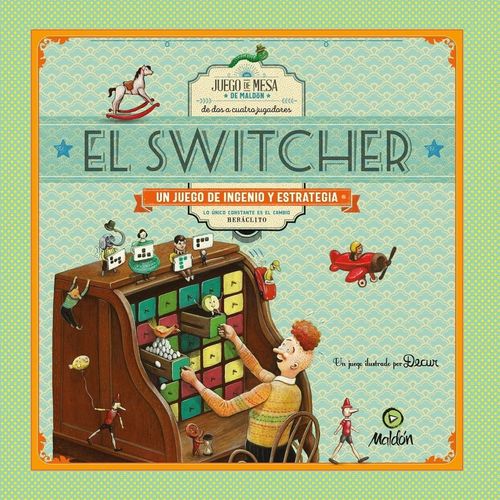
El Switcher
El Switcher Rulebook
Table of Contents
Table of Contents
Content
- 36 square tiles of four different colours (9 each)
- 49 movement cards
- 4 decks of 23 figure cards in four different colours
- 1 game board
- Rules
The Game
The goal of the game is to arrange the tiles on the board to form the figures of your figure cards. Therefore, the tiles on the board will be moved by the movement cards. The first player who manages to form all the figures of its deck is the winner.
Start of the Game
At the beginning, the 36 coloured tiles must be shuffled and put on random positions on the board. Each player gets one of the four decks of figure cards, shuffles it and places it face down on his side of the board. The first three figure cards are put face up next to the deck. The deck of movement cards is also shuffled and placed next to the board. Each player draws three movement cards on his hand. Each player can only see their own movement cards. The player who has proposed to play the game will begin.
On Your Turn
You have two minutes to use your three movement cards. In this short period you will try to form on the board some of the figures that lay open in your or your opponents' figure card areas on the table. You show the movement card you chose, perform the movement on the board and then discard the used movement card on the discard pile.
If you manage to form a valid figure, you will discard the corresponding figure card and draw a new one from your deck to replace it. If you manage to form a figure of an opponent, that player must flip it upside down, converting it into a blocked figure.
Once the two minutes are over or you have used all three movement cards your turn is over: draw new movement cards from the deck until you have again three cards in your hand. Play then proceeds to the next player on your right.
Figures
Valid Figures
A figure is considered valid when:
- Rule 1: The tiles that form the figure are all the same colour.
- Rule 2: No side of the figure is in contact with another tile of the same colour.
- Rule 3: The colour of the tiles was not used to form the previous figure (either by yourself or by the previous player).
Examples:
- VALID: None of the side edges in contact with another of the same color.
- INVALID: One of its side edges is in contact with another of the same color.
- VALID: None of the side edges in contact with another of the same color. The diagonals are allowed to touch.
Clarifications:
a) If any of the figures in the game is already formed on the board when a player draws a new figure card, it is accepted as valid if it is not the previous colour used (Rule 3). This is also the case for an old figure card that remains on the table.
b) If a player manages to form a figure of more than one card on the table, he has to choose which of the figure cards needs to be discarded (and be redrawn if his own or become blocked if it is from his opponent).
c) The player can form as many valid figures as possible with every movement. According to your strategy you must decide what is best for your game: get rid of many cards in one turn, block open cards of your opponent in the hope that he can not form the figures, etc.
d) Once all movement cards from the deck are used, the discard pile is shuffled and forms a new draw deck.
e) The drawings in the lockers on the board have no direct impact on the game. Their existence proves the direct relationship between play and aesthetic pleasure.
Blocked Figures
When you form a figure of your opponent on the board, the owner must flip it face down. So it becomes a blocked figure.
A player with a blocked figure card in his area loses the right to card replacement until he forms all the remaining figures in his area. However he will not lose the right to block figures of the other players.
Example: A player has in his area figures A, B and C. Another player blocks figure A. The player now has in his area only two figures open: B and C. If he can form one of his figures (e.g. B) he is left with one card open (the figure C) and another flipped: the locked figure A.
When he now forms figure C, he can flip over the locked figure (A). Only when he manages to form figure A (the only one left in the area) he may draw new figure cards for all three spaces in his area and return to normal game play.
You are not allowed to block more than one figure of a player. Also you are not allowed to block the only remaining figure of a player.
End of the Game
The first player to form all of the figures in his figure deck wins. The game ends immediately after the player forms the last figure of his area on the board.
Movement Cards
Movement cards are the way players move tiles on the board. The movements are performed by switching places of tiles as indicated by each card.
- Linear movements can be made horizontally or vertically.
- Diagonal movements can be to the right or left.
- You can exchange a tile with any of the four that are on the ends of the same row or column.