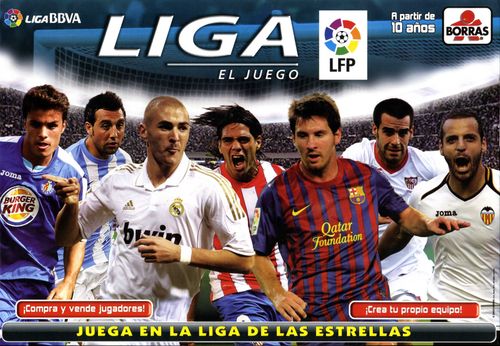
El Juego de la Liga
El Juego de la Liga Rulebook
Table of Contents
Table of Contents
Components
- 2 Dice
- 1 Game board
- 160 Player cards
- 56 Action cards
- 12 Player tokens
- 6 Game system sheets
- Competition calendar
- Banknotes
The player card components are labelled in the instructions as: crest (Escudo), official name, position (Posición: Portero, Defensa, Medio, Delantero), full name (Nombre completo), LaLiga symbol, shirt number (Dorsal), photo (Foto futbolista), special abilities (Habilidades especiales), plays (Jugadas), club (Club), position colour (Color posición) and transfer price (Precio futbolista). The illustration shows player card types Portero, Defensa, Medio, Delantero, Crack and Mega-crack.
Initial Setup
Take a competition calendar and choose whether you will play with 4 or with 6 teams.
Deal one game system sheet to each coach (player) at random. This sheet represents the team of each coach, which they must complete with the best footballers they can sign.
If there are not enough coaches (players) to have 4 or 6 different teams for the league competition in Phase 2, you must use rival teams without a coach. To do so, use the game system sheets left over until the required number of teams is reached. These teams act as rivals without a coach: they play with the values printed on the sheets, and no signings may be made for them.
Competition with 4 teams:
- 1 coach (player) + 3 rivals without a coach
- 2 coaches (players) + 2 rivals without a coach
- 3 coaches (players) + 1 rival without a coach
- 4 coaches (players)
Competition with 6 teams:
- 5 coaches (players) + 1 rival without a coach
- 6 coaches (players)
Next, place the game board in the centre of the table next to the dice and carry out the following actions in the order indicated:
- Shuffle all the player cards and place them face down in two piles in the marked areas of the game board. Turn over 8 player cards in total, 4 from each pile, to form the transfer market. Each player card has a different background colour depending on its position. Cards with a silver and gold background are stars of their teams and have better values in their actions.
- Shuffle the action cards and place them face down in a pile in the marked area of the board.
- Deal 150 million € to each coach as follows: 6 banknotes of 5M; 4 banknotes of 10M; 4 banknotes of 20M.
- Each coach takes two tokens of the same colour. One is used to move around the board and the other is used to record the goals of each match on the game system sheets.
Now you have everything ready to start playing.
Phase 1: Transfer Period
In this phase you can sign the best footballers of LaLiga to complete your teams. In turns, roll the dice and move your token around the game board clockwise.
To sign a footballer you must land on a transfer space. You may sign as many footballers as the space indicates, from among the 8 cards visible in the market. If there is no footballer in the market of the position matching the space, or none that interests the coach (signing is not compulsory), the turn passes without signing.
To sign a footballer you must pay the bank the transfer price shown on their card. If you do not have enough money, you cannot sign. Optionally, a coach may sell one of their footballers to the bank for half of their acquisition price and place that card on the discard pile, in order to obtain money to sign another footballer.
A newly signed footballer must be placed on the coach's (player's) game system sheet in the position that corresponds to them (goalkeeper, defender, midfielder or forward). Note that not all positions have the same chances of taking part (except the goalkeeper) when you play the matches. The more numbers there are in the lower part of a space, the more chance that footballer has of taking part in the match. If you place the signed footballer's card on the space marked with a C, that footballer becomes the captain of the team and is protected from the CLAUSULAZO (see below, in the description of the board spaces, what the clausulazo is).
If a coach signs footballers from more than one position, these will be substitutes, because the game system may not be altered in any case, nor may footballers be placed in a position other than their own.
Each time a footballer is signed, the empty space left in the transfer market on the board must be refilled by placing a new footballer face up from one of the two piles.
This phase ends when all the coaches have passed the START space THREE TIMES.
Board Spaces
- START (Salida): the space where one token of each coach is placed at the start of the game. Each time a coach passes this space they receive 6 million from the bank, or 9 million if they land on it exactly.
- Action card (Cartas de acción): the coach takes the action card on top of the pile on the board. (See below for the explanation of each action card.)
- 4 Million penalty (4 Millones sanción): the coach must pay a penalty of 4 million into the pot (that is, place the money in the centre of the board). A coach may never go into negative money because of a penalty. If this happens they must sell one or more footballers to the bank to cover the penalty and always remain with a positive balance.
- 6 Million income (6 Millones ingresos): the coach gains 6 million from the bank.
- Sign 1 defender (Ficha 1 defensa): allows signing only one defender from those available in the market.
- Sign 1 midfielder (Ficha 1 medio): allows signing only one midfielder from those available in the market.
- Sign 1 forward (Ficha 1 delantero): allows signing only one forward from those available in the market.
- Sign 1 goalkeeper (Ficha 1 portero): allows signing only one goalkeeper from those available in the market.
- Defenders token (Ficha defensas): allows signing any number of defenders available in the market.
- Midfielders token (Ficha medios): allows signing any number of midfielders available in the market.
Action Cards
- Poor physical form (Baja forma física): your team is in poor physical condition and in the first minutes of the first match of the matchday will concede a goal. Show this card to the other coaches at the moment you draw it and leave it face up in front of you. Once the match ends, discard it.
- Red card (Tarjeta roja): show this card to the other coaches at the moment you draw it and leave it face up in front of you. In the first match of the matchday that you play, the footballer with the highest market value on your team may not play, and you must replace them with another if you have substitutes.
- Contract end (Finalización contrato): the footballer of highest value on your team immediately ends their contract and leaves your team for half of their value. If it is the captain, you receive the full value shown on the card. This card must be played immediately. The footballer goes to the discard pile and the bank gives you the money.
- 7M penalty (Sanción 7M): pay 7 million into the pot immediately. If you do not have enough money, the coach must sell to the bank one of their footballers at half price. The footballer sold must go to the discard pile.
- 4M penalty (Sanción 4M): pay 4 million into the pot immediately. If you do not have enough money, the coach must sell to the bank one of their footballers at half price. The footballer sold must go to the discard pile.
- Row elimination (Eliminación fila): allows eliminating one of the two rows of footballers in the market and replacing them with 4 new ones. This card may only be played on your own turn, although it is not compulsory to play it immediately. The eliminated footballers go to the discard pile.
- Market elimination (Eliminación mercado): allows eliminating all the footballers in the market and replacing them with new ones. This card may only be played on your own turn, although it is not compulsory to play it immediately. The eliminated footballers go to the discard pile.
Phase 2: LaLiga Matchdays
Once the Transfer Period phase is finished (all the players have passed the START space 3 times), start the LaLiga Matchdays.
Give names to your teams and complete the competition calendar with all the matches to be played, so that each coach plays 2 matches against each of the other coaches. Take into account that every matchday must include all the 4 or 6 teams that make up the competition. For the teams that have no coach, use the generic name of rival without a coach 1, rival without a coach 2, and so on.
Playing the Matches
Before starting a match, each coach may place the footballers they signed in the Transfer Period phase on their game system sheet as they consider appropriate. In no case may the game system be altered, nor may footballers be placed in positions other than their own. A coach may have substitute footballers if they signed more than 11.
Then each coach rolls a die. The one with the higher score plays first.
Each coach makes 3 plays per match. The first is made with their defender line, the second with their midfielder line, and finally they use their forward line.
For each line (defenders, midfielders and forwards) the following steps are followed:
- Define the footballer. Roll a die to define which footballer in that line will make the action. To do so, look at the numbers in the lower part of each footballer space on the game system sheets.
- Define the action. Then roll the die again to know what action that footballer will make, according to the actions on their card (see the section on footballer actions below). If in the space that came up in the first roll there is no footballer card, use the actions printed on the game system sheet itself.
The first play of each team is always made by the defenders, then the midfielders and finally the forwards. This alternates between the two teams. Each time a team scores a goal, mark it on the game system sheets using the coloured tokens.
Matches Against a Rival Without a Coach
If a match is played against a rival without a coach (because there were not enough coaches to complete the competition calendar), one of the coaches who is not playing at that moment takes on temporarily the role of coach of that team. The order of play is exactly the same, omitting the first roll to define the footballer who will make the action, since rivals without a coach cannot make signings and have the same values on all the footballers in the three lines (defenders, midfielders, forwards) of the game system sheets.
Footballer Actions in Matches
- Back pass (Pase atrás): implies a pass to the defence. Continue the play by rolling the die to define which defender the ball goes to, and then roll the die again to see what action that player takes.
- Midfield assist (Asistencia medio): implies a pass to the midfield. Continue the play by rolling the die to define which midfielder receives the ball and continue the play.
- Forward assist (Asistencia delantero): implies a pass to the forward. Continue the play by rolling the die to define which forward receives the ball and continue the play.
- Red card (Tarjeta roja): the footballer may not continue playing in the match and their card is removed from the game system sheet. In addition, they are sanctioned and may not be lined up in the next match. A sent-off footballer cannot be substituted.
- Loss of ball (Pérdida de balón): the footballer loses the ball and the turn passes to the next team.
- Own goal (Gol en propia): a goal in favour of the opposing team. In this case the team that concedes the goal does NOT have the chance for its goalkeeper to act.
- Shot on goal (Tiro a puerta): our footballer shoots on goal. The opposing goalkeeper rolls a die and, depending on the number that comes up and the actions on their card, saves the shot or it is a goal.
- Penalty for (Penalti a favor): the same footballer making this action must roll the die again to take the penalty. If they roll 1 or 2, the penalty is missed. If they roll 3, 4, 5 or 6 it is a goal. If the footballer has the ability to take penalties, the chances of scoring become: 2, 3, 4, 5 and 6.
- Penalty against (Penalti en contra): the coach who has possession of the ball must try to save the penalty with their goalkeeper by rolling a 1 or a 2 on a new roll of the dice. If the goalkeeper is an expert at saving penalties, the chances of saving it are rolling a 1, a 2 or a 3.
The following table is printed on the game board sheet and summarises the outcome numbers for these actions:
| Play | Save (parada) | Goal (gol) | Goal with special ability (gol + futbolista especial) |
|---|---|---|---|
| Penalty for (penalti a favor) | 1, 2 | 3, 4, 5, 6 | 2, 3, 4, 5, 6 |
| Penalty against (penalti en contra) | 1, 2 | 3, 4, 5, 6 | 4, 5, 6 |
| Direct free kick (libre directo) | 1, 2, 3, 4 | 5, 6 | 4, 5, 6 |
| Corner for (córner a favor) | 1, 2, 3, 4, 5 | 6 | 5, 6 |
End of the Match
When both coaches have made their three plays (one for each line of footballers), they check the goals scored and record the corresponding points for each in the competition calendar. A match won gives 3 points, a drawn match 1 point, and a lost match 0 points.
Then the next match of the matchday is played.
Extra Transfer Period
When all the matches of each matchday have finished, two extra turns are played on the transfer board, in order to improve the team by buying and selling footballers in the market. Then the second matchday of El Juego de LaLiga is played, and so on until all the matchdays of home and away fixtures on the competition calendar are complete.
Who Wins?
Once all the matches have been played, count the points gained by each team in the different matchdays. The team with the most points is the winner of LaLiga. If two or more teams finish with the same points, the team with the better goal difference between goals scored and goals conceded wins the title.