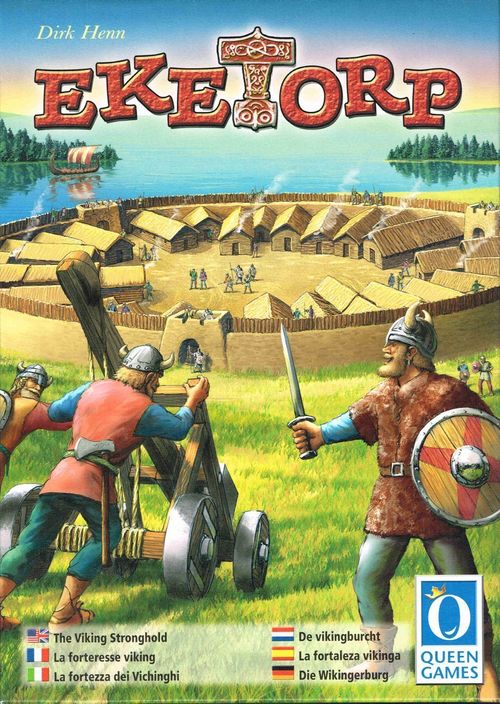
Eketorp
Eketorp Rulebook
Table of Contents
Table of Contents
- Contents of the Game
- Aim of the Game
- Preparing the Game
- The Game
- End of the Game and Scoring
- Overview of a Round of Play
Contents of the Game
- 1 Game Board – shows seven fields for the building material, the field hospital, as well as 6 Viking castles each with 6 fields.
- 6 Name Tags for the castles – their colour indicates which castle belongs to which player.
- 12 Material Cards – indicate the building bricks available for each round and indicate on which fields the bricks must be laid.
- Fields for the building materials: A to G.
- Building bricks: Green = Grass, Brown = Wood, Natural = Clay, Grey = Stone.
- The marked building bricks are only distributed when playing with five or six players.
- 54 Battle Cards – showing the numbers 1 to 6 (9 times).
- 48 Viking Figures – 8 in each of the six player colours.
- 112 Building Bricks comprising:
- 52 green (Grass), score: 1 point.
- 42 brown (Wood), score: 2 points.
- 12 natural (Clay), score: 3 points.
- 6 grey (Stone), score: 4 points.
- 30 Amulets – 5 in each of the player colours. "Thor's Hammer" can bring luck up to five times for each player, or one victory point for each amulet at the end of the game.
- 6 Player mats with player screens – used for placement of a player's own Vikings.
- 1 set of game Instructions.
Each castle has 6 wall fields, a field for a player's exchanged battle cards, a field hospital area with 4 wards, and 3 siege fields, from each of which 2 wall segments of a castle can be attacked.
Aim of the Game
The players send their Vikings out to plunder as much good building material for their castle as they can. The building bricks have different values and at the end of the game each player hopes to have the castle built of the most valuable bricks.
Preparing the Game
The game board is placed in the middle. Each player marks his castle on the board using the name tag in the colour of his choice.
Each player is given the following in his colour:
- 1 Player mat with screen.
- 1 Set of amulets (5).
- Depending on the number of players:
- 8 Viking figures when playing with 3 players.
- 6 Vikings when playing with 4 and 5 players.
- 5 Vikings when playing with 6 players.
Each player places his Vikings on the game board in his own castle.
The battle cards are shuffled and each player is dealt 4 cards face down. The remaining battle cards are put face down to one side.
Note: If a player (at the start of the game only!) is only dealt battle cards of the value 1, 2 or 3 – he will be given four new cards (this continues until he has been dealt cards that do not just have these three low values). All exchanged battle cards are shuffled back into the pack before the game begins.
The various kinds of building bricks are also placed next to the game board.
The pile of material cards is shuffled. Two of the cards are placed face down out of the game and the rest of the pile is placed face down at the ready.
The Game
The oldest player starts first and is given the pack with the material cards.
The game is played in several rounds. Each round is made up of 6 steps, which are carried out in a prescribed order:
- Distribution of material on the game board.
- Setting up the Vikings.
- Placing the Vikings on the game board.
- Battles and Sieges.
- Bagging the booty and building castles.
- Ending the round.
The Individual Steps Explained
1. Distribution of Material on the Game Board
The starting player turns over the top material card and distributes the bricks appropriately on the various fields for building materials in line with the instructions on the card.
The building bricks marked with white symbols on the card are only distributed when playing with 5 or 6 players.
Example: In a game of three or four players, 3 green, 4 brown and 1 natural brick are distributed (8 bricks in total). In a game of five or six players, 10 bricks are distributed: 4 green, 5 brown and 1 natural (the last only in games of 5 or 6 players).
2. Setting Up the Vikings
All players take their Viking figures out of their castles and place them on the desired positions on the player mat behind their screen.
Each player mat features the same illustrations shown on the game board, i.e.:
- The 7 fields (A-G) for building materials.
- The siege fields (catapult, boat and ram-rod) pertaining to the other players' castles.
- And the player's own castle.
Any number of Vikings can be placed on the fields A to G; here the Vikings battle for the valuable building bricks, which are to be found on the individual fields.
Only 1 Viking can be placed on any one siege field. The field indicates from which side a certain opponent's castle is to be attacked.
Note: Only castles that are in the game can be placed under siege, i.e. castles belonging to co-players.
Any number of Vikings can again be placed in the field representing the player's own castle. These are to defend the player's own castle in this round and cannot be used for attacking.
Note: Vikings that are still in the field-hospital may not be deployed in battle.
Tip: There is no point in placing Vikings on empty material fields (A to G) or on siege fields of a castle which has no wall bricks (e.g. in the first round!).
3. Placing the Vikings on the Game Board
After the players have placed the Vikings on the player mats behind the screens, the screens are all removed at the same time. Each player now transfers the Vikings from his mat onto the appropriate fields of the game board.
4. Battles and Sieges
4.1 Where to Battle and Where Not to Battle
Depending on how the various Vikings meet on the material and siege fields, peace may be preserved or battles may ensue.
Battle-free fields
The Vikings on a material field live in peace if there are sufficient building bricks, i.e. there is the same number of building bricks or more than there are Vikings.
If there are only Vikings belonging to one player on a particular material field, there will of course be no battle, even if there are fewer bricks than there are Vikings. On "peaceful" material fields, each Viking present gets one building brick, and to make things clearer the figure is placed on top of the brick.
Note: If there are more of a player's Vikings than there are building bricks, the surplus Vikings remain empty-handed in this round.
Note: The building material booty is taken along with the Viking figures to a player's own castle, placed on the game board and used there for building.
Battle fields
There is a battle for the bricks on every material field, where Vikings belonging to different players meet, and there are not enough bricks for each of the figures.
A battle takes place on a siege field in front of a player's castle for the right to lay siege if several Vikings are positioned there.
Fields with a siege
On every siege field with exactly 1 Viking (e.g. after a battle) there is a siege.
Note: It may happen as a result of a draw that no Viking figure is left following a battle for a siege field. The siege does not take place.
Battles always take place in a certain order. Firstly, the starting player checks whether and on which fields his Vikings can stage battles or sieges. He then conducts one of those battles or sieges. The others then follow in a clockwise direction. The players take turns to battle until all battles and sieges have been played out.
Conditions for a battle/siege
- Fewer building bricks than Vikings (Vikings belonging to opposing players): battle.
- Several Vikings on a siege field: battle.
- 1 Viking on a siege field: siege.
4.2 Conducting Battles and Sieges
The player whose turn it is chooses on which field he wishes to attack and then determines clearly – for all to see – his own figure and his opponent's Viking figure.
Both opponents then each play one of the cards in their hand face down and then turn the cards over simultaneously. The highest card wins. The difference in value between the two cards determines the battle difference. The player with the lower value card places his figure in the field-hospital. In the case of a draw, both players put their figures in the field-hospital. The battle difference indicates in which hospital-field the figure is placed.
In cases where the battle difference is:
- 3 or more, the figure is placed on field "3•4•5".
- If it is 1 or 2, the figure is placed on field "1•2".
- If there is a draw, both figures are placed in field "0".
Example: The battle difference is "2". Blue – the losing player – must then put his figure on field [1•2] of the field hospital.
Both players then swap the cards they played and place these face down on the fields next to their castle. Both now have one card fewer in their hand.
If a player has no more cards in his hand, he picks up the discarded cards (he now has four cards in his hand again).
Using the amulets
Before a battle the two parties, starting with the attacker, may exchange the cards in their hands. However, when swapping cards, all of the cards in a player's hand must be exchanged. This costs 1 amulet per exchanged card, the amulet being discarded thereafter. Players throw their cards face down on a throw-away pile and draw the appropriate number of new cards.
If a player wishes and still has sufficient amulets to allow this, he may repeat this process. Amulets are not returned. Each amulet left over at the end of the game is worth 1 victory point.
4.3 Special Cases During Sieges
A siege is a battle between the besieger and the defender. The defender is not permitted to attack and the besieger may only attack once, even though there may be several defenders in the castle. A siege is conducted in the same way as a battle. If the defender loses, the following changes:
-
The defender is placed in the field-hospital. The Viking figure of the defeated defender is placed in the appropriate field-hospital field and then immediately moved on by one field in the direction of the arrow.
-
No defenders in the castle. The owner of the castle still has to play a card. However, for this battle the card assumes the value "0". This card is also exchanged afterwards.
Tip: To leave a castle without defenders is a high risk action. If a siege were then to take place, there is a great risk of losing many bricks.
Note: If a siege takes place without any castle defenders – nobody will end up in the field-hospital.
-
The attacker has won; there is booty to be had! If the attacker has won his siege, he can now remove bricks from the castle, regardless whether there are more defenders there or not. Here the rules are:
- Bricks may only be taken from the two wall fields neighbouring the siege field.
- Bricks can only be removed from top to bottom.
- The total point value of the bricks taken may not exceed the battle difference.
- The attacker may select one of the dismantled bricks as booty and place his Viking figure on top of this.
- The other dismantled bricks are put into the reserve store.
Example: Blue wins the siege with a battle difference of 2 [5-3=2] against opponent red. He may therefore remove bricks to a value of up to 2 points from the two neighbouring parts of wall. From these bricks he may choose any one as booty and build this into his own castle at the end of the round. In this case, either the 2 green bricks (2 x 1 point) or the brown brick (2 points). He decides to take the latter option because he can then take a 2 point brick home with him as booty. The red Viking (defender of the castle) ends up in the field-hospital on field "1•2" and is then moved on 1 field.
After every battle and every siege it is checked to see whether all fields have now become peaceful or whether there are still battles to be fought.
5. Bagging the Booty and Building Castles
Now all players take their Viking figures that are not in the field hospital and place them back in their castle with their brick booty.
The bricks are used for building according to the following rules:
- One brick is placed on one of the 6 building fields of the castle or on top of one that is already there.
- Up to 3 bricks may be stacked on top of each other.
- If a stone has already been used it cannot be moved within the castle.
6. Ending the Round
Now, all of the Vikings in the field-hospital are moved 1 field in the direction of the arrow. If as a result, the Viking leaves the field-hospital, he is placed back in his own castle.
Any green and brown bricks that are left on the building material fields are returned to the store. If natural or grey bricks are left over, these stay on the material fields.
The pack of material cards is passed on to the next player in a clockwise direction; he becomes the starting player for the next round, which begins now.
End of the Game and Scoring
The game is over when one or more players manage to build a castle with 18 bricks. Alternatively, the game is over at the end of the 10th round at the latest.
Scoring
The players receive points in accordance with the following list:
- For each brick in the castle, depending on the colour:
- Green (Grass): 1 point.
- Brown (Wood): 2 points.
- Natural (Clay): 3 points.
- Grey (Stone): 4 points.
- For a completed castle (18 bricks): 5 points.
- For every amulet still held: 1 point.
If at the end of the game a player has more than 18 building bricks, these extra bricks are also counted.
Each player tallies his points. The player with the highest point score wins.
Example: The red player receives the following: for his remaining amulets, 3 points. For his bricks: Green (9 x 1 point) = 9 points, Brown (6 x 2 points) = 12 points, Natural (2 x 3 points) = 6 points, Grey (1 x 4 points) = 4 points. For his completed castle: 5 points. This means he has scored 39 points.
Overview of a Round of Play
Preparation
Each player receives in the colour of his choice: 1 player mat with screen, 5 amulets, and 1 name tag for his castle as well as (depending on player numbers):
- 5 Vikings – when playing with 6 players.
- 6 Vikings – when playing with 4 and 5 players.
- 8 Vikings – when playing with 3 players.
1. Distribution of Material on the Game Board
The starting player turns over the top material card. The building bricks are distributed appropriately on fields A to G.
2. Setting Up the Vikings
Each player sets up his Vikings behind the player screen on his mat.
- A maximum of 1 Viking on every siege field.
- Any number of Vikings on fields A to G.
- Any number of Vikings on his own castle field.
3. Placing the Vikings on the Game Board
The Viking figures are now placed on the game board fields according to their position on the mat.
4. Battles and Sieges
The player, whose turn it is, establishes where he is involved in battle, chooses one and fights that battle. Then the next player fights a battle.
Battle-fields
- Every field with fewer building bricks than Vikings but with figures from at least 2 players.
- Each siege field with more than 1 Viking.
Fields with a siege
- Each siege field with exactly 1 Viking.
Please note: Only one siege battle takes place regardless of how many defenders are in the castle. Even if there are no defenders, a battle card is exchanged.
5. Bagging the Booty and Building Castles
All figures that are not in the field-hospital (even those with their brick booty) are returned to their own castles on the game board. Bricks taken as booty are now used for building. If a castle is complete (18 bricks) the game finishes with scoring or continues with step 6.
6. Ending the Round
All of the Vikings in the field-hospital are moved 1 field in the direction of the arrow. If as a result, the figure leaves the field-hospital, it is placed back in its own castle.
Any remaining green and brown bricks are returned to the store (grey and natural coloured bricks remain on the board). The pack of material cards is passed clockwise to the next player.