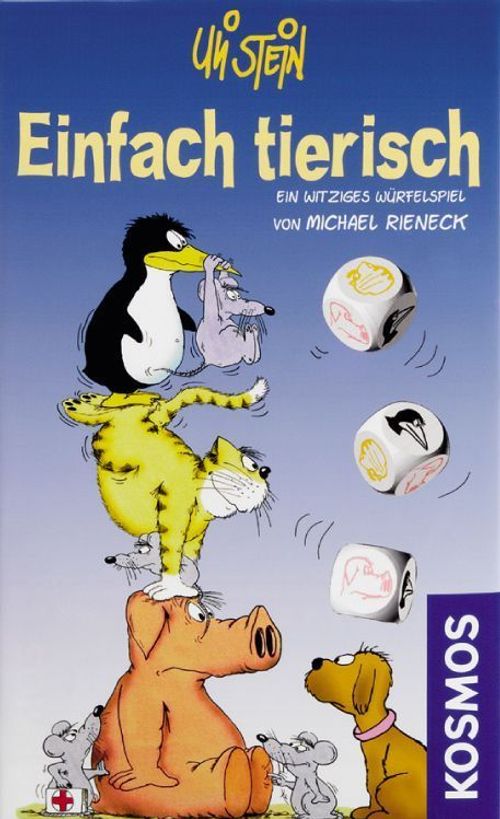
Einfach tierisch
Einfach tierisch Rulebook
Table of Contents
Table of Contents
Game Idea and Objective
In this turbulent dice game a player only scores points when his animal appears most often in the roll. But beware: whoever risks too much hands points over to the other players! And the police thwart many a plan. The player who first reaches 2 victory points wins. You earn one victory point when you have marked all 5 boxes of another player's animal on your scoresheet.
Components
- 6 dice
- 1 scoring pad (Wertungsblock)
Setup
- Each player needs a pencil and a sheet from the scoring pad. Then, going around the table, each player chooses one of the five animals shown on the scoresheet: pig, mouse, penguin, dog or cat. An animal that a player has already chosen may not be chosen by the other players. The youngest player begins.
- Each player draws a circle around his animal on his scoresheet, so that everyone can see which animal each player is playing.
- Then each player crosses out all boxes in the column of his chosen animal. Points can never be scored for your own animal. That would be going too far.
Gameplay
Turn Sequence
- The player whose turn it is completes his roll in full before the next player clockwise takes his turn.
- In his roll, the player rolls all 6 dice and sets aside some of them. He then rolls the remaining dice again and sets aside more dice again. Finally, he rolls the remaining dice once more.
- In his turn the player must therefore roll exactly three times. He must observe the following rule: over the three rounds of his roll he must set aside exactly 3 dice once, exactly 2 dice once and exactly 1 die once.
- Important: the player decides for himself in which round of his roll he sets aside 3, 2 or 1 dice. No order is prescribed.
- Examples: He may first set aside 2 dice, then roll the remaining 4 and set aside 1 of them. Finally he rolls the last 3 dice. Or he first sets aside 1 die, then 3 dice and finally 2 dice. However, it is not allowed, for example, to set aside 2 dice first and then, after the next roll, set aside 2 more, even if that would fit perfectly. The player would then have to choose between 3 or 1 die.
- Example of a roll: Player "Mouse" sets aside 1 mouse and 1 dog in his first dice round. In his second dice round he sets aside 1 mouse, 1 dog and 1 penguin. In his third dice round he sets aside 1 mouse. His roll is then complete.
- Dice that have been set aside may not be rolled again.
- Only after all 6 dice have been set aside is the roll evaluated.
Evaluation
- If after the third dice round of the roll 2 or more police officers are showing, the roll is lost (see "2 x Police = Fun Over").
- If at the end of the roll only one or no police officer is showing, the player whose animal appears most often in the roll may mark one, two or three boxes on his scoresheet.
- He may mark boxes for all animals that appear in the roll but less often than his own animal. A player may also mark 2 boxes for one animal.
- If several animals appear most often in the roll, all the corresponding players may mark boxes on their scoresheets for the animals that appear less often.
- If no animal appears more often in the roll than the others, nobody marks any boxes.
- Example: In the roll of player "Penguin" the following animals are showing: two cats, two penguins, a mouse and a dog. Player "Penguin" and player "Cat" each mark 1 box for the mouse and 1 box for the dog.
- Example: In the roll of player "Pig" the following animals are showing: two pigs, two cats and two mice. Nobody marks a box, because there are only animals that appear equally often. The same applies in this case: [illustration of a further example roll in which the animals appear equally often; no player marks a box].
- Example: After his third dice round, player "Mouse" has the animals shown in the illustration lying. He may mark 2 boxes for the dog and 1 box for the penguin. Nobody else marks a box. Player "Mouse" may not mark a box for his own animal. His scoresheet now looks like this: [illustration of the scoresheet with the marked boxes].
- Naturally it can happen that a player's roll helps an opponent to score boxes and he himself scores nothing.
- Example: Player "Cat" has the following animals lying after his roll: three dogs, two cats and one police officer. Player "Dog" rejoices, because his animal now appears most often in the roll: he may mark 2 boxes for the cat. Player "Cat" scores nothing himself. Nobody may mark a box for the police officer.
- Note: If fewer than five players are playing and an animal that belongs to no player appears most often in a roll, nobody receives points for that animal. If in the example just shown there were no player "Dog", then nobody would mark any boxes, and player "Cat" would not either, because his cat does not appear most often. In the top example on page 4, player "Penguin" may nevertheless still mark the mouse and the dog for himself, even if there were no player "Cat". There is no animal that appears more often than the penguin.
2 x Police = Fun Over
- If after the third dice round of a player's roll 2 or more police officers are showing, no player receives points.
- Example: In the roll of player "Mouse" the following are showing: two mice, a pig, a penguin, and two police officers. Nobody marks a box, because the two police officers make the roll invalid. If only one police officer were in the roll, the roll would remain valid.
- Notes: If 2 or more police officers are rolled in the first or second dice round of a roll, this has no effect yet. The dice can be rolled again. Only when the roll is evaluated after the third dice round must the police officers be taken into account.
- Of course, police officers may also be set aside in the first and second dice rounds.
Victory Points and End of Game
- As soon as a player has marked all 5 boxes of another player's animal, he has 1 victory point. He may not mark any further boxes for that animal.
- The game ends as soon as a player has 2 victory points, i.e. when he has marked all 5 boxes for each of 2 other players' animals. That player has immediately won the game.
- Example: Player "Dog" has 1 victory point each for the penguin and the cat and has therefore won. [illustration of player "Dog's" scoresheet with the completed columns]