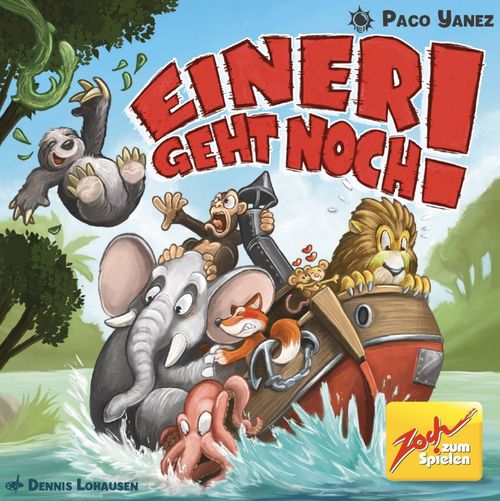
Einer geht noch!
Einer geht noch! Rulebook
Table of Contents
Table of Contents
Components
Take the 5 boat cards and lay out one per player in a row. Start with boat 1 and count up. With three players, boats 1 to 3 are laid out.
Mix the 30 weight tiles face down to form the supply. Put one tile on each boat, then flip it face up. Each tile shows its boat's maximum weight.
Place the 20 cupid cards in a stack beside the boats.
From the 60 animal cards, shuffle the 12 animals of your color. Place them as a face-down deck in front of you. Draw 3 of these cards into your hand.
Whoever was most recently on a boat takes the starting-player buoy, which you must assemble before the first game.
Goal of the game
Load the boats so that your animals in the harbor are the heaviest. And collect a lot of cupid cards along the way!
Overview
You load the animals on to the boats! Each time you empty your hands carry out any animal actions, then weigh each boat to see if it reaches the harbor. You get cupid cards for any animals that find true love on the high seas. The winner is the player who brings the heaviest animals to the harbor, and so garners the most love.
Loading boats
Beginning with the starting player, you each play one card from hand to a boat of your choice. Continue doing this till everyone has played 3 cards. When playing:
- Each player must play one of his cards face down and two face up.
- Boats with 3 animals are full. You can't add a fourth animal.
- You may exceed the boats' maximum weights.
- Don't draw any cards till you've played all 3.
Example: Sina, Tobi and Leo play their first cards face up. Only Evi plays hers face down.
Sina and Leo play their second cards face down. Tobi plays his face up. Boat 4 now has 3 animals and so is full. As Evi played her first card face down, she must play her second face up.
Tobi played his first two cards face up, so he must play his third face down. The others, who have already played cards face down, must play their third cards face up. Now all hands are empty and all boats full.
Resolve the boats
Once you've all played your 3 cards, reveal all face-down animals.
- If three animals of one type are on a boat, remove them from the game. If they're squid they swim to the harbor – place them face up in front of their owners.
The animals' actions
Now, four types of animals become active: mouse, fox, monkey and lion.
- Start with the animals in boat 1, then do the rest of the boats in ascending order.
- If a boat contains several active animals, start with the lightest and work your way up to the heaviest.
- Animal actions may cause more than three animals to be on a boat. This is allowed (unlike when loading the boats).
- Always follow the rules for love-struck animals (below).
ATTENTION: Love-struck animals? Take a cupid card!
If exactly two animals of a kind are on board they fall in love.
Each of their owners takes a cupid card and places it in front of him.
Love-struck animals...
- never carry out any actions,
- never trigger other animals' actions,
- are never affected by other animals' actions.
The mouse
She is only active when there is an elephant on board: mix this boat's weight tile back into the supply, then put a new one on the boat face up.
No mouse action takes place if mice or elephants are love-struck!
The fox
He cunningly plans to send the heaviest animal to the next boat.
His plan works if the animals on board exceed the boat's maximum weight. Move the heaviest animal to the next boat.
His plan fails if the boat can support the animals' weight. In this case throw the fox overboard. The fox card is removed from the game.
Example:
- Boat 1: The animals exceed the maximum weight. The bear is sent to the next boat.
- Boat 2 can support the weight of the (now 4) animals. This fox's plan backfires and he flies overboard.
- Boat 3: The animals exceed the maximum weight. The peacock's plumage tricks the fox into thinking that he, the peacock, is the heaviest animal on board. So the peacock and not the bear is sent to boat 4.
- Boat 4: There are two love-struck giraffes, so the fox doesn't carry out his plan.
Peacock special case
If the peacock is on board, the fox and the monkey mistake it for the heaviest animal thanks to its impressive plumage.
- Fox: Sends the peacock to the next boat, if the cunning plan is successful.
- Monkey: Makes the peacock send the actual heaviest animal to the next boat. This could be the monkey itself (only in the Peacock special case).
Love-struck animals on board play no part in any fox or monkey action.
The monkey
He makes the heaviest animal (not himself) send the third animal present to the next boat. If there are more than 3 animals on board, it sends the heavier of those others. If there are only 2 animals on the monkey does nothing.
Example:
- Boat 1: The monkey makes the deer send the mouse to the next boat.
- Boat 2: The monkey makes the sloth send the squid to boat 3.
- Boat 3: The monkey thinks the peacock is the heaviest animal. He makes the peacock send the real heaviest animal, the monkey, to boat 4.
- Boat 4: The monkey thinks the peacock is the heaviest animal. He makes him send the bear overboard.
If an animal is sent from the last boat (by a fox or monkey action), it goes overboard and is removed from the game. Squid, however, swim to the harbor. Place such squid face up in front of their owners.
The lion
He likes eating the next-heaviest animal on board – remove that animal's card from the game. If only heavier animals are on board he does nothing.
Love-struck animals don't eat and aren't eaten.
Example:
- Boat 1: The monkey makes the heaviest animal, the lion, send the third animal, the zebra, to the next boat. Then the lion eats the next-heaviest animal: the monkey.
- Boat 2: The next-heaviest animals (2 zebras) are too in love to be eaten. The sloth isn't eaten as he's not the next-heaviest.
Arriving at the port (evaluate boats)
- Check whether the animals on each boat exceed its maximum weight.
- Start with boat 1 and go up.
Mouse special case: ONE mouse weighs nothing (weight 0). Two (love-struck) mice together weigh 1.
Does the boat reach the harbor?
Yes, the animals are light enough.
- Land animals reach the harbor.
- Squid spent too long on the dry boat. Sadly, they don't reach the harbor and are removed from the game.
- Example: The two zebras and the squid are together light enough for the boat. The land animals (zebras) reach the harbor, the squid doesn't. He is removed from the game.
No, the animals are too heavy.
- The boat capsizes. No land animals reach the harbor. Remove them from the game.
- Squid swim safely to the harbor.
- Example: The two zebras and the squid are together too heavy for the boat. Only the squid reaches the harbor. The other animals are removed from the game.
Animals that reach the harbor are placed face up in front of their owners.
Changing maximum weights and starting player
After resolving the boats:
- everyone draws 3 cards.
- remove the weight tiles on the boats from the game and add new ones from the supply.
- pass the starting-player buoy left.
Game end and winner
Once everyone has played his last card, finish the current round.
- Carry out animal actions and see one last time which animals reach the harbor.
Then everyone adds up the weights of his animals in the harbor. Each cupid card adds another 2 to this total. The player with the highest total wins. Ties are broken in favor of the player with more cupid cards. If still tied, either share the victory or fall in love. In this happy case the game of course has no winner.