EGO Family
EGO Family Rulebook
Table of Contents
Table of Contents
Contents
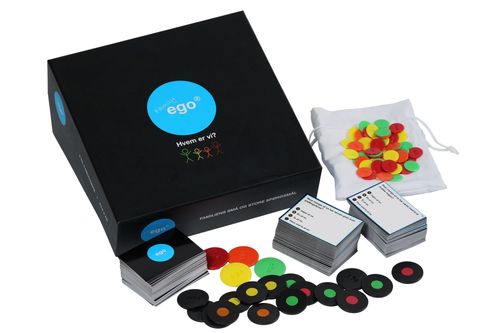
Game components: 165 double-sided question cards, 16 answer tokens, 4 player tokens, 60 small tokens, a round board, and these instructions.
Players: 2–4. Age: 8+. Playing time: 20–60 minutes.
Goal of the Game
The goal of the game is to get to know yourself and your family better while having a great time.
EGO Family has very simple rules. Draw a question card and choose an answer. Then each of the other players tries to guess it.
Setup
Place the board in the middle of the table. Each participant chooses their coloured player token and places it in front of them for the duration of the game (this is the player's colour). Then each person takes 15 small tokens in their colour and places them in the pool in the middle of the table (on the board). Each player receives a set of 4 answer tokens with 4 different coloured dots.
Place the box of shuffled cards on the table.
The youngest participant starts the game.
Questions
EGO Family contains 3 different types of questions:
-
Questions beginning with: "Who among us…?" In this case, choose 1 player as the answer (you may choose yourself). To do this, take the answer token with the dot in the colour of the chosen player.
Example: The question reads: "Who among us tells the best jokes?". Your answer is: the player whose colour is RED. Choose the token with a red dot and place it face down on the table in front of you.
-
Questions beginning with: "How many of us…?" In this case, choose the number of players from the 4 options written on the card. These are: "Nobody", "One person", "Two people", or "More than two people".
-
Questions about you – and only you. In this case, choose 1 of the 4 answers on the card. Each answer is marked with a coloured dot.
Gameplay
-
Draw a card from the box. Read the question and the given answers aloud to the other players. Then place the card on the table so that everyone can see and read it.
-
Now consider the question and the possible answers, but without revealing or hinting at your choice to the other players.
-
When you have decided how to answer, place an answer token face down on the table (so that the dot is hidden).
-
Then each of the remaining players tries to guess what your answer is. To do this, they choose an answer token with a dot in the colour they think is your choice. They place the token face down on the table.
Example: A player has decided that your chosen answer is: the player with the orange colour. They therefore take the token with an orange dot and place it colour-side down.
Players may also choose two different answers by laying out 2 answer tokens on the table, i.e. "half and half".
Example: A player is not sure which answer you chose: red or yellow. They therefore decide on "half and half" and lay out 2 face-down answer tokens on the table: one with a red dot and one with a yellow dot.
-
When all players have laid down their tokens with dots, you may reveal your answer. To do this, turn over your token so that everyone can see the colour of the dot. Then the other players reveal their tokens. Those whose dot is the same colour as yours have guessed correctly.
-
Tokens are then distributed (see: Distribution of Tokens). When this is finished, the next player to the left draws the next question card and a new round begins.
Distribution of Tokens
Players who guessed correctly receive small tokens from the pool. Participants take tokens only in their own player colour.
Distribution of tokens always works as follows:
- You receive 1 token for each player who guessed your answer. Example: 2 players guessed your answer, so you receive 2 tokens.
- A player who guessed your answer using one token receives 2 small tokens in their colour.
- A player who guessed your answer using two tokens ("half and half") receives 1 small token in their colour.
- A player who did not guess your answer receives no tokens.
End of the Game
The first player to collect 15 small tokens in their colour wins the game.
Note: The player who read the question always takes tokens first, and then the other players take theirs, in clockwise order.