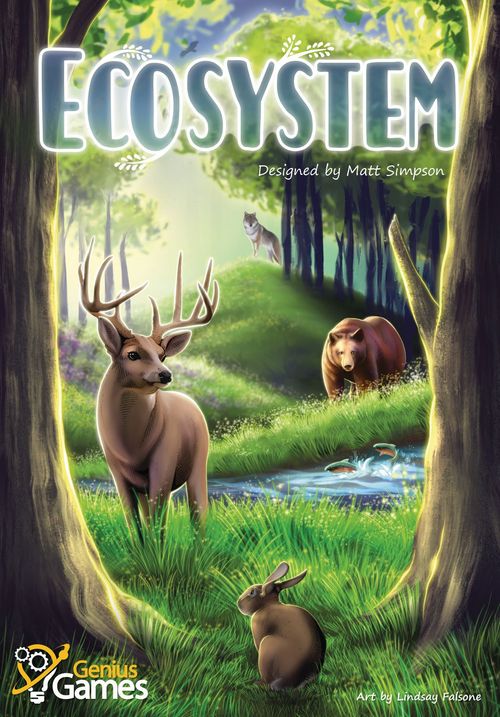
Ecosystem
Ecosystem Rulebook
Table of Contents
Table of Contents
Setup and Overview
Give a player aid to each player. Shuffle the deck of cards and deal 10 cards to each player, setting the remaining cards aside until Round 2.
To begin playing Ecosystem, each player looks at their hand of cards and selects one to keep, placing it face down in front of them. Once all players have selected a card, they simultaneously reveal the cards and place them into their ecosystems. Each player's hand of cards is then passed to the left, so that each player will receive a new hand of the same number of cards from the player to their right, in a clockwise circle. The players' next selection will come from this new hand.
Play continues in this way until all 10 cards have been placed, signifying the end of Round 1. When this happens, deal each player 10 new cards for Round 2. Play proceeds in the same way, except that players will pass cards to their right, circulating counterclockwise this Round. At the end of Round 2, players score the 20 total cards in their ecosystems to determine the winner.
Placing Cards
After selecting each card, players will add them to their ecosystem. A player's ecosystem is their personal grid of cards, arranged on the play area in front of them. When players place new cards, they must observe the following rules:
- Starting with the second pick, new cards must always be placed adjacent to an existing card. "Adjacent" in this game always means left, right, above or below—not diagonally.
- Players' ecosystems will eventually make a grid 4 cards high and 5 cards wide. New cards may never be placed in a location that would exceed this size, and the full 4x5 grid will eventually be completely used.
Since players start with a single card, it is okay for their ecosystems to grow naturally and with uncertainty at the beginning of the game. However, once a player has played into a 4th row or 5th column, they may no longer expand further in that direction.
As long as players observe the placement rules above, they may place new animals and landforms in their ecosystem anywhere they choose (though some options may be strategically preferable). At the end of the game, they will score points according to the rules for each card, then receive Diversity points for the number of animals and landforms they have utilized well in their ecosystem.
Card Types
Most of the card types score points for being placed in their preferred environments, adjacent to other suitable cards.
Bees like Meadows—Each Bee scores 3 points for each adjacent Meadow.
Bears like Bees and Trout—Each Bear scores 2 points for each adjacent Bee and each adjacent Trout.
Trout like Streams and Dragonflies—Each Trout scores 2 points for each adjacent Stream and each adjacent Dragonfly.
Foxes don't like Wolves or Bears—Each Fox scores 3 points, as long as it is not adjacent to any Wolves or Bears.
Eagles hunt Rabbits and Trout—Each Eagle scores 2 points for each Rabbit and Trout within 2 spaces in any direction.
Dragonflies like Streams—Each Dragonfly scores points for the total length of all adjacent Streams (continuously connected Stream cards in any pattern).
Deer like their freedom—Score 2 points for each row and column that has at least 1 Deer in it. (Spreading out Deer scores more points.)
Rabbits are quick—Rabbits allow the player to immediately switch the positions of any 2 cards in their ecosystem when played. Rabbits score 1 point each.
Meadows—Meadows score points based on the number of adjacently connected Meadow cards: 0/3/6/10/15 points for 1/2/3/4/5+ Meadows. A player may score multiple separate Meadows, but a single Meadow scores a maximum of 15 points.
Streams—After all the cards have been placed, players compete for the largest Stream. The player with the most continuously connected Streams scores 8 points, and the second most receives 5 points. Players must have at least 1 Stream to score any points.
Wolf Pack—After all the cards have been placed, players compete for the largest Wolf pack (they need not be adjacent). The player with the most Wolves scores 12 points, second most scores 8 points, third most scores 4 points. Players must have at least 1 Wolf to score any points.
Ties—If players tie for largest Stream or most Wolves, the tying players earn full points. In this case, the next lower prize would not be given. For example, a two-way tie for most Wolves would result in 12 points for the tying players and 4 points to the player with the third most Wolves.
Scoring Examples
- The Bee in the top row scores 6 total points for the Meadows to its left and below it. The Bee in the second row scores 3 points for the Meadow to its left. Neither Bee scores for the other two Meadows, which are not adjacent to either Bee.
- The Eagle scores 6 total points for the adjacent Rabbit, the Rabbit 2 spaces above it, and diagonal Trout.
- The Dragonfly in the bottom row scores 2 points for the total Stream adjacent to it. The Dragonfly in the second row scores 6 total points for the two Streams next to it (4 points above and 2 points for below).
Diversity Points
After players have scored the points from their cards, they assess overall diversity by examining how many distinct card types have contributed to their ecosystems. Review the card scoring for each player and count the number of card types that did not score any points. These are called ecosystem gaps. (Players may have ecosystem gaps because they did not play any of a particular card type, the scoring condition for the card type was not met, or they did not have one of the largest Streams or most Wolves.) Based on the number of ecosystem gaps, each player receives the following Diversity bonuses or penalties:
| ecosystem gaps | 6+ | 5 | 4 | 3 | ≤2 |
|---|---|---|---|---|---|
| Diversity Points | -5 | 0 | 3 | 7 | 12 |
2-Player Game Rules
For a 2-player game, deal a third hand of 10 cards on an unused player aid for a neutral player. When passing cards, the neutral player aid is included in the rotation (so that one player will always be passing to the neutral player in Round 1 and the other player will be passing to the neutral player in Round 2).
After both players have made each selection, randomly remove one of the cards from the neutral player hand and set it next to the neutral aid face up in a pile. Players may look at these cards at any time (they are not arranged or used). Ecosystem placement and scoring proceed as normal, except that the neutral player's Stream and Wolf cards are compared when scoring Largest Stream and Most Wolves (the neutral player Streams are all considered connected).