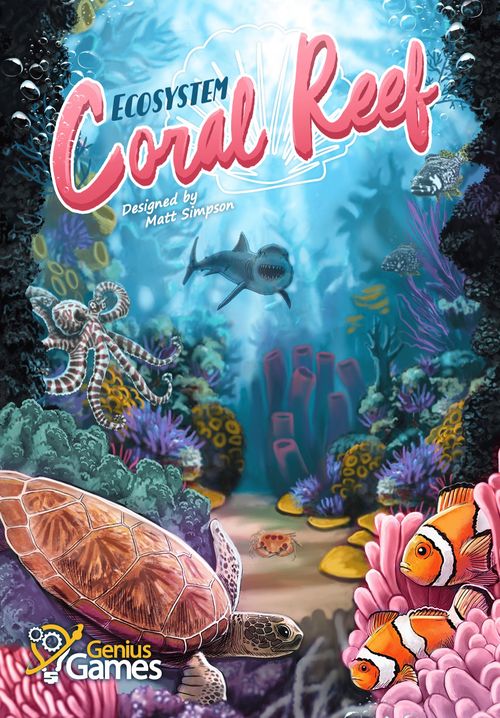
Ecosystem: Coral Reef
Ecosystem: Coral Reef Rulebook
Table of Contents
Table of Contents
Setup and Overview
Give a player aid to each player. Shuffle the deck of cards and deal 10 cards to each player for Round 1, setting the remaining cards aside until Round 2.
To begin playing Ecosystem, each player looks at their hand of cards and selects one to keep, placing it face down in front of them. Once all players have selected a card, they simultaneously reveal the cards and place them into their ecosystems. Each player's hand of cards is then passed to the left, so that each player will receive a new hand of the same number of cards from the player to their right, in a clockwise circle. The players' next selections will come from this new hand.
Play continues in this way until all 10 cards have been placed, signifying the end of Round 1. When this happens, deal each player 10 new cards for Round 2. Play proceeds in the same way, except that players will pass cards to their right, circulating counterclockwise this Round. At the end of Round 2, players score the 20 total cards in their ecosystems to determine the winner.
Placing Cards
Each time a player selects a card, they will place it into their ecosystem. A player's ecosystem is their personal grid of cards, arranged on the play area in front of them. When players place new cards, they must observe the following rules:
- Starting with the second card selection, new cards must always be placed adjacent to an existing card. "Adjacent" in this game always means left, right, above, or below — not diagonally.
- Players' ecosystems will eventually make a grid 4 cards high and 5 cards wide. New cards may never be placed in a location that would exceed this size, and the full 4x5 grid will eventually be completely used. Since players begin from a single card, their ecosystems will grow gradually and naturally at the beginning of the game. However, once a player has placed into a 4th row or 5th column, they may no longer expand farther in that direction.
Example: The outlined spaces are available for the next card placement.
As long as players observe the placement rules above, they may place new cards in their ecosystem anywhere they choose (though some options may be strategically preferable). At the end of the game, they will score points according to the rules for each card, then receive a food web bonus for how well they have balanced their ecosystem.
The Cards
The organism cards generally score points for being placed in their preferred environments, adjacent to other suitable cards. Most of the cards have an icon identifying them as Producers, Prey, or Predators. These groups affect some scoring conditions and players' food web bonuses (see Food Web Points and Scoring).
Coral score 3 points if they are in the bottom row of your ecosystem. Otherwise, they score 0.
Krill score in groups, based on the number of adjacently connected Krill cards: score 1/4/9 points for 1/2/3+ Krill cards. A player may score multiple groups of Krill, but a single continuous group of Krill scores a maximum of 9 points.
Example: The Coral on the bottom left will score 3 points as long as no cards are placed below it, so it remains on the bottom row.
Example: There are currently 2 groups of Krill worth 13 total points: 4 points (for 2 Krill cards) and 9 points (for 3 Krill cards). This score could actually go down, if more Krill were added in a way that combined all of the Krill into a single group.
Example: The Grouper is currently worth 6 points for the pair of adjacent Krill.
Plankton reward collecting the most. The player with the most Plankton scores 12 points, second most scores 8 points, and third most scores 4 points. Players must have at least 1 Plankton to score any points.
If players tie for a Plankton reward, all tying players earn full points. In this case, the next lower prize would not be given. For example, a two-way tie for most Plankton would result in 12 points for the tying players, while the player with the next most Plankton would still earn 4 points.
Groupers score 3 points for each adjacent Krill card. (Remember that adjacent means left, right, above, or below – not diagonally.)
Clownfish score 2 points for each adjacent Plankton and each adjacent Coral.
Crabs score 2 points for each Plankton in the same row (anywhere in a straight line left or right).
Eels score 4 points for each adjacent Prey (Groupers, Clownfish, and Crabs) as long as the Eel is adjacent to Coral. If the Eel is not adjacent to Coral, it scores 0.
Sharks score 2 points for each Prey in the same row and each Prey in the same column.
Example: The Clownfish in the middle will score 4 total points for the Plankton above and the Coral below. The Clownfish on the left will not currently score any points. The pair of Crabs will score 4 points each for the Plankton in their row.
Example: The left Eel will score 12 total points for the 3 adjacent Prey. The right Eel will not score any points unless a Coral is placed adjacent to it. The Shark is worth 6 points so far.
Whales — Before scoring, for each of your Whales, you must flip 1 adjacent card face down (it will be ignored during scoring). Whales score 2 points for each Krill anywhere in your ecosystem.
Turtles score 2 points for each row and column that has at least 1 Turtle in it. Players score the row and column for each Turtle, but do not receive additional points for having more than 1 Turtle in the same row or column. (Spreading out Turtles scores more points.)
Example: These 3 Turtles have been placed in 2 columns and 3 rows for 10 total points.
Octopuses — Octopuses score 3 points each. Additionally, when you place an Octopus, you may immediately move any 1 card in your Ecosystem or switch the positions of a pair of cards.
Note: Turtles and Octopuses are not a part of any food web group.
Food Web Points and Scoring
After all players have completed their 20-card ecosystems, it's time for scoring. First, any players with Whale cards must select a face-up card adjacent to each Whale to turn face down. Players then record their scores for each card type.
Players will evaluate the balance of their ecosystem's food web by adding up the total points scored for their food web groups of Producers, Prey, and Predators. For each player, identify which of these groups scored the fewest points. That player will add that amount of points to their total score again as their food web bonus.
Example: After recording scores for each card type, the players add up their scores for each food web group. Zoe scored 18 points from her Producers, 23 points from her Prey, and 28 points from her Predators. She circles her Producer score of 18, the lowest of these, and writes it in as her food web bonus. In the same way, Avery will earn a food web bonus of 14, from her Predators, and Ellie earns 17, from her Prey.
The scorepad tracks each player's totals for Coral, Krill, and Plankton (summed as the Producer total); Grouper, Clownfish, and Crab (summed as the Prey total); Eel, Shark, and Whale (summed as the Predator total); the Food Web bonus (the lowest of the Producer/Prey/Predator totals); and Turtle and Octopus points, which are added on their own.
All players calculate their final score by adding up the shaded boxes on the scorepad: the point totals for each food web group, their food web bonus, and the points scored for the turtle and octopus (which are not part of another group).
The player with the most points wins! If players tie, they share the victory.
Full Scoring Example
Example: Zoe scores her ecosystem.
Producers: Zoe's single Coral was placed on the bottom row and earned 3 points. None of her Krill were adjacent to any others, so each lone Krill only scored 1 point. Zoe tied for most Plankton with Avery, so both earned the full 12 points.
Prey: Zoe's Groupers were well placed near her Krill, scoring her 9 points (note that both Groupers are able to score off the same Krill, and a single Grouper is able to score off multiple Krill). Similarly, she earned 12 points from Clownfish and 2 for her Crab (the Crab scored for the Plankton further to the right in its row, but scores nothing for Plankton below it).
Predators: Zoe had some very efficient Predators. Her Sharks scored 8 points each, with 2 Prey in their shared column and 2 Prey in each Shark's row (again, multiple Predators can "hunt" the same Prey). Her Eel scored a full 12 points for being completely surrounded by 3 Prey and a Coral (each Eel needs an adjacent Coral in order to score). Zoe has no Whales, so she does not score any points for Whales (and does not need to flip any cards face down).
Other: Zoe's Turtles are spread out, giving her 2 rows and 2 columns containing a Turtle, for a total of 8 points. The Octopus (which had helped her rearrange her ecosystem during the round) scores 3 points.
Food Web: After adding up each food web group, Zoe has the fewest Producer points, and earns 18 bonus points. Totalling the shaded areas, she scores 98 points. She wins!
2-Player Game Rules
For a 2-player game, deal a third hand of 10 cards on an unused player aid for a neutral player. When passing cards, the neutral player aid is included in the rotation (so that one player will always be passing to the neutral player in Round 1 and the other player will be passing to the neutral player in Round 2).
After both players have made each selection, randomly remove one of the cards from the neutral player hand and set it next to the neutral aid face up in a pile. Players may look at these cards at any time, but they are not placed. Ecosystem placement and scoring proceed as normal, except that the neutral player's Plankton cards are compared when scoring most Plankton.
Solo Game Rules
By Richard Wilkins
For a solo game, shuffle the deck and deal yourself a single hand of 10 cards. You will use your cards to build your own ecosystem (according to the normal rules), but will also discard cards into a second ecosystem for Mocha, your opponent.
Each turn, place 1 card into your Ecosystem according to the normal rules, then choose 1 card to discard. The discarded card will be played into Mocha's ecosystem, creating a 4x5 grid as normal, starting at the top-left and proceeding left to right, then top to bottom, until you reach the bottom-right.
After discarding to Mocha's ecosystem, draw 1 new card from the deck. If Mocha has just finished a completed row, draw 5 new cards instead. Continue playing in this way until your ecosystem is complete and Mocha has finished its 4th row (20 total turns).
To score the game, calculate both scores like normal (if Mocha has any Whale cards, you choose what to flip face down). Your goal is to beat Mocha by 55 points for an easy victory, 70 points for a normal victory, or 80 points for a difficult victory.
The Great Barrier Reef
Ecosystem: Coral Reef features species found in the Great Barrier Reef. Covering over 130,000 square miles, the Great Barrier Reef is the planet's most extensive stretch of coral reef, making it a haven of marine biodiversity. Ecosystem: Coral Reef attempts to model the relationships between the species found in the different links of the food web in this part of the world.
Plankton is the collective term for several collections of marine microorganisms, including bacteria and tiny crustaceans that depend on ocean currents for mobility.
Krill are tiny crustaceans that feed on plankton. Despite being so small (about 0.5" long), krill make up the bulk of the diet of larger animals because they are found in such large quantities.
Although they might look like plants, corals are actually invertebrate animals, many of which feed on plankton and small fish.
All clownfish (Amphiprion ocellaris) are born male. In a group of clownfish, the dominant individual will become the female of the group.
As it ages, a giant grouper's (Epinephelus lanceolatus) coloration changes from black and white spots to dark blue-gray.
Spotted reef crabs (Carpilius maculatus) are nocturnal, which means they hunt at night. They eat smaller crustaceans and gastropods, such as sea snails.
The mimic octopus (Thaumoctopus mimicus) gets its name from its ability to change color and mimic other animals, such as jellyfish and lion fish, to scare away predators.
Many moray eels can live in fresh and salt water environments. Some giant morays (Gymnothorax javanicus) will join other predators to help them hunt larger prey.
Each population of humpback whales (Megaptera novaeangliae) sings a different "song," so that two whales from different populations make completely different sound patterns.
Although green sea turtles (Chelonia mydas) live most of their lives underwater, they actually breathe oxygen, so they have to surface every few hours in order to take breaths.
Despite their reputation, great white sharks (Carcharodon carcharias) prefer not to feed on humans, whose fat and bone content makes us difficult to digest.