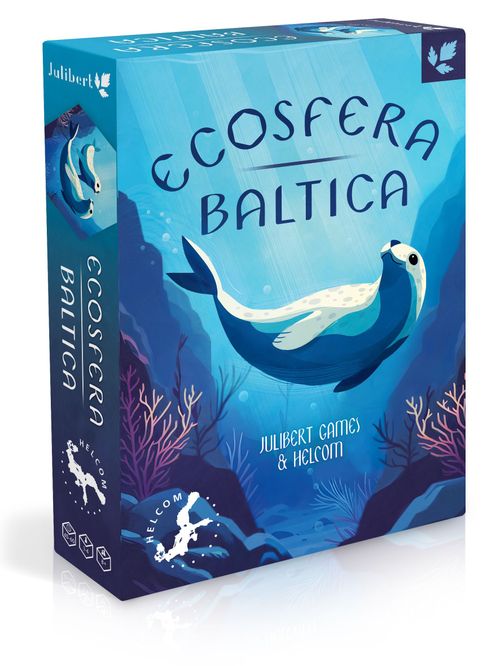
Ecosfera Baltica
Ecosfera Baltica Rulebook
Table of Contents
Table of Contents
Components
- 60 Element cards (12 of each: Sunlight, Oxygen, Salinity, Nutrients, Temperature)
- 6 Habitat tiles: Glacies (Ice), Lutosus (Mud), Flumina (River), Saxosus (Rock), Pelagicus (Water), Litoralis (Coast)
- 18 Water droplets
- 6 Impact tiles
- 12 Ability tokens (4 of each: Pass, Plus, Refresh)
- 50 Pressure cards
- 30 Producer cards
- 30 Consumer cards
Setting Up the Game
Market Area
Shuffle the Producer cards, place the pile face down on the board, and reveal the top four cards, placing them to the right of the pile. Do the same for the Consumer cards, placing this row above the Producer cards.
For the final, third row of the market area, place a stack of three to eight cards (depending on the chosen difficulty level—see Variations in Difficulty Level below) of each of the five elements face up on the board, below the Producer cards. This is your shared pool of resources for the duration of the game.
Start deck for each player:
- One of each Element card
- 2 Human Activities cards
- One of each ability token
Player Area
Each player shuffles the cards in their starting deck and places the deck face down in front of them. Place the three ability tokens face up on the left side of the deck.
Next, each player draws the top four cards from their deck and places them face up on the right side of the deck, side by side, to form their row of cards below the Producer cards. This is your shared pool of resources for the duration of the game.
Variations in Difficulty Level
The variations in difficulty level described here can be introduced individually or combined to create new and varied playing experiences.
Element restrictions. The number of Element cards placed in the market area can be adjusted to change the difficulty level. For an easy game, use eight cards of each element; for an advanced level, use only three. Any number from three to eight can be used. This variation reflects the differing availability of natural resources within an ecosystem.
High levels of pressure. Reflect the current situation for the Baltic Sea by starting with a higher number of Pressure cards in each player's deck. The whole sea is just one stroke of bad luck away from being irreversibly impacted!
The number of Pressure cards placed in the starting decks can be adjusted to change the difficulty level. For an advanced game, include three Pressure cards in each player's starting deck. If a player ends up with three Pressure cards in their row during the initial setup phase, remove the row, reshuffle their deck, draw four new cards, and place them in the row.
Eutrophication scenario. Eutrophication is one of the main pressures affecting the Baltic Sea ecosystem. It is caused by too many nutrients (nitrogen and phosphorus) entering the sea, creating an imbalance in the ecosystem. By introducing more nutrients into the deck, you can simulate the effect of eutrophication.
Players add two extra Nutrient cards into their starting deck (for a total of three Nutrient cards). This increases the likelihood of a "eutrophication scenario". If a player ends up with three of the same element in their row at once, they must immediately add another Pressure card to that row and end their turn (see Pressure Cards and Impact Tiles in the gameplay section).
Loss of biodiversity. If the ecosystem loses key species, its functionality becomes impaired and restoration efforts become much more complicated. Zooplankton, like Calanoida, play a key role in many marine food webs. They feed on algae and are a major food source for fish. To represent this in the game, Calanoida is the consumer with the most habitat symbols.
What would happen if the loss of biodiversity impacted such a cornerstone species in the Baltic Sea food web? How much more difficult would it be to achieve a healthy balance in the environment?
To simulate this, remove the Calanoida card entirely from the game before you start.
Complexity Levels
The game has two levels of complexity.
Level 1 focuses on ecological interactions and the pressures that human activities place on the sea.
Level 2 introduces a deck of Policy cards into play, which represent policy decisions, stochastic events, and funding. These cards alter the rules and introduce both positive and negative changes into the game.
The game can be played with or without the Policy cards. See Introducing Policy, Funding and Star Symbol (Level 2 Complexity) below for rules for including the Policy cards.
Note that while the game is language independent at complexity level 1, the Policy cards used at complexity level 2 are available only in English.
Gameplay
Ecosfera Baltica is a cooperative, turn-based deck-building game for two to four players (a solo mode option is also available).
The aim of the game is to save the Baltic Sea by restoring all six unique habitats (represented by the different coloured habitat tiles) before accumulating six impacts, which would irreversibly damage the ecosystem (represented by the grey impact tiles).
As players take actions—acquiring producer and/or consumer cards from the market, and/or securing habitat tiles—the state of the sea progressively improves. Players can cooperate and improve their chances by using their abilities.
On each turn, a player can perform as many actions as they wish, potentially acquiring multiple cards. However, each card in a player's row can only be used for one action per turn. The abilities on a card (indicated by symbols—see Abilities and Other Symbols below) are separate from the actions and can still be used even if the card has already been used for an action during that turn. If a card has multiple abilities, only one ability can be used each turn.
The players win the game as soon as they place their sixth unique habitat tile. Conversely, the players lose the game as soon as they place their sixth impact tile.
The game can also be played solo. In this version, the player opens an additional (or more rows) and cooperates across these rows, following the rules outlined for a multiplayer game.
Who Starts the Game?
The player who most recently had a dip in the sea starts the game. Turns will proceed in a clockwise direction.
Obtaining Producer Cards and Additional Elements
Producer cards have two or more different element symbols at the bottom, which represent the elements required to acquire the card (i.e. the cost of the card). At the top, Producer cards feature one or more different coloured symbols, representing the habitat(s) that these plant and algae species help to create.
Each player should check the Element cards in their row and compare them to the cost of the Producer cards in the market. If they have the required elements to acquire a Producer card, they can take it from the market and add it into their row during their turn.
If a player is missing only one element needed to acquire a desired Producer card, they can check the market for that missing element. If the needed element is available, they can add it to their row and use it to acquire the Producer card of their choice.
The elements added this way become part of their deck, while decreasing the available elements in the shared market. A player can only add an element to their row in this way if they immediately use it to acquire a Producer card.
When acquiring a Producer card, a player must indicate which Element cards in their row were used for the action. This can be done by moving them slightly upwards on the table. This helps ensure that players do not use the same cards for more than one action during the same turn.
Newly acquired Element and Producer cards are immediately active in a player's row during the turn they were acquired. They can be used for further actions and/or for their abilities.
After a player acquires a Producer card from the market, they must immediately refill the empty space in the market by drawing a new card from the top of the Producer card deck.
Obtaining Consumer Cards
Consumer cards feature different coloured symbols at the bottom, which correspond to the same symbols found at the top of the Producer cards. These symbols indicate the habitats where these animals live.
If a player has two Producer cards in their row that share at least one shared habitat symbol, they can use these cards during their turn to acquire a Consumer card from the market that matches the shared symbol. Consumer cards often have multiple different habitat symbols, but they can be acquired as long as two Producer cards share at least one of those habitat symbols.
For example, if the Consumer card a player wishes to acquire has both mud (red) and river (yellow) symbols, they can acquire the card if they have either two Producer cards with a matching mud (red) habitat or two Producer cards with a matching river (yellow) habitat. The two Producer cards must share at least one habitat symbol; they cannot be combined if they do not share a common habitat symbol, even if a Consumer card has a habitat represented on both Producer cards. This means a player cannot acquire a Consumer card if one Producer card has a mud (red) habitat and the other has a river (yellow) habitat, as the two habitats are not shared between the two Producer cards.
When acquiring a Consumer card, a player must indicate which Producer cards in their row they have used for the action. This can be done by moving them slightly upwards on the table, ensuring that the player does not use the same cards for more than one action during the same turn. The ability symbols on a card can still be used, even if the card has already been used in an action during the turn. If a card has multiple abilities, only one ability can be used per turn.
Newly acquired Consumer cards are immediately active in the player's row during the turn they were acquired and can be used for actions and/or for their abilities.
Obtaining Habitat Tiles
If, during a player's turn, they have two Consumer cards in their row that share one or more of the same habitat symbol(s), they can use these cards to acquire as many habitat tiles as the two Consumers have in common.
When acquiring habitat tiles, a player must indicate which Consumer cards in their row they have used for the action. They can do this by moving those cards slightly upwards on the table. This step ensures that a player does not use the card for more than one action during the same turn.
The ability symbols on a card can still be used, even if the card has already been used for an action during the turn. If a card has multiple abilities, only one ability can be used per turn.
The acquired habitat tiles are placed at the top of the playing space, forming a star-shaped puzzle around the central placeholder tile.
If a player has three Consumer cards with different matching habitat symbols in their row at the same time, they must choose which two cards to use based on their shared habitats, as each card can only be used once per turn.
Pressure Cards and Impact Tiles
If a player cannot acquire a Producer or Consumer card from the market, or place a new habitat tile during their turn, they must add a new Pressure card to their row before discarding their cards at the end of the turn.
If, as a result of adding the new Pressure card, or at any other time during their turn, the player has three Pressure cards in their row, they must place an impact tile at the top of the playing space, around the respective central placeholder tile, and immediately end their turn.
A player must also add a new Pressure card to their row if, at any point during their turn, they have three Element cards of the same type in their row. Adding a new Pressure card to their row automatically ends their turn, even if it does not result in an impact tile.
If a player starts their turn with three Pressure cards already in their row, they do not take a fourth Pressure card from the market. The player's turn is simply terminated as soon as it begins, and an impact tile is placed. If a player starts their turn with four Pressure cards in their row, their turn is terminated immediately, and three impact tiles are placed instead of one.
Abilities and Other Symbols
Each player has access to three different types of in-game abilities during their turn. These abilities allow players to affect the game outside of the regular actions they take to secure cards or tiles. The three abilities are as follows:
- Pass ability: This allows a player to move an unused card from their row to another player's row, or to recycle an unused Element card by taking it from the player's row and returning it to the market. A player cannot pass cards they have already used for an action during their turn, nor can a card with a Pass ability symbol be used to pass itself.
- Plus ability: This allows a player to lift the top card from their deck and add it to their row. If this results in a third Pressure or a third Element card of the same type being added to their row, the respective rules are activated immediately.
- Refresh ability: This allows a player to refresh the Producer cards OR the Consumer cards in the market. Discard the cards from the chosen row, replace them with new cards from the top of the respective deck, and place the discarded cards under the same deck. The deck is not shuffled and is returned to its place.
Each player has three ability tokens, one for each of the three abilities (Pass, Plus and Refresh). These tokens can only be used once per token. After use, they are turned over and remain inactive until reactivated.
Any time a player starts their turn with two Consumer cards in their row that share a habitat symbol, they can immediately reactivate one of their ability tokens, placing it face-up again. The player can choose which token to reactivate. Reactivating a token does not count as using the Consumer cards, nor does it count as an action that would prevent the player from receiving a Pressure card at the end of the turn.
Some Producer and Consumer cards also have these same ability symbols (located in the upper right corner). At any point during a player's turn, if a card with an ability symbol is in their row, they can use it as an extra ability token in line with the general rules. The ability symbols on a card can be used even if the card has already been used for an action during the turn (e.g. to acquire another card or habitat). However, if a card has multiple abilities, only one ability can be used during each turn.
To keep track of which cards have been used for their abilities, players can place water droplet markers over the ability symbols on their cards. At the end of their turn, when a player discards their row, the water droplets are removed. Each time a card with abilities is added to a player's row—whether from their own deck, the market, or another player's row—its abilities are available to be used again during their turn.
There is no limit to how many separate abilities a player can use during their turn, as long as the rules mentioned are followed.
NOTE: using one or more abilities during a player's turn does not count as an action. Therefore, it does not prevent the player from receiving a Pressure card at the end of the turn if they were unable to acquire a Producer card, Consumer card, or habitat tile.
Other symbols. A small number of cards include a star symbol at the top. This symbol is not an ability but refers to an additional game feature introduced in the more complex version of the game (see Introducing Policy, Funding and Star Symbol below). It is not relevant when playing at the lower complexity level.
Some cards may have a magnifying glass symbol. This indicates that the species represented on the card is microscopic and has no impact on the gameplay.
End of Turn
Once a player cannot or does not wish to take further actions or use more abilities, they collect all the cards from their row, both used and unused, and place them together on the right side of their row to form a face-down discard pile.
Next, the player immediately draws four new cards from the deck to form their new row. If the supply deck has fewer than four cards remaining, the player adds all the remaining cards to their row, shuffles the discard pile, and places it as their new supply deck. The player continues drawing cards from the new deck to complete their row.
At this point, it will be the next player's turn, and the current player cannot take any more actions until it is their turn again.
Introducing Policy, Funding and Star Symbol (Level 2 Complexity)
The overall setup and gameplay remain the same, with the exception that the Policy card deck is introduced into the market area, and the star symbol on some of the Producer and Consumer cards comes into play.
The Policy cards reflect four categories:
- Negative (10 cards, indicated by purple colour and a symbol): These cards introduce negative effects that impact the gameplay.
- Dual (5 cards, indicated by green colour and a symbol): These cards can have either a positive or negative effect, depending on the context and the cards in play when the card is drawn.
- Positive (Measures) (10 cards, indicated by blue colour and a symbol): These cards provide beneficial effects to the game.
- Funding (5 cards, indicated by turquoise colour and a symbol): These cards represent financial resources needed to activate certain positive measures.
Negative and Dual Policy cards take effect immediately when lifted.
A Positive measure card requires the player to combine it with a Funding card to activate the benefit presented on the card. This reflects the fact that positive management and restoration of the sea require financial support. Each Funding card can only be used once, meaning there are often more positive ideas than can be financially implemented.
Some Policy cards are applicable for a single turn or round, while others apply for the entire game. The duration is indicated on the card using symbols.
Playing with Policy Cards
At the start of the game, shuffle the Policy cards and place the deck face down next to the market area.
Policy cards can enter play in two ways during the game:
- Activation of the star symbol: When a Producer or Consumer card with a star symbol is in a player's row, they can choose to activate the Policy card by drawing the top card from the Policy card deck. This does not count as an ability, meaning that the player can still use any ability symbols on the card during the same turn.
- Placement of habitat or impact tiles: Any time a player places a habitat tile and/or an impact tile, they must draw a Policy card from the top of the Policy card deck. If they place more than one habitat or impact tile during their turn, they must draw the corresponding number of Policy cards.
Whenever a Policy card is drawn from the top of the deck, the card text must be read out loud. If the required reaction is immediate, the card's instructions must be carried out before any further actions are taken. Cards that remain active throughout the game are retained face up next to the market to serve as an ongoing reminder. Cards that apply for only a single turn or for a round are placed in a Policy card discard pile once their effect expires.
Measure and Funding cards are collected jointly by all players and are placed face up next to the market area. Any player can combine a Funding card with a Measure card during their turn if both are available during their turn regardless of who originally drew the card. The combination must be agreed upon by all players, emphasizing the cooperative nature of the game. Smart coordination in using measures and funding is essential to improving the state of the ecosystem.
Background
The designers' credits, the publisher and funding attributions, and the artwork and layout credits from the rulebook's background section are not reproduced here.
What Is the Baltic Sea Marine Environment Protection Commission?
The Baltic Marine Environment Protection Commission – also known as the "Helsinki Commission" or "HELCOM" – is an intergovernmental organization (IGO) established in 1974. It includes all the coastal states around the Baltic Sea and the European Union.
HELCOM's work focuses on the protection and sustainable use of the Baltic Sea and the HELCOM Secretariat facilitates the regional work of several thousand scientific and policy experts. HELCOM carries out regional assessments of the Baltic Sea's health and develops recommendations for best practices and solutions to improve and maintain its health, working closely with other European and international processes.
Why Did We Make This Game?
Firstly, we hope the game is simply fun to play!
If, while playing, we can grab your imagination and get you excited, because of the artwork, because a species intrigues you, or because you want to understand more, then even better. Should this result in people feeling engaged with and a little more empathetic towards the sea then even better, as what you see in the game is only a tiny glimpse of what is out there in the Baltic Sea. Moreover, maybe it can help us remember that our activities as humans can have both positive and negative impacts on this ecosystem and most importantly of all, that we are part of that ecosystem and rely on it in so many ways, both as people and as a society.
If you have questions do feel free to contact us and we will try to answer you or put you in contact with an appropriate expert.
The Science Behind It
The Baltic Sea is one of the largest brackish water seas in the world. It is connected to the North Sea by a narrow channel located in the southwestern part and stretches across a wide range of latitudes. These natural conditions create a complex ecosystem with large gradients in factors such as temperature and salinity. Other factors such as freshwater run off, rainfall, and inflows of salt water from the North Sea, also influence salinity and oxygen conditions.
These conditions also have a distinct influence on the species that live in the Baltic Sea and how they are distributed across the region. Geologically, the Baltic Sea is relatively young, having formed after the last ice age, which also influences its biodiversity. While there are relatively few species present, around 5,000, some species have been present since the last ice age.
The base game is built on real ecology, even though it presents a simplified version of the Baltic Sea ecosystem and includes only 60 species. All featured species are found in the Baltic Sea, and care has been taken to ensure that the elements and habitat depicted on each card reflect the ecological realities of each species.
For example, a species with a large number of temperature elements marked on it may respond strongly to temperature or have its distribution influenced by it, and the assignment of habitats per species suggests that the species is found in or plays an important role in that habitat. The selected species represent different components of the Baltic Sea food web, illustrating the complex interactions between the 5,000 species in the Baltic Sea as they grow and feed, transferring energy and nutrients up the food chain. These food chains may be relatively simple and efficient, such as phytoplankton being eaten by zooplankton that are then eaten by fish, and finally eaten by humans or seals; while others can be extremely complex.
As part of the project, we have developed some initial educational material should it be of value to interested persons or educational institutions. This also includes an overview of the species and their names in national languages. During the development process, we have also been contacted by a number of organizations with an interest in the educational angle. We provide links to relevant material for organizations interested in more information.
The Logic Behind the Policy Cards (Level 2 Complexity)
HELCOM carries out regional assessments every six years to evaluate the health of the Baltic Sea environment and the pressures on it. Sadly, there is a general trend in the results of these assessments showing poor health for many biodiversity components or ecosystem functions as a result of human activities creating pressures that are too high. However, we also know that by balancing our activities, we can limit pressures on the sea and, where needed, we can also set about restoration to recover damaged parts of the environment. So human interactions with the sea can be positive, negative and simply neutral or sustainable. This is a key factor to remember as we must not forget that humans are part of this ecosystem and rely on it for many things, be it food, recreation, or less obvious factors such as global temperature and oxygen regulation.
The expansion pack has been developed to more strongly reflect the human link to the sea, as well as to include other key aspects from a global or management perspective. For example, the cards in the expansion pack reflect the consequences of environmental policy and management, accidents, inputs of nutrients or contaminants, and climate change. They also reflect management responses that would be used to try and prevent impacts and maintain a healthy and sustainably used Baltic Sea. However, to reflect the fact that positive environmental management requires funding, the expansion cards that are positive also need to be paired with a funding card from the expansion pack.
You Can Also Play the Digital Version
The Ecosfera Baltica game has also been developed into a digital resource that is free to play. The game has been coded so that the rules are built into the mechanic, and players can sit around a computer or pad and play together (e.g., as a resource for events or schools). The digital game was developed under the Play-ducate project. A link to the digital game can be found at the QR code in the publisher's rulebook.
We hope you enjoy and join us in saving the unique and beautiful Baltic Sea!
Species Included in the Game
The following table provides a list of the species included in the game. The general group the species fall into, the scientific names, and where available, the common names are provided. This reflects only a small proportion of the real biodiversity present in the Baltic Sea but aims to introduce some iconic species as well as other less well-known species (or groups), all of which have key roles in the ecosystem and reflect a simplified food web. Where possible, the species common names in other languages are also provided in the online reference material at the QR codes.
Scientific and common names are reproduced as printed in the rulebook, including its spellings.
| General group | Scientific name | Common name |
|---|---|---|
| Mammals | Phocoena phocoena | Harbour porpoise |
| Mammals | Halichoerus grypus | Grey seal |
| Mammals | Pusa hispida | Ringed seal |
| Mammals | Lutra lutra | Otter |
| Birds | Haliaeetus albicilla | White-tailed eagle |
| Birds | Larus fuscus | Lesser black-backed gull |
| Birds | Somateria mollissima | Eider duck |
| Birds | Alca torda | Razorbill |