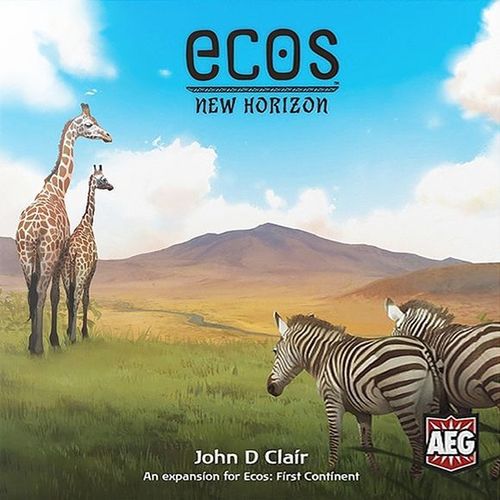
Ecos: New Horizon
Ecos: New Horizon Rulebook
Table of Contents
Table of Contents
Components
This expansion contains:
- 6 Landscape Feature tiles
- 32 Game cards
- 6 Animal token reference cards
- 6 Energy cubes
- 1 Mount Kilimanjaro token
- 46 Animal tokens and 1 storage container
How to Play with the New Content
If you are drafting, draft normally as detailed in the Ecos: First Continent rule book. Shuffle the new game cards into their respective decks prior to the draft.
If you want to learn to use the new content with pre-made starting hands (see Ecos: First Continent rule book page 4), then two additional sets have been added to this expansion, using the following symbols:
- Baobab
- Acacia
Landscape Features
New Horizon introduces new cards that add Landscape Features to the game.
Landscape Feature cards differ from other cards in Ecos and are played using different rules. They are not played from a player's hand to their tableau like normal cards and they do not require Element tokens to activate.
After a player has finished resolving all the "ECO" effects from their own cards, and a pattern of tiles and/or tokens on the landscape matches the entire pattern criteria on a Landscape Feature card, they may immediately declare that card and place it into their tableau from their hand.
Where a Landscape Feature card has a map tile icon (the land-tile icon, which shows a desert and grassland hex) in its pattern criteria, it means that the tiles in the pattern only have to be land tiles, they can be either desert or grassland.
When a player declares a Landscape Feature card, they immediately take the Landscape Feature tile and place it over the corresponding map tiles indicated on the card.
The Landscape Feature tile does not destroy any tokens on the map tiles it covers, so carefully remove the tokens, and then replace them in the corresponding position on the new feature tile.
NOTE: In the case of Kilimanjaro, the mountain meeple also replaces all of the mountain meeples that were previously there, so in this case they are removed. Kilimanjaro counts as all 3 mountains for game purposes.
Sometimes a Landscape Feature's pattern will be created by other players, rather than by the player holding the card. If this happens, after all other players have finished resolving their "ECO" effects from the Element token drawn, the player may declare and play their Landscape Feature card and tile.
In the very rare circumstances that more than one player wishes to play a Landscape Feature tile in this way, then this happens in clockwise order, starting with the Harbinger, as per other placements. It is possible that this could result in a player not being able to play their card if the two features would overlap.
NOTE: The actual Landscape Feature tile will sometimes not exactly match the whole pattern criteria. The Nile tile is only the "river" element of the pattern and the Madagascar tile is only the "island" element. In the case of Kilimanjaro it is both a tile and a wooden token.
NOTE: In some cases the pattern criteria explanation will indicate that the tokens required are "at least", or "or more". In these cases the Landscape Feature can be played if the number is more or less than the number (as indicated on the card). If these terms are not used then the pattern must match exactly. If a type of token is not indicated on the card then it does not matter whether it is there or not. So animal tokens will not affect placement of a Landscape Feature tile, neither will tree or mountain tokens, unless they are specifically indicated to do so.
Once a Landscape Feature tile is in place it cannot be removed or moved, although tokens on it can be. Cards that remove or move map tiles will not affect a Landscape Feature. The mountain meeple of Kilimanjaro also cannot be moved or removed.
A Landscape Feature tile can never be placed such that it overlaps with a previously placed Landscape Feature, although it can be adjacent.
Each hex on the Landscape Feature counts as a normal land or water space for game purposes other than for moving and removing tiles, e.g. movement, space-counting, token placement, and so on.
For example, the 3 edge hex spaces of the Serengeti could be counted as normal grassland map tiles to form the banks of the Nile for the purposes of meeting the pattern criteria of the Nile Landscape Feature card, resulting in the two features being adjacent.
Landscape features have a range of rewards. Some provide VPs immediately, others provide ongoing benefits such as VPs, or resources, and some provide VPs at the end of the game. Each is described in the benefits section of each card.
Landscape Feature Cards
The sheet prints each Landscape Feature card with a title, a pattern criteria drawing (black line), a feature tile shape (red line), and a benefit. The pattern drawings are shown on the card and are not reproduced here; the text of each card is given below.
Madagascar
Pattern criteria and feature tile shape: as drawn on the card (black line for the pattern criteria, red line for the tile shape).
Card text:
Up to 4 of the water spaces may be the edge of the landscape instead of water.
Gain 3 victory points when placed.
Gain 2 victory points each time a token is placed on or adjacent to the Madagascar tile.
Card number: 123.
The FAQ below explains what counts as the edge of the landscape.
Serengeti
Printed text:
SERENGETI
River (indicator on the card)
Contains 0 or 1 Forest and 0 Mountain.
Gain 1 victory point when placed.
Gain 1 victory point each time an animal is placed on the Serengeti tile.
Gain 1 victory point each time an animal on the Serengeti tile moves.
Card number: 121.
Nile River
Pattern criteria: as drawn on the card, with a "River" indicator pointing at the water spaces.
Card text:
NILE RIVER
River (indicator on the card)
Gain 2 victory points when placed.
Gain 1 [icon not legible on the scan] each time an animal is placed in the habitat containing the Nile River tile, or each time a [icon not legible on the scan] is placed as part of the habitat containing the Nile River tile.
Card number: 120.
The Nile tile is only the "river" element of the pattern (see the note under Landscape Features above).
Unnamed card 111
The sheet shows this card with a zebra icon and a red down arrow, and its title bar is not printed. Its printed text:
Move all Zebra 0 or 1 space.
Gain 2 victory points per animal type that shares a space with a zebra (including other zebras).
Gain [Water element icon] [Sun element icon].
Card number: 111.
Animal Token Reference Cards
The sheet includes six Animal token reference cards titled "Placing Animal Tokens". They restate the placement rules for animal tokens:
- A Green Tab means you must place this animal token onto a Grassland tile.
- A Blue Tab means you must place this animal onto a Water tile.
- A Brown Tab means you must place this animal onto a Desert tile.
- Multiple Tabs means you must place this animal onto any of the indicated type of Map tiles.
- Gorillas don't care about the type of Map tile. Instead they can only be placed on Map tiles that have a Mountain.
- Leopards don't care about the type of Map tile. Instead they can only be placed on Map tiles that have at least one Forest.
FAQ
The mountain meeple for Kilimanjaro covers the 3 spaces of the Landscape Feature tile. Is it 1 mountain or 3?
Kilimanjaro counts as 3 mountains, 1 in each space. Each space on the Landscape Feature tile can hold an additional forest token as though there were a mountain in that space, as normal. When considering a mountain habitat, Kilimanjaro counts as a habitat of 3 mountains, which could be part of a bigger mountain habitat.
I declared "ECO" on my turn, and created a landscape that let me play Kilimanjaro. The player that declared "ECO" after me placed a mountain, meaning I gained [element icon: three-circle cluster] and [element icon: concentric rings]. This filled another of my cards, when do I resolve my second ECO?
Players continue resolving in turn order until it comes back round the table to you.
Do I score VPs when animals outside the Serengeti move into or across it as part of a move?
No. Regardless of the number of spaces moved the Serengeti only scores when the move began in the Serengeti itself. By the same measure a move that began inside the Serengeti, but ended outside of it, will score.
When I place the Serengeti tile, do I get VPs for putting any animals back onto it that were in the habitat before it was placed?
No.
What does "The Habitat containing the Nile River" mean?
Once placed, the Nile tile is a water habitat of three spaces. Any other water tile that is connected to it by a continuous group of water map tiles is part of that habitat.
What is the edge of the landscape mentioned on the Madagascar card?
A tile is on the edge of the landscape if it is not completely surrounded on all 6 sides.
I have an effect that says to gain a card and then play it. What happens if that card is a Landscape Feature, where the pattern criteria has not been met?
Reveal the Landscape Feature card, note to all players that you cannot play it, and then add it to your hand.
Transcriber Notes
The following are transcription conventions and gaps, not rules.
- The cards print the gain for victory points as a red spiral symbol. The sheet does not name it, so it is written as "victory points" here. This is an inference from the card text (for example, the Madagascar card's "Gain 3 ... when placed"), not a stated icon key.
- Where an icon on the printed sheet could not be read, the position is marked "[icon not legible on the scan]" rather than guessed.
- The two element icons in the Kilimanjaro FAQ are identified only by their shape, since the sheet does not name them in the text.
- The sheet's customer-service contact and copyright/trademark lines, and its credits, are not transcribed.