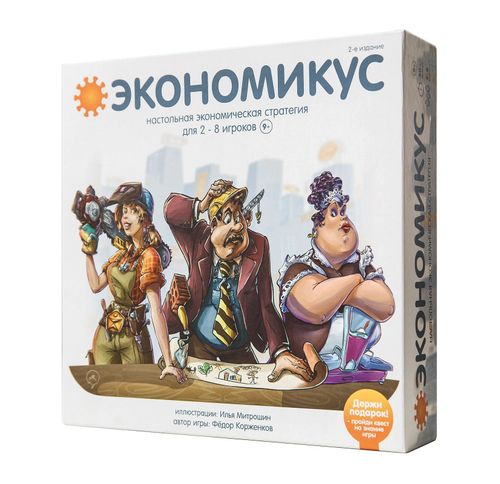
Economicus
Economicus Rulebook
Table of Contents
Table of Contents
- Components
- Quick and Full Rules
- Field Layout
- Prepare the Game
- How to Win
- The Main Rule: Earning the Reputation Stars
- Start the Game
- Any Time Actions
- The Turn
- Phases 1 and 2 are played with concerning to the active and its neighbour industries
- Phases 3 and 4 are played only with respect to the active industry
- Completion of the Turn
- Rules Details
- Tips
- Comments on the Rules
- Alternative Rules
Components
- Central element of the playing field
- Segments of the playing field: x10
- Active Industry Token
- Reputation Stars: x50
- Chips of players' companies: x12 x8
- Players' startup chips: x3 x8
- Coins: x100
- Crisis forecast token: x1
- Tokens of crisis strength: x4
- 6-faced dice: x2
- Erasable markers with an eraser: x2
- Event cards (blue): x25
- Crisis cards (black): x8
- Option cards (orange): x79
- Active Player Token: x1
- Rule Book: x1
Quick and Full Rules
You can play by fast or full rules. Quick rules are suitable for a family game with children and to meet the game.
When reading quick rules, skip the green text.
Full rules: Green text refers to full rules - crises, loans, state companies, game cards with hostile takeovers and special rules for creating startups.
Field Layout
The industry number.
How often the industry should fall out in the game (shown by stars under the number).
Industry price field - write the price there with an erasable marker.
Profit of each company - the figure on the industry nameplate (shown as +2 in the figure).
Company owned by a player - a chip of that player's colour.
State companies not owned by players - the bottom-row fields marked with the bank symbol.
Private companies not owned by players - the bottom-row fields marked with the person symbol.
Prepare the Game
-
Make up the playing field - put the central element on the table and attach segments of industries in random order.
-
Study how industries look (fig.). In the 7th industry there are no companies, only startups could be created there, and the second industry is really unprofitable, this is not a misprint, it is the automotive industry.
-
Each player chooses the color of chips and receives 12 companies and 3 startups, as well as coins worth 20M.
-
Put the remaining coins and Reputation Stars in the center of the playing field.
-
Full rules: Among option cards (orange) find and give each player 1 special option card - the privatization quota (see fig.) and 2 random cards. Then all the option cards (orange) and crises (black) are mixed into one deck.
Full rules: The two decks are placed next to the field face down: event cards (blue) and mixed together option and crises cards (orange and black).
-
In the 7th industry next to the industry number the Active Industry Token Full rules: and the Crisis Forecast Token are placed. Using an erasable marker write down the value of 17 in a field of the industry price - the initial price in the innovation industry equals 17 coins. In other industries, initial prices are equal to their numbers. They may be written down later.
-
Define the first player by rolling the die - he receives the Active Player Token and starts the game. Turn moves clockwise between players.
How to Win
To win, you need to be the first, who collected the winning number of Reputation Stars:
- 2 players play the game up to 10 Stars;
- 3 - 4 players - up to 9 Stars;
- 5 - 6 players - up to 8 Stars;
- 7 - 8 players - up to 7 Stars.
The Main Rule: Earning the Reputation Stars
Players earn Reputation Stars not for the company, but for the industries where their companies are.
A player gets one Star when he has his first company in the industry - for presence, and the second Star, when he becomes the industry leader by the number of companies - for leadership.
Losing leadership or presence in the industry, the player loses the corresponding Stars.
Thus, Star chips of a player always reflect the situation on the playing field. Anytime you can count the industries where the player is present and the industries where he is in the lead.
Start the Game
Players place 2 of their company chips on the playing field - only in industries with white numbers (industries № 2, 3, 4, 5 and 6).
Do it in the following order:
-
the first player chooses and occupies one of any free companies;
-
the following players choose and take one company;
-
all players in the reverse order from the last player to the first choose and occupy their second company;
-
after placing companies, players receive their first Reputation Stars (see The Main Rule).
According to the quick rules, the state companies are considered as private and do not differ from them in any way. Full rules: By the full rules – occupying state company, player must discard the privatization quota card. It makes sense at the initial arrangement if all private companies are already taken in the chosen industry.
Players always keep open their chips, coins, received Reputation Stars and Full rules: privatization quota cards in front of themselves on the table. Full rules: Other option cards (except for quotas) should not be shown to other players.
Any Time Actions
It is important to remember that at any time of the game (and not even in your turn), players can:
- sell companies and drop startups;
- declare bankruptcy;
- Full rules: borrow and repay loans;
- Full rules: play option cards according to the text of the cards.
The Turn
The player who makes a turn (active player), rolls the dice. The sum on the dice determines the active industry. Place the Active Industry Token into the industry near to its number.
If the industry price field is still empty (the industry fell out for the first time) – the industry price equals to the industry number: write it in the price field.
Doubles or repeat of the industry
Full rules: Getting the same values on the dice or refalling number of the same industry means the end of the fiscal year in the game.
Full rules: At this moment:
- Full rules: all players pay an interest on loans;
- Full rules: all players are given one option card from the top of option cards deck. If there are the crisis cards on the top of the deck, they get opened and executed;
- Full rules: the top card from the event deck gets opened and executed.
Full rules: When there is the only card left in any deck, cards from the discard pile are mixed back into the deck.
Phases 1 and 2 are played with concerning to the active and its neighbour industries
Phase 1 – Companies profit
If there are players' companies in the active or neighbour industries, these companies bring profit (or loss), indicated on the nameplate of the industry, to their owners. Owners get profits from the bank.
Phase 2 - The fate of startups
If there are startups in the active or neighbour industries, players try to turn them into companies - see Startups Fate.
Phases 3 and 4 are played only with respect to the active industry
Phase 3 - Auction
If there are free companies (not belonging to the players) in the active industry, one of them is put up for auction and all players are trading for its purchase.
Full rules: The active player chooses which company is auctioned, state or private, if there is a choice. Only players who have a quota of privatization card can bargain for state company. The quota is discarded by the player who bought the state company.
The first bet is made by the active player - not lower than the price recorded in the industry, or he passes.
Next, all in their turns, players call their bets greater than named earlier or pass. The player who once passed can't then take part in this auction.
Full rules: Players can bid more than they have, but in case of victory in the auction, they must pay it - if necessary getting loans. If a player can't pay the bet, he is declared bankrupt, and the player who named the previous bet buys the company.
The player, who won the auction:
- pays the bet to the bank;
- writes the new industry price as the price for which the company was bought;
- marks the purchased company with his chip.
With emergence of new companies players can lose and receive Reputation Stars (see The Main Rule).
Phase 4 - New startups
All players can create one or more startups in the active industry - for half of the current industry price (rounding up). Startup is an attempt to create a new additional company in the industry. The startup does not bring profit and does not affect Reputation Stars until it becomes a full-fledged company. Full rules: However, you can take a loan for a startup.
The procedure for creating startups:
-
players place their startup chips on the top of the industry field (without taking up the layout of free companies);
-
the cost of startups is paid to the bank.
The order does not matter. After the creation of startups by everyone who wanted to, the industry price is updated: + 2M for each new startup.
Completion of the Turn
-
If no one has bought the company at the auction or created a startup, price of companies in the industry falls by 3M, but not lower than 1M.
-
The player passes the active player token and dice to the next player (clock-wise), and the next player starts a new turn.
Rules Details
Further rules can be read in the way of the game.
Startups Fate
For each startup in the active and neighbour industries its fate is determined by rolling the die by the owner of the startup. The first one to decide the fate of his startups in these industries is the active player, then turn goes clockwise.
When playing by fast rules, you need to just roll 5 or 6 on the die to turn startup into a company.
Full rules: When playing by full rules, the player rolls the die and applies the following modifiers to it:
Full rules: 1) a penalty of -1 for each player's company in the same industry and a bonus of +1 for each player's company in the neighbour industries;
Full rules: 2) the player can get an additional bonus of +1 for each discarded option card (the quotas can also be discarded)
Full rules: If the total is 7 or more, then the startup successfully turns into a company.
Turning a startup into a company, a player removes a startup chip and places a company chip in the bottom of the industry. A company created from a startup does not take the mark of free companies - free companies can only be occupied through an auction.
With emergence of new companies players can lose and receive Reputation Stars (see The Main Rule).
Sale of Companies
At any time except of the auction phase in any industry, players can sell their companies to the bank at half-price (rounded up).
After each sale of the company, the price of companies in the industry falls by 3M, but not below 1M.
As a result, players can lose and receive Reputation Stars (see The Main Rule).
Full rules: In case of a sale of a company with a loan, the player must repay the loan immediately after the company is sold.
Bankruptcy
Each player, if he considers his situation hopeless, can declare himself bankrupt. In this case, the player:
- satisfies financial claims of other players, if necessary, selling his companies at half-price;
- removes his companies and startups from the field (while others can get stars for leadership), discards his Stars, cards and coins;
- at the beginning of the next turn comes into play anew: gets 20M, a privatization quota + 2 random option cards, places 2 of his companies in industries with white numbers, gets his first Stars. If all private companies in industries with white numbers are already occupied, the player places his companies as additional in any of these industries.
The same way new players can join the already-running game, with the consent of all players.
Loans
Full rules: At any time, players can take loans under pledge of their own companies and even startups - the player turns over the chip of the company / startup and gets 5M from the bank.
Full rules: A Loan is of unlimited duration, an interest on the loan - 1M.
Full rules: A company with a loan remains a full-operating company - it generates profits and is taken into account in determining Reputation Stars owed to the player.
Full rules: To repay the loan, the player returns the taken amount and interest, that is 6M, and turns the chip of the company / startup back. If the player repays the loan immediately after paying the interest at the end of the fiscal year, then the interest is not to be repaid.
Full rules: A startup with a loan, if successful, turns into a company with a loan. To drop a startup with a loan, you need to repay the loan first.
Option card
Full rules: Players receive option cards at the start of the game and then with every new fiscal year.
Full rules: Option cards give special opportunities to influence the game and can be played at any time of the game according to the text on cards - on some cards limitations are written, such as when or in what industries they can be used.
Full rules: In addition to its direct purpose, option cards can be discarded to receive bonuses to the value on the die for the success of a startup or to influence the crime success.
Full rules: To play the card, the player announces this by stopping the game and reads out the text on the card.
Full rules: Some option cards are marked with a crime icon indicating its complexity.
Full rules: The example card printed in the original is Hostile Takeover (crime icon 6+):
Hostile Takeover
Takeover of someone else's private company, not necessarily owned by the players.
The card is played only in the active industry.
If the crime succeeds, the player who lost the company receives an option card as a compensation.
It is a crime. Playing this card you risk losing a Reputation Star.
Full rules: To play such cards:
Full rules: - the player declares that he is trying to commit a crime and reads the text on the card;
Full rules: - rolls the die for the crime success: if the value is equal to or greater than the complexity, the crime succeeds. Otherwise, the crime is considered a failure, and the player loses the Reputation Star.
Full rules: After the roll of the die the criminal and the victim can influence the result of the roll: +/-1 for each discarded option card.
Crisis
Full rules: Among the crisis cards, there is an equal number of crisis forecast cards and crisis point cards.
Full rules: When you open a crisis forecast card: the crisis forecast token is moved to the active industry and placed next to the industry number.
Full rules: When you open a crisis point card: the crisis begins or increases. Place the "-1" crisis strength token over the company's profit notation in the industry, where the forecast token lies. If there is already the crisis strength token, replace it with the next one more powerful ("-2", "-3", etc).
Full rules: When the crisis begins in a new industry, in any other industry the crisis ends (the token is removed).
Tips
Profitability of industries. The background color of industries on the playing field reflects their profitability considering the probability of an industry falling out. So the 12th industry, despite high profits of companies, is painted in a rather dark colour - because it is very rare – there is only one combination on the dice, which gives a total of 12.
Loans. Be cautious with excessive loans - if all of your companies have loans taken under their pledge, in addition to paying substantial interest, changes in economic situation can lead to your bankruptcy. However, reasonable borrowing will allow to you accelerate the development of your companies network.
Crises. You can predict the likelihood of crises by tracking out cards. The crisis that has started in the industry can be a convenient moment for buying companies at a low price, especially if there are a lot of forecasts in the deck or if you have a card that allows you to overcome the crisis. And vice versa - sometimes it is important to leave the unprofitable industry in time.
Purchase of state-owned companies. Use privatization quota cards rationally - without them you will not be able to participate in auctions for the purchase of state-owned companies, and someone can get one at a minimum price.
Combinations of option cards. Many game option cards and event cards can be especially effective in combination with other cards.
Exclusive offer. At the end of the turn after the auction, creating startups and updating the price, any player can make an exclusive offer to buy another player's company in the active industry for a double price. The owner of the company that received such an offer must either agree to sell the company or spend an amount equal to the company's price in order to keep the company himself (the amount is given to the bank).
At any outcome, the industry price doubles. In one turn, several exclusive proposals can be made, the price in the industry doubles after each such offer.
Related companies. Profits and determination of startups' fate occur in a chain of related industries and include an active industry, each of which has your company or startup.
That is, you generally do not make a profit, if you do not have any companies or startups in the active industry. If you have at least one company or startup in the active industry, then all of your companies bring profits to you from the entire "chain" of industries connected by neighbourhood, where your companies or startups are.
Comments on the Rules
If the price of companies in the industry is not written in the price field, the price is considered to be equal to the industry number.
If a player does not have free startup chips, he can not create new startups. Without free companies chips a player can not create a new company or buy it - in case of winning an auction the player must sell another company to release the chip.
With the sale of companies, fields of private companies should be cleared - as long as there are such fields occupied by players' companies chips. If necessary, move chips so as to free the layout of the private company. Occupied fields of state companies are released last, when there are no more companies left in the industry.
Sale, lending and transfer of coins, companies, startups and option cards between players are prohibited. You can agree that you allow certain types of transactions. This can lengthen the game.
A player is considered a victim if, as a result of a crime, the number of his companies, startups, coins, company profits or the amount of available loan is reduced.
Alternative Rules
If you are playing not for the first time, you can enter one or more of the following complications:
-
the game is played till a greater number of reputation stars;
-
a game with a time limit or number of moves limit: the player with the greatest number of Reputation Stars wins, and among players with an equal number of Stars - the player with the largest amount of net assets: the amount of coins + the sum of the values of companies at current prices in industries - the amount of loans taking into account interest.
You can also use the following special rules:
I'll take two! If a player is supposed to get an option card and he does not have option cards (and privatization quotas), player receives an additional card.
The unlucky startuper. If the player rolls a unit when rolling the dices for the success of a startup (editor's note: "a unit" is printed as in the source and is read as a roll of 1), the startup is burned and the player receives an option card as a compensation. Only game cards that affect the value of the dice can save the startup in this situation.