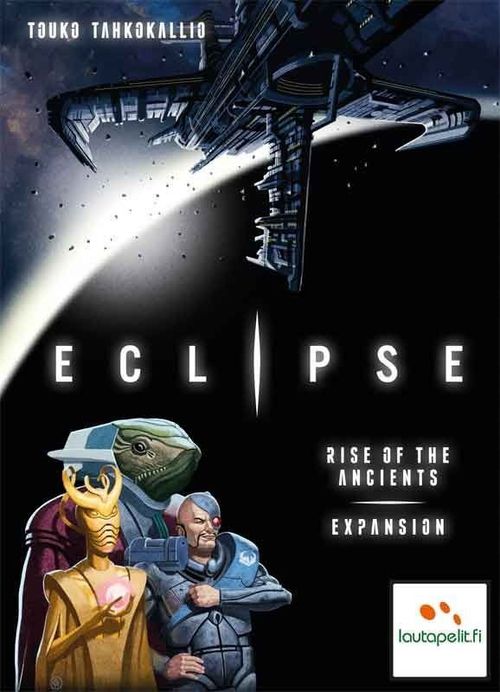
Eclipse: Rise of the Ancients
Eclipse: Rise of the Ancients Rulebook
Table of Contents
Table of Contents
Expansion Overview
This expansion introduces several new additions to the base game: Ancient Homeworlds and Hives, Ancient Cruisers and Dreadnoughts; Rare Technologies and Developments; Warp Portals and Alliances. There are also four new alien species to choose from – three unique ones and one identical species (The Magellan) on the flipside of the player boards.
The expansion is designed to be modular: you can use all of these additions or just some of them in any game of Eclipse, according to your play group's preferences and play style. Feel free to leave out even just single components you don't like.
The expansion contains components for additional players, allowing up to nine players in one session. To save your table space, the box also includes a Compact Supply Board that you can use instead of the original one.
Identifying expansion tiles: If you wish to separate the expansion tiles from the base game ones, the relevant tiles are marked with a small notch symbol on one edge.
Components
Player materials (in 3 player colors: natural, grey, magenta, one color for each player): 14 plastic spaceship miniatures (8 Interceptors, 4 Cruisers, 2 Dreadnoughts), 4 Starbase Tiles, 33 Population Cubes, 16 Influence Discs, 3 Ambassador Tiles.
Ship models and other pieces: 3 Starting Sector hexes (#233–238), 4 Ancient Homeworld hexes (#271–274), 3 Warp Sector hexes (#291, #393–394), 2 Ancient Hive hexes (#212, #319), 6 regular Sector hexes (#213, #320–324), 3 Player Boards, 1 Compact Supply Board (all two-sided).
Tiles: 10 Rare Technology Tiles, 18 Extra Technology Tiles, 8 Development Tiles, 9 Discovery Tiles, 8 Ancient Cruiser Tiles, 1 Ancient Dreadnought Tile, 9 Extra Reputation Tiles, 9 Colony Ship Tiles, 3 Summary Cards, 5 Info Cards, 1 Direction Card, 9 Alliance Tiles, 9 Shrine Tiles, 3 Shrine Bonus Tiles, 1 Warp Portal Tile, 1 Shellworld Tile, 72 Ship Part Tiles, 1 blank tile.
Miscellaneous: 9 Storage Markers (3 each in orange, pink and brown), 1 Prosperity Influence Disc (purple), 1 Primary Action Marker (pink), 1 Secondary Action Marker (dark grey).
The back page of the rulebook is a quick-reference card that repeats figures already given in the sections below; it is not reproduced here.
Rare Technologies
Rare Technology Tiles are acquired with the Research action. Some give you access to new Ship Parts, while some give new abilities. There is only one of each Rare Technology available (not including the species' starting Technologies).
Preparations: Place all Rare Technology Tiles in the Technology bag.
Drawing Technology Tiles: When drawing new Technology Tiles from the bag in the Setup or Cleanup Phase, place any Rare Technology Tiles you draw next to the Supply. They are ignored in the Technology Tile draw count, so always draw as many regular Technology Tiles as the base rules say.
Buying Rare Technologies: You may buy a Rare Technology Tile with the Research action, instead of a regular Technology Tile. The Rare Technology Tiles may be placed on any of your Technology Tracks. You get the discount on that track, just like with the regular Technologies.
You may not take a Rare Technology with the Ancient Technology Discovery.
Species starting Technologies: Some of the new species have Rare Technologies as their starting Technologies. They are not allowed to Research another copy.
New Ship Parts: Several of the new Rare Technologies allow you to take new Ship Parts with the Upgrade action.
- Interceptor Bay: Each Interceptor Bay Ship Part allows you to move up to two unpinned Interceptors in the ship bay with one Ship activation (see explanation under Ship Activation below). After each activation, one or more Interceptors may leave the Interceptor Bay and then be moved by themselves with further Ship activations. When moving Interceptors in the bay, they do not affect pinning. The Interceptors are unloaded from the bay at the end of the Move action. Interceptors are not allowed to have Interceptor Bays.
- Conifold Field: Creates a brane field, giving three Hull points and consuming two Energy.
- Sentient Hull: Part of the hull is constructed of a sentient semi-autonomous substrate that provides +1 Computer and one Hull point.
- Flux Missile: Two modified Ion Missiles capable of warping the flux grid, giving two Initiative.
- Zero-Point Source: Taps into the quantum ground state, providing 12 Energy.
The Rare Technologies:
- Antimatter Splitter: Allows you to split damage from Antimatter Cannons freely over several targets (including Missiles if you have the Point Defense Technology). You need to be able to hit all the targets with the die roll.
- Neutron Absorber: Enemy Neutron Bombs have no effect on you. Note: this does not affect Planta's species weakness.
- Distortion Shield: Enemy missiles have a –2 modifier to hit.
- Cloaking Device: Opponents need two ships to pin each of your ships.
- Point Defense: After your opponent has rolled and allocated the dice for Missiles of one Ship type, you get to fire all your Cannons once against the incoming Missiles before they hit your fleet. Each die that hits destroys a Missile. Your Computers affect the Point Defense, but your opponent's Shields do not.
- Conifold Field: Allows you to take Conifold Field Ship Parts.
- Sentient Hull: Allows you to take Sentient Hull Ship Parts.
- Interceptor Bay: Allows you to take Interceptor Bay Ship Parts.
- Flux Missile: Allows you to take Flux Missile Ship Parts.
- Zero-Point Source: Allows you to take Zero-Point Source Ship Parts.
Ship Activation
One Move action consists of several Ship activations. The number of arrows in your Move action symbol shows the amount of activations per Move. For each activation, you may move one Ship as far as its Drives allow.
Developments
Developments allow you to score points and boost your production. The Warp Portal creates a more open galaxy when combined with the Warp hexes.
The Developments:
- Ancient Monument: 3VP at the end of the game.
- Artifact Link: 1VP per Artifact at the end of the game.
- Diplomatic Fleet: You may place one Ambassador or Reputation Tile on top of this tile.
- Mining Colony: Immediately take 12 Materials.
- Research Station: Immediately take 12 Science.
- Trade Fleet: Immediately take 12 Money.
- Shellworld: Place the Shellworld tile on one of your controlled hexes. The Shellworld has a Science Population Square and is worth 5VP at the end of the game if controlled.
- Warp Portal: Place the Warp Portal tile on one of your controlled hexes. The Warp Portal (see page 8) connects to all other Warp Portals and is worth 1VP at the end of the game if controlled.
Preparations: Take random Developments (one more than the amount of players, to the maximum of 8, see below) and place them next to the Supply. Place the rest of the Development Tiles back in the box.
Development Tiles: 2 players: 3 tiles · 3 players: 4 tiles · 4 players: 5 tiles · 5 players: 6 tiles · 6 players: 7 tiles · 7+ players: 8 tiles.
Buying Developments: You may buy a Development Tile with the Research action, instead of a Technology Tile. The Development Tiles are placed next to your Player Board. Unlike the basic and Rare Technologies, the Developments are often paid with Resources other than Science. For example, the Research Station Development (above) costs 5 Money and 5 Materials.
Development Tiles are acquired with the Research action. Some of them are useful during the game and some give you Victory Points at the end of the game. All Development Tiles are unique.
Warp Portals
Warp Portals open up the galaxy, making it often possible to connect and move to the other side of the galaxy. This offers new options for both offensive and diplomatic strategies.
Overview: There are three Warp Sectors, one in the Middle (II) Sectors and two in the Outer (III) Sectors. Each hex contains a Warp Portal which connects to other Warp Portals.
Preparations: During the game setup, shuffle the Warp Sector hexes with the other Middle and Outer Sector hexes before building the hex stacks.
Rules: All hexes with Warp Portals are considered to be adjacent to each other and to have a full Wormhole connection between them. You may Move, Influence and form Diplomatic Relations through the Warp Portals.
Note that there are also Warp Portals in the new Developments and Discovery Tiles.
New Discoveries
- +3 Money, +2 Science, +2 Materials: move your Storage Markers and discard the tile.
- Ancient Warp Portal: place in the hex where found. The Warp Portal connects to other Warp Portals (see Warp Portals above) and is worth 2VP at the end of the game if controlled.
- Ancient Orbital: place in the hex where found. Note that the Orbital also contains an Artifact symbol.
- Jump Drive: with the Move action, you may move the Ship to any neighboring hex, regardless of Wormholes. The Jump Drive may be used once per Ship activation (see Ship Activation above). If the same Ship is activated more than once during the same Move action, the Jump Drive may be used during each activation at any time. The Jump Drive may be the only Drive on a Ship.
- Muon Source: the Ship Part is placed outside your ship blueprint grid.
- Morph Shield: after each Engagement Round, remove one Damage Cube from each Ship with this Ship Part.
- Ion Disruptor: this Ship Part provides the Ship with one Ion Cannon and adds three Initiative.
Running out of Discoveries: If Discovery Tiles run out, shuffle the discarded Tiles as a new Discovery Tile stack.
Movement example: Red's Cruiser is equipped with the Jump Drive and one Fusion Drive. It can thus move two hexes and make one jump with one activation. Red is playing the Magellan, so he has two activations per one Move action. He uses the whole Move action to move one Cruiser.
For the first activation, he first moves two hexes [1 & 2] and then jumps [3]. For the second activation, he moves one hex [4], jumps [5] and moves one hex [6].
New Ancients
New Ancients provide a military challenge. They require specialized Ship designs but give good rewards in return. The Homeworlds make the galaxy tighter as they block your expansion.
Ancient Homeworlds
Overview: With fewer than six players, the Ancient Homeworlds can be used to fill the empty Starting Sector places. Each Homeworld is guarded by a powerful Ancient Cruiser.
Preparations: Place a random Ancient Homeworld on each Ancient Homeworld place, according to the diagram below. Place a random Discovery Tile face down on each Homeworld and a random Ancient Cruiser face up on top of each Discovery Tile.
Diagram: Ancient Homeworld places and layouts for 5, 4, 3 and 2 players.
Rules: The Cruiser on the Homeworld must be destroyed before you may place the Influence Disc. When you destroy an Ancient Cruiser, keep the tile face down next to your Player Board. Each destroyed Ancient Cruiser is worth 1 Victory Point at the end of the game. Destroying Ancient Cruisers allows you to draw two Reputation Tiles.
Descendants of Draco: Following their own unfathomable logic, the Ancients do not tolerate even the Descendants of Draco in their Homeworlds. Contrary to the ordinary Ancient sectors, the Descendants of Draco must battle the Cruiser if they move to a Homeworld hex. Contrary to the basic Ancient Ships, the surviving Cruisers do not give the Descendants any Victory Points at the end of the game.
Galactic Center Takeover
Preparations: Before starting the game, place the Ancient Dreadnought in the Galactic Center hex instead of the GCDS, a randomly chosen side up.
Rules: The Ancient Dreadnought pins all Ships just like the GCDS. When you destroy the Ancient Dreadnought, keep the tile face down next to your Player Board. It is worth 1 Victory Point at the end of the game. Destroying the Ancient Dreadnought allows you to draw three Reputation Tiles.
Descendants of Draco: Contrary to the ordinary Ancient sectors, the Descendants of Draco must battle the Dreadnought if they move to the Galactic Center hex. Contrary to the basic Ancient Ships, a surviving Dreadnought does not give the Descendants any Victory Points at the end of the game.
Special Ancient Abilities
Some Ancient Cruisers and Dreadnoughts have new special abilities:
- Regeneration: After each Engagement Round, remove 1 Damage Cube from the Ship.
- Distortion Shield: See the Distortion Shield Technology on page 4.
- Point Defense: See the Point Defense Technology on page 4.
Ancient Hives
Ancient Hives are somewhat unpredictable in nature, creating unexpected situations and a new kind of tension.
Overview: There are two Ancient Hive hexes, one in the Middle (II) Sectors and one in the Outer (III) Sectors. Each hex contains three basic Ancient Ships that may move out of the hex to neighboring hexes.
Preparations: During the game setup, shuffle the Ancient Hive hexes with the other Middle (II) and Outer (III) Sector hexes before building the hex stacks.
Rules: Each Wormhole on the Hive is marked with a die result from 1 to 6. At the end of the Cleanup Phase, roll one die for each Hive. If there is an explored hex on the side indicated by the roll result, move one Ancient Ship to that hex. The Ancient Ships have Wormhole Generators, so they can move through half a Wormhole (see the example diagram on the Ancient Hive page).
The Ancients also have Neutron Bombs. Thus they will automatically destroy population at the end of the battle, just like the human players with the Neutron Bombs Technology. If the target has the Neutron Absorber Technology, the Ancients try to destroy the Population Cubes in this order: first Money, then Science, then Materials.
The Ancient Ships are always the defenders, even when they moved to another hex from the Hive.
Descendants of Draco: If the Descendants of Draco draw a Hive hex tile when Exploring, they must discard it and draw another one.
The Descendants may move to the Hive hexes and place an Influence Disc there but not collect the Discovery Tile if there are still Ancient Ships on the hex – just as with the ordinary Ancient hexes.
If the Ancient Ships move from the Hive to a hex containing the Descendants' Ships or Influence Disc, they will not battle the Descendants. Similarly, if an Ancient Ship moves from the Hive to an Ancient Homeworld, the Descendants may not have to battle it, only the Cruiser. Ancient Ships will never attack Descendants' population with the Neutron Bombs. Surviving Ancient Ships from the Hives give the Descendants Victory Points at the end of the game.
Alliances
Players may decide to join their efforts and found an Alliance. Allies may move in each others' hexes and they battle together against their enemies. At the end of the game, the Allied players will share their points and win or lose together.
Alliances create another layer of diplomacy. They are especially recommended if you enjoy fighting against a common enemy and plotting complex military campaigns.
Preparations: Alliances are not used in two or three player games. In the four and five player games, only two players may belong to the same Alliance.
Founding an Alliance: Two players, who have Diplomatic Relations with each other, may agree on founding an Alliance at any time during either player's action in the Action Phase. They both take an Alliance Tile of one yet unfounded Alliance (Nova, Vortex or Flare) and place them face up next to their Player Boards. In a game of six or more players, a third player may join the Alliance if he has Diplomatic Relations with either of the two Allies and if both founders agree. You can only be part of one Alliance.
Effects of the Alliance: The players in the same Alliance are not allowed to attack each other. They are allowed to move in and through their Allies' hexes. Allied Ships do not pin each other. They are added together when checking whether they are pinned by opponents.
- Combined battle: In combat, the players of the same Alliance battle together on the same side in the same battle, instead of fighting separate battles. If one of the Allies is the defender, all other allies are also considered defenders and win Initiative ties.
- Ancient targeting priority: If the Ancients have multiple similar targets (for example, their die roll allows them to destroy a Dreadnought from two different Allies), they attack the player who entered the hex last. Following the base rules, the Ancients will always try to destroy the largest Ship, or inflict as much damage as possible, regardless of the Ship owner.
- Reputation Tiles: All Allied players will draw Reputation Tiles for the battle and for the Ships they personally destroyed, in the order they entered the hex. You may show Reputation Tiles to your Allies, but do not have to.
- Influence priority: At the end of the Combat Phase, if several Allies are in a hex where an Influence Disc can be placed, the player who entered the hex first has the first priority to place the disc; if he doesn't want to, the player who entered next may place the disc, and so on.
Example: Green and Red are part of the Nova Alliance. Green has two Interceptors and Red has one Cruiser in a hex. Their opponent Blue has two Dreadnoughts in the same hex. Either Green or Red may still move one Ship out of the hex.
Leaving the Alliance: You can leave the Alliance during any of your actions in the Action Phase by flipping your Alliance Tile the Betrayer side up before taking the action. The other players in the Alliance keep their Alliance Tiles face up.
Leaving the Alliance does not affect your Diplomatic Relationships nor give you the Traitor Card. However, if you leave the Alliance while you have Ships in a hex with your former Allies' Ships or Disc, you are considered to have attacked them and receive the Traitor Card. You may not rejoin an Alliance you have once left.
Alliance Tile points: At the end of the game, a face up Alliance Tile is worth 2 Victory Points. An Alliance Tile with the Betrayer side up is worth –3 Victory Points.
Last round restriction: Alliances may not be founded or left on the last round of the game.
Scoring: At the end of the game, all players of the same Alliance will add up their points and divide them between the players (rounding down). They share the win if their score is the highest. For a possible tiebreak, their Resource totals are divided in the same way.
Example: Alastair, Iain and Ken form the Nova Alliance. At the end of the game they score 26, 44 and 30 points respectively. Their opponents Vernor, Isaac and Larry score 32, 31 and 30 points and are not allied. The Nova Alliance scores (26+44+30)/3 = 33 ⅓ → 33 points and enjoys a shared victory!
Descendants of Draco: If you're allied with the Descendants of Draco, you still have to battle the basic Ancient Ships. Your Descendant allies are not allowed to not battle them.
7–9 Player Game
Overview: In the 7–9 player game the players start from the Outer Sectors. It's also possible to use a simultaneous play variant (see Simultaneous Play Variant below) to speed up the game.
The 7–9 player game is meant for experienced players. The game is tighter and more unforgiving, but also allows for grander strategies and more intricate tactical situations.
Preparations: The setup follows the basic rules, with the following changes:
- Add the 18 Extra Technology Tiles in the Technology Tile bag and the Extra Reputation Tiles in the Reputation Tile bag.
- Build the Middle and Outer Sector stacks according to the number of players.
- Place the Inner (I) and Middle (II) Sector hexes face down in concentric rings around the Center. This will help you find the locations for the Starting Sectors (see the diagrams on the opposing page). Make note of the starting player sector location [1].
- The player on the right side of the starting player chooses a species and places their Starting Sector hex in the first Starting Sector location counterclockwise from the starting player's sector [2]. He may orient the hex freely, provided at least one of the wormholes on the hex is connected to a Middle Sector hex. Then the next player counterclockwise does the same, and so on. Finally, the starting player may orient his hex, following the same restrictions as the other players.
- Finally, each player removes one Population Cube from a freely chosen Population Track. The cube is removed from the game.
Cleanup Phase: The amount of new Technology Tiles drawn in the Cleanup Phase depends on the number of players (10 new tiles with 7 players, 11 tiles with 8 or 9 players).
Setup quantities (7–9 players):
- Extra Reputation Tiles: 2× 4, 3× 3, 2× 2, 2× 1 VP.
- Middle Sectors: 7 players: 12 · 8 players: 12 · 9 players: 12.
- Outer Sectors: 7 players: 22 · 8 players: 24 · 9 players: 24.
- Tech Tiles: 7 players: 22 · 8 players: 24 · 9 players: 26.
- New techs in the Cleanup Phase: 7 players: 10 · 8 players: 11 · 9 players: 11.
Ancient Homeworlds: Ancient Homeworlds (see page 6) can also be used in 7 and 8 player games. Use the 9 player layout and place the Homeworld hexes according to the number of players before the starting player chooses his species (see the diagram on the right). Galactic Center Takeover (see page 6) can also be used.
Notes on game play: Note that the Middle and Inner Sectors are much more contested than in the base game, so it is often vital to secure a position at least in the Middle Sectors. In the setup phase, pay attention on the orientation of your neighbors' Starting Sectors and note possible threats and Diplomatic opportunities. Also, to compensate for the highly contested Inner and Middle Sectors, discarding one Population Cube in the beginning of the game gives you some flexibility.
The starting positions are not completely equal (some have a possibility to access two Middle Sector hexes from the start). Make note of this when placing and orienting your Starting Sector. Due to the more crowded board, the Extra Tech Tiles contain one Wormhole Generator. If you are locked out of expansion, they may offer you a way to gain more ground.
Planta and Descendants are not recommended for the 7–9 player game.
Starting layouts for 7, 8 and 9 players are shown as hex diagrams on the printed page: start sectors, the starting player sector, and the Primary and Secondary Action Markers.
Simultaneous Play Variant
Overview: When playing with the Simultaneous Play variant, the game follows the basic rules, with the following changes.
Preparations: Give the Primary Action Marker to the starting player and the Secondary Action Marker to the player opposite of the starting player (see the diagrams on the printed page).
Rules: The players holding the Primary and Secondary Action Marker take actions simultaneously. Only the player with the Primary Action Marker may take the Research Action. After taking an action, immediately give the marker clockwise to the next player. If the next player is still holding the other Action Marker, wait until he gives it forward – a player may not hold two markers at the same time. Important: the markers move independently of each other! You need not wait for the other player to finish his action.
First player to pass gets the Primary Action Marker and the Starting Player Marker. The Secondary Action Marker goes to the player opposite the Starting Player (4 steps from the Starting Player in the 7–8 player game, 5 steps in the 9 player game), as in the beginning of the game.
Conflicting interests: If neither player is willing to do an action (due to conflicting interests) and the game stalls, the player who last received either Action Marker may force the other player to take and complete his Action first.
Notes on game play: To ensure that the game flows smoothly, announce clearly the action you are taking and proceed with it. No backtracking should be allowed unless everyone agrees it does not affect the other players.
Warp Portals (hexes, Development and Discovery) are not recommended for the Simultaneous Play Variant.
Simultaneous Play Variant can be used to speed up the game considerably. Note, however, that this variant can cause some timing issues which some players may feel uncomfortable with. Therefore each group should weigh the upsides and downsides of this variant when deciding whether to use it.
Official Variants
Some or all of these variant rules can be used in a game session. Agree before the game which variant rules are used.
Predictable Technologies: If you want the Technologies to be more predictable (and thus also encourage passing first), you can also draw the Technology Tiles for the round after the upcoming one, both in the Cleanup Phase and in the game preparation. Place the Tiles face up next to the Supply.
Direction of Play: If you want to encourage passing after the first player has passed, you can let the second player to pass choose the turn order direction for the next round. He places the Direction of Play Card in front of him when passing. At the end of the Cleanup Phase, he chooses either clockwise or counterclockwise order and places the Direction of Play Card the appropriate side up next to the Supply.
Small Galaxy: If you want the three player game to be tighter, use only 7 Outer (III) Sector hexes.
Secret Homeworld Variant: If you want to have more surprises when Exploring, you can also shuffle one or more Ancient Homeworld hexes in the Middle Sector hex stack during the game setup and then play with the base game layout.
Supplementary Components
Compact Supply Board: The Compact Supply Board can be used to save table space. The board is two-sided: one side shows the setup and Technology Tile draw for 2–6 players and the other for 7–9 players.
Extra Ship Parts: Some of the Ship Parts in the base game may occasionally run out. The expansion contains 40 extra base game Ship Parts.
Alien Species
The relative balance of the Seven has shifted considerably with the arrival of the Exiles and their strong lobbying to be allowed in the Council. While the Magellan and Enlightened mostly follow their own agenda and the Syndicate live outside the galactic rules, they also play a big part in the recent events of the galaxy.
Wardens, Sentinels, Keepers of Magellan
The Magellan are forever travelling between galaxies in their enormous worldships, collecting and exploiting relics of civilizations long gone. Their ships synthesize resources from the cosmic debris and are able to sustain the worldship during the long aeons spent in the void. Several Magellan factions have specialized in tracking the Ancient relics, looking for their source. Just as the Ancients are rising, the great worldships arrive on the fringes of our galaxy. The Council informants claim that the pattern of their appearance suggests that the Magellan are here not just to explore and exploit, but to seek a long-standing galactic dominance.
- Receive a free Discovery Tile from Technological advancement (see Revelation below).
- With the Move action may move up to two Ships, or one Ship twice.
- With the Influence action may flip one Colony Ship face up.
- At any time, may flip unused Colony Ships and receive one free Resource per Colony Ship.
- 1 VP at the end of the game for each Discovery Tile you discarded or used as a Ship Part; keep the discarded tiles next to your Player Board.
- Reputation Track.
- Initial Technologies: Fusion Source.
- Trade rate: 3 : 1.
- Starting Storage: Money 2, Science 2, Materials 3.
- Starting Sector numbers: 233, 235, 237.
Revelation: The first time a Technology is placed on the fourth space on any of your Technology tracks, you receive a free Discovery Tile. You receive the tile only once, not for each Technology track. If the tile allows you to place something in a hex (such as Ancient Cruiser or Ancient Orbital), you place it in your Starting Sector. If you do not control your Starting Sector, you have to take the tile as 2VP.
The Exiles
When the Cataclysm Wars swept through the galaxy, one of the civilizations was exiled from the core. The Exiles were forced to live in the outer rims of the galaxy and had to adapt to the harsh void. They found their new habitat in the Orbitals, capable of supporting their civilization even in systems with low resources. The Orbital technology was eventually adopted – some would claim stolen – by many of the Seven, and while the Exiles still are superior in Orbital design, this causes friction between the Council and the Exiles. The latter are demanding to be considered a full member of the Council, so far to no avail.
- With the Move action may move up to two Ships, or one Ship twice.
- 1 VP for each Orbital you have a cube on at the end of the game.
- Reputation Track.
- Orbital in the Starting Sector hex.
- Different Ship blueprints; may not construct Starbases.
- Orbitals function as Ships (see Orbital Ships below).
- Initial Technologies: Cloaking Device, Orbital.
- Trade rate: 3 : 1.
- Starting Storage: Money 2, Science 3, Materials 4.
- Starting Sector number: 234.
Orbital Ships: Orbitals that have your cube are considered to be your Ships in all aspects, having their own blueprints. They are not allowed to have Drives. When an Orbital is destroyed in battle, place your cube to the Graveyard but never remove the tile. A destroyed Orbital allows your opponent to draw 1 Reputation Tile.
Rho Indi Syndicate
The Terran–Hegemony War (30.027–33.364) tore the Rho Indi sector apart, leaving whole planetary systems in ruin. After the war, shady individuals and factions of all known species began to gravitate towards the lawless haven of The Desolation, as it soon became known. These days the sector is controlled by the Syndicate, a ruthless faction whose ships have recently raided many unsuspecting systems. Their fleets appear unexpectedly, striking fast and causing fear and terror with their stealth attacks. The Syndicate are known to occasionally ally with whoever pays the most, but also regarded fickle allies at best.
- Starts with two Interceptors instead of one.
- With the Move action may move up to four Ships (four activations).
- Two Colony Ships.
- Two Ambassadors.
- No minus points for the Traitor Card at the end of the game.
- Money for destroyed Ships (see Pillage below).
- Reputation Track.
- Different Ship blueprints; may not construct Dreadnoughts.
- Initial Technologies: Starbase, Gauss Shield.
- Trade rate for Money: 3 : 2.
- Trade rate for others: 3 : 1.
- Starting Storage: Money 2, Science 3, Materials 3.
- Starting Sector number: 236.
Pillage: You receive Money for opposing Ships you destroy. After drawing Reputation Tiles, take 1 Money less than the number of tiles you drew. For example, if you drew four tiles, move your Money Storage Marker forward three steps.
Enlightened of Lyra
The Enlightened preferred the reclusion of the Lyra system, slowly expanding their elaborate Shrine grid into the neighboring star systems and subliming their minds into it. The Enlightened were only recently contacted by the Seven, when the edges of the growing grid were discovered. As the Shrines connect in the mind sublimation process, they form powerful Trinities that reshape the base manifold structure, allowing for significant leaps in the civilization's progress. The Enlightened colonisation fleets have reportedly tapped into the grid, causing minor warping of the causality continuum and turning the tide of several battles.
- May construct Shrines (see Shrines below).
- In Combat Phase, may flip an unused Colony Ship to reroll one own die; may do this as long as there are unflipped Colony Ships.
- With the Move action may move up to two Ships, or one Ship twice.
- 1 VP for each Shrine you control at the end of the game.
- Reputation Track.
- Initial Technologies: Distortion Shield.
- Trade rate: 3 : 1.
- Starting Storage: Money 2, Science 3, Materials 3.
- Starting Sector number: 238.
Shrines: In the beginning of the Upkeep Phase, you may construct one Shrine on any hex you control. Shrines cost Resources. A Shrine may only be placed next to a planet of the same color. Each planet may only hold one Shrine, and each hex may hold several Shrines. Any color may be placed next to a grey planet. If you build all three Shrines of the same cost, you immediately receive the related Shrines Bonus Tile.
- Shrines of Freedom (cost 2): the tile gives you all the abilities of the Wormhole Generator Technology.
- Shrines of Prosperity (cost 4): the tile gives you an extra Influence Disc (take the purple Prosperity Influence Disc).
- Shrines of Enlightenment (cost 6): the tile gives you 3VP at the end of the game.
Descendants of Draco: Note that the base game species Descendants of Draco have new special rules regarding the new Ancients. These are explained on pages 6, 7 and 11.
Examples
Action Phase Example
These examples use the new alien species. Their special abilities are presented in more detail in the Alien Species section.
Alastair (Magellan), Ken (Exiles), Iain (Syndicate) and Vernor (Terran) have already played a few rounds, using the Warp Hexes [1], Ancient Homeworlds [2] and the Galactic Center Takeover [3]. Ken and Vernor have founded the Flare Alliance. Alastair is the starting player for this Action Phase.
Alastair decides to Research. He wants to Research the Zero-Point Source Rare Technology. Placing the Technology on the Military Technology Track [4] gives a –3 discount, but Alastair only has 10 Science in Storage. He flips two Colony Ships [5] and takes two Science. He then pays 12 Science and places the Zero-Point Source on the Military Technology Track. As it is his first Technology Track to reach four Technologies, he also takes a Discovery Tile – an Ancient Orbital. He decides to keep it and places the tile on his Starting Sector [6].
Ken also researches. He takes the Warp Portal Development, pays 8 Materials, places the Development tile next to his Player Board and the Warp Portal tile in one of his controlled hexes [7]. The Portal connects to Alastair's Warp Portal hex [8], so Ken proposes Diplomatic Relations to Alastair. He agrees and they exchange Ambassadors.
It's now Iain's turn, and he decides to move his Ships. Iain's Cruisers have Jump Drives in addition to the Nuclear Drives, and he uses them to launch a surprise attack on Ken's systems. He activates both Cruisers once, moving [9] and then jumping [10] into Ken's Starting Sector. The Syndicate's Move action allows four activations, so he also moves both his Interceptors once [11].
Vernor decides that Ken is no longer a useful ally. Before taking his action he leaves the Flare Alliance, flipping the tile the Betrayer side up [12]. He then moves two Dreadnoughts to Ken's hexes. On an earlier round, Vernor has Researched the Cloaking Device Technology, and this now comes in handy. One of the Dreadnoughts is pinned in the first hex by the Interceptor and Orbital [13], but the second may move through due to the Cloaking Device. The Dreadnoughts have the Interceptor Bay Ship Part, so the second Dreadnought carries the two Interceptors with it, moving through the Warp Portal [14] into Alastair's sector [15]. Vernor and Ken return each other's Ambassadors and Vernor takes the Traitor Card. Ken keeps the Flare Alliance tile face up.
The Action Phase continues until all players have passed. The game then moves to the Combat Phase.
Combat and Upkeep Phase Example
In another game, Alastair (Enlightened), Ken (Terran), Iain (Syndicate) and Vernor (Exiles) are in the Combat Phase. Alastair and Vernor have founded the Vortex Alliance. In the Action Phase, Iain's Syndicate attacked one of Vernor's hexes, and Alastair later moved in to help his ally.
Initiative order: Alastair 5 (defender), Iain 5, Vernor 1.
The battle begins with the Missile Phase, and Iain fires his Flux Missiles. He rolls the dice and assigns three of them to hit Vernor's Orbital [1] and two to Alastair's Cruiser [2]. One roll is a miss. Alastair has the Point Defense Technology, so he fires his Antimatter Cannon against the incoming missiles. He rolls a 4, which aided by the Computer is enough to hit the missiles. He then uses his Antimatter Splitter Technology to split the damage, destroying the two missiles targeting his Cruisers [3]. Three of the missiles assigned to Vernor's Orbital hit their target, destroying it [4]. Vernor moves the cube from the Orbital to his Graveyard, leaving the Orbital empty. The battle continues with the Engagement Rounds.
Alastair's Cruiser attacks first. His roll misses, so he decides to flip one Colony Ship and reroll a die [5]. The roll is still a miss, so he flips another Colony Ship for a reroll [6]. This time the roll is a 5, enough to hit, and Alastair again uses the Antimatter Splitter to destroy two of Iain's Cruisers [7].
Iain's remaining Cruisers fire their Plasma Cannons and hit Alastair's Cruiser [8], destroying it.
Iain has got the Neutron Bombs Technology, but it is negated by Vernor's Neutron Absorber Technology. Iain has to attack the population with his Cannons, and scores only one hit, removing two of Vernor's Population Cubes [9]. One cube is left, leaving also Vernor's Influence Disc on the hex.
The battle is over and all three players draw Reputation Tiles. Vernor goes first and gets to draw one Tile for the battle. Iain draws four tiles (one for battle, one for the Orbital and two for the Cruiser). He also receives three Money for his Pillage ability. Alastair draws five tiles (one for battle and four for the destroyed Cruisers). The game moves to the Upkeep Phase.
In the beginning of the Upkeep Phase, Alastair builds his remaining Shrine of Prosperity [10], paying 4 Money. He immediately receives the Shrines of Prosperity Bonus Tile [11], takes the Prosperity Influence Disc and places it on his Influence Track [12]. Vernor has unused Colony Ships but is not allowed to place Population Cubes in the hex since his opponent Iain has Ships there.
FAQ
Q: Are Planta allowed to Research the Neutron Absorber Rare Technology, even though they do not benefit from it? Likewise, may the Exiles Research Starbase, or the Enlightened the Wormhole Generator if they already have the Shrines of Freedom?
A: Yes, even though it does not give them any benefit (except possible Technology Victory Points).
Q: Can Enlightened Shrines be destroyed? What about Shellworlds or Warp Portal tiles?
A: No.
Q: Do the Enlightened lose the bonus tiles and their bonuses if they lose control of the related Shrines?
A: No.
Q: What if the Magellan receive the Ancient Orbital from the Revelation bonus and they have already built an Orbital in their Starting System? Are they allowed to have two Orbitals on that hex?
A: No. They will have to take the Discovery as 2VP.
Q: Doesn't the 7–9 player simultaneous play variant actually make the game run slower, as the player who last received an Action Marker can control the game pace?
A: If the players are constantly "invoking their rights" to force the other player to move first and thus slowing down the game, the variant is most likely not for them. The normal rules can always be used, and a nine player game is still easily played in one evening if the players take their actions swiftly.
Q: Isn't the combination of Antimatter Cannon, Antimatter Splitter and Point Defense extremely strong against Missiles?
A: It is very strong. If you are relying on a Missile-only fleet, make sure you do not make enemies with that player – or do not let him get all three Technologies.
Q: Can the Interceptor Bay be used when jumping with the Jump Drive?
A: Yes. The Jump Drive is in all respects just like all other Drives: it may be the only Drive on a Ship, and it cannot be placed on Starbases or Exile Orbitals.
Q: Can Point Defense be used against Missiles assigned to your Allies' Ships?
A: No, only against Missiles assigned to your own Ships.
Q: What if my opponent has several Ship types with missiles – can I use Point Defense against each Ship type?
A: Yes. The base combat rules state that dice are rolled and resolved separately for each Ship type.