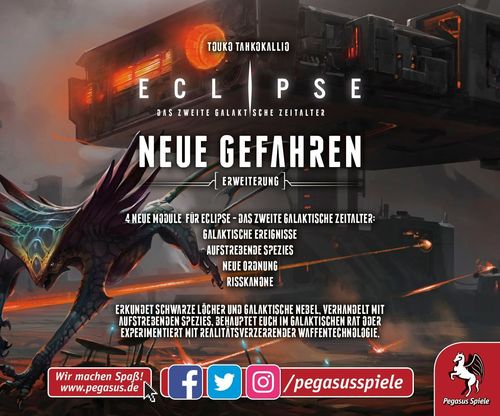
Eclipse: Das zweite galaktische Zeitalter – Neue Gefahren
Eclipse: Das zweite galaktische Zeitalter – Neue Gefahren Rulebook
Table of Contents
Table of Contents
Galactic Events
Pulsars, Black Holes, Supernovae and Nebulae follow special rules. To add a chosen sector type to the game, shuffle its tiles into the stacks of the matching rings (marked with Roman numerals on the backs) before the sector stacks are formed. Use only one Black Hole sector per game. The number of outer-ring (III) sectors used in the game does not change. The expansion contains 2 Pulsar sectors, 2 Black Hole sectors, 2 Supernova sectors and 2 Nebula sectors.
Pulsar
A pulsar is a rotating neutron star formed by a supernova explosion. Its constant pulse opens new tactical possibilities.
Rules
- Pulsar sectors have 3 action spaces, which replace the influence space. When you take control of a Pulsar sector, place your influence disc in its Move action space. A Pulsar sector can hold only 1 influence disc.
- Each Pulsar sector you control can be activated once per round instead of taking a normal action. To activate a Pulsar sector, move the disc in it to one of the empty action spaces (for example, if the disc is in the Move space, you may move it to the Upgrade or Build space). Then perform 1 activation of the action that corresponds to the newly occupied action space.
- You cannot activate a Pulsar sector if you have already Passed.
Black Hole
For centuries black holes remained the greatest mystery of the universe, an impassable boundary. With the arrival of technology for manipulating the space-time continuum, travel through black holes became possible, carrying you to another place and time.
Rules
- Unlike exploring ordinary sectors, you do not receive a Discovery tile from a Black Hole sector you have just explored. Instead, it is received by the player whose ship first enters the Black Hole sector.
- Any ship that moves into a Black Hole sector ends its activation and is removed from the game board. Roll the yellow die to determine when the ship returns from the Black Hole.
- Blank face or explosion face: the ship returns immediately. (The chart row for these two faces is labelled "the ship receives 1 damage and immediately returns to the game board".)
- Face 2 or 3: the ship returns in the round whose number is 1 higher than the current round.
- Face 4 or 5: the ship returns in the round whose number is 2 higher than the current round.
- During the round in which you must return a ship, you may place it on the game board before performing any of your actions. If you must return several ships, you may return all of them at once or one at a time before different actions.
- If you do not return a ship in the correct round, or if it must return after the 8th round, it is considered lost in the space-time continuum and is placed in the supply.
- The sector to which a ship returns is determined by the Black Hole used. If there is no suitable sector on the game board, the ship is also returned to the supply.
- Black hole sector Cygnus X-1 (sector 396): ships return to any inner (I) sector.
- Black hole sector V616 Mon (sector 399): ships return to any sector that contains a wormhole adjacent to an unexplored area (a part of the game board without a sector).
- DAMAGE. Damage taken while travelling through a Black Hole is removed as usual (at the end of the Combat phase).
Supernova
Supernovae are extremely unstable by nature and can explode at any moment. Modern technology, however, makes it possible to stabilise them temporarily.
Rules
- At the start of the Upkeep phase, roll 2 yellow dice for each explored Supernova. To each result of each yellow die roll (ignoring blank faces and explosion symbols), add the largest number of Technologies among the tracks of the player who controls the Supernova sector. If no player controls the Supernova sector, add nothing. If the sum is less than the number of the current round, the Supernova explodes: remove from its sector all ships, structures, population cubes and the influence disc (if any), and flip its tile over. Return the removed population cubes and influence disc to the corresponding tracks. A sector in which a Supernova has exploded has no wormhole connections to adjacent sectors, but you may still move into and out of it with the Wormhole Generator technology, following the normal rules.
- EXAMPLE. It is the 6th round of the game. Ivan controls 1 Supernova sector, and has 2 Military and 4 Network technologies, plus 1 Nanotechnology. At the start of the Upkeep phase Ivan rolls 2 yellow dice, gets an explosion symbol and a 2, and then adds 4 for his Network technologies. The total is 6, which equals the number of the current round. The Supernova is stabilised... for now.
Nebula
Nebulae are cosmic clouds of dust and gas. The stars in Nebula sectors are too small and unsuitable for colonisation. However, bold explorers can make many discoveries in these sectors (or find an excellent place to hide).
Rules
- Nebula sectors have no influence space, and they are divided into 3 parts connected by wormholes. When you explore a Nebula sector, place 1 Discovery tile and 1 Ancient on the matching symbols in each part of the sector. You may NOT place influence discs in Nebula sectors.
- Discovery tiles from Nebula sectors can be obtained only if your ship is in the part of the sector containing such a tile at the end of the Combat phase. If the reward for a Discovery tile calls for adding a component to the sector, place it in the part of the sector from which the tile was taken.
- You may NOT place an Ancient Orbital (Орбита древних) or an Ancient Monolith (Монолит древних) in a Nebula sector. When you take a Discovery tile that would bring one of these, place it in the discard pile and draw a new one before choosing its reward or VP.
- For Move, Explore and Influence actions, each part of a Nebula sector counts as an ordinary sector.
- EXAMPLE. The Red player may explore through wormholes A and B. To move his Interceptor carrying one Fusion Drive through wormhole B requires 2 Move activations. If at the end of the Combat phase the Interceptor is still where it is now, the Red player receives the Discovery tile from this part of the sector.
Minor Species
Although the Minor Species have no representatives on the Galactic Council, they are no less interested in the outcome of the current conflict than the others. Unable to oppose the financial and military might of the Council members directly, they offer their knowledge in science, diplomacy and construction to anyone who is willing to form an alliance with them. Perhaps this will lead to the emergence of a new power which, after the end of the conflict, will reward them not only financially...
Components: 9 Minor Species Ambassador tokens.
Rules
- To add the Minor Species to the game, before the start of the game take 4 random Minor Species Ambassador tokens and place them in the supply.
- You may establish Diplomatic Relations with a Minor Species at any moment of your turn. Pay the credits shown on the chosen Ambassador token, and place the token in a suitable empty space on your Reputation track. The abilities of a Minor Species Ambassador take effect immediately. You may establish Diplomatic Relations with several Minor Species.
- A Minor Species Ambassador token cannot be discarded.
- NOTE. Minor Species can be used in games with 2–3 players, even though normal Diplomatic Relations cannot be established in those games.
Minor Species abilities
Each token is one of the following nine abilities:
- At the end of the game, gain 1 VP for each of your Reputation tokens.
- At the end of the game, gain 1 VP for each of your Ambassador tokens (including this one).
- At the end of the game, gain 3 VP.
- Immediately place on this token a population cube from any of your population tracks. At the end of the game, gain 1 VP.
- You receive a -1 material discount on building Cruisers. At the end of the game, gain 1 VP.
- You receive a -2 material discount on building Monoliths. At the end of the game, gain 1 VP.
- You receive a -1 material discount on building Orbitals. At the end of the game, gain 1 VP.
- You receive a -2 material discount on building Dreadnoughts. At the end of the game, gain 1 VP.
- You receive a -1 knowledge discount on researching technologies (taking the minimum cost into account). At the end of the game, gain 1 VP.
Rift Cannon
The Rift Cannon uses a powerful technology for which neither computers nor shields are an obstacle. It creates destructive space-time rifts that pass through enemy ships. However, manipulating time and space is often unpredictable: there are known cases of Rift Cannons ricocheting and inflicting damage on the ship that carries them.
Components: 12 tokens, 4 dice.
Tile rules
- Rift Cannon (rare technology). You may upgrade your ships with Rift Cannon parts.
- Rift Cannon part (ship part). Adds 1 special Rift Cannon die to a battle (see below) and consumes 2 energy. The Rift Cannon ignores all computers and shields and inflicts 1–3 damage on the opponent and/or 1 damage on its owner.
- Rift Conductor (Discovery tile). A ship part that increases the hull value by 1, adds 1 Rift Cannon die in battle and consumes 1 energy.
Die rules
The Rift Cannon die has these results:
- Deals 1 damage to the target.
- Deals 2 damage to the target.
- Deals 3 damage to the target and 1 damage to one of your Rift Cannon ships participating in the battle.
- Deals 1 damage to one of your Rift Cannon ships participating in the battle.
- Miss (two faces).
Damage that you yourself take from Rift Cannons is applied to ships upgraded with Rift Cannons. If possible, it is distributed so that your ships are destroyed (from largest to smallest). If the Rift Cannon damage you take cannot destroy any one of your Rift Cannon ships, it is distributed so as to deal as much damage as possible (from the largest ship to the smallest).