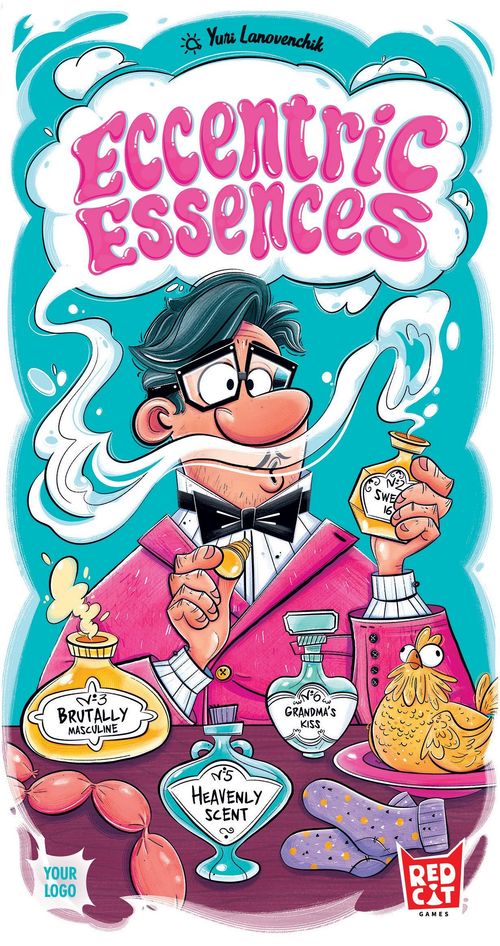
Eccentric Essences
Eccentric Essences Rulebook
Table of Contents
Table of Contents
Game Components
- 58 double-sided perfume cards
- 100 essence cards
- 4 ticket cards
- 7 "Nose in the Wind" tokens (5 small, 2 large)
- 4 number tokens
- 10 student sets of different colors, each containing: 3 choice tokens and 1 student marker
About the Game
Students, attention! The decisive hour has come that will determine your fate in the perfume world! This is how the exam will go:
The lead student draws a ticket with the name of a perfume they must create, and receives several essences to do it. Using logic and associative thinking, they must decide which ingredients to add a lot of to their perfume and which are better not touched at all.
The others, seeing only the chosen essences and their intensity, must try to catch the lead student's train of thought. Guess which of the 4 revealed perfume names their smelly composition corresponds to, vote, and then swap roles.
Success on the exam is measured in points that the lead student and the others receive for correct guesses each turn. Score as many points as possible by the end of the exam to receive your coveted diploma and the right to smirk for the rest of your life at the sight of your classmates!
Game Setup
- Take the components out of the box and place the bottom of the box with the score track so that everyone can reach it.
- Give each player one of the student sets. Put your student marker on the "0" space of the score track and place the choice tokens next to you. Put unneeded student sets back in the box.
- In the center of the table, lay out the 4 number tokens in a row in ascending order.
- Shuffle the deck of perfume cards. One by one, lay out the top 4 perfume cards, each on a random side, so that there is one card under each number token. Put the rest of the deck nearby.
- Shuffle the deck of essence cards and put it nearby face down. Leave room nearby for a discard pile.
- Take "Nose in the Wind" tokens depending on the number of players:
| Players | Large tokens | Small tokens |
|---|---|---|
| 3 | 0 | 1 |
| 4 | 1 | 1 |
| 5 | 1 | 2 |
| 6 | 1 | 3 |
| 7 | 2 | 2 |
| 8 | 2 | 3 |
| 9 | 2 | 4 |
| 10 | 2 | 5 |
- The player with the freshest diploma from any institution becomes the lead student and puts the 4 ticket cards in front of them.
Everyone ready? Hurry, the professor is already waiting!
(Example: setup for a game with 4 participants.)
Gameplay
The exam takes place over several rounds depending on the number of students:
| Students | Rounds |
|---|---|
| 3 students | 3 rounds (everyone becomes lead student 3 times) |
| 4-6 students | 2 rounds (everyone becomes lead student 2 times) |
| 7-10 students | 1 round (everyone becomes lead student 1 time) |
Players pass the turn to each other clockwise, taking turns being the lead student. Each turn consists of 4 steps:
- Draw a ticket!
- What does it smell like?
- Debriefing
- Next!
1. Draw a ticket!
-
The lead student shuffles all the ticket cards, draws one of them face down and looks at its number, then puts it next to themselves without showing anyone. The revealed perfume card under that number contains the name of the perfume they must compose.
Example: bold Victor answers first and draws the ticket with number 2. The perfume he must create is called "Unequal Marriage".
-
Then the lead student draws 5 essence cards from the deck and looks at their faces without showing the others. They choose the 3 essences that in their view are best suited for composing the given scent, and discard the other 2 face down.
-
The lead student reveals the chosen essence cards to the others. Then they place a choice token at one of the divisions of the first card; in this way they indicate the intensity of that smell in their perfume. They must do the same with the second and third essences.
Know your limits! The bottom division of the scale on an essence card means complete absence of that smell in the perfume, and the top one means the greatest intensity.
Example (continued): Victor received essences for his perfume. He got mothballs, leather, strawberry, mold and baby powder.
What a set! Victor decided that for the perfume "Unequal Marriage" strawberry and mothballs (which will symbolize youth and old age) and also baby powder (since children are a likely result of a marriage) would be ideal. He places his choice tokens at divisions of these essence cards, marking their intensity, and discards the unchosen cards.
Important: place the essence cards facing the other players so that everyone can see them well.
2. What does it smell like?
-
The other players carefully study the combination created by the lead student and try, faster than the others, to guess which of the 4 perfumes revealed next to the number tokens they were trying to create.
-
When you have a guess, hurry to place all of your choice tokens next to the revealed perfume cards with the names that seem the most probable answer. (No whispering! Thinking aloud is not allowed on the exam!) You may place the tokens in any combination: all three on one option, two on one and the last on another, or one on different cards. (Try to place choice tokens around the card or under it so as not to cover the perfume names on the cards.)
-
As soon as you have placed all your choice tokens, quickly grab one of the "Nose in the Wind" tokens! At the end of the turn a large token will bring you 2 extra points, and a small one 1 point, if at least 2 of your choice tokens are on the correct answer.
Example (continued): Mark immediately understood Victor's idea and confidently placed all 3 choice tokens on "Unequal Marriage", then grabbed a large "Nose in the Wind" token. Sophia thought the composition suited the name "Bitter Truth" better, so she placed 2 tokens on that option and only 1 on the correct one. She took the remaining small token. Daria decided to hedge her bets and placed one token on each of three different options. Since she was last, there was no "Nose in the Wind" token left for her.
If your quick classmates have snatched up all the "Noses in the Wind", place your choice tokens as you think right and hope for the results check; quite possibly their haste will play a cruel joke on them.
3. Debriefing
When all players have placed their choice tokens, the lead student reveals the ticket they drew at the start of their turn. Now that the correct answer is known, you can move on to scoring points for this turn:
-
The lead student gets as many points as the number of players who guessed the name of their perfume (placed at least 1 choice token on the correct answer).
-
Each guessing player gets points equal to the number of their choice tokens on the hidden perfume card. If you managed to get a "Nose in the Wind" and at least 2 of your choice tokens are on the correct answer, do not forget to add extra points: 2 points for a large "Nose in the Wind" token or 1 point for a small one.
Example (continued): this turn Victor gets 3 points (since each guessing player placed at least 1 choice token on "Unequal Marriage"). Mark gets a whole 5 points: 3 points for his choice tokens on the correct answer, plus 2 extra points for the large "Nose in the Wind" token. Sophia and Daria get only 1 point each for their choice tokens. (The "Nose in the Wind" token brings Sophia no extra points, since she placed only 1 choice token on the correct answer.)
After counting their points, each player must move their student marker forward along the score track by the corresponding number of spaces.
And now, dear students, you can freely discuss your guesses and associations!
4. Next!
Prepare for the new player's turn:
- Take your choice tokens back from the revealed perfume and essence cards.
- Return the "Nose in the Wind" tokens to the center of the table.
- Discard the essence cards used this turn.
- Discard the revealed perfume cards and lay out new ones.
The lead student becomes the player to the left of the previous one. They take the 4 ticket cards, after which the game continues as described above.
End of the Game
The game ends as soon as every player has been the lead student the required number of times. The student who has advanced furthest along the score track wins and is declared the best pupil of the course! If several players pulled ahead and scored the same number of points, they are all considered winners.
If you did not succeed... do not hang your nose! This exam is just one of the life's trials you will have to pass. But, unlike the others, you can repeat this experience again and again to achieve a better result!
Cooperative Mode
Get ready to test your team's sense of smell! In this mode you are not rivals but one team, and your goal is to give, unnoticed by the professor, the most accurate hints possible to the lead student answering at the board. It is in your common interest to work smoothly, because you earn exam points together! To play the cooperative mode, apply the changes described below to the rules of the basic mode.
Game Setup (Cooperative)
- Place only one student marker on the track (of any color). Each player, as usual, takes 3 choice tokens of one of the colors.
- Put the "Nose in the Wind" tokens back in the box; you will not need them in this mode.
Gameplay (Cooperative)
1. Draw a ticket!
- The lead student draws one of the tickets, but does not look at its face side themselves, instead showing it to the other players. Thus everyone except the first student knows the correct answer this turn.
- Everyone except the lead student acts simultaneously and draws 3 random essence cards. From them each player must choose only 1 essence that will be useful for composing the given perfume, and discard the others (when playing with 3 or 4 participants, choose 2 essences each).
- Then the players set the intensity of the chosen essences using choice tokens.
Important: discussing the choice of essences is still not allowed, but you can, and even should, look at the cards the others place, so your combined combination of smells will be much more logical!
Example: Victor drew and showed the others a ticket: it is perfume No. 4 named "Drink Me".
Mark, Sophia and Daria each chose 2 essences to give Victor a hint:
Mark chose the essences "honey" and "pencils". On "honey" he marked the second cell from the top of the intensity scale, because honey can be drunk (if you try hard enough). On "pencils" he indicated the lowest intensity, because they obviously cannot be drunk, and also to hint that the given perfume is not No. 2 ("Childhood Played Up").
Sophia marked the bottom cell of "ink", since ink certainly should not be drunk, and also the second cell from the top of the essence "pineapple", because juice can be made from pineapple.
Daria chose two essences that can be drunk: "milk" and "energy drink" (although we recommend that students not get carried away with energy drinks and choose milk instead!). She marked the top intensity cells of both essences.
2. What does it smell like?
When the players have set the intensity of the essences, the lead student can study their combination. They place all their choice tokens on the perfume names that seem to them the most probable answers, distributing them as they see fit.
3. Debriefing
Reveal the ticket drawn at the start of the turn. See how many choice tokens the lead student placed on the correct answer: that is exactly how many points your team earns this turn. Move your shared student marker forward along the score track by the corresponding number of spaces.
4. Next!
Proceeds by the rules of the competitive mode.
End of the Game (Cooperative)
In the cooperative mode, the number of rounds of the competitive mode is kept. As soon as every player has been the lead student the required number of times, the game ends.
Look at which division of the score track your student marker reached and find out your overall result:
| Players | Result 1 | Result 2 | Result 3 | Result 4 |
|---|---|---|---|---|
| 3 or 9 | 10 or less | 11-18 | 19-24 | 25 or more |
| 4 or 8 | 9 or less | 10-16 | 17-21 | 22 or more |
| 5 or 10 | 12 or less | 13-21 | 22-27 | 28 or more |
| 6 | 14 or less | 15-25 | 26-32 | 33 or more |
| 7 | 8 or less | 9-14 | 15-18 | 19 or more |
- Result 1: "Retake!"
- Result 2: "Satisfactory. You can definitely do better!"
- Result 3: "A solid B. Something was missing!"
- Result 4: "Excellent! Professor Dushnilsky is proud of you!"
Remember: if you are not satisfied with the result or (which is likely) you simply enjoyed the process, you can always take the exam again!