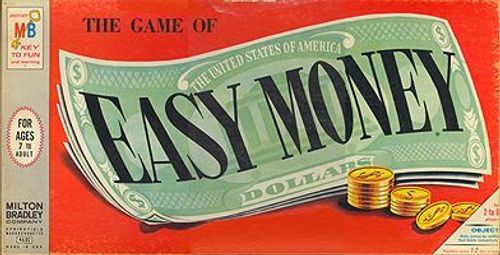
Easy Money
Easy Money Rulebook
Table of Contents
Table of Contents
The Board
Read Carefully — Learn the Board — and You Learn the Game
The playing board is divided into 48 spaces. Of these, 22 are Property Spaces (streets, avenues, roads); 5 are Utility Spaces; 3 are Public Buildings; 1 is City Hospital; 17 are "legend spots" with instructions to the player.
Building Costs — The numbers preceded by the letter "B" (as "B-110," etc.), in the circle surrounding center of the board, are the "Building Cost," i.e., the price a player must pay the Bank for each house he places on that property.
Mortgage Value — The numerals directly beneath the Building Cost, also in the circle, preceded by the letter "M" (as "M-240"), show the amount a player owning the property may borrow from the Bank if he mortgages the property.
Rents — The figures on the outside end of the property show the amount of rent collected by the player with one house on that property. The adjacent figures show the rent collectable for the property with 2, 3, 4 or 5 houses.
Utility Spaces — These are AIRDALE BUS LINES, L. M. NAVIGATION CO., L. M. TELEPHONE CO., INTERURBAN TRANSIT CO., and ASSOCIATED AIRWAYS. Each of these bears a legend stating the amount collected by the owner, or leasee, when an opponent's man stops on it.
The Utilities are sold at auction, same as the Property Spaces, but no houses are built on them. The agent, however, gives the buyer a house of his own color which is placed on the outer edge of the Utility Space to identify the owner.
The CITY HOSPITAL, WALDORF HOTEL, BLACK KAT NIGHT CLUB, and MAJESTIC THEATRE are not "properties" in the same sense as the streets and avenues, and are governed by individual rules, as follows, which read carefully:
City Hospital — This is not saleable, nor are any houses placed on it, but it may prove of great value in enriching the fortunes of any player. Two spaces of the board are related to the city hospital, one, "AIRPLANE CRASH — Pay City Hospital $200" and the other, "AUTO ACCIDENT — Pay City Hospital $150." When a player's man lands on either of these spaces, he pays the amount specified to the Hospital, by placing that amount on the outside edge of the board, partly overlapping the CITY HOSPITAL space. The next man to land on the CITY HOSPITAL by a throw of the dice, collects all the money on the Hospital, and adds it to his own private capital. If there is no money on the Hospital space, of course a man landing there collects nothing.
If it happens that while one player's man is on the CITY HOSPITAL, another player stops on AIRPLANE CRASH or AUTO ACCIDENT and pays the Hospital a remittance, the man already on the space cannot collect it. A player may only collect money that is on the Hospital when his man arrives at that point by a throw of the dice. Money paid the Hospital while a man is resting on that space is left "on the Hospital" for the next player landing on that space.
Waldorf Hotel — Players bid for position of manager of the hotel, the award going to the highest bidder. He collects from each "guest" who stops on the Hotel space, ten times the amount of the dice throw which landed the "guest" at the Hotel. While, of course, no houses are erected on the Hotel space, the player owning it places a house of his own color on it to identify his ownership.
Example: A player throws a 5 and 2, and lands on Waldorf Hotel. His throw is 7, and he must pay the hotel manager ten times that amount, $70, for accommodations.
Black Kat Night Club — Players bid for "proprietor" of the Night Club, the club going to highest bidder. He collects $50 from each player whose man stops on that space, whether landing there on a throw of the dice or sent by a "Give-or-Take" card. Should a man be sent to the Night Club by a "Give-or-Take" card before the Club is sold, he does not pay, but the Club is immediately offered for sale, and after it is sold each player landing on it pays the owner $50.
Majestic Theatre — Players bid for lease of the Majestic Theatre, and successful bidder identifies it with a house of his color. He then collects $100 for "percentage of receipts" from each player who stops on that space.
Other board spaces, as RADIO PROGRAM CONTEST, UNITED TRUST CO., ESPANOLA LOTTERY, Y. M. C. A., BELMONT PARK RACES, etc., carry their own instructions. Where a legend reads "Take" or "Win," the player takes the amount specified from the Bank. When stopping on spaces which read "Pay" or "Lose," he pays the amount stated to the Bank, unless otherwise specified.
Bonus — Each time a player makes the circuit of the board and stops on or crosses the space marked "Bonus," he collects $250 from the Bank.
Give-or-Take Cards
These are placed face down in a pack at any convenient point on the table. When a player throws doubles of any number, before moving his man, he draws the top card from the "Give-or-Take" deck, and follows the instructions printed on it, even though it is first throw of the game. If the card drawn instructs him to go to some specified space, he moves his man to that point and his turn is ended. If it reads "Take" or "Pay," he acts accordingly and then moves his man the number of spaces indicated by the dice.
Special Exemption Card — The player drawing the "Special Exemption Card" retains it, and while it is in his possession is exempt from violation of the traffic rules or paying any taxes. He may, however, if he wishes, sell the card to the highest bidder and so realize cash for it.
Colored Houses — These are "improvements" and are to be placed on the property. They are purchased from the Bank, except the one house a player receives with each property he buys.
The term "Property" always refers only to those spaces with name of streets, roads or avenues on which more than one house may be placed — not to Utilities or Public Buildings.
Each player uses one of the colored playing pieces, and throws the two dice in turn.
Playing the Game
For Two to Five Players
The Agent — Appoint one player as "Agent" for all transactions, who also acts as referee in case of disputes. He takes part in the game, same as the other players.
The Agent gives to each player $2000 in script, made up of various denominations. The balance of the money is then placed in the Bank, in the center of the board.
Method of Play — Players throw the dice in turn, high throw having first play. This player throws the dice again, and moves his "man" from the starting point (counting the starting space as one) — in the direction indicated by the arrow, a number of spaces equal to the total of the numbers uppermost on the dice.
Buying Property — If his man lands on a "property," the agent announces the name of the property, its building cost and rent schedule, and offers it for sale at auction, with one house. The highest bidder is declared owner of the property. He pays to the Bank the amount bid and is given a house of an identifying color, the same color as his "man" or playing piece. He places the house over the first figures at the outside end of the property space. The numerals which the house covers represent the rent which that player will thereafter collect from each opponent whose "man" stops on that property.
Buying Utilities or Public Buildings — If a player's "man" lands on a Utility or Public Building, the agent reads its name and the amount it pays — and offers it for sale to the highest bidder. The buyer is given a colored house (of his own color) which he places on the space purchased to identify his ownership.
The second player now throws the dice and plays in like manner, the agent auctioning off the space on which this player's man rests. The process for all other players is the same.
Buy on Four Sides of Board — When a player has acquired one property and identified it with a colored house, his next property must be purchased on another side of the board — that is, a player cannot have more than one property on the same side of the board, nor more than one house on any one property, UNTIL HE HAS FIRST PURCHASED FOUR PROPERTIES — one each on four different sides of the board.
A player having four properties, one each on four sides of the board, with one house on each property, may now purchase other houses from the Bank to be added to his acquired properties. He may build from two to five houses on any or all of his four properties, and thereby collect maximum rents.
Or when a player has four Properties, one on each side of the board — he may buy any unsold Property when it is offered for sale, and build on it immediately.
If a player uses all the houses of his own color, and buys more property, he identifies it with one house of his own color on the outside end of the space and uses pieces of any available color to represent his additional houses.
A player may buy a Utility or a Public Building whenever it is offered for sale, even though he has a real estate Property space on that same side of the board.
Each Utility is an independent unit, and has no relation to any other Utility, nor to the "Properties" on which houses are built. The same rule applies to Public Buildings — i.e., Theatre, Hotel, Night Club — as each of these is also an independent unit without affiliation with any other units.
Bank Must Sell to Highest Bid — The Bank is obliged to offer an unsold property for sale the first time a "man" lands on it, and accept the highest bid. It may be that all players but one already have a property on the side of the board on which a space is offered for sale, and cannot bid on it. Therefore, the last player may bid it in for an absurd price — as "five dollars," for example — and the Bank must sell.
Collecting Rents — When a player has acquired a property (street, road or avenue) with one house on it, he collects from each opposing player who lands on it, the amount printed at the end of the property space toward the outside end of the board. The second figure from the end indicates the amount of rent collected with two houses on the property; the third figures show the amount collected with three houses; and the fourth and fifth figures, the rents collected for four or five houses.
A player landing on his own property obviously does not pay anything.
Mortgages — An owner may mortgage a Property, borrowing from the Bank the amount preceded by the letter "M" stated on that property. When a property is mortgaged, all houses on it are stood on end to show it is mortgaged. The mortgage may be lifted by paying the Bank the amount borrowed, plus 10% interest. A player cannot collect rents nor build additional houses on mortgaged property.
Mortgaged property may be transferred "for a consideration," from one player to another, but the new owner must pay the Bank the amount of the mortgage, plus 10% interest, before he can build a new house on the property or collect rents for that property.
The PUBLIC BUILDINGS, Theatre, Hotel, and Night Club, may be mortgaged for the amount stated on each, but a player cannot collect revenues for any Public Building while it is mortgaged.
UTILITIES cannot be mortgaged. Their only income is the amount stated on each, collected from opposing players who land on them.
A player may purchase additional buildings or take out "mortgages" only when it is his turn to play. He may buy or mortgage before or after he throws the dice for his play.
Re-Sales — If a player, having a Property, Utility or Public Building becomes "pressed for money," he may sell it at any time to the highest bidder.
Winning the Game
When a player has insufficient cash to pay his rents due or meet other demands, and has no further property to mortgage, he is forced into bankruptcy, and the play ends . . . Each player counts his cash on hand, plus the value of the property he owns, and the one having the largest total WINS THE GAME. Mortgaged property is not counted, as the player has credit for this in the cash he borrowed when taking out the mortgage.
Should the Bank run out of funds, the game is called, and the player having the most money and property WINS.
EASY MONEY is adapted to any number of players. If more play than the number of "men" included in the implements, the additional players may use buttons, poker chips, or any other suitable playing pieces for their "men."
For Six or More Players
When six or more play EASY MONEY, it is not possible for each player to acquire four properties before building houses on any of them, as there are only twenty-two Property spaces on the board. Therefore, for six or more players the rules are modified as follows:
Each Property is sold when a man first lands on it, same as in the game for five players or less . . . When a player buys a Property, he may build houses on it immediately, without waiting to acquire any additional Properties . . . The Public Buildings and Utilities are sold to highest bidder, same as in the five-player game, and all other "five-player" conditions apply to the game for six or more players.
NOTE — The Rules for "Six or More Players" may, of course, be applied to the game for any number of players — that is, ignoring the rule of acquiring four Properties, one on each side of the board, before building; and buying and building with a single Property, if desired, and agreed to by all players.