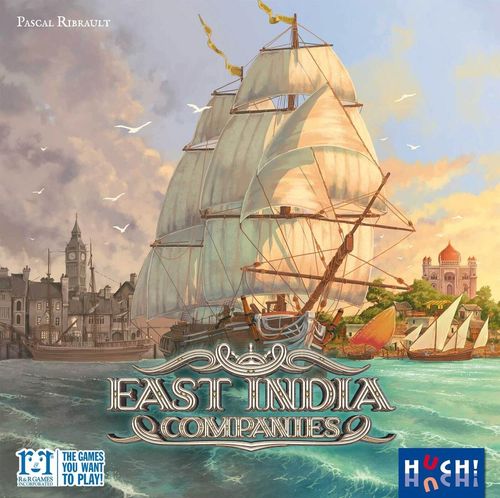
East India Companies
East India Companies Rulebook
Table of Contents
Table of Contents
Goal of the Game
A game of East India Companies is played in 5 periods, at the end of which the richest player is declared the winner. This wealth is based upon the trade in goods and the investments in the stock exchange.
Materials
1 game board. This game board includes the 5 Characters solicited by the Agents of the players, the map of the Indies, the Stock Exchange, and the registry of phases and periods.
2 Market boards, front for 4 players, back for 2 and 3 players, one for Europe the other for the Indies. Markets allow you to manage the supply and demand mechanisms that form the core of the game.
I. 1 Loading track. This track is used to know the order of arrival of ships in the Indies.
II. 4 Port tiles (1 for each player). Each Port can accommodate two ships from the same player. The Treasury, on their left, is used to keep money earned and available to spend.
III. 4 Amount of Sales tiles (one per player). This tile, to be placed to the right of your Port tile, is used to store earnings from sales until each Period end.
IV. 8 Dock Extensions tiles: 4 level 1, 4 level 2 (2 for each player). Dock Extensions allow you to acquire additional ships and a warehouse to store goods that you don't want to sell immediately.
40 Ship tiles, 4 different colors (10 for each player). Each ship has its own abilities. Ships can be purchased during the game, except for Galleons, which are available at set-up.
28 Company Share tiles, in 4 different colors (7 for each player). These shares can be acquired by players who wish to invest in any of the companies.
8 Presidency Share tiles, 4 different colors (2 for each player). These shares represent the player's initial shares in their own company.
12 Agents, 4 different colors (3 for each player). Agents are used to activate the abilities of the five Characters on the central board.
8 Trading Posts (2 for each player). These Counters reduce the purchase price of goods by 1 GP in the area where they are located.
4 Sales markers (1 for each player).
4 Initiative markers (1 for each player).
4 Share Value markers (1 for each player).
1 Period marker.
1 Phase marker.
114 Goods cubes (33 green, 30 orange, 28 brown, and 23 white). These cubes represent goods that players can buy and sell during the game. Orange represents spices, brown represents coffee, white represents silk, and green represents tea.
8 Market dice: 1 of each color for both the Indies and Europe. These dice are used to determine the fluctuations in the value of the goods on the two Markets for the current period. Each die corresponds to one of the four commodities.
V. 20 Market cards each for the Indies and Europe. These cards adjust the values rolled by the Market dice. Players can use an action to choose and/or view these for inside information concerning market fluctuations.
120 coins divided as follows: 66 coins of 1 GP, 31 of 5 GP, 15 of 10 GP and 8 of 50 GP. Historically, there was no reference currency at that time. For the sake of simplicity, gold pieces (GP) are therefore used here for reference.
2 Player aids. Summarizes the character abilities and phases of each epoch.
1 End of Period tile (for the 2/3 player game).
2 Closed Trading Post tiles (for the two-player game).
6 Agents cards (for the two-player game).
9 Destination cards (for the two-player game).
As you read through this booklet, you will find boxes with a picture, like this one. These boxes are intended to explain what is behind a rule point.
Game Board Overview
The central board and its surrounding boards lay out as follows:
- I. Loading Track — placed above the game board; tracks the order of arrival of ships in the Indies.
- II. Port — each player's Port tile, holding two ship docks and a Treasury space to its left.
- III. Amount of Sales — placed to the right of each player's Port; stores sales earnings until Period end.
- IV. Dock Extensions — two piles of level 1 and level 2 extension tiles near the center board.
- V. Europe Market / Indies Market — placed left and right of the center board respectively, each with its own Trading Tracks, Market cards, and goods cubes.
- Stock Exchange — holds each company's Company Share and Presidency Share tiles, plus the Stock Exchange Track where Share Value markers travel.
- Map of the Indies — the central map showing trading ports (Malacca, Bombay, Batavia, and others) where goods are bought.
- Characters — five character cards (Trader, Investor, Shipowner, Captain, Governor) on the central board that Agents can be placed on to activate their abilities.
- Registry — the phase/period tracker (Agent, Stock Exchange, Navigation, Loading, Selling) and the Initiative track, plus the End of Period box.
Game Set-up
Boards
The following setup is for four players. For two- or three-player games, make the modifications indicated on page 14 (see 3-Players Games and 2-Players Games).
Unfold the game board.
Place the Europe Market on the left side of the center board. Place the Indies Market on the right.
Place the Loading track above the game board.
Place the Phase marker in the Agents box and the Period marker in the ★ 1700-1750 box.
Be sure to place the Markets on the front or back, depending on the number of players: 4-players games use one side, 2 or 3 players games use the other.
Markets
Place a matching Goods cube on each of the light colored spaces on the trading tracks of both Markets. Slots with a darker background remain empty.
The remaining goods are placed near the Indies Market.
Separate the Indies cards from the Europe cards. Sort each set into 3 piles by the symbol on their back (★ / ★★ / ★★★).
Shuffle and place these decks face down near their respective Market.
Stock Exchange
Each player will place their 7 Company Shares on the Stock Exchange and their Share Value marker on the starting value of the Stock Exchange (on the left of the track).
There are two Presidency Share tiles for each company, give these to the player who runs that Company.
Initiative
Initiative determines the order in which players act in each phase and is used to break ties (the player with the higher initiative wins the tie).
At the start of the game, the order of initiative is determined randomly. Each player puts their Initiative marker on the track with the top position being the first or highest initiative.
Now, following the order of initiative, each player receives 10, 10, 11 or 12 GP. The money received is placed on the player's Treasury space (the one to the left of their Port).
The remaining coins are placed in a common pool near the game board.
Your Company
Each player:
- receives a Port tile, and an Amount of Sales tile that they put on the right side of their port.
- places a Galleon ship tile of their color in each of the two docks in their Port,
- places their Sales marker on the first space of the Sales Track,
- places their 2 Trading Posts, 3 Agents and the 2 Presidency Share tiles of their company next to their Port.
Each player also has 8 additional Ship tiles, which they can buy during the game. We recommend you classify these Ships by period (★ < ★★ < ★★★), and keep them near your port.
Dock Extensions
The 8 Dock Extensions are placed in two piles near the center board. They can be acquired during the game through the Shipowner action.
Each player can get for free a Dock Extension of level 1, then a Dock Extension of level 2.
Both are placed between the Port and the Amount of Sales tile, completing the picture of the port for each player.
Ship Characteristics
Each type of ship has 4 characteristics:
- An availability period — before this date, you cannot purchase the Ship.
- A cost in GP — which you must pay to acquire that Ship, when using the Buy Ship action.
- A speed — which determines the order of arrival of ships in the Indies and Europe.
- A tonnage — which indicates the number of goods (cubes) that can be transported in one trip. Cubes loaded on ships may be of different types or the same.
Gameplay
A game of East India Companies lasts 5 rounds, also called "periods". Each period is divided into 6 phases, in which all players participate:
- A. Agent Placement
- B. Stock Exchange
- C. Navigation
- D. Loading
- E. Selling
- ↻ End of Period
A. Agent Placement
During this phase, players send their Agents to meet with influential people in order to receive benefits for the current period.
Market Estimate
The player with the highest initiative rolls the 4 Indies dice and places them on the Indies Market according to their corresponding good.
Then they do the same with the 4 Europe dice, which they place on the Europe Market.
The value of the dice makes it possible to estimate the supply (in the Indies) or the demand (in Europe) of each of the goods.
Placement of Agents
Then, each player, in turn and in order of initiative, may activate one of the Character's Abilities by placing one of their Agents in the corresponding box and paying the cost (if any) indicated in that box.
To keep track of placement order, place subsequent Agents to the right of already placed ones.
The phase ends as soon as all players have placed their 3 Agents on a Character's ability box.
Restrictions in the Placement of Agents
During the first period, players can place their Agents on the ability boxes of any Character.
During subsequent periods, Agents start the round on the various Characters that they used last round. They now can be placed on either one of the ability boxes of the Character they are on, or the ability boxes of the 2 adjacent characters.
There may be several Agents on the same ability box as long as they belong to different players.
The same ability can be activated more than once, but by different players. However, a player must immediately pay 1 GP to each player who already has an Agent in that ability box.
It is always possible to send an Agent to the central zone. In this case, no ability is triggered. Then, when it is their turn to place again during this phase, the player can move this Agent to any Character ability (except for an ability box already occupied by one of their Agents).
Examples of Placement
The blue player moves their Agent currently on the Governor. They may send this Agent to any Governor, Shipowner or Captain's ability (both adjacent to the Governor).
- If they send the Agent to the Shipowner's Dock Extension ability where a red Agent is already present, they must pay the red player 1 GP.
- They cannot send it to an ability where one of their Agents is already there.
- They cannot send this Agent to an ability of the Investor or the Trader (both too far away).
- They may place their Agent on the central zone. This allows them to move it again on a future placement turn during this period, and thus send it to an Investor's or Trader's ability.
Character Abilities
Trader
- Trading — For this period, sell the corresponding item at +1 GP of its value. Phase: E (Selling).
Investor
- Influence — First placed Agent: Secretly choose the Europe card. Other placed Agents: Secretly consult the card chosen by the first placed Agent. Phase: C (Navigation).
- Expertise — First placed Agent: go first on the initiative. Other placed Agents: Move your marker to the next highest position on the initiative track. First placement here takes spot 1, second takes 2, and so on. Markers of other players who did not use this ability are moved down accordingly. Cost: 1 GP x current period ★ (from 1 to 5). Phase: B (Stock Exchange).
Shipowner
- Ship — Buy a ship, see below. Cost: depending on the ship. Phase: immediate.
- Dock Extension — Obtain a Level I Dock Extension, or Level II if you already have Level I. Phase: immediate.
Captain
- Ship — Buy a ship, see below. Cost: depending on the ship. Phase: immediate.
- Cartography — Your ships do not have to pay the usual cost of travel to zones I and II. Phase: C (Navigation).
Governor
- Influence — First placed Agent: Secretly choose the Indies card. Other placed Agents: Secretly consult the card chosen by the first placed Agent. Phase: C (Navigation).
- Trading Post — Place a Trading Post on a free seal space. A player may place only one Trading Post in each area of the center board. Cost: 3 GP. Phase: immediate.
If the ability is accompanied by a boxed letter, the effect will only apply during the matching phase. Abilities without a letter are immediately triggered.
Abilities with a GP cost (Ship, Expertise, Trading Post) must be paid immediately to the bank, even if the effects are triggered later.
Details
Ship (Shipowner, Investor)
- The player must choose an available ship from their personal stack.
- In order to purchase a ship, the player must have a free Dock space or discard one of their docked ships, which is then returned to the box.
- A player may only purchase a ship from the current or a past period.
Dock Extensions (Shipowner)
- Each player can have up to 2 Dock Extensions. They cost nothing to procure.
- On your first visit, take a level 1 Extension. Next visit, take the level 2 Extension.
- Each Dock Extension allows for one additional ship.
- Each Extension offers warehouse spaces (2 for the 1st Dock Extension, 1 for the 2nd Dock Extension), in which the player can store goods that they don't want to sell immediately.
- Place Dock Extensions between the Port and the Amount of Sales tile. The 2nd Extension will be placed to the right of the first one.
B. Stock Exchange
During this phase, players can purchase shares from any company in play.
At the beginning of this phase, players who activated the Captain's Expertise ability modify the Initiative order. They move up their Initiative marker (in the order of activation), whereas the Initiative markers of the other players are moved down accordingly.
Purchasing Shares
Each player, in turn and according to the order of initiative, can either:
- Purchase one and only one Share, from any company available on the Stock Exchange.
- Pass.
Once all players have either bought a Share or passed, proceed to a new round of Stock Exchange.
The phase ends as soon as all players have passed in succession.
Note: This means that if not all players pass in a row, a player who has previously passed can buy a Share when their turn comes around.
The Purchase Cost of a Share
The cost is indicated on the Stock Exchange track by the value in GP shown above the Share Value marker of a company.
Example: to buy a Share of the French company (blue), a player must spend 5 GP.
Money spent to buy a Share always goes to the bank, never to a player.
Each time a Share of a company is purchased, its value is immediately increased by one space on the Stock Exchange. Move the Share Value marker for that company one space to the right.
Example: after the purchase, the value of these Shares is 6 GP.
The buyer takes one Share tile of this company from the Stock Exchange, and places it near their Port.
Note: If there are no Shares of a company left in the Stock Exchange, it is not possible to buy Shares of this company.
A Share increases in value with each acquisition. This same Share will depreciate with each sale.
Selling Shares
Players are allowed to sell to the bank all or part of the Shares they own at any time while they are taking an action. It is not allowed to sell Shares during actions of other players.
There are two important caveats to this:
- Players can never sell ANY Shares during B, the Stock Exchange phase.
- In the game's final period, it is possible to sell Shares during phase A (Agent Placement) ONLY! After that, no Shares can be sold for the rest of the game.
When a player sells Shares, they receive from the Bank as much GP as the current value of the Share(s) sold (indicated by the company colored disc on the Stock Exchange Track). This money is placed on their Treasury space.
The marker is moved back one space per Share sold.
Sold Shares are placed back into the Stock Exchange.
Several Shares can be sold at the same time by the same player for the current price. Drop the Share value after the sale, one space per Share sold.
A player is NEVER allowed to sell their Presidency Shares, which represent the control of their company. These Shares can be mortgaged by following this optional rule:
Optional Rule: Mortgage a Presidency Share
During your first few games, it is possible to allow a player to mortgage their Presidency Shares.
Mortgaging can be done at any time during the game, including during the Stock Exchange phase.
For each mortgaged Share, the player receives half the current value of the Share from the bank (rounded down). The money received is placed on their Treasury space.
Mortgaged Shares are flipped (crossed side visible) and will not count for victory at the end of the game.
A player may redeem one of his mortgaged Presidency Shares during a Stock Exchange phase by paying its current value to the bank.
This action is done in lieu of buying a Share on their turn to purchase.
It is not possible to purchase mortgaged Presidency Shares from another player.
C. Navigation
During this phase the players decide where to send their ships.
Drawing of the Indies and Europe Market Cards
Shuffle both the Indies and Europe cards corresponding to the current period. Draw one card from both piles and place them, face down, in their respective market.
If players have activated the Governor's or Investor's Influence ability, the course of this phase changes: The first player to activate the Investor's Influence ability consults the pile of Europe cards of the current period and chooses the card for this period. Other players who have activated these Abilities can now secretly view the chosen card. Do the same thing for the Governor's Influence ability and the Indies cards.
The cards reflect the adjustments in the price of goods. The voyages between Europe and Asia being long, the expeditions are launched without knowing exactly what prices will be like when they arrive. Thus, these cards are only revealed later, once the ships have arrived at their destination. The Influence Abilities reflect knowledge gained from outside sources concerning the state of those markets.
Expeditions to the Indies
The game board is divided into three shipping areas: China (zone I on the right), the East Indies (zone II on the bottom) and India (zone III on the left).
Each player takes the Ships docked in their Port into their hands.
Each player, in turn order of initiative, places one of their Ships face down in one of the three navigation areas, paying the cost of the trip indicated on the board: 1 GP for the East Indies (zone II) and 2 GP for China (Zone I).
Ship tiles are stacked atop each other as they are placed in each of the navigation areas of the game board.
Players who have activated the Captain's Cartography ability do not pay the cost of their trip during this period.
Continue in this way until all players have placed all of their ships from their hands into the shipping areas of the board.
D. Loading
During this phase the prices of goods are revealed, goods are purchased and then loaded onto ships.
Evaluation of the Goods Supply in the Indies
Reveal the Indies card placed on the Indies Market.
On some cards you could find this sidebar around cubes. In 4 players games, ignore these sidebars and consider those cubes as normal cubes. Such cubes shall not be counted in 2- or 3-players games.
For each of the goods, add the value of the die to the value of the Indies card. This determines the number of each good to add to the Market.
Place these cubes onto the empty spaces of the Indies Market trading tracks, according to their color and in descending order of purchase cost (i.e., from the highest value to the lowest value).
Note: When all the slots for a good are occupied, any extra cubes that should have been placed are ignored.
Arrival of the Ships to the Docks of the Markets
Players can only purchase the goods available in the areas in which they have a Ship. Purchases are made area by area, starting with China (Area I).
- Reveal the top Ship in the stack.
- Place this Ship on the Loading Track, in the section corresponding to its speed.
- Reveal the next Ship and proceed in the same manner. If this Ship is to be placed in a section that already contains a Ship, place it on the previous Ship tile.
- Once all the Ships in Zone I have been placed on the Loading Track, players proceed to purchase goods.
Purchase Price of the Goods
The type of goods that can be purchased depends on the loading area:
- Zone III: spices and tea
- Zone II: coffee and tea
- Zone I: silk and tea
The cost of a goods cube is determined by the location on the trading track from which it is taken.
Example: Cubes located in these spaces cost 4 GP.
Money spent by a player to buy goods is paid to the bank.
Trading Posts
If a player has placed a Trading Post in an area, they pay 1 GP less for each cube in that area (the cost can be reduced to 0).
Purchase and Loading of Goods
The purchase of goods is done according to the speed of the Ships: priority is given to the Ships with the highest speed.
Thus, the order of purchases is left to right on the loading track.
- In case of stacked Ships in the same section, priority is given to the Ship on top of the stack.
- It is possible to buy goods of different types.
- It is not possible to buy a good if there are no more cubes of that type in the Indies Market.
- It is not mandatory to fill the Ship to its maximum capacity.
Cubes purchased are placed on the Ship. The Ship is then placed back in one of the player's available docks.
Once all the Ships in area I have been used, proceed in the same way for area II and then for area III (with Arrival of Ships, then Purchase and Loading of goods).
Leaving a Ship in the Indies
On any particular turn in this phase, a player may decide to buy no goods and leave that Ship in the Indies.
They pay 1 GP (even if they activated the Captain's Cartography ability) to leave the Ship, face up, in the zone. If several Ships are left in the same zone, they stay stacked with the first Ship being the top of stack.
During the next period, Ships that are sent to the zone are stacked apart from those that have been left. Ships left in the Indies will be loaded, upon the order of stacking, before the Ships that have just arrived in this zone.
Attention: A Ship that has been left in the Indies still counts as one of the owned Ships of the player and "occupies" a Dock that no other Ship can use. The Ship may be discarded if a new Ship is bought, but the new tile must be placed in the Port.
E. Selling
During this phase, players can sell the goods brought back from the Indies into Europe.
Evaluation of Europe's Demand for Goods
Reveal the Europe card placed on the Europe Market at the beginning of the Navigation phase.
For each of the goods, add the value of the die to the value of the Europe Card.
Remove this number of goods cubes from the Europe Market trading track, according to their color and in ascending order of selling price (i.e., from lowest value to highest value).
Note: When all slots for a good have been cleared, ignore the extra cubes to be removed.
Sale of Goods
Players may now sell the goods in their possession.
Selling a good means placing the cube of that good in the first (highest value) empty space in the Europe Market.
The selling price of a goods cube is determined by the location in the Europe Market in which it is placed.
The player receives money from the Bank for each good sold. These funds are placed on the Amount of Sales tile to the right of their port.
Example: Cubes placed in those slots are sold for 6 GP.
Determining the Selling Order
In turn order of initiative, each player has the possibility to sell all or part of the goods present in all their warehouses (held on the Dock Extensions).
Then, the Ships may sell their cargos in decreasing order of speed (from the fastest to the slowest).
For each speed: each player, in turn order of initiative, sells the cargo of one of their Ships of that speed (see example).
Each Ship must be fully unloaded before unloading the next one.
Warehouses: A player may choose to instead stock some or all of their goods from a Ship in their warehouses (if they have enough spaces) to have priority in selling them during the next period.
Please note: It is always possible to sell a good even if the Selling Track is full. The value of this good is then 1. The excess cubes are not added to the Market but returned to the common reserve.
A player who has activated the Trader's Negotiation ability for a specific good receives an additional 1 GP for each cube they sell of that color this period.
IMPORTANT: ALL money accumulated during the Selling phase is placed on the Amount of Sales tile. Do NOT mix it with the funds kept in your Treasury!
Prices fluctuate as goods are bought and sold. The players' decisions will therefore have a significant impact on prices. This reflects the real world effects of supply and demand.
Examples of Unloading
Speed 4 Ships are unloaded first. There is only one, the red player's.
There are no Speed 3 Ships.
The Speed 2 Ships are unloaded. There are three: Two for the blue player and one for the yellow player. Depending on the order of initiative, the blue player unloads one of their Speed 2 Ships (their choice). Then the yellow player unloads their Ship. Finally, the blue player unloads their second Ship. Finally, the Speed 1 Ships are unloaded.
Again in order of initiative, the blue player unloads their Ship, then the red player and finally the yellow player.
F. End of Period
During this phase, the company's performance against its competitors and the previous period is examined. The company's results will have an impact on its Shares and the new initiative order.
Adjust the Company Shares Values for Earnings
First, compare the money placed on each player's Amount of Sale tile.
- » The player who has collected the most money during this period sees the value of their company's Shares increase, two spaces on the Stock Exchange track.
- › The second highest earning player in this period sees the value of their company's Shares increase by one space on the Stock Exchange track.
- • The third highest earning player in this period sees the value of their company's Shares stagnate, and does not advance.
- ‹ Only in a 4-player-game: The lowest earning player in this period sees the value of their company's Shares decrease, by one space on the Stock Exchange track.
Note: in case of a tie, the tie is broken in favor of the player with the higher initiative.
Determination of the New Initiative Order
The new initiative order is the reverse of the one established above for the change in the value of the Shares.
This means that the player with the highest Amount of Sale will be the last (4th) in the Initiative, whereas the player with the lowest Amount of Sale will become first in initiative, and so on.
Adjust the Company Shares Values for Growth
On their Port tile, each player moves their Sales marker to the box corresponding to the money placed on their Amount of Sale tile (rounded down to the nearest 10).
Then, on the Stock Exchange track, move their company's Share Value marker the same number of spaces that their Sales marker has moved (forward or backward).
Example: Here, with 43 GP gained while they were on the 20+ space, they pass 2 tens and thus increase both their Sale and Share Value markers by 2 spaces.
Dividend Payments
All players now transfer the money from their Amount of Sales tile to their Treasury space.
Then, in accordance with the new order of initiative, each player pays dividends to each of the other players holding Shares in their company.
For each Share, the value of the dividend is indicated above the Stock Exchange track. Players must pay this amount to each player, for each Share possessed by the other player.
Each player must pay to each opponent: Dividend amount × Number of Shares of their company owned by the opponent.
A company that manages to show the best sales will be attractive, which will cause the value of its Shares to rise. On the other hand, this company must be able to maintain its sales level or risk seeing its Shares lose value. The Shares of a highly valued company are worth many points at the end of the game for the players who own them.
Preparation for the Next Period (except Period 5, see below)
Put both Market cards of Indies and Europe used during this period back in the box.
Move the Agents present on a Character's ability to the portrait of that Character.
Move the Period marker forward one space and begin a new period.
Special Rules for Period 5
At the beginning of period 5, all the Galleons are discarded.
After the end of the Agent Placement phase of period 5, no one may sell Shares at all.
At the end of period 5, the players proceed to the final scoring.
Final Scoring
At the end of the game, each player calculates their victory points to determine the winner.
Each player calculates their final wealth by adding:
- the total value of their Presidency Shares (except those still mortgaged)
- the total value of all Company Shares possessed.
- all money remaining on their Treasury space.
The player with the highest total wealth is declared the winner.
In the event of a tie, the player with the highest value of their own company's Shares is declared the winner.
In the event of a further tie, the player with the highest final treasury is declared the winner.
If the tie persists, the player who is first in the order of initiative is declared the winner.
3-Player Games
With three players, make the following changes:
Setting Up
Cover the End of Period block by the End of Period tile.
Use the side of the Markets with the 2/3-player icon.
Place a Closed Trading Post tile on Bombay and Formosa. It will be forbidden to place Trading Posts there during the game.
Place only 6 Shares from each company in the Stock Exchange, and only those of the players' colors. The extra Shares are left in the box.
Each player receives 10, 11 or 12 GPs, depending on the order of initiative, as starting money.
During the game, ignore all goods printed in the "4 players only" block (see on the left of the Indies and Europe cards).
2-Player Games
With two players, make the following changes:
Setting Up
The set up is the same as for a 3-players game, except for the starting cash flow: each player receives 10 or 11 GP, depending on the order of initiative, as a starting treasury.
A third player, known as the "neutral player", will be directed by the game:
- Prepare its Port, with its 2 Galleons, 2 Trading Posts and 3 Agents.
- The neutral player receives an Amount of Sale tile, but no Starting Cash.
- Place a disc of their color on the starting value of the Stock Exchange and another on the initiative track (in third position).
- Agent and Destination cards are specific to the 2-player mode. Take them and separate them into two piles. Shuffle them and place them face down near the board.
During the Game
Use the Indies and Europe Market as in a 3-player game.
Agent Phase
The neutral player acts only once during this phase.
When it is their turn, draw an Agent card and immediately apply all the effects of that card (from top to bottom, two effects to activate then 3 Agents to place).
This Agent card is then discarded and removed from the game.
Agent cards effects:
- If the icon is accompanied by a sail, it takes the fastest Ship (Sail icon) of the current period.
- If the icon is accompanied by a crate, it takes the Ship with the largest tonnage (crate icon) of the current period.
- The new Ship is placed in the neutral player's first available dock. If they do not have a dock available, they discard their oldest Ship (the one with the fastest or largest tonnage, depending on whether they are getting a fast Ship or a Ship with a large tonnage, respectively).
- The neutral player receives a Dock Extension (the 1st, or the 2nd if they already have the 1st). If they already have their 2 Extensions, nothing happens.
- The neutral player places a free Trading Post in the area indicated. If all spaces in the area are already filled, or if their two Trading Posts are already placed, the action is ignored.
Placement of the Agents
The three Agents of the neutral player are placed on the locations indicated at the bottom of the Agent card, from the left to the right, without triggering Abilities.
- If a neutral player's Agent is placed on an ability box that already contains another player's Agent, then that player receives 1 GP from the bank.
- If a player wishes to place an Agent on a location where a neutral player's Agent is already located, the additional cost of placement is paid to the bank.
- If a neutral player's Agent is placed first on an Influence ability (Investor or Governor), the corresponding Market card (Indies or Europe) will be randomly drawn. Players who subsequently place themselves in these Abilities may consult it.
Stock Exchange Phase
The neutral player does not participate in this phase.
Their Shares can however be bought by the other players.
Navigation Phase
When it is the neutral player's turn, as long as there is a Ship in their Port, draw a Destination card.
If the card indicates only one Navigation area (I, II, or III), place their Ship (the leftmost of those still in Port) on the Ships stack in the Navigation area indicated by the Destination card.
If the card indicates Trading Posts, the Ship is sent in priority to the first area of the list containing a Trading Post of the neutral player. If the neutral player does not have a Trading Post, the Ship is sent to the first area indicated on the card.
At the end of the Navigation Phase, shuffle all the Destination Cards together, including those used during this period.
Loading Phase
The neutral player is subject to the usual rules for determining the order of loading their Ships.
When you need to load a neutral player's Ship, always load the Primary good (silks, coffee or spices) when possible.
If the Primary good runs out, then load tea if possible.
The Ship should be loaded to its maximum tonnage capacity if possible.
The neutral player does not pay for the goods (having no cash).
Each neutral player's Ship that has just been loaded is returned with its goods cubes to the first available dock (from the left).
Selling Phase
The neutral player is subject to the usual rules for determining the order of unloading his Ships. They receive money for the sale of goods, just like any other player. This money is placed on their Amount of Sales tile.
The neutral player always sells all the goods located in their warehouses.
When they need to unload one of their Ships, the neutral player sells all the goods on that Ship and places them in the corresponding slots on the Trading Track.
The neutral player only uses Warehouses if that good's row is full.
If the neutral player has more than one Ship of the same speed, unload the ship occupying the leftmost dock first.
End of Period Phase
The value of the neutral player's company Shares rises or falls according to the money placed on their Amount of Sales tile, and any rise/fall in Earnings. Then their position on the Initiative track is reviewed accordingly, as for any player.
The money on the Amount of Sales tile is then given to the bank.
Finally, the dividend amount of the neutral player's company Shares is paid by the bank to the other players, for each neutral player's company Shares they own.
End of the Game
The neutral player does not participate in determining victory, but the other players count any of their company's Shares that they own towards their wealth.
Cards Manifest
The final page of the booklet is a visual reference chart showing the exact contents (goods cube counts and Trading Post icons, by color) of every Indies and Europe Market card, grouped by period tier (★/★★, ★★★/★★, and ★★★). This chart is intended as an in-play lookup for players who want to know card contents at a glance and contains no additional rules text.