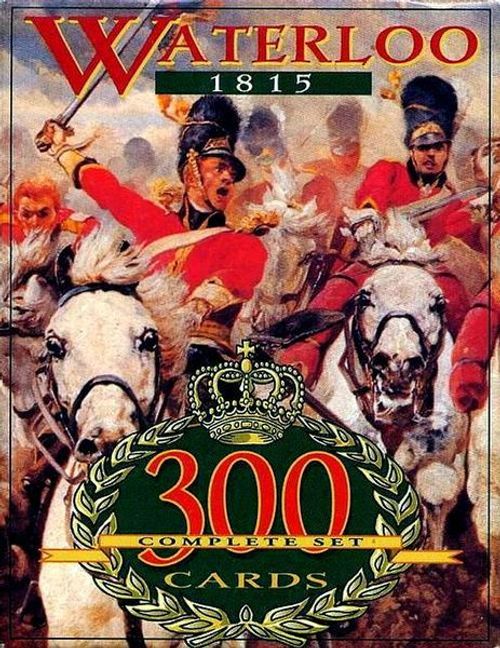
Eagles: Waterloo
Eagles: Waterloo Rulebook
Table of Contents
Table of Contents
- 1.0 The Cards
- 2.0 Battle Decks
- 3.0 Battle Musters
- 4.0 The Battlefield
- 5.0 Battle Turns
- 6.0 Morale
- 7.0 Combat
- 8.0 Battle Moves
- 9.0 Formations
- 10.0 Reinforcements
- 11.0 Terrain
- 12.0 Generals
- 13.0 Special Cards
- 14.0 Decoys (Optional)
- 15.0 Custom Decks
- 16.0 Campaign Game
- 17.0 Historical Notes
- 18.0 Collector Notes
- Napoléon (Related Game)
- Quick Reference Sheet
1.0 The Cards
Each deck contains 60 cards, a random assortment from 300 different cards in the Waterloo series. Cards are numbered 1-300. Card backs are Blue (French), Red (British), and Gray (Prussian). There are six (6) different card types: Generals, Infantry, Cavalry, Artillery (Horse & Foot), Terrain, and Specials.
2.0 Battle Decks
Players form Battle Decks from their available cards. Duplicate cards are prohibited, but see 15.0.
First determine sides and the battle to be played. Consult the Battles Chart to determine the Battle Deck size noted with the code "D". For Quatre Bras, the chart shows French D14 and British D18. Deal out (face-down) this number of cards.
Note: Players can limit Battle Decks to contain only cards that fought in the historical battle, but this is optional, and may be difficult until most cards are collected. However, Terrain cards should always be historical.
Players may vary Battle Deck sizes up/down as they wish, but card ratios must be maintained. That is, Waterloo calls for French D36, British D36, and Prussian D24, a ratio of 3:3:2. Waterloo can be played with 18 French, 18 British, and 12 Prussian cards.
3.0 Battle Musters
Muster, the number of cards a player has to start play, is listed on the Battles Chart as code "M". Hence, M18 means a Muster of 18 cards. From your Battle Deck, deal the specified Muster face-down. The cards remaining in your Battle Deck are placed to one side, face down, as a Reinforcement deck.
Important: if players play with larger/smaller Battle Decks, the specified Musters and Reinforcement rates are altered proportionally. That is, if Battle Decks are doubled, M18 becomes M36, and R1 becomes R2.
Note: In Waterloo games, the Prussians have no Muster; all cards in their Battle Deck are a separate Reinforcement deck.
4.0 The Battlefield
The battlefield (Diagram 2) consists of two opposing Battlelines, separated by a line referred to as the Middle Ground. Each battleline has three (3) Positions, Left, Right, and Center, a total of six (6) Positions. The Middle Ground is not a Position; no cards may be played here, with one exception noted in 11.3.
4.1 Battle Deployment
Examine your Muster cards and then deploy one (1) to four (4) cards, face-down, in each of your three Positions. Terrain and General cards may be deployed in excess of the four card limit per Position provided they are deployed face-up. The remaining cards in your hand are your Reserve. Players may deploy simultaneously, but the French player may adjust last.
4.2 Terrain Deployment
Terrain cards are marked Left (L), Center (C), or Right (R) and can only be deployed in these Positions. They must always be deployed face-up (exception, see 14.0) and cannot be moved. Terrain cards are playable during a game, see 11.0.
4.3 Victory Condition
To win any battle, you must occupy, unopposed, any one (1) of the three (3) enemy Positions with one or more Infantry and/or Cavalry cards. Occupation of an enemy Position by any other card type is not a victory.
Important: victory occurs at the instant of sole occupation of any one enemy Position. This can occur during your turn, or your opponent's turn.
5.0 Battle Turns
The game is played in alternate Battle Turns. The French player has the first turn in all games.
The following three (3) phases, played in the exact order given, comprise a player's Battle Turn:
- Morale: make morale rolls for all friendly cards that took hits last enemy turn.
- Combat: Fire or Move any/all cards as possible. Generally, a card that fires may not move (and vice-versa).
- Reinforce: draw one (1) or two (2) cards (this depends on the side and battle) from your Reinforcement Deck and add to your Reserve.
6.0 Morale
All Troop cards are rated for Morale, a letter code A, B, C, or D:
| Morale | Class | Value |
|---|---|---|
| A | Guard/Elite | 4 |
| B | Regulars/Veterans | 3 |
| C | Regulars/Conscripts | 2 |
| D | Militia/Landwehr | 1 |
During the Morale Phase, cards that received one or more hits during the previous enemy Battle Turn make a 1d6 Morale Roll per hit. Hence, a card with two hits makes two Morale checks.
If the number rolled is equal or less than a card's Morale Value, this hit has no effect and is removed. If any roll exceeds Morale Value, the card is Routed and eliminated.
Example: a card with "A" Morale has two hits. Two dice are rolled each with the following effects:
- 1-4 No Effect
- 5-6 Rout
Important: morale may be modified by supporting General, Terrain, and Special cards. But any natural roll of "6", regardless of modifiers, is always a Rout. Any roll of "1", regardless of modifiers, is a Pass (no effect).
7.0 Combat
Generally, each card may move or fire in a Battle Turn. These options apply to individual cards and players may move or fire cards in any order to exploit any possible advantage.
7.1 Combat Value (CV)
Cards fire individually in any order desired by the firing player. Troop cards (Infantry, Cavalry, and Artillery) have a rated combat value (1-5 cv). To "fire" a card, roll one die per cv. That is, an Infantry 3cv rolls three (3) dice. Any card that fires must be revealed.
7.2 Firepower (F)
Troop cards have a rated Firepower of F1, F2, or F3. Depending on the card's Firepower, certain numbers rolled score hits:
| Firepower | Hit #s |
|---|---|
| F1 | 6 |
| F2 | 5/6 |
| F3 | 4/5/6 |
| F4 | 3/4/5/6 |
7.21 Infantry cannot fire until Engaged. They must first make an Engage move (8.1) and then fire on their next Battle Turn, or fire at (already) engaged enemy cards.
Example: Infantry 3cv rolls 3 dice. Assuming the card is rated F2 and the roll is 2/4/5, the card scores one hit (for the 5). If the card was rated F3, two hits would be scored (for the 4 and 5).
7.22 Cavalry, like Infantry, must engage to fire. They have poor firepower (F1), but much better "Shock". See: 7.3.
7.23 Artillery have different firepowers for long/short range depending on gun type. A card rated F1/F3 has F1 on long range and F3 on short range. Long range allows Artillery to fire across the Middle Ground into enemy cards in the opposing Position, except they may not fire Long if their own Position is engaged, or if the enemy Position is engaged by friendly cards. Artillery must be revealed to fire, as must any cards they hit. Short range is firing at engaging enemy cards.
7.24 Horse Artillery have the unique ability to Move & Fire (not Fire & Move). The Move can be to Engage. They never get two moves.
7.3 Shock (S)
Infantry & Cavalry have Shock from S2 to S4. Shock functions just like Firepower (F3 is the same as S3) but has some restrictions.
7.31 Cavalry are immediately "Blown" (turn card sideways) when they use Shock; thereafter, they can only fire at F1 until they Disengage (or are Disengaged) allowing them to recover and use Shock again on their next combat turn. Engaged Cavalry have the option to employ Fire and save their Shock.
7.32 Infantry can only employ Shock when deployed in Column (9.2). They can employ Shock any number of times in the same engagement. Infantry in Column may be targeted at +1F by enemy Artillery. Infantry in Column have the option to fire at F1 instead of using Shock.
7.33 Shock may never be used against Infantry defending a Building, nor against Infantry in Square (see: 9.3).
7.34 Infantry can never Shock Cavalry. Cavalry may only Shock enemy Cavalry that are "blown".
7.4 Targeting
When Firing or employing Shock, each card must target a specific enemy card. All hits scored are applied only to the targeted card. Once an enemy card takes one or more hits, it cannot be targeted again this combat turn until all enemy Troop cards in the same Position have been hit. Thereafter, any enemy card may be targeted as often as possible.
Important: Infantry may target engaged Artillery at +1F or +1S (S3 becomes S4, etc.)
8.0 Battle Moves
Each friendly card can make one Battle Move to an adjacent Position. Legal moves are shown in Diagram 3. Note that lateral or diagonal movement is prohibited.
Cards are moved individually, one by one, in any order. Stacking Limits (8.4) are ignored until all movement is completed.
8.1 Engaging
Cards Engage when they move to a Position containing enemy cards. All engaged cards (both sides) are revealed by turning them face-up (after all movement is completed). Foot Artillery can never Engage (but can be Engaged). Horse Artillery may engage (and fire).
Important: Once cards are revealed, for whatever reason, they remain face-up until moved to the Reserve.
8.2 Disengaging
Moving engaged cards to an unengaged, friendly Position.
8.3 Cavalry/General Moves
Cavalry and Generals can make two (2) consecutive battle moves in one turn, but they may not Engage and Disengage (or vice-versa) in the same turn, nor move through an engagement.
8.4 Stacking Limits
A maximum of four (4) cards (per player) can be located in any one Position. Exceptions: (1) General, Terrain, and Special cards never count for stacking, but such cards must always (see 14.0) be deployed face-up; (2) The Reserve has no stacking limit.
9.0 Formations
Infantry cards can be in one of three formations: Line, Column, or Square. They are assumed to be in Line, unless identified with a Column or Square marker.
Engaged Infantry must expend a Move to change formation. Unengaged infantry can Move (even to Engage) AND change Formation. Hence, Infantry may Move from the Reserve to their Center in any formation, even if a Square and even if Engaging.
9.1 Line
Infantry in Line fire normally. They cannot employ Shock, but may be targeted for Shock.
9.2 Column
Infantry in Column can employ their rated Shock, or they can Fire at F1. Columns may be targeted by enemy artillery at +1F (artillery rated F1/F3 fire on Columns at F2/F4). Columns are targeted by Cavalry or Infantry for Fire or Shock at normal levels.
9.3 Square
Infantry in Square can move and engage normally, have F1 Fire (no Shock), but have +1 Morale. Squares cannot be targeted for Shock by any card, but may be targeted for Fire (+1F if artillery). Hence, Cavalry cannot Shock a Square (but may fire on it at F1) and artillery rated F2/F3 may target Squares at F3/F4.
10.0 Reinforcements
For the last step in a Battle Turn, draw one (1) or two (2) cards from your Reinforcement deck (the amount is indicated by code "R" on the Battles Chart) and add to your Reserve. These cards cannot be played until your next Battle Turn, except for a Special Card playable on an Enemy Turn.
In Waterloo games all Prussian cards enter play as Reinforcements. They are added to the British Reserve like other Reinforcements, but cannot be played until a Prussian General is drawn (and revealed). Prussian cards are restricted to the British Left and the French Right.
11.0 Terrain
Terrain cards are Battle and Position specific; Hougoumont can only be played in a Waterloo battle in the British Right Position. Two terrain cards exist for the same Position in some battles; both may be played.
Terrain cards provide their defensive benefits to one (1) or two (2) troop cards, which must be deployed overlapping the Terrain card to indicate occupation. Terrain cards may be played before or during a Battle, but only in friendly unengaged Positions and always (see 14.0) face-up. Four types of Terrain exist:
11.1 Hills
Add one (+1) cv to Defending cards for Fire or Shock. Hence, an Infantry 3cv defending a Hill fires at 4cv, and an Artillery 2cv fires at 3cv at long or short range. Attacker cv is normal.
11.2 Woods
Only Infantry can defend or attack Woods. Normal Fire or Shock may be employed, but Attacking Infantry are -1cv.
11.3 Rivers
This terrain class includes Bridges and has a noted Move Limit of one (1) or two (2) cards per Battle Turn. When a River card is deployed it is moved to the Middle Ground between the two opposing Positions and becomes a barrier for both sides. Players seeking to cross the River, whether to Engage or Disengage, must obey the stated Move Limit each Battle Turn. Generals and Special cards are exempt from Move Limits.
11.4 Buildings
A terrain class that includes farms, villages, etc. Only Infantry can defend Buildings. Cards in a Building can only Fire; they cannot employ Shock, nor may they be attacked with Shock.
11.5 Capturing Terrain
If a Terrain card is currently vacant, or its defenders Rout during a Morale check, the Terrain is immediately captured by engaging Infantry (if any). Rotate a Terrain card to face the player who now occupies it.
Troop cards may occupy a vacant Terrain card, including one just played this turn. but this is a Move. Hence, a card can be played from the Reserve to occupy a vacant building that has just been played.
12.0 Generals
Generals may make one or two Battle Moves, but cannot disengage and engage (or vice-versa) in the same turn. They never count for stacking, and must be deployed face-up. Generals also ignore Movement Limits of Rivers. Only one (1) General may occupy each Position.
12.1 Command
Generals have Offense/Defense ratings. A card rated 2/1 has an Offense rating of "2" and a Defense rating of "1". Generals do not affect Fire or Shock combat; they provide "morale support" to friendly Troop cards in the same Position.
- Attack: add the Offense rating to Morale of friendly cards when attacking a Position.
- Defense: add Defense rating to Morale of friendly cards when defending a Position.
12.2 Corps Integrity
The Morale benefits of a General are limited to Troop cards of the same Corps. Cards of other corps may exist in the same Position, but they do not get a Morale benefit.
Some Generals (those noted Corps "A") are Army Commanders (Napoléon, Wellington, and Blücher) or special high ranking generals such as Ney. These leaders provide morale support to any cards regardless of Corps ID, except that Prussian generals can never assist British cards (or vice-versa).
12.3 Chiefs of Staff
The French and Prussian armies have a special Chief of Staff General, namely Soult (French) and Gneisenau (Prussian). These men are Army Commanders only when their respective commanders are absent or dead. Otherwise, they must be kept in the Reserve.
Note: The British second in command was Lord Uxbridge, commander of the British cavalry. He functions as the British Army commander if Wellington is absent or killed.
12.4 General Hits
A General takes one (1) hit for each "1" rolled during enemy fire or shock at his Position. For each hit, roll 1d6 during the Morale Phase, before all other Morale checks:
- 1-5 No Effect
- 6 Killed
Note: If Generals are alone in a Position and engaged, they are eliminated immediately.
13.0 Special Cards
Special Cards (crown symbol) modify the normal rules of play. Their effect is printed on each card.
Special cards are played direct from your Reserve to a Position and their effect (generally) only applies to the turn played. A maximum of two Special cards can be played on the same Position at the same time (phase) and these must be two different cards.
Prussian Specials in Waterloo can only be played after the Prussians arrive, only in a Position containing Prussian cards, and only to aid Prussian cards. British Specials may only be played in a Position containing British cards and only to aid British cards.
14.0 Decoys (Optional)
General, Special, and Terrain cards are normally played face-up, but may be deployed face-down in any unengaged Position as a "decoy". They are subject to automatic elimination if targeted and hit by enemy artillery, or if engaged by any enemy card, even if friendly troop cards are present.
15.0 Custom Decks
Duplicate cards may not exist in a Battle Deck except when players use Battle Points to build custom Battle Decks.
All cards are rated for Battle Points (BPs), an assessment of value in game play. All battles have a rated BP value per side. Players may stock a Battle Deck with any number of cards provided the deck does not exceed this total BP value. Up to three (3) duplicate cards can exist in a Custom Deck, except Generals and Terrain cards can never be duplicated. Musters should equal 50% (round down) of the custom Battle deck size. BP totals may be scaled up/down proportionally for larger or smaller battles.
16.0 Campaign Game
This game requires all (or most) of the 300 cards in the Waterloo series. First, separate the cards into Quatre Bras and Ligny Battle Decks for each army, excluding all cards not present at either battle.
Quatre Bras and Ligny are played as two simultaneous battles. Play sequence is Quatre Bras (French/British) and then Ligny (French/Prussian).
The Musters for each battle are 50% of the respective Decks. Reinforcement rates (assuming most cards are in play) are double the rates note on the Battle Chart.
All cards eliminated during play are eliminated for the entire campaign. However, a player facing certain defeat in one battle may retreat all surviving cards from a battle after their Morale Phase (before Moving or Firing any cards). Such cards will be available to fight a future battle, but Retreat concedes a victory to the opposing player.
When a player wins one battle, all enemy cards MUST immediately Retreat (after making any necessary Morale checks) AND, each engaged card must survive another Morale check. The victor may use surviving cards (including reinforcements) to reinforce the other battle as normal. Hence, if the French win Quatre Bras, they add (reshuffle) surviving cards to their Ligny Reinforcement deck.
If the French lose both battles, they lose the campaign.
If the French win both battles, Wavre and Waterloo are now played simultaneously. Use all surviving cards, adding Waterloo cards not yet in play. Separate the cards into Waterloo (Prussians as Reinforcements) and Wavre Decks and start play with the normal 50% Musters. The winner of Wavre may reinforce Waterloo. The winner of Waterloo wins the campaign.
If the French lose one of the first two battles, a (non-historical) Battle of Charleroi is played in which all surviving cards (including Waterloo and Hal cards) can participate. Muster is 50% and Reinforcements are R2 British and R2 Prussians (separate decks), and R3 French (one deck). The winner of this battle wins the campaign.
17.0 Historical Notes
17.1 Troop Cards
Each infantry card depicts one battalion, but represents one French or British brigade, or one Prussian regiment. Each cavalry card depicts one regiment, but represents one British or Prussian brigade, or one French division. Each Artillery card represents 2-4 batteries of guns. Generally, 1cv equals 800 Infantry, 400 Cavalry, or 6-8 guns.
17.2 Morale Values
Morale ratings in Eagles reflect training, experience, and tenacity. We have rated the Prussians higher than normally found in Waterloo games because of their tenacity after defeat at Ligny. Conversely, French morale is rated lower since their initial high morale proved to be fragile.
Half of the forces commanded by Wellington were Belgian, Dutch, and Hanoverian troops that fought for Napoléon in prior years. Their tenuous loyalty to the Allied cause is reflected in low Morale ratings.
17.3 Generals
Only French and Prussian Corps and Army commanders are depicted in the game. Wellington's army had a Corps structure based more on Anglo-Dutch politics than military reality. The powerful First Corps was "officially" commanded by the Prince of Orange, the inexperienced 22 year old heir to the Dutch throne. For play balance, division commanders have been added to the Anglo-Dutch OB.
Generals marked with a White Star were wounded during the campaign; those with a White Cross were killed (or mortally wounded). These symbols have no game effect.
17.4 Orders of Battle
Each Troop or General card has a historical O/B reference in the upper right margin, listed right to left as Corps/Division/Brigade. Hence V1/21/Penne indicates VI Corps, 21st Division, Penne's Brigade. Some units, like the British cavalry, did not have a division structure, so they are listed only as Corps/Brigade.
18.0 Collector Notes
There are 110 French, 90 British, and 100 Prussian cards in the Waterloo series. The table below gives the respective total numbers of each card type.
All cards are printed in three versions: Gold, Silver, and Bronze, distinguished by metalic inks in the Oval border and Combat/Morale boxes. For example, there is a gold Napoléon, a silver Napoléon, and a bronze Napoléon.
This color-coding has no effect on game play, but Gold cards are rare, Silver cards are uncommon, and Bronze cards are common. The approximate ratios are Gold 10%, Silver 30%, and Bronze 60%.
Napoléon (Related Game)
If you have enjoyed Eagles, you may also enjoy Napoléon, our board game covering the Waterloo Campaign. This game allows you to maneuver forces on a game map of southern Belgium, then resolve your battles with Eagles cards by substituting 1cv = 1 card.
Quick Reference Sheet
Infantry
| Formation | When Being Targeted | When Targeting |
|---|---|---|
| When in Line | Normal | Fire only/No Shock; +1 Fire at artillery |
| When in Column | Artillery Fire at +1F | Shock OK/Fire at F1; Cannot Shock Cavalry; +1 Shock/Fire at artillery |
| When in Square | Cannot be Shocked; Artillery Fire at +1F; Morale +1 | Fire at F1/No Shock |
| Hills | Normal | When defending +1 CV |
| Woods | Attacking Inf. Fire & Shock at -1 CV | Fire & Shock at -1 CV |
| Buildings | Fire only/No Shock; Must be in Line | Fire only/No Shock |
Cavalry
Does Not Change Formation.
| Terrain | When Being Targeted | When Targeting |
|---|---|---|
| Hills | When defending +1 CV | |
| Woods | Cannot be in woods | Cannot attack woods |
| Buildings | Cannot be in buildings | Fire only/No Shock |
Note: May only target blown cavalry for Shock. Blown cavalry may only Fire at F1 until recovered. Cavalry recovers from being blown at the instant that it is no longer engaged.
Artillery / Horse Artillery
Does Not Change Formation.
Engaged infantry Fire & Shock at +1 (except when in square).
| Terrain | When Being Targeted | When Targeting |
|---|---|---|
| Hills | When defending +1 CV | |
| Woods | Cannot be in woods | Cannot attack woods |
| Buildings | Cannot be in buildings | Fire only/No Shock |
Note: Artillery and horse artillery never may use Shock. Foot Artillery cannot move to engage; horse artillery can engage. Horse artillery can move and fire in the same turn.