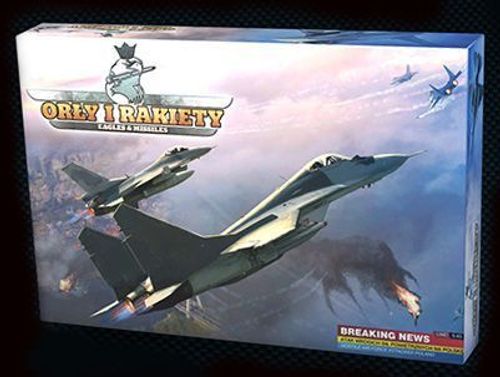
Eagles & Missiles
Eagles & Missiles Rulebook
Table of Contents
Table of Contents
I. Game Components
- A game board, representing Poland and neighboring countries. The board contains fields for three separate decks of cards representing Polish, NATO and Russian forces, respectively. Also there is a field for a single card representing Russian fleet. Additionally, there are airfields and "cities" placed on the board – in reality they represent industrial facilities and military factories on the territory of Poland. Finally, the arrows on the board represent the Russian plans for a land invasion on Poland.
- Three decks of cards (Russian assault, Polish and NATO reactions).
- A set of counters representing air force squadrons, anti-aircraft units and ruins.
- The Baltic Fleet card.
- Two d6 dice.
- One reference sheet for the players.
II. Game Objectives
The objective for the Russian player is to either destroy or capture as many of the "city" fields on the Polish territory as possible. The Polish player has to stop the enemy by any means necessary and prevent the destruction of the Polish economical and defense potential.
III. Before You Begin
- Both players shuffle their decks and place them on the appropriate fields on the board.
- The Russian player places all 22 air force counters – with the red star emblem on the reverse – on the right side of the board (in the Russian pool).
- The Polish player places 4 green counters, representing anti-aircraft units, on designated fields in the borderlands: in Central Pomerania, Warmia, Podlasie region and the Lublin Province. The remaining three blue counters, representing air defense units, can then be placed anywhere on the Polish territory.
- The Polish player places the air force squadron counters in the following air bases:
- 2 squadrons of Su-22 in Świdwin
- 1 squadron of MiG-29 in Malbork
- 1 squadron of MiG-29 in Mińsk Mazowiecki
- 1 squadron of F-16 in Łask
- 2 squadrons of F-16 in Krzesiny
IV. Turn Sequence
Each turn is divided into four phases:
A. Russian Phase B. Polish Phase C. Resolution Phase D. AA Unit Movement
A single turn represents 24 hours of battle.
A: Russian Phase
- The Russian player first checks the number of active invasion lines. These are represented by yellow arrows on the board, marked with numbers from I to IV. (Note: an invasion line is considered active when all designated territories on this path have not been captured yet. Additionally, invasion line I can be eliminated by destroying the Baltic Fleet.) The Russian player draws one "Russian assault" card from the respective deck for each active invasion line.
- Optionally, the Russian player can draw up to three additional "Russian assault" cards.
- Next, the Russian player places the assault cards on the invasion lines. At least one assault card must be placed on each active invasion line; however, the player may choose to place up to two cards on each active line (with the exception of Central Pomerania, where only one card can be placed). Simultaneously, missile attack cards are placed – the Russian player is free to choose any fields on the board.
- The Russian player adds up all the fighters and bombers from the assault cards placed on the board. Next, an adequate number of fighter and bomber squadrons is chosen from the Russian pool.
- Finally, the Russian player places the selected air force squadrons on chosen territories in Poland, Czech Republic and Germany.
B: Polish Phase
-
The Polish player begins this phase by drawing cards from the NATO deck – one plus the number of additional number of cards drawn by the Russian player.
For example: The Russian player draws 7 assault cards – 4 active assault lines + 3 additional cards. Result: the Polish player draws 4 cards this turn – 1 + 3 for "additional" Russian assault cards.
-
The NATO cards are revealed immediately after drawing and their effects are brought into the game one after another.
-
The Polish player then draws 2 cards from the Polish deck (with red and white chessboard emblem on the reverse). Those cards are not revealed to the Russian player and can be played once each game, at any time – they are removed from the game afterwards.
-
Anti-aircraft defense. The Polish player can fire at selected Russian squadrons in each field containing an anti-aircraft unit counter.
-
Next, the effects of Russian missile strikes are being resolved.
-
Finally, the Polish player places the squadrons on any fields on the map (in Poland, Czech Republic and Germany) and designates targets to attack (an enemy squadron, fleet or an assault card).
C: Resolution Phase
- The Polish player chooses the order in which aerial combat is resolved. The Polish air forces that have not been shot down this turn return to any free airfields.
- Those Russian assaults which could not be stopped allow the Russian player to conquer the territory. A conquered territory is marked by placing the used assault card on it (reverse up). All cities, airfields and Polish squadrons assigned to them that are on the conquered territory are destroyed.
- Russian bombers destroy the chosen airfields or anti-aircraft tokens on each field they were sent to.
- Surviving Russian aircrafts return to the Russian pool.
D: Anti-Aircraft Unit Movement
- The Polish player can move each blue anti-aircraft unit (AA) by one field.
The game ends when the Russian assault deck is empty.
V. Movement
-
The movement of air force squadrons is not limited in any way – they can be freely placed in Poland, Czech Republic and Germany.
-
Blue anti-aircraft units can move by one field in any direction at the end of each turn. (more about anti-aircraft units in chapter VII)
-
When a territory is conquered by the Russian player, all Polish anti-aircraft units on that territory have to withdraw (move by one field) immediately. They are forced to move away from the assault line, in the opposite direction.
Example: The Russians have conquered the Podlasie Region. The anti-aircraft unit stationed in that region is therefore forced to withdraw to Mazovia (by one field, in direction opposite to the Russian assault line). If Mazovia falls in a consecutive round, the AA unit must withdraw to Łódź (again – by one field, in direction opposite to the assault line).
VI. Combat
Combat is resolved in the following way:
Both players roll a d6 dice and add the result to the strength of their units. The player with the higher score wins.
Combat order:
The Polish player chooses the territories where combat is resolved. The following resolution order is mandatory on each territory:
- Fighter combat,
- Attack against enemy bombers,
- Attacks against ground targets.
Each squadron has two parameters:
- Aerial combat strength,
- Ground assault strength.
Aircraft Strength Table
| Aircraft type | Aerial combat strength | Bombardment strength | Special rules |
|---|---|---|---|
| Su-27 | 5 | 3 | – |
| MIG-29 | 4 | 1 | – |
| Su-24 | 2* | 5 | Strategic bombardment |
| Su-25 | 1* | 4 | – |
| Tu-22M | 3* | 12 | Strategic bombardment |
| Aircraft type | Aerial combat strength | Bombardment strength |
|---|---|---|
| MIG-29 | 4 | 1 |
| Su-22 | 1 | 4 |
| F-16C | 5 | 5 |
| JAS-39 Gripen | 5 | 4 |
| Eurofighter | 6 | 5 |
| L-159 Alca | 2 | 3 |
| F-15E | 5 | 6 |
| F-22 | 10 | 3 |
* If this bomber wins in combat, the fighter attacking it is not destroyed – it returns to the airfield and the bomber "break through" the attack and can still bomb the designated target.
1. Aerial Combat
a) The aerial combat over a territory is resolved as a series of duels between opposing aircraft squadrons. The aerial combat strength parameter is used for resolving this type of combat.
Example: There are two squadrons of Russian Su-24 and two squadrons of Polish F-16 over a certain territory. Therefore, two duels between the F-16 (aerial combat strength = 5) and Su-24 (aerial combat strength = 2) are resolved.
b) *The Polish player can assign two squadrons to engage one squadron owned by the enemy. This is a good method for ensuring the destruction of the Russian squadron.
Example: Two F-16 squadrons both attack a single Su-24 squadron and ignore the other one. Their combined aerial combat strength is 10 against the strength of Su-24 = 2. No dice roll can save the Russian squadron.
c) The Russian player cannot assign two squadrons to attack a single NATO one. This is due to inferior technological level in radio-electronic combat and data exchange systems.
d) If any squadron lost the aerial combat, it is considered "destroyed" and is put away on a separate pile. The number of squadrons destroyed on both sides is important when counting up victory points and finding out who wins the game.
e) Victorious squadrons return to the Russian or NATO pool (respectively), or to the airfields (in case of Polish aircrafts). They are considered to have run out of ammunition and cannot act this turn.
f) Number on airfield is the number of squadrons which can be place there. If there is no room for squadron on board then it is destroyed.
g) In case of a draw both squadrons return to their pools / bases and cannot act this turn.
2. Ground Assault
Our primary objective is to approach as low as possible and drop our cargo where we were ordered to do it. It's hard to predict what happens after that. Perhaps we'll make it back home. – Su-22 squadron leader
a) Only the Russian forces can conquer territories in the game – this is represented by the assault cards:
[Illustration: assault card showing "Assault strength" (the number at top), "Numbers of fighters" and "Numbers of bombers" (the icons at bottom).]
b) The ground assault strength on a specific territory is represented by the statistic on the assault cards (or a sum of both cards) aimed at this territory.
c) Two factors are taken into consideration when trying to stop the assault – the strength (or sum of strengths) of Russian assault cards on a territory and the sum of bombardment strength of Polish aircrafts attempting to stop the assault. A dice roll is added to both the attacker's and defender's strength.
Example: there are two assault cards aimed at Podlasie, with strength 8 and 3. Therefore, the total strength of the Russian attack on this territory is 11. Two squadrons of Su-22 (their bombardment strength statistic is 4 each) and a squadron of F-16 (bombardment strength 5) try to stop the assault. Their combined bombardment strength is therefore 13. Both sides roll a dice. The result on both dice is 3. The Polish side wins: 13+3 = 16, against the Russian result, which is 11+3=14. Both assault cards are removed from the game and the Polish aircrafts return to their bases.
d) Note: the assault cards are removed from the game regardless of the result of the assault. The only use for them after the assault is to mark a conquered territory by placing the card on it, reverse up. If the result was a draw, the ground assault is stopped.
e) Supporting the assault. Ground assault may receive assistance by Russian squadrons. If the player chooses to do so, the squadrons are placed on the assault cards – each assault card may be supported by only one squadron. The bombardment strength of the squadron is then added to the ground assault strength on the assault card.
Example: Podlasie is being attacked with the assault strength of 3. The assault is supported by a squadron of Su-25 (bombardment strength 4). Therefore, the combined strength of the assault is 7.
f) If the supporting squadron is destroyed or forced to retreat, its bombardment strength is not added to the strength of the assault.
g) If the assault supported by a Russian squadron is stopped and the supporting squadron has not been shot down, it returns safely to the Russian pool. In other words – the fact that the assault failed does not affect the squadron's condition.
3. Escort
a) Russian fighter squadrons can be assigned to escort the bombers or protect assaults or the Baltic Fleet. This is represented by placing fighter counters on the territories where the protected units are.
b) Bomber squadrons, assault cards and the Baltic Fleet cannot be attacked as long as the escorting squadron is not engaged by at least one Polish or NATO squadron.
Example: a Su-24 bomber squadron is escorted by two MiG-29 squadrons. The F-16 and Eurofighter have to attack the Russian MiGs. This allows the Gripen to attack the bomber squadron.
4. Bombers
a) Bomber squadrons in aerial combat. Su-22, Su-24, Su-25 and Tu-22 are bombers. This is represented by red and blue frames on their counters. Their victory in aerial combat does not lead to destroying the enemy; a victorious bomber squadron is considered to have eluded the enemy and is free to continue the mission. A fighter squadron which failed to destroy the bombers simply returns to the airfield.
b) Strategic bombardment. Su-24 and Tu-22 have the capacity of strategic bombardment. Each of these squadrons that is not destroyed or forced to retreat can – at the end of the turn – destroy a field of player's choice (city or airfield) or an anti-aircraft unit on a territory the squadron was initially sent to. All the squadrons stationed on the airfield which was destroyed by these bombers during strategic bombardment are automatically destroyed.
c) Aircraft used to support ground assault cannot perform strategic attack.
VII. Anti-Aircraft Units (AA)
I don't know how it works, I don't know how to fly this, but I sure know how to blow it up. – saying of Polish AA personnel
- The anti-aircraft units cannot destroy the whole squadron counter – it can only force the squadron to retreat.
- Each AA unit designates the target it wants to fire at. The AA unit can attack only those squadrons that were assigned to the territory the AA unit counter is on.
- Movement of green AA units – check chapter V, s. 3.
- AA units colored in blue can be placed anywhere in Poland in the beginning of the game. They can move by one territory in any direction in the end of every turn (check turn sequence).
- The "4+" parameter means that on each dice roll, when the result is 4, 5 or 6, the targeted squadron is automatically forced to retreat and return to the Russian pool.
- You can have any number of AA units on a single territory. Their effects cumulate and this territory is better protected.
- An American unit, armed with Patriot missiles, can force the enemy squadron to retreat on a dice roll of 2+. Alternatively, it can choose to eliminate a missile assault on this territory, also on a dice roll of 2+.
- Air defense units stationed in Central Pomerania are able to attack fighters which are defending Baltic Fleet.
VIII. NATO and Russian Pools
- The NATO and Russian pools represent airfields located away from the war zone. Those airfields cannot be a target of an attack.
IX. NATO Reaction
- In response to the Russian invasion the NATO may temporarily assign their squadrons under Polish command.
- NATO has assigned two airfields in Germany and one in Czech Republic to support Polish forces. Since only the F-16 aircrafts are compatible with western airfield infrastructure and equipment, only those squadrons can use them.
- If, at any point, the Russian player attacks any airfield in Germany or Czech Republic, all NATO air counters not yet engaged in the conflict enter play immediately.
X. The Baltic Fleet
Flights over the sea are among the longest and most difficult. Not only you have to wear the safety vest, but you also really need to remember to visit the toilet before the trip. – F-16 pilot
-
The starting strength of the Baltic Fleet is 10.
-
During the assault from the Baltic Fleet on Central Pomerania the strength of the fleet is not taken into consideration. The Polish player has to defeat the Baltic Fleet to stop this line of assault.
-
The Baltic Fleet can be weakened permanently. Each time it loses combat with Polish squadron, the strength of the Fleet is reduced by the number it lost combat by.
Example: The Baltic Fleet (strength 10) has been attacked by 2 Su-22 squadrons and 1 F-16 squadron (combined bombardment strength = 13). Both players roll a dice and both have the result of 2. Therefore, the Baltic Fleet has lost by 3 points and the Fleet's strength is reduced by 3. Starting from this point, the strength of the Fleet is 7 (10-3). Additionally, since the fleet has been defeated this turn, the assault on Central Pomerania has been stopped.
-
If the fleet's strength is reduced to 0 or less, the fleet card is removed from the game. Additionally, the assault line I becomes inactive. This affects the number of assault cards the Russian player draws each turn.
-
Losing the Baltic Fleet costs the Russian player 2 victory points.
-
If the Baltic Fleet is destroyed but the assault coming through line I has already been successful, then the next assault on line I commences this turn as normal. However, beginning with the next turn, this attack line becomes inactive.
-
The Baltic Fleet can be escorted by fighter squadrons, but it cannot receive any support from bomber squadrons.
-
Marking the strength of the fleet: if the Fleet's strength is 10, the card representing the fleet is turned on the side with numbers 6-10. The right edge of the card should be at the same level as number 10 [5]. If Fleet's strength drops to 9, the card representing it has to be moved left by one field, over the number 9 [4]. When the strength drops to 5, the card is turned upside down, with the right edge again placed on the 10 [5] field. Additional loses mean the card moves to the right.
XI. Missile Attack
The missile attack card can be placed on any territory in Poland, Germany or Czech Republic.
XII. Victory Conditions
When it comes to new trends in technology and tactics, the US are the main player. We do have a mutual understanding with them. It's quite possible that they'll come here to train with us. – F-16 pilot. Two weeks before the invasion.
At the end of the game both players sum up their achievements.
The Russian player gains:
- 1 point for each "city" field destroyed (both through air strikes and ground assaults);
- 1 point for each 3 Polish, NATO and AA units destroyed;
- 2 point for conquering all Polish territories on the sea coast and cutting Poland off the sea;
- 2 points for conquering all territories on the German border and cutting Poland off the West;
- 1 point for completing each assault line.
The Russian player gets the following penalties:
- -2 points if the Baltic Fleet is destroyed;
- -1 point for each 3 Russian squadrons destroyed (each Tu-22M counts as 2 squadrons).
If the final score is more than 10, the Russian player wins. This means the Polish military potential has been defeated and NATO has to seriously consider getting into a costly, long war.
XIII. Playing with 3-4 Players
a) Two players can play on the Polish side. If they wish to do so, then one player commands the squadrons originating from the east (Su-22 and MiG-29) and the AA units. The other player takes command over F-16 squadrons and all the aircrafts send by NATO as support. Players draw the NATO cards together and each of them draws one card from the Polish deck each turn.
b) Analogically, two players can also play the Russian side. In this case, one of them takes command over assault lines I and II, and the other one – assault lines III and IV. Both players can use those squadrons they received from the assault cards and can put them on the board freely (for example – one player can support the assault of another). When drawing additional assault cards, the Russian players take turns – the player who controls assault lines III and IV draws first.
Aircraft Notes
"Few people realize that Poland is a regional empire. When Polish soldiers find themselves under enemy fire, they don't drop on the ground – they kneel down and fire back. Their Air Force is numerous and as modern as the country's economy can keep..." – fragment of an article regarding the state of Polish army, from a Czech newspaper
MiG-29A arrived to the Polish Air Force in 1989, in Mińsk Mazowiecki. This is where the first 12 aircraft of this type were tested. The Soviets wanted to sell additional 36 of those aircrafts to Poland, but the politicians of the newly formed 3rd Republic refused, giving "poor economic condition" as the reason. In time, more of these aircrafts appeared in Poland. In late 90s the Czechs traded 10 of them for 11 brand new W-3 Sokół helicopters. At the start of the XXI century, Poland received 23 MiG 29 A from Germany, for a symbolic price of 1 euro each. Today those aircrafts are stationed in 2 air bases – in Malbork and Mińsk Mazowiecki. They are currently going through modernization process. The plan is to keep these machines on active duty until the 30s of this century.
Su-22 M4 arrived in Poland in mid-80s as the "super weapon" for the Third Word War. It has never been modernized and today it is just a relict of the past. However, it is still capable of carrying up to 5 tons of armament. According to official data, the Polish Air Force currently has 32 of those aircrafts, organized into 2 squadrons, stationed in the Świdwin air base in the Western Pomerania district. It is believed however that the Polish hangars secretly keep more of them – there were 120 of them in the past! Many of them could be restored to active duty in case of war. Additionally, Su-22 is the most commonly used aircraft during training ground practices.
F-16C Block 52+ is not based on the technology from the 70s. Except for the hull, this is a brand new machine, equipped with modern radar, electronics and data exchange protocol Link 16. No F-16 in any version has ever been shot down in aerial combat. After Poland purchased this machine, several other countries, with highly renowned armies, made the same choice – Greece and Israel among them. Contrary to popular belief, the F-16 was indeed the best choice offered for tender on Polish multitasking aircraft – even better than the highly modern JAS-39 Gripen, which was designed as a fighter and has a much lower carrying capacity.