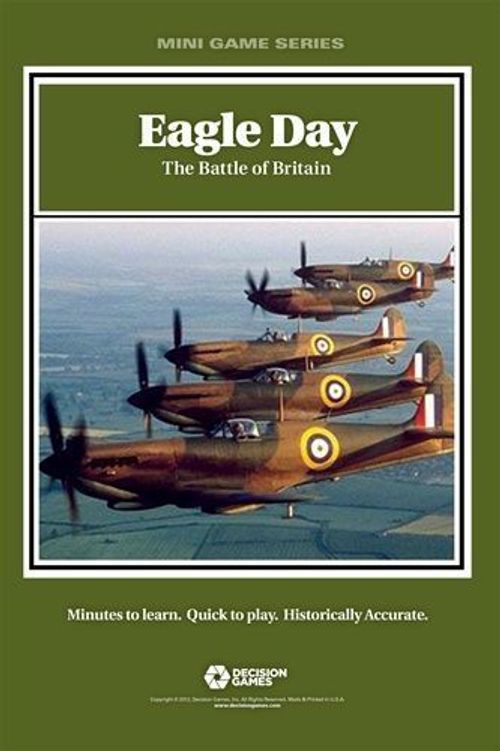
Eagle Day: The Battle of Britain
Eagle Day: The Battle of Britain Rulebook
Table of Contents
Table of Contents
- Part 1: Air Wars Mini Game System Rules
- 1.0 Components
- 2.0 Introduction
- 3.0 The Map
- 4.0 Charts
- 5.0 Target Sheet
- 6.0 Air Units
- 7.0 Ground Units
- 8.0 Campaign Cards
- 9.0 Players
- 10.0 How to Play
- 11.0 The Campaign Cards
- 12.0 Reinforcements & Refits
- 13.0 Redeploying
- 14.0 Stacking
- 15.0 Air Basing
- 16.0 Sorties
- 17.0 How to Fly Units (Movement)
- 18.0 Air to Air Combat
- 19.0 Anti-Aircraft (AA) Fire
- 20.0 Bombing
- 21.0 Strafing
- 22.0 Fog of War
- 23.0 Radar
- 24.0 Headquarters Units
- Part 2: Eagle Day Scenario Rules
Part 1: Air Wars Mini Game System Rules
1.0 Components
This Mini Game is complete if it includes: 40 game pieces (units), 18 campaign cards, one 11x17" map and this rules & scenario sheet.
Players will need to provide themselves at least one die (two per player is ideal) to play the game. Players will also need a pencil and paper to record various game functions.
2.0 Introduction
Air Wars is a wargame system of air campaigns. There are two players, designated by the scenario. Each player has his own game pieces, called "units," representing formations of aircraft and air defense forces. Players move their units, conduct air-to-air battles, and bomb ground targets in an attempt to win the scenario.
Each player has a set of Campaign Cards. Players use the cards to take special actions (to be explained later).
This booklet is the "system rules." These are used for all air warfare games of this series. The scenario sheet gives the rules for the specific game being played.
The following game terms are defined as follows.
- Enemy. All units belonging to the other player.
- Friendly. All units belonging to you.
- Pick at Random. Choose by making a random (blind) draw of a card or unit.
- Select. Deliberately choose a card or unit of your choice.
3.0 The Map
The game map shows the theater of operations in which the actual campaign took place. The map has the following features:
- Grid. These are the square spaces. The specific types of grid squares are shown in the scenario rules and on the Terrain Effects Chart. Units are placed and then moved on the grid.
- Reinforcement Box. Place units here that are not yet in play but are scheduled to appear.
- Abort Box. Place units here that have received "Abort" results in combat.
- Command Level. This indicates the current command level for an air force. This determines the number of cards to be drawn and the air stacking limit for that air force. This can potentially change during the course of a game.
- Damage Box. Place units here that have been destroyed via combat (or other game actions). They are out of play, but can potentially be returned via refit (see below).
4.0 Charts
The map includes several charts.
- Combat Results Tables (CRT). The CRT is used to resolve air combat, anti-aircraft (AA) fire and bombing attacks.
- Terrain Effect Chart (TEC). The TEC shows the effects of the various map grids.
- Turn Record Track. The Turn Record Track is used to record the current day and hour with the Turn marker.
5.0 Target Sheet
This lists the various targets on the map. As targets are bombed, players should make note of it with pencil. Players can photocopy the Target Sheet for game use.
6.0 Air Units
There are three basic types of air units in the game: bombers, fighters and decoys. Certain games will have additional special units.
The printed numbers on the game pieces are, from left to right.
- Air Combat Value. This is the number of combat dice that the unit is eligible to roll (fire) when engaged in air-to-air combat.
- Bomb Value. This is a number of bomb symbols. It is the number of bombing dice the unit can roll when attacking (dropping bombs on) a ground target.
- Speed. This is how many grids the air unit can move (in one hour). If the number is parenthesized, then the unit is short ranged, which means that it must land at a friendly base during the following turn after it has launched.
- Backprinting. The reverse of the counter shows the air unit when it is based (landed at an airbase or aircraft carrier).
- Identification. This is the unit type, which determines specific unique capabilities, as explained later. They are: B = Bomber; F = Fighter; FB = Fighter Bomber; D = Decoy.
Some units will have a number following the type, representing the unit's historical formation (or an ahistorical numbering system).
7.0 Ground Units
Ground units represent installations and defenses.
- Antiaircraft unit. Antiaircraft units (AA) are printed with an anti-aircraft value.
- Headquarters unit. HQ units enhance certain game functions.
7.1 Backprinting
The reverse side shows the ground unit in its fog of war status.
8.0 Campaign Cards
Each player is provided with a set of Campaign Cards. See 11.0 for details.
9.0 Players
There are two players in the game, called the Intruder and Interceptor; these terms are used simply to distinguish between the two players. Both sides generally function in the same manner, though they may have different mixes of forces.
10.0 How to Play
The game is played in game turns called "Days." Each turn will be subdivided into a Planning Phase and an Operations Phase. Each of these phases is further sub-divided into segments to regulate game activities.
10.1 The Sequence of Play
During each turn, players must follow the Sequence of Play. Each day turn consists of the following.
A. Planning Phase
- Campaign Card Pick. First the Intruder player and then the Interceptor player picks a number of campaign cards equal to their command level from their deck.
- Reinforcement. First the Intruder player and then the Interceptor player places any units designated as a "reinforcement" for the scenario, or "refits" units onto the map. Next, they place all units and decoys from the Abort Box onto the map.
- Redeploy. First the Intruder and then the Interceptor player move their ground units. They then move their air units to any friendly air base(s). This is at the players' option.
Note: The Planning Phase is conducted only once per day. Once completed, players proceed to the Operations Phase.
B. Operations Phase
- Intruder First Hour.
- a) Flying. The Intruder player moves his air unit(s).
- b) Air Combat. The Intruder player initiates any air-to-air combat.
- c) AA. The Interceptor player fires antiaircraft at Intruder aircraft (if in the same grid square).
- d) Bomb. The Intruder players makes any bombing and/or strafing attacks.
- Interceptor First Hour. The Interceptor player does all of the following, in this order:
- a) Flying. The Interceptor player moves his air unit(s).
- b) Air Combat. The Interceptor player initiates any air-to-air combat.
- c) AA. The Intruder player fires anti-aircraft at Interceptor aircraft.
- d) Bomb. The Interceptor players makes any bombing and/or strafing attacks.
- Intruder Second Hour. The Intruder repeats the same exact steps listed under step "1" above.
- Interceptor Second Hour. The Interceptor repeats the same exact steps listed under "2" above.
- Continue. Repeat the Intruder and Interceptor hour procedures above to complete a full turn as designated by the specific scenario. Players can also end a turn by mutual agreement if they have landed all aircraft, and do not intend to fly any more this turn.
Example: A scenario might have five days and each day would have six hours. This would mean that the game would have a total of five turns, each composed of one Planning Phase followed by an Operations Phase of six hours.
11.0 The Campaign Cards
During the Planning Phase, Campaign Cards are picked and played per the following rules.
11.1 Picking
During the Campaign Card Pick segment, players randomly pick campaign cards from their respective decks. Each picks a number of cards up to their current command level, as indicated by the scenario. Examine the cards, but do not reveal them to the enemy.
11.2 Playing
Each card will state the phase of the day during which it can be played. When playing a card, it is shown face up, and its effects are implemented per the instructions.
Note: If a card says "Immediate", then it must be played as soon as it is picked. Otherwise, a card is not required to be played immediately.
Any number of available cards can be played during a turn, but only during the indicated phases.
11.3 Disposition
Disposition indicates what happens to the card after being played.
- Discard. After playing, place the card face up to one side. It is permanently out of play.
- Permanent. After playing, the card is placed face up and remains in effect for the remainder of the game. It is never reshuffled.
- Reshuffle. At the end of the phase in which it is played, shuffle the card back into the deck.
Note: You may hold unplayed cards from turn to turn, and play them later in the game. There is no limit to the number you can hold.
11.4 Card Actions
The action of each card is self-explanatory, but the following details are noted:
- Combat Bonus. This gives the player additional die rolls when conducting certain types of combat. All such bonuses are cumulative.
- Special Cases. If the card contradicts the rules, then the card takes precedence.
- Wild Cards. Certain cards will have "Wild Card" printed on them. A player can play them either individually for their normal function, in which case they're reshuffled, or played simultaneously to invoke the wild card effect.
Note: If you play all of them simultaneously, then do not use them for their normal function. Instead, you get the Wild Card effect (described on the card or the scenario rules). All Wild Cards must then be discarded.
12.0 Reinforcements & Refits
Various game events will call for reinforcements. These are units that were not initially deployed on the map. The actions which generate reinforcements are listed as follows:
- Scenario. A scenario may specify reinforcements appearing on certain turns.
- Cards. A card may specify reinforcements appearing under certain circumstances.
- Refits. Certain cards will allow you to refit damaged units. To refit, take the unit from the Damage Box and place it as a reinforcement.
- Aborts. Units in the Abort Box are automatically restored to play in the Reinforcement Phase. This requires no card.
- Decoys. Any decoys revealed and removed from the map in a turn are automatically returned to play as reinforcements on the turn following.
12.1 Placing Reinforcements
Air units are placed on friendly airbases. Ground units are placed on friendly ground space.
13.0 Redeploying
During Redeployment, players can move their air units to any other friendly airbase. Players can also move ground units to any other friendly ground space. This is the only time when ground units can be moved.
14.0 Stacking
Stacking is having more than one unit in a grid. You can place your units in a stack in any order, per the following restrictions.
- Ground Units. Ground units may be placed in any type of ground grid (but never in any all-water space). Up to one of each ground unit type may be placed in a ground grid.
- Air Units (on the ground). Air units which are based on the ground (at a base) may be stacked up to the airbase's capacity, which is printed on the grid in each such space. Example: An airbase with a capacity of "2" could base two air units.
- Air Units (in the air). Air units in the air may be stacked up to that side's Command Level. This may be any combination of air unit types. Stacking only applies at the end of movement. Thus, a player can fly through other friendly air formations in excess of the Command Level limit.
Note: If Command Level changes in the course of an hour, then the player must immediately abort any air units that are in excess of stacking limits.
14.1 Mutuality Exception
Air units in the air are not counted against the stacking limit of air units on a base, and vice versa.
Example: A player has a command level limit of 3. This means he could have three air units in the air, even if there are also two air units at a base.
Air units in the air are not affected by enemy air units at a base in the same grid—they can even move through them without restriction. However, such moving air units may be susceptible to AA fire if they end their movement in a grid space where AA is present.
14.2 Engaging
Air units may enter grids containing enemy air units in the air, but must stop there. Both sides can stack up to their own Command Level limit in the same grid.
Example: The Intruder has a command level limit of "2", and the Interceptor of "3". Thus, there can be up to two Intruder air units, and three Interceptor air units in that same grid.
15.0 Air Basing
Each airbase can base a number of air units per the number printed in its grid.
All air units start each turn in airbases. This is indicated by placing them face down.
15.1 Taking Off
An air unit takes off by simply flipping it face up, indicating that it is in the air. It can then move (or simply stay in place over the airbase).
15.2 Landing
An air unit lands by moving into an airbase grid, and then flipping it over. Air units can land at any friendly airbase grid, if not in excess of the airbase's printed stacking limit.
An air unit which does not land by the end of the turn is eliminated (place in the Damage Box).
Based (landed) air units may never use their combat strengths, nor may they move. But, they may be attacked by enemy bombers and/or fighters in the same grid space (though they cannot fire back).
16.0 Sorties
All air units are printed with either a parenthesized or an un-parenthesized speed value, explained as follows.
16.1 Short Range Aircraft
These have a parenthesized speed value. They fly from a base during one hour. By the end of the next hour, they must land. If they do not land by the end of that next hour, they crash and are placed in the Damage Box. Each short range aircraft can fly any number of missions per turn, effectively flying a mission every other hour.
Example: A short range fighter unit takes off on turn 1, lands on turn 2, takes off again on turn 3, lands on turn 4, etc.
16.2 Long Range Aircraft
These have un-parenthesized speed value. These can stay in the air any number of hours, although they must land by the last hour of the turn or they crash.
Each long range aircraft unit can fly one mission per turn. They can take off on any hour, fly any number of hours, and then land during any subsequent hour. Once landed, they cannot fly again during that same turn.
16.3 Sortie Optional
A player does not have to fly aircraft. Aircraft can remain on the ground for an entire scenario for whatever reason.
17.0 How to Fly Units (Movement)
A player can move some, none or all of his air units each Flying segment. A player can move his air units, up to their limit (in spaces) of their printed speed value. A player can move his air units only via the sides of grids, not diagonally.
Each air unit can be moved a number of grids, from zero up to its speed value. Multiple air units may be moved together as stacks.
After a player has moved a piece and withdrawn his hand from it, its current movement is over.
17.1 Engagement (Air)
Air units can enter a space containing flying enemy air units. Those air units must stop, and this will trigger Air to Air Combat (see below) unless only bombers are present.
17.2 Engagement (Ground)
Air units can enter a space containing enemy ground units or based air units. This does not require them to stop. Air units can move through spaces where ground unit or based air units are present.
Note: Ground units, of course, can't move during a Flying segment. They can only be moved during redeployment.
18.0 Air to Air Combat
Air to air combat occurs during a player's Air Combat segment. All friendly aircraft in the air in the same grid with enemy air units in the same air must engage in air to air combat. The player whose hour is in progress is termed the "attacker," while the other player is the "defender." Air to air combat is resolved on a grid by grid basis, using the Air Superiority Combat Table.
Example: It is the Intruder's hour, and the Intruder moves two long range fighters into a grid space where there are two Interceptor fighters in the air. The Intruder is thus the "attacker."
18.1 Air Superiority Combat Procedure
The attacker resolves each combat individually, and finishes each combat before proceeding to the next one. These are resolved in any order the attacker chooses. Each combat must go through the following stages.
-
Attacker Combat Strength Determination The attacker totals the air combat strength of all air units in the battle.
-
Defender Combat Strength Determination The defender totals the air combat strength of all air units in the battle.
Note: Certain cards can increase or decrease combat strength. These are cumulative, but if a unit has a value of one or more, it may not be reduced to zero.
-
Fire Each player simultaneously rolls a number of dice equal to the totals from above. Then they consult the Air Superiority CRT (see below).
Note: Fighters and bombers each utilize a separate CRT. If there are enemy fighters and bombers present in a grid space, total their values separately. If both sides have only bombers present in a grid space, no combat occurs there.
-
Loss Extraction Each player must remove any losses called for by the CRT.
18.2 Explanation of Combat Results
- Abort. One enemy air unit is placed in the Aborted Box. An aborted unit is out of play for the remainder of the turn (day or month). It is automatically received as a reinforcement on the turn following. If a unit suffers more than one Abort, there is no additional effect.
- Kill. One enemy air unit is shot down (destroyed). Place it in the Damage Box. It may be redeployed only via a card that allows Refit.
18.3 Loss Procedure
A player can choose which friendly units will take the losses. Any type of units involved in the combat may be chosen.
- Priorities. All "kill" results must be removed before aborts.
- Excess Losses. If more losses are suffered by a player than he has units involved in combat, there is no additional effect.
Example: The Intruder has one fighter and two bombers in a combat. During combat, he suffers one abort and one kill. He could kill one bomber and abort one fighter, or kill one bomber and abort the other bomber, etc.
18.4 Post Combat
Any surviving air units in a space remain in place. There is only one "round" of combat per air superiority segment. Air units can move off or reengage in their following flying phase.
19.0 Anti-Aircraft (AA) Fire
During the AA phase, a defending player can (but is not required to) fire anti-aircraft at enemy air units in the same grid. A game may include two types of anti-aircraft: AA units and map-printed AA (values printed on the map, usually with airbasing values). Both function the same.
Anti-Aircraft Fire Procedure
- The defender flips face up any anti-aircraft units he wants to fire.
- Total all AA values in a grid space.
- Roll one 6-sided die for each combat factor of AA in the grid space. Use the AA CRT to determine losses.
Note: AA can only fire at air units that end their movement in the same grid space (not just passing through) during a player's own AA phase. Air units cannot fire back at any AA.
20.0 Bombing
Each bomber may (but is never required to) conduct one bombing mission per turn. Bombers that have bombed must be rotated diagonally to indicate that they have no more bombs.
A player conducts bombing during his Bombing phase. The bombing air unit(s) must occupy a grid space with an eligible enemy target (see the Bombing CRT for the scenario). Reveal all bombers and enemy units and installations in that same grid. The bombers are considered to be the attacker, the targets are the defender.
20.1 Bombing Procedure
The attacker resolves each bombing attack individually, and finishes each attack before proceeding to the next one. These are resolved in any order the attacker chooses. Use the Bombing CRT. For each bombing attack:
- Designate the target. Each bomber can attack one target in the grid. This can be a printed target, or one ground unit, or one based air unit. If there is more than one bomber, they can be combined against a single target, or split up among different targets. You have to designate targets before rolling dice.
- Roll one die for each bomb strength point. See the Bombing CRT for outcomes. Apply outcomes immediately.
Note: Certain cards can increase or decrease a bomber's bombing strength. These are cumulative, but if a unit has a value of one or more, it may never be reduced to zero.
20.2 Bombing Results
If a "Target Bombed" result occurs, then, if the target is a unit, remove it from the map and place it in the Damage box; if the target is a printed installation, it is destroyed—make a notation of this on the Target Roster.
20.3 Target Status
Once a printed target has been bombed, it remains useless for the remainder of the game. An eliminated ground unit may be Refit. Some scenarios may state exceptions.
Note: Only those map features specifically stated as potential targets on the Terrain Effects Chart may be bombed.
21.0 Strafing
Fighter units can attack based enemy air units, which is done in the same manner as the bombing of based air units (see above), except the fighters roll only one die per unit, regardless of strength. Fighter-bomber type air units can bomb or strafe, but never both during the same hour. Fighter type units may never strafe ground units or installations.
22.0 Fog of War
A player may always examine his own units, but cannot generally inspect enemy stacks, except by play of a pertinent card, or when combat commences, or via radar. A player can always examine the top enemy unit in a stack. Face down enemy units may also be revealed during combat or via card.
Air stacks are revealed in their entirety if they enter any grid space with any other enemy unit or map-printed installation.
Any unit that is revealed remains so for the remainder of that same day. All units are flipped face down at the start of the next Redeployment Phase.
22.1 Decoys
Decoy units are air units in every respect, but have no combat capability (and they do not interrupt enemy movement). They reveal enemy units just the same, or can be used within a friendly stack to deceive the enemy as to that stack's actual size. Once any decoy is revealed it is removed from the map, and placed into the Abort Box. Decoy units in the Abort Box are automatically received as reinforcements each Reinforcement Phase.
22.2 Air Recon
Decoy units may move into spaces containing enemy units, and in so doing, cause them to be revealed. This also reveals the decoy, and causes its removal.
23.0 Radar
One or both sides may have radar. The extent of radar cover is shown by a printed radar line on the map. The owning player may examine all flying enemy units within his radar cover. If the radar line is even slightly printed in a grid, it is considered a radar grid.
24.0 Headquarters Units
One or both sides may be assigned headquarters type units. These are ground units; their functions are described in the scenario rules.
Part 2: Eagle Day Scenario Rules
25.0 Introduction
Eagle Day is a two player wargame of the Battle of Britain, August-September 1940. The Intruder player commands the German. The Interceptor player commands the Royal Air Force (RAF). The objective of the German is to gain air superiority over Britain (to prepare for a hypothetical German invasion of England). The objective of the RAF is to prevent this and also to cripple the German for future operations.
26.0 Forces
- Intruder: Controls German forces.
- Interceptor: Controls British forces.
27.0 Game Length
The game lasts five days (each day representing one day of operations). Each day has eight hours of operations.
28.0 How to Win the Game
Each player gains Victory Points (VP) for certain game actions. At the end of the game, each player totals their VP. Then, the British player subtracts his VP from the German. This gives the level of victory.
Players will need to keep track of VP by using the roster on the back of this sheet.
28.1 Levels of Victory
| Result | Level of Victory |
|---|---|
| 16 or more | German Strategic |
| 4 to 15 | German Operational |
| -8 to +3 | British Operational |
| -9 or less | British Strategic |
28.2 Acquiring German VP
- One for each British air unit in the Damage Box at the end of the game.
- Zero for each ground unit destroyed.
- One for each aircraft factory bombed; plus, if all are bombed, receive a bonus of +4 VP.
- One for each naval base bombed; plus if all are bombed, receive a bonus of +2 VP.
Note: The German player can bomb British aircraft factories, naval bases, air units on the ground, and ground units. He cannot bomb airbases per se (though the air units based on them can be bombed and strafed, but nothing happens to the airbase itself).
28.3 Acquiring RAF VP
Two for each German unit in the Damage Box at the end of the game.
29.0 How to Set Up the Game
Germans set up first, then the British. Place the Day marker on Day 1.
29.1 German
- German Command Level. Start at three. Maximum is four.
- German Territory. All land grids in France, Belgium and the Netherlands. Plus, see the Luftflotte Five special rule.
- German Deployment.
- On any Luftflotte Two or Luftflotte Three bases: 4 x Me-109s, 2 x Ju-87s
- On any Luftflotte Five base: 1 x He-115
- On any Luftflotte Two, Luftflotte Three or Luftflotte Five bases: 2 x Me-110s, 4 x He-111s, 2 x Do-17s, 3 x Ju-88s
- German Reinforcements. There are no German reinforcements (only refits).
- Campaign cards. Shuffle the German deck.
29.2 British
- British Command Level. One; plus add +1 for each RAF HQ on the map. HQ may be face up or down to provide the bonus. Maximum is 5.
- British Territory. All land grids in Britain.
- British Deployment.
- On any British cities or airbases: 3 x RAF HQs, 5 x AAA
- On any British airbases: 2 x Spitfire, 1 x Blenheim, 3 x Hurricane, 3 x Decoys, 1 x Defiant
- British Reinforcements. There are no British reinforcements (only refits).
- Campaign cards. Shuffle the British deck.
30.0 Special Rules
30.1 Command Levels
Command Levels may change owing to cards; or-for the British side-destruction of HQ units. A player's command Level may never be reduced to less than one.
30.2 Wild Cards
If a player has all three Wild Cards in his hand, he can play them at the start of any turn. Instead of the effects on the cards, raise the command level by one for the rest of the game.
30.3 Luftflotte Five
Luftflotte Five is based in Denmark and Norway, off the east map edge. Its bases are marked on the east row of the map. The German cannot base any short-range (parenthesized movement) units on these grids. Long-range air units may be based there. British units may never enter these grids.
30.4 Ju-87 Stukas
Stukas can perform more than one bombing mission per day as long as each one is on a different hour segment. A Stuka unit can take off and conduct a bombing attack on one turn, land on the next, then take off on the turn following to bomb again.
30.5 German Seaplanes
The He-115 is a seaplane bomber that specialized in naval attacks. It may be based only in Luftflotte Five bases and bases located on the coast. The He-115 may bomb only British naval bases.
30.6 Radar
Only the British side has radar. Radar covers all land grids in Britain and all sea grids within the interior of the radar line.
30.7 RAF HQs
Any British short-ranged air units based in or adjacent to a grid with an RAF HQ has its speed/range increased by +1. This is cumulative with cards that extend range. In such a case, the RAF HQ must be revealed to use this bonus.
30.8 Bomber Command Strikes!
If the British player picks this Campaign card, it may be played during any British Bombing Phase. Roll one die and consult the Bomber Command Table in the game charts.
Eagle Day Target Roster
| Aircraft Factories | VP | Bombed | Naval Bases | VP | Bombed |
|---|---|---|---|---|---|
| Gloucester | +1 | Pembroke | +1 | ||
| Liverpool | +1 | Weymouth | +1 | ||
| Derby | +1 | Portsmouth | +1 | ||
| Coventry | +1 | East London | +1 | ||
| Southampton |
- British air units in Damage Box (1VP each)
- German air units in Damage Box (-2VP each)
(Roster as printed. Section 28.3 awards the RAF 2 VP per German unit in the Damage Box; the roster prints this as -2 VP each for the German total.)
Bombing Combat Results Table
| Die roll | Target is an aircraft factory or naval base | Target is a based air unit | Target is a ground unit |
|---|---|---|---|
| 1-3 | No effect. | No effect. | No effect. |
| 4 | Target bombed. | Place the based air unit in the Abort Box. | No effect. |
| 5-6 | Target bombed. | Place the based air unit in the Damage Box. | Place the ground unit in the Damage Box. |
Bomber Command Table (see the card)
| Die roll | Outcome |
|---|---|
| 1-2 | Bomber Command Debacle: the Luftwaffe player rolls one die and gains that number of VP (for shot down RAF bombers). |
| 3 | No effect. |
| 4 | Sealion Ports Hit: the RAF player rolls one die and gains that number of VP. |
| 5 | Luftwaffe Airfields Hit: the RAF indicates one Luftwaffe airbase. Pick at random one air unit on it and place it in the Luftwaffe Damage box. |
| 6 | Berlin Bombed by Accident: the Luftwaffe player reshuffles all cards in hand back into the deck and then picks an equal number of substitutes. |