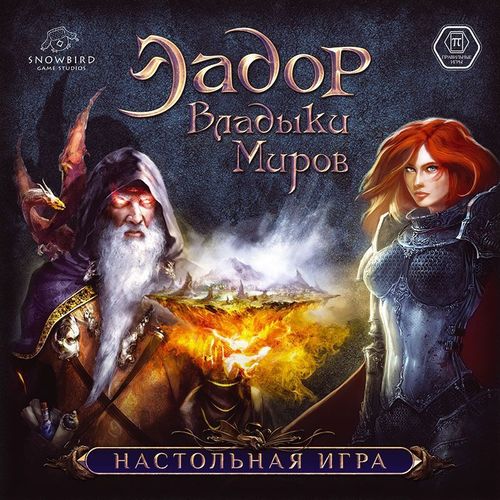
Эадор: Владыки миров
Эадор: Владыки миров Rulebook
Table of Contents
Table of Contents
Game Components
Lord cards — 6. Lords help players in the struggle for the shards. Each Lord patronises three shards.
Shard cards — 18. Eador's shards have the following characteristics:
- Astral points — counted when determining the winner of the game.
- Loyalty — shows which Lord has the advantage in the struggle for the shard.
- Properties — for example, a ban on the use of certain troops, or strength bonuses for them.
- Terrain symbol — hills, swamps, forests or plains — gives a +1 strength bonus to troops with the same symbol.
Action cards — 102.
Ritual cards — 21. A player may play 1 ritual card only at the start of a round, and after that does not take part in the battle for the shard. Some rituals remain on the table in front of the player until the end of the game (active rituals); others produce a one-time effect and are placed in the discard pile.
Spell cards — 16. A player may play 1 spell card in each battle circle for a shard. Spell cards marked with the crossed-swords symbol act only during the circle in which they were played; spell cards marked with the hourglass symbol act until the end of the battle.
Troop cards — 65. A player may play 1 troop card in each battle circle for a shard, unless the properties of the shard or of a spell allow otherwise. Troop cards have the following characteristics:
- Strength — the troop's base strength; it ranges from 1 to 10.
- Type — a troop belongs to one of the following types: Light, Chaos or Neutral. A player cannot play Light and Chaos troops during one battle for a shard, unless the properties of the shard, a ritual or a spell allow otherwise. Neutral troops may be combined with both Light and Chaos troops.
- Terrain symbol — the troop gets a +1 strength bonus in the battle for a shard with the same symbol.
- Class — a troop belongs to one of the following classes: warrior, mage, monster, undead.
Influence tokens — 10. Awarded to the winner of each battle circle. Used to determine the result of the battle.
Basic Principles
- The game is played in rounds; in each round 1 shard is played.
- The game ends after all shards have been played.
- The shard deck and the action card deck lie face down.
- All discarded cards are placed face down; players may not look through them.
- If the action card deck runs out while not all shards have been played yet, carefully shuffle the discard pile and form a new deck.
- Troop and spell cards taking part in a battle for a shard lie face up until the end of the battle (spells cancelled by the defensive spell JUSTICE are immediately placed in the discard pile). At the end of the round, all these cards are placed face down in the discard pile.
Rules for 4–6 Players
Setup
Shuffle the Lord cards. Each player draws 1 Lord card and places it face up in front of themselves. Then remove from the game the extra Lords and all shards loyal to them.
Thus, a 4-player game plays 12 shards; a 5-player game plays 15 shards; a 6-player game plays 18 shards.
Shuffle the shard cards and form a deck from them. Turn up the first and second shards from the top and place them next to the deck. When the first shard has been played, the second becomes the first, and the next shard from the deck is turned up in its place.
Shuffle the action cards and form a deck from them. Deal 7 cards to each player.
Play proceeds clockwise. The first player is the player holding the Lord card to which the first shard to be played is loyal; or the winner of the previous game. In subsequent rounds, the first player is the player who won the previous shard.
Start of the Round
At the start of the round, each player in turn may take one of the following actions:
- Draw 1 card from the deck. After this, the player passes until the end of the round.
- Play 1 ritual card on themselves or an opponent. After this, the player passes until the end of the round.
- Enter the first circle of the battle for the shard: play 1 troop card and/or 1 spell card, unless the properties of the shard or of spells allow otherwise.
Battle for the Shard
A battle may consist of one or more circles. After each circle its winner is determined — the player who played the troop with the greatest strength. When calculating a troop's strength, all bonuses are counted (for the terrain symbol, the properties of the shard, and the spell cards played). The winner receives influence tokens.
Number of influence tokens = (X − Y) / 2, where X is the strength of the winning troop and Y is the strength of the second-strongest troop. Fractional values are rounded up. If two or more players have troops of equal strength, no influence points are awarded.
The table below gives the influence token count.
| Strength difference | Influence points |
|---|---|
| 1–2 | 1 |
| 3–4 | 2 |
| 5–6 | 3 |
| 7–8 | 4 |
| 9–10 | 5 |
| 11–12 | 6 |
Spells marked with the hourglass symbol continue to act until the end of the battle. Other spells and troops remain on the table but have no effect until the end of the battle.
In subsequent circles the players in turn may either:
- play 1 troop card and/or 1 spell card again; or
- pass until the end of the round.
If all players have passed, the battle for the shard ends. The shard is awarded to the player who has the most influence tokens.
If several players have gained an equal number of influence tokens, the shard is awarded (in decreasing order of precedence) to:
- The player who has the active ritual AUTHORITY, if they took part in the battle.
- The player who has the active ritual RULER.
- The player holding the Lord card to which the shard being played is loyal.
Thus, a shard may go to a player who did not take part in the battle at all.
Troop Compatibility
In a battle for a shard, a player may not use Light and Chaos troops at the same time, unless the properties of the shard, a ritual or a spell allow otherwise. Neutral troops may be used in the same battle with any other troops.
Playing Defensive Cards
The ritual card MAGIC BARRIER may be played only on an opponent's turn, if that opponent has played any ritual on you (except the ritual OVERPOPULATION). The ritual's effect is cancelled, and both cards go to the discard pile.
The spell card JUSTICE may be played on an opponent's turn, if that opponent has played the spell TRAITOR (or the spell VETO) on you. The spell's effect is cancelled, and both cards go to the discard pile.
End of the Round
At the end of the round, all played troop and spell cards are placed in the discard pile. Active ritual cards remain in play. Influence tokens are returned to the centre of the table.
If after the battle a player has more than 7 cards in hand, they discard the excess. Then all players, starting with the player who won the shard, each draw 1 card from the deck.
Determining the Winner of the Game
After all shards have been played, count the astral points of each player:
- For each shard they own, a player receives the number of astral points shown on it; in addition, they receive 1 astral point if the shard is loyal to their Lord.
- The points on the player's active rituals are added to (or subtracted from) the resulting sum.
The player with the most astral points becomes the winner of the game. If several players have equal astral points, the winner is the player with the greater number of shards loyal to their Lord. If this is also equal, the game is declared a draw.
Rules for 2–3 Players
When playing with two or three players, two rules change:
- All Lord cards are dealt to the players evenly. All 18 shards are played.
- The start of the round is split into two stages.
In the first stage, the player may either:
- draw a card; or
- play 1 ritual card on themselves or an opponent.
In the second stage, the player may either:
- draw a card; after this, the player passes until the end of the round; or
- enter the first circle of the battle for the shard: play 1 troop card and/or 1 spell card.
The battle then continues as usual.
Accelerated Variant
In the accelerated variant, remove from the game all shards with the value "1". This means 12 shards will be played (for two, three or six players); 10 (for five players); or 8 (for four players). The game becomes more dynamic and each game is shorter. You may also devise your own variants of the rules.
Symbol Key
Rituals and Spells
- Ritual: infinity symbol — the ritual remains in play (an active ritual) until the end of the game.
- Spell: hourglass symbol — acts for the whole round.
- Spell: crossed-swords symbol — acts only during the current circle.
- Ritual / Spell: shield symbol — defensive.
Transcriber's note on the key: the printed key describes the hourglass symbol as "acts for the whole round", while the rules text above says spells with this symbol act "until the end of the battle". The rules text is transcribed as printed; the discrepancy is in the source.
Terrain Symbols
- Plains
- Hills
- Forests
- Swamps
Troop Types
- Chaos (solid black symbol)
- Neutral (swirl symbol)
- Light (solid white symbol)
Troop Classes
- Warrior
- Mage
- Monster
- Undead