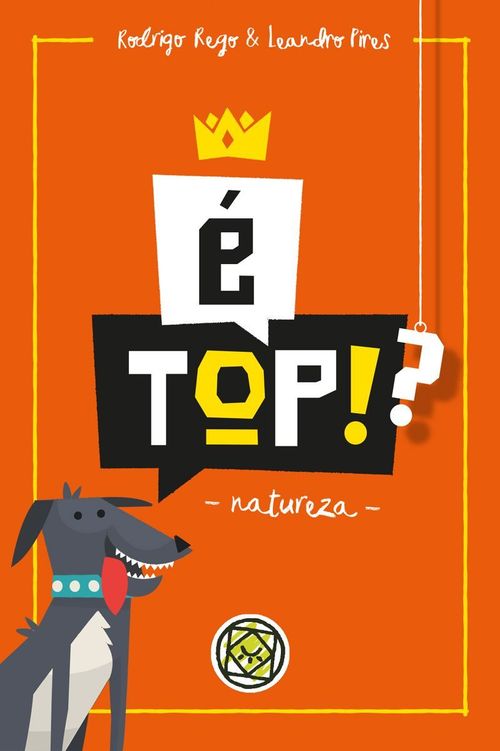
É Top!?: Natureza
É Top!?: Natureza Rulebook
Table of Contents
Table of Contents
Components
- 100 Category cards (front: category; back: Top 10 list of words)
- 10 Character cards
Setup
- Shuffle the category cards and place them in the center of the table with the Top 10 side (list of words) face down.
- Each player takes a character card and places it on the table in front of them, with the side showing 4 hearts pointing up (3 for shorter games). The hearts indicate the number of times the player can make a mistake before being eliminated.
The Game
É TOP!? is played over several rounds. At the start of each round, draw a card from the bottom of the category deck and place it in the center of the table with the category face up. Do not look at the Top 10 list on the back of the card.
The youngest player starts and play continues clockwise.
On your turn, you may pass or answer. If you pass, you can no longer take part in the round. To answer, name an item that you believe is in the Top 10 on the back of the card. If you answer, any player may challenge your answer if they think it is not on the card.
Example: In the category "Most produced fruits in the world", you might say "Apple é top!" or "Lemon é top!".
If no player challenges your answer, the player to your left must give a different answer from those already given, or pass.
Play continues around the table until an answer is challenged. Thus, a player may have to answer more than once in the same round (always one at a time).
Challenging an Answer
Any player who has not yet passed may challenge another player's answer. If you do not believe a player's answer is in the card's Top 10, say "Não é top!". If several players challenge an answer, the first player to say "Não é top!" is the challenger.
The challenger takes the category card and examines the Top 10 on the back. ONLY THE CHALLENGER MAY READ THE BACK OF THE CARD!
If the challenged answer is listed in the card's Top 10, the challenge fails. The challenger loses a heart and must rotate their character card clockwise so that the number of remaining hearts is shown at the top of the card. Put the category card back in the center of the table with the category face up, so that no other player can see the answers in the Top 10.
The challenger does not play any more in this round and play continues clockwise with the player to the left of the challenged player.
If the challenged answer is NOT listed in the card's Top 10, the challenge succeeds. The challenged player loses a heart, rotating their character card clockwise. The round ends and the challenger takes the category card and places it in front of them.
The round also ends if all players but one pass. In that case, the remaining player takes the category card and places it in front of them.
To start a new round, draw a card from the bottom of the category deck and place it in the center of the table with the category face up. The first player is the one to the left of whoever took the category card in the previous round.
Being Eliminated
If you lose your last heart, flip your character card over. You are out of the game and can no longer answer or challenge answers until the end of the game.
Victory
The winner is the first player to collect four category cards (three for shorter games), or the only player not eliminated.
Additional Rules
- If a player gives an answer that has already been given by another player, the others should simply point out the mistake without challenging.
- Some category cards may have more than 10 possible answers, because some answers share the same position. Tied answers are indicated by a comma (,) separating them.
- Some answers have synonyms. In this case, they are separated by a slash (/). Synonyms are not considered different answers.
- If the challenger is not sure whether the challenged answer is right or wrong, they should ask the opinion of the other players. Example: "Karen said Tiger, but the answer is Sabre-Toothed Tiger. Do you think it's the same thing?" It is up to the players to decide, but we encourage you to be lenient with guesses that are close. Intention matters more than exactness. Some common errors you should allow: Russia/USSR, United Kingdom/England, Cobra/Serpent (both words for snake).
- That said, if it is not on the list, the answer is wrong, even if a player cites another source.