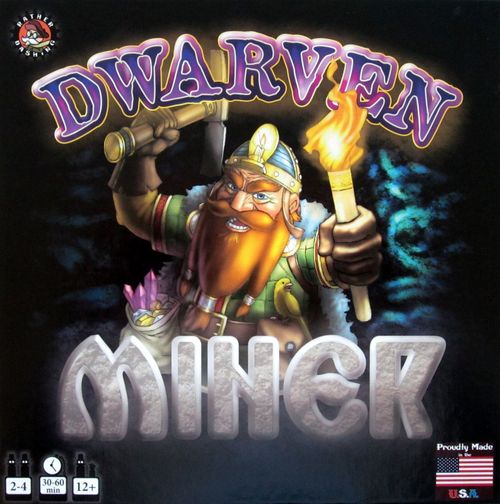
Dwarven Miner
Dwarven Miner Rulebook
Table of Contents
Table of Contents
Goal
Be the first player to earn 30 Victory Points.
Components
- 42 Patron Cards
- 60 Resource Cards
- 80 Item Cards
- 8 Vaults
- 1 Game Board
- 4 Scoring Pawns
- 6 dice (stickers must be applied before the first game)
- 4 Backpacks
Setup
Place the game board within easy reach of all players. Place the Item, Vault, and Resource cards face up in piles on their respective spaces. Shuffle and deal 3 Patron cards to each player, then place the deck face down on the board. Give each player a backpack board. Place a pawn for each player on the area of the game board marked start.
Players should look at their 3 Patron Cards. Each Patron card when completed awards you Victory Points but also has a unique ability that initiates once, and only once, the requirements of the card are fulfilled. Each player may, before the game begins, discard any, all, or no Patron cards in their hands and draw new ones. They must keep the new cards drawn.
Decide who will go first. Play proceeds clockwise around the board.
NOTE: If this is your first time playing you will need to apply the stickers to the dice (see Setting up the dice).
Taking a Turn
A player's turn consists of three phases: the Mining Phase, the Crafting Phase, and the Fulfillment Phase. The Patron cards that are in a player's hand determine the items that they are trying to make and the resources required to make those items.
Mining
Roll the 6 dice to see what you can pull out of your mine. Every resource rolled represents 1 resource of that kind. You may roll the dice as often as you wish until you are satisfied with what you have, but beware: each of the 6 dice has an Orc on it. If an Orc is rolled, that die cannot be re-rolled and you lose that die as a resource this turn. Once you roll, you may set aside dice you are happy with and roll the remainder. Repeat this until you have the resources you desire or you run out of dice to roll.
Artifacts and Burglars: In addition to the 5 resources and Orcs, some of the dice also have Artifacts and Burglars. Artifacts act as a wild and can be used as any of the 5 resources. Burglars allow you to steal from your opponents. With 1 burglar you may steal a resource card from another player, with 2 you may steal an item card, with 3 a resource or item from someone's vault, and with 4 you may steal another player's vault, along with everything in it. Players only get one burglar action per turn.
Crafting
Once you have the resources you desire, you may use those to "craft" items on the board. Each item card has the "recipe" of resources necessary to craft it. Recipes are always found on the left of the item card. (Example: the Tome of Wisdom's recipe requires 2 Arcane Crystals, 1 Alchemist Powder, and 1 Mithril.) Crafted items may be placed in your backpack, vault(s) or left on the table during your turn. On your turn you may have as many crafted items as you like. However, at the end of that turn you may only have as many items as you have slots for in your backpack and any vaults you may have (2 for your backpack, 1 for each vault).
Resource cards placed into your backpack or vault (you won't have any on your first turn) may also be used in the crafting of items. When used, they are placed back into their respective piles.
Items and resources may be rearranged or discarded from your backpack and vault(s) any time during your turn. If there are any resources unused from your mining phase you may take resource cards matching those resources and place those cards in either your backpack or vault(s). If you choose, you may not craft on a given turn and "bank" resources for your next turn. Like items, you can only have as many resource cards as you have slots for in your backpack and vaults (4 for your backpack, 2 for each vault).
If an action gives you resources on another player's turn and you wish to replace resources in your backpack or vault with a new one, you may do so as a free action.
Vaults may be crafted during this phase of your turn; the recipe is located on the left of the vault.
Fulfillment
With your crafted items, you may now use them to meet the requirements of the Patrons in your hand. If you cannot meet the requirements of one of your Patrons yet, place the items in your backpack or vault(s) and your turn is over. If you can meet the requirements of one or more of your Patrons, "cash in" the required items by placing them back into their respective piles and laying face up your Patron(s). You immediately receive the Victory Points, measured by the pawns on the board, and any powers that the Patron(s) have are activated. Some of these will be instantaneous, while others will have an ongoing effect on the game, so read each card carefully. Remember, Patron abilities are ONLY ACTIVATED ONCE A PATRON IS FULFILLED. For every Patron made, that player takes two new Patron cards from the draw pile into their hand. Decide then which one(s) to be kept from your hand and discard down to three.
Example: The Defender requires the items Heavy Armor, Helm, Shield, and Dirk to fulfill it. The Victory Points for the Defender are 11, as seen in the bottom right hand corner. Its ability ("None shall pass"): one of your vaults can no longer be stolen nor stolen from for the remainder of the game. Place this card by it for reference.
Patron Cards
These have different abilities that take effect when they are fulfilled. Some of their abilities are immediately activated, others have a longer term effect and remain on the table until their effect is done. The rule is, a card stays face up on the table in front of the owning player until its ability is completed. Any card's power that begins with "Discard this card," is done at any time during your turn once it's been fulfilled. It does not have to be used the same turn the Patron was fulfilled. The Rune Singer and the Tracker stay in play until the end of your next turn while the Bardic War Chanter remains in play until any other player fulfills a customer. The Deep Delver, Berserker, Wizard, and the Chieftain's effects are immediate and are discarded as soon as their ability is enacted. With the Wizard and the Chieftain, do not discard until each player has taken advantage of its ability, whether it's on the same turn or a subsequent one.
Example (Wizard, "Prestidigitation"): all other players may swap any one crafted item for any other crafted item. Then discard.
Scoring and Winning
Every time a player fulfills a Patron, they immediately score their points by advancing their pawn along the scoring track. The first player to reach 30 Victory Points is the winner! VICTORY POINTS, ONCE SCORED, ARE NEVER LOST, even if an action in the game removes a Patron from play.
Regarding the Cumulative Point system for the Tale Smith, Brew Maiden, and the Monk, the first fulfilled Patron is worth 3 points. When a second Patron of the same type is played, either by the same or different player, that Patron is worth 4 points. Also the previously played Patron is now worth 4 points as well. A third played would give them all a value of 5, and the fourth would give them all a value of 6. Scores are adjusted to reflect these additional points. If one of these cards is eliminated by the Rogue, players do not lose points. However the next one played would be of the lower value.
In the rare event of a tie, the player whose turn it currently is would be the winner.
Setting up the Dice
Before you play for the first time, you will need to put the stickers on the dice. There are six dice in the game, and you apply the stickers according to the layout shown in the rulebook (each layout represents two of the six dice). It's important to get the layout right, or the game may not play correctly. Enough stickers are included for two full sets, so you can replace them if they ever get worn out.
Source note: the sticker layout diagram is a picture in the printed rulebook and is not reproduced here.