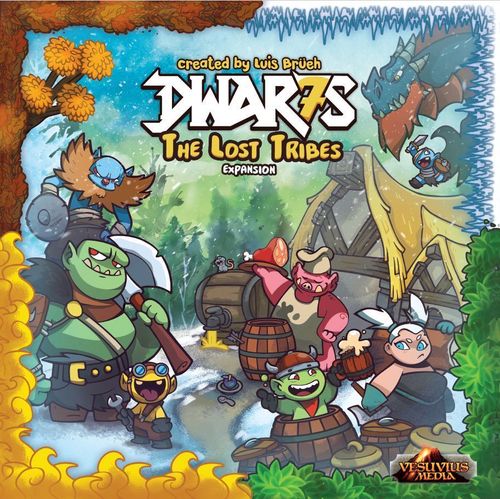
Dwar7s: The Lost Tribes Expansion
Dwar7s: The Lost Tribes Expansion Rulebook
Table of Contents
Table of Contents
Components
Content belonging to this expansion is marked with an expansion emblem (not reproduced in the text layer).
- Kingdom Cards (23 cards)
- Campfire (3 cards)
- Breach Disasters (8 cards)
- Starting Heroes (27 cards)
- Starting Heroes (21 cards)
- 3 Player Boards
- Tokens: 7 of each type (Crystal Dwarfs, Ogres, Half-bloods)
- Settlements: 12 of each colour
- Fortresses: 1 of each colour
- Windmill: 1 of each colour
- Lumber Camp: 1 of each colour
- Mine: 1 of each colour
- Ogres: 7 miniatures
- Crystal Dwarfs: 7 miniatures
- Half-bloods: 7 miniatures
- Legendary Half-bloods: 1 of each type (Mighty Troll, Half-blood King, Baby Dragon)
- Legendary Ogres: 1 of each type (Ogre King, Alchemist, Baby Dragon)
- Legendary Crystal Dwarfs: 1 of each type (Peace Keeper, Rescuer, Restless King, Alchemist, Baby Dragon)
The printed component list gives the two Starting Heroes entries without a label distinguishing them; they are reproduced in the order printed.
Ogres
Ogres come in all sorts of shapes and sizes. Some are big and strong, while others are tiny engineers, repurposing buildings and making all sorts of tools and explosive devices. They are not as good at gathering resources as dwarfs, or skilled in hunting as elves, but they excel at bending the rules in their own favour. In battle, ogres are brutal opponents, relying on their cunning tactics and expendable troops to deploy maximum damage.
Ogres for Dwar7s Fall
1. Starting Setup
Ogres will start the game with 7 orange kingdom cards and two random ogre cards in their hand, one random secret goal and the 7 ogres on their campfire.
2. Special Abilities
- Reciprocity: All cards (secret goals, ogre cards and royal decrees) that affect dwarfs will work the same way on ogres.
- Slow Gathering: Ogres do not gather gems as well as dwarfs. To complete a task at a mine, you will need to have 3 ogres on top of it, no matter the action cost described on the mine card (example: gathering an emerald requires 3 ogres instead of 2).
- Thievery: Every time you perform an ogre action towards an opponent (such as Brute, Ambush, Panic, etc or the Ogre King's ability), after you resolve the card, you get a gold from the supply.
- A life of Party: Ogres count every kingdom card that is worth -2 VP within their castle walls (including their own castle) as +2 VP instead.
Example, A Life of a Party: If the ogres end a game sharing a kingdom, they will score more victory points than their neighbors (as they score +2 instead of -2). In this example, the red player scores 4 VP for their kingdom, and the ogres score 12 VP.
3. Legendary Classes
By spending one action and discarding the required gems, you may upgrade one of the ogres on your campfire to Legendary (Ogre King, Alchemist or the Baby Dragon). Legendary ogres keep their tribe's abilities, but also have special abilities and will score extra Victory Points (VP) at the end of the game.
- Ogre King: Cost: spend 2 gold and a diamond to replace one of your ogres with the Ogre King. Placing the Ogre King from your campfire on a kingdom card is a free action. As an action, you may discard one opponent's dwarf from the same kingdom card as your Ogre King. Having the Ogre King awards you 4 VP at the end of the game.
- Alchemist: Cost: spend 1 ruby to replace one of your ogres with the Alchemist. By spending one action with the Alchemist, you transform a gem into any other gem (except gold into ruby). Having the Alchemist awards you 2 VP at the end of the game.
- Baby Dragon: Cost: spend 1 ogre card to replace one of your ogres with the Baby Dragon. You ignore any monster abilities from monsters on the same kingdom card as your Baby Dragon. These monsters still affect other players as usual. Having the Baby Dragon awards you 2 VP at the end of the game.
Ogres for Dwar7s Winter
1. Starting Setup
Ogres will start the game with 10 Starting hero cards marked with an orange ribbon and 7 ogres on their Player Board.
2. New Musical Abilities
- Reciprocity: All cards that affect dwarfs will work the same way on ogres.
The ten musical abilities for ogres (icon-only on the card, captioned as follows):
- Place 1 ogre in a Mine zone.
- Place 1 ogre in a Forest zone.
- Place 1 ogre in a Field zone.
- Spend one wood to place a building in one zone.
- Place (or move) one ogre in each zone with a building you placed.
- Remove 1 of your ogres from a Forest to Produce 3 wood.
- Remove 1 of your ogres from a Field to Produce 3 food.
- Remove 1 of your ogres from a mine to Produce 3 Stone.
- Remove 1 of your ogres from the game board to gain 3 gold.
- Spend 2 gold to upgrade 1 of your ogres into Legendary.
3. Buildings
Using buildings requires the Ocarina music, included in the Enchanted Forest expansion.
Placing a Building: Lumber camps may only be built in a Forest zone, windmills in a Field zone, and mines in a Mine zone. You can't build in a zone that already has a building.
At the end of the game, you are awarded 1 VP for each building you have in play.
Example: In this example, the ogres play their Ocarina card to place one ogre in each of the zones where they have a building!
4. Legendary Classes
The Sage allows you to upgrade one of the ogres on your player board into Legendary at a cost of 2 gold. When you replace one of the ogres on your player board with the Legendary of your choice (Ogre King, Alchemist or Baby Dragon), put the replaced miniature back in the box. You may have all 3 of your Legendary ogres in play. Legendary ogres keep their tribe's abilities, but also have special abilities. Each Legendary you have in play at the end of the game awards you 2 VP.
- Ogre King: Placing the Ogre King on the board is a free action that can be performed once a turn, at any point during your turn. After placing him, you may spawn a new disaster to push back an adjacent monster by one zone.
- Alchemist: Anytime you produce resources in a zone with an Alchemist, you may choose any other resource or gold instead.
- Baby Dragon: You ignore any monster abilities from monsters in the same zone as your Baby Dragon. These monsters still affect other players as usual.
Example: In this example, the player places the Ogre King for free and then reveals an extra disaster to push back the Treant by 1 zone.
Example: In this example, the ogre player discards their ogre as part of the card's effect. Instead of producing 3 stones, because their Alchemist is present, they produce 3 gold.
Example: In this example, when the Dire Wolf attacks, the ogre player will not lose a food because they have a Baby Dragon in that zone.
Ogres for Dwar7s Spring
1. Starting Setup
Ogres start the game with 7 Starting hero cards marked with an orange ribbon, 1 faerie card, and 1 Level 1 Dragon card. On their Player Board they start with 7 ogres, 12 settlements and 1 fortress. When playing with ogres, shuffle 9 Monster cards in the expedition deck, instead of the usual 6 Monster cards.
2. Special Abilities
- Reciprocity: All cards that affect dwarfs will work the same way on ogres.
- Ogres Strength: Get +1 success every time you fight monsters.
- Chaos Magic: Get +1 faerie card at the beginning of each era.
- Do it again, you maggot: Order an ogre to repeat an action that you have already performed in this era.
Example: It's the ogres' first turn and they execute the build action by placing one of the settlements from their food production line. On their second turn, they place their ogre on the special ogre action spot and repeat the same action they performed the previous turn (building another settlement from the food production line).
3. Buildings
During Setup, give all players one of each building. Buildings are kept on the players treasury before they are built.
Placing a Building: As a free action, you can spend 4 wood to place a building on a wild land where you have an ogre. There cannot be more than 3 buildings on the same wild land. Lumber camps may only be built on a forest petal, windmills on hills, and mines on mines.
- Militia Headquarters: When fighting monsters, buildings count as 3 of your ogres. Buildings do not help you gather resources.
At the end of the game, each of your buildings in play awards you 1 VP.
Example: As a free action, the ogre player pays 4 Wood to build their lumber camp in the forest.
Example: Every time you place an ogre to fight a monster, reveal 3 extra hero cards for having your lumber camp there!
4. Legendary Classes
As a free action, you can upgrade one ogre in your bastion to Legendary (Ogre King, Alchemist or Baby Dragon) by discarding 4 gold from your treasury. Legendary ogres keep their tribe's abilities, but also have special abilities. At the end of the game, each Legendary ogre awards you 1 VP.
- Ogre King: When you place the Ogre King on a wild land with a monster, you may either fight it or scare the monster, making it move to an empty wild land.
- Alchemist: If your Alchemist takes part in a gathering action, you may choose to gather any type of resource instead.
- Baby Dragon: You ignore any monster abilities from monsters in the same wild land as your Baby Dragon. This monster still affects other players as usual.
Example: By placing the Ogre King in this wild land, the ogres could either reveal 2 heroes to fight the Witch or move the Witch to the mine and then gather resources!
Example: In this example, the ogre player reveals 3 hero cards: one for the Alchemist, one for the regular ogre, and one for having a settlement. They then choose to gather 3 gold instead of 3 wood using their Alchemist's special ability.
Example: In this example, the ogre player's Baby Dragon negates the Witch's effect. As such, they will collect 2 food for building their settlement.
Half-bloods
Before the Red King unified the kingdoms, trolls protected these lands. The half-bloods are the descendants of trolls and ogres, a nomadic barbarian tribe. They have no formal education, so they are not able to train alchemists, but they are fearsome warriors, experienced in the battlefields and in the hardships of life. Being a nomadic tribe, the half-bloods are able to move across the kingdoms quickly.
Half-bloods for Dwar7s Fall
1. Starting Setup
Half-bloods in Dwar7s Fall are a nomad tribe. They don't have a castle card and, as such, do not score VP from kingdom cards. Half-bloods start the game with 7 light blue kingdom cards and two random ogre cards in their hand, 7 half-bloods on their campfire and no secret goal!
2. Special Abilities
- Reciprocity: All cards (secret goals, ogre cards and royal decrees) that affect dwarfs will work the same way on half-bloods.
- Hard Working: Half-bloods mine as well as dwarfs.
- Warmongering: Count adjacent half-bloods for the purpose of defeating a monster.
- Violent: You may remove ONE half-blood to remove another dwarf from the same kingdom card.
- Epic Meal: Half-bloods start the game without a secret goal, but every 3 monsters they kill count as one goal (for the purposes of initiating the end game phase) and awards you 7 VPs for each goal, at the end of the game.
Example: In this example, the Half-bloods score 12 VPs for defeating the monsters plus 7 VPs due to their Epic Meal ability.
3. Legendary Classes
By spending one action and discarding the required gems, you can upgrade one of the half-bloods on your campfire to Legendary (Half-blood King, Mighty Troll or the Baby Dragon). Legendary half-bloods keep their tribe's abilities, but also have special abilities and will score extra Victory Points (VP) at the end of the game.
- Half-blood King: Cost: spend 1 ruby and 1 emerald to replace one of your half-bloods with the Half-blood King. Placing the Half-blood King from your campfire on a kingdom card is a free action. When fighting monsters, the Half-blood King counts as an extra half-blood for each half-blood in the zone or adjacent zones. At the end of the game, having the Half-blood King in play awards you 4 VPs.
- Mighty Troll: Cost: spend 2 gold to replace one of your half-bloods with the Mighty Troll. You may spend up to 2 gold when fighting monsters or mining. For each gold spent, the Mighty Troll counts as an extra Half-blood in the same zone. At the end of the game, having the Mighty Troll in play awards you 2 VPs.
- Baby Dragon: Cost: spend 1 ogre card to replace one of your half-bloods with the Baby Dragon. You ignore any monster abilities from monsters on the same kingdom card as your Baby Dragon. These monsters still affect other players as usual. At the end of the game, having the Baby Dragon in play awards you 2 VPs.
Half-bloods for Dwar7s Winter
1. Starting Setup
Half-bloods will start the game with 10 Starting hero cards marked with a light blue ribbon and 7 half-blood troops on their Player Board.
- Warmongering: You count half-bloods in adjacent territories for the purpose of defeating a monster.
2. New Musical Abilities
- Reciprocity: All cards that affect dwarfs will work the same way on half-bloods.
The musical abilities for half-bloods (icon-only on the card, captioned as follows):
- Gain 1 food or 1 gold.
- Gain 1 stone or 1 gold.
- Gain 1 wood or 1 gold.
- Place or Move up to 2 of your half-bloods.
- Spend 2 gold to upgrade 1 of your half-bloods into Legendary.
- Remove 1 of your half-bloods to place a building in that zone.
- Produce 1 gold in each of your buildings.
3. Buildings
Using buildings requires the Ocarina music, included in the Enchanted Forest expansion.
Placing a Building: Lumber camps may only be built in a Forest zone, windmills in Field zones, mines in a Mine zone. You can't build in a zone that already has a building.
At the end of the game, you are awarded 1 VP for each building you have in play.
Example: In this example, the half-bloods play their Ocarina card to get 3 gold from their buildings!
4. Legendary Classes
The Sage allows you to upgrade one of the half-bloods on your player board into Legendary at a cost of 2 gold. When you replace one of the half-bloods on your player board with the Legendary of your choice (Ogre King, Alchemist or Baby Dragon), put the replaced miniature back in the box. You may have all 3 of your Legendary half-bloods in play. Legendary half-bloods keep their tribe's abilities, but also have special abilities. Each Legendary you have in play at the end of the game awards you 2 VP.
- Half-blood King: Placing the Half-blood King on the board is a free action that can be performed once a turn, at any point during your turn. In battle, the Half-blood King's strength is increased by 1 per Half-blood in his zone or any adjacent zone.
- Mighty Troll: You may spend up to 2 gold when fighting monsters or resolving disasters. For each gold spent, the Mighty Troll counts as an extra Half-Blood in the same zone.
- Baby Dragon: You ignore any monster abilities from monsters in the same zone as your Baby Dragon. These monsters still affect other players as usual.
Example: In this example, the Half-blood King enters the board as a free action, his total strength along with 2 adjacent half-bloods is 5! Enough to defeat the Chimera!
Example: In this example, the Troll spends 1 gold, 4 stone and 2 wood to resolve the disaster.
Example: In this example, when the Dire Wolf attacks, the Half-blood player will not lose a food, as they have a Baby Dragon in that zone.
Half-bloods for Dwar7s Spring
1. Starting Setup
Half-bloods start the game with 7 Starting hero cards marked with a light blue ribbon, 1 faerie card, and 1 Level 1 Dragon card. On their Player Board they start with 7 half-bloods, 12 settlements and 1 fortress. When playing with half-bloods, shuffle 9 Monster cards in the expedition deck, instead of the usual 6 Monster cards.
2. Special Abilities
- Raiding parties: Once per era, swap one of your Settlements with an opponent's. Take the resources shown underneath. If they do so, they also collect the resources shown underneath the target!
- Experienced Hunters: When fighting a monster, half-bloods in adjacent locations also take part in the fight.
- Sharpen your weapons: +1 success every time you fight monsters. You also get 5 VP at the end of the game.
- Have no Fear: You may place a Half-blood to either get a faerie card or ignore all monster abilities in this era.
At the beginning of each era, the half-blood can swap a settlement for each of their revealed raiding parties.
Example: While this could be used to swap a settlement into a water spot, it would not give them any resources.
3. Buildings
During Setup, give all players one of each building. Buildings are kept on the players treasury before they are built.
Placing a Building: As a free action, you can spend 4 wood to place a building on a wild land where you have a half-blood. There cannot be more than 3 buildings on the same wild land. Lumber camps may only be built on a forest petal, windmills on hills, and mines on mines.
- Protection Racket: Every time half-bloods Gather or Fight in wild lands where they have buildings, they get 2 gold from the supply.
At the end of the game, each of your buildings in play awards you 1 VP.
Example: As a free action, the Half-blood player pays 4 wood to build their lumber camp in the forest.
Example: When you place a Half-blood to fight the Witch, your building gives you 2 gold and you don't add an extra card!
4. Legendary Classes
As a free action, you can upgrade one half-blood in your bastion to Legendary (Ogre King, Alchemist or Baby Dragon) by discarding 4 gold from your treasury. Legendary half-bloods keep their tribe's abilities, but also have special abilities. At the end of the game, each Legendary half-blood awards you 1 VP.
The heading line above reads "Ogre King, Alchemist or Baby Dragon" as printed. The Legendary figures shown below are the Half-blood King, Mighty Troll and Baby Dragon, which are the half-blood Legendaries.
- Half-blood King: When Fighting, the Half-blood King's strength is increased by 1 per half-blood in his wild land or any adjacent spot.
- Mighty Troll: You may spend a gold to get 2 additional Hero cards to Gather resources or Fight monsters.
- Baby Dragon: You ignore any monster abilities from monsters in the same wild land as your Baby Dragon. This monster still affects other players as usual.
Example: In this example, the Half-blood King has a strength of 1 plus 1 for having a Half-blood adjacent.
Example: In this example, the Half-blood player pays 1 gold to draw 2 extra hero cards when gathering, getting 3 Wood from their gather action.
Example: In this example, the Half-blood player will collect 2 food from building their settlement because their Baby Dragon allows them to ignore the Witch's ability.
Example: If the player unlocks the experienced hunters ability, then they can also add another +1 from the adjacent half-blood, revealing 3 hero cards!
Crystal Dwarfs
The Dark Princess and her troops sealed the entrance to the crystal caves from the inside to stop the frost giants. Living with scarce resources for so long, the Crystal Dwarfs are far better at gathering than their dwarf cousins, but not as keen on fighting monsters.
Crystal Dwarfs for Dwar7s Fall
1. Starting Setup
Crystal dwarfs will start the game with 9 black kingdom cards in their hand, one random secret goal and the 7 crystal dwarfs on their campfire.
2. Special Abilities
- Reciprocity: All cards (secret goals, ogre cards and royal decrees) that affect dwarfs will work the same way on crystal dwarfs.
- Suspicious: You can not use the dig action nor score Victory Points from another player's castle.
- Crystal Heart: Once per turn, as a free action, you may transform one of your gems into a diamond.
- Sanctuary: At the end of the game, each monster inside your kingdom awards you 2 VP.
Example: If the crystal dwarfs end a game sharing a kingdom, they may score more victory points than their neighbors. In this example, the red dwarf scores 9 VP with his kingdom, and the crystal dwarfs score 11 VP.
3. Legendary Classes
By spending one action and discarding the required gems, you can upgrade one of the crystal dwarfs on your campfire to Legendary (Restless King, Rescuer, Peace Keeper, Alchemist or the Baby Dragon). Legendary crystal dwarfs keep their tribe's abilities, but also have special abilities and will score 2 extra Victory Points (VP) at the end of the game.
- Restless King: Cost: spend 2 diamonds to replace one of your crystal dwarfs with the Restless King. The Restless King counts as 2 dwarfs when mining or fighting monsters in his zone. He is not removed from the kingdom card when his task is completed.
- Rescuer: Cost: spend 1 diamond to replace one of your crystal dwarfs with the Rescuer. When you place or move the Rescuer, you may swap one of your crystal dwarfs on that kingdom card with an opponent's dwarf.
- Peace Keeper: Cost: spend 1 diamond to replace one of your crystal dwarfs with the Peace Keeper. If the Peace Keeper is present on another player's castle, you may use their dig action and score end game Victory Points for shared kingdom castles.
- Alchemist: Cost: spend 1 diamond to replace one of your crystal dwarfs with the Alchemist. By spending one action with the Alchemist you transform a gem into any other gem (except gold into ruby).
- Baby Dragon: Cost: spend 1 diamond to replace one of your crystal dwarfs with the Baby Dragon. You ignore any monster abilities from monsters on the same kingdom card as your Baby Dragon. These monsters still affect other players as usual.
Crystal Dwarfs for Dwar7s Winter
1. Starting Setup
Crystal dwarfs will start the game with 10 Starting hero cards marked with a black ribbon and 7 crystal dwarfs on their Player Board.
2. New Musical Abilities
- Reciprocity: All cards that affect dwarfs will work the same way on crystal dwarfs.
The musical abilities for crystal dwarfs (icon-only on the card, captioned as follows):
- Produce 1 wood per Forest you occupy.
- Produce 1 food per Field you occupy.
- Produce 1 stone per Mine you occupy.
- Get 1 gold or Place/Move 1 of your dwarfs.
- Spend 2 gold to upgrade 1 of your dwarfs to Legendary.
- Move a monster closer to the castle and place a building in a zone where you have a dwarf.
- Produce 2 resources of your choice in each zone that you have a building and a monster present.
3. Buildings
Using buildings requires the Ocarina music, included in the Enchanted Forest expansion.
Placing a Building: Lumber camps may only be built in a Forest zone, windmills in Field zones, mines in a Mine zone. You can't build in a zone that already has a building.
At the end of the game, you are awarded 1 VP for each building you have in play.
Example: In this example, the Crystal Dwarf player plays their Ocarina card to produce 2 resources of their choice in each zone occupied by one of their buildings. They gain 2 wood and 2 food.
4. Legendary Classes
The Sage allows you to upgrade one of the crystal dwarfs on your player board into Legendary at a cost of 2 gold. Replace your crystal dwarfs with a Legendary of your choice (Restless King, Rescuer, Peace Keeper, Alchemist or Baby Dragon), putting the replaced miniature back in the box. You may have all 5 of your Legendary crystal dwarfs in play. Legendary crystal dwarfs keep their tribe's abilities, but also have special abilities. Each Legendary you have in play at the end of the game awards you 2 VP.
- Restless King: When using the Restless King to resolve a disaster or fight a monster, do NOT return him back to the player board. He stays in his zone.
- Rescuer: If the Rescuer is on the game board, you may produce resources in zones with a disaster. He doesn't need to be in the same zone as the disaster.
- Peace Keeper: If the Peace Keeper is on the game board, you may produce resources in zones with a monster. He doesn't need to be in the same zone as the monster.
- Alchemist: Anytime you produce a resource in a zone with your Alchemist, you may choose any other resource or gold instead.
- Baby Dragon: You ignore any monster abilities from monsters in the same zone as your Baby Dragon. These monsters still affect other players as usual.
Example: After resolving the disaster, you return the disaster token to the supply and only the Crystal Dwarf goes back to your player board. The Restless King will stay in his zone.
Example: If you have the Rescuer on the game board, you may produce in zones with disasters!
Example: If you have the Peace Keeper on the game board, you may produce in zones with monsters!
Example: In this example, the Crystal Dwarf player chooses to produce gold instead of wood using their Lute card.
Example: In this example, when the Dire wolf attacks, the Crystal Dwarf player will not lose a food, as they have their Baby Dragon in that zone.
Crystal Dwarfs for Dwar7s Spring
1. Starting Setup
Crystal dwar7s start the game with 7 Starting hero cards marked with a black ribbon, 1 faerie card, and 1 Level 1 Dragon card. On their Player Board they start with 7 crystal dwarfs, 12 settlements and 1 fortress.
2. Special Abilities
- Reciprocity: All cards that affect dwarfs will work the same way on crystal dwarfs.
- Aqueduct Builders: You can build your settlements over water spots. When you do, take one resource of your choice.
- Explorers: Get +2 successes every time you gather resources.
- Cartographers: Get +2 success every time you gather resources. You also get 5 VP at the end of the game.
- Shamans: Once per era, in the production phase, you may move a monster in a wild land to another empty wild land.
Example: The aqueduct builders allow you to build in areas where other players can not and also collect resources of your choice!
Example: Using your shaman ability, you may move monsters from one wild land to another.
3. Buildings
During Setup, give all players one of each building. Buildings are kept on the players treasury before they are built.
Placing a Building: As a free action, you can spend 4 wood to place a building on a wild land where you have a crystal dwarf. There cannot be more than 3 buildings on the same wild land. Lumber camps may only be built on a forest petal, windmills on hills, and mines on mines.
- Shelters: Buildings count as 3 crystal dwarfs when gathering resources, but don't help you fight monsters.
At the end of the game, each of your buildings in play awards you 1 VP.
Example: As a free action, the crystal dwarf player pays 4 wood to build their lumber camp in the forest.
Example: Every time you place a crystal dwarf to gather, reveal 3 extra hero cards for having your lumber camp there!
4. Legendary Classes
As a free action, you can upgrade one crystal dwarf in your bastion to Legendary (Ogre King, Alchemist or Baby Dragon) by discarding 4 gold from your treasury. Legendary crystal dwarfs keep their tribe's abilities, but also have special abilities. At the end of the game, each Legendary crystal dwarf awards you 1 VP.
The heading line above reads "Ogre King, Alchemist or Baby Dragon" as printed. The Legendary figures shown below are the Restless King, Rescuer, Peace Keeper, Alchemist and Baby Dragon, which are the crystal dwarf Legendaries.
- Restless King: After placed on the world map, the Restless King remains on the world map in between Eras. So, in your next production phase, take a regular crystal dwarf from the supply and place onto your bastion.
- Rescuer: When you place the Rescuer on the world map, you may swap one of your crystal dwarfs with an enemy dwarf.
- Peace Keeper: You may use enemy fortresses to draw hero cards when fighting or gathering with the Peace Keeper.
- Alchemist: If your Alchemist takes part in a gathering action, you may choose to gather any type of resource.
- Baby Dragon: You ignore any monster abilities from monsters in the same zone as your Baby Dragon. These monsters still affect other players as usual.
Example: Be mindful where you place your Restless King, as he won't come back to your bastion between eras. He stays on the world map, helping you fight or gather until the end of the game. In his place on the bastion, place another crystal dwarf from the game box.
Example: By placing the Rescuer, the crystal dwarf player may also swap one enemy dwarf with a crystal dwarf on the world map immediately!
Example: Using the Peace Keeper to fight, will allow you to draw 4 hero cards (1 for himself, 1 for the settlement, 2 for the ogre fortress).
Example: In this example, the player would gather 3 Wood, but instead chooses to take 3 gold.
Example: In this example, the crystal dwarfs player will collect 2 food from building their settlement because their Baby Dragon allows them to ignore the Witch's ability.
The Wall Has Fallen
"There is a calm before the storm, a brief moment where you almost feel safe. In the last few weeks, we had no attacks. Instead, more and more monsters gathered near our walls... Waiting. They know something we don't. We have to prepare ourselves, before it is too late..."
To play this crossover module, you will need Dwar7s Winter and Dwar7s Spring.
The Breach: Additional setup: shuffle all Breach disasters along with the other disasters. Breach: these disasters happen on the spawning zones! If a monster spawns in a zone with a Breach, immediately move it one zone closer to the castle.
The three Breach disasters are:
- Spawn an extra monster immediately (ignoring the limit for the number of players and the location on its card).
- Move a monster one step closer to the castle.
- Discard one of the hero cards from your hand back to the game box.
Rebuilding the Wall: to resolve a Breach disaster you must discard dwarfs from an adjacent zone, perform the breach effect and spend the required resources!
During phase 1.3 "monster reinforcements", when a monster spawns on a wall that has a breach, you immediately move it one step closer to the castle.
Example: In the example above, the Ogre player discards 2 of each resource, spawns a new monster (Ice Chimera) in the SAME location as the breach and discards two ogres in the adjacent zone to remove the Breach Disaster. This awards them 2 gold.
Fortified Defenses
All tribes (dwarfs, crystal dwarfs, elves, half-bloods and ogres) are capable of building watch towers and citadels, using the same rules shown below. If you are combining this module with the Enchanted Forest expansion, watch towers and citadels are not considered buildings for the purpose of generating resources.
Building Watch Towers
"Next time they come, we will be prepared!"
As a free action, remove 2 of your dwarfs to place a watch tower on an adjacent wall. A watch tower on an adjacent wall counts as +1 tribe mini when fighting monsters or resolving disasters. You cannot build a watch tower on a wall that already has a watch tower or a citadel. Each of your watch towers on the board awards you 1 VP at the end of the game.
Example: The ogre player removes 2 ogres to build a watch tower! Once built, it acts as an extra ogre in adjacent zones without being removed.
Building Citadels
"The Citadels will provide us valuable resources if we fall under attack, while keeping our families safe inside its quarters"
As a free action, remove 2 of your dwarfs to place your citadel on an adjacent wall. Resolving a disaster or fighting a monster adjacent to a citadel requires 2 less resources (of your choice!). You cannot build a citadel on a wall that already has a citadel or a watch tower. Your citadel on the board awards you 1 VP at the end of the game.
Example: The half-blood player removes 2 half-bloods to build a Citadel! The citadel allows them to spend less resources to resolve disasters or fight monsters in these zones!
Placement Rules
The wall sections are numbered from 1 to 8. You may not have more than 1 citadel or watch tower in each section of the wall. A citadel or watch tower can never be adjacent to more than 1 zone. If in doubt, use the image bellow for reference. The reference diagram is marked "CAN'T BUILD HERE" and is not reproduced in the text layer.
If you are playing using the family mode for Dwarfs Winter, citadels and watch towers apply their bonus effect to all players in adjacent zones.