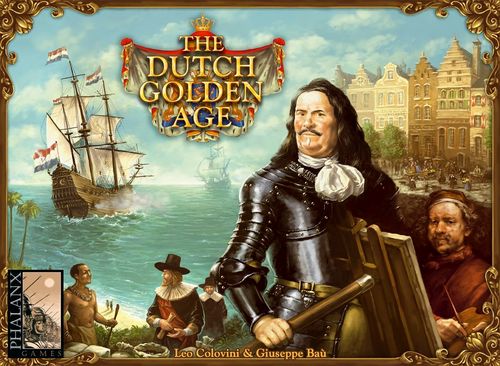
The Dutch Golden Age
The Dutch Golden Age Rulebook
Table of Contents
Table of Contents
Components
Each box contains:
- 1 large game board
- 27 Culture cards
- 22 Art cards
- 21 Investment cards
- 21 Spice cards
- 19 Colony cards
- 20 Movement Tokens in 4 colors, 5 per player
- 24 Influence Markers in 4 colors, 6 per player
- 1 King pawn
- 60 coins in 3 denominations: 0.5, 1, and 5 guilders
- 2 dice
- 1 rulebook
The Board
The board shows the Netherlands (Holland) in the 17th century. It is loosely divided into 10 provinces, each with its own name and color. The map is bordered by a track of provinces: the King moves along this track. Most spaces on the track show two different provinces; six other spaces show a Governor, and the last space shows King William II. In the upper left is the Guild Table, with five colored columns corresponding to the five province colors. The West Indies (one space) and the East Indies (five spaces) are placed at the top of the board.
The Cards
There are 110 cards, of 5 types and 5 colors:
- Culture cards. Grey, and related to cultural progress.
- Art cards. Brown, and depicting the famous painter Rembrandt van Rijn.
- Investment cards. Yellow, representing the players' development in investments (tulip cultivation, the stock exchange).
- Spice cards. Orange, showing various spices from the New World.
- Colony cards. Blue, allowing players to outfit a ship for the colonies.
Movement Tokens (MT)
Each player has 5 wooden Movement Tokens, which are placed and moved on the board.
Influence Markers (IM)
Each player receives six cardboard Influence Markers, which are used on the Guild Table, in the Indies, or on the board.
The King
The King's pawn is moved space by space along the province track that runs around the board.
Money
Coins in three denominations are included: 0.5, 1, and 5 guilders.
Dice
The two dice are used to move the King along the province track.
Setup
First, set up the board in the middle of the table.
- The cards are separated by color into five decks; these are shuffled separately and placed near the board.
- The money is separated by denomination and kept accessible to the players. Each player receives 10 guilders.
- Each player chooses a color and receives 5 Movement Tokens and 6 Influence Markers.
- The oldest player begins.
- Place one Influence Marker. Starting with the first player and continuing clockwise, each player places one Influence Marker in a province on the board. Each province can hold only 1 Influence Marker. The other five Influence Markers make up the player's reserve.
- Place two Movement Tokens. Starting with the first player and continuing clockwise, each player places two Movement Tokens in provinces on the board. They cannot be placed in a province that already holds an Influence Marker, and no more than two Movement Tokens can be in a province (though they may belong to different players). The remaining 3 tokens make up the player's reserve.
- The player who places the last token decides where the King will start. That player chooses the Governor space where the King is placed.
General Aspects of the Game
"The Dutch Golden Age" is played in turns. The first player takes a turn, then the player to their left, and so on clockwise, until a winner is determined. During a turn, the active player:
- Rolls the dice and moves the King.
- Performs as many actions (Free and Special) as desired, in any order, as follows:
- As many Free Actions as they like. The Free Actions are:
- move a Movement Token
- take control of a guild on the Guild Table
- place a new Influence Marker
- The player carries out Special Actions with their own Influence Markers. Each Influence Marker lets the player buy a specific card, or a Movement Token, once per turn, depending on where the Influence Marker is located. After each such action, the corresponding marker is flipped over (inactive).
- The player may run auctions.
- As many Free Actions as they like. The Free Actions are:
- At the end of the turn, the player totals their victory points and declares them.
- At this point, the player flips their Influence Markers back to the active side.
Note: Free Actions may be combined with Special Actions and auctions. So a player may, for example, first take a Free Action, then open an auction, then take a Special Action, and finally take two more Free Actions.
Moving the King
The player whose turn it is rolls the dice and moves the King clockwise a number of spaces equal to the total of the two dice. Depending on the space where the King stops, players receive the following payments:
- The space shows two provinces. Every owner of a Movement Token or an Influence Marker in those provinces receives 1 guilder per Movement Token and 2 guilders per Influence Marker.
- The space shows a Governor. Every player receives 1 guilder.
- The space shows King William II. Every player receives 3 guilders.
Note: some Culture cards affect the King's movement and these payments. See "Grey Special Actions" below.
Free Actions
These actions may be taken by the player in any order and as many times as desired. Remember: Free Actions can be alternated with Special Actions and auctions. Important: Free Actions can be limited by their costs!
Movement
The player moves a Movement Token from one province to an adjacent province at a cost of 0.5 guilders per province entered. The player may move several Movement Tokens, and move them multiple times; each move costs 0.5 guilders. The money goes to the bank. There is no limit on how many Movement Tokens can be in a province.
Guild Control
The player may take control of one or more colored Guilds on the Guild Table. They must pay the bank the amount shown in the first empty space beyond the one currently occupied.
Example: if there is currently no Influence Marker in a column, the player pays 3 guilders (the number shown in the lowest space of the column) and places their Influence Marker there. If another player wants to take control, they must pay 4 guilders (the next empty space) and place their Influence Marker there; the player who was outbid takes back their Influence Marker into their own reserve. The next player who wants to take control of the guild will pay 5, and so on.
Creating a New Influence Marker
When a player has 3 Movement Tokens in a single province, they may, if they wish, replace the 3 tokens with an Influence Marker from their reserve, at no cost. Only 1 Influence Marker can be placed in a province (not one per player).
Note: if the player wants to create a new Influence Marker on the map or in a colony but has none in their reserve, they may take one that is still active from anywhere on the board and move it to the new destination. If they remove an Influence Marker from the Guild Table in this way, the guild becomes free and can be occupied again at the lowest cost, 3 guilders.
Special Actions
Every Influence Marker present on the board (whether in a province, on the Guild Table, or in the Indies) allows its owner to take one Special Action. The effect of the action depends on the color of the province or guild. The player either spends 3 guilders to draw a card of the matching color, or spends 5 guilders to create a new Movement Token. However, taking a Special Action is not mandatory. If a player cannot or does not want to buy something, they may auction off their right to take the action (only if the Influence Marker is in a province, not on the Guild Table or in a colony). As soon as a player has used their Special Action, they flip the marker to its inactive side (marked with an X).
Green Special Actions
Green is the color of population and reinforcements. The player may use the green provinces (Holland and Limburg) and the green guild to create new Movement Tokens. Each eligible Influence Marker lets the player spend 5 guilders to place a new Movement Token from their reserve into any province on the board, even one that already contains other Movement Tokens and/or Influence Markers.
Note: if there are no Movement Tokens left in the reserve, this action cannot be taken. If the player places the token into a province that already contains at least 2 of their own Movement Tokens and no Influence Marker, they may replace the 3 Movement Tokens with 1 Influence Marker from their reserve.
Yellow Special Actions
Yellow is the color of investments. The player may use the yellow provinces (Brabant and Groningen) and the yellow guild to buy Investment cards. Each eligible Influence Marker lets the player spend 3 guilders and take the top card of the yellow deck. There are 3 types of yellow cards:
- (7) A girl with tulips. May be exchanged with the bank at any time for 5 guilders.
- (8) Two girls with tulips. Two of these cards may be exchanged with the bank at any time for 12 guilders. A single card has no value.
- (6) Stock exchange action. Three of these cards may be exchanged with the bank at any time for 20 guilders. One or two cards have no value.
Once exchanged with the bank, the cards are discarded. The money may be used immediately for Free Actions or Special Actions.
Brown Special Actions
Brown is the color of art. The player uses the brown provinces (Utrecht and Overijssel) and the brown guild to buy Art cards and pay painters. Each eligible Influence Marker lets the player spend 3 guilders to take the top card of the brown deck, or make a payment of 1 guilder to a painter. Whenever the player buys an Art card, they enter into a contract with the artist. Each card has a victory point value (between 3 and 8). The player places the card face up in front of themselves. The victory points are scored once the painting is finished. The more victory points a painting is worth, the longer it takes the painter to finish it, and the more times it must be paid for. The grey coin on the card shows how many times the artist must be paid 1 guilder before the painting is finished (and the victory points received). (The first number represents the number of payments, the second the corresponding victory points. There are four cards each of 1/3, 2/4, 3/5, and 4/6, and three cards each of 5/7 and 6/8.)
Example: to receive the 6 victory points for a painting, the player must make 4 payments, placing 1 guilder on the card each time. When the last payment is made, the player immediately receives the victory points.
Remember: each time a player can take a brown Special Action, they may either buy an Art card for 3 guilders or pay 1 guilder to a painter — not both with a single action.
Blue Special Actions
Blue is the color of the colonies. The player may use the blue provinces (Zeeland and Friesland) and the blue guild to buy Colony cards. Each eligible Influence Marker lets the player spend 3 guilders to buy the top card of the blue deck. The blue cards show:
- (5) A ship
- (5) A captain
- (5) A cannon
- (4) The flag of the Dutch East India Company. This card counts as a wild card.
As soon as the active player has a set of 3 different cards (a ship, a captain, and a cannon — though one or more of these may be replaced by the flag), or 5 matching cards, they may set out for the colonies. They discard the 3 cards used and place an Influence Marker on a colony space of their choice (numbered from 2 to 7).
Note: spaces 2 through 6 have room for only 1 Influence Marker (not one per player). Space 7 (the West Indies) has room for any number of Influence Markers. Colonies are special Influence Markers that let players invest in spices.
Grey Special Actions
Grey is the color of cultural growth. The player may use the grey provinces (Vlaanderen and Gelderland) and the grey guild to buy Culture cards. Each eligible Influence Marker lets the player spend 3 guilders to buy the top card of the grey deck. There are different types of Culture cards:
- (4) Windmill, Palace, and Market. Each of these cards is valid immediately and is worth 2 victory points.
- (10) Governor. Each of these cards represents the Governor of a province and is worth 1 victory point. In addition, when the King stops on that province's space, the card's owner receives 1 guilder (in addition to any payments for Influence Markers and Movement Tokens).
- (2) Dice. This card lets the player determine the result of the dice roll. Once used, it is discarded.
- (4) Investment. Functions as a yellow card.
- (7) Colony. Functions as a blue card.
Orange Special Actions
Orange is the color of the spice market. The player may use the colony spaces to buy Spice cards. Each eligible Influence Marker lets the player spend between 2 and 7 guilders (depending on the space it occupies) to buy the top card of the orange deck. Spice cards work like Investment cards but give a greater financial return (there are 7 cards individually convertible for 7 guilders, 8 convertible in pairs for 16 guilders, and 6 convertible in sets of three for 27 guilders; cards that don't reach the required set have no value).
Remember: there are 5 spaces in the East Indies. Only 1 Influence Marker can occupy each space. The West Indies is different: there is no limit on Influence Markers there. It is more expensive, but worth more in victory points.
Auctions
A player who decides not to use an Influence Marker on the board (but not one on the Guild Table or in a colony) may put that Special Action up for auction. Bidding starts with the player to the auctioneer's left and proceeds clockwise. The minimum opening bid is 0.5 guilders, and the minimum raise is 0.5 guilders. A player may pass, but may not bid again afterward. When everyone has passed, the auction ends and the player who made the last bid wins. They pay the money to the player who opened the auction, and immediately take the corresponding Special Action. Taking the action costs nothing further. The player who opens the auction cannot bid in it. If an auction receives no bids, the action does not happen.
A player who wins a green auction may immediately build a new Movement Token wherever they wish, but cannot move their Movement Tokens or convert them into an Influence Marker until it is their own turn. Likewise, a player who becomes able to set out for the colonies because of the blue (or grey) card they acquired at auction cannot do so until it is their own turn.
Example: Giuseppe wins an auction and pays Marco the 2 guilders of his bid for the blue Special Action. He immediately takes the top card of the blue deck; he does not have to pay the 3 guilders for the card to the bank. With the card acquired he completes a set of 3 different blue cards, but he cannot found a colony yet — he must wait for his own turn.
Remember: Influence Markers on the Guild Table and in colonies cannot be auctioned — only those in provinces.
Note: auctions are important because they let a player receive money that can be spent on the same turn.
Winning the Game
A player receives the following victory points:
| Source | Victory Points |
|---|---|
| Movement Token | 1 VP per token in a province |
| Influence Marker | 4 VP per marker in a province |
| Influence Marker | 5 VP per marker in the East Indies |
| Influence Marker | 6 VP per marker in the West Indies |
| Art | 3–8 VP per finished painting |
| Windmill / Palace / Market | 2 VP each |
| Governor | 1 VP per Governor card |
| Money | 1 VP per 10 guilders (money on unfinished paintings does not count) |
The first player to total 33 or more victory points at the end of their turn wins the game.
Examples from the Rulebook
The following worked examples accompany illustrations in the official rulebook.
- The dice roll is a 6. The King moves six spaces along the province track.
- Example 1. The blue player begins their turn with Movement Tokens in Utrecht and Overijssel. They move both toward Holland. They pay the bank 1.5 guilders: 0.5 for the move from Utrecht, plus 1 guilder for the double move from Overijssel.
- Example 2. The blue player pays the bank 4 guilders. They place an Influence Marker on space 4 of the Culture column on the Guild Table. The red player removes their Influence Marker from space 3 and returns it to their reserve.
- Example 3. The blue player converts 3 Movement Tokens present in Groningen into 1 Influence Marker. This action has no cost.
Official FAQ
This official English-language FAQ is published alongside the rulebook (also hosted on goblins.net), based on a BoardGameGeek thread by designer Leo Colovini, with additional rulings.
Setup. Yes, when you have placed your Influence Marker you should have 5 left. Yes, when you have placed your two Movement Tokens, you should have 3 left. Note that the limitations on where you setup your Movement Tokens only apply during setup, not later in the game.
Using A Guild. Using a guild is a two step process. First gain control of the guild. This is a Free Action that costs one more guilder than the old controller paid, or 3 guilders if nobody owns it. You don't pay this again (unless you lose control of the guild). You must take the Influence Marker from your reserve (not from on the board).
Once you control the guild you may use its Special Action on the same turn. This costs the same as a province's Special Action (e.g. 3 to draw a card, 5 for a Movement Token, 1 to advance a painting). The cost to use the Special Action is NOT the number you paid to take control of the guild. Next turn, if you still control the guild, you can use the Special Action again.
Brown Special Actions. You may only add a guilder to one painting with each Special Action. You may have several unfinished paintings in play. Sometimes this is useful if you don't want to have to finish a big painting because you don't need that many VPs to win the game. Note: if you win a Brown auction you do not have to pay 3 guilders if you want to draw a card, but you do have to pay the one guilder to advance a painting that is in play.
Put Influence Markers. You can't place an Influence Marker (by exchanging 3 Movement Tokens) on a region that already has one.
Moving Influence Markers. If you are using all six Influence Markers, you can move an old one, with two restrictions:
- You cannot move an Influence Marker when it is flipped.
- You cannot move an Influence Marker to gain control of a guild, but you can move one to create a colony in the Indies or to control a province.
Once moved, you can use its Special Action on the same turn (the same as if it had come from your reserve).
When To Play Cards and Hidden Information. There is no bluffing in the game. All player cards and money stacks are open for any player to inspect. You do not have to play cards immediately, but there's no point in delaying because everyone can see you have that Windmill or cash card in your hand. Yes, even if all you have is a cannon card, everyone can see that card.
Timing Issues. There are no timing issues. Everything happens on your own turn and nobody else can do anything while it is your turn. You do anything you can in any order you like. Your turn ends, you announce your total number of VPs, possibly win the game, and if not, the next player goes. There are only two exceptions.
Things You Can Do On Someone Else's Turn.
- Bid on an auction.
- If you win an auction, you must pay the bid and then perform the Special Action (draw a card, put a coin onto the artist, or place a Movement Token).
In particular you cannot do these things on another player's turn: you cannot play any card, even one you just drew in an auction. You cannot merge 3 Movement Tokens to create an Influence Marker. You cannot total up your VP score and win the game, even if you managed to increase your VP score to 33 or more as a result of an auction (if this happens, you cannot win until your next turn).
Bidding. You cannot bid on your own auctions (although it might make an interesting 2-player variant). If nobody bids on an auction, the Influence Marker is still flipped.
Playing a Card From Your Hand. This is a Free Action and can only happen on your turn. Exception: you can play the Dice card instead of rolling the dice on your own turn (normally you cannot perform a Free Action before the King has been moved).
Dice Card. As above, this card is used instead of rolling the dice on your own turn. You do not get to roll first and then play the card, or play it on another player's turn.
Reshuffle. Yes, if you need to draw a card and the deck is empty, just reshuffle the discard pile.
Map Details / Corrections. The numbers in the provinces represent the cost of their usual Special Action (it's just a reminder). Holland is considered adjacent to Zeeland and Friesland (the two blue provinces) for the purposes of moving Movement Tokens. The blank grey space on the track in the bottom left of the board is supposed to be Vlaanderen. The province's crest is correct, but in some editions the name was left blank.
VPs. Influence Markers for guilds do not score VPs. This is stated in the English rules, but not as clearly as in the original.